
A Comprehensive Thesis on the Northern Sea Route, Its Strategic Advantages, Economic Opportunities, Risks and Disadvantages
Abstract
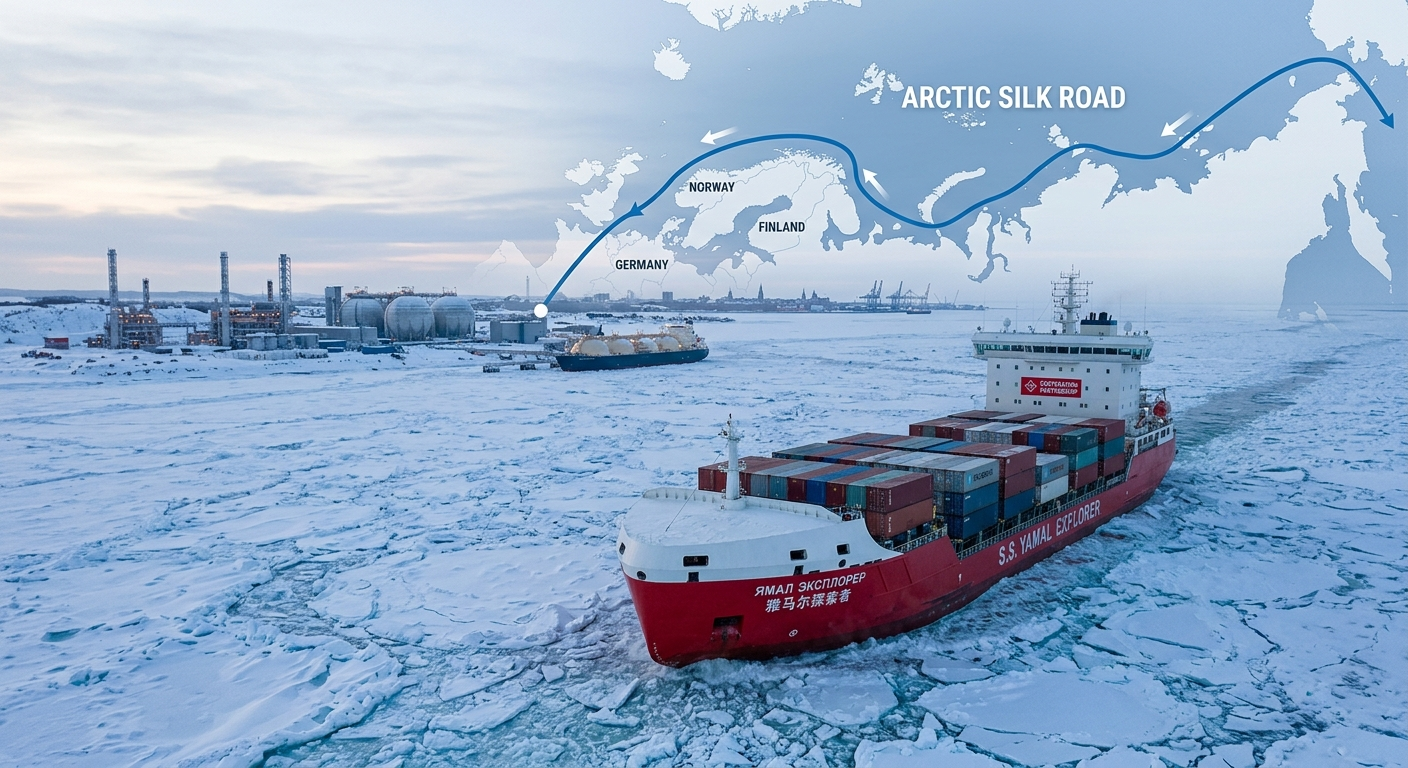
The emergence of an Arctic maritime corridor connecting China and Europe through Russia’s Northern Sea Route (NSR) represents one of the most important potential changes in Eurasian transportation. Often described as the “Polar Silk Road” or “Ice Silk Road,” the concept combines China’s commercial and strategic interest in Arctic connectivity with Russia’s control, infrastructure and geographic position along the Northern Sea Route.
The route follows Russia’s northern coastline from the Bering Strait toward the European Arctic and the Atlantic. Under favorable seasonal conditions, it can substantially shorten the maritime distance between East Asia and Northern Europe compared with routes through the Suez Canal. In August 2026, a Chinese shipping company began a scheduled container service between Ningbo and Felixstowe using the Northern Sea Route, providing an important real-world test of whether Arctic shipping can move beyond experimental voyages into regular commercial operations.
The strategic attraction is considerable. China can diversify its trade routes, Russia can increase the economic importance of its Arctic territory and strengthen its position as an energy and transportation supplier, while European markets can potentially gain another Asia-Europe logistics corridor. However, the project also faces major disadvantages: seasonal ice, severe weather, limited infrastructure, expensive ice-capable vessels, insurance difficulties, geopolitical tensions, sanctions, environmental risks, search-and-rescue limitations and Russia’s control over the principal route.
The central conclusion of this thesis is that the Arctic Silk Road should not yet be viewed as a complete replacement for the Suez Canal. Rather, it is better understood as an additional strategic corridor that could become increasingly important for selected cargoes and during particular seasons, while remaining vulnerable to environmental, economic and geopolitical constraints.
1. Introduction
Global trade depends upon a relatively small number of major maritime corridors. The Suez Canal has historically provided the principal maritime connection between Asian manufacturing centers and European markets without requiring ships to travel around Africa.
The Arctic introduces another geographical possibility.
The Northern Sea Route runs along Russia’s northern coastline and connects the Atlantic and Pacific sides of the Eurasian Arctic. The increasing commercial interest in this route has been encouraged by several simultaneous developments:
- declining seasonal Arctic sea ice;
- China’s expanding international trade;
- Russia’s investment in Arctic infrastructure;
- China’s interest in alternative transportation corridors;
- geopolitical instability affecting traditional shipping routes;
- advances in ice-class vessel technology;
- development of Russian nuclear-powered icebreaker capabilities; and
- China’s broader Belt and Road connectivity strategy.
China formally described its interest in developing a “Polar Silk Road” in its 2018 Arctic policy. Beijing stated that it wished to cooperate with Arctic countries in developing shipping routes, infrastructure, scientific research and other economic activities while emphasizing international law and environmental protection.
The significance of the idea has increased in 2026 because regular commercial Arctic container shipping has begun to move from theoretical possibility toward practical experimentation.
2. What Is the Arctic Silk Road?
The expression Arctic Silk Road does not describe a single road or railway. It describes a network of maritime, port, energy, logistics, digital and industrial connections associated with Arctic transportation.
At its center is the Northern Sea Route.
A simplified transportation chain can be represented as:
China
↓
Chinese manufacturing centers
↓
Ningbo / Shanghai / other Chinese ports
↓
East China Sea
↓
Pacific Ocean
↓
Bering Strait
↓
Russian Arctic
↓
Northern Sea Route
↓
Kara Sea
↓
Barents Sea
↓
European Arctic
↓
Northern European ports
↓
European distribution networks
The route therefore creates a potential maritime bridge between:
East Asia → Arctic Russia → Northern Europe
China calls the broader concept the Polar Silk Road, linking Arctic shipping with its wider connectivity strategy.
3. The Northern Sea Route
The Northern Sea Route follows Russia’s northern maritime frontier.
Its importance comes primarily from geography.
Traditional China-Europe maritime transportation through the Suez Canal requires ships to travel through:
China → Indian Ocean → Arabian Sea → Red Sea → Suez Canal → Mediterranean → Europe
The Arctic route instead follows:
China → Bering Strait → Russian Arctic → Barents Sea → Europe
Under favorable conditions, the Arctic route can significantly reduce sailing distance and transit time.
Recent commercial trials illustrate the potential. A 2026 Chinese service between Ningbo and Felixstowe has been advertised at approximately 18 days, compared with more than 40 days for the same broad origin-destination pairing through the Suez route, although actual times vary according to vessel, weather, ice, port operations and routing.
This difference is strategically important for cargo where time has high economic value.
4. Historical Development of the China-Russia Arctic Relationship
China is not an Arctic coastal state. Nevertheless, Beijing has developed significant scientific, diplomatic and economic interests in the region.
China became an observer in the Arctic Council in 2013 and has conducted Arctic scientific research for decades. Its Arctic research has included oceanography, climate, ice, atmospheric science, biology and geology.
Russia, by contrast, is an Arctic coastal state with an enormous Arctic coastline.
Consequently, the two countries possess complementary interests:
| China | Russia |
|---|---|
| Manufacturing capacity | Geographic control |
| Shipping companies | Arctic coastline |
| Capital | Ports |
| Consumer markets | Icebreakers |
| Technology | Energy resources |
| Global trade network | Arctic infrastructure |
| Demand for energy | Northern Sea Route |
This complementarity forms the foundation of their Arctic cooperation.
5. Why China Wants the Arctic Route
China’s interest has several dimensions.
5.1 Shorter transportation
The most obvious attraction is geographical.
A shorter route can potentially reduce:
- sailing time;
- fuel consumption;
- vessel utilization time;
- inventory in transit;
- exposure to certain traditional chokepoints.
Recent analyses indicate that the NSR can provide substantial distance and time reductions under favorable operating conditions.
5.2 Diversification
China currently depends on numerous maritime corridors.
The Arctic offers another option.
This is strategically valuable because a diversified transportation network is generally more resilient than dependence on a single corridor.
5.3 Reduced dependence on traditional chokepoints
The Arctic route can bypass several important maritime chokepoints associated with the conventional Asia-Europe route.
This does not eliminate geopolitical risk; it changes its geographical location.
The Northern Sea Route itself is heavily dependent on Russia, while ships approaching the Arctic must pass through the Bering Strait.
Consequently, the Arctic route should be understood as diversification rather than complete strategic independence.
5.4 Energy security
Russia possesses enormous Arctic energy resources.
China is a major energy importer.
This creates a powerful economic relationship involving:
- natural gas;
- LNG;
- crude oil;
- petroleum products;
- minerals;
- other raw materials.
Russia has already increased Arctic oil shipments toward Asia in 2026, with China remaining an important destination.
6. Why Russia Wants the Arctic Silk Road
Russia has perhaps an even stronger motivation.
The Arctic is strategically important to Russia because it represents:
- territory;
- natural resources;
- maritime access;
- economic development;
- national security;
- scientific research;
- transportation infrastructure.
The Northern Sea Route provides Russia with an opportunity to transform its northern coastline from a geographical frontier into a major transportation corridor.
6.1 Economic development
Arctic infrastructure requires:
- ports;
- airports;
- roads;
- telecommunications;
- energy systems;
- warehouses;
- rescue stations;
- icebreakers;
- navigation systems.
A successful Arctic corridor could stimulate investment in all these areas.
6.2 Resource exports
Russia has substantial Arctic oil and gas resources.
The NSR provides an alternative transportation system for moving some of these resources toward Asian markets.
Recent Russian LNG and oil movements demonstrate that the NSR is already being used for resource transportation, even though international container transit remains much smaller.
7. Why Europe Could Benefit
Europe is the destination market at the western end of the proposed corridor.
Potential European advantages include:
7.1 Faster access to selected Asian cargoes
Shorter transit could benefit high-value or time-sensitive products.
7.2 Supply-chain diversification
Europe could have another potential route for receiving Asian goods.
7.3 Competition
Additional transportation capacity could increase competition between shipping corridors.
7.4 Arctic-European infrastructure
Northern European ports could benefit from increased transshipment and logistics activity.
However, Europe’s ability to benefit depends heavily on geopolitical relations, sanctions, environmental rules and the future political relationship between Europe and Russia.
8. Major Economic Advantages
8.1 Reduced distance
The fundamental economic advantage is geographical efficiency.
Shorter routes can mean fewer vessel-days.
A vessel that spends fewer days at sea can potentially make more voyages over a given period.
8.2 Potential fuel savings
A shorter voyage can reduce fuel consumption.
This is particularly relevant when fuel prices are high.
However, the calculation is complicated by Arctic requirements.
Ice-class vessels can consume more fuel, and icebreaker support can impose additional costs.
Therefore:
Shorter distance ≠ automatically lower total cost.
8.3 Faster delivery
For some goods, time is extremely valuable.
Examples include:
- electronics;
- machinery;
- automotive components;
- electric vehicles;
- batteries;
- solar equipment;
- specialized industrial products.
Recent reporting identifies temperature-sensitive and high-value Chinese exports as potential candidates for Arctic shipping.
9. Strategic Advantages
The Arctic Silk Road has significance beyond economics.
9.1 Strategic redundancy
A modern global logistics system benefits from multiple routes.
If one corridor becomes disrupted, alternative corridors can provide partial capacity.
This is one reason governments and companies increasingly study:
- maritime routes;
- railways;
- highways;
- pipelines;
- air freight;
- Arctic shipping.
9.2 China-Russia strategic partnership
The Arctic provides another area where China and Russia can cooperate.
China contributes:
- markets;
- investment;
- manufacturing;
- shipping demand;
- technology.
Russia contributes:
- geography;
- Arctic infrastructure;
- energy;
- icebreaker capability;
- ports;
- experience operating in polar conditions.
Academic research published in 2025 describes the Polar Silk Road as a major dimension of China-Russia Arctic cooperation while emphasizing the challenge of balancing economic development with environmental sustainability.
10. Technological Advantages
The development of Arctic transportation encourages innovation.
Important technologies include:
Ice-class ships
Ships operating in Arctic conditions require specialized hulls and propulsion systems.
Icebreakers
Russia possesses extensive nuclear-powered icebreaker capabilities that support navigation through difficult Arctic waters.
Satellite navigation
Satellites assist with:
- navigation;
- communications;
- weather forecasting;
- ice monitoring;
- emergency response.
Artificial intelligence
AI could improve:
- route optimization;
- ice prediction;
- weather forecasting;
- fuel optimization;
- vessel scheduling;
- predictive maintenance.
Autonomous systems
In the longer term, autonomous navigation and remote monitoring could reduce some operational difficulties, although Arctic autonomy presents significant technical and regulatory challenges.
11. Environmental Paradox
One of the most complicated aspects of the Arctic Silk Road is the relationship between climate change and Arctic transportation.
Declining sea ice is making some Arctic shipping windows more accessible.
But this creates a paradox:
Climate change makes Arctic shipping easier while Arctic shipping can contribute additional environmental pressure.
Research and recent reporting emphasize the ecological sensitivity of the Arctic and the potential consequences of increased shipping.
12. Environmental Disadvantages
12.1 Oil-spill risk
Oil spills in Arctic environments can be exceptionally difficult to clean.
Low temperatures, remote geography and limited infrastructure create major response challenges.
12.2 Black carbon
Ships burning fossil fuels can emit black carbon.
When black carbon settles on snow and ice, it can increase absorption of solar radiation and contribute to warming.
This is particularly concerning in the Arctic.
12.3 Wildlife disturbance
Increased shipping can affect:
- marine mammals;
- seabirds;
- fish;
- Arctic ecosystems.
Noise pollution is another concern.
12.4 Climate feedback
The Arctic is warming rapidly.
Shipping expansion therefore presents a difficult policy question:
Should humanity exploit newly accessible Arctic routes created partly by climate change, or should the region be protected from additional industrial pressure?
There is no simple answer.
13. The Biggest Economic Disadvantage: Seasonality
The NSR is not currently equivalent to a conventional year-round maritime highway.
Ice conditions remain variable.
The most favorable operating window occurs during warmer months.
A 2026 analysis notes that regular Chinese Arctic container service is currently planned around a limited seasonal window rather than functioning like an unrestricted year-round route.
This creates problems for companies that depend on predictable weekly schedules throughout the year.
14. High Infrastructure Costs
A successful Arctic shipping system requires enormous investment.
Infrastructure includes:
- icebreakers;
- ports;
- fuel facilities;
- repair yards;
- warehouses;
- communications;
- satellite systems;
- navigation equipment;
- meteorological stations;
- search-and-rescue facilities;
- emergency medical facilities.
Building infrastructure in remote Arctic environments is much more expensive than building comparable facilities in populated temperate regions.
15. Insurance Problems
Arctic shipping involves unusual risks.
Insurance costs can increase because of:
- ice;
- extreme weather;
- limited rescue facilities;
- vessel damage;
- geopolitical uncertainty;
- sanctions;
- environmental liability.
Consequently, the headline fuel savings of a shorter route cannot be considered separately from the complete cost structure.
16. Geopolitical Risk
Perhaps the most significant disadvantage is geopolitical.
The route is closely connected to Russia.
Russia controls much of the Northern Sea Route and has significant authority over access, navigation and infrastructure.
China therefore gains an alternative to some maritime chokepoints but becomes more dependent on Russian Arctic infrastructure.
This creates a fundamental strategic contradiction:
The Arctic route reduces some risks while creating others.
Instead of:
Dependence on traditional maritime chokepoints
China could experience:
Greater dependence on Russian-controlled Arctic infrastructure.
Financial and geopolitical restrictions related to Russia also complicate the commercial attractiveness of the route. Recent assessments emphasize sanctions and geopolitical tensions as important constraints on Arctic shipping.
17. European Political Concerns
European governments and companies must consider the political implications of increasing commercial dependence on Russian-controlled infrastructure.
The Ukraine conflict has fundamentally changed European-Russian economic relations.
Consequently, even if the route is geographically attractive, political restrictions may limit:
- European participation;
- insurance;
- banking;
- vessel ownership;
- port access;
- technology transfers;
- investment.
This is one of the biggest differences between the theoretical Arctic route and a truly global commercial shipping system.
18. Arctic Indigenous Peoples
The Arctic is not an empty region.
It is home to Indigenous peoples with long-established communities, cultures and economic activities.
Large infrastructure projects can affect:
- hunting;
- fishing;
- migration patterns;
- traditional livelihoods;
- land use;
- cultural heritage.
China’s official Arctic policy states that Arctic resource development should respect Indigenous peoples’ interests and concerns.
Any responsible Arctic development strategy therefore needs meaningful consultation and participation.
19. Security and Search-and-Rescue Problems
The Arctic is enormous and remote.
If a vessel experiences a serious emergency, assistance may be much farther away than in heavily trafficked regions.
Potential problems include:
- extreme cold;
- poor visibility;
- sea ice;
- storms;
- limited ports;
- limited medical facilities;
- communication difficulties.
A major accident involving a large vessel could therefore become a multinational emergency.
20. The Bering Strait Problem
The Arctic route does not eliminate strategic chokepoints.
Ships entering or leaving the Northern Sea Route must pass through the Bering Strait.
That means the Arctic corridor remains connected to the geopolitical environment of:
- Russia;
- the United States;
- Alaska;
- the Pacific Ocean.
Consequently, the Arctic route should not be described as completely independent of great-power competition.
21. Comparison with the Suez Route
| Factor | Arctic/Northern Sea Route | Suez Canal |
|---|---|---|
| Distance China-Europe | Generally shorter | Longer |
| Transit time | Potentially much shorter | Generally longer |
| Seasonality | Major limitation | Much less significant |
| Ice | Major issue | No Arctic ice |
| Infrastructure | Limited | Highly developed |
| Global shipping experience | Limited | Extremely mature |
| Geopolitical dependence | Strong Russian influence | Egyptian canal + wider regional risks |
| Environmental sensitivity | Extremely high | High |
| Icebreaker requirement | Important in difficult conditions | Not normally required |
| Container-network maturity | Limited | Very high |
| Rescue infrastructure | More limited | More developed |
| Long-term potential | Significant | Very significant |
| Current reliability | Limited/seasonal | High relative to Arctic |
The key point is that the NSR does not currently outperform the Suez Canal in every category.
It has a distance advantage, but Suez possesses a massive infrastructure and network advantage.
22. Arctic Silk Road Versus Cape of Good Hope
When the Suez Canal becomes disrupted or expensive, ships can travel around Africa’s Cape of Good Hope.
This makes the competitive landscape:
Arctic Route
versus
Suez Route
versus
Cape of Good Hope Route
The Arctic route becomes particularly attractive when:
- Suez risks rise;
- Red Sea disruptions increase;
- Arctic ice conditions are favorable;
- fuel prices are high;
- high-value cargo needs rapid delivery.
This demonstrates why the Arctic route may function primarily as a strategic supplementary corridor rather than an exclusive replacement.
23. Cargo Most Suitable for the Arctic Route
Not every commodity is equally appropriate.
Potentially suitable cargo includes:
High-value manufactured goods
Because shorter transit can reduce inventory time.
Energy
Oil and LNG already constitute important Arctic cargoes.
Industrial equipment
Particularly when rapid delivery matters.
Automotive products
Especially electric vehicles and components.
Seasonal goods
Products where timing is particularly important.
The route is less attractive for cargo where:
- transportation costs are extremely low;
- delivery time is unimportant;
- cargo volumes are enormous;
- Arctic insurance costs outweigh time savings.
24. China’s Possible Long-Term Strategy
China’s Arctic strategy can be understood through five layers.
Layer 1 — Commercial
Move goods between China and Europe.
Layer 2 — Energy
Access Russian Arctic oil and gas.
Layer 3 — Infrastructure
Participate in ports, logistics and communication networks.
Layer 4 — Scientific
Develop Arctic climate and environmental knowledge.
Layer 5 — Strategic
Create additional transportation options and strengthen China’s position in global trade.
This layered approach explains why China may remain interested in the Arctic even if the route is not immediately cheaper than conventional alternatives.
25. Russia’s Possible Long-Term Strategy
Russia’s Arctic strategy can similarly be divided into five objectives:
- monetize Arctic resources;
- develop northern territories;
- strengthen the Northern Sea Route;
- increase Asian trade;
- reinforce Russian sovereignty and strategic influence in the Arctic.
The NSR is therefore not simply a commercial shipping project.
It is part of Russia’s broader Arctic development strategy.
26. The Role of Icebreakers
Icebreakers are fundamental to Arctic transportation.
They perform several functions:
- open passages through ice;
- escort commercial vessels;
- provide navigation assistance;
- support emergency operations;
- extend the shipping season.
Russia has invested heavily in icebreaker capabilities.
This gives Moscow an important strategic advantage because access to the Northern Sea Route is connected to the availability of icebreaking services.
27. China’s Shipbuilding Advantage
China is also becoming increasingly capable of producing specialized vessels.
This creates a potential division of labor:
Russia → Arctic geography + icebreaker infrastructure
China → ships + cargo + capital + manufacturing
This could produce a powerful Sino-Russian Arctic logistics ecosystem.
Recent reporting notes the rapid expansion of Chinese shipbuilding capacity as an important factor in the broader Arctic shipping competition.
28. The Digital Arctic Silk Road
The Arctic Silk Road will not be exclusively physical.
Digital infrastructure could become equally important.
A modern Arctic logistics system could incorporate:
- satellite communications;
- undersea cables;
- cloud computing;
- AI;
- weather prediction;
- digital twins;
- autonomous navigation;
- vessel tracking;
- cyber-security;
- smart ports.
The combination of physical and digital infrastructure could turn the Arctic into a technologically advanced logistics corridor.
29. Artificial Intelligence and Arctic Navigation
AI has an especially interesting role.
AI systems could process:
- satellite images;
- sea-ice movements;
- weather data;
- vessel positions;
- ocean currents;
- historical navigation patterns.
An intelligent routing system could calculate:
Shortest route + safest route + lowest fuel consumption + lowest ice risk + lowest delay probability.
This could make Arctic shipping more efficient.
However, AI cannot eliminate physical hazards.
A computer cannot make sea ice disappear.
Therefore:
AI improves decision-making; it does not eliminate Arctic risk.
30. Economic Disadvantages in Summary
The principal economic disadvantages include:
- expensive ice-class ships;
- icebreaker fees;
- insurance costs;
- limited ports;
- limited repair facilities;
- seasonal operation;
- unpredictable weather;
- limited cargo volumes;
- sanctions;
- uncertain return on infrastructure investment.
A route can be shorter but still be more expensive.
This is one of the most important lessons when evaluating the Arctic Silk Road.
31. Strategic Disadvantages in Summary
The principal strategic disadvantages include:
- dependence on Russia;
- geopolitical tensions;
- sanctions;
- uncertainty over international participation;
- possible confrontation between major Arctic powers;
- dependence on the Bering Strait;
- Arctic militarization concerns;
- limited multinational trust.
Therefore, the Arctic Silk Road should not be interpreted simply as an economic project.
It is simultaneously:
economic + technological + environmental + diplomatic + geopolitical.
32. Environmental Balance
The future of Arctic shipping requires a difficult balance.
The economic argument says:
A shorter route can reduce voyage distance and potentially reduce fuel use.
The environmental argument responds:
Increasing shipping activity in a rapidly warming and ecologically fragile region can generate additional environmental damage.
The correct policy is therefore not necessarily “develop everything” or “develop nothing.”
A better principle is:
controlled, scientifically monitored and environmentally responsible development.
Research published in 2025 specifically emphasizes the need to balance Polar Silk Road development with environmental sustainability.
33. International Law
Arctic shipping operates within a complex international legal environment.
China has stated that Arctic activities should comply with:
- the United Nations Convention on the Law of the Sea;
- relevant international agreements;
- international maritime regulations;
- laws of Arctic states.
China’s Arctic policy also emphasizes navigation safety and cooperation in infrastructure development.
The legal framework is therefore a fundamental component of the Arctic Silk Road.
34. Could the Arctic Silk Road Replace the Suez Canal?
No—not in the foreseeable future.
It could become a major supplementary route.
The Suez Canal benefits from:
- enormous shipping volumes;
- extensive ports;
- established container networks;
- mature insurance systems;
- global logistics connections;
- year-round accessibility;
- extensive commercial experience.
The Arctic route benefits primarily from:
- shorter geography;
- strategic diversification;
- potentially lower transit times;
- access to Arctic resources;
- growing technological capability.
The two routes are therefore more likely to coexist than for one to completely eliminate the other.
35. A Possible Future Three-Corridor System
The future Asia-Europe logistics system could increasingly consist of three major options:
Corridor A
China → Suez → Europe
Corridor B
China → Northern Sea Route → Europe
Corridor C
China → Indian Ocean → Cape of Good Hope → Europe
Companies could choose between them according to:
- price;
- season;
- political risk;
- fuel cost;
- cargo type;
- insurance;
- weather;
- capacity.
This would create a more diversified Eurasian transportation system.
36. Scenarios for 2030–2040
Scenario 1 — Limited Arctic Growth
The NSR remains primarily a Russian resource-export corridor.
International container shipping remains small.
Probability:
Plausible.
Scenario 2 — Seasonal Commercial Corridor
The NSR becomes a regular summer route for selected China-Europe cargoes.
Probability:
Highly plausible if infrastructure and geopolitical conditions permit.
Scenario 3 — Major Alternative to Suez
Large numbers of international shipping companies use the Arctic route routinely.
Requirement:
- improved infrastructure;
- greater navigational reliability;
- lower costs;
- better insurance;
- stable international relations;
- stronger environmental controls.
This is possible but considerably more difficult.
Scenario 4 — Geopolitical Fragmentation
Relations between Russia and Western countries remain highly strained, restricting European participation.
China and Russia develop the route primarily for their own trade.
Consequence:
The Arctic Silk Road becomes a powerful Sino-Russian corridor but not a genuinely global shipping highway.
37. The Most Important Advantage
The greatest advantage is not simply speed.
It is strategic diversification.
A country or company with several transportation options is generally more resilient than one dependent on a single route.
The Arctic corridor therefore provides China with another option between Asia and Europe.
38. The Most Important Disadvantage
The greatest disadvantage is uncertainty.
The Arctic environment is unpredictable.
The political environment is unpredictable.
The commercial environment is unpredictable.
Infrastructure remains incomplete.
Consequently, businesses cannot evaluate the route simply by comparing:
18 days vs 40 days.
They must calculate:
total cost + insurance + ice risk + sanctions + reliability + infrastructure + seasonal availability + environmental compliance.
39. Overall SWOT Analysis
| Strengths | Weaknesses |
|---|---|
| Shorter distance | Seasonal |
| Potentially faster | Ice |
| Strategic diversification | Expensive infrastructure |
| Russian icebreaker capability | Limited ports |
| Chinese manufacturing capacity | High insurance |
| Access to Arctic resources | Geopolitical dependence |
| Technological development | Limited global network |
| Opportunities | Threats |
|---|---|
| New China-Europe trade corridor | Climate change |
| Arctic resource development | Environmental accidents |
| Smart-port development | Geopolitical conflict |
| AI navigation | Sanctions |
| New shipping technologies | Severe weather |
| Digital infrastructure | International political disputes |
| Northern European logistics | Ecosystem damage |
40. Policy Recommendations
A sustainable Arctic Silk Road should be developed according to several principles.
Recommendation 1: Do not treat it as a Suez replacement
The Arctic should initially be treated as a complementary corridor.
Recommendation 2: Build environmental safeguards first
Infrastructure development should include:
- spill-response capability;
- environmental monitoring;
- wildlife protection;
- black-carbon reduction;
- emergency response.
Recommendation 3: Strengthen international cooperation
China, Russia, European states, Indigenous representatives and other Arctic stakeholders should maintain dialogue.
Recommendation 4: Improve search-and-rescue infrastructure
Safety must precede commercial expansion.
Recommendation 5: Develop better ice forecasting
Satellite and AI technologies should be used to improve navigation.
Recommendation 6: Maintain multiple trade routes
China and Europe should not become excessively dependent on the Arctic.
Recommendation 7: Increase transparency
Commercial and environmental data should be shared wherever legally and commercially possible.
41. The Broader Meaning for Global Trade
The Arctic Silk Road represents something larger than a shipping route.
It demonstrates that global transportation is changing from a system based primarily on fixed historical corridors into a system based on multiple competing networks.
Future global logistics may involve:
Sea + Rail + Road + Air + Arctic + Digital Infrastructure
The Arctic therefore becomes part of a broader transformation in Eurasian connectivity.
42. Conclusion
The China-Russia Arctic Silk Road is one of the most strategically interesting transportation developments of the twenty-first century.
Its foundation is the Northern Sea Route, which offers a potentially shorter maritime connection between China and Europe through the Arctic.
China brings enormous manufacturing capacity, shipping demand, capital and technological capability. Russia brings geography, Arctic infrastructure, energy resources and icebreaking expertise.
Together, these capabilities create the possibility of a new Eurasian logistics corridor.
The advantages are substantial:
- shorter distance;
- potentially faster delivery;
- fuel-saving opportunities;
- strategic diversification;
- access to Arctic resources;
- technological innovation;
- new economic activity;
- stronger China-Russia connectivity.
But the disadvantages are equally significant:
- seasonal ice;
- extreme weather;
- high infrastructure costs;
- insurance challenges;
- limited search-and-rescue capacity;
- environmental vulnerability;
- Indigenous-community concerns;
- sanctions;
- geopolitical tensions;
- dependence on Russia;
- uncertainty about long-term commercial economics.
The latest development in 2026—China’s move toward scheduled commercial Arctic container service—provides an important test of whether the Polar Silk Road can evolve from a strategic concept into a durable commercial corridor.
The most realistic conclusion is therefore neither that the Arctic Silk Road will inevitably dominate global shipping nor that it will fail.
Its most likely future is as a strategic supplementary corridor.
During favorable Arctic seasons, selected cargoes could move rapidly between China and Europe. During unfavorable conditions, companies could return to the Suez Canal or the Cape of Good Hope.
This would create a diversified Eurasian transportation system in which the Arctic becomes an additional option rather than the sole route.
Ultimately, the success of the Arctic Silk Road will depend on whether its economic advantages can overcome its environmental, technological, infrastructural and geopolitical disadvantages.
The central equation can therefore be expressed as:
Arctic Silk Road Success = Shorter Distance + Technology + Infrastructure + International Cooperation − Environmental Risk − Geopolitical Risk − Seasonal Uncertainty − High Operating Costs
The Arctic Silk Road is consequently not merely a shipping project. It is a developing intersection of Chinese trade strategy, Russian Arctic policy, European supply chains, climate change, maritime technology, energy security and twenty-first-century geopolitics.




Be First to Comment