
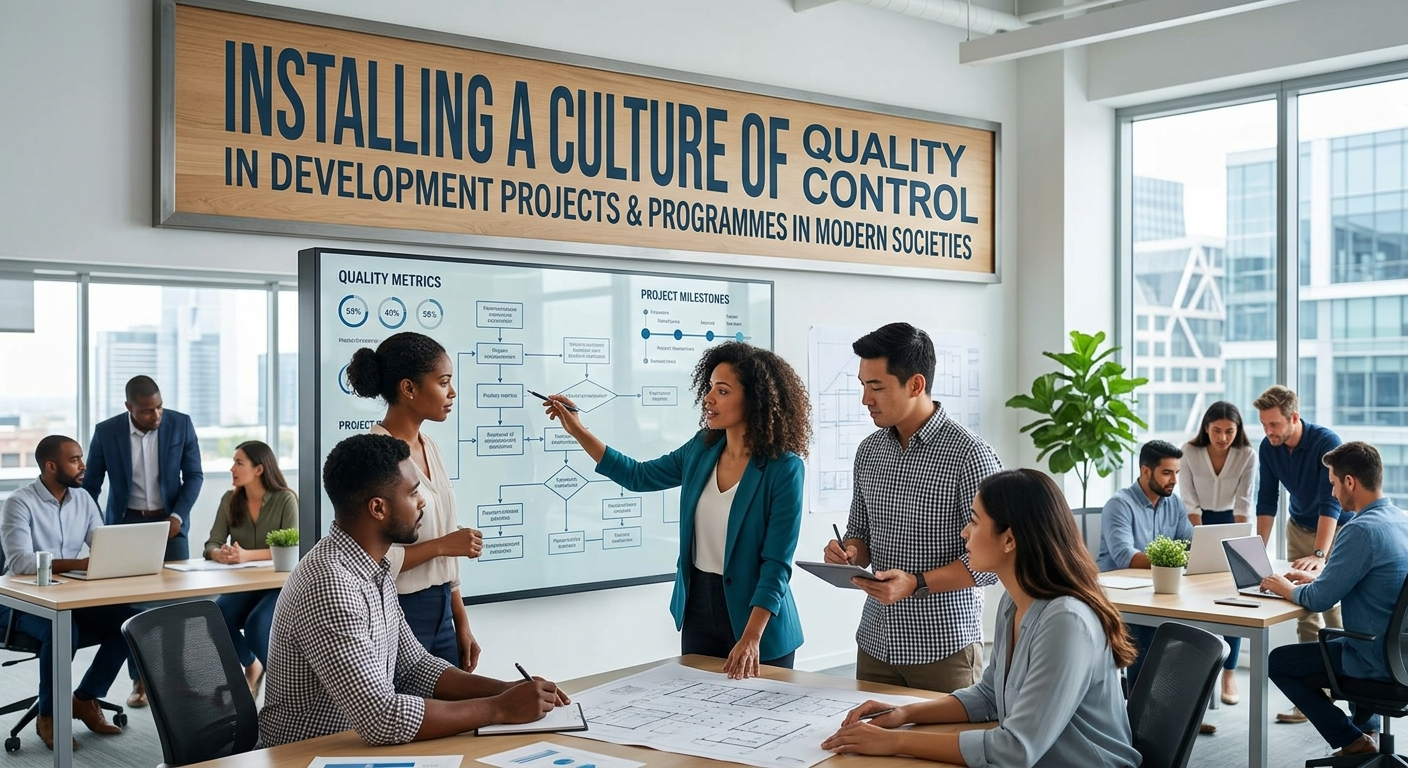
A Comprehensive Thesis
Abstract
Quality control is one of the fundamental disciplines required to transform development ambitions into sustainable, reliable and socially valuable outcomes. Roads, schools, hospitals, water systems, housing programmes, telecommunications networks, digital platforms, energy infrastructure, agricultural programmes and public-service reforms can consume enormous financial and human resources, yet their success ultimately depends on whether they deliver the required quality, functionality, safety, durability and value to society.
This thesis examines how modern societies can install a culture of quality control across development projects and programmes. It argues that quality cannot be treated as an inspection activity performed at the end of a project. Rather, quality must become an organisational culture embedded from project conception through planning, procurement, design, construction or implementation, testing, commissioning, operation, maintenance and eventual evaluation.
The study develops a comprehensive framework based on leadership, standards, accountability, competent personnel, risk management, quality assurance, quality control, independent verification, data, technology, procurement discipline, continuous improvement and public accountability. It further examines the responsibilities of governments, private companies, development institutions, project managers, engineers, contractors, consultants, communities and citizens.
The central argument is that quality is not merely a technical requirement; it is a governance, economic, social and ethical requirement. A society that systematically builds quality into its development programmes reduces waste, improves public trust, protects lives, extends infrastructure life, strengthens economic productivity and increases the return on development investment.
Keywords: Quality Control, Quality Assurance, Development Projects, Project Management, Governance, Infrastructure, Risk Management, Procurement, Continuous Improvement, Standards, Accountability, Modern Society.
Chapter 1: Introduction
1.1 Background
Modern societies are continuously engaged in development projects and programmes. Governments construct infrastructure, businesses develop products and services, municipalities provide public utilities, universities build research facilities, communities implement social programmes, and technology companies create increasingly sophisticated digital systems.
Development therefore represents a continuous cycle of investment.
A country may spend billions constructing:
- roads;
- bridges;
- railways;
- airports;
- hospitals;
- schools;
- water-treatment facilities;
- electricity networks;
- telecommunications infrastructure;
- housing;
- data centres;
- agricultural systems;
- industrial facilities;
- public buildings;
- digital government platforms; and
- environmental programmes.
However, the existence of a project does not automatically mean that development has occurred successfully.
A road that deteriorates shortly after construction is not a high-quality development outcome. A hospital without reliable water, electricity or medical systems cannot fully perform its intended function. A school constructed without adequate classrooms, sanitation or maintenance planning may represent an incomplete investment. A software system that repeatedly fails can become a liability rather than an asset.
The fundamental question is therefore:
How can modern societies create a permanent culture in which quality is designed, measured, verified, protected and continuously improved throughout every development project and programme?
This is the central problem addressed by this thesis.
Chapter 2: Understanding Quality
2.1 What Is Quality?
Quality can be understood as the degree to which a product, service, process, infrastructure asset or programme satisfies defined requirements and fulfils its intended purpose.
Quality therefore involves several dimensions:
- Conformance – meeting specified requirements.
- Performance – functioning as intended.
- Reliability – performing consistently.
- Durability – maintaining functionality over time.
- Safety – avoiding unacceptable risks.
- Efficiency – using resources responsibly.
- Effectiveness – achieving intended outcomes.
- Maintainability – being capable of continued operation.
- User satisfaction – meeting legitimate stakeholder needs.
- Sustainability – remaining viable economically, socially and environmentally.
Quality should consequently not be reduced to appearance.
A beautifully constructed building can still be poor quality if its structural, electrical, plumbing or safety systems are defective.
Chapter 3: Quality Control and Quality Assurance
3.1 Quality Control
Quality control primarily concerns the examination and verification of outputs.
Examples include:
- testing concrete;
- inspecting road surfaces;
- testing electrical systems;
- checking software functionality;
- verifying dimensions;
- laboratory testing;
- inspecting materials;
- reviewing documents;
- checking manufactured components; and
- validating project deliverables.
Quality control asks:
Does the actual output meet the required specification?
3.2 Quality Assurance
Quality assurance is broader.
It examines whether the processes used to produce the output are capable of consistently producing acceptable results.
Quality assurance asks:
Do we have a reliable system for producing quality?
A mature development organisation therefore requires both.
Quality assurance prevents problems through controlled processes.
Quality control detects problems through measurement and inspection.
The two disciplines should operate together.
Chapter 4: The Quality Culture
4.1 From Quality Department to Quality Culture
One of the greatest mistakes organisations make is assuming that quality is the responsibility of the quality-control department alone.
It is not.
Quality is the responsibility of:
- political leadership;
- boards;
- executives;
- project sponsors;
- project managers;
- engineers;
- architects;
- procurement officers;
- contractors;
- suppliers;
- consultants;
- technicians;
- workers;
- inspectors;
- regulators;
- users; and
- communities.
A quality department cannot compensate for an organisation whose broader culture rewards shortcuts.
4.2 What Is a Quality Culture?
A quality culture exists when people routinely ask:
- What standard must we meet?
- What could go wrong?
- How will we measure quality?
- Who is responsible?
- What evidence proves that the requirement was met?
- What happens if the requirement is not met?
- How can we prevent recurrence?
- What can we learn from this project?
Quality becomes part of normal decision-making rather than an emergency activity.
Chapter 5: The Quality Lifecycle
Quality must be introduced throughout the entire development lifecycle.
A comprehensive quality lifecycle can be represented as:
Need → Concept → Feasibility → Requirements → Design → Planning → Procurement → Implementation → Inspection → Testing → Commissioning → Handover → Operation → Maintenance → Evaluation → Lessons Learned
Quality should exist at every stage.
5.1 Stage 1: Identifying the Development Need
The first quality question is whether the project itself is necessary.
Poor-quality development can begin before construction or implementation starts if the wrong problem is selected.
A high-quality project therefore begins with:
- needs assessment;
- stakeholder consultation;
- economic analysis;
- technical assessment;
- environmental assessment;
- social assessment;
- risk assessment; and
- long-term sustainability analysis.
Chapter 6: Quality at the Planning Stage
A project should have measurable quality objectives before implementation begins.
For example:
| Area | Quality Question |
|---|---|
| Cost | Is the budget realistic? |
| Time | Is the schedule achievable? |
| Materials | Are specifications clearly defined? |
| Safety | What hazards must be controlled? |
| Performance | What must the completed project achieve? |
| Sustainability | Can the asset operate long term? |
| Maintenance | Can future operators maintain it? |
| Users | Does the design meet user requirements? |
Quality objectives should be converted into measurable indicators.
Chapter 7: Requirements Management
Many project failures originate from unclear requirements.
Before implementation begins, stakeholders should define:
- what must be delivered;
- performance standards;
- technical specifications;
- safety requirements;
- environmental requirements;
- legal requirements;
- service levels;
- acceptance criteria;
- testing procedures; and
- responsibilities.
A requirement should ideally be measurable.
Instead of saying:
“Build a good road.”
A better requirement would specify measurable engineering, safety, material, drainage, capacity, durability and maintenance requirements.
Chapter 8: Quality in Design
Design is one of the most important quality-control stages.
Errors incorporated into a design can become extremely expensive to correct during construction.
Design quality should include:
- technical review;
- independent checking;
- constructability analysis;
- safety analysis;
- environmental considerations;
- lifecycle costing;
- maintainability;
- accessibility;
- resilience;
- cybersecurity where relevant;
- interoperability for digital systems; and
- future expansion requirements.
A major principle should be:
Prevent defects in design rather than discovering them after construction.
Chapter 9: Quality in Procurement
Procurement has enormous influence on development quality.
If procurement decisions focus almost exclusively on the lowest initial price, organisations can unintentionally encourage:
- inferior materials;
- unrealistic project schedules;
- inexperienced contractors;
- inadequate staffing;
- cost-cutting;
- excessive variations; and
- poor lifecycle performance.
The objective should instead be value for money.
Procurement evaluation can consider:
- technical competence;
- previous performance;
- quality-management systems;
- personnel qualifications;
- equipment;
- financial capacity;
- safety performance;
- delivery capacity;
- sustainability;
- lifecycle cost; and
- price.
The cheapest proposal is not necessarily the least expensive solution over the lifetime of an asset.
Chapter 10: Quality of Materials and Suppliers
Supply-chain quality is critical.
A development project may depend upon thousands of components supplied by multiple organisations.
Examples include:
- cement;
- steel;
- electrical equipment;
- pipes;
- cables;
- computer hardware;
- software;
- telecommunications equipment;
- medical equipment;
- mechanical systems; and
- specialised components.
Organisations should therefore establish supplier qualification, inspection, testing, traceability and acceptance procedures.
A defective component can become a systemic failure when thousands of identical components are installed.
Chapter 11: Quality Control During Implementation
Implementation should contain systematic inspection and verification.
A project may establish:
First-level control
Workers and supervisors verify their own work.
Second-level control
Project quality personnel independently inspect the work.
Third-level control
Consultants, regulators or independent specialists conduct additional verification where appropriate.
Final acceptance
The client formally verifies that requirements have been satisfied.
This layered approach reduces the possibility that errors remain hidden.
Chapter 12: Testing and Inspection
Inspection without testing can be inadequate.
Different development sectors require different forms of testing.
Construction
- material testing;
- structural testing;
- dimensional inspection;
- drainage testing;
- electrical testing;
- safety inspections.
Telecommunications
- signal testing;
- capacity testing;
- latency measurement;
- redundancy testing;
- cybersecurity assessment.
Software
- functional testing;
- integration testing;
- performance testing;
- security testing;
- usability testing;
- reliability testing.
Healthcare
- equipment verification;
- facility testing;
- infection-control verification;
- electrical and backup-power testing.
The principle is universal:
If performance matters, performance must be measured.
Chapter 13: Documentation and Traceability
Quality requires evidence.
A mature project should maintain appropriate records of:
- specifications;
- designs;
- approvals;
- inspections;
- test results;
- materials;
- suppliers;
- deviations;
- corrective actions;
- changes;
- approvals;
- commissioning;
- maintenance requirements; and
- final acceptance.
Traceability makes it possible to answer:
What was done, who did it, when was it done, what standard applied, what test was performed, and what evidence proves compliance?
Chapter 14: Managing Non-Conformities
No large project is likely to operate without defects or deviations.
The important issue is how the organisation responds.
A non-conformity should trigger a structured process:
Identify → Record → Assess → Contain → Correct → Verify → Analyse Cause → Prevent Recurrence
This is better than simply repairing the visible problem.
For example, if several installations fail because workers repeatedly misinterpret a drawing, the solution may not simply be repairing each installation. The organisation should investigate why the design or communication process allowed the error.
Chapter 15: Root-Cause Analysis
Quality culture requires organisations to move beyond blaming individuals.
When something goes wrong, organisations should ask:
Why did the system allow this to happen?
Root causes can include:
- inadequate training;
- unclear specifications;
- poor supervision;
- defective procurement;
- unrealistic schedules;
- inadequate resources;
- weak communication;
- poor design;
- insufficient testing;
- ineffective management;
- weak governance; or
- organisational incentives that reward speed over quality.
The objective is to correct the system rather than merely punish the person who happened to discover the failure.
Chapter 16: Risk Management and Quality
Quality and risk management are inseparable.
Every development project contains uncertainties.
Risks may involve:
- technical failure;
- cost escalation;
- delays;
- supply shortages;
- environmental conditions;
- cybersecurity;
- safety;
- regulatory changes;
- climate-related events;
- human error;
- equipment failure; and
- organisational failure.
A quality culture therefore requires early identification and continuous monitoring of risks.
Chapter 17: The Human Dimension of Quality
Technology cannot create a quality culture by itself.
People create quality.
Organisations therefore need:
- competent employees;
- training;
- professional development;
- ethical leadership;
- clear responsibilities;
- adequate supervision;
- communication;
- teamwork;
- respect for technical expertise; and
- mechanisms for reporting problems.
Workers should be able to report potential quality problems without fear of inappropriate retaliation.
A worker who notices a serious defect should be encouraged to stop, report and resolve the problem rather than conceal it.
Chapter 18: Leadership and Quality
Leadership is perhaps the most important factor in creating a quality culture.
Employees observe what leaders reward.
If leaders say:
“Quality is important.”
but reward only:
“Finish as quickly and cheaply as possible.”
the real organisational culture will prioritise speed and cost.
Leaders must therefore align:
- policies;
- budgets;
- performance indicators;
- procurement;
- training;
- rewards;
- accountability; and
- management behaviour
with quality objectives.
Chapter 19: The Economics of Quality
Quality is sometimes incorrectly viewed as an additional expense.
In reality, poor quality can be significantly more expensive.
Costs associated with poor quality include:
- rework;
- repairs;
- delays;
- legal disputes;
- replacement;
- accidents;
- service interruptions;
- reputational damage;
- lost productivity;
- maintenance costs; and
- premature asset replacement.
A useful economic concept is:
Total Lifecycle Cost = Initial Cost + Operating Cost + Maintenance Cost + Failure Cost + End-of-Life Cost
Consequently, development decisions should not focus exclusively on initial construction or implementation cost.
Chapter 20: Quality and Public Infrastructure
Infrastructure is one of the clearest areas where quality culture matters.
A country can invest heavily in infrastructure but still experience poor development outcomes if assets are:
- badly designed;
- poorly constructed;
- inadequately maintained;
- overloaded;
- incorrectly operated; or
- allowed to deteriorate.
Infrastructure quality should therefore be considered across its entire lifecycle.
Infrastructure lifecycle
Planning → Design → Construction → Commissioning → Operation → Maintenance → Rehabilitation → Replacement
Quality must follow the asset through every phase.
Chapter 21: Quality in Government Programmes
Government programmes often involve enormous numbers of people and institutions.
Examples include:
- education programmes;
- healthcare programmes;
- housing programmes;
- water programmes;
- agricultural programmes;
- employment programmes;
- digital-government programmes;
- social-development programmes.
Programme quality requires more than checking individual projects.
Government should evaluate whether the entire programme is achieving its intended outcomes.
For example:
Building 1,000 classrooms is an output.
But:
Improving access to quality education is an outcome.
This distinction is critical.
Chapter 22: Quality in Digital Development
Modern societies increasingly depend on software and digital infrastructure.
Quality control must therefore extend to:
- applications;
- cloud systems;
- databases;
- artificial intelligence;
- telecommunications;
- cybersecurity;
- digital identity;
- payment systems;
- government platforms; and
- data-management systems.
Digital quality includes:
- availability;
- accuracy;
- security;
- privacy;
- scalability;
- interoperability;
- usability;
- reliability;
- maintainability; and
- resilience.
A digital system can fail society just as seriously as a physical infrastructure system.
Chapter 23: Technology as an Enabler of Quality
Modern technologies can dramatically improve quality management.
23.1 Digital Project Management
Digital platforms can provide:
- real-time progress monitoring;
- document management;
- inspection records;
- task tracking;
- automated alerts;
- photographic evidence; and
- audit trails.
23.2 Sensors and IoT
Sensors can monitor:
- temperature;
- pressure;
- vibration;
- structural conditions;
- equipment performance;
- energy consumption;
- water systems; and
- environmental conditions.
23.3 Artificial Intelligence
AI can assist with:
- anomaly detection;
- predictive maintenance;
- image-based inspection;
- risk identification;
- schedule analysis;
- document analysis;
- quality prediction; and
- pattern recognition.
AI should, however, support qualified human decision-making rather than replace professional accountability.
Chapter 24: Quality Metrics
What is not measured can be difficult to manage consistently.
Useful indicators include:
Project indicators
- defect rate;
- rework percentage;
- inspection pass rate;
- test failure rate;
- schedule deviation;
- cost deviation;
- safety incidents;
- change-order frequency;
- customer complaints;
- equipment failure;
- maintenance requirements.
Programme indicators
- percentage of projects meeting standards;
- percentage completed successfully;
- lifecycle performance;
- user satisfaction;
- benefit realisation;
- sustainability;
- reliability; and
- social outcomes.
However, organisations should avoid creating excessive indicators.
The objective is not to measure everything.
The objective is to measure what matters.
Chapter 25: Independent Quality Verification
For major development projects, independent verification can strengthen accountability.
Independent reviewers can examine:
- design;
- procurement;
- construction;
- testing;
- safety;
- financial controls;
- performance;
- compliance; and
- commissioning.
Independence is particularly important where large public resources are involved.
Chapter 26: Ethics and Quality
Quality has an ethical dimension.
If an organisation knowingly delivers an unsafe or defective product, quality becomes a question of professional responsibility.
Ethical quality management requires:
- honesty;
- transparency;
- professional competence;
- accurate reporting;
- responsible procurement;
- evidence-based decisions;
- respect for safety; and
- accountability.
A culture in which people conceal defects is fundamentally incompatible with sustainable development.
Chapter 27: Quality and Corruption
Weak quality control can create opportunities for corruption.
Examples may include:
- inflated specifications;
- substitution of inferior materials;
- false inspection records;
- payment for incomplete work;
- manipulated testing;
- inappropriate variations;
- collusion; and
- fraudulent certification.
Strong quality systems therefore contribute to governance by creating documented evidence and independent verification.
Quality control is consequently not only a technical mechanism.
It can also become an important component of institutional integrity.
Chapter 28: Community Participation
Modern development should not treat communities merely as passive recipients.
Communities can contribute valuable information about:
- actual service requirements;
- environmental conditions;
- accessibility;
- local risks;
- infrastructure use;
- service quality; and
- operational problems.
Citizen feedback can therefore become part of the quality-management system.
Chapter 29: Education and Training
A society cannot sustain quality without developing quality-conscious professionals.
Education should therefore incorporate quality principles into:
- engineering;
- architecture;
- construction;
- information technology;
- healthcare;
- business;
- public administration;
- project management;
- manufacturing; and
- vocational education.
Quality should become a professional habit.
Chapter 30: Establishing a National Quality Culture
A national quality culture can be developed through several interconnected layers.
Layer 1: National standards
Develop and enforce appropriate standards.
Layer 2: Institutional governance
Require organisations to establish quality-management systems.
Layer 3: Professional competence
Ensure that responsible personnel have appropriate qualifications and experience.
Layer 4: Procurement
Integrate quality requirements into contracting.
Layer 5: Project controls
Require inspection, testing and verification.
Layer 6: Independent oversight
Provide appropriate external review.
Layer 7: Transparency
Make appropriate project information available.
Layer 8: Continuous improvement
Capture lessons and apply them to future projects.
Chapter 31: The Quality Management Architecture
A mature development organisation can establish the following architecture:
Leadership
↓
Quality Policy
↓
Standards and Requirements
↓
Risk Management
↓
Planning
↓
Design Control
↓
Procurement Control
↓
Supplier Quality
↓
Implementation Control
↓
Inspection and Testing
↓
Non-Conformity Management
↓
Corrective and Preventive Action
↓
Independent Verification
↓
Commissioning
↓
Performance Monitoring
↓
Maintenance
↓
Evaluation
↓
Lessons Learned
↓
Continuous Improvement
This creates a closed quality loop rather than a one-time inspection.
Chapter 32: The PDCA Improvement Cycle
One of the most useful conceptual models for continuous improvement is:
PLAN
Determine requirements, objectives, risks and methods.
DO
Implement the project according to the approved processes.
CHECK
Measure, inspect, test and evaluate performance.
ACT
Correct problems and improve the system.
The cycle then begins again.
Plan → Do → Check → Act → Plan → Do → Check → Act
Quality culture requires this cycle to become institutional behaviour.
Chapter 33: Quality Maturity Model
Organisations can be classified into five broad maturity levels.
Level 1 — Reactive
Problems are discovered after failure.
Level 2 — Inspection-Based
Products are inspected for defects.
Level 3 — Process-Controlled
Processes are formally controlled.
Level 4 — Preventive
Risks are identified and problems prevented.
Level 5 — Continuous Improvement
The organisation systematically learns from data and continuously improves.
The goal of modern development institutions should be to move toward Level 5.
Chapter 34: Common Barriers to Quality Culture
Several factors can prevent successful implementation.
1. Short-term thinking
Organisations focus on immediate project completion rather than lifecycle performance.
2. Lowest-price procurement
Initial cost becomes more important than long-term value.
3. Weak leadership
Management does not demonstrate commitment to quality.
4. Poor training
Employees lack necessary technical capabilities.
5. Inadequate supervision
Defects remain undiscovered.
6. Weak documentation
Organisations cannot establish what happened.
7. Fear culture
Workers conceal problems.
8. Political pressure
Projects are accelerated without adequate controls.
9. Fragmented responsibility
No one accepts ownership of quality.
10. Poor maintenance
Quality at construction is undermined by inadequate operation and maintenance.
Chapter 35: A Practical Implementation Framework
Organisations seeking to install quality culture can follow a structured programme.
Phase 1: Leadership Commitment
Create a formal quality policy.
Phase 2: Quality Baseline
Evaluate current project performance.
Phase 3: Standards
Define applicable technical, legal and organisational standards.
Phase 4: Roles
Clearly assign quality responsibilities.
Phase 5: Training
Train employees, contractors and suppliers.
Phase 6: Quality Plans
Require project-specific quality plans.
Phase 7: Risk Management
Identify major quality risks before implementation.
Phase 8: Inspection
Establish inspection and testing procedures.
Phase 9: Digitalisation
Create electronic quality records where appropriate.
Phase 10: Independent Verification
Introduce independent checks for significant risks.
Phase 11: Performance Measurement
Track meaningful quality indicators.
Phase 12: Corrective Action
Investigate failures and implement corrective measures.
Phase 13: Lessons Learned
Document experience.
Phase 14: Continuous Improvement
Update standards, processes and training.
Chapter 36: Quality Control Checklist for Major Development Projects
Before implementation:
- Project objectives defined
- Requirements documented
- Applicable standards identified
- Risks assessed
- Design independently reviewed where appropriate
- Quality plan approved
- Contractors evaluated
- Suppliers evaluated
- Testing requirements defined
- Acceptance criteria established
During implementation:
- Materials verified
- Work inspected
- Tests performed
- Records maintained
- Defects documented
- Corrective actions tracked
- Changes controlled
- Safety requirements monitored
Before completion:
- Final inspections completed
- Tests passed
- Defects resolved
- Documentation completed
- Commissioning completed
- Operators trained
- Maintenance plans established
- Handover formally approved
After completion:
- Performance monitored
- User feedback collected
- Maintenance performed
- Failures analysed
- Lessons documented
- Future projects updated using lessons learned
Chapter 37: Quality in Developing Economies
Quality culture is particularly important for developing economies because resources are often limited.
When a country has limited capital, every infrastructure investment must produce maximum value.
Poor-quality development can consume resources that could otherwise finance:
- additional schools;
- hospitals;
- water systems;
- roads;
- electricity;
- housing;
- digital infrastructure; and
- employment programmes.
Therefore:
The poorer the resource environment, the more important disciplined quality management becomes.
Quality is not a luxury reserved for wealthy societies.
It is a mechanism for maximising scarce resources.
Chapter 38: Quality and Sustainable Development
Quality contributes directly to sustainability.
High-quality infrastructure generally has the potential to:
- last longer;
- require fewer repairs;
- consume resources more efficiently;
- reduce waste;
- improve safety;
- increase productivity;
- support economic activity; and
- reduce lifecycle costs.
Sustainability therefore should be integrated into quality requirements rather than treated as a completely separate concept.
Chapter 39: Quality in the African Development Context
African countries are undertaking major development programmes in:
- transport;
- energy;
- telecommunications;
- water;
- mining;
- manufacturing;
- housing;
- agriculture;
- healthcare;
- education;
- digital infrastructure; and
- urban development.
The continent’s development challenge is not simply to build more.
It is to build better, longer-lasting and more productive systems.
This requires strengthening:
- engineering capacity;
- procurement systems;
- technical standards;
- vocational education;
- project management;
- inspection institutions;
- laboratories;
- professional regulation;
- maintenance systems;
- digital monitoring; and
- institutional accountability.
Chapter 40: The Future of Quality Control
Quality management is changing rapidly.
Future development projects will increasingly combine:
- artificial intelligence;
- digital twins;
- robotics;
- sensors;
- satellite monitoring;
- drones;
- automated inspection;
- predictive analytics;
- blockchain-based traceability in selected applications;
- advanced materials;
- real-time dashboards; and
- automated compliance systems.
The future quality manager will therefore need both technical and digital capabilities.
However, technology will not eliminate the fundamental requirement for human responsibility.
Chapter 41: A New Philosophy of Development
Traditional development often asks:
“Did we complete the project?”
A quality-driven society asks much deeper questions:
Did we build the correct project?
Did we meet the required standards?
Is it safe?
Does it work?
Will it continue working?
Can users maintain it?
Does it provide value?
What did we learn?
How can the next project be better?
This represents a transformation from project completion culture to performance culture.
Chapter 42: The Quality Culture Equation
A useful conceptual model is:
Quality Culture = Leadership + Standards + Competence + Process Control + Measurement + Accountability + Learning
If one component is severely weakened, the entire system can deteriorate.
Another useful model is:
Development Value = Quality × Functionality × Sustainability × Usability × Reliability
A project that has a high construction value but poor functionality or reliability may deliver significantly less social value than expected.
Chapter 43: Recommendations
This thesis proposes the following major recommendations.
Recommendation 1
Every major development project should have a formal quality-management plan.
Recommendation 2
Quality requirements should be established before procurement and implementation.
Recommendation 3
Public and private organisations should evaluate contractors on competence and performance, not price alone.
Recommendation 4
Independent technical verification should be used for high-risk projects.
Recommendation 5
Quality training should become part of professional and vocational education.
Recommendation 6
Organisations should establish confidential and protected mechanisms for reporting quality concerns.
Recommendation 7
Digital quality-management systems should be adopted where they provide measurable benefits.
Recommendation 8
Project evaluation should consider lifecycle performance rather than only construction completion.
Recommendation 9
Governments should strengthen technical standards, laboratories, regulatory institutions and professional capacity.
Recommendation 10
Every major project should produce a formal lessons-learned report.
Recommendation 11
Maintenance should be incorporated into project planning from the beginning.
Recommendation 12
Quality indicators should be incorporated into organisational performance management.
Recommendation 13
Procurement systems should emphasise value for money and lifecycle cost.
Recommendation 14
Quality failures should be investigated for systemic root causes.
Recommendation 15
Societies should develop a long-term culture in which quality is viewed as everyone’s responsibility.
Chapter 44: Conclusion
The quality of development ultimately determines the quality of society.
A nation can possess impressive plans, enormous budgets, advanced technology and ambitious development strategies, yet still experience disappointing outcomes if projects are poorly designed, poorly procured, poorly implemented or inadequately maintained.
Quality control must therefore move beyond the traditional concept of an inspector examining finished work.
Modern quality management should begin at the moment a development need is identified and continue throughout the entire lifecycle of the resulting asset, service or programme.
The most important transformation is cultural.
An organisation must move:
from inspection to prevention;
from blame to learning;
from lowest price to value;
from project completion to lifecycle performance;
from isolated quality departments to organisation-wide responsibility;
from paper-based control to intelligent digital monitoring;
from short-term thinking to long-term sustainability;
and ultimately:
from a culture of fixing failures to a culture of preventing failures.
Quality is therefore not an administrative burden placed on development projects. It is one of the mechanisms through which societies protect their investments and convert resources into lasting public value.
The central principle of this thesis can be expressed simply:
Build quality into the system from the beginning, measure it throughout the lifecycle, correct failures systematically, learn from experience, and make continuous improvement part of the culture.
When this philosophy becomes embedded in government, business, infrastructure, education, healthcare, technology and community development, quality ceases to be an isolated technical function and becomes a defining characteristic of modern society.
A truly developed society is therefore not merely one that builds many things.
It is a society capable of building things that work, last, deliver value, remain safe, serve people and continuously improve.



Be First to Comment