
Abstract
The history of medicine is also a history of invention. Physicians have not merely diagnosed diseases and prescribed treatments; many have developed instruments, procedures, diagnostic systems, surgical techniques, preventive methods, and therapeutic technologies that fundamentally changed how humanity understands and treats disease.
From the rational clinical traditions associated with Hippocrates in ancient Greece to the sophisticated gene therapies and artificial-intelligence-assisted medical technologies of the twenty-first century, medical innovation has evolved through a continuous interaction among observation, experimentation, engineering, biology, chemistry, mathematics, and clinical practice. The transformation has been especially dramatic since the Renaissance, when systematic anatomical investigation challenged ancient authorities, and during the nineteenth and twentieth centuries, when germ theory, anesthesia, antisepsis, imaging, vaccination, antibiotics, transplantation, molecular biology, computing, and biotechnology transformed medicine.
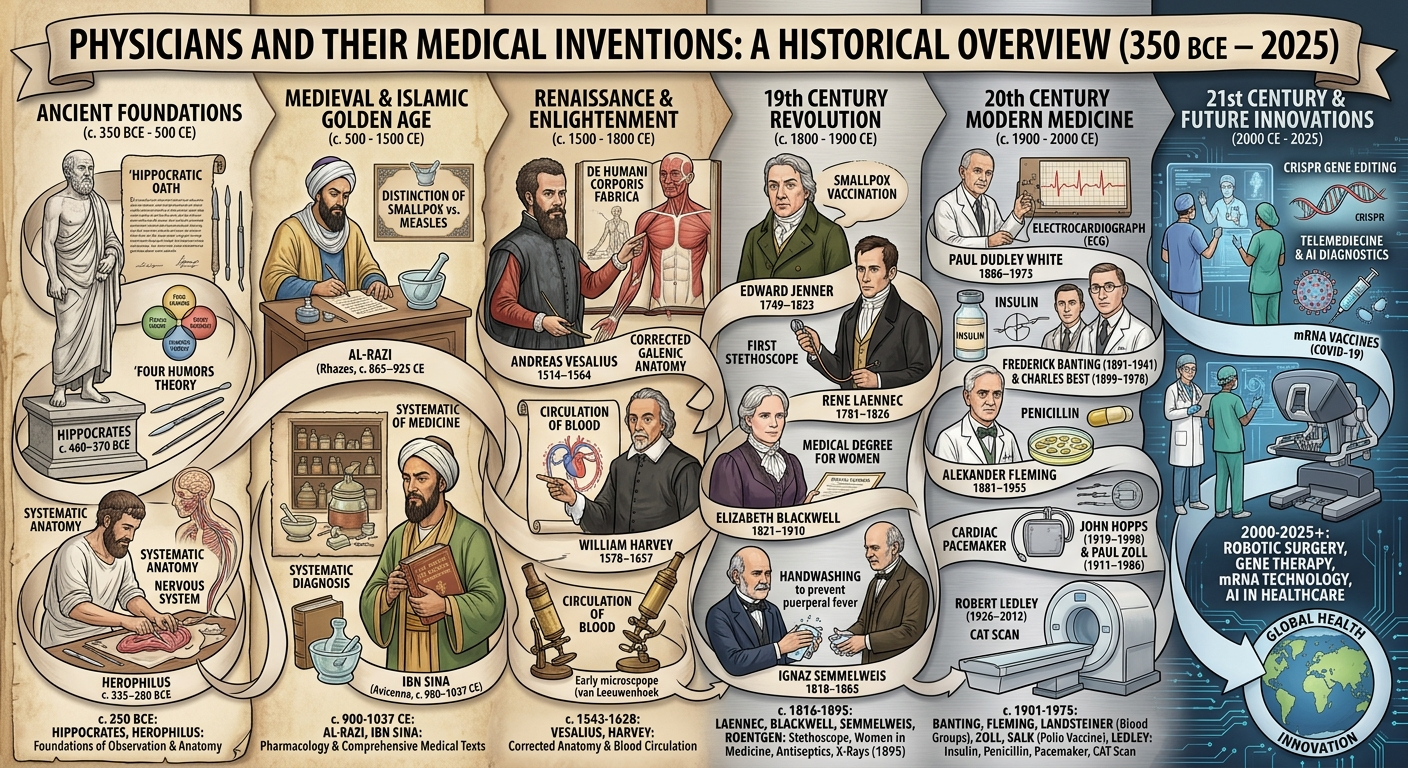
This thesis examines that development from approximately 350 BCE to 2025. It focuses particularly on physicians and medically trained innovators whose work produced enduring inventions or major clinical innovations. It also emphasizes an important historical distinction: not every medical breakthrough was invented by a physician. Modern medicine increasingly depends upon teams combining physicians, nurses, scientists, engineers, mathematicians, computer scientists, technicians, entrepreneurs, and patients.
Keywords: history of medicine, physicians, medical inventions, surgery, diagnosis, vaccination, anesthesia, antibiotics, medical imaging, transplantation, biotechnology, gene therapy, artificial intelligence.
1. Introduction
Medicine began as a practical human response to injury, disease, childbirth, pain, disability, and death. Early healing traditions existed in many civilizations, including ancient Egypt, Mesopotamia, India, China, Greece, Rome, Africa, the Islamic world, and later Europe and the Americas.
The transformation of medicine into a systematic science was gradual. Ancient Greek physicians increasingly emphasized observation and natural explanations for disease. The U.S. National Library of Medicine identifies Hippocratic medicine as an important turning point because it placed observation of the body and rational explanations of illness at the center of medical thought.
The subsequent history of medicine can therefore be understood as a sequence of expanding capabilities:
Observation → Diagnosis → Measurement → Intervention → Prevention → Molecular understanding → Digital medicine → Precision medicine → Computational medicine.
Physicians have repeatedly participated in this progression.
A physician confronted with a practical clinical problem might ask:
- How can a disease be recognized earlier?
- How can an internal organ be examined?
- How can pain during surgery be controlled?
- How can infection be prevented?
- How can blood be transferred safely?
- How can damaged organs be replaced?
- How can cancer cells be targeted?
- How can genetic disease be corrected?
- How can computers assist diagnosis and treatment?
The inventions that emerged from these questions transformed healthcare.
2. Defining a “Medical Invention”
The term medical invention should be interpreted broadly.
It can refer to:
- Medical instruments — stethoscopes, syringes and diagnostic devices.
- Surgical techniques — new operative procedures.
- Therapeutic technologies — methods for treating disease.
- Preventive technologies — vaccination and infection-control systems.
- Diagnostic systems — clinical examination and laboratory methods.
- Pharmaceutical discoveries — medicines and therapeutic compounds.
- Biomedical technologies — dialysis, prostheses and implants.
- Biotechnologies — recombinant DNA, gene therapy and cellular therapies.
- Digital medicine — electronic monitoring, medical software and AI.
- Medical systems and protocols — standardized approaches that make treatment safer and reproducible.
Consequently, the physician-inventor is not necessarily someone who patented a physical machine. A physician may also have invented a procedure, clinical methodology, diagnostic technique, or therapeutic system.
3. The Ancient Foundations: Approximately 350 BCE–200 CE
3.1 Hippocratic Medicine
Hippocrates and the medical tradition associated with him represent one of the most important foundations of Western clinical medicine.
Rather than explaining every illness through supernatural causes, Hippocratic medicine emphasized observation, symptoms, environmental factors, diet, lifestyle, prognosis, and clinical experience. The National Library of Medicine describes this transition toward observation-based medicine as a defining feature of the Hippocratic tradition.
The significance of Hippocratic medicine was therefore methodological as much as technological.
The physician became an observer.
The patient’s symptoms became evidence.
The clinical examination became a source of knowledge.
This helped establish a fundamental principle of medicine:
Disease should be studied through systematic observation of the patient.
The Hippocratic tradition also contributed to professional ethics, including principles associated with the Hippocratic Oath.
3.2 Herophilus and Erasistratus
During the Hellenistic period, physicians and anatomists in Alexandria pursued more systematic investigations of anatomy and physiology.
Herophilus of Chalcedon and Erasistratus are particularly important because anatomical and physiological investigation became increasingly central to medical knowledge.
Their work helped establish a tradition in which the human body could be investigated as a physical system rather than merely interpreted through philosophical speculation.
3.3 Galen
Galen of Pergamum, born around 129 CE, became one of the most influential physicians of antiquity.
He studied anatomy, physiology, surgery and pharmacology and conducted experiments involving animal anatomy and physiological function. The National Library of Medicine describes him as one of the earliest experimental physiologists, including work concerning the kidneys and spinal cord.
His influence lasted for approximately fifteen centuries.
However, Galen’s history illustrates an important principle:
A medical authority can make enormous contributions while also holding theories later shown to be incorrect.
Scientific medicine therefore requires continuous testing and revision.
4. Medicine in the Islamic Golden Age
Between approximately the eighth and thirteenth centuries, scholars working in the Islamic world preserved, translated, criticized, expanded and reorganized medical knowledge from Greek, Persian, Indian and other traditions.
Important figures included:
- Al-Razi (Rhazes)
- Ibn Sina (Avicenna)
- Al-Zahrawi
- Ibn al-Nafis
- Ibn Zuhr
4.1 Al-Razi
Al-Razi made important contributions to clinical medicine, pharmacology and the classification of diseases.
His emphasis on clinical observation helped move medicine toward systematic differentiation between diseases.
4.2 Avicenna
Avicenna’s Canon of Medicine became one of the most influential medical texts in medieval medicine.
It organized knowledge concerning:
- anatomy,
- diseases,
- medicines,
- diagnosis,
- treatment,
- pharmacology,
- preventive medicine.
His contribution illustrates another form of invention: the organization of knowledge itself.
4.3 Al-Zahrawi
Al-Zahrawi was particularly important in surgery.
His writings described numerous surgical instruments and procedures and helped establish surgery as a systematic technical discipline.
5. The Renaissance: Anatomy Becomes an Experimental Science
The Renaissance fundamentally changed medical investigation.
5.1 Andreas Vesalius
Andreas Vesalius challenged traditional anatomical assumptions through direct human dissection.
His 1543 work De Humani Corporis Fabrica represented a major transformation in anatomical science.
The lesson was revolutionary:
Anatomical truth should be determined by observation rather than simply inherited authority.
Vesalius therefore represents one of the earliest great medical innovators of the scientific era.
6. William Harvey and the Circulatory System
William Harvey’s work on blood circulation in the seventeenth century transformed understanding of the cardiovascular system.
Harvey demonstrated that the heart functions as a pump and that blood circulates through the body in a systematic process.
This transformed physiology from speculation into experimentally supported science.
The cardiovascular system could now be conceptualized as a dynamic mechanical and biological network.
That conceptual breakthrough later supported:
- cardiovascular surgery,
- blood-pressure measurement,
- cardiac catheterization,
- artificial hearts,
- bypass surgery,
- transplantation,
- cardiac imaging.
A major medical invention can therefore have consequences centuries after its original discovery.
7. The Scientific Revolution and Medical Instrumentation
The seventeenth and eighteenth centuries saw rapid development of scientific instruments.
Microscopy became especially important.
Anton van Leeuwenhoek’s observations of microscopic structures demonstrated that the biological world was vastly more complex than could be seen with the naked eye. The BMJ’s historical review notes his description of red blood cells among the significant medical observations associated with the period.
The microscope eventually became fundamental to:
- histology,
- microbiology,
- pathology,
- hematology,
- bacteriology,
- cell biology.
The invention of an instrument therefore created an entirely new scientific scale of observation.
8. The Stethoscope: René Laënnec
One of the most famous physician inventions is the stethoscope.
In 1816, French physician René Théophile Hyacinthe Laënnec developed an early wooden stethoscope.
The instrument allowed physicians to listen to internal sounds generated by the heart and lungs without placing the ear directly against the patient’s body.
It transformed physical examination.
Modern medicine subsequently developed increasingly sophisticated auscultation techniques.
The stethoscope became an extraordinary example of a simple technology producing enormous clinical value.
9. Vaccination: Edward Jenner
One of the most important preventive medical innovations came from English physician Edward Jenner.
In 1796, Jenner demonstrated the protective effect of cowpox exposure against smallpox.
The significance extended far beyond smallpox.
Vaccination introduced a new principle:
Disease could be prevented by deliberately training the immune system.
The historical medical timeline records Jenner’s 1796 smallpox vaccination as the first vaccine against a disease.
Vaccination subsequently became one of the greatest public-health technologies in human history.
10. Anesthesia and the Transformation of Surgery
Before modern anesthesia, major surgery was severely limited by pain.
The nineteenth century transformed this situation.
Important developments included investigations of:
- nitrous oxide,
- ether,
- chloroform,
- inhalational anesthesia,
- anesthetic delivery systems.
Historical medical timelines identify Crawford Long, Horace Wells and William Morton among important figures in the development and clinical introduction of anesthesia.
Anesthesia transformed surgery from an extreme last resort into an increasingly precise medical discipline.
It made possible:
- longer operations,
- deeper surgery,
- abdominal procedures,
- orthopedic reconstruction,
- neurosurgery,
- cardiac surgery,
- transplantation.
11. Ignaz Semmelweis and Hand Hygiene
Ignaz Semmelweis demonstrated the importance of hand hygiene in preventing puerperal fever.
His work represented a fundamental change in thinking:
Physicians themselves could unintentionally transmit disease.
This insight contributed to the emergence of infection-control medicine.
The historical record identifies Semmelweis’s 1847 work as a major development in preventing transmission of puerperal fever.
12. Louis Pasteur and Germ Theory
Louis Pasteur’s work transformed medicine by demonstrating the importance of microorganisms in biological processes and disease.
Germ theory provided a scientific explanation for infection.
Once microorganisms became recognized as causal agents, medicine could develop targeted approaches to:
- sterilization,
- sanitation,
- antisepsis,
- vaccination,
- microbiological diagnosis,
- antimicrobial treatment.
This was one of the great intellectual revolutions in medical history.
13. Joseph Lister and Antiseptic Surgery
Joseph Lister applied emerging understanding of microorganisms to surgery.
His antiseptic surgical methods dramatically changed surgical practice.
The historical timeline records Lister’s 1867 publication of Antiseptic Principle of the Practice of Surgery.
The basic logic was powerful:
If microorganisms cause infection, reducing microbial contamination should reduce surgical infection.
Modern surgery rests on the descendants of this principle:
- sterilization,
- surgical hand preparation,
- sterile instruments,
- operating-room protocols,
- infection surveillance,
- antimicrobial strategies.
14. Medical Imaging
The nineteenth and twentieth centuries produced another enormous transformation: physicians no longer needed to rely exclusively on external physical examination.
14.1 X-rays
Wilhelm Conrad Röntgen’s discovery of X-rays in 1895 created a new way to see inside the human body.
For the first time, clinicians could obtain images of internal structures without conventional surgery.
This transformed diagnosis of:
- fractures,
- chest disease,
- foreign bodies,
- certain tumors,
- skeletal abnormalities.
14.2 Ultrasound
Ultrasound eventually became a major diagnostic technology, particularly in obstetrics, cardiology and abdominal medicine.
14.3 Computed Tomography
CT combined X-ray technology with computing to generate cross-sectional images.
14.4 Magnetic Resonance Imaging
MRI introduced powerful imaging based on magnetic fields and radio-frequency signals.
The development of medical imaging illustrates a broader transformation:
Medicine moved from examining the body primarily from the outside to visualizing its internal structures.
15. Blood Transfusion
Blood transfusion became progressively safer as physicians and scientists learned about blood groups, compatibility and preservation.
James Blundell performed an important early human blood-transfusion procedure in the nineteenth century. Historical medical timelines identify his 1818 work among major developments in transfusion medicine.
Modern transfusion medicine subsequently developed:
- blood typing,
- blood banks,
- anticoagulation,
- component therapy,
- screening,
- refrigeration,
- transfusion medicine laboratories.
This created a medical infrastructure capable of moving blood from donor to recipient safely.
16. The Syringe and Injectable Medicine
The development of the hypodermic syringe transformed drug delivery.
Charles Pravaz and Alexander Wood are associated with important nineteenth-century syringe developments.
Injectable medicine subsequently became essential for:
- anesthesia,
- vaccination,
- antibiotics,
- insulin,
- emergency medicine,
- intravenous therapy,
- chemotherapy.
The syringe appears simple, but it became a fundamental interface between pharmaceutical science and the human body.
17. Antibiotics and the Antimicrobial Revolution
The discovery and development of antibiotics fundamentally changed medicine.
Alexander Fleming’s observation of penicillin was followed by the work of Howard Florey, Ernst Chain and collaborators that enabled therapeutic development.
Antibiotics transformed the treatment of bacterial infections.
Diseases that had previously been life-threatening became treatable.
This dramatically affected:
- surgery,
- childbirth,
- trauma care,
- infectious diseases,
- cancer treatment,
- transplantation.
The antimicrobial revolution also introduced a major contemporary challenge:
antimicrobial resistance.
The invention of antibiotics therefore created both extraordinary benefits and a continuing requirement for responsible medical stewardship.
18. Insulin and the Treatment of Diabetes
The discovery of insulin transformed diabetes from a frequently fatal disease into a condition that could be medically managed.
Frederick Banting, Charles Best, John Macleod and James Collip were central to the development and purification of insulin therapy.
Insulin subsequently evolved through multiple technological generations:
animal insulin → purified insulin → recombinant human insulin → insulin analogues → insulin pumps → continuous glucose monitoring → automated insulin-delivery systems.
This illustrates how a medical discovery can become the foundation for an entire technological ecosystem.
19. Cardiology and the Mechanical Understanding of the Heart
The twentieth century transformed cardiology.
Important technologies included:
- electrocardiography,
- cardiac catheterization,
- pacemakers,
- artificial heart valves,
- coronary angiography,
- bypass surgery,
- cardiac ultrasound,
- implantable defibrillators.
The heart increasingly became understood through measurable electrical, mechanical and circulatory parameters.
Modern cardiology is therefore simultaneously:
biology + physics + electrical engineering + imaging + pharmacology + computing.
20. Dialysis and Artificial Organ Technology
Kidney failure presented medicine with a profound engineering problem:
Could an external machine perform some of the functions of a human organ?
Dialysis answered part of that question.
Artificial filtration systems can remove waste products and excess fluid from blood when the kidneys cannot perform adequately.
Penn Medicine records an early practical dialysis-machine design developed by William Y. Inouye in 1951, illustrating the broader development of dialysis engineering.
The concept eventually expanded into:
- hemodialysis,
- peritoneal dialysis,
- portable systems,
- automated dialysis,
- kidney transplantation.
This represents the emergence of organ-support technology.
21. Organ Transplantation
Transplantation required breakthroughs in:
- surgery,
- immunology,
- tissue matching,
- organ preservation,
- anesthesia,
- infection control,
- immunosuppressive therapy.
Kidney transplantation became a major early success, followed by:
- liver transplantation,
- heart transplantation,
- lung transplantation,
- pancreas transplantation,
- multi-organ transplantation.
Transplant medicine demonstrated that modern healthcare could replace or support biological organs rather than merely treat their symptoms.
22. The Rise of Biotechnology
During the second half of the twentieth century, medicine entered the molecular age.
DNA became central to medical research.
Important developments included:
- molecular genetics,
- recombinant DNA,
- monoclonal antibodies,
- genetic testing,
- sequencing,
- recombinant pharmaceuticals,
- biotechnology manufacturing.
The biotechnology revolution also changed the identity of the medical inventor.
Medical innovation was no longer produced primarily by an individual physician working alone.
It increasingly emerged from multidisciplinary research teams.
23. Cancer Medicine
Cancer treatment evolved from relatively nonspecific approaches toward increasingly targeted therapies.
Major technological categories include:
- surgery,
- radiation therapy,
- chemotherapy,
- hormonal therapy,
- targeted molecular therapies,
- immunotherapy,
- cellular therapies,
- precision oncology.
One particularly important development is CAR-T cell therapy.
Penn Medicine identifies Carl June’s research as central to the development of CAR-T therapy and notes that it led to an FDA-approved CAR-T treatment for advanced acute lymphoblastic leukemia.
This represents a remarkable conceptual change:
Instead of only attacking cancer directly, medicine can modify the patient’s own immune cells to recognize and attack cancer.
24. Gene Therapy
Gene therapy seeks to treat disease by modifying genetic material or its biological expression.
The development of gene therapy required the convergence of:
- genetics,
- molecular biology,
- virology,
- cell biology,
- biotechnology,
- medicine,
- bioengineering.
Penn Medicine identifies the work of Jean Bennett, Albert Maguire and Katherine High among the developments leading to the first FDA-approved gene therapy for an inherited condition, concerning inherited blindness.
Gene therapy therefore represents a new stage of medicine:
Treating the molecular cause of disease rather than merely treating its consequences.
25. mRNA Medicine
The development of mRNA technologies created another major medical platform.
Katalin Karikó and Drew Weissman’s work on modified mRNA contributed to the technology underlying COVID-19 mRNA vaccines. Penn Medicine describes this technology as foundational to the COVID-19 vaccines.
The broader significance extends beyond one disease.
mRNA technology potentially provides a platform for developing therapies and vaccines in areas including:
- infectious diseases,
- cancer,
- rare diseases,
- personalized medicine.
26. CRISPR and Genome Editing
CRISPR-based genome editing represents a new stage in biomedical intervention.
Earlier medicine generally treated disease using:
drugs → surgery → radiation → biological therapies.
Genome editing introduces another possibility:
modify the genetic instructions associated with disease.
By 2025, clinical applications of genome editing had entered an important new phase.
Penn Medicine reported a 2025 case involving customized CRISPR gene therapy for a child with a rare metabolic disease, illustrating how genome editing was moving toward individualized treatment.
This development points toward an era of increasingly personalized medicine.
27. Medical Computing
Computers transformed medicine during the twentieth century.
Initially, computing was used for:
- numerical calculations,
- laboratory analysis,
- medical records,
- imaging,
- statistical research.
Later, computers became embedded in:
- CT scanners,
- MRI systems,
- laboratory instruments,
- intensive-care monitoring,
- electronic health records,
- robotic surgery,
- telemedicine.
Medicine became increasingly dependent upon digital infrastructure.
28. Artificial Intelligence in Medicine
The twenty-first century introduced a new category of medical invention: computational intelligence.
AI can assist with:
- medical-image analysis,
- pattern recognition,
- risk prediction,
- clinical decision support,
- drug discovery,
- genomics,
- personalized medicine,
- administrative processes,
- patient monitoring.
The historical development of precision medicine demonstrates how diagnostic technology has evolved from the stethoscope to imaging, big data and artificial intelligence.
However, AI does not eliminate the physician.
Instead, it introduces a new model:
Physician + patient + data + computation + scientific evidence.
The physician remains responsible for integrating clinical context, patient preferences, uncertainty, ethics and professional judgment.
29. The Physician-Inventor Through the Ages
The physician-inventor has changed dramatically.
| Historical period | Dominant medical innovation |
|---|---|
| Ancient world | Clinical observation and medical theory |
| Hellenistic period | Anatomy and physiology |
| Roman era | Experimental medicine and surgery |
| Medieval Islamic world | Medical texts, pharmacology and surgery |
| Renaissance | Human anatomy |
| Scientific Revolution | Experimental physiology |
| 18th century | Clinical classification and therapeutics |
| 19th century | Vaccination, anesthesia, antisepsis and instruments |
| Early 20th century | Laboratory medicine and pharmaceuticals |
| Mid-20th century | Antibiotics, transplantation and medical machines |
| Late 20th century | Molecular biology and biotechnology |
| Early 21st century | Genomics, cellular therapy and digital medicine |
| 2020s | AI, mRNA platforms, gene editing and precision medicine |
30. From Individual Inventors to Innovation Ecosystems
One of the most important conclusions from this history is that the concept of the lone inventor is increasingly inadequate.
Early medical inventions could sometimes be associated with one physician.
Modern medical innovations frequently require enormous teams.
A modern therapeutic product may involve:
Physicians → biologists → chemists → engineers → geneticists → computer scientists → statisticians → regulatory scientists → manufacturing specialists → clinical researchers → nurses → patients.
The invention is therefore an ecosystem rather than a single event.
This transition is visible in biotechnology and advanced medicine. UCSF’s history of biotechnology, for example, illustrates how medical schools, molecular biology research and biotechnology became interconnected during the second half of the twentieth century.
31. Major Physician-Associated Innovations: Selected Timeline
c. 350 BCE–200 CE
Hippocratic and Galenic traditions establish systematic clinical observation, anatomy, physiology and medical ethics.
Medieval period
Physicians in the Islamic world expand clinical medicine, pharmacology, surgery and medical literature.
1543
Vesalius publishes his major anatomical work based on direct human dissection.
1628
Harvey publishes his work on blood circulation.
17th century
Microscopy expands biological observation.
1796
Edward Jenner develops smallpox vaccination.
1816
Laënnec develops the stethoscope.
1818
Blundell performs an important early human blood transfusion.
1840s
Anesthesia begins transforming surgery.
1847
Semmelweis demonstrates the importance of hand hygiene in preventing puerperal fever.
1850s–1860s
Pasteur’s germ theory and Lister’s antiseptic methods transform infection control.
Late 19th century
X-rays, bacteriology and laboratory medicine expand diagnostic capabilities.
Early 20th century
Insulin, antibiotics, blood banking and modern pharmaceuticals transform treatment.
Mid-20th century
Dialysis, transplantation, cardiac devices and advanced imaging emerge.
Late 20th century
Genetic engineering, biotechnology, MRI, CT, minimally invasive surgery and molecular diagnostics expand medicine.
2000s
Genomics, digital health, robotic surgery, targeted cancer therapy and personalized medicine accelerate.
2010s
CAR-T therapy, gene therapy and advanced genomic technologies reach clinical practice.
2020s
mRNA vaccines, AI-assisted medicine and genome-editing therapies become increasingly important.
2025
Medical innovation increasingly converges around precision medicine, advanced cell and gene therapies, computational biology, AI and individualized treatment.
32. The Most Important Transformations
The history of medical invention can be condensed into several great transformations.
Transformation 1: From superstition to observation
Disease as supernatural phenomenon → disease as biological phenomenon.
Transformation 2: From external observation to anatomy
What the patient looks like → what the body contains.
Transformation 3: From anatomy to physiology
Structure → function.
Transformation 4: From physiology to microbiology
Disease processes → microorganisms and pathogens.
Transformation 5: From diagnosis to imaging
Symptoms → visible internal structures.
Transformation 6: From treatment to prevention
Treat disease → prevent disease.
Transformation 7: From organ treatment to organ replacement
Support failing organs → replace or mechanically assist them.
Transformation 8: From chemistry to molecular biology
Treat symptoms → target molecular mechanisms.
Transformation 9: From molecular biology to genetic medicine
Treat biological pathways → modify genetic instructions.
Transformation 10: From human-only analysis to human-machine intelligence
Physician interpretation → physician plus computational intelligence.
33. Ethical Dimensions of Medical Invention
Medical invention creates enormous benefits but also raises ethical questions.
Important issues include:
- informed consent,
- patient privacy,
- medical experimentation,
- equitable access,
- genetic privacy,
- reproductive ethics,
- AI bias,
- algorithmic transparency,
- ownership of biological data,
- affordability,
- intellectual property,
- clinical safety.
A new invention is not automatically a beneficial invention.
Its value depends upon:
Safety + effectiveness + accessibility + ethics + appropriate clinical use.
This is why modern medical innovation requires regulatory systems and ethical oversight.
34. The Global Nature of Medical Innovation
Although many historical accounts emphasize Europe and North America, medical innovation has never been exclusively Western.
Medical knowledge has emerged from many civilizations.
Ancient Egyptian medicine, Indian Ayurveda, Chinese medicine, Greek medicine, Roman medicine, African healing traditions, Islamic Golden Age medicine, European scientific medicine and modern global biomedical research all contributed to humanity’s evolving understanding of health.
The modern medical system is consequently a cumulative global inheritance.
35. The Changing Role of the Physician
The physician of 350 BCE and the physician of 2025 operate in radically different technological environments.
The ancient physician depended heavily upon:
- observation,
- touch,
- hearing,
- experience,
- herbal remedies,
- clinical reasoning.
The contemporary physician may have access to:
- genomic sequencing,
- CT,
- MRI,
- ultrasound,
- electronic medical records,
- laboratory automation,
- robotic systems,
- artificial intelligence,
- molecular diagnostics,
- cellular therapies,
- gene-editing technologies.
Yet one principle remains unchanged:
The physician must understand the patient.
Technology can increase diagnostic and therapeutic capability, but medicine remains fundamentally concerned with human beings.
36. The Future Beyond 2025
The history ending in 2025 points toward several major future directions.
36.1 Precision medicine
Treatment will increasingly be adapted to individual biological characteristics.
36.2 AI-assisted diagnosis
AI will increasingly analyze medical images, laboratory results, genetic data and longitudinal health records.
36.3 Digital twins
Computational representations of patients may eventually assist with simulation and treatment planning.
36.4 Regenerative medicine
Stem cells, tissue engineering and biomaterials may increasingly support repair of damaged tissues.
36.5 Gene editing
CRISPR and related technologies may expand treatment options for genetic disorders.
36.6 Personalized vaccines
Vaccines may increasingly be designed around specific pathogens or even individual biological characteristics.
36.7 Advanced prosthetics
Neural interfaces may improve communication between artificial devices and the nervous system.
36.8 Medical robotics
Robotic systems may increase precision in surgery, rehabilitation and remote healthcare.
37. Conclusion
The history of physicians and medical inventions from approximately 350 BCE to 2025 is ultimately the history of humanity learning how to investigate, understand, prevent and modify disease.
Hippocratic medicine established the importance of clinical observation. Galen expanded experimental physiology. Medieval Islamic physicians preserved and developed medical knowledge. Vesalius transformed anatomy. Harvey transformed cardiovascular physiology. Jenner transformed disease prevention. Laënnec transformed physical diagnosis. Semmelweis and Lister transformed infection control. Pasteur transformed understanding of microorganisms. Anesthesia transformed surgery. X-rays and later CT and MRI transformed diagnostic imaging. Antibiotics transformed infectious disease treatment. Insulin transformed diabetes care. Dialysis and transplantation transformed organ failure medicine. Molecular biology transformed our understanding of disease at the cellular and genetic levels. Gene therapy, CAR-T therapy, mRNA technologies and genome editing are now pushing medicine toward increasingly precise biological intervention.
The twenty-first century has added another dimension: computation.
Medicine is becoming a convergence of:
biology + chemistry + physics + engineering + computing + mathematics + genetics + artificial intelligence + human clinical judgment.
The physician of the future will therefore not simply be a practitioner who possesses medical knowledge. Increasingly, the physician will operate within a vast technological ecosystem capable of measuring the body at multiple scales—from the whole organism to organs, tissues, cells, molecules and genes.
The central lesson of this 2,300-year journey is that medical progress rarely comes from one invention alone. Each generation inherits technologies from previous generations and combines them in new ways.
The stethoscope made internal sounds measurable.
The microscope made cells visible.
The X-ray made bones and organs observable.
The laboratory made biochemical processes measurable.
The CT and MRI scanner made internal anatomy computationally reconstructable.
Genomics made DNA clinically accessible.
AI makes enormous quantities of medical information computationally analyzable.
And gene editing increasingly gives medicine the ability to intervene at the level of genetic instructions.
Thus, the history of medical invention is not simply a catalogue of machines and discoveries. It is a record of humanity progressively extending the senses, reasoning capabilities and therapeutic powers of the physician.
From the physician listening to a patient’s heartbeat with a simple instrument to modern clinical teams combining molecular diagnostics, advanced imaging, computational analysis and cellular or genetic therapies, the fundamental objective remains the same:
to understand disease more accurately, prevent it where possible, treat it effectively, reduce suffering, and extend healthy human life.
Selected References
- National Library of Medicine. Greek Medicine: Hippocrates and Galen.
- BMJ. Medical Anniversaries in 2025.
- History of Medicine Timeline. PMC.
- American Journal of Respiratory and Critical Care Medicine. From Laënnec’s Stethoscope to the Magic of Imaging, Big Data and Artificial Intelligence.
- Penn Medicine. Penn Medicine Firsts.
- UCSF. Biotech’s Birthplace: How UCSF Sparked a Medical Renaissance.
- World History Encyclopedia. Ancient Greek Inventions: Medicine.
- History of Medicine: The Metamorphosis of Scientific Medicine in the Ever-Present Past.


Be First to Comment