
Executive Summary
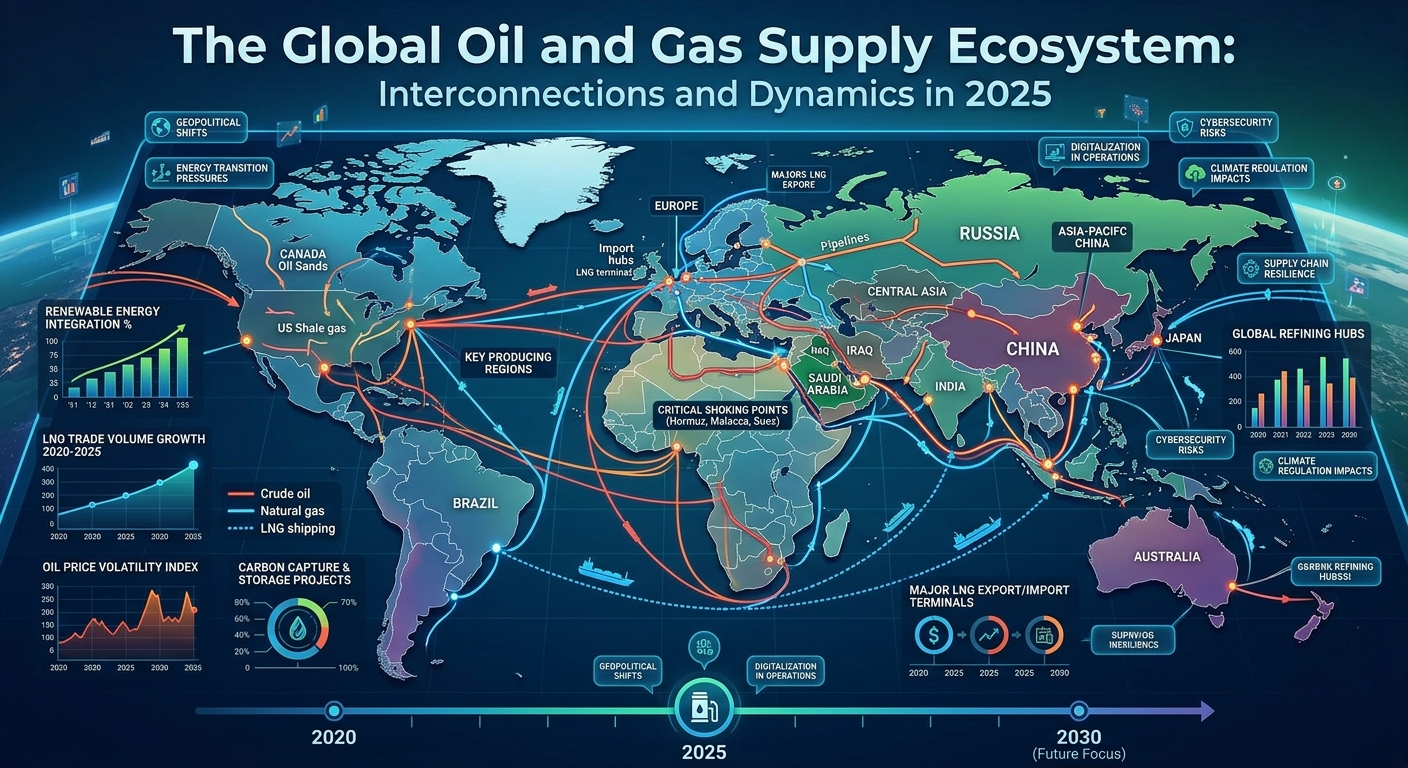
The global oil and gas industry is not a single supply chain but a vast, interconnected ecosystem linking geological resources, exploration companies, drilling contractors, national oil companies, international oil companies, pipelines, ports, tankers, refineries, LNG facilities, storage terminals, traders, financial markets, governments, utilities, industries and final consumers.
In 2025, this ecosystem was undergoing a major structural transition. Oil markets were influenced by OPEC+ production policy, expanding production outside OPEC+, changing Chinese demand, rising production from the United States, Canada, Brazil and Guyana, geopolitical risks, refinery capacity and changes in transportation. The International Energy Agency projected global oil supply to increase by approximately 1.8 million barrels per day in 2025 to about 104.9 million barrels per day.
Natural gas was experiencing an equally important transformation. LNG was becoming increasingly central to international gas trade because it can be transported by ship rather than requiring continuous pipeline connections. The IEA estimated that around 300 billion cubic metres per year of new LNG export capacity could come online by 2030, representing roughly a 50% increase in global LNG supply capacity.
The result is an energy ecosystem in which events at one point can rapidly affect the entire network. A production disruption can influence tanker rates; tanker disruptions can affect refinery feedstock; refinery constraints can affect fuel prices; gas shortages can increase electricity costs; and geopolitical events can alter global trade routes.
1. Introduction: Oil and Gas as a Global Ecosystem
Oil and gas should be understood as interconnected systems rather than isolated commodities.
At the simplest level:
Resources → Exploration → Production → Gathering → Processing → Transportation → Trading → Refining/LNG → Distribution → End Users
But beneath this apparent simplicity exists an enormous network of supporting industries.
These include:
- geology and geophysical surveying
- drilling
- oilfield services
- offshore engineering
- subsea equipment
- pipelines
- storage
- shipping
- ports
- refineries
- petrochemical plants
- LNG liquefaction
- LNG shipping
- regasification
- electricity generation
- financial markets
- commodity exchanges
- insurance
- cybersecurity
- engineering and construction
- government regulation
- environmental management
The global system therefore resembles a large technological and economic organism.
2. The Basic Architecture of the Global Oil Ecosystem
The oil ecosystem can be divided into five major layers.
Layer 1 — Resource Base
Oil originates from geological formations containing hydrocarbons.
Major resource categories include:
- conventional crude oil
- shale/tight oil
- offshore oil
- oil sands
- condensates
- natural gas liquids
The geological resource is the starting point of the entire system.
Layer 2 — Upstream
Upstream companies search for and produce hydrocarbons.
Activities include:
- geological analysis
- seismic surveying
- exploration drilling
- appraisal drilling
- field development
- production drilling
- well completion
- artificial lift
- offshore production
- gathering and initial processing
Layer 3 — Midstream
Midstream infrastructure connects production with processing and markets.
It includes:
- pipelines
- gathering systems
- crude terminals
- storage tanks
- pumping stations
- LNG terminals
- oil tankers
- gas pipelines
- gas storage
Layer 4 — Downstream
Downstream transforms crude oil into useful products.
Refineries manufacture products such as:
- gasoline
- diesel
- jet fuel
- marine fuels
- lubricants
- asphalt
- petrochemical feedstocks
Layer 5 — Consumers
The final products reach:
- households
- transport companies
- airlines
- shipping companies
- factories
- farms
- mines
- electricity generators
- governments
- commercial businesses
3. The Major Oil-Producing Regions
Global oil production is geographically concentrated, but production outside traditional producing regions has become increasingly important.
Major supply centres include:
- Middle East
- North America
- Russia
- Latin America
- Africa
- North Sea
- Central Asia
The United States has become particularly important because of the shale revolution. The IEA notes that US oil production increased by more than 8 million barrels per day between 2015 and 2024, while the United States accounted for approximately 90% of the increase in global oil supply during that period.
Other important growth centres include Canada, Brazil and Guyana.
4. OPEC and OPEC+
One of the most important institutional structures in the oil ecosystem is OPEC.
OPEC coordinates petroleum policies among participating oil-producing countries.
OPEC+ extends cooperation to additional producers, including Russia.
The importance of OPEC+ comes from its ability to influence the quantity of oil reaching global markets.
When production is reduced:
Supply ↓ → inventories may decline → prices may rise
When production increases:
Supply ↑ → inventories may rise → prices may fall
The relationship is not automatic because prices are also affected by demand, inventories, economic growth, currency movements, geopolitics and financial markets.
During 2025, OPEC+ began unwinding some production restrictions, contributing to changing global supply expectations.
5. The United States and the Shale Revolution
The United States transformed global oil supply through hydraulic fracturing and horizontal drilling.
The shale model changed the industry because production could respond more rapidly than many conventional megaprojects.
The major producing region is the Permian Basin of Texas and New Mexico.
The transformation created several consequences:
- higher US production
- greater US exports
- reduced dependence on imported crude
- increased global supply
- stronger competition for traditional producers
- increased importance of US infrastructure
The United States therefore became simultaneously:
Producer + exporter + refiner + consumer + LNG supplier
This combination gives it an unusually important position in global energy markets.
6. Russia and the Restructuring of Energy Trade
Russia remains a major hydrocarbon producer, but sanctions and geopolitical developments have substantially changed its trading relationships.
European purchases of Russian pipeline gas declined dramatically after Russia’s invasion of Ukraine.
This accelerated the movement toward LNG and alternative suppliers.
Consequently:
Russia-Europe pipeline relationship ↓
while:
LNG trade + alternative pipeline routes + new Asian markets ↑
The global gas network consequently became more flexible in some areas but also more dependent on LNG shipping capacity.
7. The Middle East
The Middle East remains fundamental to global oil security.
Important producing countries include:
- Saudi Arabia
- Iraq
- United Arab Emirates
- Kuwait
- Qatar
- Iran
The region possesses enormous conventional reserves and major export infrastructure.
Saudi Arabia has a particularly important position because of its large production capacity and historically significant spare capacity.
The Gulf region also contains critical maritime infrastructure.
This creates an important distinction:
Oil security depends not only on underground reserves but also on the ability to transport those reserves to customers.
8. Maritime Chokepoints
Global oil and gas transportation depends on strategic waterways.
Important chokepoints include:
Strait of Hormuz
Connects the Persian Gulf with the Gulf of Oman.
It is one of the world’s most strategically important energy corridors.
Strait of Malacca
A major route connecting Indian Ocean energy suppliers with Asian consumers.
Bab el-Mandeb
Connects the Red Sea with the Gulf of Aden.
Suez Canal
Provides a major route between the Mediterranean and Red Sea.
Turkish Straits
Important for energy exports from the Black Sea region.
A disruption at any of these locations can alter:
- shipping distances
- tanker availability
- insurance costs
- freight rates
- delivery times
- regional fuel prices
9. Oil Tankers: The Floating Infrastructure of the System
Crude oil is transported internationally by specialised tankers.
Major tanker categories include:
- VLCC
- Suezmax
- Aframax
- Panamax
Tankers connect producing regions to refining centres.
A simplified journey is:
Oil field → pipeline → export terminal → tanker → import terminal → refinery
The tanker is therefore effectively a moving section of the global pipeline.
10. Pipelines
Pipelines remain one of the most important components of the energy ecosystem.
They transport:
- crude oil
- refined products
- natural gas
- NGLs
Pipeline systems can extend thousands of kilometres.
They require:
- pumping or compression stations
- valves
- monitoring systems
- maintenance
- corrosion management
- leak detection
- control systems
Natural gas pipelines are particularly significant because gas is more geographically constrained than oil unless it is converted into LNG.
11. Refineries: Converting Crude Into Useful Products
Crude oil is not normally consumed directly by most end users.
Refineries separate and transform crude into different products.
The basic refinery pathway is:
Crude oil → separation → conversion → treatment → blending → finished fuels
Important refinery processes include:
- atmospheric distillation
- vacuum distillation
- catalytic cracking
- hydrocracking
- reforming
- hydrotreating
- alkylation
A refinery is therefore a complex chemical manufacturing facility.
12. The Importance of Refining Capacity
The price of crude oil and the price of finished fuel are related but not identical.
A country can have abundant crude oil but still experience fuel shortages if it lacks sufficient refining capacity or transportation infrastructure.
This creates several different markets:
Crude market
Refined-product market
Fuel retail market
The relationship between crude prices and product prices is strongly influenced by refinery utilisation and margins.
13. Natural Gas: A Different Supply Architecture
Natural gas has historically been more geographically constrained than oil.
Pipeline gas requires physical connections.
LNG changes this relationship.
The LNG chain is:
Gas field → gathering → processing → pipeline → liquefaction → LNG carrier → regasification → pipeline → consumer
This allows gas to travel between continents.
The IEA describes the expected expansion of LNG capacity as one of the most important transformations in global gas markets toward 2030.
14. LNG Liquefaction
Natural gas is cooled to approximately −162°C to convert it into liquid form.
Liquefaction dramatically reduces the volume of natural gas, making long-distance transportation by ship practical.
A typical LNG facility contains:
- gas reception
- separation
- acid-gas removal
- dehydration
- mercury removal
- fractionation
- refrigeration
- liquefaction trains
- LNG storage tanks
- loading facilities
LNG plants are therefore among the most technically complex facilities in the energy industry.
15. LNG Shipping
LNG carriers transport liquefied natural gas between continents.
The ship contains heavily insulated tanks designed to maintain extremely low temperatures.
The LNG supply chain therefore combines:
Gas production + cryogenic engineering + maritime transportation + port infrastructure + regasification
This is why LNG has become increasingly important in international gas trade.
16. Regasification
At the importing country, LNG is unloaded and converted back into gaseous form.
The process is:
LNG → heat exchange → natural gas → pipeline network
Regasification terminals can be:
- onshore
- floating
- floating storage and regasification units
This gives countries different options for increasing gas-import capacity.
17. Major LNG Suppliers
The LNG market is increasingly dominated by several major suppliers.
Important sources include:
- United States
- Qatar
- Australia
- Russia
- Malaysia
- Indonesia
- Nigeria
- Algeria
- Canada, increasingly
The IEA expects the United States and Qatar to account for much of the new LNG capacity entering service through 2030.
18. Energy Trading Companies
Physical oil and gas flows are supported by commodity trading companies.
Traders can coordinate:
- purchases
- sales
- storage
- transportation
- cargo scheduling
- price hedging
- financing
The global oil market therefore contains both:
Physical infrastructure
and
Financial infrastructure
These two systems interact continuously.
19. Commodity Exchanges and Financial Markets
Oil prices are influenced by financial markets.
Major benchmark systems include:
- Brent
- WTI
- Dubai/Oman
These benchmarks provide reference prices for physical transactions.
Financial instruments can include:
- futures
- options
- swaps
- forwards
These markets allow participants to manage price risk.
For example, an airline exposed to rising jet-fuel prices may use financial contracts to reduce uncertainty.
20. Storage: The Energy Buffer
Storage provides time between production and consumption.
Oil storage includes:
- above-ground tanks
- underground storage
- strategic petroleum reserves
- floating storage
Gas storage is particularly important for seasonal demand.
Storage can help absorb temporary differences between:
Supply and demand
If production temporarily exceeds consumption:
Inventory ↑
If consumption exceeds production:
Inventory ↓
Inventory changes are therefore closely watched by energy markets.
21. Electricity and Natural Gas
Natural gas is deeply connected to electricity systems.
Gas-fired power stations can convert natural gas into electricity.
The chain is:
Gas field → processing → pipeline/LNG → power plant → electricity grid → consumers
This means a gas shortage can become an electricity-security problem.
Conversely, abundant renewable electricity can reduce gas consumption in some markets.
22. Petrochemicals: The Hidden Oil Demand Engine
Oil is not used only as fuel.
Hydrocarbons are feedstocks for:
- plastics
- synthetic fibres
- solvents
- detergents
- coatings
- chemicals
- packaging
- industrial materials
Natural gas and NGLs are also important petrochemical feedstocks.
The IEA expects NGL production to become an increasingly important contributor to global liquids supply, with NGL production projected to rise significantly through 2030.
23. Africa’s Position in the Ecosystem
Africa contains major oil and gas resources.
Important producers and emerging producers include:
- Nigeria
- Angola
- Algeria
- Libya
- Egypt
- Republic of the Congo
- Ghana
- Senegal
- Mozambique
- Tanzania
Africa’s challenge is not simply resource availability.
It also involves:
- exploration investment
- pipelines
- refineries
- LNG infrastructure
- electricity access
- ports
- financing
- governance
- technical skills
- environmental management
Some African countries export crude while importing refined petroleum products.
This demonstrates the difference between resource ownership and industrial capacity.
24. South Africa’s Position
South Africa is a significant energy consumer but has relatively limited conventional crude production.
Its energy system therefore depends heavily on imported petroleum and other energy resources.
South Africa also possesses important refining, storage, port and fuel-distribution infrastructure.
Its strategic challenge is to balance:
Energy security + affordability + industrial development + environmental objectives
The country’s position at the southern tip of Africa also gives it maritime significance for shipping routes around the Cape.
25. China and India: Major Demand Centres
China and India are among the most important energy-consuming economies.
China has historically been a major driver of global oil demand growth.
However, the IEA expects structural changes in China’s transportation system—including rapid electric-vehicle deployment, LNG-powered trucks and high-speed rail—to influence future oil demand.
India remains an important growth market because of:
- population
- industrialisation
- urbanisation
- transportation demand
- expanding manufacturing
The future oil market is therefore increasingly influenced by Asian demand.
26. The Oil Price Formation System
A simplified representation is:
Production
↓
Global supply
Global demand
Inventories
Spare capacity
Geopolitical risk
Financial markets
↓
Benchmark crude prices
↓
Refinery economics
↓
Wholesale fuel prices
↓
Retail prices
The actual system is much more complicated, but this framework explains the basic transmission mechanism.
27. Geopolitics
Oil and gas are strategically important because hydrocarbons influence:
- transportation
- electricity
- industry
- national revenue
- military logistics
- trade balances
- inflation
- economic growth
Therefore, energy infrastructure can become an instrument of international influence.
Geopolitical events can affect the system through:
- sanctions
- export restrictions
- wars
- pipeline disruptions
- shipping interruptions
- investment restrictions
- tariffs
- diplomatic agreements
28. Why 2025 Was a Transitional Year
The 2025 oil market combined several contradictory forces.
On one side:
More supply
- US production
- Canadian production
- Brazilian production
- Guyanese production
- OPEC+ production adjustments
On the other:
Demand uncertainty
- slower economic growth
- changing Chinese consumption
- electrification
- energy efficiency
- continued growth in emerging economies
The IEA projected global oil supply to increase more rapidly than demand during 2025, contributing to a relatively well-supplied market in its June assessment.
29. The Coming LNG Wave
Natural gas presents a different picture.
The IEA identified an enormous expansion of LNG export capacity.
Approximately 300 bcm/year of additional LNG export capacity was expected to be added globally by 2030.
This could produce:
More LNG supply → greater competition → potentially lower prices → greater access for importing countries
But it also creates investment and market risks.
If supply grows faster than demand:
LNG oversupply → lower utilisation → weaker producer economics
30. The Complete Global Ecosystem
The entire system can be visualised as:
GEOLOGY
↓
Exploration
↓
Drilling
↓
Oil & Gas Production
↓
Gathering & Processing
↓
Pipelines / Tankers
↓
Storage & Trading
↓
OIL
Refineries
↓
Gasoline / Diesel / Jet Fuel / Lubricants / Petrochemicals
↓
Distribution
↓
Consumers
NATURAL GAS
Gas Processing
↓
Pipeline Gas OR LNG
↓
LNG Liquefaction
↓
LNG Carrier
↓
Regasification
↓
Gas Pipeline
↓
Power / Industry / Buildings
↓
Consumers
31. The Digital Layer
Modern oil and gas infrastructure increasingly depends on digital technology.
Important technologies include:
- industrial control systems
- SCADA
- sensors
- satellite monitoring
- artificial intelligence
- machine learning
- predictive maintenance
- digital twins
- robotics
- drones
- cloud computing
- cybersecurity
- high-performance computing
The modern oil field is therefore not merely a mechanical environment.
It is simultaneously:
Geological + Mechanical + Chemical + Electrical + Digital + Financial
32. Artificial Intelligence in Oil and Gas
AI can be applied to:
Exploration
Analysing seismic and geological data.
Drilling
Optimising drilling parameters.
Production
Predicting equipment performance.
Maintenance
Identifying equipment anomalies before failure.
Pipelines
Detecting abnormal flow patterns.
Refineries
Optimising process conditions.
Trading
Analysing market information and scenarios.
Logistics
Optimising shipping and cargo movements.
AI therefore connects the physical energy system with the information system.
33. Environmental Dimension
Oil and gas development has environmental consequences.
Important issues include:
- greenhouse-gas emissions
- methane leakage
- air pollution
- water use
- land disturbance
- spills
- ecosystem impacts
- flaring
The industry is therefore under increasing pressure to reduce emissions while maintaining reliable energy supplies.
Potential technologies include:
- methane detection
- electrification
- carbon capture
- energy efficiency
- reduced flaring
- renewable electricity integration
- lower-carbon fuels
34. The Energy Transition
The oil and gas ecosystem is increasingly interacting with:
- solar
- wind
- batteries
- nuclear power
- electric vehicles
- hydrogen
- biofuels
- energy efficiency
This does not mean that oil and gas disappear immediately.
Instead, the energy system is becoming increasingly diversified.
The transition can therefore be represented as:
Fossil-dominated system
↓
Fossil + renewable hybrid system
↓
Increasingly diversified low-carbon energy system
The speed of this transition will vary substantially by country and sector.
35. Systemic Risks
The global ecosystem contains several categories of risk.
Geopolitical risk
Wars, sanctions and political instability.
Geological risk
Unexpected declines in production.
Infrastructure risk
Pipeline, refinery, terminal or LNG failures.
Maritime risk
Shipping disruption and chokepoint constraints.
Financial risk
Commodity-price volatility and financing costs.
Environmental risk
Climate-related regulation and physical environmental impacts.
Cyber risk
Attacks or failures affecting digital infrastructure.
Demand risk
Faster-than-expected electrification or economic slowdown.
36. The Concept of Energy Security
Energy security has four major dimensions:
Availability
Is sufficient energy physically available?
Affordability
Can consumers afford it?
Reliability
Can it be delivered continuously?
Resilience
Can the system withstand shocks?
A country can have large oil reserves and still have poor energy security if it lacks:
- refineries
- pipelines
- storage
- electricity infrastructure
- skilled personnel
- financing
- reliable governance
37. The Future Competitive Landscape
The oil and gas industry is gradually changing from a simple competition over reserves into competition over entire ecosystems.
Future competitive advantage may depend on:
Resources
Technology
Capital
Infrastructure
Data
Logistics
Markets
Political stability
Human skills
A country with resources but weak infrastructure may remain dependent on foreign technology and capital.
A country with limited resources but sophisticated infrastructure can become a major trading and refining centre.
38. Strategic Lessons From the 2025 Ecosystem
Several major lessons emerge.
Lesson 1
Oil is global, but infrastructure is local.
A global price can be established internationally, while physical shortages may occur locally.
Lesson 2
Gas is becoming increasingly global.
The growth of LNG is connecting previously separated regional gas markets.
Lesson 3
Transportation infrastructure is as important as production.
A barrel underground has little economic value if it cannot reach a refinery or customer.
Lesson 4
Refining matters.
Crude production does not automatically guarantee fuel security.
Lesson 5
Digital technology is becoming fundamental.
Modern energy systems depend increasingly on data, automation and advanced computing.
Lesson 6
Energy security is increasingly about resilience.
Countries must prepare for simultaneous disruptions involving production, shipping, finance and infrastructure.
39. Conclusion
The global oil and gas supply ecosystem of 2025 was an enormous interconnected network extending from geological formations beneath the Earth to fuel stations, factories, electricity generators, airlines, ships and households.
The system can ultimately be reduced to one fundamental chain:
Natural resources → technology → production → processing → transportation → markets → energy products → society
But every arrow represents thousands of companies, millions of workers, enormous infrastructure networks and complex financial relationships.
Oil markets were being reshaped by rising non-OPEC+ production, OPEC+ policy, changing Asian demand and technological transformation. The IEA’s 2025 outlook projected substantial increases in oil supply capacity through 2030, with US and Middle Eastern producers playing major roles.
Natural gas was entering another transformation through LNG. The expected addition of roughly 300 bcm/year of LNG export capacity by 2030 could significantly reshape global gas trade.
The most important conclusion is therefore that the future of oil and gas will not be determined by production alone. It will be determined by the interaction of geology, engineering, infrastructure, shipping, refining, LNG, finance, geopolitics, digital technology, environmental policy and changing energy demand.
The global oil and gas industry is consequently best understood as a planet-scale energy network—one in which a disruption, innovation or policy decision at one node can propagate through thousands of interconnected nodes and ultimately affect the price and availability of energy for people and businesses around the world.

Be First to Comment