
The World’s Research and Innovation Powerhouses, 2022–2026
A Comprehensive Global Thesis on Research, Science, Technology, Industrial Innovation and the Race for Technological Leadership
Abstract
Research and development (R&D) has become one of the most important foundations of economic power, scientific advancement, technological sovereignty and national competitiveness. Nations that continuously invest in research are able to create new knowledge, develop advanced technologies, improve industrial productivity, build sophisticated companies and influence the technological direction of the world.
During the 2022–2026 period, the global R&D landscape underwent an important transformation. The United States and China emerged as the two dominant R&D superpowers, while Japan, Germany, South Korea, France, the United Kingdom, India, Taiwan and other economies maintained important positions in specific scientific and technological fields.
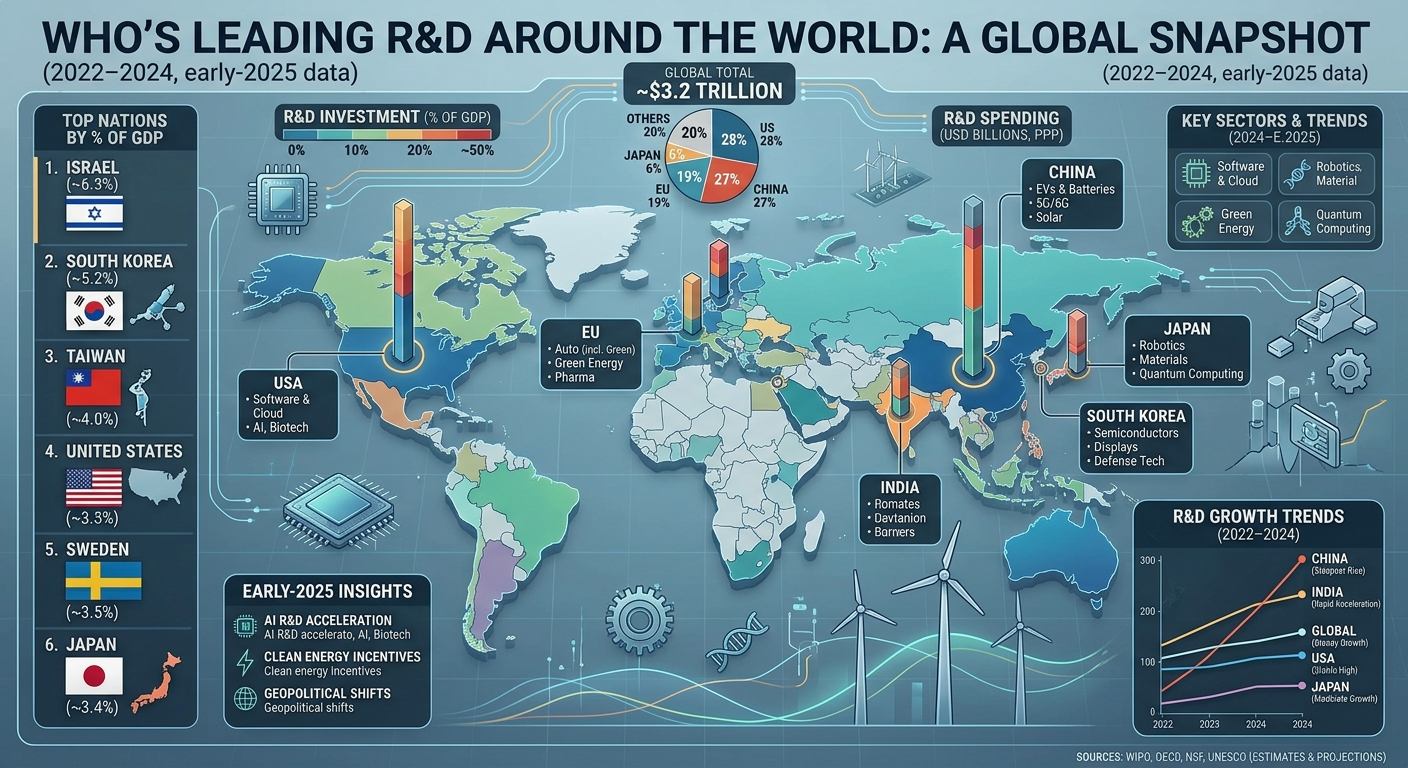
The most striking development is the convergence between China and the United States in total R&D expenditure. OECD estimates indicate that, after purchasing-power adjustments, China’s R&D expenditure caught up with and surpassed that of the United States in 2024. The two countries each reached approximately the trillion-dollar scale when expressed in 2024 prices.
WIPO’s 2025 Global Innovation Index similarly estimated 2024 R&D expenditure at approximately $785.9 billion for China and $781.8 billion for the United States using comparable 2015 purchasing-power-parity dollars. Japan followed at approximately $186 billion, with Germany at approximately $132.2 billion.
However, R&D leadership cannot be determined by expenditure alone. Scientific publications, patents, researchers, university quality, corporate R&D, venture capital, manufacturing capacity, infrastructure, computing resources, semiconductor capability, biotechnology, artificial intelligence and the ability to commercialise discoveries must all be considered.
This thesis therefore examines global R&D as an interconnected ecosystem rather than merely a ranking of countries.
1. Introduction
Research and development is the organised process through which humanity transforms questions, observations and existing knowledge into new knowledge, technologies, products, services and systems.
It can begin with a scientist asking a fundamental question about nature.
It can continue with a university laboratory developing a theory.
It can move into an engineering laboratory developing a prototype.
A corporation may then transform that prototype into a commercial product.
A manufacturing system can produce it at scale.
Finally, governments, businesses and consumers can deploy the resulting technology throughout society.
This creates a chain:
Knowledge → Research → Discovery → Engineering → Development → Manufacturing → Commercialisation → Economic Value → Further Research
The countries that control large portions of this chain possess substantial technological power.
2. What Does R&D Actually Mean?
R&D is broader than laboratory science.
It normally consists of three major categories.
2.1 Basic research
Basic research seeks to understand fundamental principles without necessarily having an immediate commercial application.
Examples include:
- particle physics;
- mathematics;
- astronomy;
- genetics;
- quantum physics;
- fundamental chemistry;
- neuroscience;
- materials science.
Basic research can take decades to produce commercial consequences.
The transistor, for example, emerged from fundamental understanding of quantum physics and solid-state materials.
2.2 Applied research
Applied research attempts to use scientific knowledge to solve defined problems.
Examples include:
- new medicines;
- advanced batteries;
- semiconductor materials;
- agricultural technologies;
- medical imaging;
- communications systems;
- renewable-energy technologies.
2.3 Experimental development
Experimental development transforms knowledge into practical technologies, products and processes.
Examples include:
- new semiconductor manufacturing processes;
- electric vehicles;
- AI systems;
- aircraft;
- satellites;
- telecommunications equipment;
- industrial robots;
- medical devices.
Therefore:
Science explains.
Engineering builds.
Industry scales.
Markets distribute.
Society adopts.
R&D connects all five.
3. How Global R&D Is Measured
The principal measure is Gross Domestic Expenditure on Research and Development (GERD).
GERD measures R&D performed within an economy, regardless of the source of financing.
It can be divided into:
- business R&D;
- government R&D;
- higher-education R&D;
- private non-profit R&D.
Another important indicator is:
R&D intensity
R&D intensity is:
R&D expenditure ÷ GDP × 100
This tells us how much of an economy’s economic output is devoted to research.
A relatively small country can therefore have greater R&D intensity than a much larger country.
South Korea and Israel are important examples. OECD data show R&D intensity around 5.1% for Korea and 6.8% for Israel in the latest comparison.
4. The Global R&D Race
The modern R&D system is dominated by several major research centres.
The most important include:
- United States;
- China;
- Japan;
- Germany;
- South Korea;
- United Kingdom;
- France;
- India;
- Taiwan;
- Canada;
- Italy;
- Australia;
- Israel;
- Netherlands;
- Switzerland;
- Sweden;
- Singapore.
Each possesses different technological strengths.
The world therefore does not have one single R&D leader in every category.
Instead, it has a multi-dimensional technological hierarchy.
5. The United States: The World’s Broadest R&D Ecosystem
The United States remains one of the world’s most powerful research ecosystems.
Its strength comes from the combination of:
- world-class universities;
- federal research agencies;
- defence research;
- biotechnology;
- pharmaceuticals;
- semiconductor design;
- software;
- artificial intelligence;
- aerospace;
- energy research;
- venture capital;
- multinational corporations;
- advanced manufacturing;
- financial markets.
The American advantage is therefore not simply the amount of money spent on R&D.
It is the depth of the entire innovation ecosystem.
The United States possesses major research universities, national laboratories and technology companies capable of converting scientific research into global commercial platforms.
Its private sector is particularly important.
WIPO reports that U.S.-based companies represented nearly half of the R&D expenditure of the world’s top corporate R&D investors in its 2025 analysis.
6. China: The Rapidly Expanding R&D Superpower
China has transformed its position in global research during the last two decades.
Its strategy has involved enormous investment in:
- universities;
- industrial laboratories;
- engineering;
- telecommunications;
- artificial intelligence;
- electric vehicles;
- batteries;
- renewable energy;
- robotics;
- advanced materials;
- aerospace;
- biotechnology;
- semiconductors;
- quantum technologies.
The scale of Chinese R&D is particularly important.
OECD estimates indicate that China’s PPP-adjusted R&D expenditure reached approximately 102% of the U.S. level in 2024 under the latest PPP comparison.
WIPO’s comparable 2015-PPP calculation also placed China slightly ahead of the United States in 2024.
China has also become an enormous producer of scientific publications.
WIPO reports that China accounted for approximately 26% of global scientific publications in 2024, compared with approximately 12% for the United States.
China’s challenge is therefore no longer simply catching up.
It is increasingly attempting to convert enormous research scale into technological leadership.
7. United States Versus China
The central question of contemporary global R&D is increasingly:
Will the United States remain the world’s dominant innovation ecosystem, or will China become the largest comprehensive technological power?
The answer is complicated.
United States strengths
- software;
- AI companies;
- semiconductor design;
- cloud computing;
- aerospace;
- biotechnology;
- pharmaceuticals;
- venture capital;
- universities;
- financial markets;
- global technology platforms.
China strengths
- manufacturing scale;
- industrial engineering;
- scientific publication volume;
- batteries;
- electric vehicles;
- renewable-energy manufacturing;
- telecommunications equipment;
- robotics;
- large engineering workforce;
- increasingly sophisticated universities and laboratories.
Consequently, the competition is not simply about who spends more money.
It is about who converts R&D into strategic technological capability more effectively.
8. Japan: The Engineering Powerhouse
Japan remains one of the world’s most important R&D economies.
Its strengths include:
- robotics;
- automotive engineering;
- electronics;
- materials;
- precision machinery;
- optics;
- industrial automation;
- batteries;
- chemicals;
- advanced manufacturing.
Japan’s R&D intensity remains among the highest of the major economies.
Its technological model is strongly associated with long-term corporate research.
Japanese corporations have historically maintained extensive internal laboratories and engineering capabilities.
9. Germany: Europe’s Industrial R&D Giant
Germany occupies a central position in European industrial research.
Its strengths include:
- automotive engineering;
- industrial machinery;
- chemicals;
- pharmaceuticals;
- materials;
- manufacturing automation;
- electrical engineering;
- renewable technologies.
Germany’s strength is especially visible in the relationship between universities, research institutes and industrial companies.
Institutions such as the Fraunhofer network demonstrate how scientific research can be connected to industrial application.
However, Germany faces challenges from:
- slower economic growth;
- energy costs;
- demographic pressures;
- intense Chinese industrial competition;
- the transition from combustion engines to electric vehicles;
- increasing digitalisation.
10. South Korea: Extreme R&D Intensity
South Korea is one of the most R&D-intensive major economies.
Its R&D ecosystem is closely connected to large industrial groups and advanced manufacturing.
Important sectors include:
- semiconductors;
- displays;
- batteries;
- telecommunications;
- electronics;
- automobiles;
- biotechnology;
- artificial intelligence.
OECD data place Korean R&D intensity at approximately 5.1% of GDP, making it one of the world’s leading major economies by this measure.
South Korea demonstrates an important principle:
A country does not need the largest population to become a technological powerhouse.
It needs concentrated investment, specialised talent, industrial capability and strong institutions.
11. Taiwan: The Semiconductor Research Hub
Taiwan occupies an unusual position.
Its overall economy is much smaller than those of the United States and China, yet its importance to global technology is enormous.
Its strengths include:
- semiconductor manufacturing;
- chip design;
- electronics;
- advanced packaging;
- precision manufacturing;
- information technology.
Taiwan illustrates why total R&D expenditure is not enough to understand technological power.
A country can dominate a strategically important technological niche without being the largest overall R&D spender.
12. The United Kingdom
The United Kingdom remains a major research power.
Its strengths include:
- life sciences;
- pharmaceuticals;
- artificial intelligence;
- aerospace;
- physics;
- mathematics;
- biotechnology;
- financial technology;
- universities.
The UK benefits from globally recognised universities and an extensive scientific tradition.
Its challenge is converting academic excellence into sufficient industrial scale.
13. France
France has major capabilities in:
- aerospace;
- nuclear science;
- mathematics;
- artificial intelligence;
- defence-related research;
- transportation;
- energy;
- pharmaceuticals.
France also maintains a relatively strong state role in strategic research.
Its combination of government laboratories, universities and large corporations creates a distinctive innovation ecosystem.
14. India: The Emerging Giant
India is one of the most important emerging R&D powers.
Its advantages include:
- huge population;
- large engineering workforce;
- information technology;
- pharmaceuticals;
- space technology;
- digital public infrastructure;
- mathematics;
- software;
- biotechnology.
India’s R&D expenditure remains considerably below that of China and the United States, but its research potential is enormous.
WIPO estimated India’s 2024 R&D spending at approximately $76 billion in comparable PPP terms.
India’s greatest opportunity is to connect:
Talent + Digital Infrastructure + Manufacturing + Scientific Research + Capital
into a single innovation system.
15. Israel: Research Intensity
Israel is exceptional in R&D intensity.
Its research ecosystem is strongly connected to:
- universities;
- technology startups;
- cybersecurity;
- biotechnology;
- defence-related technology;
- artificial intelligence;
- communications;
- agricultural technology.
Its small population demonstrates another principle of technological development:
Research intensity can sometimes matter more than absolute economic size.
16. The European Union: A Collective Research Superpower
The European Union must be considered both individually and collectively.
Individually:
- Germany;
- France;
- Italy;
- the Netherlands;
- Sweden;
- Belgium;
- Denmark;
- Finland;
- Austria
all contribute significant research capabilities.
Collectively, the EU possesses an enormous scientific base.
WIPO estimated EU-wide R&D expenditure at roughly $424 billion in 2024 using comparable PPP methodology—more than half the level of either China or the United States.
The EU’s major challenge is fragmentation.
The United States has one enormous integrated market.
China has one enormous integrated national system.
Europe has many countries, languages, regulatory systems and industrial structures.
European research therefore has enormous depth but can face difficulties converting research into globally dominant technology companies.
17. The Corporate R&D Revolution
Government laboratories are only one component of modern R&D.
Corporations have become enormous research institutions.
Major corporate research fields include:
- AI;
- semiconductors;
- pharmaceuticals;
- biotechnology;
- automobiles;
- batteries;
- cloud computing;
- telecommunications;
- robotics;
- aerospace;
- energy.
WIPO reports that business R&D accounts for more than 70% of global R&D expenditure in its global innovation analysis.
This changes the nature of technological competition.
A country’s technological strength increasingly depends upon the R&D capabilities of its companies.
18. The Geography of Corporate R&D
WIPO’s analysis of major corporate R&D investors shows the extraordinary concentration of corporate research.
The United States accounted for approximately 47% of the R&D spending of the top corporate R&D investors in the analysed sample.
Asia accounted for around 30%, led by China, Japan and South Korea.
Europe accounted for around 22%, with Germany being the leading European contributor.
This creates a second global R&D map:
National R&D map
Government + universities + companies.
Corporate R&D map
Multinational companies + industrial laboratories + technology platforms.
The two maps overlap but are not identical.
19. Artificial Intelligence and the New R&D System
Artificial intelligence is changing research itself.
Traditionally:
Human → hypothesis → experiment → analysis → conclusion
Increasingly:
Human + AI → hypothesis generation → simulation → experiment → automated analysis → discovery
AI can assist researchers with:
- literature analysis;
- protein prediction;
- materials discovery;
- simulation;
- code generation;
- mathematical reasoning;
- data analysis;
- drug discovery;
- engineering optimisation.
This means AI is becoming not merely a product of R&D but an R&D instrument.
The countries with access to:
- advanced AI models;
- GPUs and accelerators;
- enormous datasets;
- high-performance computing;
- research talent;
- energy;
- semiconductor technology
can potentially accelerate scientific discovery.
20. Semiconductor R&D
Semiconductors are at the centre of modern technological power.
Almost every advanced digital system depends upon them.
The semiconductor R&D chain includes:
Physics → Materials → Chip architecture → EDA → Design → Lithography → Deposition → Etching → Metrology → Packaging → Testing → Manufacturing
Different countries dominate different stages.
The United States has exceptional strength in semiconductor architecture and design.
Taiwan has enormous advanced manufacturing capability.
South Korea has major memory and semiconductor manufacturing capabilities.
Japan has critical materials and manufacturing equipment.
The Netherlands possesses strategically important lithography technology.
China has developed enormous domestic semiconductor capabilities but continues to face challenges in some of the most advanced manufacturing technologies.
This demonstrates the importance of R&D ecosystems rather than individual inventions.
21. Biotechnology and Pharmaceutical R&D
Life sciences represent another major technological frontier.
R&D includes:
- genomics;
- molecular biology;
- vaccines;
- cancer research;
- cell biology;
- drug discovery;
- medical devices;
- computational biology;
- personalised medicine.
Pharmaceutical and biotechnology companies are among the most R&D-intensive industries.
WIPO reports that pharmaceuticals and biotechnology had the highest R&D intensity among major industries, reaching roughly 19% in 2024.
22. Energy R&D
The global energy transition is creating another enormous research competition.
Important fields include:
- solar energy;
- wind;
- batteries;
- nuclear power;
- hydrogen;
- carbon capture;
- energy storage;
- power electronics;
- smart grids;
- geothermal technology.
China has become particularly powerful in manufacturing many clean-energy technologies.
The United States, Europe, Japan and South Korea retain important research and industrial capabilities.
The future energy system will therefore be shaped partly by R&D competition.
23. Space R&D
Space research combines many advanced technologies:
- propulsion;
- materials;
- robotics;
- telecommunications;
- sensors;
- artificial intelligence;
- astronomy;
- satellite systems;
- launch technology.
The United States remains a major space innovation centre.
China has developed a rapidly expanding space programme.
Europe, Japan, India and other nations maintain important capabilities.
Space R&D is increasingly connected to terrestrial technological development.
24. Defence and Strategic R&D
Historically, military research has produced technologies that later became important to civilian society.
Examples include developments associated with:
- computing;
- communications;
- navigation;
- aerospace;
- materials;
- sensors.
Modern strategic R&D increasingly includes:
- AI;
- cybersecurity;
- autonomous systems;
- advanced communications;
- space systems;
- sensing;
- quantum technologies.
OECD reports that government R&D budgets in many OECD countries have increasingly emphasised defence, while public R&D budgets have faced pressure in other areas.
This indicates that geopolitical competition is increasingly influencing scientific priorities.
25. Universities as R&D Engines
Universities remain fundamental to the global research system.
They provide:
- fundamental research;
- doctoral education;
- laboratories;
- scientific publications;
- patents;
- researchers;
- technology transfer;
- startup creation.
The strongest innovation ecosystems therefore create connections between:
University → Laboratory → Startup → Corporation → Market
The United States has been particularly successful at creating these connections.
China has invested heavily in upgrading universities and research institutions.
Europe, Japan and other advanced economies also possess major university systems.
26. Research Talent
Money alone cannot produce technological leadership.
R&D requires people.
These include:
- scientists;
- engineers;
- mathematicians;
- computer scientists;
- technicians;
- researchers;
- entrepreneurs;
- managers;
- laboratory specialists.
Countries therefore compete not only for capital but for human talent.
The global research system has become increasingly international.
Scientists move between:
- universities;
- corporations;
- countries;
- laboratories;
- research institutes.
Talent mobility can therefore redistribute technological capability.
27. Scientific Publications
Scientific publications provide one measurement of research output.
WIPO reports that China produced approximately 26% of global scientific publications in 2024, while the United States produced approximately 12%.
But publication volume should not be confused with scientific quality.
Important measurements include:
- citations;
- highly cited papers;
- research collaboration;
- breakthrough discoveries;
- patents;
- commercialisation.
A country can produce many papers without necessarily dominating commercial technology.
28. Patents and Intellectual Property
Patents provide another window into technological activity.
A patent generally represents a claim over a novel technical invention that meets applicable legal requirements.
Patent systems can therefore reveal:
- invention;
- corporate research;
- university research;
- industrial strategy;
- technological competition.
However, patents are not perfect measures.
Some inventions are kept as trade secrets.
Some patents have little commercial value.
Some companies patent defensively.
Therefore:
Patents + publications + R&D expenditure + commercialisation
provide a better picture than any one indicator.
29. Venture Capital
Venture capital converts research into startups.
The process can be represented as:
Research → Intellectual Property → Startup → Venture Capital → Product → Market → Scale-up
The United States has historically possessed a powerful venture-capital ecosystem.
China developed substantial technology venture ecosystems.
India, Israel, Europe, Singapore and other regions have also developed significant startup ecosystems.
Venture capital therefore acts as a bridge between research and commercialisation.
30. Manufacturing as the Missing Link
One of the most important conclusions of global R&D analysis is:
Innovation does not end when a laboratory succeeds.
A prototype is not the same as an industrial product.
A country must also possess:
- factories;
- machinery;
- supply chains;
- skilled technicians;
- logistics;
- energy;
- materials;
- financing;
- quality control.
China’s enormous manufacturing system gives it an important advantage in converting engineering research into mass-produced products.
The United States has exceptional strengths in design, software and high-value technology but has also been attempting to rebuild selected manufacturing capabilities.
31. R&D and National Power
R&D contributes to national power through several channels.
Economic power
New technologies create industries and productivity.
Scientific power
Research produces knowledge.
Industrial power
Engineering creates manufacturing capabilities.
Strategic power
Advanced technology increases national resilience and security.
Financial power
Successful technology companies create enormous economic value.
Diplomatic power
Countries controlling critical technologies can influence international relationships.
Therefore:
R&D is not merely a scientific activity.
It is an element of national strategy.
32. Why Spending More Does Not Automatically Produce Leadership
Suppose Country A spends $100 billion on R&D and Country B spends $50 billion.
Country A does not automatically produce twice as much innovation.
The effectiveness of R&D depends on:
- research quality;
- institutional efficiency;
- education;
- scientific freedom;
- infrastructure;
- capital markets;
- industrial capacity;
- management;
- collaboration;
- intellectual-property systems;
- talent;
- commercialisation.
The real equation is closer to:
Innovation Power = R&D Capital × Talent × Institutions × Infrastructure × Commercialisation × Industrial Scale
If one component is weak, the entire system can underperform.
33. R&D Intensity Versus R&D Scale
Two different questions must therefore be asked.
Who spends the most?
China and the United States.
Who spends the highest percentage of GDP?
Countries such as Israel and South Korea are exceptional.
Who has the greatest industrial scale?
China is exceptionally powerful.
Who has the broadest technology ecosystem?
The United States remains exceptionally strong.
Who dominates particular semiconductor manufacturing capabilities?
Taiwan and South Korea are extremely important.
Who dominates particular advanced manufacturing technologies?
Leadership is distributed across several countries.
This is why a simple ranking can be misleading.
34. Africa and the Global R&D Gap
Africa remains significantly underrepresented in global R&D.
The continent possesses:
- enormous human potential;
- young populations;
- natural resources;
- agricultural opportunities;
- renewable-energy potential;
- growing technology ecosystems.
However, many African countries face:
- limited R&D funding;
- insufficient laboratories;
- shortages of researchers;
- weak university-industry links;
- limited venture capital;
- inadequate infrastructure;
- brain drain;
- low industrialisation.
The African opportunity is therefore enormous.
Africa does not necessarily need to reproduce the exact research structure of the United States, China or Europe.
It can develop specialised capabilities around:
- agriculture;
- climate science;
- medicine;
- mining technology;
- renewable energy;
- telecommunications;
- financial technology;
- African-language AI;
- water systems;
- food technology.
35. South Africa’s Position
South Africa has one of Africa’s most developed research ecosystems.
Its strengths include:
- universities;
- mining research;
- astronomy;
- medicine;
- engineering;
- agriculture;
- renewable energy;
- information technology;
- scientific infrastructure.
Institutions such as the South African Radio Astronomy Observatory and major universities contribute to international research.
South Africa’s opportunity is to strengthen the connection between:
University Research → Industrial R&D → Startups → Manufacturing → Export Markets
This could help transform scientific knowledge into broader economic development.
36. The Global R&D Hierarchy
The global R&D system can broadly be visualised as follows:
Tier 1: Global R&D superpowers
United States and China
Tier 2: Major comprehensive R&D powers
Japan, Germany, South Korea, France, United Kingdom, India
Tier 3: Highly specialised technology powers
Taiwan, Israel, Netherlands, Switzerland, Sweden, Singapore and others
Tier 4: Important emerging research economies
A growing group of countries including Brazil, Türkiye, Australia, Canada and others.
This hierarchy should not be treated as permanent.
Countries can rise or fall rapidly when investment, talent and industrial capabilities change.
37. The New Geography of Innovation
The old model was largely:
North America + Western Europe + Japan
The new model is increasingly:
North America + China + Europe + East Asia + India + specialised technology hubs
The global innovation system is becoming more multipolar.
WIPO’s research indicates China’s rise in both R&D expenditure and scientific output, while other economies retain strong specialised capabilities.
The result is a world in which technological leadership is distributed rather than controlled by one country.
38. The Importance of Research Networks
Modern science is increasingly collaborative.
A scientific project can involve:
**Researcher in South Africa
- University in Britain
- laboratory in Germany
- computing infrastructure in the United States
- manufacturing partner in Taiwan
- pharmaceutical company in Switzerland**
The result is a global research network.
This creates an important paradox:
Countries compete technologically while scientists frequently cooperate internationally.
39. The Geopolitics of R&D
Technology has increasingly become geopolitical.
Countries are concerned about dependence upon foreign suppliers for:
- semiconductors;
- advanced computing;
- telecommunications;
- pharmaceuticals;
- energy technologies;
- critical minerals;
- AI infrastructure.
Consequently, governments increasingly pursue:
technological sovereignty
or at least:
technological resilience.
This is changing investment priorities.
40. The AI Era Will Change the R&D Ranking
The next phase of global R&D may be determined by access to AI-powered scientific infrastructure.
Imagine a future research laboratory containing:
- AI research assistants;
- autonomous laboratory equipment;
- advanced simulation;
- robotics;
- quantum computers;
- high-performance computing;
- automated data analysis;
- enormous scientific databases.
Such laboratories could dramatically increase research productivity.
The countries capable of combining AI with physical laboratories may therefore obtain a major research advantage.
41. Quantum Technology
Quantum research represents another strategic frontier.
Important areas include:
- quantum computing;
- quantum communications;
- quantum sensing;
- quantum materials;
- quantum cryptography;
- quantum simulation.
The field remains comparatively immature, but governments and corporations are investing heavily.
The countries with strong physics, mathematics, engineering and computing ecosystems are likely to compete intensely in this area.
42. The Future of R&D: From Laboratories to Intelligent Research Systems
Traditional R&D was centred around human researchers.
The emerging model is:
Human + AI + Robotics + Simulation + Automation + High-Performance Computing
This could create a new type of research organisation.
Instead of hundreds of researchers manually performing every step, researchers may increasingly supervise intelligent systems capable of:
- reading millions of scientific papers;
- identifying research gaps;
- proposing hypotheses;
- simulating possibilities;
- designing experiments;
- operating laboratory equipment;
- analysing results;
- generating new hypotheses.
This represents a potential transition from:
R&D 1.0 — Human laboratory
to:
R&D 2.0 — Computer-assisted laboratory
and eventually:
R&D 3.0 — AI-integrated autonomous research ecosystem
43. The Most Important R&D Indicators
A serious assessment of global technological power should therefore examine at least twelve indicators:
- Total R&D expenditure.
- R&D expenditure as percentage of GDP.
- Business R&D.
- Government R&D.
- University R&D.
- Number of researchers.
- Scientific publications.
- Highly cited research.
- Patents.
- Venture capital.
- High-technology manufacturing.
- Global technology companies.
Additional indicators should include:
- computing capacity;
- semiconductor capability;
- energy availability;
- university quality;
- research infrastructure;
- startup formation;
- technology exports;
- industrial productivity.
44. A Better Global R&D Scorecard
A future Millennium Tech Saga 3001 R&D index could assign separate scores for:
| Dimension | Meaning |
|---|---|
| R&D Scale | Total research expenditure |
| R&D Intensity | Research relative to GDP |
| Human Capital | Scientists and engineers |
| Scientific Output | Publications and citations |
| Intellectual Property | Patents and technological inventions |
| Corporate Innovation | Business R&D |
| Industrial Capability | Ability to manufacture |
| Venture Capital | Ability to finance innovation |
| Digital Infrastructure | Computing and networks |
| AI Capability | AI research and deployment |
| Semiconductor Capability | Chip ecosystem |
| Biotechnology | Life-science capability |
| Energy Innovation | Future-energy technologies |
| Space Capability | Space research and technology |
| Commercialisation | Ability to turn research into products |
Such an index would be more meaningful than simply ranking countries according to R&D expenditure.
45. The Central Finding
The evidence from the 2022–2026 period reveals a fundamental transformation.
The world is moving from a relatively concentrated research system toward a multipolar R&D system.
The United States remains exceptionally powerful.
China has risen to approximately the same overall R&D scale.
Japan remains a major engineering and research power.
Germany remains Europe’s industrial R&D leader.
South Korea has extraordinary R&D intensity.
Taiwan occupies a strategically critical semiconductor position.
The United Kingdom and France retain major scientific capabilities.
India is emerging as a major long-term research and technology power.
Israel and other smaller economies demonstrate that concentrated R&D intensity can generate disproportionate technological influence.
46. The Central Competition Is No Longer “Who Spends the Most?”
The more important question is:
Who can convert knowledge into technological capability fastest and most effectively?
This requires an entire chain:
Education
↓
Scientific Research
↓
Engineering
↓
R&D
↓
Intellectual Property
↓
Startup Formation
↓
Venture Capital
↓
Manufacturing
↓
Global Distribution
↓
Economic Value
↓
Reinvestment into R&D
This creates a technological feedback loop.
The stronger the loop becomes, the faster a nation can advance.
47. The Global Innovation Feedback Loop
A successful technological ecosystem can be represented as:
Education → Talent → Research → Discovery → Patent → Startup → Capital → Manufacturing → Revenue → Scale → More R&D → More Talent
This is the fundamental engine of modern technological power.
Countries that successfully establish this loop can accelerate.
Countries that fail to connect these stages may spend large amounts on research without obtaining equivalent economic benefits.
48. Implications for the Future
The next decade is likely to be shaped by competition in:
- artificial intelligence;
- advanced semiconductors;
- robotics;
- biotechnology;
- quantum computing;
- advanced materials;
- energy storage;
- nuclear technology;
- space systems;
- autonomous systems;
- synthetic biology;
- high-performance computing.
The countries that dominate these fields will possess enormous economic influence.
49. Conclusion
The global R&D system of 2022–2026 demonstrates that technological leadership is becoming increasingly complex.
The United States and China have emerged as the two dominant comprehensive R&D powers, with the latest OECD estimates placing China slightly ahead of the United States in PPP-adjusted R&D expenditure in 2024.
But the conclusion should not be that China has simply “replaced” the United States.
The two countries possess different strengths.
The United States has extraordinary capabilities in software, AI, biotechnology, aerospace, advanced computing, universities, venture capital and global technology companies.
China possesses enormous manufacturing capacity, engineering scale, scientific output and rapidly expanding research capabilities.
Meanwhile, Japan, Germany, South Korea, Taiwan, the UK, France, India, Israel and other economies remain essential components of the global innovation system.
The result is a multipolar technological world.
The most important lesson is therefore:
R&D leadership is not determined by money alone. It is determined by the ability to transform money, knowledge, talent, institutions, infrastructure and industrial capacity into continuous innovation.
The future technological leaders will be those capable of building the most effective complete innovation ecosystems.
And as artificial intelligence becomes embedded within scientific research itself, the definition of R&D leadership may change again.
The next generation of technological competition may no longer be primarily:
Who has the largest laboratory?
It may become:
Who has the most intelligent, connected and productive research ecosystem?
That question could define the technological balance of power toward 2030, 2040 and ultimately the Millennium 3001 vision of technology.
Selected Research Sources
- OECD, Main Science and Technology Indicators, including the March 2026 assessment of global R&D trends.
- WIPO, Global Innovation Index 2025 – Global Innovation Tracker.
- WIPO, End of Year Edition – Global R&D Spending in 2024.
- WIPO, Global Innovation Index 2025 – China Economy Profile.
- OECD Data Explorer, Gross Domestic Expenditure on R&D by Sector of Performance and Type of R&D.
Final Thesis Statement
The 21st-century R&D race is not simply a competition between countries for scientific prestige. It is a competition to construct complete knowledge-to-industry ecosystems capable of continuously converting human intelligence into scientific discovery, technological invention, industrial production and economic value.

Be First to Comment