
Abstract
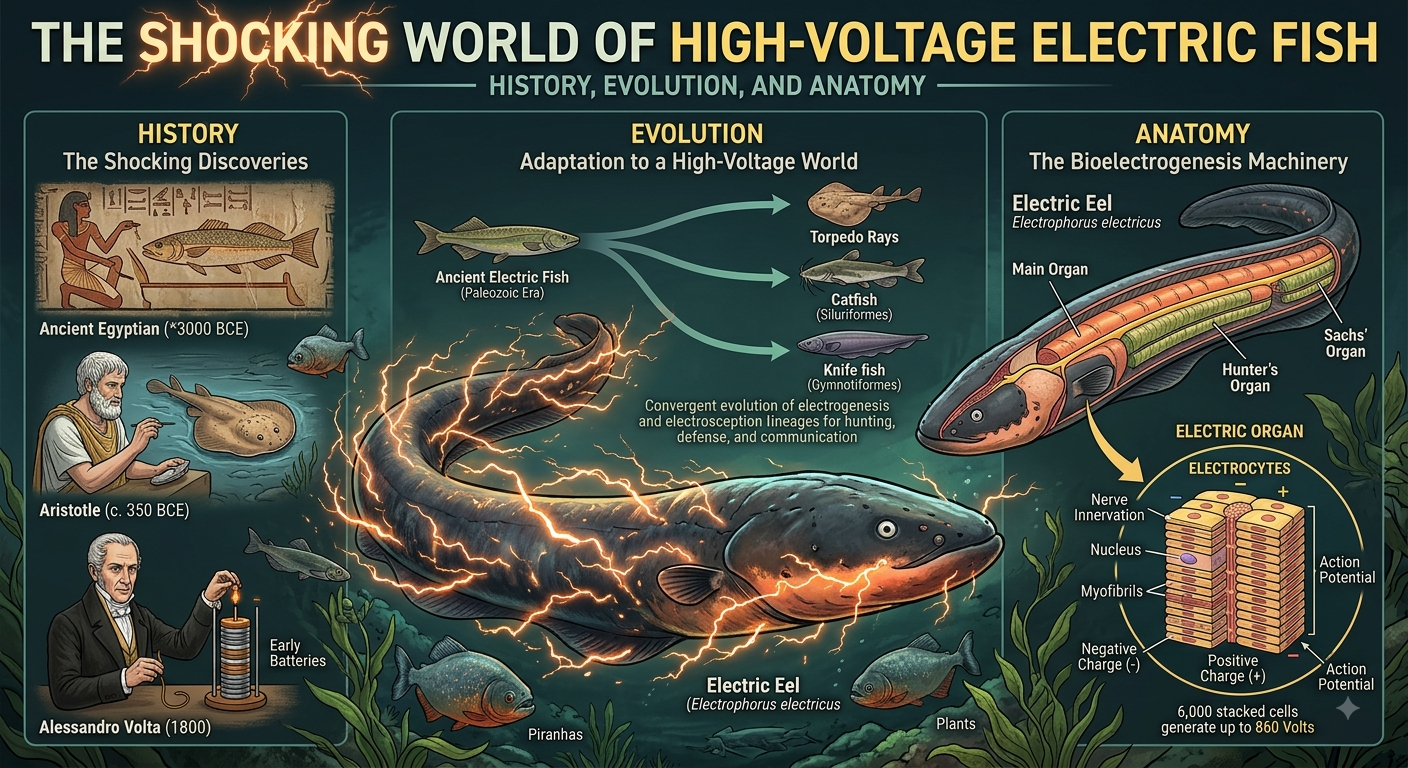
Electric fish represent one of the most extraordinary examples of biological engineering on Earth. Through specialized organs composed of electrically excitable cells called electrocytes, certain fish can generate electrical discharges ranging from weak signals used for environmental sensing and communication to powerful pulses capable of incapacitating prey.
The most spectacular example is the electric eel, although the name is biologically misleading: electric eels are not true eels but elongated South American knifefishes. Members of the genus Electrophorus possess specialized electric organs occupying a remarkable proportion of their bodies. Electrophorus voltai has been documented producing electrical discharges of up to approximately 860 volts, making it the strongest known biological voltage generator.
This thesis examines electric fish from historical discovery and evolutionary biology to cellular anatomy, ion transport, electrical-field generation, nervous-system control, ecological function and technological biomimicry. It also examines the important distinction between voltage, current, electrical energy and power, because the extraordinary voltage of an electric fish does not mean that it functions like a conventional high-voltage power station.
1. Introduction: When Biology Became Electrical Engineering
Electricity is usually associated with batteries, generators, power stations, transformers, motors and electronic circuits. Yet biological systems have been manipulating electrical charge for hundreds of millions of years.
Every nervous system depends on electrical phenomena. Cell membranes maintain voltage differences. Ion channels control charged particles. Muscles respond to electrical signals. The heart is coordinated by electrical activity.
Electric fish take this ordinary biological principle to an extraordinary level.
Evolution has transformed specialized cells into biological electrical organs capable of producing external electric fields. These fields can serve several purposes:
- electrosensing
- communication
- navigation
- prey detection
- prey immobilization
- predator defense
- social interaction
The result is a remarkable convergence between biology and electrical engineering.
2. What Is an Electric Fish?
An electric fish is a fish capable of producing or detecting electrical fields.
There are two broad functional categories.
Weakly electric fish
These generate relatively weak electrical discharges primarily for:
- sensing their environment
- locating objects
- detecting predators
- identifying prey
- communicating
- recognizing other individuals
African mormyrid fishes are particularly sophisticated examples. Their electric organs and sensory systems have evolved into complex biological information-processing systems. Molecular studies have reconstructed substantial evolutionary diversification in their electrocytes and electric organs.
Strongly electric fish
These generate substantially stronger discharges that can be used for:
- prey capture
- defense
- stunning nearby organisms
Electric eels and electric rays are prominent examples.
3. The Electric Eel Is Not Really an Eel
The common name “electric eel” creates an important taxonomic misconception.
Electric eels belong to the order Gymnotiformes, a group of South American knifefishes. They are more closely related to other knifefishes and several other ray-finned fish lineages than to true eels.
Their elongated body is therefore an example of convergent body shape rather than evidence that they are members of the true eel lineage.
This distinction illustrates an important biological principle:
Similar environments can cause unrelated organisms to evolve similar physical solutions.
4. Historical Discovery of Bioelectric Animals
Humanity recognized unusual electrical phenomena in animals long before modern electrophysiology existed.
Ancient observations of electric rays contributed to early recognition that certain aquatic animals could produce sensations resembling electric shocks.
The scientific revolution transformed these observations into experimental investigation.
During the eighteenth and nineteenth centuries, scientists increasingly connected animal electricity with:
- nerves
- muscles
- biological membranes
- ion movement
- electrical potential
- excitation
The study of electric fish eventually became central to the history of electrophysiology.
5. Alessandro Volta and the Electric Fish
The relationship between electric fish and the history of electrical technology is particularly fascinating.
The Italian scientist Alessandro Volta investigated biological electricity and the famous experiments associated with frog tissues and electrical contact.
Volta subsequently developed the voltaic pile, one of the earliest practical chemical batteries.
The electric eel also became an inspiration for terminology and scientific thinking about biological electrical generation. The species Electrophorus voltai was named in recognition of Volta.
Thus a fascinating historical circle emerged:
electric animal → scientific investigation → electrical theory → battery technology → modern electrical engineering
6. The Anatomy of an Electric Eel
The body of an electric eel is highly specialized.
Unlike conventional fish, whose internal anatomy is distributed relatively conventionally, the electric eel has an extraordinary concentration of electrical tissue.
Three major electric organs are recognized:
- Main electric organ
- Hunter’s organ
- Sachs’ organ
Together they occupy approximately 80% of the animal’s body, while many of its conventional internal organs are compressed toward the anterior region.
This represents one of nature’s most dramatic examples of anatomical specialization.
7. Electrocytes: The Biological Equivalent of Battery Cells
The fundamental units of many electric organs are called electrocytes.
An electrocyte is a specialized electrically excitable cell.
Its biological machinery establishes an electrical potential across its membrane using ion gradients.
The essential ingredients include:
- sodium ions
- potassium ions
- membrane proteins
- ion channels
- ion pumps
- ATP-dependent metabolism
- nervous-system control
The basic principle resembles a battery:
chemical energy → ion gradients → electrical potential
But an electrocyte is not literally a miniature chemical battery. It is a living cell whose membrane machinery creates and controls voltage.
8. How One Electrocyte Produces Voltage
A biological membrane separates solutions containing different concentrations of ions.
Ion pumps and channels maintain these differences.
The sodium-potassium pump is particularly important in maintaining cellular ion gradients.
When an electrocyte is activated, membrane ion channels change their permeability.
This rapidly changes the membrane potential.
One cell produces only a relatively small voltage.
The extraordinary electrical output of electric fish comes from organization.
9. Nature’s Series Connection
Electrical engineers increase voltage by connecting voltage sources in series.
Electric fish independently evolved a biological version of this principle.
Thousands of electrocytes can be organized so that their voltage contributions add together.
Conceptually:
electrocyte + electrocyte + electrocyte + … → high-voltage electric organ
The key is synchronized activation.
If cells activate at approximately the same time, their voltage contributions can combine to produce a much larger external electrical potential.
This is one reason the electric eel resembles a biological electrical generator.
10. Voltage Is Not the Same as Power
A critical scientific distinction is necessary.
Voltage
Voltage is electrical potential difference.
Current
Current describes the rate of electrical charge flow.
Power
Power is the rate at which energy is transferred.
It is commonly expressed as:
P = V × I
Therefore, a high-voltage organism does not automatically produce enormous continuous electrical power.
The duration of the pulse, current, electrical resistance and characteristics of the surrounding water all matter.
Electric fish produce brief biological discharges, rather than continuously supplying electricity like a power station.
11. The Electrical Circuit Is Completed Through Water
The fish’s body forms part of an electrical system involving the surrounding environment.
The discharge establishes an electric field in the water.
Nearby organisms can therefore experience differences in electrical potential.
The conductivity of the water strongly influences how the electrical field propagates.
This creates an important ecological relationship:
fish anatomy + body fluids + surrounding water + target organism = biological electrical circuit
12. Why Freshwater Is Important
Electric eels inhabit freshwater environments in tropical South America.
Freshwater generally has lower electrical conductivity than seawater.
This affects the transmission of electrical signals.
The evolution of electric organs therefore cannot be separated from environmental conditions.
Interestingly, researchers proposed that the exceptionally high voltage of E. voltai may be associated with adaptation to relatively low-conductivity environments.
13. The Record-Setting Electrophorus voltai
In 2019, researchers described multiple species of electric eel, dramatically changing the traditional view that there was only one recognized species.
One newly recognized species, Volta’s electric eel (Electrophorus voltai), demonstrated a discharge of approximately 860 volts.
The discovery was scientifically important for two reasons.
First, it revealed previously unrecognized biological diversity.
Second, it demonstrated that electric-eel evolution had produced substantially different electrical capabilities in different environments.
Researchers estimated that E. voltai and E. electricus diverged millions of years ago.
14. Evolutionary Origins of Electric Organs
Electric organs did not suddenly appear as fully developed structures.
Evolution works through modification of existing biological structures.
Many electric organs are believed to have evolved through modification of tissues associated with excitable cells, particularly muscle-derived systems.
The evolutionary pathway can be represented conceptually as:
ordinary excitable cell
↓
specialized electrical cell
↓
electrocyte
↓
electrocyte organization
↓
electric organ
↓
specialized electrical behavior
This demonstrates a central principle of evolutionary innovation:
New biological functions can emerge by reorganizing existing cellular machinery.
15. Independent Evolution: Nature Solving the Same Problem Multiple Times
Electricity-producing organs evolved independently in several fish lineages.
This phenomenon is called convergent evolution.
Different evolutionary lineages independently discovered that electrical fields could provide useful biological information or defensive and predatory capabilities.
African electric fishes and South American electric fishes therefore provide an extraordinary natural experiment.
Their common solution is electricity, but their evolutionary histories are different.
16. African Electric Fish
Africa possesses a remarkable diversity of weakly electric fishes, especially members of the Mormyridae.
These fish use electrical signals as a sensory and communication system.
Their electric organs and specialized nervous systems allow them to interpret disturbances in their electrical environment.
The mormyrid lineage has undergone extensive diversification, and molecular studies have helped reconstruct the evolution of its electrocytes.
17. Electrolocation: Seeing With Electricity
Electrolocation is one of the most fascinating applications of biological electricity.
A weakly electric fish generates an electrical field around its body.
Objects in the environment alter that field because they have different electrical properties.
The fish’s sensory receptors detect these distortions.
The nervous system then interprets the pattern.
Conceptually:
electric discharge → environmental interaction → field distortion → sensory detection → neural processing → perception
This is analogous in principle to using radar or sonar, although the physical mechanisms are completely different.
18. Communication Through Electricity
Electric fish can also use electrical signals as a communication channel.
Different patterns can contain information about:
- species
- identity
- reproductive condition
- social interactions
- behavioral state
The Smithsonian notes that electric eels use weak electrical pulses for communication and that individuals can detect and interpret these signals.
Electricity therefore becomes a biological language.
19. Hunting With Electricity
Strongly electric fish can use electrical discharges during predation.
An electric eel may first use weaker electrical activity to detect or locate prey.
It can then produce stronger discharges.
The resulting electrical disturbance can interfere with the prey’s neuromuscular activity, making escape more difficult.
This represents an elegant sequence:
detect → locate → activate → discharge → capture
20. Defense Against Predators
Electricity can also function as a defensive system.
The electric eel can discharge electricity when threatened.
The Smithsonian reports that electric eels can progressively increase their electrical pulses and can use their electrical organs for defense as well as hunting.
Electricity therefore functions simultaneously as:
- sensory technology
- communication technology
- predatory technology
- defensive technology
21. The Nervous System as the Controller
An electric organ requires coordination.
The nervous system provides this control.
The fish must determine:
- when to discharge
- how strongly to discharge
- which behavioral context is occurring
- whether it is detecting prey
- whether another fish is nearby
- whether a predator is approaching
The electric organ is therefore not simply a battery.
It is part of an integrated neural-electrical system.
22. The Energy Cost of Electricity
Electrical discharge is not free.
Electrocytes depend on cellular metabolism.
After electrical activity changes membrane ion distributions, biological systems must restore the ion gradients.
This requires energy.
ATP-dependent ion pumps help restore the membrane’s electrochemical conditions.
Therefore:
food energy → metabolism → ATP → ion gradients → electrical discharge
The fish essentially converts chemical energy from food into controlled electrical phenomena.
23. The Biological Power System
The electric fish can therefore be interpreted as a complete energy-conversion system.
Stage 1 — Energy acquisition
Food provides chemical energy.
Stage 2 — Cellular metabolism
Mitochondria convert chemical energy into ATP.
Stage 3 — Ion-gradient maintenance
Membrane proteins establish electrochemical gradients.
Stage 4 — Electrical storage
Electrocyte membranes maintain voltage differences.
Stage 5 — Neural activation
The nervous system synchronizes electrocytes.
Stage 6 — Discharge
Large numbers of electrocytes change membrane potential.
Stage 7 — Environmental coupling
The resulting electrical field propagates through surrounding water.
24. Why the Electric Eel Has Such a Large Electric Organ
The electric eel’s body represents an extreme example of evolutionary specialization.
The electrical organs dominate its anatomy, while many conventional organs are concentrated toward the front of the body.
This architecture reflects a fundamental evolutionary trade-off:
less conventional body space → more electrical capability
The fish has effectively invested a major portion of its biological resources in electricity.
25. Swimming Without Conventional Fins
The electric eel’s body is also highly specialized for movement.
It lacks prominent dorsal and pelvic fins.
Instead, its elongated anal fin allows it to move forward, backward and hover.
This allows the fish to maintain a stable position while investigating its surroundings electrically.
The anatomy therefore integrates:
movement + sensing + electricity
26. Electric Rays: A Different Biological Generator
Electric rays provide another extraordinary example.
Their electric organs are located within the body near the head and pectoral region.
Unlike the elongated electrical architecture of an electric eel, the ray has evolved a different anatomical solution.
The principle remains similar:
specialized cells + ion gradients + synchronized activation = electrical discharge
This is another example of convergent evolution.
27. Biological Electricity and Human Electricity
Human beings also depend on electricity.
The difference is scale and purpose.
Humans use electrical activity for:
- neurons
- muscle contraction
- heart rhythm
- sensory processing
- cellular signaling
Electric fish have evolved additional structures capable of producing external electrical fields.
Thus the fundamental biological machinery is related to processes already present in ordinary animals.
The remarkable achievement is evolutionary amplification and specialization.
28. From Muscle to Electric Organ
One of the deepest lessons from electric fish is that evolution does not necessarily invent entirely new cellular chemistry.
Instead, existing mechanisms can be modified.
Muscle cells already possess:
- membrane potentials
- ion channels
- electrical excitability
- specialized membrane proteins
Evolution can modify these properties and reorganize cells into new functional architectures.
The electric organ is therefore an extraordinary example of biological repurposing.
29. The Electric Fish as a Living Battery
The analogy with a battery is useful but imperfect.
A conventional battery stores chemical energy and releases it through electrochemical reactions.
An electric fish continuously maintains ion gradients through metabolism and releases electrical energy through controlled membrane processes.
The comparison can nevertheless be made:
| Engineering | Electric fish |
|---|---|
| Battery cell | Electrocyte |
| Battery stack | Electrocyte array |
| Wiring | Biological tissue |
| Switching | Ion channels |
| Controller | Nervous system |
| Chemical energy | Food metabolism |
| Electrical load | Surrounding environment |
| Recharge | Metabolic restoration |
The fish is therefore better described as a metabolically powered biological electrical generator than as a simple battery.
30. Biomimicry: Learning From Electric Fish
Electric fish have become important models for biomimetic engineering.
Researchers have attempted to imitate their principles using artificial materials.
One research direction has produced artificial electric organs based on ion gradients and stacked soft materials. Such systems demonstrate that principles inspired by electric fish can potentially be used to construct compact bio-inspired power sources.
This opens possibilities in:
- soft robotics
- wearable electronics
- biomedical devices
- implantable technologies
- low-power sensors
- artificial organs
- environmentally compatible energy systems
31. From Eel to Artificial Electric Organ
The engineering principle is conceptually elegant.
Instead of using conventional metal electrodes and batteries, researchers can create artificial systems containing materials that reproduce aspects of biological ion-gradient generation.
A simplified architecture is:
ion gradient
↓
membrane or hydrogel
↓
electrical potential
↓
series-connected layers
↓
increased voltage
↓
electronic load
This is a powerful example of biomimicry.
32. Artificial Intelligence Meets Electric Fish
Electric-fish research is increasingly intersecting with computational science.
Researchers have begun applying machine learning and multi-agent reinforcement learning to models of weakly electric fish.
Such models can investigate:
- electrocommunication
- collective behavior
- signal patterns
- environmental sensing
- social interaction
Recent computational research has modeled collective electrosensing and communication using artificial agents inspired by weakly electric fish.
This creates a fascinating research chain:
biological fish → electrophysiology → mathematical model → AI simulation → robotic system
33. Electric Fish and Robotics
The sensory systems of electric fish could inspire robots capable of operating where cameras perform poorly.
Potential applications include environments with:
- darkness
- muddy water
- sediment
- low visibility
- complex underwater structures
A robot inspired by electrosensing could theoretically detect electrical-property differences in its environment rather than relying entirely on visible light.
This could complement:
- sonar
- radar
- cameras
- lidar
- chemical sensors
34. Evolution as an Engineering Laboratory
Electric fish provide an extraordinary lesson about natural engineering.
Nature has optimized:
- material selection
- cell arrangement
- electrical isolation
- signal timing
- energy consumption
- sensory feedback
- neural control
The result is a system that has emerged through evolutionary selection rather than human design.
This makes electric fish valuable not only to zoology but also to:
- electrical engineering
- neuroscience
- materials science
- robotics
- artificial intelligence
- biomedical engineering
35. Why High Voltage Does Not Mean Unlimited Electrical Power
Popular descriptions sometimes create the impression that an electric eel is equivalent to an enormous electrical generator.
That interpretation is incorrect.
Voltage alone does not determine the total energy available.
A biological discharge is:
- brief
- biologically controlled
- dependent on the surrounding electrical conditions
- constrained by the fish’s metabolism
The scientifically meaningful question is therefore not simply:
“How many volts?”
It is:
“How much voltage, current, energy, power and for how long?”
That distinction is essential for understanding biological electricity.
36. Electric Fish as Complex Systems
The electric fish cannot be understood by studying its electric organ alone.
Its electrical system includes:
Molecular level
Ion channels and membrane proteins.
Cellular level
Electrocytes.
Tissue level
Organized electrocyte arrays.
Organ level
Electric organs.
Neural level
Electrical control circuits.
Sensory level
Electroreceptors.
Behavioral level
Hunting, defense and communication.
Ecological level
Interaction with prey, predators and other fish.
Evolutionary level
Natural selection and lineage diversification.
This is a classic multiscale biological system.
37. The Deep Scientific Question
The most important question is not simply:
“How does an electric eel produce electricity?”
The deeper question is:
How can evolution transform ordinary cellular electrochemistry into a sophisticated biological electrical technology?
The answer requires integration of:
chemistry + physics + cell biology + anatomy + neuroscience + evolution + ecology
Electric fish therefore provide an unusually powerful interdisciplinary research subject.
38. A Timeline of Discovery and Understanding
Ancient world
Humans observe electric shocks from aquatic animals.
1600s–1700s
Scientific investigation of electricity expands.
1700s
Animal electricity becomes increasingly important to experimental science.
1800s
Electrophysiology develops rapidly.
1900s
Electrocytes, neural control and sensory mechanisms become subjects of systematic laboratory research.
Late 1900s
Molecular biology begins revealing ion channels and membrane mechanisms.
2000s
Genomics and molecular phylogenetics transform understanding of electric-fish evolution.
2010s
New electric-eel diversity is discovered.
2019
Electrophorus voltai is reported with discharges reaching approximately 860 volts.
2020s
Research increasingly combines electrophysiology, genomics, robotics, biomaterials and artificial intelligence.
39. A New Understanding of Electric Eels
Modern research has fundamentally changed the traditional picture of the electric eel.
The old model was essentially:
one species + solitary predator + powerful shock
The modern picture is more complex:
multiple species + evolutionary diversification + sophisticated electrical communication + sensory systems + specialized hunting strategies + unexpected social behavior
Researchers have even documented E. voltai hunting collectively, challenging the assumption that electric eels are invariably solitary.
40. The Electric Fish as a Natural Supercomputer
Calling an electric fish a “biological computer” must be done carefully, but its information-processing system is extraordinary.
The animal must continuously integrate:
- electrical signals
- sensory information
- movement
- prey position
- environmental conductivity
- social signals
- internal physiological state
The nervous system converts this information into decisions.
The electric organ then executes those decisions.
Thus the system resembles a closed-loop control architecture:
environment → sensors → neural processing → decision → electric organ → environment
41. Lessons for Future Technology
Electric fish suggest several technological principles.
Principle 1: Distributed power
Thousands of small biological units can collectively create a large output.
Principle 2: Biological switching
Ion channels provide extraordinarily rapid biological control.
Principle 3: Soft electronics
Biological electrical systems operate inside soft, flexible bodies.
Principle 4: Integrated sensing and power
The same organism can sense the environment and generate electrical output.
Principle 5: Energy efficiency
Biology performs complex electrical functions using metabolic energy.
Principle 6: Self-repair
Living systems can maintain and repair their components.
These principles are highly attractive to future bio-inspired engineering.
42. The Future of Bioelectric Technology
Research inspired by electric fish could eventually contribute to:
- artificial electric organs
- soft robotics
- underwater sensing
- wearable electronics
- biomedical implants
- autonomous sensors
- biological-machine interfaces
- environmentally compatible power systems
The most promising systems may not attempt to copy an electric eel literally.
Instead, engineers can extract the principles behind the biological system and reproduce them using modern materials.
43. Conservation and the Future of Electric Fish Research
The scientific value of electric fish creates an additional reason to protect their ecosystems.
Amazonian and African freshwater environments contain biological diversity that remains incompletely understood.
New species continue to reveal unexpected evolutionary solutions.
The discovery of multiple electric-eel species demonstrates how incomplete scientific knowledge can remain even for animals that have been studied for centuries.
Protecting biodiversity therefore protects a natural library of biological technologies.
44. The Great Scientific Lesson
Electric fish demonstrate that electricity is not exclusively a human technological invention.
Humans invented electrical machines.
Nature evolved electrical systems long before humans existed.
The electric fish demonstrates that biological systems can:
- generate voltage
- regulate current
- transmit electrical signals
- detect electrical fields
- process electrical information
- communicate through electricity
- convert chemical energy into electrical output
This makes electric fish one of the most compelling bridges between biology and engineering.
45. Conclusion
The high-voltage electric fish represents one of evolution’s most remarkable technological achievements.
Its electrical capability begins at the molecular level with ion gradients and membrane proteins. These mechanisms operate inside specialized electrocytes. Thousands of electrocytes become organized into electric organs. The nervous system synchronizes their activity. The resulting electrical field interacts with the surrounding water, allowing the animal to sense, communicate, hunt and defend itself.
The electric eel provides the most dramatic example. Modern research has shown that the traditional image of a single electric-eel species was incomplete. Multiple species exist, and Electrophorus voltai has demonstrated discharges of approximately 860 volts.
But the real significance of electric fish extends far beyond the shock.
They reveal a fundamental principle of nature:
chemistry can become electricity; electricity can become information; information can become behavior; and evolution can integrate all of these processes into one living system.
From the electrocyte to the electric organ, from the neuron to the sensory system, and from the fish to the surrounding ecosystem, the electric fish is a living demonstration of systems engineering.
It is simultaneously an animal, a biological generator, a sensory instrument, a communication system and an evolutionary experiment.
And increasingly, it is also becoming a teacher for the engineers of the future.
Selected Scientific Themes for Further Research
A full research program on electric fish could be divided into the following disciplines:
- Evolutionary biology of electrogenesis
- Comparative anatomy of electric organs
- Electrocyte membrane physiology
- Ion-channel biophysics
- Neural control of electric discharge
- Electrolocation
- Electrocommunication
- Electrical ecology of freshwater environments
- Electric-eel taxonomy and genomics
- Electric-ray physiology
- African mormyrid evolution
- Bioelectricity and neuroscience
- Bio-inspired energy generation
- Artificial electric organs
- Soft robotics
- Underwater bio-inspired sensing
- Artificial intelligence for electric-fish behavior
- Biomaterials and ion-gradient energy systems
- Evolutionary engineering
- Conservation of electrically sensing freshwater ecosystems
Central Thesis
Electric fish demonstrate that evolution can transform fundamental cellular electrochemistry into a sophisticated integrated technology capable of generating electricity, sensing environments, transmitting information and controlling behavior. Their anatomy and physiology provide one of the clearest natural examples of how molecular biology, physics, neuroscience, evolution and engineering converge within a single living organism.



Be First to Comment