
The Great Pyramid of Giza is genuinely extraordinary—but the strongest scientific explanation is not that it required supernatural technology. The evidence points instead to something arguably more remarkable: ancient Egyptian mathematics, surveying, engineering, logistics, organization, astronomy, stone-working and thousands of skilled workers operating together over many years.
Modern science can explain much of the pyramid, but not every detail has been solved. In particular, the exact construction system used to raise the highest stones remains debated.
1. The basic scientific identity of the Great Pyramid
The Great Pyramid was constructed during Egypt’s Fourth Dynasty, for Pharaoh Khufu, roughly 4,500 years ago. Harvard’s Digital Giza project identifies Khufu as the builder and describes the Great Pyramid as the only surviving member of the ancient Seven Wonders. (Digital Giza)
It originally had:
- a massive square base;
- four triangular faces meeting at the apex;
- polished Tura limestone casing;
- an internal system of chambers and passages;
- a granite King’s Chamber;
- the Grand Gallery;
- carefully engineered relieving structures above the King’s Chamber;
- and additional spaces whose purposes remain uncertain.
The original pyramid was considerably taller than the approximately 139 m structure visible today because much of its outer casing and the pyramidion are gone.
2. Why does it appear miraculous?
There are several reasons.
A. Its enormous scale
The pyramid contains millions of stone blocks, ranging from relatively manageable blocks to enormous pieces of granite weighing many tonnes.
B. Extraordinary geometric regularity
Its four sides are remarkably straight and its base is extraordinarily level.
C. Extraordinary orientation
The pyramid is aligned extremely closely with the cardinal directions.
Survey work has found the orientation to true north within roughly one-tenth of a degree. (AERA)
D. Transportation
Stone had to be obtained from different locations and transported to Giza.
E. Vertical construction
The Egyptians had to raise blocks hundreds of feet above ground without modern cranes.
F. Internal engineering
The interior contains sophisticated architectural arrangements that required planning before and during construction.
Taken together, these achievements can look almost impossible.
But “extremely difficult” is not the same thing as “scientifically impossible.”
3. The most important scientific principle
The central mistake in many popular discussions is asking:
“What single machine built the pyramid?”
The better scientific question is:
“What complete engineering system allowed ancient Egypt to repeatedly perform millions of relatively simple operations?”
That changes everything.
A pyramid does not require one magical machine.
It requires:
Surveying → quarrying → shaping → transporting → lifting → positioning → checking → repeating.
The extraordinary achievement was therefore partly systems engineering.
4. The human organization behind the pyramid
Archaeology has provided important evidence for a large settlement associated with pyramid construction.
The Ancient Egypt Research Associates excavated what is known as the Lost City of the Pyramids, or Heit el-Ghurab, about 400 metres south of the Sphinx. Archaeologists interpret it as a major settlement supporting pyramid construction, containing workers, craftsmen and administrators. (AERA)
This changes our picture dramatically.
The pyramid was not simply:
Pharaoh + slaves + stones.
It was closer to an enormous state-organized construction project involving:
- quarry workers;
- stone cutters;
- haulers;
- boat crews;
- engineers;
- surveyors;
- architects;
- craftsmen;
- administrators;
- food producers;
- cooks;
- doctors and other support personnel;
- supervisors;
- scribes;
- and specialist workers.
The pyramid was therefore also an economic and administrative machine.
5. The fascinating evidence from Merer’s papyrus
One of the most important discoveries for understanding the construction process is the journal associated with an official named Merer.
His records describe crews transporting limestone from Tura toward Giza during Khufu’s reign. The evidence provides a rare contemporary window into the logistics of pyramid construction. (Smithsonian Magazine)
This is enormously important scientifically.
It means that we do not have to imagine the entire transportation system.
We have documentary evidence that:
quarry → boat → waterway → Giza → construction project
was part of the logistical system.
6. The Nile was essentially an ancient transportation highway
Moving enormous quantities of stone over land is difficult.
Moving heavy materials by water is much easier.
Ancient Egyptian civilization was built around the Nile, so the river became a natural transportation network.
Stone could be:
- quarried;
- loaded onto boats;
- transported along waterways;
- unloaded near the construction zone;
- dragged or moved to the appropriate position.
Research into the Giza landscape also indicates that waterways and harbours were important components of the construction environment. (Smithsonian Magazine)
This is one of the great scientific lessons of the pyramid:
Infrastructure can be more important than machinery.
7. How did they cut the stone?
The Egyptians possessed sophisticated stone-working technology for their period.
Different materials required different approaches.
For limestone, workers could use:
- copper tools;
- stone tools;
- pounding stones;
- wooden implements;
- abrasives;
- leverage;
- repeated cutting and dressing.
Harder stone such as granite presented a much greater challenge.
The important point is that ancient engineering did not require a modern steel saw.
A process can be slow but technologically feasible.
That distinction is crucial.
8. Copper was important—but copper alone did not do everything
Copper was relatively soft compared with granite.
Therefore, it is misleading to imagine an Egyptian craftsman simply taking a copper knife and slicing through granite.
Instead, stoneworking could involve combinations of:
tool + abrasive + repeated action + percussion + skill.
Copper tools could also be maintained and reshaped.
Archaeological evidence from the pyramid-building period includes extensive evidence for organized material supply and craft production. The Wadi al-Jarf papyri, for example, are associated with the logistical world of Khufu’s reign and mention materials and transport connected with the project. (Smithsonian Magazine)
9. The biggest mystery: how did they raise the stones?
This is where scientific honesty becomes essential.
There is no universally accepted reconstruction of the entire lifting system.
Several possibilities have been proposed, including different types of:
- straight ramps;
- zigzag ramps;
- side ramps;
- internal ramps;
- lever systems;
- combinations of ramps and levers;
- temporary construction platforms.
It is quite possible that the Egyptians did not use one single method throughout the entire pyramid.
The lower levels could have required one approach while the upper levels required another.
That would be normal engineering.
10. The ramp problem
A simple straight ramp sounds attractive.
But there is a mathematical problem.
To achieve a gentle slope over the entire height of the Great Pyramid, a straight ramp could become extraordinarily long.
Therefore, scientists have proposed alternative configurations.
One possibility is that the builders progressively changed the geometry of their transportation system as the pyramid became taller.
This is an important principle:
Construction technology does not have to remain constant throughout a building project.
11. Levers may have been extremely important
A lever is one of the simplest machines known to humanity.
Its basic principle is:
small force × long lever arm = large mechanical effect
The Egyptians did not need a modern crane if they could combine:
- ropes;
- wooden components;
- sledges;
- ramps;
- rollers or sliding systems where appropriate;
- levers;
- manpower;
- gravity;
- carefully prepared surfaces.
Engineering frequently works through many small mechanical advantages multiplied together.
12. Why ropes were technologically important
Rope transforms human effort.
Instead of ten people individually pushing a stone, a coordinated group can pull together.
If the stone is placed on a sledge, friction can also be reduced.
This produces a mechanical chain:
Human muscle → rope → sledge → reduced friction → controlled movement
That is primitive technology—but it is still engineering.
13. Wet sand and friction
One interesting experimental idea concerns the use of moisture to reduce the resistance encountered when dragging heavy sledges across sand.
This does not mean that “wet sand solved pyramid construction.”
Rather, it illustrates an important principle:
understanding material behavior can dramatically increase mechanical efficiency.
Ancient engineers did not possess modern equations of friction, but they could discover useful relationships experimentally.
14. The extraordinary surveying achievement
One of the most impressive aspects of the Great Pyramid is its orientation.
The Egyptians were able to establish remarkably accurate cardinal alignment.
Modern surveys indicate that the pyramid’s orientation is extremely close to true north. (AERA)
How?
One scientifically plausible explanation involves astronomical observation.
By carefully observing stars that appear to rotate around the celestial pole, ancient surveyors could establish north.
Possible methods include observing pairs of stars at particular positions and constructing a geometric reference line.
The important point is:
Astronomy became surveying technology.
15. Mathematics was built into the pyramid
The pyramid demonstrates practical geometry.
The builders needed to understand:
- straight lines;
- right angles;
- squares;
- slopes;
- verticality;
- horizontal levels;
- ratios;
- areas;
- volumes;
- proportional measurement.
They did not need modern algebraic notation to perform sophisticated geometry.
Mathematics can exist as practical measurement technology.
16. The pyramid as a gigantic coordinate system
Imagine the construction site as an ancient three-dimensional coordinate system.
The engineers had to control:
X = east-west position
Y = north-south position
Z = height
Every block ultimately needed to occupy an intended location.
The higher the pyramid became, the more important surveying became.
This is essentially an ancient form of 3D construction management.
17. Why the base is so important
If the foundation is wrong, every subsequent level becomes progressively wrong.
Therefore:
foundation accuracy → structural accuracy → final accuracy
The extraordinary precision at the bottom was not merely cosmetic.
It was mathematically necessary.
A small error repeated thousands of times could eventually produce a visibly distorted pyramid.
18. The pyramid was also a structural-engineering masterpiece
The pyramid has an enormous advantage:
Its shape naturally transfers loads downward.
A pyramid is extremely stable because its mass is distributed over a large base.
Gravity acts almost perfectly in the pyramid’s favour.
The structure therefore does not require the same type of horizontal-span engineering needed by a huge bridge.
This is one reason pyramidal structures can become extraordinarily massive without collapsing.
19. But the interior is more complicated
The Great Pyramid contains:
- descending passage;
- ascending passage;
- Grand Gallery;
- Queen’s Chamber;
- King’s Chamber;
- granite structural elements;
- shafts;
- relieving chambers;
- and other spaces.
Some of these elements remain subjects of interpretation.
This is where the phrase “miraculous” becomes scientifically interesting.
We understand the general engineering principles, but we do not yet understand every decision made by the ancient architects.
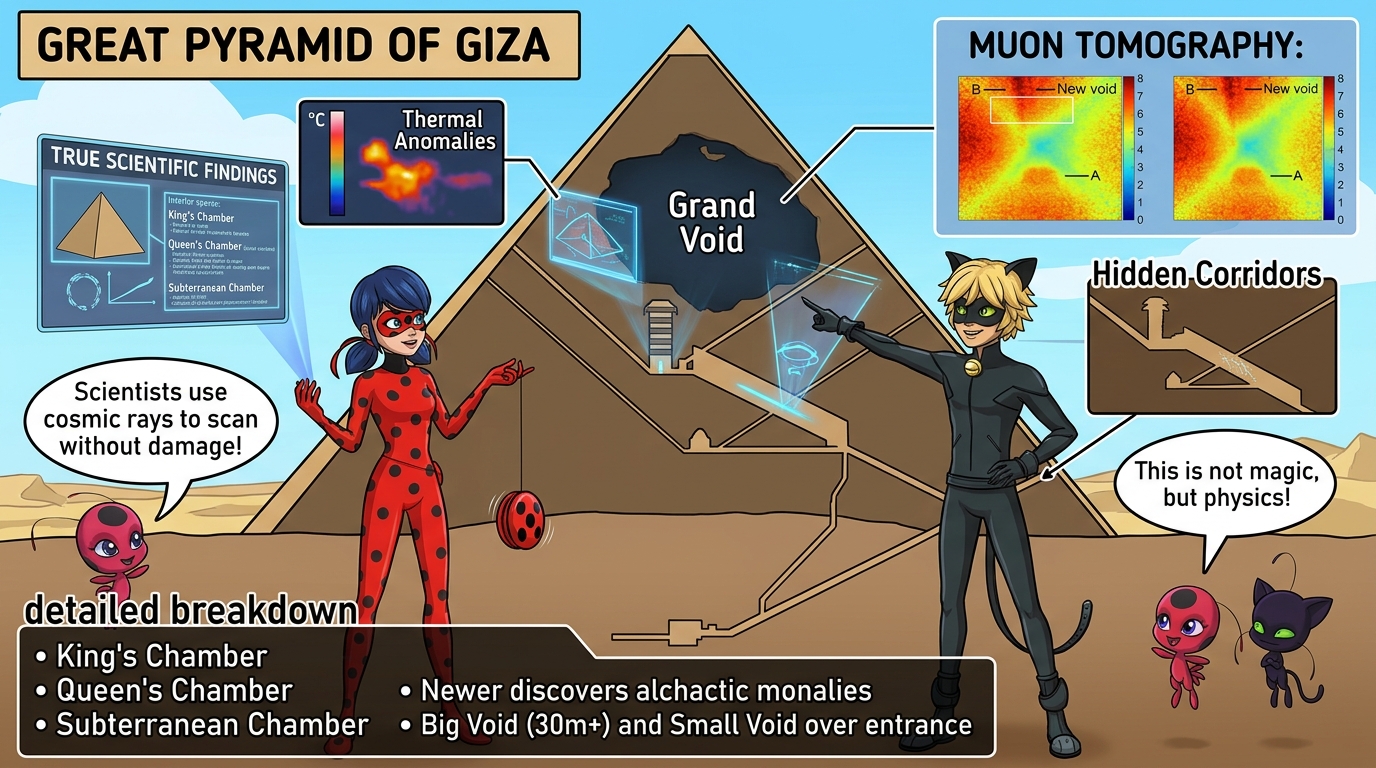
20. Modern particle physics has literally looked inside the pyramid
This is perhaps the most astonishing modern development.
Scientists have used cosmic-ray muons to investigate the pyramid.
Muons are particles produced when cosmic rays interact with Earth’s atmosphere.
They can pass through enormous amounts of material.
By measuring how many muons arrive from different directions, researchers can infer differences in the density of material inside a structure.
It is conceptually similar to an enormous X-ray system.
But instead of an artificial X-ray source:
the universe provides the radiation.
21. The Great Pyramid’s “Big Void”
In 2017, researchers reported a large previously unknown void above the Grand Gallery.
The discovery was made using muon radiography and was independently confirmed using three detector technologies. The reported void has a minimum length of about 30 metres. (Nature)
This is genuinely remarkable.
Modern physics discovered a previously unknown internal feature of a 4,500-year-old building without dismantling it.
But there is an important scientific limitation:
We do not yet know with certainty what the void was for.
The scientific conclusion is:
void detected = high confidence
but:
purpose of void = unresolved
That distinction is extremely important.
22. Another hidden corridor
Modern non-destructive investigation has also confirmed the existence of the ScanPyramids North Face Corridor.
A 2025 Scientific Reports study describes multimodal investigation using techniques including ground-penetrating radar, ultrasonic testing and electrical resistivity tomography to investigate the hidden structure. (Nature)
This demonstrates something profound:
The Great Pyramid is not scientifically “finished.”
It remains an active research subject.
23. The Great Pyramid is therefore a meeting point of sciences
To understand it properly, we need several disciplines simultaneously.
Archaeology
Determines what ancient people actually left behind.
Egyptology
Interprets Egyptian culture, religion and records.
Physics
Explains forces, materials and particle-based scanning.
Mathematics
Explains geometry, measurement and proportions.
Astronomy
Helps explain orientation.
Geology
Studies limestone, granite and quarry sources.
Engineering
Investigates construction methods.
Materials science
Studies stone, mortar, tools and surfaces.
Hydrology
Studies ancient waterways.
Computer science
Creates three-dimensional models and simulations.
Remote sensing
Allows scientists to examine structures without destroying them.
The pyramid is therefore not merely an archaeological object.
It is a multidisciplinary scientific laboratory.
24. What science has actually proved?
We should separate evidence from hypothesis.
Very strongly supported
1. Khufu was the pharaoh associated with the Great Pyramid.
2. It belongs to Egypt’s Fourth Dynasty.
3. It was constructed as a royal monument/tomb complex.
4. Large quantities of stone were quarried and transported.
5. Organized workers and administrators supported the project.
6. Water transportation played an important logistical role.
7. The pyramid was surveyed with extraordinary accuracy.
8. Ancient Egyptian engineers possessed sophisticated practical mathematics.
9. The pyramid contains previously unknown internal spaces.
10. Modern muon imaging can investigate its interior without destroying it.
The archaeological and scientific evidence strongly supports these conclusions. (Nature)
25. What remains uncertain?
Several important questions remain open.
Exactly which ramp system was used?
Not completely established.
How were the heaviest granite blocks positioned at great height?
Several engineering models exist, but no single complete reconstruction has been universally demonstrated.
What was the purpose of every internal space?
Not known.
What exactly was the function of the newly discovered void?
Still uncertain.
How did the builders coordinate the entire project?
We have substantial evidence, but not a complete ancient project-management manual.
This is where responsible science differs from sensationalism.
“We don’t know yet” is a scientific answer.
26. The biggest misconception: “Ancient people could not have done it”
This argument misunderstands technological development.
Technology is not simply:
modern machine vs ancient human.
Technology is the ability to combine available resources intelligently.
The Egyptians possessed:
- enormous labour organization;
- mathematics;
- astronomy;
- boats;
- ropes;
- wood;
- stone tools;
- copper;
- sledges;
- ramps;
- levers;
- surveying techniques;
- administrative systems;
- food supply;
- specialist craftsmanship;
- generations of accumulated knowledge.
Combine those technologies over many years and the apparently impossible becomes physically achievable.
27. The real miracle
There is a deeper interpretation.
The Great Pyramid demonstrates that civilization itself is a technology.
A single person cannot build the Great Pyramid.
But a society can.
The true system was:
Knowledge
↓
Education
↓
Specialization
↓
Measurement
↓
Engineering
↓
Logistics
↓
Administration
↓
Labour coordination
↓
Construction
↓
Quality control
↓
Monument
That is arguably more impressive than any hypothetical lost machine.
28. A modern analogy
Imagine a modern company building a massive semiconductor factory.
No single engineer can build it.
You need:
- architects;
- civil engineers;
- electrical engineers;
- mechanical engineers;
- software engineers;
- accountants;
- logistics specialists;
- construction workers;
- managers;
- suppliers;
- transportation networks;
- quality-control teams.
The final building is therefore the product of an ecosystem of knowledge.
The Great Pyramid was an ancient version of this principle.
29. The pyramid and modern computation
There is even an interesting conceptual connection to your interest in computation.
A computer solves a huge problem by breaking it into smaller operations.
The pyramid project could similarly be understood as:
Huge objective
→ divide into departments
→ divide into crews
→ divide into tasks
→ repeat standardized operations
→ measure results
→ correct errors
→ continue
This is essentially large-scale systems engineering.
The Egyptians did not have computers.
But they had something every computer-dependent civilization still needs:
organized information.
30. Why its precision is so impressive
Modern humans sometimes underestimate ancient people because they lacked modern electronics.
But precision does not necessarily require electronics.
A surveyor can use:
- sighting;
- plumb lines;
- water levels;
- measuring cords;
- astronomical observations;
- repeated measurements;
- reference markers.
If thousands of measurements are repeated carefully, extraordinary accuracy can emerge.
The Egyptians had time, institutional knowledge and skilled specialists.
31. What about extraterrestrials?
There is no credible scientific evidence that extraterrestrials built the Great Pyramid.
The archaeological evidence instead fits an Egyptian construction project.
We have:
- Egyptian historical context;
- worker settlements;
- quarry evidence;
- transportation evidence;
- administrative records;
- construction-related archaeology;
- Egyptian architectural development before Khufu.
The extraordinary nature of the pyramid therefore does not require an extraterrestrial explanation.
32. What about a lost advanced civilization?
Again, there is no need for this hypothesis to explain the evidence.
Egyptian pyramid construction developed through earlier monuments.
The Great Pyramid did not suddenly appear from nowhere.
There was a technological progression involving earlier pyramids and monumental architecture.
That evolutionary history is exactly what archaeology would expect if Egyptian engineers gradually improved their techniques.
33. The true scientific answer
If we compress thousands of pages of archaeology, physics, mathematics and engineering into one statement:
The Great Pyramid was probably constructed by an exceptionally organized ancient Egyptian state using practical mathematics, astronomical surveying, quarrying technology, water transport, sledges, ropes, ramps, levers and highly coordinated human labour over many years.
However:
Science has not yet reconstructed every detail of the construction process, particularly the precise methods used for some of the highest and heaviest stones and the purpose of certain internal spaces.
That is the scientifically honest position.
34. Why the Great Pyramid remains “miraculous”
We can distinguish two meanings of miracle.
Supernatural miracle
There is insufficient scientific evidence to claim that the pyramid required supernatural intervention.
Human miracle
Absolutely.
The pyramid represents an extraordinary achievement of:
human intelligence + mathematics + astronomy + engineering + organization + persistence.
And that second meaning is supported by evidence.
35. The deepest lesson
The Great Pyramid teaches an extraordinarily modern principle:
Human civilization can accomplish things that appear impossible when knowledge is organized into a system.
The Egyptians did not possess:
- computers;
- GPS;
- laser levels;
- excavators;
- cranes;
- trucks;
- helicopters;
- CAD;
- modern metallurgy.
Yet they created a monument whose geometric accuracy still astonishes modern engineers.
Modern science has not diminished the achievement.
It has made the achievement more understandable—and therefore, in some ways, even more impressive.
Final scientific conclusion
The Great Pyramid should not be presented as a mystery that science cannot explain.
Nor should it be presented as a completely solved engineering exercise.
The most accurate position lies between those extremes:
We understand the civilization, materials, mathematics, surveying, logistics and much of the construction environment remarkably well.
We do not yet possess a universally accepted, minute-by-minute reconstruction of how every stone was moved into its final position.
And modern technology is still discovering new information inside the monument—most dramatically through cosmic-ray muon imaging. (Nature)
So the real “miracle” of the Great Pyramid is not that it violates the laws of physics.
It is that human beings understood enough of physics, geometry, materials, astronomy, organization and logistics—without modern machines—to turn millions of individual operations into one of the most extraordinary structures ever created.
That is the true scientific wonder of Giza.






Be First to Comment