
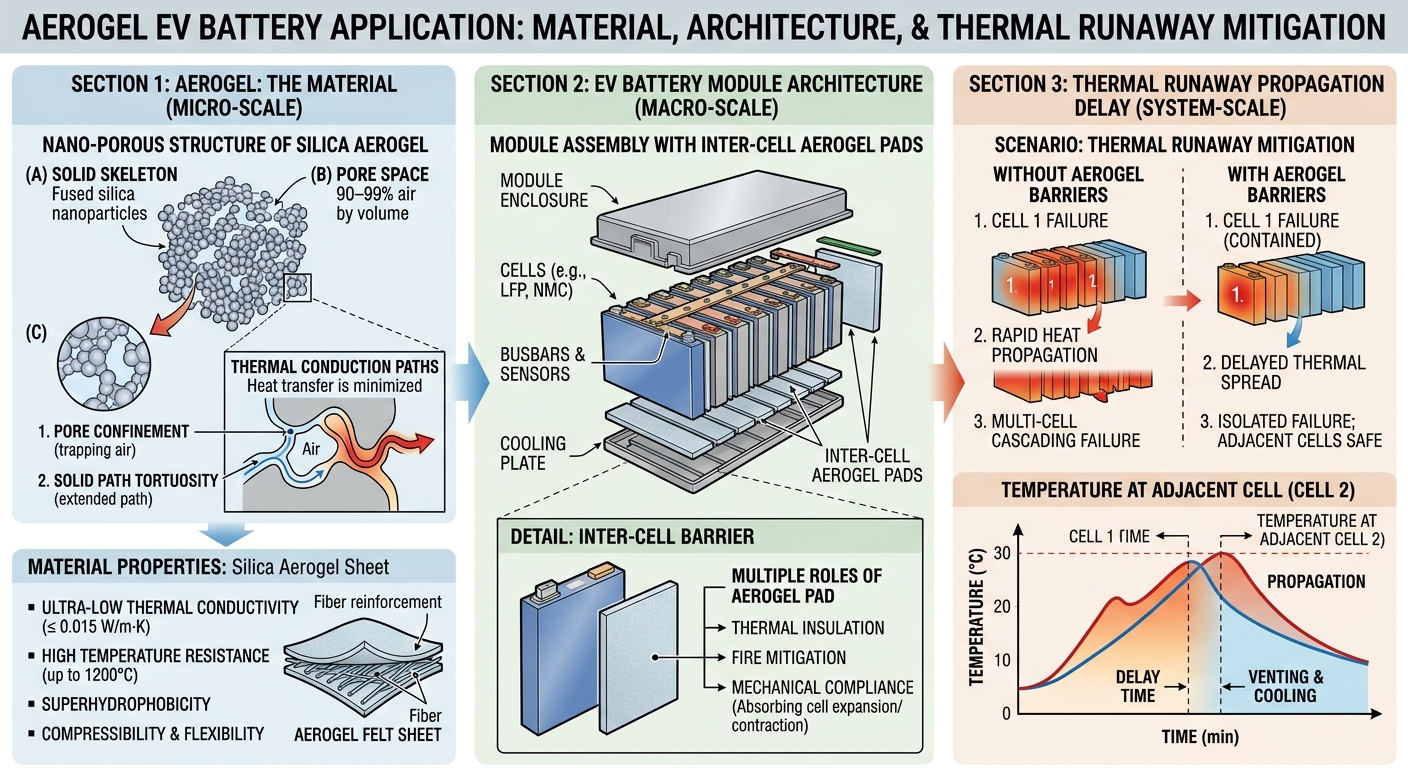
A Comprehensive Thesis on Material Science, Battery Architecture, Thermal Management, and Future EV Applications
Aerogel is not one single battery material. It is a family of extremely porous solid materials whose internal structure can be engineered for use in several parts of an EV battery—especially thermal barriers, separators, electrodes, and multifunctional composite layers.
The central scientific idea is:
Aerogel engineering attempts to use an enormous internal surface area and interconnected nanoscale pores to control heat, ions, electrons, mechanical structure, and chemical reactions inside an energy-storage system.
Recent reviews describe applications of aerogels in electrodes, separators and electrolytes, while newer work is particularly focused on thermal protection against lithium-ion battery thermal runaway. (MDPI)
1. What Exactly Is an Aerogel?
An aerogel is a solid three-dimensional network containing an exceptionally large volume of pores.
A conventional solid might look approximately like:
SOLID → SOLID → SOLID → SOLID
An aerogel instead resembles:
          AIR / PORE
             ↓
      ──●───────●──
        \       /
         ●─────●
         │     │
     ●───●─────●───●
       \       /
        ●─────●
The dots and connecting structures represent the solid framework; much of the remaining volume consists of pores.
For silica aerogels, roughly 95% of the volume can be air, depending on formulation and processing. Their unusual combination of low density, high porosity, high surface area and low thermal conductivity makes them attractive for thermal-management applications. (Wiley Online Library)
2. Why Would an EV Battery Need Aerogel?
An EV battery has several competing requirements:
- Store large amounts of energy.
- Deliver high electrical power.
- Charge rapidly.
- Operate across a wide temperature range.
- Prevent excessive heating.
- Prevent heat from spreading rapidly between cells.
- Maintain mechanical integrity.
- Survive thousands of charge/discharge cycles.
- Remain lightweight.
- Be manufacturable at automotive scale.
These requirements conflict with one another.
For example:
More insulation
→ better thermal isolation
but potentially
→ worse heat removal during normal operation.
This is one of the fundamental challenges of aerogel battery engineering. Recent research specifically identifies a trade-off between thermal protection and normal heat rejection. (ScienceDirect)
3. The Basic EV Battery Architecture
A simplified lithium-ion EV battery can be represented as:
                 EV BATTERY PACK
                       │
                       ▼
              ┌─────────────────┐
              │ Battery module  │
              └────────┬────────┘
                       │
             ┌─────────┴─────────┐
             ▼                   ▼
          CELL 1               CELL 2
             │                   │
       ┌─────┴─────┐       ┌─────┴─────┐
       │            │       │            │
     Cathode   Separator   Cathode   Separator
       │            │       │            │
     Anode      Electrolyte Anode   Electrolyte
       └────────────┘       └────────────┘
At the microscopic level, each cell contains:
- Cathode
- Anode
- Separator
- Electrolyte
- Current collectors
- Housing
- sometimes additional thermal-management materials.
Aerogel technology can potentially enter several of these layers.
4. Four Major Roles of Aerogel
The most important distinction is this:
Aerogel can function as:
A. Thermal insulation
B. Separator material
C. Electrode architecture
D. Composite multifunctional material
These applications require very different types of aerogel.
5. Aerogel as a Thermal Barrier
This is arguably the most important EV application.
During ordinary operation, lithium-ion cells generate heat.
Simplified:
Electrical operation
       ↓
Electrochemical reactions
       ↓
Internal resistance
       ↓
       HEAT
       ↓
Battery temperature
If excessive heat accumulates, undesirable reactions can accelerate.
A particularly serious failure process is thermal runaway.
6. Thermal Runaway
Thermal runaway can be represented conceptually as:
Temperature rises
       ↓
Side reactions accelerate
       ↓
More heat generated
       ↓
Temperature rises further
       ↓
More reactions
       ↓
Rapid thermal escalation
In severe circumstances, thermal runaway can propagate from one cell to neighbouring cells.
This creates the engineering problem known as:
Thermal Runaway Propagation — TRP
The objective of an aerogel barrier is therefore not necessarily to stop a battery from becoming hot.
Instead, one important objective is:
Slow the transfer of dangerous heat from one region of the battery to another.
Research published in 2025 describes aerogels as promising passive thermal-protection materials because of their low density and low thermal conductivity. (ScienceDirect)
7. Why Aerogel Is a Good Thermal Insulator
Heat can move through:
- conduction,
- convection,
- radiation.
Aerogel’s nanoscale porous structure strongly restricts heat transport, particularly conductive and gaseous contributions.
Conceptually:
HOT CELL
████████████

       ↓ heat

┌──────────────────┐
│  AEROGEL LAYER   │
│ ●─● ●─● ●─● ●─●  │
│   tiny pores     │
│ ●─● ●─● ●─● ●─●  │
└──────────────────┘

       ↓ reduced heat transfer

COOLER CELL
░░░░░░░░░░░░
The solid network is extremely thin and the pores are extremely small, making the material an effective thermal barrier.
8. Silica Aerogel
One important aerogel family is:
SiO₂ — silica aerogel
Its basic network consists of silicon and oxygen.
Conceptually:
       O
      / \
 Si──O──Si
 |       |
 O       O
 |       |
 Si──O──Si
The actual structure is far more complex and exists on nanoscale dimensions.
Silica aerogel possesses:
- very low density,
- high porosity,
- high surface area,
- low thermal conductivity.
However, conventional silica aerogel can be brittle and sensitive to environmental conditions, which is why researchers increasingly investigate composite versions. (American Chemical Society Publications)
9. Why Pure Silica Aerogel Is Not the Complete Answer
An EV battery environment is mechanically demanding.
The material needs to tolerate:
- vibration,
- impacts,
- thermal cycling,
- manufacturing forces,
- compression,
- expansion and contraction.
Traditional silica aerogel can have insufficient mechanical strength.
Therefore researchers investigate:
Aerogel composites
For example:
Silica aerogel
      +
Polymer
      +
Fibres
      +
Ceramic reinforcement
      ↓
Stronger aerogel composite
Recent research specifically identifies reinforcement with fibres, polymers, carbon materials and other functional fillers as strategies for improving aerogel robustness and functionality. (American Chemical Society Publications)
10. Polyimide Aerogel
Another important concept is the polyimide aerogel.
Polyimides are high-performance polymers capable of operating under demanding thermal and chemical conditions.
A polyimide aerogel can therefore provide a different balance between:
- thermal stability,
- mechanical strength,
- electrolyte compatibility,
- porosity,
- flexibility.
A 2026 review identifies polyimide aerogel separators as a particularly active research area for rechargeable lithium batteries because of their electrochemical stability, thermal stability and electrolyte wettability. (DOI)
11. Aerogel as a Battery Separator
The separator is one of the most misunderstood parts of a battery.
It sits between:
Anode ↔ Cathode
and performs two seemingly contradictory tasks.
It must:
Prevent direct electrical contact
while allowing:
Lithium-ion movement.
Conceptually:
ANODE
  │
  │ Li⁺
  ↓
╔══════════════╗
║  SEPARATOR   ║
║ ● ● ● ● ● ●  ║
║ porous       ║
╚══════════════╝
  │
  ↓ Li⁺
CATHODE
The electrons should not simply pass directly through the separator.
The lithium ions, however, need pathways through it.
12. Why Aerogel Porosity Matters
Suppose the separator has interconnected pores:
●──●──●
│  │  │
●──●──●
│  │  │
●──●──●
Lithium ions can move through electrolyte-filled pathways.
Therefore the aerogel architecture can be engineered to control:
- pore size,
- pore connectivity,
- porosity,
- tortuosity,
- electrolyte uptake.
Separator microstructure strongly influences ion transport, thermal stability and battery safety. (ScienceDirect)
13. The Meaning of Tortuosity
Tortuosity describes how complicated the pathway is through a porous material.
A straight pathway:
Li⁺ → → → → → →A tortuous pathway:
Li⁺ → ↗ ↓ → ↘ ↑ → →Too much tortuosity:
→ ions travel farther
→ resistance increases
→ high-rate performance can suffer.
Too little structural control:
→ mechanical and safety properties may deteriorate.
Thus aerogel design becomes an optimization problem.
14. Aerogel as an Electrode Framework
This is an even more advanced application.
Instead of simply putting aerogel around the battery, researchers can construct electrode architectures using porous carbon or other aerogel-like networks.
For example:
             ELECTRODE

       ●────●────●
      /│    │    │\
     ●─●────●────●─●
      \│    │    │/
       ●────●────●

   Active material
   distributed through
   porous framework
The objective is to create a large interconnected structure through which:
- electrons can travel,
- lithium ions can diffuse,
- electrolyte can penetrate,
- active material can participate in reactions.
15. Carbon Aerogel
Carbon aerogels are particularly interesting because carbon can be electrically conductive.
This creates an important distinction:
Silica aerogel
Excellent thermal insulation but electrically insulating.
Carbon aerogel
Can provide electrical conductivity and a porous framework.
Therefore carbon aerogels can potentially participate directly in electrochemical architectures.
16. Graphene Aerogel
A graphene aerogel is a three-dimensional network derived from graphene or graphene-related structures.
Conceptually:
Graphene sheet
──────────────

       ↓ assembly

   ╱──────╲
  ╱        ╲
 ●          ●
  ╲        ╱
   ╲──────╱
The result can combine:
- high surface area,
- electrical conductivity,
- low density,
- interconnected porosity.
This makes graphene-based aerogel structures attractive for energy-storage research. Reviews have examined graphene and silica aerogels for energy-storage and thermal-management applications. (ScienceDirect)
17. The Three Networks Inside an Advanced Aerogel Electrode
An ideal electrode can be thought of as requiring three interconnected networks.
Network 1 — Electron network
●──●──●──●Provides electrical conductivity.
Network 2 — Ion network
○  ○  ○  ○
 \ | / \ |
  ○──○──○
Provides lithium-ion transport.
Network 3 — Structural network
████████████
████████████
Maintains mechanical integrity.
The advanced electrode attempts to combine all three.
18. The “Triple-Transport” Principle
A high-performance electrode therefore needs:
Electronic transport
Ionic transport
Mass/chemical transport
while maintaining:
Mechanical stability
This can be represented as:
                ELECTRODE
                    │
       ┌────────────┼────────────┐
       ↓            ↓            ↓
   ELECTRONS      Li⁺       ELECTROLYTE
       │            │            │
       └────────────┼────────────┘
                    ↓
              ELECTROCHEMICAL
                 REACTION
Aerogel architectures are attractive because their three-dimensional porosity can potentially support these simultaneous transport pathways.
19. Aerogel + Silicon Anodes
One particularly important research direction is silicon.
Silicon can store substantially more lithium per unit mass than conventional graphite, but silicon undergoes very large volume changes during lithiation and delithiation.
Conceptually:
Before lithium insertion:

██████
██████

After lithium insertion:

████████████
████████████
████████████
Repeated expansion and contraction can cause:
- cracking,
- loss of electrical contact,
- unstable interfaces,
- capacity degradation.
A porous carbon/aerogel framework can potentially provide space for expansion.
20. The “Buffer Space” Concept
Imagine silicon particles inside a porous framework:
Carbon framework
●────────●
│  Si    │
│   ●    │
│        │
●────────●
When silicon expands:
●────────●
│   Si   │
│ ●████● │
│   ↑    │
●────────●
The surrounding pore structure provides some room for expansion.
This is one reason three-dimensional porous carbon architectures are investigated for advanced anodes.
21. Aerogel and Fast Charging
Fast charging produces additional thermal and electrochemical demands.
During charging:
Electrical energy
       ↓
Lithium-ion movement
       ↓
Electrode reactions
       ↓
Heat + concentration gradients
An advanced porous architecture can potentially shorten ion-transport pathways.
But there is a major engineering warning:
High porosity does not automatically mean a better battery.
Increasing porosity can reduce density of active material and therefore reduce volumetric energy density.
22. Gravimetric vs Volumetric Energy Density
Two important measurements are:
Gravimetric energy density
where:
- = stored energy
- = mass
Measured commonly in Wh/kg.
Volumetric energy density
where:
- = volume.
Measured commonly in Wh/L.
Aerogels are extremely lightweight.
That sounds ideal.
But their large pore volume also means that a kilogram of aerogel may contain relatively little electrochemically active material.
Therefore:
Low mass ≠ automatically high battery energy density.
This is one of the most important principles in understanding aerogel batteries.
23. Aerogel Thermal Architecture in an EV Pack
A possible conceptual architecture is:
        BATTERY PACK
┌──────────────────────────────┐
│                              │
│  CELL │ AEROGEL │ CELL       │
│       │ BARRIER │            │
│       │         │            │
│  CELL │ AEROGEL │ CELL       │
│       │ BARRIER │            │
│       │         │            │
│  CELL │ AEROGEL │ CELL       │
│                              │
└──────────────────────────────┘
             │
             ▼
       COOLING SYSTEM
The aerogel does not necessarily replace active cooling.
Instead, it can complement:
- liquid cooling,
- cold plates,
- heat pipes,
- phase-change materials,
- structural battery components.
24. A Critical Design Principle: Insulation vs Cooling
This is extremely important.
During normal operation:
CELL → HEAT → COOLING SYSTEMYou want heat to leave the cell.
During a dangerous event:
HOT CELL → X → NEIGHBOURING CELLYou want heat transfer between cells to be slowed.
Therefore an ideal battery architecture needs directional thermal management:
Normal operation
Efficient heat extraction.
Abnormal event
Strong thermal isolation.
This is why researchers increasingly investigate hybrid architectures rather than simply surrounding every cell with maximum insulation. (ScienceDirect)
25. Aerogel + Phase-Change Materials
A sophisticated architecture can combine:
Aerogel + PCM
where PCM means phase-change material.
The PCM absorbs heat through a phase transition.
Conceptually:
Battery heat
    ↓
 ┌─────────┐
 │   PCM   │
 │ absorbs │
 │  heat   │
 └─────────┘
    +
 ┌─────────┐
 │ AEROGEL │
 │ slows   │
 │ heat    │
 └─────────┘
The two materials perform different functions:
PCM
→ absorbs thermal energy.
Aerogel
→ slows thermal propagation.
Hybrid thermal-management systems are an active area of battery research. (DOI)
26. Aerogel + Ceramic Materials
Ceramic aerogels can offer improved high-temperature resistance.
Potential components include:
- silica,
- alumina,
- zirconia,
- other ceramic networks.
A recent review of aerogel thermal protection for lithium-ion batteries highlights ceramic aerogels and organic–inorganic hybrids as important research directions. (ScienceDirect)
27. Aerogel + Fibres
Fibres can reinforce an aerogel.
Conceptually:
Aerogel network

●──●──●──●
│  │  │  │
●──●──●──●

       +

████████████
 fibre
████████████

       ↓

reinforced aerogel
The objective is to improve:
- tensile strength,
- compression resistance,
- flexibility,
- handling during manufacturing.
28. Bio-Based Aerogels
Another fascinating direction is the use of biological materials.
Potential precursors include:
- cellulose,
- lignin,
- chitosan.
Bio-based aerogels are being investigated for electrodes and separators as well as other energy-storage applications. (PubMed)
This introduces a sustainability pathway:
Biomass
   ↓
Cellulose / lignin
   ↓
Aerogel architecture
   ↓
Energy-storage component
However, “bio-based” does not automatically mean environmentally superior. The entire life cycle—including processing chemicals, energy consumption, drying, manufacturing and recycling—must be evaluated.
29. How Aerogel Is Manufactured
A simplified aerogel production route is:
Step 1 — Create precursor solution
Chemical precursor
       ↓
Sol
Step 2 — Gel formation
Sol
 ↓
Gel
A three-dimensional network forms.
Step 3 — Aging
The network strengthens and develops.
Step 4 — Solvent exchange
The original liquid is replaced by another suitable solvent.
Step 5 — Drying
The liquid is removed while attempting to preserve the fragile pore network.
Step 6 — Aerogel
3D solid network
+
nanopores
+
air
Sol–gel processing and advanced drying methods are central to aerogel fabrication. (Wiley Online Library)
30. Why Drying Is So Difficult
Imagine a tiny porous structure:
●──●
│  │
●──●
If liquid evaporates incorrectly, surface tension can pull the structure together:
●─●
 \/
 ●
The pores collapse.
The objective of advanced drying is therefore:
Remove the liquid while preserving the three-dimensional network.
This is one reason aerogel production can be technically complex and expensive. (MDPI)
31. Supercritical Drying
One traditional technique uses supercritical fluids.
The fundamental concept is to pass through conditions where there is no conventional liquid–gas interface.
This greatly reduces capillary forces that could collapse the pore network.
However:
excellent material properties
can come with
more complicated manufacturing.
Consequently, researchers are investigating alternative scalable drying and processing techniques.
32. The Battery “Architecture Stack”
An advanced EV battery can therefore be viewed as a hierarchy:
LEVEL 1
Material atoms
       ↓
LEVEL 2
Nanoporous aerogel
       ↓
LEVEL 3
Electrode / separator / thermal layer
       ↓
LEVEL 4
Battery cell
       ↓
LEVEL 5
Battery module
       ↓
LEVEL 6
Battery pack
       ↓
LEVEL 7
Electric vehicle
This is an important engineering concept:
Battery performance emerges from interactions between multiple architectural levels.
33. The Four Functions of a Future Aerogel Battery System
A sophisticated system could potentially integrate:
             AEROGEL PLATFORM
                    │
       ┌────────────┼────────────┐
       ↓            ↓            ↓
   ELECTRODE     SEPARATOR     THERMAL
   NETWORK       NETWORK       BARRIER
       │            │            │
       └────────────┼────────────┘
                    ↓
             BATTERY CELL
                    ↓
              BATTERY PACK
This is more realistic than imagining “an aerogel battery” as one material replacing everything.
34. Main Advantages
Aerogel technology offers several scientifically interesting advantages.
1. Extremely high porosity
Creates large internal surface area.
2. Low density
Potentially reduces the mass of passive battery components.
3. Thermal insulation
Useful for slowing heat propagation.
4. Tunable pore structure
Pore size and connectivity can be engineered.
5. Large electrolyte interface
Potentially useful for electrochemical reactions.
6. Three-dimensional architecture
Can create interconnected transport pathways.
7. Composite compatibility
Aerogels can be combined with:
- polymers,
- ceramics,
- carbon,
- graphene,
- fibres,
- biological materials.
35. Major Limitations
The technology also has substantial challenges.
Mechanical fragility
Some aerogels are brittle.
Manufacturing complexity
Producing a precise porous structure at automotive scale is difficult.
Cost
Advanced aerogels may currently cost more than conventional materials.
Low volumetric density
Too much empty space can reduce volumetric energy density.
Moisture sensitivity
Some silica aerogels require protection or modification.
Interface engineering
The aerogel must interact correctly with electrolytes and electrodes.
Recycling
Complex composite materials can complicate end-of-life processing.
These limitations are repeatedly identified in the aerogel energy-storage literature. (MDPI)
36. The Central Engineering Trade-Off
The entire field can be summarized by an optimization problem:
where:
- = energy density
- = power capability
- = thermal management
- = safety
- = lifetime
- = cost
- = manufacturability.
Improving one parameter can hurt another.
For example:
but:
Likewise:
but potentially:
37. Aerogel Battery Research Is Therefore a Materials-Architecture Problem
It is tempting to ask:
“Is aerogel a better battery material?”
The more scientifically accurate question is:
Which aerogel composition, pore architecture, thickness, location and manufacturing process produces the best combination of electrochemical, thermal, mechanical and economic performance for a particular battery design?
That is a much more sophisticated question.
38. Future EV Battery Architecture
A possible future architecture could look conceptually like this:
                EV BATTERY PACK
┌────────────────────────────────────────┐
│                                        │
│  ┌─────┐  ┌─────┐  ┌─────┐            │
│  │CELL │  │CELL │  │CELL │            │
│  │     │  │     │  │     │            │
│  └─────┘  └─────┘  └─────┘            │
│     │        │        │                │
│  ───AEROGEL THERMAL BARRIERS───        │
│                                        │
│  ─────── COOLING PLATE ───────         │
│                                        │
│       TEMPERATURE SENSORS              │
│          ↓     ↓     ↓                 │
│       BATTERY MANAGEMENT SYSTEM        │
│                                        │
└────────────────────────────────────────┘
The future is therefore likely to involve integrated materials, rather than one miracle material.
39. The Battery Management System Still Matters
Aerogel is a passive material.
The battery management system, or BMS, performs active monitoring and control.
It monitors variables such as:
- cell voltage,
- current,
- temperature,
- state of charge,
- state of health.
Conceptually:
Sensors
  ↓
BMS
  ↓
Decision
  ↓
Charging / discharging control
  ↓
Thermal management
The aerogel provides material-level protection; the BMS provides electronic/system-level management.
40. The Future Research Direction
The most interesting future architecture is probably not:
“100% aerogel battery.”
Rather:
Hybrid intelligent battery architecture
             ┌──────────────┐
             │ Active       │
             │ electrode    │
             └──────┬───────┘
                    │
             ┌──────▼───────┐
             │ Aerogel      │
             │ separator    │
             └──────┬───────┘
                    │
             ┌──────▼───────┐
             │ Electrolyte  │
             └──────┬───────┘
                    │
             ┌──────▼───────┐
             │ Aerogel      │
             │ thermal      │
             │ barrier      │
             └──────────────┘
combined with:
- liquid cooling,
- advanced electrodes,
- improved separators,
- sensors,
- BMS,
- structural materials,
- recycling-oriented design.
41. A Useful Classification of Aerogels for EV Batteries
| Aerogel type | Primary potential function |
|---|---|
| Silica aerogel | Thermal insulation |
| Polyimide aerogel | Separator / thermal protection |
| Carbon aerogel | Conductive electrode framework |
| Graphene aerogel | Conductive porous architecture |
| Ceramic aerogel | High-temperature protection |
| Cellulose aerogel | Sustainable electrode/separator platform |
| Hybrid aerogel | Multiple functions simultaneously |
This classification is conceptual: actual battery performance depends strongly on formulation, processing and where the material is incorporated. Research reviews show that aerogels are being investigated across electrodes, separators, electrolytes and thermal-protection systems rather than as a single universal battery component. (MDPI)
42. The Scientific Significance
Aerogel research demonstrates an important transformation in modern materials science.
Older engineering often asked:
What material should we use?
Modern materials engineering increasingly asks:
How should we design the material’s structure from the atomic scale to the system scale?
Aerogels embody this approach.
Their performance comes not simply from chemical composition but from:
That is the fundamental scientific idea.
43. Final Thesis
Aerogels should not be understood simply as “new battery chemicals.”
They are better understood as architectural materials.
Their extraordinary porosity gives engineers a platform for controlling:
heat
→ ions
→ electrons
→ electrochemical interfaces
→ mechanical structure
→ thermal propagation
→ battery safety.
For EVs, one of the strongest near-term scientific cases is thermal protection and safety, while more ambitious research investigates aerogel-derived electrode and separator architectures. Recent 2026 work on polyimide aerogel separators and battery thermal barriers shows that the field is continuing to move toward application-specific designs rather than a single universal aerogel. (DOI)
The ultimate objective is therefore not simply:
“Put aerogel into a battery.”
It is:
That is the deeper meaning of aerogel battery architecture: using nanoscale architecture to solve problems that exist at the cell, module and entire electric-vehicle level.





Be First to Comment