
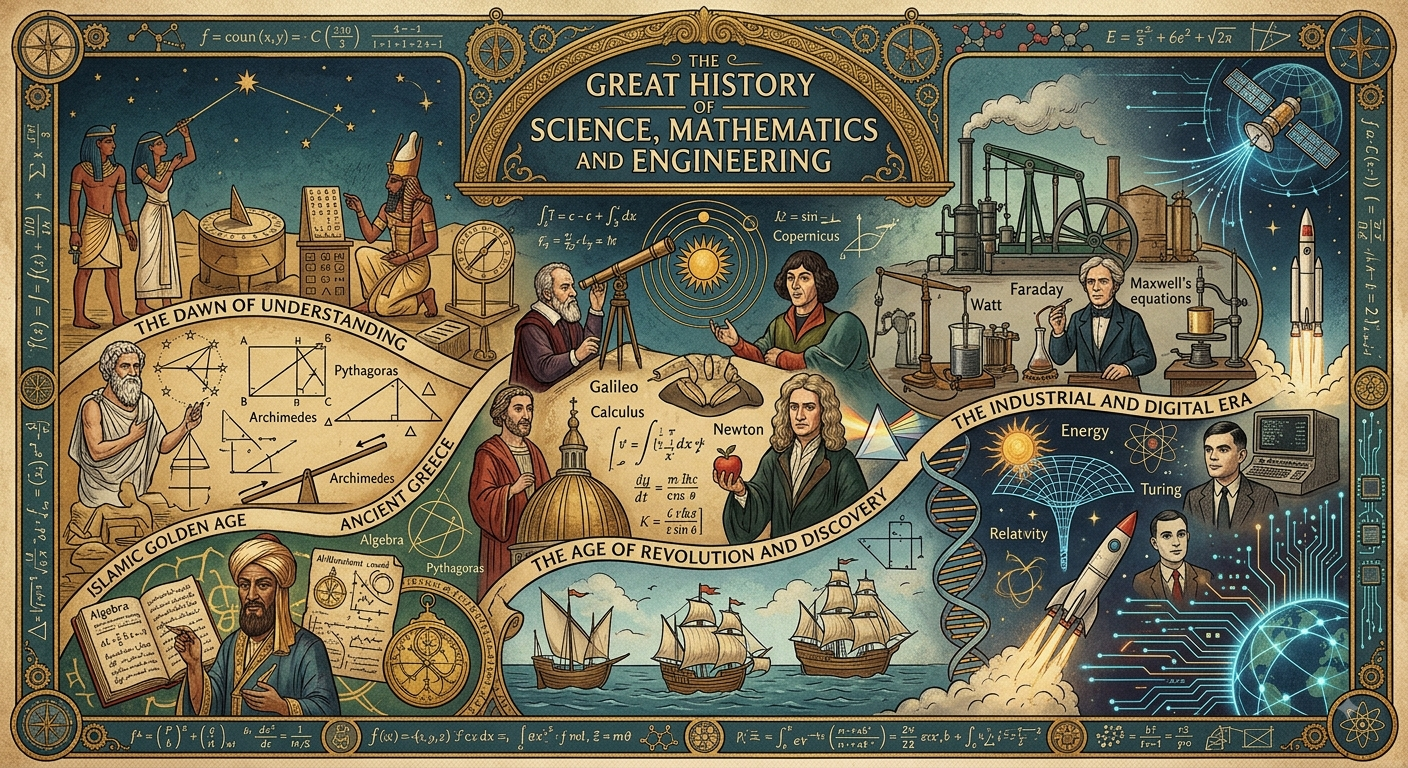
From 3500 BC to 2026
How the Discoveries of Scientists, Mathematicians, Engineers and Inventors Built the Modern Civilised World
Abstract
Human civilisation is, in large measure, the accumulated result of humanity learning how to observe nature, measure reality, represent patterns mathematically, explain physical phenomena, design machines, control energy, preserve knowledge and transmit information.
From the first cities of Mesopotamia and Egypt around 3500 BC to artificial intelligence, biotechnology, quantum computing and advanced semiconductor technology in 2026, civilisation has developed through an extraordinary chain of intellectual contributions. No single civilisation, nation, scientist, mathematician or engineer created the modern world. Instead, knowledge moved across generations and geographical boundaries: Mesopotamian mathematics influenced later mathematics; Egyptian engineering demonstrated large-scale organisation; Greek thinkers developed systematic natural philosophy and geometry; Indian mathematicians transformed numerical computation; Chinese engineers developed sophisticated technologies; scholars of the Islamic Golden Age preserved, criticised and extended Greek, Persian and Indian knowledge; European scientific revolutions transformed experimental and mathematical science; and modern global science integrated discoveries from every major region of the world.
This thesis follows that development from approximately 3500 BC to 2026, highlighting major scientists, mathematicians, physicians, astronomers, engineers, inventors and technological pioneers and explaining how their work contributed to agriculture, medicine, architecture, transportation, energy, telecommunications, computing, space exploration, biotechnology and artificial intelligence.
1. Introduction: Civilisation as a Chain of Knowledge
Modern civilisation can be understood as a gigantic technological and intellectual system.
A smartphone, for example, depends upon:
- mathematics;
- semiconductor physics;
- electromagnetism;
- chemistry;
- materials science;
- computer science;
- telecommunications;
- satellite navigation;
- optical engineering;
- software engineering;
- manufacturing;
- energy systems;
- global logistics.
Behind those technologies stand thousands of discoveries made over thousands of years.
The modern world therefore did not suddenly appear in the twentieth or twenty-first century. It is the result of a long historical chain:
Observation → Measurement → Mathematics → Scientific theory → Experiment → Engineering → Manufacturing → Infrastructure → Digital systems → Artificial intelligence.
The history of science is consequently also a history of civilisation itself.
2. 3500–2000 BC: The First Mathematical and Engineering Civilisations
2.1 Mesopotamia: the beginning of systematic calculation
One of the earliest major centres of recorded mathematics was Mesopotamia, particularly Sumer and later Babylon.
By approximately 3500 BC, Mesopotamian societies had developed cities, writing, accounting systems, irrigation, architecture and organised administration.
The development of writing was itself a technological revolution. Cuneiform allowed societies to record:
- agricultural production;
- taxation;
- trade;
- property;
- astronomical observations;
- contracts;
- mathematical calculations.
Mathematics was initially closely connected to practical civilisation.
People needed mathematics to answer questions such as:
How much grain was stored?
How large is a field?
How much material is required for a building?
How should taxes be calculated?
How can irrigation systems be organised?
This practical mathematics eventually developed into sophisticated arithmetic, geometry and astronomy.
Babylonian mathematicians used a base-60 numerical system, whose legacy remains with us today in:
- 60 seconds per minute;
- 60 minutes per hour;
- 360 degrees in a circle.
This demonstrates an important principle of technological history: ancient mathematical systems can remain embedded in civilisation thousands of years after their creators.
3. Ancient Egypt: Engineering, Medicine, Architecture and Measurement
Ancient Egypt became one of the world’s great engineering civilisations.
The Nile required sophisticated knowledge of:
- surveying;
- irrigation;
- flood management;
- construction;
- transportation;
- astronomy;
- calendar systems.
The development of large irrigation and water-management systems illustrates how civil engineering emerged from practical necessity. Modern civil-engineering history similarly recognises water management as one of the foundations of civilisation.
3.1 Imhotep
Imhotep, who lived during the 27th century BC, is one of the earliest named individuals associated with engineering, architecture and medicine.
He is traditionally associated with the Step Pyramid of Djoser at Saqqara.
The monument represents an enormous transition:
mud-brick construction → stone construction → monumental architecture.
The engineering required:
- quarrying;
- transportation;
- stone cutting;
- geometric planning;
- structural organisation;
- labour management;
- logistics.
The achievement demonstrates that sophisticated engineering existed thousands of years before modern engineering schools.
3.2 Egyptian mathematics
The Rhind Mathematical Papyrus, associated with the scribe Ahmes, demonstrates ancient Egyptian knowledge of arithmetic, fractions, geometry and practical problem solving.
Egyptian mathematics was strongly connected to:
- land surveying;
- construction;
- taxation;
- commerce;
- astronomy.
The pyramids therefore should not be understood merely as monuments. They were products of mathematics, surveying, materials engineering, logistics and organisational technology.
4. Ancient African Knowledge
Africa’s contribution to civilisation extends far beyond Egypt.
UNESCO’s General History of Africa treats African history as a continuous intellectual and technological history extending from prehistory through the modern era, including agriculture, metallurgy, ancient states, scientific knowledge and cultural development.
African societies developed important knowledge concerning:
- agriculture;
- metallurgy;
- architecture;
- medicine;
- astronomy;
- navigation;
- animal husbandry;
- environmental management;
- trade;
- mathematics.
Ironworking became particularly important across many African regions.
Later, centres of learning such as Timbuktu became major intellectual centres. UNESCO records Timbuktu as an important centre of Islamic learning, with Sankore and other institutions supporting large scholarly communities.
Its manuscripts preserved knowledge concerning subjects including:
- mathematics;
- astronomy;
- medicine;
- law;
- philosophy;
- geography.
This is important because the history of science should not be presented as a simple story of knowledge moving from one European country to another. It was a global process.
5. Ancient Greece: Mathematics Becomes a Formal Language of Nature
Greek thinkers transformed mathematics and natural philosophy by asking fundamental questions about reality.
5.1 Thales of Miletus
Thales is traditionally associated with early Greek geometry and natural philosophy.
His importance lies partly in the movement toward explaining phenomena through rational principles rather than relying exclusively on mythological explanations.
5.2 Pythagoras
Pythagoras and the Pythagorean tradition helped establish mathematical relationships as fundamental tools for understanding nature.
The famous Pythagorean theorem describes the relationship:
[
a^2+b^2=c^2
]
Its applications extend from architecture to surveying, engineering, navigation, computer graphics and physics.
5.3 Hippocrates
Hippocrates of Kos became one of the most influential figures in the history of medicine.
The Hippocratic tradition encouraged physicians to study disease through observation and clinical reasoning.
Its broader historical importance was the development of medicine as a systematic discipline rather than merely supernatural explanation.
6. Euclid: The Architecture of Geometry
Around 300 BC, Euclid of Alexandria compiled Elements.
Euclidean geometry became one of the most influential mathematical frameworks in history.
Euclid demonstrated how mathematical knowledge could be organised through:
definitions → axioms → propositions → proofs.
This logical architecture became a model for later mathematics and scientific reasoning.
Engineering, architecture, surveying, astronomy and physics all benefited from geometric reasoning.
7. Archimedes: Mathematics Meets Engineering
Archimedes of Syracuse was simultaneously a mathematician, physicist and engineer.
His work involved:
- geometry;
- mechanics;
- hydrostatics;
- centres of gravity;
- levers;
- buoyancy;
- machines.
His famous principle of buoyancy became fundamental to physics and engineering.
His mechanical reasoning helped establish the idea that mathematical laws could describe physical machines.
The Archimedean tradition can therefore be viewed as an early bridge between:
mathematics → physics → engineering.
8. Eratosthenes and the Measurement of Earth
Eratosthenes used geometry and observations of shadows to estimate Earth’s circumference.
His work demonstrated a profound scientific principle:
A large physical reality can be measured indirectly using mathematics.
This principle eventually became fundamental to:
- geodesy;
- astronomy;
- cartography;
- navigation;
- Earth science;
- satellite positioning.
9. Hipparchus and Ptolemy: Mathematical Astronomy
Hipparchus developed sophisticated astronomical measurements and star cataloguing.
Later, Claudius Ptolemy produced the Almagest, a major mathematical astronomical system.
Although the Ptolemaic model of the Solar System was eventually replaced, its mathematical astronomical tradition influenced scientific work for more than a millennium.
10. India: The Mathematical Revolution
Ancient and medieval India made enormous contributions to mathematics and astronomy.
10.1 Aryabhata
Aryabhata developed important mathematical and astronomical ideas.
He worked on:
- arithmetic;
- algebra;
- trigonometry;
- astronomical calculation;
- approximation of π;
- planetary motion.
10.2 Brahmagupta
Brahmagupta made fundamental contributions to arithmetic and algebra.
Particularly important was his systematic treatment of zero and negative numbers.
The development of zero as a mathematical number transformed computation.
Modern civilisation would be almost impossible without positional numerical notation and zero.
It ultimately became fundamental to:
- algebra;
- calculus;
- engineering;
- accounting;
- computers;
- digital electronics;
- artificial intelligence.
10.3 Bhaskara II
Bhaskara II further developed mathematics and astronomy, including work involving algebra, equations and mathematical analysis.
The Indian mathematical tradition subsequently travelled westward through intellectual exchange.
11. China: Engineering and Technological Systems
China developed one of history’s most sophisticated technological traditions.
Important developments included:
- papermaking;
- printing;
- gunpowder;
- the compass;
- hydraulic engineering;
- mechanical devices;
- metallurgy;
- astronomical instruments.
11.1 Zhang Heng
Zhang Heng was an astronomer, mathematician, engineer and inventor of the Han period.
He constructed sophisticated astronomical instruments and is associated with an early seismoscope.
11.2 Cai Lun
Cai Lun is traditionally associated with improvements in papermaking.
Paper transformed civilisation because it dramatically improved the ability to:
- record information;
- educate populations;
- administer governments;
- preserve scientific knowledge;
- distribute literature.
11.3 Su Song
Su Song developed sophisticated astronomical and mechanical systems, including a famous astronomical clock tower.
Chinese technological history demonstrates that mechanical engineering and scientific observation developed independently and creatively outside Europe.
12. The Islamic Golden Age: Connecting Civilisations Through Knowledge
Between approximately the eighth and thirteenth centuries, scholars working across the Islamic world became major contributors to mathematics, astronomy, medicine, optics, chemistry and engineering.
This period was particularly important because scholars translated, preserved, criticised and extended knowledge originating from:
- Greece;
- Persia;
- India;
- earlier Middle Eastern civilisations.
UNESCO notes the extensive historical Arabic manuscript tradition and its contributions to mathematics, astronomy, medicine, engineering, pharmacology, chemistry and mechanics.
13. Muhammad ibn Musa al-Khwarizmi: Father of Algebraic and Algorithmic Thinking
Muhammad ibn Musa al-Khwarizmi was one of history’s most influential mathematicians.
His work contributed to:
- algebra;
- arithmetic;
- astronomy;
- mathematical computation.
The word algorithm derives from the Latinised form of his name.
The word algebra comes from the title of his mathematical work concerning restoration and balancing.
His importance to the modern world is enormous.
The modern digital economy depends upon algorithms.
A simplified intellectual chain is:
Al-Khwarizmi → systematic calculation → algorithms → mathematical computation → computer algorithms → software → artificial intelligence.
14. Ibn al-Haytham: The Experimental Study of Light
Ibn al-Haytham, known in Latin Europe as Alhazen, was a pioneering scholar of optics.
He investigated:
- light;
- vision;
- reflection;
- refraction;
- cameras;
- experimental observation.
His work helped establish the importance of combining mathematical reasoning with controlled observation.
The modern camera, telescope, microscope, optical fibre and imaging technologies all ultimately belong to the broad scientific lineage of optical science.
15. Avicenna: Medicine and Scientific Classification
Ibn Sina, known in Europe as Avicenna, was one of the most influential physicians and philosophers of the medieval period.
His Canon of Medicine systematised extensive medical knowledge and influenced medical education for centuries.
His legacy illustrates another important principle:
Scientific progress often depends on organising existing knowledge before new discoveries can be made.
16. Al-Biruni: Earth, Astronomy and Measurement
Abu Rayhan al-Biruni worked across:
- astronomy;
- mathematics;
- geography;
- geology;
- measurement;
- comparative studies.
He applied mathematical reasoning to physical geography and astronomical questions.
17. Al-Jazari: Mechanical Engineering
Ismail al-Jazari was a major medieval engineer.
He described and designed sophisticated:
- water-raising machines;
- pumps;
- clocks;
- mechanical devices;
- automated mechanisms.
His work demonstrates that mechanical engineering has a history extending many centuries before the Industrial Revolution.
18. Medieval Europe: Knowledge Re-enters a New Intellectual Environment
During the later medieval period, European scholars increasingly encountered Greek, Arabic and Indian mathematical and scientific knowledge.
Fibonacci, or Leonardo of Pisa, helped popularise Hindu-Arabic numerals in Europe through Liber Abaci.
The numerical system eventually became essential to European commerce, accounting and mathematics.
The development of universities created institutional environments where knowledge could be taught and debated.
19. Leonardo da Vinci: The Universal Engineer
Leonardo da Vinci represents one of history’s most extraordinary combinations of:
- art;
- anatomy;
- mechanics;
- architecture;
- hydrology;
- military engineering;
- machine design;
- observation.
His notebooks contain studies of:
- human anatomy;
- gears;
- bridges;
- flying machines;
- water;
- mechanical systems.
Leonardo demonstrated that science, engineering and visualisation could reinforce one another.
20. Nicolaus Copernicus: The Sun-Centred Model
Nicolaus Copernicus proposed a heliocentric model in which Earth moves around the Sun.
The importance of Copernicus was greater than simply changing the location of the Sun in a diagram.
He helped initiate a transformation in humanity’s conception of its position in the universe.
21. Andreas Vesalius: Modern Human Anatomy
Andreas Vesalius challenged errors inherited from ancient anatomical traditions by conducting detailed studies of human bodies.
His work helped establish direct anatomical observation as a foundation of modern medicine.
22. Galileo Galilei: Observation, Experiment and Mathematical Physics
Galileo Galilei became one of the central figures of the Scientific Revolution.
He contributed to:
- astronomy;
- mechanics;
- motion;
- experimental science.
His telescopic observations strengthened the case for a changing and dynamic heavens.
Galileo also helped establish a powerful scientific methodology:
measure → experiment → mathematically analyse → compare with observation.
23. Johannes Kepler: Mathematical Laws of Planetary Motion
Johannes Kepler transformed astronomy by discovering mathematical laws describing planetary orbits.
His laws demonstrated that planetary motion could be represented mathematically.
This became essential to the later development of Newtonian physics.
24. Francis Bacon and René Descartes: New Methods of Thinking
Francis Bacon emphasised systematic observation and empirical investigation.
René Descartes developed analytical geometry and promoted mathematical reasoning.
Together with other Scientific Revolution thinkers, they contributed to the emergence of modern scientific methodology.
25. Isaac Newton: The Mathematical Framework of Classical Physics
Sir Isaac Newton stands among the most influential scientists in history.
His contributions included:
- laws of motion;
- universal gravitation;
- calculus;
- optics;
- mathematical physics.
Newton’s laws transformed mechanics from a collection of observations into a mathematical physical system.
The famous relationship:
[
F=ma
]
expresses the relationship between force, mass and acceleration.
Newtonian mechanics became fundamental to:
- architecture;
- civil engineering;
- mechanical engineering;
- astronomy;
- transportation;
- aerospace engineering;
- machine design.
The Industrial Revolution subsequently relied heavily on this emerging mathematical understanding of mechanics.
26. Leibniz and the Development of Calculus
Gottfried Wilhelm Leibniz independently developed calculus.
Calculus became one of the most important mathematical tools in civilisation.
It allows humanity to analyse:
- changing quantities;
- motion;
- acceleration;
- fluid flow;
- population growth;
- electrical systems;
- economic models;
- machine learning;
- orbital mechanics.
Modern engineering would be impossible without calculus.
27. The 18th Century: Mathematics Becomes an Industrial Tool
The eighteenth century produced major mathematical advances through figures such as:
- Leonhard Euler;
- Daniel Bernoulli;
- Joseph-Louis Lagrange;
- Pierre-Simon Laplace.
Their work advanced:
- mechanics;
- differential equations;
- fluid dynamics;
- probability;
- celestial mechanics;
- mathematical physics.
This period created the mathematical foundations needed for modern engineering.
28. The Industrial Revolution
The Industrial Revolution transformed scientific knowledge into industrial power.
Major figures included:
James Watt
Improved the steam engine and helped transform industrial energy systems.
George Stephenson
Contributed to railway engineering and locomotive development.
James Hargreaves and Richard Arkwright
Contributed to mechanised textile production.
Joseph-Marie Jacquard
Developed punched-card control for textile machinery, an important conceptual ancestor of programmable machines.
The Industrial Revolution created the modern relationship:
energy + machines + factories + transportation + finance + engineering = industrial civilisation.
29. Electricity: Volta, Ørsted, Ampère and Faraday
The nineteenth century brought the systematic study of electricity and magnetism.
Alessandro Volta
Developed the voltaic pile, an early practical battery.
Hans Christian Ørsted
Demonstrated the relationship between electricity and magnetism.
André-Marie Ampère
Developed mathematical descriptions of electrodynamics.
Michael Faraday
Made foundational discoveries concerning electromagnetic induction and electric motors.
Faraday’s work was crucial because electromagnetic induction became the foundation of modern electrical generation.
Modern power systems can therefore be connected through a historical chain:
Faraday → generators → electrical grids → motors → industrial electrification → electronics → computers.
30. James Clerk Maxwell: Unifying Electricity, Magnetism and Light
James Clerk Maxwell produced one of the greatest theoretical achievements in physics.
His equations unified electricity and magnetism.
Maxwell demonstrated that electromagnetic phenomena propagate as waves and connected electromagnetic theory with the speed of light.
This became the theoretical foundation for:
- radio;
- radar;
- television;
- telecommunications;
- wireless networks;
- antennas;
- satellite communications;
- optical technologies.
The modern telecommunications civilisation owes an enormous intellectual debt to Maxwell.
31. Thermodynamics: Understanding Energy
Scientists such as:
- James Prescott Joule;
- Sadi Carnot;
- Rudolf Clausius;
- William Thomson (Lord Kelvin);
- Ludwig Boltzmann
developed thermodynamics and statistical physics.
Thermodynamics explains relationships between:
- heat;
- work;
- energy;
- temperature;
- entropy.
Modern engines, refrigerators, power stations, turbines and many industrial systems depend upon thermodynamic principles.
32. Charles Darwin: Evolution and Biological Science
Charles Darwin transformed biology through the theory of evolution by natural selection.
His work provided a unifying explanation for the diversity and adaptation of life.
Modern evolutionary biology, genetics, ecology and medicine are deeply connected to evolutionary theory.
33. Gregor Mendel: The Mathematics of Heredity
Gregor Mendel conducted experiments with pea plants and identified statistical patterns in inheritance.
His work established foundations for genetics.
Later, genetics and molecular biology would combine to produce:
DNA science → genomics → biotechnology → genetic medicine.
34. Louis Pasteur and Robert Koch: The Germ Theory of Disease
Louis Pasteur demonstrated important relationships between microorganisms and disease and contributed to vaccination and microbiology.
Robert Koch developed methods for identifying disease-causing organisms.
Their work transformed medicine.
The consequences included:
- improved hygiene;
- microbiology;
- vaccination;
- infectious-disease diagnosis;
- public health.
35. The Rise of Modern Chemistry
Major figures included:
- Antoine Lavoisier;
- John Dalton;
- Dmitri Mendeleev;
- August Kekulé;
- Svante Arrhenius.
Lavoisier
Helped establish modern quantitative chemistry.
Dalton
Developed an influential atomic theory.
Mendeleev
Created the periodic table framework.
The periodic table became one of science’s most powerful organisational systems.
It allowed scientists to understand relationships among chemical elements and eventually enabled modern materials science, pharmaceuticals, electronics and industrial chemistry.
36. Nikola Tesla and Thomas Edison: The Electrical Age
Nikola Tesla
Tesla contributed substantially to:
- alternating-current electrical systems;
- motors;
- transformers and power transmission concepts;
- high-frequency electrical experiments.
Thomas Edison
Edison developed and commercialised numerous electrical technologies, including practical electric-lighting systems and associated infrastructure.
Their era helped move electricity from laboratory experiments into mass civilisation.
37. Alexander Graham Bell and Telecommunications
Alexander Graham Bell contributed to the development of practical telephone technology.
The telephone transformed communication by allowing human voices to travel across long distances.
The technological lineage subsequently became:
telephone → switching networks → radio → digital telecommunications → cellular networks → Internet.
38. The Wright Brothers and Aviation
Orville and Wilbur Wright demonstrated controlled powered flight in 1903.
Their achievement depended upon:
- aerodynamics;
- mechanical engineering;
- materials;
- propulsion;
- control systems;
- experimental testing.
Modern aviation later evolved into:
- passenger aircraft;
- jet engines;
- satellites;
- spacecraft;
- unmanned aerial systems.
39. The Early 20th Century: Physics Changes Reality
The twentieth century produced a dramatic transformation in physics.
Important figures included:
- Max Planck;
- Albert Einstein;
- Marie Curie;
- Ernest Rutherford;
- Niels Bohr;
- Werner Heisenberg;
- Erwin Schrödinger;
- Paul Dirac;
- Enrico Fermi.
40. Max Planck and Quantum Theory
Max Planck introduced the quantum hypothesis to explain black-body radiation.
Quantum theory ultimately transformed humanity’s understanding of matter and energy.
Modern technologies based on quantum physics include:
- lasers;
- transistors;
- semiconductor electronics;
- LEDs;
- medical imaging;
- atomic clocks;
- quantum computers.
41. Albert Einstein: Relativity and the Nature of Space and Time
Albert Einstein transformed physics through special and general relativity.
His famous relationship:
[
E=mc^2
]
expresses the equivalence of mass and energy.
General relativity provided a new theory of gravity based on spacetime geometry.
Einstein’s work contributed to modern understanding of:
- space;
- time;
- gravity;
- energy;
- cosmology.
Relativity is also practically important. Satellite navigation systems require corrections related to relativistic effects.
42. Marie Curie: Radioactivity
Marie Skłodowska Curie was a pioneering scientist in radioactivity.
She received Nobel Prizes in physics and chemistry and was the first person to receive two Nobel Prizes. Her work included the study of radioactivity and the discovery of polonium and radium.
Her work helped establish nuclear science and influenced:
- medical imaging;
- radiation therapy;
- nuclear physics;
- radiochemistry.
43. Ernest Rutherford: The Nuclear Atom
Ernest Rutherford demonstrated that the atom possesses a small, dense nucleus.
This transformed atomic theory.
Later work in nuclear physics led to:
- nuclear energy;
- nuclear medicine;
- particle physics;
- nuclear astrophysics.
44. Niels Bohr and Quantum Structure
Niels Bohr developed an influential model of atomic structure and contributed to quantum theory.
The developing quantum framework eventually explained the behaviour of electrons in matter.
This knowledge became crucial to semiconductor engineering.
45. Heisenberg, Schrödinger and Dirac
Werner Heisenberg
Developed matrix mechanics and the uncertainty principle.
Erwin Schrödinger
Developed wave mechanics and the Schrödinger equation.
Paul Dirac
Unified quantum mechanics with special relativity and predicted the existence of antimatter through his theoretical framework.
Together these scientists helped create modern quantum mechanics.
46. Astronomy: From Telescopes to the Expanding Universe
The twentieth century transformed astronomy.
Edwin Hubble
Demonstrated evidence that galaxies exist beyond the Milky Way and established relationships associated with cosmic expansion.
Georges Lemaître
Developed theoretical work concerning an expanding universe and the early universe.
Subrahmanyan Chandrasekhar
Made foundational contributions to stellar structure and the physics of white dwarfs.
Modern astronomy eventually developed:
- radio astronomy;
- space telescopes;
- planetary science;
- cosmology;
- gravitational-wave astronomy.
47. Alan Turing: The Mathematical Architecture of Computing
Alan Turing was one of the foundational figures of theoretical computer science.
His concept of a universal computing machine provided a mathematical model for general-purpose computation.
His work helped establish the question:
What can a machine compute?
Modern software, programming languages and artificial intelligence exist within the broader intellectual tradition of computational theory.
48. Claude Shannon: Information Becomes Mathematics
Claude Shannon founded modern information theory.
He showed how information could be mathematically represented and transmitted.
This became fundamental to:
- telecommunications;
- data compression;
- error correction;
- digital communications;
- computer networks;
- mobile phones;
- Internet infrastructure.
The modern information society therefore rests partly upon the combination:
Maxwell + Shannon + Turing + semiconductor engineering.
49. John von Neumann: Computer Architecture
John von Neumann made major contributions to mathematics, physics and computing.
The stored-program computer architecture associated with his work became fundamental to modern computers.
Modern computers essentially combine:
memory + processor + instructions + input/output + data.
50. The Transistor: The Birth of Modern Electronics
In 1947, John Bardeen, Walter Brattain and William Shockley developed the transistor effect and transistor technology.
The transistor replaced bulky vacuum-tube technologies and became the fundamental building block of modern electronics. The three scientists received the 1956 Nobel Prize in Physics for their semiconductor research and discovery of the transistor effect.
A transistor can function as:
- a switch;
- an amplifier;
- a logic element.
Billions of such devices can be integrated into modern processors.
51. Jack Kilby and Robert Noyce: The Integrated Circuit
The next revolution was miniaturisation.
Jack Kilby demonstrated an integrated circuit in 1958.
Robert Noyce independently developed an important silicon integrated-circuit approach.
The integrated circuit placed multiple electronic components onto a single semiconductor structure.
Nobel records identify Kilby’s contribution to the invention of the integrated circuit, while the historical development also recognises Noyce’s independent work.
This transformed:
room-sized electronics → computers → personal computers → smartphones → AI accelerators.
Modern chips now contain enormous numbers of transistors and are fundamental to almost every digital device.
52. Gordon Moore and Semiconductor Scaling
Gordon Moore observed the rapid growth in transistor density that became known as Moore’s Law.
Although Moore’s Law was an observation rather than a fundamental law of physics, it became a powerful industrial target.
It drove enormous investment in:
- lithography;
- semiconductor materials;
- manufacturing;
- chip architecture;
- fabrication equipment.
The result was an extraordinary increase in computing power.
53. Rosalind Franklin and the Molecular Structure of Life
Rosalind Franklin made major contributions to X-ray diffraction studies of biological molecules.
Her work was important to understanding DNA structure.
The history of DNA also includes:
- James Watson;
- Francis Crick;
- Maurice Wilkins;
- Rosalind Franklin;
- numerous laboratory researchers.
The modern understanding of DNA was therefore a collective scientific achievement rather than the accomplishment of one or two individuals.
54. Biotechnology and Molecular Biology
The twentieth century produced an extraordinary sequence:
Mendel → chromosomes → DNA → molecular biology → genetic engineering → genomics → biotechnology.
Important figures include:
- Oswald Avery;
- Erwin Chargaff;
- Rosalind Franklin;
- James Watson;
- Francis Crick;
- Maurice Wilkins;
- Frederick Sanger;
- Kary Mullis;
- Jennifer Doudna;
- Emmanuelle Charpentier.
Modern biotechnology includes:
- DNA sequencing;
- recombinant DNA;
- gene editing;
- synthetic biology;
- molecular diagnostics;
- personalised medicine.
55. Space Engineering
Humanity’s scientific understanding eventually became capable of leaving Earth.
Important contributors include:
Konstantin Tsiolkovsky
Developed foundational mathematical ideas concerning rocket propulsion and spaceflight.
Robert Goddard
Conducted pioneering practical rocket experiments.
Wernher von Braun
Played a major role in rocket development.
Sergei Korolev
Was central to the Soviet space programme.
Katherine Johnson
Made important mathematical contributions to American human-spaceflight trajectories.
Margaret Hamilton
Led major software engineering work for NASA’s Apollo programme.
Space engineering integrated:
- physics;
- mathematics;
- electronics;
- materials;
- computing;
- propulsion;
- communications;
- control systems.
56. The Internet
The Internet emerged from decades of research.
Important contributors and developments include:
- Paul Baran;
- Donald Davies;
- Leonard Kleinrock;
- Vint Cerf;
- Robert Kahn;
- packet switching;
- TCP/IP;
- the World Wide Web.
The Internet represents a new form of civilisation in which information can move globally at electronic speed.
57. Tim Berners-Lee and the World Wide Web
Tim Berners-Lee developed the fundamental technologies of the World Wide Web:
- HTML;
- HTTP;
- URLs.
The Web transformed the Internet from a specialised network into a global information environment.
It enabled:
- online education;
- digital commerce;
- social communication;
- digital publishing;
- cloud computing;
- global collaboration.
58. The Smartphone Era
The smartphone is not a single invention.
It is a convergence of hundreds of technologies:
transistor + integrated circuit + microprocessor + memory + display + battery + camera + radio + Internet + software + GPS + cloud computing.
The modern smartphone therefore represents thousands of years of accumulated scientific development.
59. Artificial Intelligence
Artificial intelligence has intellectual roots extending far earlier than modern large language models.
Important contributors include:
- Alan Turing;
- John McCarthy;
- Marvin Minsky;
- Herbert Simon;
- Allen Newell;
- Frank Rosenblatt;
- Geoffrey Hinton;
- Yann LeCun;
- Yoshua Bengio;
- many other researchers.
59.1 Neural networks
Artificial neural networks were inspired partly by attempts to mathematically model aspects of biological neurons.
59.2 Machine learning
Machine learning shifted computing from explicit programming toward systems that can learn patterns from data.
59.3 Deep learning
Large-scale computing and datasets enabled deep neural networks to achieve major advances in:
- image recognition;
- speech recognition;
- translation;
- recommendation systems;
- scientific modelling.
59.4 Transformers and modern generative AI
Transformer architectures greatly advanced natural-language and multimodal AI.
Large language models combine:
mathematics + statistics + algorithms + massive datasets + semiconductor computing + distributed systems + optimisation.
Thus modern AI is not a completely new branch disconnected from history.
It represents the convergence of many earlier scientific revolutions.
60. The Semiconductor Revolution and AI Hardware
Modern AI depends heavily upon advanced semiconductor technology.
The historical chain is approximately:
Maxwell’s electromagnetism
↓
quantum mechanics
↓
solid-state physics
↓
semiconductor theory
↓
transistor
↓
integrated circuit
↓
microprocessor
↓
GPU/accelerator
↓
AI computing
The transistor and integrated circuit were therefore not merely electronic inventions. They became foundations of the information civilisation. Nobel Prize historical material describes the transistor and integrated circuit as central steps in the development of modern information technology.
61. Major Scientists and Their Civilisational Contributions
| Scientist / Engineer | Period | Major contribution |
|---|---|---|
| Imhotep | c. 27th century BC | Architecture, engineering |
| Ahmes | c. 1650 BC | Egyptian mathematics |
| Thales | c. 6th century BC | Geometry, natural philosophy |
| Pythagoras | c. 6th century BC | Mathematics |
| Hippocrates | c. 5th century BC | Medicine |
| Euclid | c. 300 BC | Geometry |
| Archimedes | c. 3rd century BC | Mechanics, mathematics |
| Eratosthenes | c. 3rd century BC | Earth measurement |
| Hipparchus | c. 2nd century BC | Astronomy |
| Zhang Heng | 2nd century AD | Astronomy, engineering |
| Aryabhata | 5th–6th century | Mathematics, astronomy |
| Brahmagupta | 7th century | Zero, algebra |
| Al-Khwarizmi | 9th century | Algebra, algorithms |
| Al-Battani | 9th–10th century | Astronomy, trigonometry |
| Ibn al-Haytham | 10th–11th century | Optics |
| Avicenna | 11th century | Medicine |
| Al-Biruni | 11th century | Astronomy, geography |
| Al-Jazari | 12th–13th century | Mechanical engineering |
| Fibonacci | 13th century | Arithmetic |
| Leonardo da Vinci | 15th–16th century | Engineering, anatomy |
| Copernicus | 16th century | Heliocentric astronomy |
| Vesalius | 16th century | Human anatomy |
| Galileo | 16th–17th century | Experimental physics, astronomy |
| Kepler | 17th century | Planetary laws |
| Descartes | 17th century | Analytical geometry |
| Newton | 17th–18th century | Mechanics, gravity, calculus |
| Leibniz | 17th–18th century | Calculus |
| Euler | 18th century | Mathematics, mechanics |
| James Watt | 18th century | Steam engineering |
| Lavoisier | 18th century | Modern chemistry |
| Faraday | 19th century | Electromagnetism |
| Charles Darwin | 19th century | Evolution |
| Gregor Mendel | 19th century | Genetics |
| Pasteur | 19th century | Microbiology |
| Maxwell | 19th century | Electromagnetic theory |
| Mendeleev | 19th century | Periodic table |
| Tesla | 19th–20th century | Electrical engineering |
| Edison | 19th–20th century | Electrical technology |
| Bell | 19th–20th century | Telephone |
| Wright brothers | 20th century | Powered aviation |
| Marie Curie | 20th century | Radioactivity |
| Rutherford | 20th century | Nuclear physics |
| Planck | 20th century | Quantum theory |
| Einstein | 20th century | Relativity |
| Bohr | 20th century | Atomic physics |
| Heisenberg | 20th century | Quantum mechanics |
| Schrödinger | 20th century | Quantum mechanics |
| Turing | 20th century | Computer science |
| Shannon | 20th century | Information theory |
| von Neumann | 20th century | Computer architecture |
| Bardeen | 20th century | Transistor |
| Brattain | 20th century | Transistor |
| Shockley | 20th century | Semiconductor engineering |
| Kilby | 20th century | Integrated circuit |
| Noyce | 20th century | Integrated circuit |
| Franklin | 20th century | Molecular biology |
| Watson | 20th century | DNA structure |
| Crick | 20th century | DNA structure |
| Hubble | 20th century | Modern cosmology |
| Katherine Johnson | 20th century | Spaceflight mathematics |
| Margaret Hamilton | 20th century | Software engineering |
| Tim Berners-Lee | 20th–21st century | World Wide Web |
| Geoffrey Hinton | 20th–21st century | Neural networks |
| Yann LeCun | 20th–21st century | Deep learning |
| Yoshua Bengio | 20th–21st century | Deep learning |
| Jennifer Doudna | 21st century | CRISPR gene editing |
| Emmanuelle Charpentier | 21st century | CRISPR gene editing |
62. The Great Intellectual Chain
The history of civilisation can be represented as a sequence of connected revolutions.
Revolution 1 — Agricultural knowledge
Agriculture → permanent settlement → cities → civilisation
Revolution 2 — Writing
Writing → records → administration → accumulated knowledge
Revolution 3 — Mathematics
Counting → arithmetic → geometry → algebra → calculus
Revolution 4 — Scientific observation
Observation → measurement → experiment → scientific theory
Revolution 5 — Mechanical engineering
Mathematics + physics → machines → industrial production
Revolution 6 — Electricity
Electromagnetism → generators → motors → telecommunications
Revolution 7 — Chemistry and materials
Atomic theory → chemical engineering → modern materials
Revolution 8 — Biology
Cell theory → germ theory → genetics → molecular biology
Revolution 9 — Nuclear physics
Atomic physics → nuclear science → medical imaging → nuclear energy
Revolution 10 — Electronics
Electron → transistor → integrated circuit → microprocessor
Revolution 11 — Computing
Logic → algorithms → computers → software
Revolution 12 — Networks
Telegraph → telephone → radio → Internet → mobile networks
Revolution 13 — Biotechnology
DNA → sequencing → genomics → gene editing
Revolution 14 — Artificial intelligence
logic + statistics + computing + data → machine learning → deep learning → generative AI
63. The Relationship Between Mathematics, Science and Engineering
One of the most important lessons from 5,500 years of civilisation is that mathematics, science and engineering are different but interconnected.
Mathematics asks:
What patterns and relationships exist?
Science asks:
What is nature doing, and why?
Engineering asks:
How can we use knowledge to build something useful?
For example:
Maxwell’s mathematics
↓
electromagnetic theory
↓
radio engineering
↓
telecommunications
↓
mobile phones
↓
Internet-connected devices
This same pattern occurs throughout civilisation.
64. Science Is a Collective Human Achievement
It is tempting to tell history through famous individuals:
Galileo → Newton → Einstein → modern physics.
But this is incomplete.
Newton himself built upon the work of:
- Galileo;
- Kepler;
- Descartes;
- ancient mathematicians;
- many earlier astronomers.
Einstein built upon:
- Newton;
- Maxwell;
- Lorentz;
- Planck;
- Riemann;
- many others.
Modern AI researchers build upon:
- mathematics;
- statistics;
- Turing;
- Shannon;
- neural-network researchers;
- semiconductor engineers;
- computer scientists;
- enormous teams of contemporary researchers.
Scientific progress is therefore better represented as a network of knowledge than as a list of isolated geniuses.
65. The Role of Engineers
Scientists discover and explain principles, while engineers convert principles into reliable systems.
The history of engineering includes:
- civil engineering;
- mechanical engineering;
- electrical engineering;
- chemical engineering;
- aerospace engineering;
- biomedical engineering;
- computer engineering;
- software engineering;
- semiconductor engineering;
- environmental engineering.
The modern city is essentially a giant engineering system.
It contains:
- roads;
- bridges;
- buildings;
- water systems;
- sewage systems;
- electrical grids;
- telecommunications;
- hospitals;
- factories;
- data centres;
- transportation networks.
Civilisation depends upon engineers converting scientific knowledge into infrastructure.
66. The Role of Mathematicians
Mathematics is the common language connecting many sciences.
Consider modern aircraft.
Aircraft design requires:
- geometry;
- calculus;
- differential equations;
- fluid dynamics;
- statistics;
- numerical computation.
Consider artificial intelligence.
AI requires:
- linear algebra;
- probability;
- statistics;
- calculus;
- optimisation;
- information theory;
- numerical methods.
Thus the ancient mathematicians remain intellectually connected to twenty-first-century technologies.
67. From the Pyramids to the Computer Chip
The enormous historical distance between a pyramid and a microchip can obscure their common foundation.
Both require:
- measurement;
- geometry;
- materials;
- labour organisation;
- precision;
- planning;
- energy;
- information.
The difference is primarily the sophistication of the underlying knowledge.
Ancient engineering manipulated:
stone, wood, metals and water.
Modern engineering manipulates:
electrons, photons, atoms, molecules and information.
That represents one of the greatest transformations in human history.
68. From the Telescope to the Space Telescope
Galileo’s telescope allowed humanity to observe celestial objects more closely.
Four centuries later, space telescopes allow scientists to observe galaxies billions of light-years away.
The intellectual chain is:
optics → telescope → astronomy → physics → rocket engineering → satellites → space telescopes → cosmology.
This is a powerful illustration of cumulative knowledge.
69. From Al-Khwarizmi to Artificial Intelligence
The connection between medieval mathematics and modern AI is especially profound.
Al-Khwarizmi helped establish systematic algorithmic calculation.
Modern computers execute algorithms at extraordinary speed.
Modern AI systems apply mathematical algorithms to enormous datasets.
Therefore:
Al-Khwarizmi’s algorithmic tradition
↓
formal mathematics
↓
Boolean logic
↓
computer science
↓
digital computers
↓
machine learning
↓
deep learning
↓
generative artificial intelligence.
70. From Maxwell to Wireless Civilisation
Maxwell’s equations provided a theoretical description of electromagnetic waves.
Later scientists and engineers developed practical communication technologies.
The chain became:
Maxwell → Hertz → radio → antennas → wireless communication → radar → television → satellites → cellular networks → Wi-Fi → modern wireless systems.
This illustrates how theoretical physics can eventually produce technologies that transform everyday life.
71. From Newton to Aerospace
Newton’s laws of motion and gravitation remain fundamental to spacecraft trajectory calculations.
The chain is:
Newtonian mechanics
↓
celestial mechanics
↓
rocket science
↓
orbital mechanics
↓
satellites
↓
GPS
↓
space exploration.
Einstein’s relativity then added corrections necessary for high-precision systems.
72. From Mendel to Genomic Medicine
The genetic revolution follows another long chain:
Mendel
↓
chromosome theory
↓
DNA
↓
molecular biology
↓
DNA sequencing
↓
genomics
↓
gene editing
↓
modern biotechnology.
This has transformed humanity’s ability to study living organisms at molecular scale.
73. 2026: The Current Frontier
By 2026, humanity has entered an era in which several technological revolutions are converging.
The major frontier areas include:
Artificial intelligence
Large-scale machine learning and generative AI.
Semiconductor technology
Increasingly sophisticated transistor structures, advanced lithography and specialised AI accelerators.
Quantum computing
Computing systems exploiting quantum mechanical phenomena.
Biotechnology
Gene editing, synthetic biology and advanced molecular medicine.
Space technology
Reusable launch systems, advanced satellites, planetary exploration and astronomical observatories.
Robotics
Machines capable of increasingly sophisticated perception, planning and physical interaction.
Renewable energy
Solar, wind, batteries, power electronics and grid optimisation.
Nuclear technology
Advanced nuclear-energy systems and fusion research.
Materials science
New semiconductor, superconducting, optical and energy materials.
Climate science
Advanced Earth-system modelling and technologies for reducing greenhouse-gas emissions and adapting to environmental change.
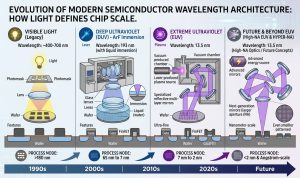
Modern semiconductor development has become particularly important to AI and information technology. Nobel Prize historical material notes that modern chips are fundamental to computers, communication systems, medical equipment, satellites and other technologies.
74. A 5,500-Year Timeline of Civilisation’s Scientific Development
3500–3000 BC
Writing, cities, accounting, mathematics and irrigation
3000–2000 BC
Egyptian engineering, monumental architecture, surveying and medicine
2000–500 BC
Babylonian mathematics, Egyptian astronomy, Greek natural philosophy
600–300 BC
Thales, Pythagoras, Hippocrates and Greek mathematics
300–100 BC
Euclid, Archimedes and Eratosthenes
100 BC–500 AD
Roman engineering, Ptolemaic astronomy, Chinese science, Indian mathematics
500–1000
Indian mathematics, Chinese technology and Islamic scientific scholarship
800–1200
Al-Khwarizmi, Ibn al-Haytham, Avicenna, Al-Biruni and Al-Jazari
1200–1500
Fibonacci, medieval universities, Chinese technological development and African intellectual centres
1500–1600
Copernicus, Vesalius, Leonardo
1600–1700
Galileo, Kepler, Descartes, Bacon, Newton
1700–1800
Calculus, mechanics, chemistry and steam engineering
1800–1900
Electricity, electromagnetism, thermodynamics, evolution, genetics, chemistry and industrial engineering
1900–1945
Quantum mechanics, relativity, nuclear physics, radio, aviation and modern biology
1945–1960
Transistor, computers, nuclear technology, space programmes
1960–1980
Integrated circuits, satellites, telecommunications and molecular biology
1980–2000
Personal computers, Internet, biotechnology, mobile telecommunications and the World Wide Web
2000–2010
Smartphones, cloud computing, genomics, advanced semiconductor manufacturing
2010–2020
Deep learning, massive data centres, advanced robotics, gene editing
2020–2026
Generative AI, AI accelerators, advanced robotics, quantum technologies, synthetic biology and increasingly interconnected digital infrastructure
75. The 20 Greatest Transformations in Human Knowledge
- Agriculture
- Writing
- Numerical mathematics
- Geometry
- Formal logic
- Astronomy
- Medicine
- Mechanical engineering
- Scientific experimentation
- Calculus
- Thermodynamics
- Electromagnetism
- Evolution and genetics
- Quantum physics
- Nuclear physics
- Semiconductor electronics
- Computer science
- Global telecommunications
- Molecular biotechnology
- Artificial intelligence
These developments are not independent. Each became a foundation for later technologies.
76. The Greatest Lesson of Scientific History
The most important conclusion from this historical survey is that civilisation is cumulative.
A farmer’s knowledge of seasons contributes to calendars.
A calendar contributes to astronomy.
Astronomy contributes to mathematics.
Mathematics contributes to physics.
Physics contributes to engineering.
Engineering contributes to machines.
Machines contribute to industrialisation.
Industrialisation contributes to electrical systems.
Electrical systems contribute to electronics.
Electronics contribute to computers.
Computers contribute to the Internet.
The Internet contributes to the global information economy.
Computing, mathematics and data contribute to artificial intelligence.
Thus the technological world of 2026 contains fragments of thousands of years of human intellectual effort.
77. Conclusion
From approximately 3500 BC to 2026, humanity has travelled from the first large-scale systems of writing, agriculture, measurement and irrigation to a civilisation capable of sequencing genomes, observing distant galaxies, communicating almost instantly across continents, designing microscopic electronic circuits and constructing artificial-intelligence systems.
The names of Imhotep, Pythagoras, Hippocrates, Euclid, Archimedes, Eratosthenes, Aryabhata, Brahmagupta, Zhang Heng, Al-Khwarizmi, Ibn al-Haytham, Avicenna, Al-Biruni, Al-Jazari, Leonardo da Vinci, Copernicus, Galileo, Kepler, Newton, Leibniz, Faraday, Darwin, Mendel, Pasteur, Maxwell, Tesla, Curie, Rutherford, Planck, Einstein, Bohr, Turing, Shannon, von Neumann, Bardeen, Brattain, Shockley, Kilby, Noyce, Franklin, Crick, Watson, Hubble, Berners-Lee and thousands of others form a vast intellectual network.
But the true history is larger than these famous names.
Millions of farmers, builders, craftsmen, physicians, technicians, teachers, engineers, laboratory workers, programmers, mathematicians and researchers contributed to civilisation without becoming famous.
The modern world is therefore not the creation of one nation or one civilisation.
It is a 5,500-year global inheritance of knowledge.
The Egyptians contributed monumental engineering and measurement. Mesopotamians developed sophisticated numerical and administrative systems. Greeks established influential traditions of formal mathematics and natural philosophy. India transformed numerical mathematics. China produced major innovations in engineering, materials, printing and navigation. Scholars across the Islamic world advanced mathematics, astronomy, medicine, optics and mechanical engineering. African societies developed agriculture, metallurgy, architecture, scholarship and systems of knowledge. European scientific revolutions transformed experimental and mathematical science. The industrial age converted scientific principles into machines and mass production. The twentieth century created quantum physics, electronics, aviation, nuclear science, computing and biotechnology. The twenty-first century is combining these foundations into AI, robotics, genomics, quantum technologies and advanced information systems.
The deepest pattern is therefore:
Human civilisation advances when knowledge is observed, recorded, mathematically represented, tested, shared, engineered and passed to the next generation.
That is the true connection between the ancient mathematician measuring a field, the Egyptian engineer constructing a monument, the Greek astronomer studying the heavens, Al-Khwarizmi developing algebra, Galileo observing the sky, Newton describing gravity, Maxwell describing electromagnetism, Einstein describing spacetime, Turing describing computation, semiconductor engineers building transistors, and today’s researchers developing artificial intelligence.
3500 BC gave humanity increasingly systematic measurement and organised knowledge.
2026 gives humanity machines capable of processing extraordinary quantities of knowledge.
The next stage of civilisation will depend on how wisely humanity uses that accumulated inheritance.
Final synthesis
3500 BC
Writing + agriculture + mathematics
↓
Ancient Civilisations
Engineering + astronomy + medicine
↓
Classical World
Geometry + mechanics + philosophy
↓
India, China, Africa and Islamic Civilisations
Numbers + algebra + optics + medicine + engineering
↓
Scientific Revolution
Experiment + mathematics + astronomy + physics
↓
Industrial Revolution
Steam + machines + factories + transportation
↓
Electrical Revolution
Electricity + electromagnetism + telecommunications
↓
Scientific Revolution of the 20th Century
Relativity + quantum mechanics + nuclear physics + genetics
↓
Electronic Revolution
Transistor + integrated circuit + microprocessor
↓
Information Revolution
Computers + Internet + software + mobile communications
↓
Biotechnology Revolution
DNA + genomics + gene editing
↓
Artificial Intelligence Revolution
Data + algorithms + computing + neural networks
↓
2026 AND BEYOND
AI + robotics + quantum technology + biotechnology + advanced materials + space technology + renewable energy
This is the great historical architecture of modern civilisation: one generation builds upon the mathematics, observations, experiments and engineering of the generations before it.
UNESCO’s long-running General History of Africa project is a useful reminder of this global perspective: its ten-volume programme was developed through decades of collaboration involving more than 550 historians and specialists, with African scholars forming a majority of the International Scientific Committee.
The history of science is consequently not merely a history of famous people.
It is the history of humanity learning how to understand reality and transform knowledge into civilisation.

Be First to Comment