
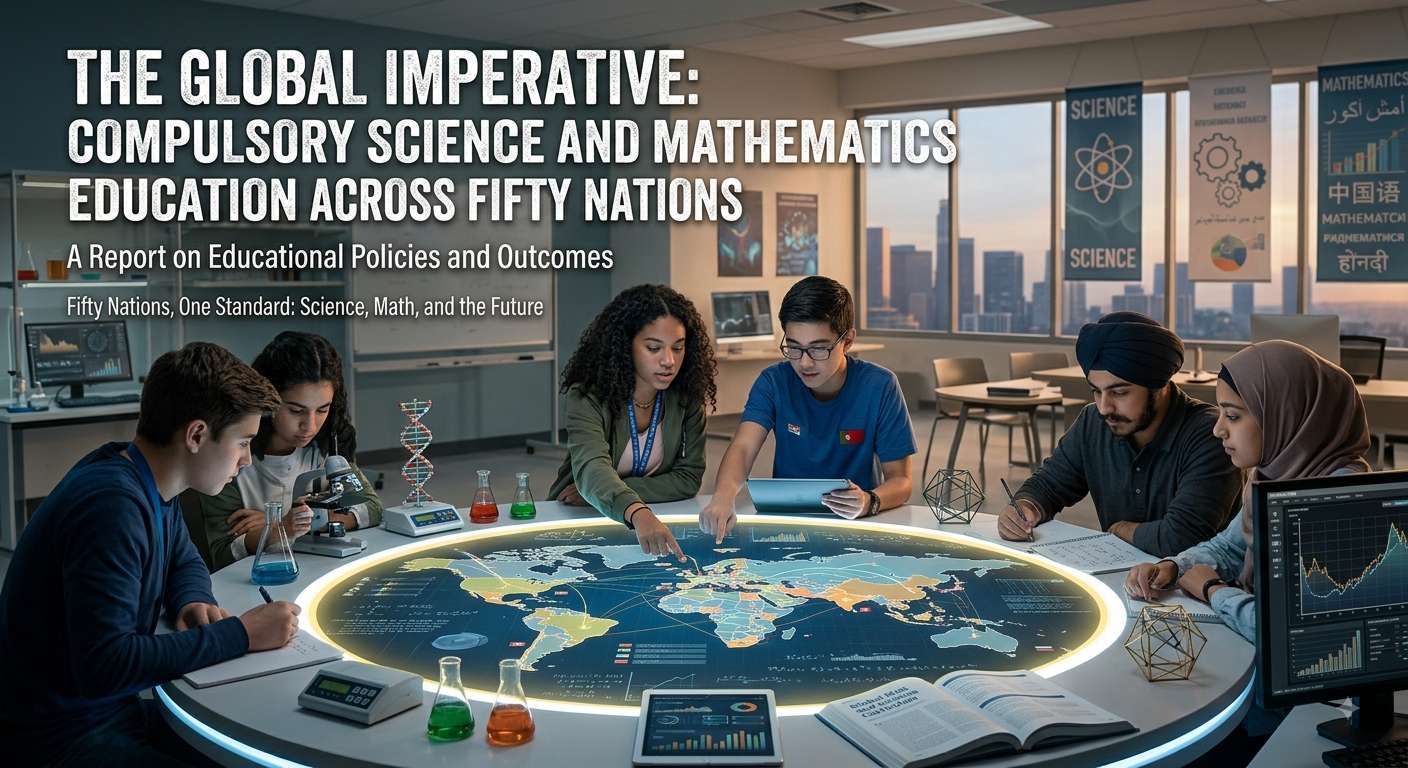
A Comprehensive Comparative Thesis on Education, Scientific Literacy, Human Capital and National Development
Abstract
Science and mathematics constitute two of the fundamental intellectual foundations of modern civilization. They provide the conceptual and analytical tools through which societies understand nature, develop technologies, construct infrastructure, manage economies, improve medicine, communicate across distances, and address increasingly complex global challenges.
This thesis examines the case for strong, universal and compulsory science and mathematics education across fifty nations. It investigates the historical development of scientific education, the role of mathematics in civilization, national education systems, curriculum design, teacher preparation, laboratories, digital technologies, artificial intelligence, engineering education, vocational pathways, socioeconomic inequality and the relationship between educational capacity and national technological development.
The study does not argue that every student must become a scientist, mathematician or engineer. Rather, it argues that every citizen should have meaningful access to foundational scientific and mathematical knowledge. The objective is to develop populations capable of reasoning with evidence, interpreting quantitative information, understanding technology, making informed decisions and participating productively in modern economies.
UNESCO’s 2026 Global Education Monitoring Report demonstrates that universal access itself remains unfinished: 273 million children and young people were estimated to be out of school in 2024. Consequently, the global STEM challenge has two dimensions: expanding access to education and improving the quality and relevance of what students learn.
PART I — THE FOUNDATIONS OF THE GLOBAL STEM IMPERATIVE
Chapter 1. Introduction
1.1 The central proposition
1.2 Why science and mathematics matter to civilization
1.3 Education as national infrastructure
1.4 From literacy to scientific and quantitative literacy
1.5 The relationship between education, innovation and economic development
1.6 Research questions
1.7 Objectives of the study
1.8 Scope and limitations
1.9 Methodology
Chapter 2. The Historical Evolution of Scientific and Mathematical Education
2.1 Mathematics in ancient civilizations
2.2 Egyptian mathematical traditions
2.3 Mesopotamian mathematics
2.4 Greek mathematics and natural philosophy
2.5 Indian mathematical contributions
2.6 Chinese scientific and mathematical traditions
2.7 Islamic Golden Age scholarship
2.8 European scientific revolution
2.9 Newton, Leibniz and the mathematical description of nature
2.10 Industrial Revolution and technical education
2.11 Nineteenth-century mass education
2.12 Twentieth-century scientific education
2.13 Space exploration and the expansion of STEM education
2.14 Digital computing and information technology
2.15 Artificial intelligence and the new educational era
PART II — WHY SCIENCE AND MATHEMATICS SHOULD BE UNIVERSAL
Chapter 3. Mathematics as a Universal Language
3.1 Numbers and measurement
3.2 Arithmetic
3.3 Algebra
3.4 Geometry
3.5 Trigonometry
3.6 Calculus
3.7 Probability and statistics
3.8 Discrete mathematics
3.9 Mathematical modelling
3.10 Mathematics in economics and finance
3.11 Mathematics in engineering
3.12 Mathematics in computing and artificial intelligence
3.13 Mathematics in medicine and public health
3.14 Mathematical literacy for ordinary citizens
Chapter 4. Science as a Method of Understanding Reality
4.1 Observation
4.2 Hypothesis formation
4.3 Experimentation
4.4 Measurement
4.5 Evidence and reproducibility
4.6 Scientific reasoning
4.7 Physics
4.8 Chemistry
4.9 Biology
4.10 Earth and environmental sciences
4.11 Astronomy and space science
4.12 Computer science
4.13 Scientific literacy and informed citizenship
The modern conception of science education increasingly emphasizes not merely memorizing scientific facts but being able to evaluate evidence, interpret scientific information and use scientific reasoning when making decisions. This direction is reflected in the OECD’s PISA 2025 science framework.
PART III — THE ARCHITECTURE OF A MODERN STEM EDUCATION SYSTEM
Chapter 5. Education from Early Childhood to University
5.1 Early childhood development
5.2 Preschool mathematics
5.3 Preschool scientific discovery
5.4 Primary-school mathematics
5.5 Primary-school science
5.6 Lower-secondary mathematics
5.7 Lower-secondary science
5.8 Upper-secondary specialization
5.9 Advanced mathematics
5.10 Physics, chemistry and biology
5.11 Computer science
5.12 Engineering pathways
5.13 Technical and vocational education
5.14 Universities and research institutions
5.15 Lifelong learning
Chapter 6. What Should Every Student Know?
6.1 Foundational numeracy
6.2 Algebraic reasoning
6.3 Geometry and spatial reasoning
6.4 Statistics and probability
6.5 Scientific measurement
6.6 Experimental reasoning
6.7 Energy and matter
6.8 Life sciences
6.9 Earth systems
6.10 Digital literacy
6.11 Computational thinking
6.12 Data literacy
6.13 Environmental literacy
6.14 Artificial intelligence literacy
6.15 Ethics and responsible technology
PART IV — COMPARATIVE STUDY OF FIFTY NATIONS
Chapter 7. Methodology for Comparing Fifty Education Systems
The fifty-country comparison should evaluate each country using the same framework rather than simply ranking countries by examination scores.
Proposed indicators
- Compulsory education age range
- Years of free education
- Mathematics curriculum
- Science curriculum
- Teacher qualifications
- Teacher-to-student ratio
- STEM teacher availability
- Laboratory infrastructure
- Digital infrastructure
- Computer access
- Internet connectivity
- Mathematics achievement
- Science achievement
- Research capacity
- University STEM participation
- Engineering graduate production
- Technical and vocational education
- Gender participation
- Rural education access
- Education expenditure
- Equity
- Industry-school partnerships
- AI and computational education
- National research and development capacity
- STEM employment opportunities
Chapter 8. The Fifty-Nation Comparative Framework
Group A — Major STEM and Research Powers
- United States
- China
- Japan
- Germany
- United Kingdom
- France
- South Korea
- Canada
- Australia
- Russia
Group B — High-Performing and Innovation-Oriented Education Systems
- Singapore
- Finland
- Sweden
- Switzerland
- Netherlands
- Denmark
- Norway
- Belgium
- Austria
- Estonia
Group C — Major Emerging Economies
- India
- Brazil
- Mexico
- Indonesia
- Türkiye
- Malaysia
- Thailand
- Vietnam
- Philippines
- South Africa
Group D — African Education and Development Systems
- Egypt
- Nigeria
- Kenya
- Ghana
- Ethiopia
- Tanzania
- Rwanda
- Uganda
- Morocco
- Algeria
Group E — Additional Global Education Systems
- Saudi Arabia
- United Arab Emirates
- Israel
- New Zealand
- Ireland
- Portugal
- Spain
- Italy
- Poland
- Chile
Important methodological principle: the fifty nations should not simply be presented as a league table. The study should distinguish between educational access, learning outcomes, research capacity, socioeconomic conditions and national development. International assessments provide useful comparative evidence but cannot by themselves capture the entire quality or purpose of an education system.
PART V — COUNTRY-BY-COUNTRY ANALYSIS
Chapter 9. United States
Education structure
Mathematics curriculum
Science curriculum
Computer science
Universities
Research ecosystem
Industry partnerships
Strengths
Challenges
Lessons for other nations
Chapter 10. China
National education structure
Mathematics
Science
Engineering
Digital education
Research universities
Industrial strategy
STEM workforce development
Strengths and challenges
Chapter 11. Japan
Mathematics and science
Teacher development
Technical education
Engineering culture
Research infrastructure
Chapter 12. Germany
Academic education
Dual vocational education
Engineering
Industry partnerships
Apprenticeship model
Chapter 13. United Kingdom
STEM curriculum
Universities
Research institutions
Engineering education
Innovation ecosystem
Chapter 14. Singapore
Mathematics achievement
Science education
Teacher quality
National planning
Digital education
Lessons for developing countries
Chapter 15. Finland
Teacher preparation
Curriculum philosophy
Mathematics and science
Equity
Student wellbeing
Chapter 16. South Korea
Mathematics
Science
Technology
Engineering
Research and industrial development
Chapter 17. India
Scale of education
Mathematics tradition
Engineering education
Digital learning
STEM workforce
Challenges of inequality and access
Chapter 18. South Africa
Basic education
Mathematics performance
Science education
Technical and vocational education
Universities
Engineering capacity
Digital divide
Rural education
Infrastructure challenges
Opportunities for African STEM leadership
Chapter 19. Other African Nations
Comparative analysis of:
- Egypt
- Nigeria
- Kenya
- Ghana
- Ethiopia
- Tanzania
- Rwanda
- Uganda
- Morocco
- Algeria
Common challenges
- Teacher shortages
- Infrastructure deficits
- Laboratory shortages
- Unequal rural access
- Digital inequality
- Mathematics achievement gaps
- Limited research funding
- Brain drain
Emerging opportunities
- Mobile education
- Digital classrooms
- AI-assisted learning
- Open educational resources
- Regional universities
- STEM scholarships
- Industry partnerships
PART VI — THE PEOPLE WHO MAKE STEM EDUCATION POSSIBLE
Chapter 20. The Teacher as the Core of the STEM System
20.1 Teacher recruitment
20.2 Mathematics teacher preparation
20.3 Science teacher preparation
20.4 Engineering educators
20.5 Continuous professional development
20.6 Digital teaching skills
20.7 AI-assisted teaching
20.8 Teacher retention
20.9 International teacher shortages
20.10 Creating a prestigious STEM teaching profession
PART VII — INFRASTRUCTURE
Chapter 21. The Physical Infrastructure of STEM Education
21.1 Classrooms
21.2 Mathematics laboratories and learning spaces
21.3 Science laboratories
21.4 Physics laboratories
21.5 Chemistry laboratories
21.6 Biology laboratories
21.7 Computer laboratories
21.8 Engineering workshops
21.9 Libraries
21.10 Internet connectivity
21.11 Electricity
21.12 Educational equipment
21.13 Rural infrastructure
PART VIII — DIGITAL AND ARTIFICIAL INTELLIGENCE EDUCATION
Chapter 22. The Digital Transformation of STEM Education
22.1 Computers in education
22.2 Internet-based learning
22.3 Educational software
22.4 Simulation laboratories
22.5 Virtual laboratories
22.6 Online mathematics
22.7 Programming education
22.8 Robotics
22.9 Data science
22.10 Artificial intelligence
22.11 AI tutors
22.12 Responsible use of AI
22.13 Digital information evaluation
Modern science education increasingly needs to address the quality of information students encounter online. The OECD’s PISA 2025 framework specifically incorporates students’ ability to research, evaluate and use scientific information for decision-making.
PART IX — STEM AND NATIONAL DEVELOPMENT
Chapter 23. From Education to Industrialization
23.1 Education and productivity
23.2 STEM and manufacturing
23.3 STEM and infrastructure
23.4 STEM and energy
23.5 STEM and telecommunications
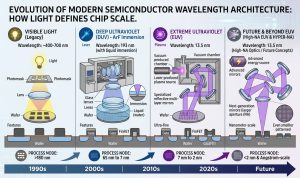
23.6 STEM and semiconductor technology
23.7 STEM and artificial intelligence
23.8 STEM and agriculture
23.9 STEM and mining
23.10 STEM and healthcare
23.11 STEM and space technology
23.12 STEM and national competitiveness
PART X — EQUITY AND UNIVERSAL ACCESS
Chapter 24. Making STEM Education Accessible to Everyone
24.1 Rural versus urban education
24.2 Poverty and educational opportunity
24.3 Gender participation
24.4 Students with disabilities
24.5 Language barriers
24.6 Digital inequality
24.7 School funding
24.8 Nutrition and learning
24.9 Transportation
24.10 Inclusive STEM education
UNESCO’s 2026 findings reinforce that access and equity must be treated as central components of education policy rather than secondary considerations.
PART XI — COMPULSORY EDUCATION: THE POLICY QUESTION
Chapter 25. Should Science and Mathematics Be Compulsory?
25.1 Arguments supporting compulsory STEM
25.2 Arguments against excessive compulsion
25.3 The difference between compulsory exposure and compulsory specialization
25.4 Minimum mathematics standards
25.5 Minimum science standards
25.6 Age-appropriate curricula
25.7 Student choice at advanced levels
25.8 Balancing STEM with humanities, arts and social sciences
25.9 The concept of a scientifically literate citizen
25.10 A proposed global minimum STEM entitlement
PART XII — MEASURING SUCCESS
Chapter 26. How Should Countries Measure STEM Education?
26.1 Literacy and numeracy
26.2 Scientific reasoning
26.3 Problem solving
26.4 Creativity
26.5 Computational thinking
26.6 Laboratory competence
26.7 Mathematics achievement
26.8 Science achievement
26.9 University progression
26.10 STEM employment
26.11 Research output
26.12 Patents and innovation
26.13 Industrial productivity
26.14 Long-term national outcomes
PART XIII — THE GLOBAL STEM EDUCATION BLUEPRINT
Chapter 27. A Proposed Global STEM Education Framework
Level 1 — Early Childhood
- Numbers
- Patterns
- Shapes
- Observation
- Nature
- Measurement
- Curiosity
Level 2 — Primary Education
- Arithmetic
- Geometry
- Basic statistics
- Physical science
- Life science
- Earth science
- Computing fundamentals
Level 3 — Lower Secondary
- Algebra
- Geometry
- Probability
- Physics
- Chemistry
- Biology
- Computer science
- Scientific experimentation
Level 4 — Upper Secondary
- Advanced mathematics
- Physics
- Chemistry
- Biology
- Computer science
- Engineering fundamentals
- Statistics
- Data science
Level 5 — Tertiary Education
- University science
- Engineering
- Medicine
- Computer science
- Mathematics
- Research
- Innovation
- Entrepreneurship
PART XIV — THE 2030 AND 2050 EDUCATION CHALLENGE
Chapter 28. From Current Education Systems to Future-Ready STEM Systems
28.1 Closing the access gap
28.2 Improving foundational learning
28.3 Strengthening teachers
28.4 Building laboratories
28.5 Connecting schools to the Internet
28.6 Expanding technical education
28.7 Integrating AI responsibly
28.8 Increasing university research capacity
28.9 Connecting education with industry
28.10 Building national innovation ecosystems
PART XV — SPECIAL FOCUS ON AFRICA
Chapter 29. Africa’s STEM Opportunity
29.1 Africa’s demographic transformation
29.2 The education challenge
29.3 Mathematics achievement
29.4 Science infrastructure
29.5 Engineering capacity
29.6 Digital transformation
29.7 AI opportunities
29.8 Renewable energy
29.9 Agriculture technology
29.10 Mining technology
29.11 Healthcare technology
29.12 African research universities
29.13 Continental STEM cooperation
29.14 Retaining scientific talent
29.15 Building an African knowledge economy
PART XVI — POLICY RECOMMENDATIONS
Chapter 30. Twenty-Five Global Recommendations
- Guarantee universal access to primary and secondary education.
- Establish strong minimum mathematics standards.
- Establish strong minimum science standards.
- Strengthen early-childhood numeracy and scientific discovery.
- Improve mathematics teacher preparation.
- Improve science teacher preparation.
- Expand laboratory infrastructure.
- Connect schools to reliable electricity.
- Expand affordable broadband access.
- Provide appropriate digital learning resources.
- Introduce computational thinking.
- Teach responsible AI literacy.
- Expand technical and vocational education.
- Strengthen engineering pathways.
- Increase STEM scholarships.
- Support girls and underrepresented students in STEM.
- Reduce rural-urban education disparities.
- Strengthen university research systems.
- Connect universities with industry.
- Increase national research and development investment.
- Promote open educational resources.
- Improve international STEM cooperation.
- Measure educational outcomes transparently.
- Protect education systems from extreme inequality.
- Treat scientific and mathematical education as strategic national infrastructure.
Chapter 31. A Proposed Global STEM Compact
The thesis can conclude by proposing a Global STEM Education Compact based on five principles:
Principle 1 — Universal Access
Every child should have meaningful access to quality mathematics and science education.
Principle 2 — Universal Foundations
Every student should acquire foundational quantitative, scientific and digital competencies.
Principle 3 — Excellence
Students with advanced STEM interests should have pathways toward higher-level mathematics, science, engineering and research.
Principle 4 — Equity
Geography, family income, gender or disability should not determine whether a student receives quality STEM education.
Principle 5 — National Development
Governments should connect education policy with research, industry, infrastructure, innovation and employment.
Chapter 32. Conclusion
The future competitiveness of nations will depend not merely on natural resources, financial capital or physical infrastructure, but increasingly on the knowledge, scientific capabilities and problem-solving capacity of their populations.
Mathematics enables humanity to quantify reality. Science provides systematic methods for understanding it. Engineering transforms knowledge into practical systems. Computing processes information at unprecedented scale. Artificial intelligence increasingly combines these capabilities into new forms of technological productivity.
For this reason, mathematics and science should not be regarded solely as specialized subjects for a small proportion of students. Their foundational principles constitute part of the intellectual infrastructure required by modern citizens.
At the same time, compulsory education must mean more than requiring attendance. It must provide teachers, laboratories, books, electricity, connectivity, appropriate curricula, effective assessment and genuine opportunities to learn.
The global objective should therefore be universal scientific and mathematical competence, combined with specialized pathways for advanced STEM education.
The ultimate measure of success is not simply how many students pass examinations. It is whether education enables societies to understand problems, generate evidence, develop technology, solve practical challenges, create productive employment and improve human wellbeing.
Appendices
Appendix A — Fifty-Nation Comparison Matrix
For every country:
- Population
- Education expenditure
- Years of compulsory education
- Years of free education
- Mathematics curriculum
- Science curriculum
- STEM teacher supply
- Mathematics achievement
- Science achievement
- Digital access
- Research expenditure
- University STEM participation
- Engineering graduates
- Technical education
- Major strengths
- Major challenges
- Recommended reforms
Appendix B — STEM Curriculum Framework
A year-by-year curriculum from early childhood through secondary school.
Appendix C — STEM Infrastructure Framework
Minimum infrastructure requirements for:
- Primary schools
- Secondary schools
- Technical colleges
- Universities
- Research laboratories
Appendix D — STEM Teacher Framework
Requirements for:
- Teacher qualifications
- Professional development
- Digital competency
- Laboratory competency
- AI literacy
- Career progression
Appendix E — Global STEM Indicators
A standardized international indicator system for measuring:
- Access
- Quality
- Equity
- Achievement
- Infrastructure
- Teachers
- Research
- Innovation
- Employment
Appendix F — Glossary
Definitions of:
- STEM
- STEAM
- Scientific literacy
- Mathematical literacy
- Numeracy
- Computational thinking
- Digital literacy
- Artificial intelligence
- Engineering education
- Technical and vocational education
- Research and development
- Human capital
- Knowledge economy
Suggested Final Blog Title
The Global Imperative: Compulsory Science and Mathematics Education Across Fifty Nations
Suggested Subtitle
A Comprehensive 2026 Comparative Thesis on STEM Education, Human Capital, Innovation, Technology and National Development
Suggested Blog Positioning
This should be presented as an independent global education research article, with no reference to Millennium 3001. Its strongest identity would be a serious comparative study connecting education → scientific literacy → human capital → engineering → technology → innovation → economic development.

Be First to Comment