
A Comprehensive Scientific, Astronomical and Technological Thesis
Abstract
Jupiter is the largest planet in the Solar System and one of the most scientifically important objects orbiting the Sun. With a mass greater than twice that of all the other planets combined, an extraordinarily rapid rotation period of approximately 9.9 hours, a powerful magnetic field, a vast magnetosphere, a complex atmosphere and a remarkable family of moons, Jupiter is effectively a planetary system within the Solar System.
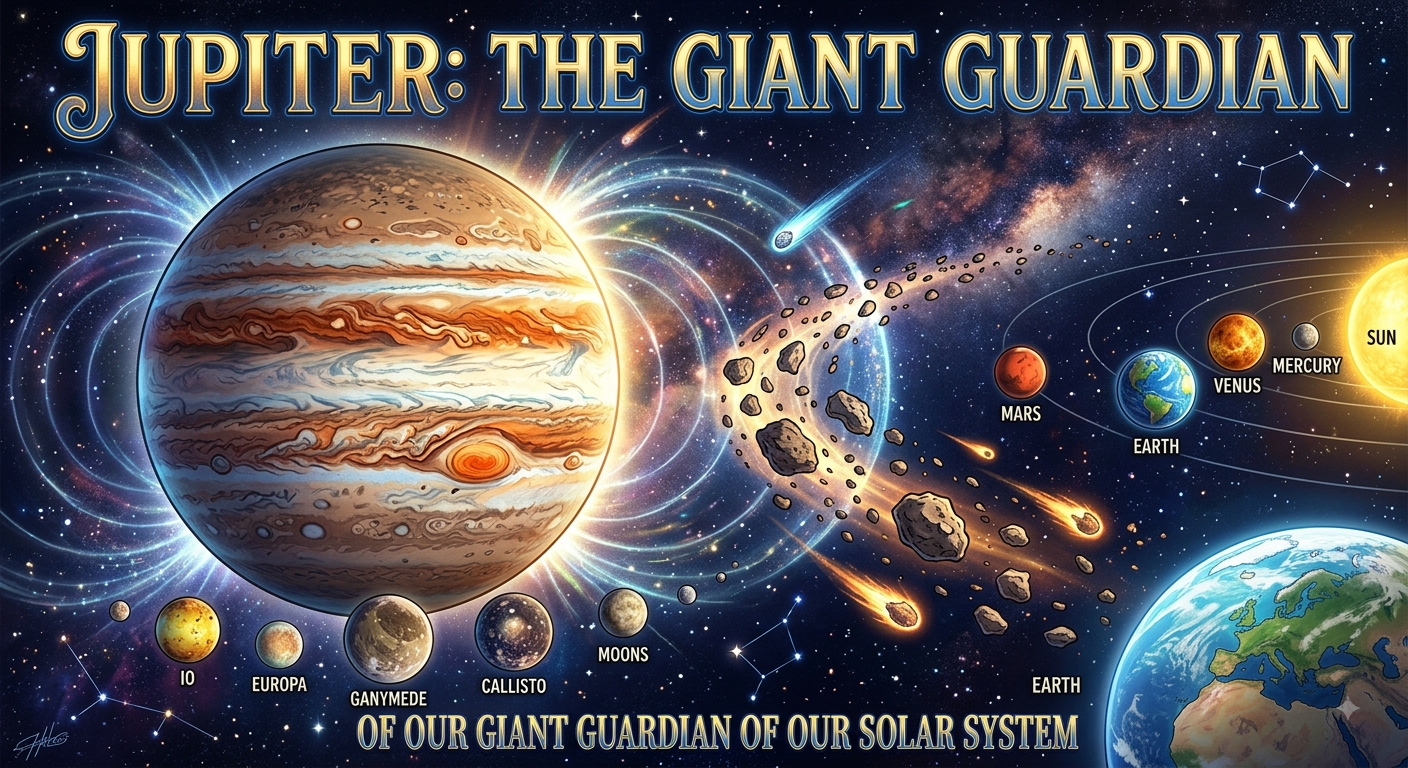
Its importance extends beyond its physical size. Jupiter’s enormous gravitational influence has affected the trajectories, migration and long-term evolution of planets, asteroids, comets and other small bodies. For this reason, it is sometimes popularly described as a “guardian” of the Solar System. Scientifically, however, this description must be treated carefully: Jupiter can redirect some small bodies away from the inner Solar System while also sending others toward it. Its role is therefore better understood as that of a powerful gravitational architect.
This thesis examines Jupiter from its formation approximately 4.6 billion years ago through its internal structure, atmosphere, storms, magnetic field, radiation environment, rings, moons, gravitational influence, potential relationship with Earth’s history and the technological exploration that has transformed our understanding of the giant planet.
1. Introduction
The Solar System contains eight planets, but Jupiter occupies a category of its own.
It is the fifth planet from the Sun and the largest planet in the Solar System. NASA notes that approximately 1,000 Earths could fit inside Jupiter if it were hollow. Its rapid rotation produces a Jovian day of only about 9.9 hours.
Jupiter is a gas giant dominated by hydrogen and helium. Unlike Earth, it does not possess a conventional solid surface upon which a spacecraft could land. Instead, atmospheric gases become progressively denser and eventually transition into exotic high-pressure states of matter.
The planet therefore represents a natural laboratory for studying:
- planetary formation;
- atmospheric physics;
- fluid dynamics;
- high-pressure physics;
- magnetohydrodynamics;
- planetary magnetic fields;
- radiation physics;
- orbital mechanics;
- planetary geology through its moons;
- and the formation of giant planets around other stars.
2. Jupiter at a Glance
| Property | Jupiter |
|---|---|
| Position from Sun | Fifth planet |
| Planetary class | Gas giant |
| Age | Approximately 4.6 billion years |
| Largest planet | Yes |
| Approximate rotation period | 9.9 hours |
| Main atmospheric elements | Hydrogen and helium |
| Conventional solid surface | No |
| Major storm | Great Red Spot |
| Major magnetic feature | Enormous magnetosphere |
| Major moons | Io, Europa, Ganymede, Callisto |
| Officially recognized moons | 101 as of March 2026 |
| Primary modern Jupiter orbiter | NASA Juno |
The number of officially recognized Jovian moons has changed as increasingly small satellites have been discovered. NASA reported 101 officially recognized moons as of March 2026.
3. The Birth of Jupiter
Jupiter formed during the earliest stages of Solar System development.
Approximately 4.6 billion years ago, the Solar System emerged from a collapsing cloud of gas and dust. Most of the material eventually became the Sun, while the remaining material formed a rotating protoplanetary disk.
Jupiter formed in the outer regions of this disk.
Its enormous mass enabled it to capture large quantities of hydrogen and helium. In this sense, Jupiter preserved material from the early Solar System.
Studying Jupiter therefore provides scientists with an opportunity to investigate conditions that existed during planetary formation.
NASA describes Jupiter as a kind of planetary time capsule because its enormous mass allowed it to retain much of its original composition.
4. Why Jupiter Became So Large
The formation of Jupiter depended on the availability of material beyond the Solar System’s early snow line, where temperatures were low enough for water and other compounds to exist as ice.
A developing planetary core could accumulate solid material and eventually become massive enough to gravitationally capture surrounding hydrogen and helium.
This process produced a feedback mechanism:
More mass → stronger gravity → more gas captured → greater mass → stronger gravity
The result was a planet dramatically larger than Earth.
5. Jupiter’s Internal Architecture
Jupiter has no conventional surface.
As altitude decreases, pressure and temperature increase continuously.
A simplified journey toward its interior can be represented as:
Cloud tops
↓
Dense molecular hydrogen
↓
Increasing pressure and temperature
↓
Liquid-like hydrogen
↓
Metallic hydrogen
↓
Heavy-element-rich deep interior
Jupiter’s interior is radically different from Earth’s.
On Earth, water, rock and metal form recognizable solid and liquid layers.
Inside Jupiter, pressure becomes so enormous that hydrogen enters states that do not occur naturally on Earth’s surface.
6. Metallic Hydrogen
One of the most extraordinary substances associated with Jupiter is metallic hydrogen.
Under extreme pressure, hydrogen can become electrically conducting.
Deep inside Jupiter, hydrogen is compressed into a metallic fluid.
This electrically conducting material is believed to play a major role in generating Jupiter’s magnetic field.
The mechanism is related to the dynamo process:
rapid rotation + electrically conducting fluid + convection
→
electric currents
→
magnetic field
NASA’s Juno measurements have provided important evidence about the depth and structure of Jupiter’s magnetic field and the interior region responsible for it.
7. The “Fuzzy” Core
For many years, scientists imagined Jupiter as having a relatively compact central core surrounded by hydrogen and helium.
Juno changed this picture.
Measurements of Jupiter’s gravity field indicate that the planet’s central heavy-element region is larger and more diffuse than previously expected.
Scientists describe this structure as a dilute or “fuzzy” core.
Rather than a simple boundary between a compact rocky core and surrounding hydrogen, the transition appears considerably more gradual.
This discovery has important consequences for theories of giant-planet formation.
8. Jupiter’s Atmosphere
Jupiter’s visible atmosphere is dominated by:
- hydrogen;
- helium;
- methane;
- ammonia;
- water;
- and other trace compounds.
The planet’s atmosphere is organized into alternating bands.
These are commonly divided into:
Zones
Relatively bright atmospheric bands.
Belts
Darker atmospheric bands.
These structures are associated with powerful jet streams moving in alternating directions.
Juno measurements indicate that the visible belts and zones extend approximately 3,000 kilometers below the cloud tops.
9. The Physics of Jupiter’s Weather
Jupiter’s atmosphere is an enormous natural laboratory for fluid dynamics.
Its weather systems are driven by:
- rapid rotation;
- convection;
- internal heat;
- atmospheric composition;
- pressure gradients;
- and interactions between enormous jet streams.
Unlike Earth’s atmosphere, Jupiter’s weather systems can persist for extraordinarily long periods.
There is no land surface interrupting the atmospheric circulation.
Consequently, enormous vortices can develop and survive.
10. The Great Red Spot
The Great Red Spot is probably Jupiter’s most famous feature.
It is a gigantic anticyclonic storm in Jupiter’s southern hemisphere.
It has existed for centuries, although scientists cannot establish with certainty that every historical observation of a Jovian “red spot” refers to exactly the same structure.
Juno has demonstrated that the Great Red Spot extends hundreds of kilometers below the visible cloud tops.
NASA measurements have placed its depth at roughly 300–500 kilometers depending on the observational analysis and measurement period.
This makes it not merely a surface-level cloud pattern but a massive three-dimensional atmospheric structure.
11. Why Is the Great Red Spot Red?
The exact chemical mechanism responsible for the storm’s reddish appearance remains an active scientific question.
Possible contributors include chemical reactions involving compounds exposed to ultraviolet radiation and materials transported from deeper atmospheric layers.
The red color should therefore not be interpreted as evidence of a single simple substance.
Jupiter’s atmosphere is a chemically complex environment.
12. Jupiter’s Lightning
Jupiter experiences powerful lightning storms.
Electrical activity in its atmosphere provides information about atmospheric convection and the distribution of water and other compounds.
Lightning demonstrates that Jupiter’s atmosphere is not a static cloud layer.
It is an active electrical and thermodynamic system.
13. Jupiter’s Polar Cyclones
One of Juno’s most remarkable discoveries was the structure of Jupiter’s poles.
Instead of looking like a simple extension of the equatorial cloud bands, Jupiter’s poles contain enormous collections of cyclones.
These storms form complex geometric patterns around the polar regions.
Juno’s polar observations were particularly important because earlier spacecraft had largely observed Jupiter from near its equatorial plane.
Juno’s polar orbit provided an entirely new perspective.
14. Jupiter’s Magnetic Field
Jupiter possesses the strongest planetary magnetic field in the Solar System.
NASA estimates that its magnetic field is approximately 16 to 54 times stronger than Earth’s, depending on the region being compared.
Its magnetic environment is generated by processes deep inside the planet.
The magnetic field:
- traps charged particles;
- produces intense radiation belts;
- generates spectacular auroras;
- interacts with Jupiter’s moons;
- and creates an enormous magnetosphere.
15. The Jovian Magnetosphere
Jupiter’s magnetosphere is enormous.
It is created by the interaction between Jupiter’s magnetic field and the solar wind.
On the Sun-facing side, the magnetosphere is compressed by solar-wind pressure.
On the opposite side, it forms an enormous magnetic tail.
NASA describes the Jovian magnetosphere as extending millions of kilometers and, in its elongated tail, reaching enormous distances comparable with the scale of Saturn’s orbit.
This makes Jupiter’s magnetosphere one of the largest structures associated with any planet.
16. Jupiter as a Radiation Laboratory
The same magnetic field that makes Jupiter scientifically fascinating also produces an extraordinarily harsh radiation environment.
Charged particles become trapped and accelerated by the magnetic field.
These energetic particles can severely affect spacecraft electronics.
This is why Juno required extraordinary radiation protection.
NASA equipped Juno with a titanium electronics vault designed to protect sensitive systems from Jupiter’s high-energy particle environment.
17. Jupiter’s Auroras
Jupiter produces spectacular auroras around its poles.
Like Earth’s auroras, Jovian auroras involve energetic charged particles interacting with the atmosphere.
However, Jupiter’s system is considerably more powerful and complex.
Juno discovered that some of Jupiter’s auroral processes operate differently from the mechanisms responsible for Earth’s northern and southern lights.
18. Jupiter’s Moons: A Planetary System Within a Planetary System
Jupiter’s moons constitute one of the greatest scientific treasures in planetary astronomy.
The four most famous are:
- Io
- Europa
- Ganymede
- Callisto
These are known as the Galilean moons because Galileo Galilei identified them telescopically in 1610.
Their discovery demonstrated that not everything in the heavens orbited Earth.
This was a major event in the development of modern astronomy.
19. Io — The Volcanic World
Io is the innermost of the four Galilean moons.
It is extraordinarily volcanically active.
Jupiter’s immense gravity and the gravitational interactions among the Galilean moons generate powerful tidal forces inside Io.
These forces produce heat.
The result is a world covered by active volcanic processes.
Juno has obtained close observations of Io, including observations of volcanic activity and fresh lava fields.
20. Europa — The Ocean World
Europa is covered by an icy surface.
Beneath that ice, scientists have strong evidence for a global subsurface ocean.
Europa is therefore one of the most important locations in the Solar System for studying environments that could potentially possess conditions suitable for life.
NASA’s Europa Clipper spacecraft launched in October 2024 to conduct an extensive investigation of Europa.
21. Ganymede — The Largest Moon
Ganymede is the largest moon in the Solar System.
It is even larger in diameter than Mercury, although it has substantially less mass.
Ganymede is also scientifically remarkable because it possesses its own intrinsic magnetic field.
It therefore represents a natural laboratory for studying planetary and satellite magnetism.
22. Callisto — The Ancient Surface
Callisto is the outermost of the four Galilean moons.
Its heavily cratered surface preserves evidence of ancient impacts.
Callisto therefore provides scientists with an important record of the early Solar System’s violent history.
Together, Io, Europa, Ganymede and Callisto demonstrate that moons can be extraordinarily diverse worlds.
23. Jupiter’s Rings
Jupiter possesses rings, although they are much fainter than Saturn’s spectacular ring system.
The Jovian rings are composed primarily of dust and small particles.
They demonstrate that ring systems are not unique to Saturn.
Jupiter’s rings also interact with the planet’s moons and surrounding dust environment.
24. Jupiter’s Gravitational Power
Jupiter’s enormous mass gives it enormous gravitational influence.
Gravity affects:
- asteroids;
- comets;
- moons;
- spacecraft;
- planetary orbits;
- and small bodies crossing the Solar System.
This is the foundation of the “guardian” concept.
However, Jupiter is not simply a cosmic shield.
Its gravity can both remove objects from dangerous trajectories and redirect objects toward the inner Solar System.
Therefore:
Jupiter is better described scientifically as a gravitational architect than as an absolute shield.
25. Jupiter and the Asteroid Belt
Jupiter strongly influences the asteroid belt between Mars and Jupiter.
Its gravitational resonances can destabilize asteroid orbits.
Some objects can be pushed into new trajectories that eventually cross the paths of the terrestrial planets.
Other objects can be captured, redirected or expelled.
Thus Jupiter contributes to the dynamic architecture of the Solar System.
26. Jupiter and Comets
Jupiter can dramatically alter the paths of comets.
A comet passing relatively close to Jupiter can experience a significant gravitational deflection.
In certain cases, Jupiter’s gravity can capture a comet into a shorter-period orbit.
The famous Shoemaker-Levy 9 event demonstrated the extraordinary gravitational interaction between Jupiter and a comet.
The comet fragmented and subsequently collided with Jupiter in 1994.
The event provided humanity with a direct demonstration of planetary-scale celestial dynamics.
27. Jupiter as a “Guardian”
The popular phrase “Giant Guardian of the Solar System” captures an important idea but requires scientific qualification.
Jupiter’s gravitational influence can:
Deflect → Capture → Scatter → Accelerate → Redirect
small bodies.
Some objects may therefore be prevented from reaching the inner Solar System.
But other trajectories can be altered in the opposite direction.
Consequently, Jupiter’s influence is neither universally protective nor universally dangerous.
Its true role is more profound:
Jupiter helps determine the long-term gravitational architecture of the Solar System.
28. Jupiter and Earth’s History
Earth’s environment has evolved within a Solar System shaped by gravitational interactions among all its major bodies.
Jupiter’s presence affects the distribution and orbital evolution of small bodies.
This means that understanding Jupiter contributes to understanding the long-term history of Earth.
However, scientists should avoid claiming that Jupiter simply “saved Earth.”
The actual gravitational dynamics are substantially more complicated.
29. Galileo’s Revolution
In 1610, Galileo Galilei turned a telescope toward Jupiter.
He observed four points of light moving around Jupiter.
These became Io, Europa, Ganymede and Callisto.
The observation demonstrated that celestial bodies could orbit something other than Earth.
This observation became one of the major milestones in the Scientific Revolution.
30. From Telescopes to Spacecraft
The technological history of Jupiter exploration can be viewed as a sequence:
Naked-eye astronomy
↓
Optical telescopes
↓
Advanced ground-based observatories
↓
Space telescopes
↓
Flyby spacecraft
↓
Orbiters
↓
High-resolution planetary science
The transformation has been extraordinary.
What Galileo saw as four tiny points of light has become a complex planetary system studied using advanced spacecraft instrumentation.
31. Pioneer and Voyager
The Pioneer missions provided early close-range observations of Jupiter.
The Voyager spacecraft subsequently transformed planetary science through extensive imaging of Jupiter and its moons.
These missions demonstrated that the Jovian system was much more active and complex than scientists had previously understood.
32. Galileo Mission
NASA’s Galileo spacecraft became the first spacecraft to orbit Jupiter.
It studied:
- Jupiter’s atmosphere;
- magnetic field;
- radiation environment;
- moons;
- and interactions between Jupiter and its satellites.
The mission fundamentally expanded scientific understanding of the Jovian system.
33. Juno: A New Generation of Jupiter Science
NASA’s Juno spacecraft launched on August 5, 2011.
After a journey of approximately five years, it entered Jupiter orbit on July 4, 2016.
Juno was specifically designed to investigate the planet beneath its clouds.
Its scientific objectives include studying:
- Jupiter’s interior;
- magnetic field;
- atmosphere;
- water and ammonia;
- auroras;
- radiation;
- moons;
- and dust rings.
34. The Engineering of Juno
Juno is an important technological achievement because Jupiter receives much less sunlight than Earth.
Yet Juno operates using solar power.
It became the first spacecraft operating at Jupiter to rely on solar power as its primary energy source.
The spacecraft also had to survive intense radiation.
Its engineering therefore represents a combination of:
- solar-energy technology;
- radiation protection;
- autonomous spacecraft control;
- deep-space communications;
- precision navigation;
- scientific instrumentation;
- and thermal engineering.
35. Scientific Instruments of Juno
Juno carries instruments designed to investigate different physical properties of Jupiter.
These include technologies for measuring:
- gravity;
- magnetic fields;
- microwave emissions;
- infrared radiation;
- charged particles;
- plasma waves;
- ultraviolet emissions;
- and visible-light imagery.
No single instrument can reveal Jupiter’s complete structure.
The scientific power comes from combining datasets.
36. Juno and Artificial Intelligence
Modern planetary exploration increasingly depends upon advanced computational systems.
Jupiter missions generate enormous quantities of scientific data.
Computing technologies help scientists:
- process spacecraft telemetry;
- reconstruct images;
- model atmospheric circulation;
- analyze magnetic-field measurements;
- identify geological structures;
- simulate orbital trajectories;
- and compare observations against theoretical models.
Machine-learning methods can increasingly assist researchers in classifying planetary features and extracting patterns from large datasets.
Thus Jupiter exploration has become both an astronomical and computational enterprise.
37. The Technological Challenge of Distance
Jupiter is hundreds of millions of kilometers from Earth.
Communication therefore involves substantial signal travel time.
A spacecraft cannot simply be controlled like a terrestrial drone.
Mission operations must account for:
- communication delay;
- spacecraft autonomy;
- navigation uncertainty;
- radiation;
- power availability;
- thermal conditions;
- and limited opportunities for intervention.
This makes Jupiter missions important demonstrations of autonomous space technology.
38. Jupiter as a Laboratory for Planetary Physics
Jupiter allows scientists to study physical conditions that cannot easily be reproduced on Earth.
It provides natural examples of:
Fluid dynamics
Enormous atmospheric storms.
Magnetohydrodynamics
Conducting hydrogen interacting with rotation and convection.
Plasma physics
Charged particles trapped within a powerful magnetic field.
High-pressure physics
Hydrogen compressed to extreme densities.
Orbital mechanics
Complex gravitational interactions among planets, moons and small bodies.
Atmospheric chemistry
Complex reactions under intense radiation and pressure.
39. Jupiter and Exoplanets
Thousands of planets have now been identified around other stars.
Many are very different from Earth.
Some are gas giants resembling Jupiter.
Studying Jupiter provides scientists with a reference point for interpreting giant planets elsewhere in the galaxy.
Questions include:
- How do giant planets form?
- How quickly do they form?
- How does migration occur?
- What determines atmospheric composition?
- How common are Jupiter-like planets?
- How do giant planets influence terrestrial planets?
Jupiter is therefore relevant to the study of planetary systems far beyond our own.
40. Jupiter’s Importance to Planetary Formation
Jupiter probably formed early enough to influence the architecture of the developing Solar System.
Its gravity could have affected:
- planetesimal populations;
- asteroid distributions;
- cometary trajectories;
- planetary migration;
- and the growth of other planets.
Consequently, Jupiter is not merely one planet among eight.
It is one of the major gravitational participants in Solar System evolution.
41. The Jupiter System as a Miniature Solar System
The Jovian system contains:
Planet
- Moons
- Rings
- Magnetosphere
- Radiation belts
- Dust
- Plasma
- Volcanic activity
- Ocean worlds
- Complex gravitational interactions
This makes Jupiter a miniature planetary system embedded inside the larger Solar System.
42. The Search for Habitable Environments
Jupiter itself is not considered a conventional habitable world.
Its moons, however, are extremely important.
Europa in particular is scientifically compelling because of its subsurface ocean.
Other icy moons may also possess internal oceans.
The search for potentially habitable environments has therefore shifted from asking:
“Is Jupiter habitable?”
to:
“What environments exist within the Jovian system?”
This is a much more productive scientific question.
43. Europa Clipper and the Next Era
NASA’s Europa Clipper mission represents the next major stage of Europa exploration.
Its purpose is to investigate whether Europa possesses environments capable of supporting conditions associated with life.
The mission is not designed simply to “find aliens.”
It is designed to characterize Europa’s:
- ice shell;
- surface;
- interior;
- ocean-related environment;
- composition;
- geology;
- and potential habitability.
NASA states that Europa Clipper launched October 14, 2024.
44. Future Jupiter Exploration
Future exploration can be expected to emphasize:
- Jupiter’s atmosphere;
- Europa;
- Ganymede;
- Io;
- Callisto;
- radiation environments;
- magnetic-field interactions;
- planetary formation;
- and comparative planetary science.
Advanced spacecraft will increasingly combine:
robotics + autonomy + AI-assisted analysis + high-performance computing + advanced sensors
to investigate distant worlds.
45. Jupiter and Human Space Exploration
Jupiter is not an easy destination for human exploration.
The major challenges include:
- extreme radiation;
- enormous distance;
- communication delays;
- lack of a solid planetary surface;
- intense magnetic fields;
- extreme atmospheric pressure;
- and the difficulty of transporting humans safely through deep space.
Robotic exploration is therefore particularly valuable.
Robots can operate in environments that would be extremely hazardous for humans.
46. Jupiter as an Engineering Teacher
Jupiter teaches engineers how to design systems for extreme environments.
Lessons include:
Radiation engineering
Protect electronics from energetic particles.
Autonomous systems
Operate spacecraft despite communication delays.
Energy systems
Generate power far from the Sun.
Thermal engineering
Control spacecraft temperatures in deep space.
Materials science
Develop materials capable of surviving severe radiation and thermal conditions.
Navigation
Precisely determine spacecraft trajectories across enormous distances.
47. Jupiter and Humanity’s Intellectual Development
The scientific story of Jupiter is also the story of human curiosity.
Galileo saw four moving points.
Newton provided the mathematical framework for gravity.
Modern astronomers developed spectroscopy and advanced telescopes.
Space agencies developed planetary spacecraft.
Juno transformed our understanding of Jupiter’s interior.
Each generation built upon the previous generation.
Thus Jupiter represents not only a planet but a history of scientific progress.
48. From Galileo to Artificial Intelligence
The progression can be summarized:
Galileo
→ telescope
→ observational astronomy
→ Newtonian gravity
→ celestial mechanics
→ spectroscopy
→ astrophysics
→ spaceflight
→ robotic exploration
→ planetary radar and imaging
→ supercomputing
→ AI-assisted planetary science
→ future autonomous exploration
This represents more than four centuries of technological advancement.
49. The Guardian Concept Reconsidered
Calling Jupiter a “guardian” is useful as a metaphor but incomplete as science.
Jupiter’s gravity has undoubtedly played a major role in shaping the Solar System.
But gravitational interactions can have different outcomes.
A better scientific formulation is:
Jupiter is a gravitational architect whose enormous mass continuously influences the distribution and trajectories of matter throughout the Solar System.
Its influence can sometimes protect inner planets from incoming objects, while in other circumstances it can redirect objects toward them.
50. Jupiter’s Greatest Scientific Mysteries
Despite centuries of observation, major questions remain.
1. How exactly did Jupiter form?
2. What is the detailed structure of its deep interior?
3. How much water exists deep within the atmosphere?
4. How does metallic hydrogen generate its magnetic field?
5. Why has the Great Red Spot survived for so long?
6. What controls Jupiter’s polar cyclones?
7. How does energy move through its atmosphere?
8. How did the Galilean moons form?
9. How deep are Jupiter’s atmospheric circulation systems?
10. How has Jupiter influenced the long-term architecture of the Solar System?
These questions ensure that Jupiter will remain an important scientific target for decades.
51. A Systems Model of Jupiter
Jupiter can be understood as an interconnected system:
Solar radiation
↓
Atmosphere
↓
Convection
↓
Rapid rotation
↓
Deep fluid motion
↓
Magnetic dynamo
↓
Magnetosphere
↓
Radiation belts
↓
Moon–magnetosphere interactions
↓
Io volcanic plasma
↓
Auroras
This demonstrates that Jupiter cannot be understood by studying its atmosphere alone.
Everything is interconnected.
52. Jupiter’s Place in the Solar System
Jupiter occupies a strategic gravitational position in the outer Solar System.
Its influence extends far beyond the visible planet.
Its gravity affects populations of smaller bodies, while its moons form a complex planetary environment of their own.
Its magnetic field extends vastly beyond the physical atmosphere.
Therefore, Jupiter should be understood as:
Planet + atmosphere + interior + magnetosphere + moons + rings + gravitational field
rather than merely as a large ball of gas.
53. Scientific Significance
Jupiter is important because it helps answer fundamental questions:
Where did planets come from?
How do giant planets form?
How do magnetic fields develop?
How does matter behave under extreme pressure?
How do planetary atmospheres evolve?
How do moons become geologically active?
How do planetary systems organize themselves?
What conditions might exist on planets around other stars?
54. Technological Significance
Jupiter exploration drives innovation in:
- spacecraft engineering;
- autonomous navigation;
- radiation-hardened electronics;
- deep-space communications;
- solar power;
- high-performance computing;
- scientific imaging;
- robotics;
- planetary modelling;
- artificial intelligence;
- and advanced materials.
The technological lessons learned at Jupiter can contribute to exploration throughout the Solar System.
55. Jupiter and the Future of Humanity
Humanity’s future exploration will increasingly move beyond Earth orbit.
The Moon and Mars may represent nearer-term destinations, while the outer Solar System presents much greater challenges.
Jupiter will remain an important gateway for understanding the outer planetary environment.
Its moons, especially Europa and Ganymede, may become among the most scientifically valuable targets of future robotic exploration.
56. Conclusion
Jupiter is far more than the largest planet in the Solar System.
It is a gigantic natural laboratory containing extreme atmospheric storms, exotic high-pressure matter, a powerful magnetic field, intense radiation belts, auroras, rings and an extraordinary family of moons.
Its gravitational influence has helped shape the Solar System over billions of years.
The term “Giant Guardian” captures part of this role, but the more scientifically precise description is that Jupiter is a gravitational architect.
Its enormous mass can redirect small bodies, alter orbital evolution and influence the distribution of material throughout the Solar System.
The planet’s importance has grown dramatically with technological progress.
In 1610, Galileo’s telescope revealed four moons orbiting Jupiter. More than four centuries later, spacecraft such as Juno have allowed humanity to investigate the planet’s interior, magnetic field, atmosphere and polar regions. NASA’s Juno mission has shown that Jupiter is even more complex than scientists expected, revealing deep atmospheric circulation, a diffuse interior, powerful magnetic phenomena and extraordinary polar storms.
Jupiter therefore stands at the intersection of astronomy, physics, mathematics, engineering, computing and planetary science.
It is simultaneously:
A planet.
A gravitational architect.
A magnetic powerhouse.
An atmospheric laboratory.
A system of worlds.
A record of Solar System history.
And a technological frontier for humanity.
The study of Jupiter ultimately teaches us something larger than the nature of one planet.
It teaches us how planetary systems are born, how they evolve, how gravity organizes matter, how extreme physics operates on a planetary scale, and how technological civilization can extend its senses across billions of kilometers of space.
Jupiter is therefore not merely the giant of our Solar System.
It is one of the great laboratories of nature—and one of humanity’s most important windows into the origin and evolution of planetary systems.
Selected Scientific Sources
- NASA — Jupiter overview and planetary facts.
- NASA — Juno mission and scientific discoveries.
- NASA — Jupiter’s moons and the Galilean satellites.
- NASA — Great Red Spot observations by Juno.
- NASA — Jupiter’s magnetosphere.


Be First to Comment