
Abstract
Carbon dioxide (CO₂) is one of the most important molecules in the Earth system. It is simultaneously a fundamental raw material for photosynthesis, a product of cellular respiration and combustion, a component of the atmosphere, an important industrial chemical, and a major greenhouse gas. Understanding CO₂ therefore requires more than studying climate change: it requires connecting molecular chemistry, biology, geology, oceanography, atmospheric physics, energy systems, industrial engineering, economics, public policy and emerging technologies.
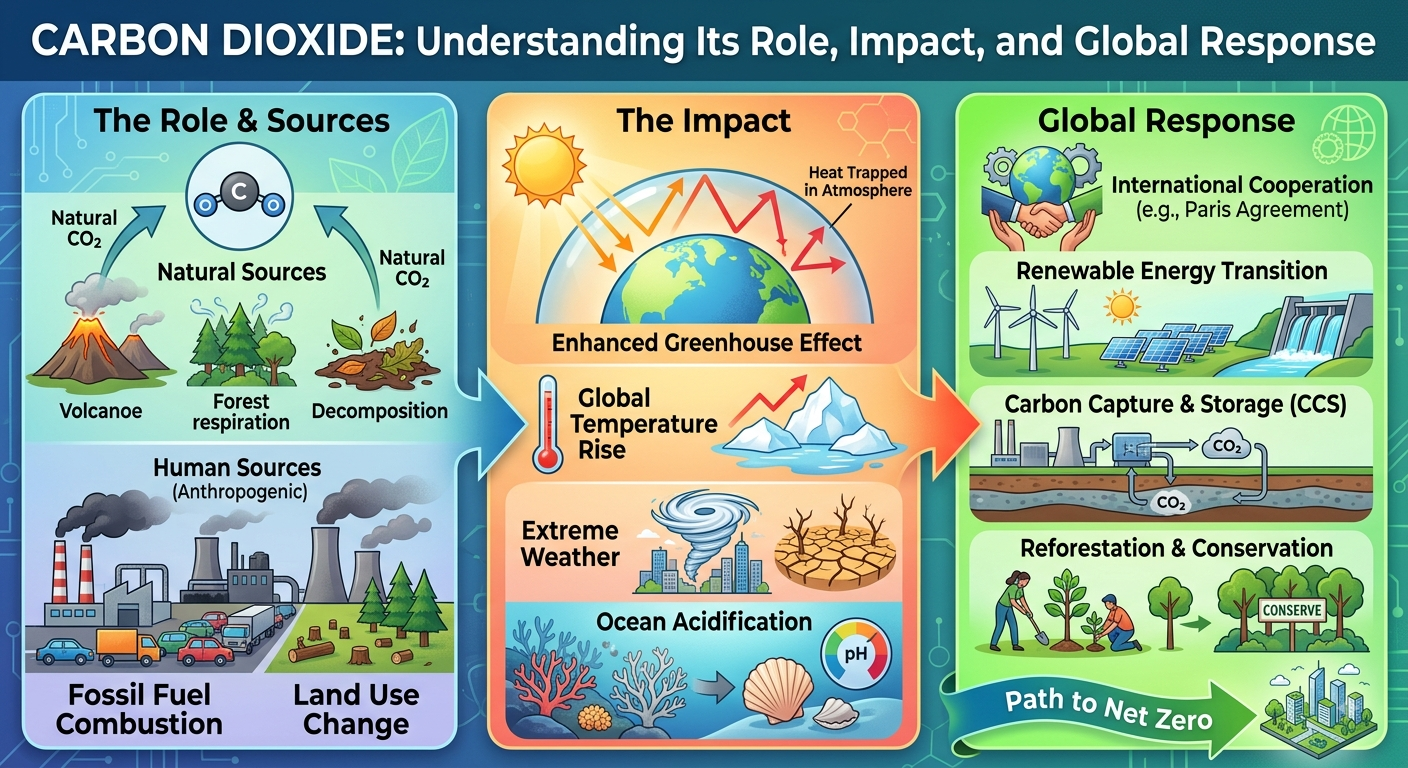
The modern carbon problem arises principally from the rapid transfer of geological carbon into the atmosphere through fossil-fuel combustion, cement production and land-use change. The Earth system naturally exchanges enormous quantities of carbon among the atmosphere, biosphere, oceans and geological reservoirs, but human activity has altered the balance. The land and oceans absorb a substantial fraction of anthropogenic CO₂ emissions, while the remainder accumulates in the atmosphere. The resulting increase in atmospheric CO₂ strengthens the greenhouse effect and contributes to global warming. Ocean uptake also changes seawater chemistry, producing ocean acidification.
Global energy-related CO₂ emissions reached approximately 38.4 gigatonnes in 2025, according to the International Energy Agency (IEA), while atmospheric CO₂ concentrations were approximately 427 ppm. The IEA also reports that deployment of solar PV, wind, nuclear power, electric vehicles and heat pumps prevented approximately 3 gigatonnes of CO₂ emissions annually in 2025, demonstrating that technological transformation is already affecting the global carbon trajectory.
The central technological challenge is therefore twofold: first, rapidly reduce the addition of fossil carbon to the atmosphere; second, responsibly manage unavoidable residual emissions and, where necessary, remove CO₂ already accumulated in the atmosphere. This thesis examines the scientific foundations of that challenge and evaluates carbon capture, utilisation and storage (CCUS), direct air capture, bioenergy with carbon capture and storage, enhanced weathering, ecosystem restoration, carbon monitoring, artificial intelligence, low-carbon industry, renewable energy, nuclear energy and future carbon-removal technologies.
For Africa, the challenge is particularly complex. The continent has very low historical and per-capita emissions compared with many industrialised economies, yet it faces major climate risks and enormous development and energy-access requirements. The IEA estimates that Africa accounts for less than 3% of global energy-related CO₂ emissions while more than 600 million Africans lack electricity access. South Africa represents a particularly important case because of its historically coal-intensive electricity and industrial system, while simultaneously possessing substantial renewable-energy potential and an increasingly developed framework for a just transition.
The future of CO₂ management will consequently depend not on one technology, but on an integrated global system combining clean energy, efficiency, electrification, industrial transformation, ecosystem protection, carbon measurement, carbon removal and international cooperation.
1. Introduction
Carbon dioxide is a simple molecule composed of one carbon atom bonded to two oxygen atoms:
CO₂
Despite its molecular simplicity, CO₂ participates in some of the most important processes known to science.
It connects:
- the atmosphere to plants;
- plants to animals;
- respiration to photosynthesis;
- oceans to the atmosphere;
- rocks to geological cycles;
- fossil fuels to modern industrial civilisation;
- electricity generation to atmospheric chemistry;
- climate physics to global economics;
- agriculture to atmospheric carbon;
- and human technology to planetary-scale environmental change.
The importance of CO₂ therefore extends from the microscopic scale of molecular bonds to the planetary scale of Earth’s climate system.
The Intergovernmental Panel on Climate Change (IPCC) concludes that human activities have unequivocally increased atmospheric greenhouse-gas concentrations and that the atmosphere, ocean, cryosphere and biosphere have undergone widespread and rapid changes.
The scientific question is not whether CO₂ is naturally present. It is.
The central question is:
How does the human alteration of the global carbon cycle affect the physical, biological and technological systems on which civilisation depends?
2. The Molecular Architecture of Carbon Dioxide
2.1 Atomic composition
A CO₂ molecule contains:
- one carbon atom;
- two oxygen atoms.
Carbon has atomic number 6, while oxygen has atomic number 8.
The molecule has a linear geometry:
O=C=O
The carbon atom occupies the centre and forms two strong carbon–oxygen bonds.
2.2 Molecular geometry
CO₂ is linear because the central carbon atom forms two regions of electron density associated with its bonding arrangement.
The approximate bond angle is:
180°
This molecular structure has important consequences for its physical and chemical behaviour.
2.3 Molecular mass
The molar mass of CO₂ is approximately:
44.01 g/mol
This relatively small molecular mass allows CO₂ to participate efficiently in atmospheric transport and biological and chemical processes.
2.4 Carbon oxidation state
The carbon atom in CO₂ is in a highly oxidised state.
This is important because CO₂ can be regarded as one of the final oxidation products of carbon-containing fuels.
When hydrocarbons are burned, carbon is generally converted toward CO₂.
For example, simplified methane combustion can be represented as:
CH₄ + 2O₂ → CO₂ + 2H₂O
The reaction releases energy because the products occupy a lower chemical-energy state than the reactants.
3. Physical and Chemical Properties
CO₂ is:
- colourless;
- generally odourless at ordinary atmospheric concentrations;
- non-flammable;
- denser than ordinary air;
- soluble in water;
- chemically stable under many atmospheric conditions;
- capable of absorbing infrared radiation.
It exists naturally in several important reservoirs:
- atmosphere;
- oceans;
- soils;
- vegetation;
- sediments;
- carbonate rocks;
- fossil fuels;
- dissolved inorganic carbon;
- living organisms.
Its global significance comes not from its quantity alone but from its interaction with Earth’s energy balance and carbon cycle.
4. CO₂ and the Chemistry of Water
When CO₂ enters water, it participates in a series of equilibria.
A simplified sequence is:
CO₂ + H₂O ⇌ H₂CO₃
Carbonic acid can then dissociate:
H₂CO₃ ⇌ H⁺ + HCO₃⁻
and:
HCO₃⁻ ⇌ H⁺ + CO₃²⁻
The major forms of dissolved inorganic carbon in seawater are therefore:
- dissolved CO₂;
- bicarbonate ions;
- carbonate ions.
This chemistry is fundamental to understanding ocean acidification.
Increasing dissolved CO₂ generally increases hydrogen-ion concentration and reduces pH, while reducing carbonate-ion availability. The IPCC identifies these chemical changes as important consequences of anthropogenic carbon uptake by the oceans.
5. The Natural Carbon Cycle
The carbon cycle is one of Earth’s fundamental biogeochemical systems.
Carbon continuously moves between:
Atmosphere ↔ Biosphere ↔ Oceans ↔ Soils ↔ Sediments ↔ Geological reservoirs
The major processes include:
- photosynthesis;
- respiration;
- decomposition;
- ocean-atmosphere exchange;
- sedimentation;
- weathering;
- volcanic activity;
- fossil-fuel formation;
- combustion.
The carbon cycle operates across radically different timescales.
5.1 Fast carbon cycle
The biological carbon cycle operates over:
- seconds;
- hours;
- days;
- seasons;
- years;
- decades.
Photosynthesis can transfer atmospheric carbon into plant biomass within minutes to hours.
5.2 Slow carbon cycle
Geological processes operate over:
- thousands;
- millions;
- tens of millions of years.
Carbon can become incorporated into carbonate rocks or buried organic material.
Fossil fuels represent ancient carbon that was stored underground for geological periods.
Modern fossil-fuel combustion rapidly transfers a portion of that geological carbon back into the atmosphere.
6. Photosynthesis: Atmospheric CO₂ Becomes Biological Carbon
Photosynthesis is one of the most important CO₂-consuming processes on Earth.
Green plants, algae and cyanobacteria use light energy to transform carbon dioxide and water into energy-rich organic compounds.
A simplified overall equation is:
6CO₂ + 6H₂O + light energy → C₆H₁₂O₆ + 6O₂
The equation is simplified because photosynthesis actually involves many reactions.
6.1 Chloroplasts
In plants, photosynthesis occurs primarily in chloroplasts.
Chloroplasts contain:
- chlorophyll;
- thylakoid membranes;
- photosystems;
- electron-transfer systems;
- ATP-producing machinery;
- carbon-fixation enzymes.
6.2 Light-dependent reactions
Photons excite electrons in photosynthetic pigments.
The resulting electron transport processes produce:
- ATP;
- NADPH;
- oxygen.
6.3 Carbon fixation
The Calvin–Benson cycle uses ATP and NADPH to incorporate inorganic carbon into organic molecules.
The enzyme Rubisco plays a central role in carbon fixation.
Thus atmospheric CO₂ becomes chemically incorporated into biological material.
7. Cellular Respiration
Photosynthesis stores energy in organic molecules.
Respiration releases that energy.
A simplified equation is:
C₆H₁₂O₆ + 6O₂ → 6CO₂ + 6H₂O + energy
Cells extract energy from organic molecules and use it to produce ATP.
Mitochondria are particularly important in aerobic respiration in eukaryotic cells.
The overall biological system can therefore be viewed as a large carbon-energy cycle:
CO₂ → photosynthesis → organic carbon → respiration → CO₂
This cycle has operated for hundreds of millions of years and is fundamental to life.
8. Plants, Animals and Decomposition
Carbon moves through ecosystems.
A simplified pathway is:
Atmospheric CO₂ → plant → herbivore → predator → decomposer → atmosphere/soil
When plants and animals die, decomposers break down organic matter.
Depending on environmental conditions, carbon can be:
- released as CO₂;
- incorporated into soil;
- converted into methane under oxygen-poor conditions;
- stored in sediments;
- transferred into longer-lived organic pools.
Forests and soils are therefore important components of the global carbon system.
9. Oceans as a Carbon Reservoir
The ocean is one of Earth’s largest active carbon reservoirs.
CO₂ moves between:
atmosphere ↔ ocean
Dissolved carbon can then be transported through ocean circulation.
Marine organisms also incorporate carbon into biological material.
Some carbon eventually reaches deeper waters and sediments.
This creates a biological and physical carbon pump.
9.1 Biological pump
Phytoplankton use CO₂ during photosynthesis.
Some organic material subsequently sinks.
A fraction is decomposed at depth, transferring carbon away from the surface.
9.2 Solubility pump
Cold seawater can absorb more CO₂ than warm seawater.
Ocean circulation therefore contributes to transporting dissolved carbon into deeper waters.
10. Ocean Acidification
Ocean acidification is one of the most important chemical consequences of rising atmospheric CO₂.
It does not mean that the entire ocean becomes an acid solution.
Rather, it means that seawater chemistry shifts toward greater acidity, represented by declining pH.
The process involves:
CO₂ ↑ → dissolved CO₂ ↑ → H⁺ ↑ → pH ↓
At the same time:
carbonate ions ↓
This can make it more difficult for some marine organisms to build calcium-carbonate structures.
The IPCC reports that observed ocean-surface pH decreases over recent decades are consistent across multiple observational datasets.
Potentially affected organisms include:
- corals;
- molluscs;
- some plankton;
- other calcifying organisms.
The consequences can propagate through marine food webs.
11. The Greenhouse Effect
Earth receives energy primarily from the Sun.
Incoming solar radiation interacts with:
- atmosphere;
- clouds;
- oceans;
- land surfaces;
- ice;
- vegetation.
Earth subsequently emits energy outward, primarily as infrared radiation.
Greenhouse gases absorb and re-emit portions of this outgoing infrared radiation.
The natural greenhouse effect makes Earth substantially warmer than it would otherwise be.
Without a natural greenhouse effect, Earth’s surface would be far colder.
The problem is not the existence of greenhouse gases.
The problem is the increase in their concentrations caused by human activity, which changes the planet’s radiative balance.
12. Why CO₂ Is a Greenhouse Gas
Molecules interact with electromagnetic radiation according to their molecular structure.
CO₂ has vibrational modes that interact with infrared radiation.
When CO₂ absorbs infrared photons, molecular energy increases.
The molecule can subsequently emit infrared radiation.
Because this process occurs throughout the atmosphere, increasing CO₂ changes the rate at which Earth loses energy to space.
The climate system eventually responds by warming until a new approximate energy balance is reached.
This is fundamentally a problem in:
- molecular physics;
- spectroscopy;
- radiative transfer;
- atmospheric dynamics;
- thermodynamics.
13. CO₂ and Global Temperature
CO₂ does not act independently of the rest of the climate system.
Climate feedbacks include:
- water vapour;
- clouds;
- snow and ice;
- vegetation;
- oceans;
- soil carbon;
- atmospheric circulation.
For example, warming can increase atmospheric water vapour, and water vapour is itself a greenhouse gas.
The IPCC concludes that human influence has warmed the atmosphere, ocean and land and that greenhouse-gas emissions are the dominant driver of observed warming since the industrial era.
14. The Industrial Revolution
Before large-scale industrialisation, human societies primarily relied on:
- biomass;
- animal labour;
- wind;
- water;
- limited coal.
Industrialisation dramatically increased the use of fossil fuels.
The major fuels became:
- coal;
- petroleum;
- natural gas.
These fuels provided enormous amounts of concentrated energy.
They enabled:
- railways;
- steel production;
- electricity;
- automobiles;
- aviation;
- shipping;
- chemical industries;
- modern cities;
- telecommunications;
- computing;
- data centres.
Modern civilisation therefore developed partly through the extraordinary energy density of fossil carbon.
15. Major Anthropogenic Sources of CO₂
Human CO₂ emissions arise primarily from:
15.1 Coal
Coal combustion remains one of the largest sources of energy-related CO₂.
15.2 Oil
Oil is heavily associated with:
- transport;
- aviation;
- shipping;
- petrochemicals;
- industrial machinery.
15.3 Natural gas
Natural gas generally produces less CO₂ per unit of energy than coal, but it still produces substantial CO₂ when burned.
15.4 Cement
Cement production has two major carbon sources:
- energy required to heat materials;
- chemical decomposition of limestone.
A simplified calcination reaction is:
CaCO₃ → CaO + CO₂
This makes cement an especially important industrial CO₂ source.
15.5 Land-use change
Deforestation and ecosystem degradation can release carbon stored in:
- vegetation;
- soils;
- biomass.
16. Scale of the Modern Carbon Problem
The IEA estimates that global energy-related CO₂ emissions increased to nearly 38.4 gigatonnes in 2025, despite the rate of growth slowing to about 0.4%. Atmospheric CO₂ concentrations reached approximately 427 ppm in the same year.
This demonstrates an important distinction:
Slower emissions growth is not the same as declining emissions.
If emissions remain positive, atmospheric CO₂ can continue accumulating.
For atmospheric concentration to stabilise, global emissions must eventually approach net zero.
17. Carbon Budgets
A carbon budget represents the amount of additional CO₂ that can be emitted while maintaining a specified probability of limiting warming to a particular temperature level.
The concept is important because CO₂ is long-lived in the climate system.
This means climate policy is not simply about:
emissions this year.
It is about:
cumulative emissions over decades.
Consequently, delays can matter greatly.
18. Decarbonisation
Decarbonisation means reducing the amount of CO₂ emitted per unit of economic output, energy service or industrial activity.
Major strategies include:
- energy efficiency;
- renewable electricity;
- nuclear power;
- electrification;
- electric vehicles;
- public transport;
- sustainable fuels;
- low-carbon hydrogen;
- industrial process transformation;
- carbon capture;
- carbon removal;
- ecosystem restoration.
19. Renewable Energy
Solar and wind power are particularly important because their operational electricity generation does not require combustion of fossil carbon.
The global deployment of clean technologies is already reducing potential fossil-fuel demand.
The IEA estimates that solar PV, wind, nuclear, electric vehicles and heat pumps together avoided approximately 3 Gt of CO₂ emissions annually in 2025 relative to a world without their deployment since 2019.
This demonstrates the importance of technology diffusion.
20. Solar Energy and CO₂
Solar photovoltaic technology converts sunlight into electricity.
The basic sequence is:
Sunlight → semiconductor → electron excitation → electric current
Solar energy can therefore replace fossil-fuel combustion in electricity generation.
Major technological developments include:
- silicon photovoltaics;
- thin-film technologies;
- tandem cells;
- perovskite research;
- large-scale solar farms;
- distributed rooftop generation;
- solar-plus-storage systems.
21. Wind Energy
Wind turbines convert kinetic energy into mechanical rotation and then electricity.
The basic pathway is:
Atmospheric motion → turbine rotor → generator → electricity
Wind and solar can complement one another geographically and temporally.
Their integration requires:
- transmission;
- storage;
- demand management;
- flexible generation;
- smart grids.
22. Nuclear Energy
Nuclear power generates electricity through nuclear reactions rather than combustion.
Modern nuclear power can provide large quantities of low-carbon electricity.
Potential roles include:
- reliable electricity;
- industrial heat;
- hydrogen production;
- grid stability;
- decarbonisation of high-energy systems.
However, nuclear deployment also involves:
- capital costs;
- construction times;
- waste management;
- safety;
- regulation;
- public acceptance.
23. Electrification
One of the most powerful decarbonisation strategies is replacing direct fossil-fuel combustion with electricity.
Examples include:
Petrol vehicle → electric vehicle
Gas boiler → heat pump
Fossil industrial process → electric process
The climate benefit depends on how the electricity is generated.
Electrification therefore works best when combined with low-carbon electricity.
24. Energy Efficiency
The cleanest unit of energy is often the unit that does not need to be produced.
Efficiency improvements include:
- efficient motors;
- improved insulation;
- efficient lighting;
- industrial optimisation;
- smart buildings;
- efficient appliances;
- reduced transmission losses;
- efficient transportation.
Efficiency reduces both energy demand and infrastructure requirements.
25. Carbon Capture, Utilisation and Storage
Carbon capture, utilisation and storage is usually abbreviated:
CCUS
The basic concept is:
CO₂ source → capture → compression → transport → utilisation/storage
Capture can occur at:
- power stations;
- cement plants;
- steel facilities;
- chemical plants;
- hydrogen production facilities.
25.1 Post-combustion capture
CO₂ is separated from exhaust gases after combustion.
25.2 Pre-combustion capture
Carbon is separated earlier in the fuel-conversion process.
25.3 Oxyfuel combustion
Fuel is burned in a high-oxygen environment to produce an exhaust stream with a higher CO₂ concentration.
26. Carbon Storage
Captured CO₂ can potentially be injected into suitable geological formations.
Potential storage formations include:
- deep saline formations;
- depleted oil and gas reservoirs;
- certain basalt formations.
The fundamental objective is long-term containment.
Successful storage requires:
- geological characterisation;
- pressure management;
- well integrity;
- monitoring;
- verification;
- regulatory oversight.
27. Carbon Utilisation
Captured CO₂ can be used as a feedstock in selected applications.
Potential products include:
- synthetic fuels;
- chemicals;
- building materials;
- carbonates;
- polymers;
- specialised industrial products.
However, utilisation does not automatically mean permanent carbon removal.
A CO₂ molecule incorporated into a short-lived product may eventually return to the atmosphere.
Therefore, carbon utilisation must be evaluated according to:
carbon balance + energy input + lifecycle emissions + permanence.
28. Direct Air Capture
Direct Air Capture (DAC) removes CO₂ directly from ambient air.
The conceptual sequence is:
Air → CO₂ separation → concentrated CO₂ → storage/use
DAC is technically challenging because atmospheric CO₂ is relatively dilute.
The technology therefore requires substantial:
- energy;
- materials;
- air-processing equipment;
- capital;
- infrastructure.
Its major potential advantage is location flexibility.
DAC facilities can theoretically be located where:
- low-carbon energy is available;
- suitable storage exists;
- water and infrastructure are available.
29. Bioenergy with Carbon Capture and Storage
Bioenergy with Carbon Capture and Storage (BECCS) combines:
- biological carbon uptake;
- biomass energy conversion;
- CO₂ capture;
- geological storage.
Conceptually:
Atmosphere → biomass → energy + captured CO₂ → geological storage
If carefully designed, this can produce net atmospheric CO₂ removal.
However, large-scale deployment raises questions about:
- land use;
- biodiversity;
- water;
- food production;
- biomass sustainability;
- transport;
- permanence.
30. Nature-Based Carbon Removal
Nature-based approaches include:
- reforestation;
- afforestation where ecologically appropriate;
- wetland restoration;
- mangrove restoration;
- improved soil management;
- ecosystem conservation.
These approaches provide additional benefits such as:
- biodiversity protection;
- soil conservation;
- water regulation;
- habitat restoration.
But biological carbon storage is vulnerable to:
- fire;
- drought;
- pests;
- land-use change;
- climate impacts.
Therefore, ecosystem carbon should not automatically be treated as permanently equivalent to geological storage.
31. Enhanced Rock Weathering
Some rocks naturally react with CO₂.
Enhanced weathering attempts to accelerate such processes by exposing reactive minerals to atmospheric CO₂.
Potential pathways involve:
silicate minerals + CO₂ + water → dissolved products → carbonate storage
This field combines:
- geology;
- chemistry;
- mining;
- agriculture;
- environmental engineering.
Its future depends on proving that carbon removal can be measured, verified and achieved with acceptable environmental impacts.
32. Carbon Removal Versus Emission Reduction
These concepts must not be confused.
Emission reduction
Prevents CO₂ from entering the atmosphere.
Example:
Coal electricity → solar electricity
Carbon removal
Takes CO₂ already present in the atmosphere and stores it.
Example:
Atmospheric CO₂ → direct air capture → geological storage
The preferred hierarchy is generally:
Avoid → reduce → replace → capture residual emissions → remove atmospheric CO₂ where necessary
Carbon removal should not become an excuse for continued avoidable fossil-fuel emissions.
33. Carbon Monitoring, Measurement and Verification
A future carbon-management system requires accurate measurement.
Technologies include:
- ground monitoring;
- aircraft measurements;
- atmospheric sensors;
- satellites;
- industrial sensors;
- digital carbon inventories;
- geological monitoring;
- remote sensing.
The objective is to create increasingly accurate:
Measurement, Reporting and Verification (MRV)
systems.
Without trustworthy measurement, carbon markets and carbon-removal claims can become unreliable.
34. Artificial Intelligence and CO₂ Management
Artificial intelligence can become an important tool in carbon management.
Potential applications include:
34.1 Emissions prediction
AI can analyse:
- energy consumption;
- weather;
- industrial activity;
- transport patterns.
34.2 Grid optimisation
AI can coordinate:
- solar;
- wind;
- batteries;
- demand;
- transmission.
34.3 Satellite analysis
Machine learning can identify:
- land-use change;
- forest degradation;
- industrial emissions;
- methane and CO₂ patterns.
34.4 Industrial optimisation
AI can reduce energy consumption by optimising:
- furnaces;
- cement plants;
- steelmaking;
- chemical processes;
- logistics.
34.5 Carbon accounting
AI-assisted systems can integrate:
company activity data → emissions calculations → reporting → verification
This could substantially improve carbon transparency.
35. Digital Carbon Infrastructure
A future carbon-management architecture could operate similarly to a global financial information system.
Conceptually:
Sensor → Data platform → AI analysis → Carbon accounting → Verification → Policy/market response
Every major industrial facility could eventually have increasingly automated carbon monitoring.
This could create a form of:
Planetary Carbon Information Infrastructure
connecting:
- satellites;
- sensors;
- industrial plants;
- electricity grids;
- transport networks;
- governments;
- researchers;
- carbon markets.
36. Global Climate Policy
The principal international framework is the United Nations Framework Convention on Climate Change (UNFCCC).
The Paris Agreement subsequently established a framework for national climate commitments.
Countries submit:
Nationally Determined Contributions (NDCs)
These describe national mitigation and adaptation objectives.
The IPCC’s Sixth Assessment Report synthesis provides the major scientific foundation for understanding current climate risks, mitigation and adaptation options.
37. Carbon Pricing
Carbon pricing attempts to incorporate some climate costs into economic decisions.
Two major mechanisms are:
Carbon tax
Government establishes a price per unit of emissions.
Emissions trading
A market establishes tradable emissions allowances.
The objective is to encourage:
- efficiency;
- cleaner technology;
- lower-carbon investment;
- innovation.
Carbon pricing must be carefully designed to avoid disproportionate impacts on vulnerable households and developing economies.
38. Carbon Markets
Carbon markets can involve:
- emissions allowances;
- carbon credits;
- carbon-removal certificates.
A credible carbon market requires:
- additionality;
- accurate measurement;
- permanence;
- avoidance of double counting;
- transparent verification;
- credible baselines.
The technological challenge is therefore closely linked to accounting science.
39. Africa’s Carbon Challenge
Africa occupies a distinctive position.
The IEA estimates that Africa accounts for less than 3% of global energy-related CO₂ emissions, while more than 600 million people lack electricity access.
This produces a fundamental development dilemma:
Africa must increase energy availability while avoiding unnecessary dependence on high-carbon infrastructure.
The solution is not simply to suppress energy consumption.
It is to accelerate access to:
- renewable electricity;
- efficient grids;
- mini-grids;
- storage;
- clean cooking;
- electric transport;
- modern industry;
- digital infrastructure.
40. Africa’s Renewable-Energy Opportunity
Africa possesses enormous renewable resources.
Important resources include:
- solar;
- wind;
- hydropower;
- geothermal;
- sustainable biomass.
Solar PV is increasingly competitive in many African markets.
The IEA reports that private-sector clean-energy investment in Africa increased from roughly USD 17 billion in 2019 to nearly USD 40 billion in 2024.
This creates opportunities for a development model in which Africa can expand energy access without reproducing every stage of the fossil-intensive development pathway taken by earlier industrial economies.
41. Africa and Green Industrialisation
Clean electricity can support new industries.
Potential sectors include:
- green hydrogen;
- green ammonia;
- low-carbon steel;
- low-carbon cement;
- electric mobility;
- battery materials;
- data centres;
- digital services;
- agricultural processing.
Africa’s mineral resources could become strategically important in global clean-energy supply chains.
But resource extraction must be accompanied by:
- environmental protection;
- local processing;
- skills development;
- infrastructure;
- transparent governance;
- value creation within African economies.
42. South Africa: A Special Carbon Case
South Africa has a particularly important role in global carbon policy.
Its energy system has historically relied heavily on coal, particularly for electricity generation and industrial activity.
At the same time, the country possesses substantial:
- solar resources;
- wind resources;
- industrial capacity;
- mining expertise;
- engineering capability;
- research institutions.
South Africa therefore represents both a major decarbonisation challenge and a major technological opportunity.
43. South Africa’s Climate Commitments
South Africa’s 2021 NDC established a greenhouse-gas emissions range of:
398–510 Mt CO₂-eq for 2025
and:
350–420 Mt CO₂-eq for 2030.
South Africa’s government subsequently submitted a second NDC with a new 2035 target range of 320–380 Mt CO₂-eq, demonstrating a progression beyond the earlier 2030 target.
The country’s climate strategy is therefore increasingly centred on a transition toward a lower-carbon and climate-resilient economy.
44. The South African Just Energy Transition
The phrase Just Energy Transition is important because energy systems are not merely technical systems.
They are also employment systems.
South Africa’s transition affects:
- coal miners;
- power-plant workers;
- industrial communities;
- electricity consumers;
- manufacturers;
- municipalities;
- transport workers;
- investors.
A successful transition therefore needs:
decarbonisation + employment + economic development + social protection.
The objective should not simply be to close carbon-intensive assets.
It should be to create viable economic alternatives.
45. South African Renewable Energy
South Africa’s renewable-energy expansion can involve:
- utility-scale solar;
- rooftop solar;
- wind farms;
- battery storage;
- transmission expansion;
- smart-grid technologies.
The country can potentially use renewable electricity to support:
- industrial electrification;
- green hydrogen;
- electric transport;
- low-carbon mineral processing.
46. Green Hydrogen
Hydrogen itself contains no carbon.
When produced through electrolysis powered by low-carbon electricity, it can be considered a low-carbon energy carrier.
The process is:
2H₂O → 2H₂ + O₂
Potential applications include:
- steel;
- chemicals;
- shipping fuels;
- fertiliser;
- industrial heat.
South Africa has potential advantages because of its:
- renewable resources;
- ports;
- industrial base;
- mining sector;
- existing energy infrastructure.
47. Low-Carbon Steel
Traditional steel production often relies heavily on coal.
Alternative pathways include hydrogen-based direct reduction.
Conceptually:
Iron ore + H₂ → iron + H₂O
rather than relying primarily on carbon as the reducing agent.
This could dramatically alter the carbon intensity of steelmaking if the hydrogen is produced using low-carbon electricity.
48. Low-Carbon Cement
Cement is particularly difficult to decarbonise because some CO₂ comes directly from limestone chemistry.
Potential solutions include:
- clinker reduction;
- alternative binders;
- energy efficiency;
- electrification;
- alternative fuels;
- carbon capture;
- mineralisation.
Cement therefore represents one of the sectors where CCUS may have an important role.
49. Transport and CO₂
Transport emissions can be reduced through:
- electric vehicles;
- rail;
- public transportation;
- cycling and walking infrastructure;
- efficient freight systems;
- sustainable aviation fuels;
- low-carbon maritime fuels.
Electrification is particularly powerful for road transport because electric motors are highly efficient.
50. Agriculture and CO₂
Agriculture interacts with the carbon cycle through:
- soil carbon;
- vegetation;
- fossil-fuel use;
- fertiliser production;
- land-use change.
CO₂ is not the only greenhouse gas associated with agriculture.
Important gases also include:
- methane;
- nitrous oxide.
Therefore, climate-smart agriculture requires management of the broader greenhouse-gas system.
51. CO₂ and Food Security
Climate change can affect:
- rainfall;
- temperature;
- crop productivity;
- pests;
- water availability;
- soil conditions.
At the same time, atmospheric CO₂ can directly influence plant physiology.
Some plants exhibit increased photosynthesis under elevated CO₂ concentrations.
However, the real-world agricultural outcome depends on:
- temperature;
- water;
- nutrients;
- pests;
- extreme weather;
- crop type;
- adaptation.
Therefore, increased atmospheric CO₂ should not be interpreted as a simple universal benefit to food production.
52. CO₂ and Human Health
CO₂ is not normally harmful at ordinary outdoor atmospheric concentrations.
At sufficiently high concentrations, however, CO₂ can become hazardous because it can displace oxygen and disturb normal respiration.
For climate policy, the major health concern is therefore generally not direct CO₂ poisoning.
It is the wider consequences of climate change and fossil-fuel combustion, including:
- heat stress;
- air pollution;
- wildfire smoke;
- food insecurity;
- water stress;
- climate-sensitive disease risks.
Reducing fossil-fuel combustion can therefore produce both climate and air-quality benefits.
53. The Carbon-Energy-Civilisation Relationship
Modern civilisation can be represented as an interconnected system:
Energy → Industry → Transport → Cities → Digital infrastructure → Economic production
Historically, much of that energy came from:
Coal + Oil + Gas
which produced:
CO₂
The central technological transition is therefore:
Fossil-energy civilisation → low-carbon energy civilisation
without destroying the ability of societies to provide:
- electricity;
- mobility;
- food;
- housing;
- communication;
- industry;
- employment.
54. Data Centres and Artificial Intelligence
Modern digital systems also consume energy.
The expansion of:
- cloud computing;
- artificial intelligence;
- data centres;
- semiconductor manufacturing;
can increase electricity demand.
This creates an important technological relationship:
AI → computation → electricity → energy infrastructure → potential CO₂ emissions
However, AI can also improve:
- grid optimisation;
- materials discovery;
- weather forecasting;
- energy efficiency;
- industrial control;
- carbon monitoring.
AI therefore has both an energy footprint and a potential decarbonisation function.
55. The Future Carbon Economy
A future carbon economy may become increasingly divided into:
Carbon entering the atmosphere
Fossil carbon emissions
Carbon remaining in circulation
Recycled carbon
Carbon permanently stored
Geological or durable biological storage
The technological objective is not necessarily to eliminate carbon from civilisation.
Carbon is too fundamental for that.
The objective is to prevent excessive atmospheric accumulation while developing sustainable carbon flows.
56. Carbon Circularity
A future circular-carbon economy could use carbon captured from:
- biomass;
- industrial processes;
- atmospheric air.
It could then be converted into:
- fuels;
- chemicals;
- materials.
The key requirement is that carbon use must be evaluated across its complete lifecycle.
A circular carbon system should answer:
Where did the carbon originate?
How much energy was required?
How long is the carbon stored?
Where does it ultimately go?
57. Future Carbon Technologies
Potential future technologies include:
- advanced DAC;
- mineral carbonisation;
- enhanced weathering;
- advanced biochar systems;
- ocean-based carbon removal;
- next-generation carbon-capture membranes;
- electrochemical CO₂ conversion;
- artificial photosynthesis;
- low-carbon cement;
- hydrogen-based steel;
- synthetic fuels;
- carbon-negative construction materials.
Some are commercially mature.
Others remain experimental.
A scientifically responsible carbon strategy must distinguish:
demonstrated technology
from:
laboratory technology
and:
theoretical future technology.
58. Artificial Photosynthesis
Artificial photosynthesis attempts to reproduce selected functions of natural photosynthesis using engineered systems.
Potential pathways include:
CO₂ + H₂O + energy → fuels/chemicals
Possible products include:
- hydrogen;
- carbon monoxide;
- methanol;
- synthetic hydrocarbons.
If powered by low-carbon energy, such systems could eventually become part of a circular carbon economy.
59. Carbon Mineralisation
Mineralisation converts CO₂ into stable carbonate minerals.
The conceptual objective is:
CO₂ → mineral carbonate → long-term geological storage
This is attractive because carbonate minerals can be extremely stable over geological timescales.
Research challenges include:
- reaction speed;
- energy consumption;
- mineral availability;
- material transport;
- lifecycle emissions.
60. Ocean-Based Carbon Removal
Researchers are investigating approaches involving:
- alkalinity enhancement;
- marine biomass;
- ocean fertilisation;
- electrochemical ocean processes.
These technologies require particularly careful assessment because marine ecosystems are complex.
Large-scale intervention must consider:
- ecosystem effects;
- chemical changes;
- carbon permanence;
- monitoring;
- governance.
61. The Carbon Removal Verification Problem
A central technological question is:
How do we prove that one tonne of CO₂ has actually been removed and permanently stored?
A credible removal system needs:
Measurement + Reporting + Verification + Permanence
This creates opportunities for:
- satellites;
- sensors;
- AI;
- blockchain-like audit systems;
- digital ledgers;
- geochemical monitoring;
- atmospheric modelling.
The future carbon economy may therefore become deeply integrated with digital technology.
62. Carbon and International Equity
The climate problem raises questions of fairness.
Countries differ substantially in:
- historical emissions;
- current emissions;
- population;
- income;
- industrial capacity;
- energy access;
- climate vulnerability.
A developing country may reasonably argue that it needs additional energy to provide:
- electricity;
- healthcare;
- education;
- manufacturing;
- transport;
- digital services.
Consequently, climate policy must address both:
decarbonisation
and:
development.
63. Climate Finance
Developing countries often require external financing to deploy advanced low-carbon infrastructure.
Potential financing mechanisms include:
- development banks;
- concessional loans;
- guarantees;
- climate funds;
- blended finance;
- private investment;
- technology partnerships.
For Africa, financing is particularly important because energy-access needs remain enormous. The IEA estimates that about USD 22 billion per year would be needed from 2023–2030 to connect African homes and businesses to electricity, with additional financing required for clean cooking.
64. Carbon Policy and Industrial Competitiveness
Climate policy increasingly interacts with international trade.
Manufacturers may face pressure to reduce the carbon intensity of products such as:
- steel;
- cement;
- aluminium;
- chemicals;
- fertilisers.
This creates both risks and opportunities.
Countries that develop low-carbon industrial production could gain access to emerging green markets.
South Africa’s government has highlighted concerns that climate-related trade measures should not undermine developing countries’ industrial and socioeconomic development while emphasising the need for a just transition.
65. A Global Carbon Management Architecture
A mature global carbon system could have six layers.
Layer 1 — Measurement
Sensors, satellites and inventories.
Layer 2 — Accounting
National and corporate carbon databases.
Layer 3 — Reduction
Energy efficiency and clean technology.
Layer 4 — Capture
Industrial and atmospheric CO₂ capture.
Layer 5 — Storage
Geological and durable biological storage.
Layer 6 — Verification
Independent measurement and auditing.
Together:
Measure → Account → Reduce → Capture → Store → Verify
This could become one of the defining technological infrastructures of the twenty-first century.
66. A Possible 2050 Carbon System
A highly decarbonised global economy could contain:
Solar + Wind + Nuclear + Hydro + Storage
feeding:
Electricity + Industry + Transport + Buildings + Digital Infrastructure
while difficult-to-decarbonise sectors use:
Hydrogen + Sustainable fuels + CCUS
and residual atmospheric carbon is managed through:
DAC + BECCS + Ecosystem restoration + Mineralisation
The result would be a much more circular relationship between carbon and civilisation.
67. The Role of Science
Science provides the knowledge needed to understand:
- atmospheric chemistry;
- molecular spectroscopy;
- carbon cycling;
- climate feedbacks;
- ocean chemistry;
- ecosystem responses.
Science tells us:
what is happening and why.
68. The Role of Engineering
Engineering converts scientific knowledge into working systems.
Engineers develop:
- solar panels;
- turbines;
- batteries;
- nuclear reactors;
- carbon-capture systems;
- pipelines;
- geological-storage systems;
- electric vehicles;
- smart grids.
Engineering answers:
How can the desired outcome actually be built?
69. The Role of Computing and AI
Computing connects the physical system to information.
AI can help:
- predict energy demand;
- optimise power grids;
- analyse satellite data;
- discover materials;
- model carbon storage;
- identify industrial inefficiencies;
- improve climate forecasting.
Computing therefore becomes an enabling layer across the carbon-management system.
70. The Central Technological Principle
The most important principle emerging from this thesis is:
The carbon problem is fundamentally an energy, industrial, ecological and information problem simultaneously.
There is no single technological solution.
A successful strategy requires a portfolio.
71. Integrated CO₂ Strategy
A comprehensive global strategy can be represented as:
1. Reduce fossil-fuel demand
↓
2. Improve energy efficiency
↓
3. Electrify transport, buildings and industry
↓
4. Expand low-carbon electricity
↓
5. Decarbonise difficult industries
↓
6. Protect natural carbon sinks
↓
7. Capture unavoidable industrial emissions
↓
8. Remove atmospheric CO₂ where scientifically justified
↓
9. Permanently store captured carbon
↓
10. Measure and verify the entire system
72. Key Scientific Conclusions
Several conclusions emerge.
First
CO₂ is essential to life.
Second
The natural carbon cycle is fundamental to Earth’s stability.
Third
Human activity has rapidly increased atmospheric CO₂.
Fourth
Fossil-fuel combustion is a major source of this increase.
Fifth
CO₂ is a greenhouse gas that alters Earth’s radiative balance.
Sixth
The oceans absorb substantial anthropogenic CO₂ but this changes ocean chemistry.
Seventh
Reducing emissions is more fundamental than relying exclusively on future carbon removal.
Eighth
Carbon capture has an important potential role in difficult-to-decarbonise sectors.
Ninth
Carbon removal may become increasingly important for residual emissions and climate stabilisation.
Tenth
Africa requires a climate strategy compatible with economic development and universal energy access.
Eleventh
South Africa represents a particularly important test case for combining industrial development, electricity security and decarbonisation.
Twelfth
Future carbon management will depend increasingly on digital measurement, artificial intelligence, advanced materials and large-scale energy infrastructure.
73. Final Conclusion
Carbon dioxide is not simply a pollutant.
It is a fundamental molecule of planetary life and civilisation.
It is created by respiration, consumed by photosynthesis, exchanged between oceans and atmosphere, stored in forests and soils, locked into rocks, released by volcanoes, extracted from geological reservoirs and converted into energy through human industry.
The modern challenge emerged because industrial civilisation began moving geological carbon into the atmosphere at a rate far faster than natural geological processes can remove it.
That transformation powered extraordinary human development.
It produced:
- electricity;
- transportation;
- steel;
- cement;
- cities;
- agriculture;
- telecommunications;
- computers;
- satellites;
- artificial intelligence.
But the same energy system also produced an accumulating atmospheric carbon burden.
The IEA’s 2026 assessment shows that global energy-related CO₂ emissions still reached a record of nearly 38.4 Gt in 2025, even though emissions growth slowed considerably. At the same time, clean technologies are increasingly displacing fossil-fuel demand and avoiding billions of tonnes of potential CO₂ emissions annually.
This demonstrates the central paradox of the carbon era:
Human technology created the modern carbon problem, but human technology is also becoming the principal means of solving it.
The transition therefore should not be understood simply as:
“CO₂ versus humanity.”
A more accurate scientific interpretation is:
Carbon + energy + technology + ecology + civilisation must be brought into a new equilibrium.
The future system will likely combine:
renewable energy
- nuclear energy where appropriate
- energy efficiency
- electrification
- hydrogen
- low-carbon industrial processes
- carbon capture
- carbon removal
- ecosystem restoration
- digital monitoring
- artificial intelligence
- international cooperation
The ultimate objective is not to eliminate carbon from the Earth.
That would be impossible and undesirable.
The objective is to establish a planetary carbon system in which the rate at which humanity adds carbon to the atmosphere is compatible with the capacity of natural and engineered systems to maintain a stable climate.
For Africa, this transformation presents an unusual historical opportunity. The continent has contributed a relatively small share of global energy-related CO₂ emissions while facing major energy-access challenges. If Africa can expand electricity access through increasingly low-carbon systems, build renewable-energy industries, process its mineral resources sustainably, develop green industrial capacity and participate in global carbon-management technologies, it can pursue development without simply reproducing the most carbon-intensive stages of earlier industrialisation.
South Africa is especially significant because its transition combines the complexity of a large industrial economy with a historically coal-intensive energy system and substantial renewable-energy resources. Its progression from the 2021 NDC range of 350–420 Mt CO₂-eq for 2030 toward the subsequently submitted 320–380 Mt CO₂-eq range for 2035 illustrates the direction of national policy toward deeper emissions reduction.
The scientific and technological future of CO₂ management can therefore be expressed in one comprehensive principle:
Measure the carbon, understand the carbon, reduce unnecessary emissions, replace high-carbon energy, capture unavoidable emissions, remove atmospheric carbon where necessary, store it securely, and verify the entire system.
That is the foundation of a future global carbon-management civilisation.
74. Glossary
Carbon cycle: Movement of carbon among Earth’s atmosphere, oceans, organisms, soils and geological reservoirs.
Carbon dioxide (CO₂): A molecule consisting of one carbon atom and two oxygen atoms.
Carbon capture: Separation of CO₂ from an industrial or other concentrated source.
CCUS: Carbon Capture, Utilisation and Storage.
Carbon removal: Deliberate removal of CO₂ from the atmosphere followed by storage.
DAC: Direct Air Capture.
BECCS: Bioenergy with Carbon Capture and Storage.
Carbon sink: A system that absorbs more carbon than it releases over a specified period.
Carbon source: A system that releases more carbon than it absorbs over a specified period.
Ocean acidification: Reduction in ocean pH and associated changes in carbonate chemistry caused primarily by increased uptake of atmospheric CO₂.
Greenhouse effect: Warming caused by atmospheric gases absorbing and re-emitting outgoing infrared radiation.
Decarbonisation: Reduction of greenhouse-gas emissions associated with economic activity.
Net zero: A condition in which anthropogenic greenhouse-gas emissions are balanced by anthropogenic removals over a specified accounting period.
Carbon budget: An estimate of cumulative CO₂ emissions compatible with a specified climate objective and probability.
NDC: Nationally Determined Contribution under the Paris Agreement.
MRV: Measurement, Reporting and Verification.
Carbon mineralisation: Conversion of CO₂ into stable mineral forms.
Carbon sequestration: Long-term storage of carbon in biological, geological or other reservoirs.
75. Principal Scientific and Institutional References
- Intergovernmental Panel on Climate Change (IPCC), Sixth Assessment Report — Synthesis Report, 2023.
- IPCC Working Group I — Climate Change 2021: The Physical Science Basis.
- IPCC Working Group II — Impacts, Adaptation and Vulnerability, including ocean and coastal ecosystems.
- International Energy Agency (IEA), Global Energy Review 2026.
- International Energy Agency (IEA), World Energy Outlook 2025.
- International Energy Agency, World Energy Investment 2025 — Africa.
- South Africa, Fourth National Communication to the UNFCCC, 2024.
- South African Government — Second NDC development and 2035 target.
Central Thesis Statement
Carbon dioxide should be understood not merely as a greenhouse gas, but as a central molecular currency connecting life, energy, geology, industry and climate. The defining technological challenge of the twenty-first century is to redesign human civilisation so that its carbon flows become measurable, efficient, increasingly circular, and compatible with long-term planetary stability.




Be First to Comment