
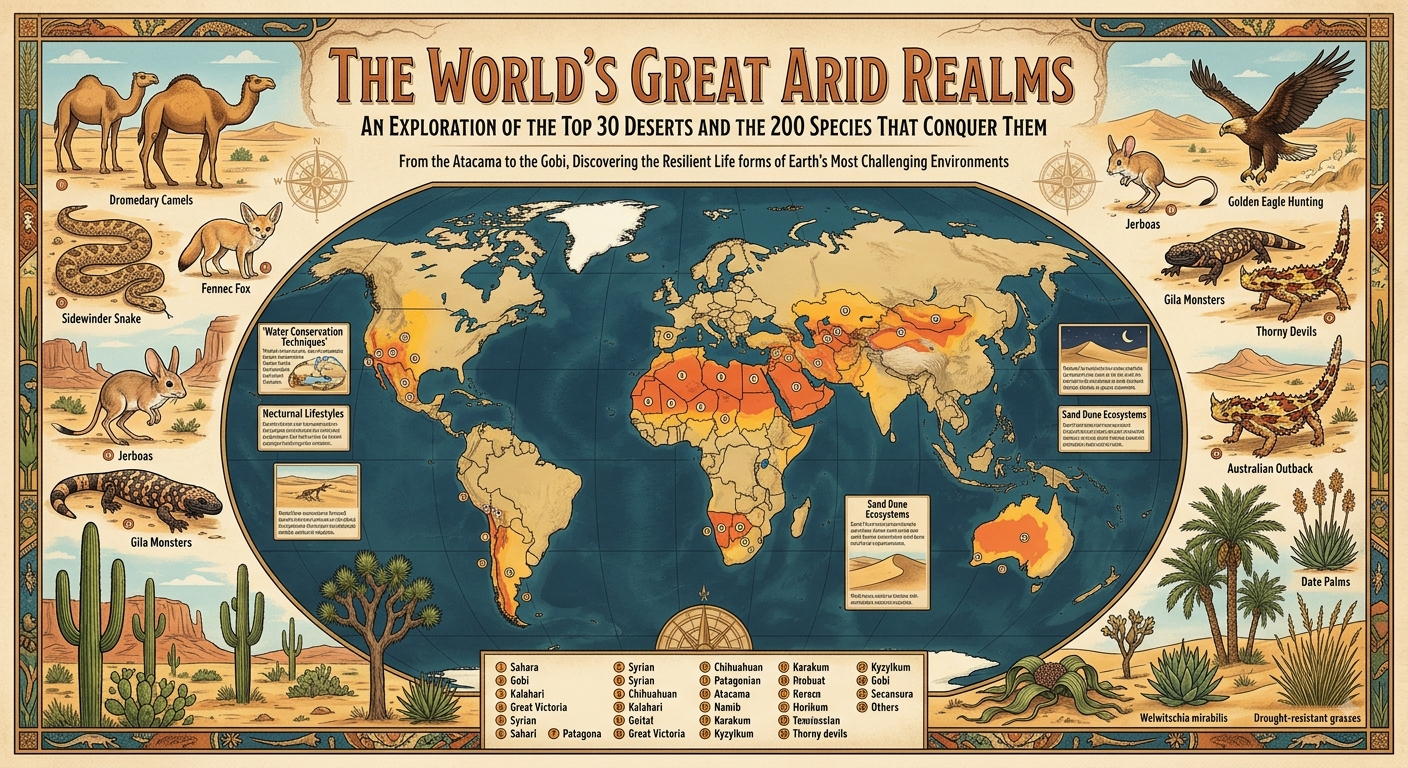
Introduction: Earth’s Great Laboratories of Survival
Deserts are among the most misunderstood environments on Earth. They are often imagined as empty landscapes of sand, heat and lifelessness, yet deserts are highly structured ecosystems containing plants, mammals, reptiles, birds, insects, microorganisms and extraordinary geological systems. Their defining characteristic is aridity—a persistent shortage of available water relative to atmospheric demand—not simply high temperature. Consequently, deserts range from scorching tropical landscapes to some of the coldest environments on Earth.
Scientific studies of desert biology reveal that these ecosystems are particularly valuable for understanding evolution. Scarce water, intense solar radiation, temperature extremes, nutrient limitations and unpredictable rainfall create powerful selective pressures. Species that survive must solve the fundamental biological problems of obtaining water, regulating temperature, finding food, reproducing and avoiding predators.
This article explores 30 major desert regions and presents a representative catalogue of approximately 200 characteristic desert species and species groups. The objective is not merely to list deserts and animals, but to explain the extraordinary ecological architecture that allows life to persist under extreme conditions.
1. What Is a Desert?
A desert is fundamentally an arid ecosystem. Low precipitation is important, but scientists also consider evaporation, temperature, atmospheric demand and the availability of water to organisms.
Many deserts receive less than approximately 250 mm of precipitation annually, although the precise boundary between desert, semi-desert and other dryland categories varies by classification system.
Deserts can be classified into several broad categories:
- Hot and subtropical deserts
- Coastal deserts
- Cold continental deserts
- Polar deserts
- Semi-arid deserts
- High-altitude deserts
Therefore, the word “desert” describes a climatic and ecological condition rather than one particular landscape.
2. The Global Desert System
Deserts occur on every continent. They occupy enormous areas of Earth’s terrestrial surface and include environments ranging from vast sand seas to gravel plains, salt flats, rocky mountains, dry valleys and polar landscapes.
A desert can contain several distinct microhabitats:
- Sand dunes
- Rocky plateaus
- Gravel plains
- Dry river channels
- Salt pans
- Oases
- Mountain valleys
- Canyons
- Springs
- Seasonal wetlands
- Underground burrows
- Coastal fog zones
This environmental diversity explains why a landscape that appears barren from a distance can support complex biological communities. USGS research, for example, emphasizes that desert biodiversity is strongly influenced by geological and landscape variation such as mountains, valleys, caves, dunes and dry lake beds.
3. The 30 Great Desert Realms
The following list represents 30 globally important deserts or desert systems. Some are enormous geographical regions, while others are ecological complexes containing several recognized desert subdivisions.
1. Antarctic Desert
Location: Antarctica
Type: Polar desert
The Antarctic Desert is the world’s largest desert by area. Its defining feature is extreme cold and extremely limited precipitation rather than heat.
Life is concentrated particularly around coastal and ice-free environments.
Representative organisms include:
- Emperor penguin
- Adélie penguin
- Antarctic petrel
- Snow petrel
- Southern fulmar
- Antarctic krill
- Antarctic toothfish
2. Arctic Polar Desert
Location: Arctic regions of North America, Greenland and Eurasia
Type: Polar desert
The Arctic contains extensive polar-desert environments characterized by extremely low precipitation, frozen ground and short growing seasons.
Representative species include:
- Arctic fox
- Polar bear
- Arctic hare
- Peary caribou
- Musk ox
- Arctic tern
- Snowy owl
3. Sahara Desert
Location: North Africa
Type: Hot subtropical desert
The Sahara is the world’s largest hot desert and extends across a vast portion of northern Africa.
Its landscape contains dunes, rocky plateaus, mountains, gravel plains and temporary water systems.
Representative species include:
- Dromedary camel
- Fennec fox
- Dorcas gazelle
- Addax
- Saharan cheetah
- Jerboa
- Sand cat
- Desert hedgehog
- Rüppell’s fox
- Barbary sheep
- Horned viper
- Desert monitor
- Egyptian spiny-tailed lizard
- Saharan silver ant
- Darkling beetles
- Desert locust
The Sahara demonstrates that desert ecosystems are not uniform. Mountains and temporary water sources create biological refuges within the broader arid environment.
4. Arabian Desert
Location: Arabian Peninsula
Type: Hot subtropical desert
The Arabian Desert encompasses several ecological subdivisions, including the Rub’ al Khali.
Representative species include:
- Arabian oryx
- Arabian gazelle
- Arabian wolf
- Sand cat
- Rüppell’s fox
- Dromedary camel
- Nubian ibex
- Arabian sand boa
- Arabian horned viper
- Spiny-tailed lizard
The Arabian oryx is particularly notable for its adaptation to environments in which water is highly limited.
5. Rub’ al Khali
Location: Saudi Arabia, Oman, United Arab Emirates and Yemen
Type: Sand desert
The “Empty Quarter” contains one of the world’s greatest continuous expanses of sand.
Its dunes may be separated by gravel plains and other habitats.
Representative species include:
- Sand cat
- Arabian oryx
- Arabian gazelle
- Dromedary camel
- Sand fox
- Arabian horned viper
6. Thar Desert
Location: India and Pakistan
Type: Hot semi-arid desert
The Thar is unusually important because human settlements, agriculture, livestock systems and wildlife occur together across the landscape.
Representative species include:
- Great Indian bustard
- Chinkara
- Blackbuck
- Indian desert fox
- Indian hedgehog
- Desert monitor
- Indian spiny-tailed lizard
- Indian sand boa
- Desert cat
- Indian peafowl
7. Gobi Desert
Location: Mongolia and northern China
Type: Cold continental desert
Unlike popular images of deserts dominated by sand, much of the Gobi consists of rocky and gravelly terrain.
Representative species include:
- Bactrian camel
- Wild Bactrian camel
- Gobi bear
- Goitered gazelle
- Mongolian wild ass
- Saiga antelope
- Snow leopard
- Pallas’s cat
- Gobi jerboa
- Steppe eagle
The Gobi demonstrates that a desert can be cold, windy and rocky rather than hot and sandy.
8. Taklamakan Desert
Location: Xinjiang, China
Type: Cold continental desert
The Taklamakan is famous for its immense sand dunes and extremely dry climate.
Representative species include:
- Goitered gazelle
- Asiatic wild ass
- Tarim hare
- Bactrian camel
- Desert monitor
- Sand fox
River corridors and mountain-fed oases provide critical biological refuges.
9. Iranian Deserts
Location: Iran
Type: Hot and continental desert
Iran contains several major arid regions, including the Dasht-e Kavir and Dasht-e Lut.
Representative species include:
- Persian leopard
- Asiatic cheetah
- Persian onager
- Goitered gazelle
- Persian wild ass
- Asiatic wild goat
- Persian sand cat
- Iranian ground squirrel
10. Dasht-e Kavir
Location: Iran
Type: Salt desert
Dasht-e Kavir contains salt flats, mud plains and extremely dry terrain.
Representative organisms include:
- Persian onager
- Goitered gazelle
- Asiatic cheetah
- Sand cat
- Desert monitor
- Various halophytic plants
- Desert beetles
Salt-tolerant vegetation illustrates how life can adapt to soils with high concentrations of dissolved minerals.
11. Dasht-e Lut
Location: Iran
Type: Extreme hot desert
Dasht-e Lut is famous for its dramatic geomorphology, including extensive wind-shaped formations.
Its importance extends beyond temperature: geology, wind, water scarcity and surface composition interact to create a highly specialized environment.
Representative species include:
- Persian leopard
- Goitered gazelle
- Persian onager
- Sand cat
- Desert lizards
- Desert rodents
- Halophytic plants
12. Kalahari Desert
Location: Botswana, Namibia and South Africa
Type: Semi-arid desert
The Kalahari is ecologically different from extremely dry sand deserts. Seasonal rainfall allows grasses, shrubs and trees to support substantial animal populations.
Representative species include:
- Kalahari lion
- Cheetah
- Leopard
- African wild dog
- Meerkat
- Springbok
- Gemsbok
- Brown hyena
- Bat-eared fox
- Kori bustard
- Ostrich
- Secretarybird
The Kalahari demonstrates that arid ecosystems can sustain large terrestrial food webs when rainfall is sufficiently seasonal.
13. Namib Desert
Location: Namibia and parts of Angola and South Africa
Type: Coastal desert
The Namib is one of Earth’s oldest desert systems.
Its coastal climate is strongly influenced by the cold Benguela Current.
Representative species include:
- Welwitschia
- Gemsbok
- Springbok
- Brown hyena
- Namib dune gecko
- Namib sand snake
- Fog-basking beetles
- Desert elephant populations in northern Namibia
- Cape fur seal
Fog is particularly important to organisms living in the hyper-arid coastal environment.
14. Karoo
Location: South Africa
Type: Semi-arid shrubland
The Karoo is a major South African dryland ecosystem rather than a simple sea of sand.
It contains exceptional plant diversity.
Representative species include:
- Karoo succulent plants
- Spekboom
- Springbok
- Black rhinoceros
- Cape mountain zebra
- Karoo korhaan
- Secretarybird
- Bat-eared fox
- Cape cobra
15. Mojave Desert
Location: Southwestern United States
Type: Hot desert
The Mojave contains distinctive mountain ranges, valleys and highly specialized vegetation.
Representative species include:
- Joshua tree
- Desert tortoise
- Gila monster
- Mojave rattlesnake
- Kangaroo rat
- Kit fox
- Bighorn sheep
- Roadrunner
- Chuckwalla
- Desert iguana
16. Sonoran Desert
Location: Arizona, California and northwestern Mexico
Type: Hot subtropical desert
The Sonoran is particularly famous for its columnar cacti and seasonal rainfall.
Representative species include:
- Saguaro cactus
- Organ-pipe cactus
- Gila monster
- Sonoran desert tortoise
- Javelina
- Coyote
- Bobcat
- Kangaroo rat
- Elf owl
- Harris’s hawk
The Sonoran demonstrates how relatively seasonal rainfall can generate greater vegetation complexity than extremely hyper-arid deserts.
17. Chihuahuan Desert
Location: Mexico and southwestern United States
Type: Hot semi-arid desert
Representative species include:
- Pronghorn
- Mexican gray wolf
- Desert bighorn sheep
- Kit fox
- Coyote
- Black-tailed jackrabbit
- Greater roadrunner
- Horned lizards
- Chihuahuan meadowlark
18. Great Basin Desert
Location: Western United States
Type: Cold desert
The Great Basin is a high-elevation desert characterized by cold winters and dry conditions.
Representative species include:
- Pronghorn
- Greater sage-grouse
- Pygmy rabbit
- Desert woodrat
- Great Basin rattlesnake
- Desert horned lizard
- Bristlecone pine
- Sagebrush
USGS identifies the Great Basin as a cold desert in contrast to the hotter Mojave, Sonoran and Chihuahuan deserts.
19. Patagonian Desert
Location: Argentina
Type: Cold semi-arid desert
The Patagonian Desert contains extensive steppe landscapes shaped by the Andes and regional climate patterns.
Representative species include:
- Guanaco
- Patagonian mara
- Pichi
- Darwin’s rhea
- Culpeo fox
- Puma
- Lesser grison
20. Atacama Desert
Location: Chile and parts of Peru
Type: Coastal hyper-arid desert
The Atacama is among the driest non-polar environments on Earth.
Despite extreme aridity, coastal fog, underground water, seasonal events and specialized habitats permit life.
Representative species include:
- Vicuña
- Guanaco
- Darwin’s rhea
- Vallenar toad
- Atacama desert lizard
- Chilean flamingo
- Andean flamingo
- Tillandsia and other specialized plants
21. Sechura Desert
Location: Peru
Type: Coastal desert
The Sechura contains dunes, dry valleys and coastal habitats.
Representative species include:
- Peruvian pelican
- Humboldt penguin
- Sechuran fox
- Peruvian desert iguana
- Marine mammals associated with the coastal ecosystem
22. Monte Desert
Location: Argentina
Type: Warm semi-arid desert
Representative species include:
- Guanaco
- Pichi
- Mara
- Culpeo fox
- Greater rhea
- Monte cacti
23. Great Victoria Desert
Location: Australia
Type: Hot desert
Australia contains a remarkable network of arid ecosystems, with many species found nowhere else.
Representative species include:
- Red kangaroo
- Bilby
- Thorny devil
- Dingo
- Emu
- Woma python
- Perentie
- Malleefowl
24. Great Sandy Desert
Location: Western Australia
Type: Hot desert
Representative species include:
- Thorny devil
- Bilby
- Dingo
- Red kangaroo
- Spinifex hopping mouse
25. Gibson Desert
Location: Western Australia
Type: Hot desert
The Gibson Desert consists of extensive sand plains, rocky areas and spinifex grasslands.
Representative species include:
- Marsupial mole
- Thorny devil
- Dingo
- Red kangaroo
- Sand goanna
- Spinifex hopping mouse
26. Simpson Desert
Location: Australia
Type: Sand desert
The Simpson is famous for its enormous parallel dune systems.
Representative species include:
- Eyrean grasswren
- Dingo
- Sand goanna
- Centralian blue-tongued skink
- Spinifex hopping mouse
27. Karakum Desert
Location: Turkmenistan
Type: Continental desert
Representative species include:
- Goitered gazelle
- Asiatic wild ass
- Sand cat
- Desert monitor
- Central Asian tortoise
28. Kyzylkum Desert
Location: Uzbekistan, Kazakhstan and Turkmenistan
Type: Continental desert
Representative species include:
- Saiga
- Goitered gazelle
- Asiatic wild ass
- Central Asian tortoise
- Desert monitor
29. Negev Desert
Location: Israel
Type: Hot semi-arid and arid desert
Representative species include:
- Nubian ibex
- Dorcas gazelle
- Arabian leopard remnants
- Golden jackal
- Fennec fox
- Sand cat
- Desert monitor
The Negev is also an important environment for research into water management, dryland agriculture and desert ecology.
30. Great Basin–Mojave Transition and North American Desert Complex
Rather than viewing North American deserts as isolated units, it is useful to understand the interconnected transition zones among the Great Basin, Mojave, Sonoran and Chihuahuan systems.
Representative organisms include:
- Joshua tree
- Saguaro
- Desert tortoise
- Bighorn sheep
- Kangaroo rat
- Pronghorn
- Gila monster
- Sage-grouse
- Coyote
- Kit fox
These transition zones demonstrate an important ecological principle: desert boundaries are often gradients rather than sharp lines.
31. The 200-Species Concept: How Desert Life Conquers Aridity
The species listed above represent far more than a catalogue of organisms. They demonstrate a common evolutionary challenge:
How can life remain functional when water is scarce?
There is no single answer.
Different organisms have evolved different solutions.
32. Plant Strategy I — Water Storage
Cacti and other succulent plants can store water within specialized tissues.
The saguaro is a classic example. Its large stem provides a reservoir while its structural tissues allow it to remain upright during changing water conditions.
Other succulent plants use:
- Thick leaves
- Swollen stems
- Water-storage roots
- Specialized tissues
- Reduced leaf surfaces
33. Plant Strategy II — Reducing Water Loss
Plants cannot simply stop losing water. Instead, many minimize transpiration.
Mechanisms include:
- Waxy surfaces
- Reduced leaves
- Leaf hairs
- Spines
- Specialized stomata
- Vertical leaf orientation
- Seasonal leaf loss
The National Park Service notes that desert plants use structures such as spines, hairs, light-colored surfaces and deep roots to manage heat and water stress.
34. Plant Strategy III — Root Architecture
Roots can be optimized for different water distributions.
Deep-rooted strategy
A plant may develop deep roots to reach groundwater or deeper soil moisture.
Shallow spreading strategy
Another plant may develop extensive shallow roots to capture rainfall immediately after a storm.
The choice depends on the local geology, soil and rainfall pattern.
35. Plant Strategy IV — The Rapid-Life-Cycle Strategy
Some desert plants behave like biological opportunists.
They remain dormant as seeds during dry periods.
When rainfall arrives:
- Seeds absorb water.
- Germination begins.
- Plants grow rapidly.
- Flowers appear.
- Pollination occurs.
- Seeds develop.
- The plant may die before the next drought.
This strategy transforms unpredictable rainfall into a short but highly productive ecological window.
36. Animal Strategy I — Nocturnal Life
For many desert animals, the safest time to move is after sunset.
Nocturnal activity reduces exposure to extreme daytime heat.
Examples include:
- Fennec foxes
- Kangaroo rats
- Many snakes
- Many rodents
- Numerous insects
- Some desert cats
Desert animals commonly combine nocturnal behavior with burrowing and physiological water conservation.
37. Animal Strategy II — Burrowing
A burrow can function as a natural climate-control system.
Below ground, an animal can escape:
- Direct solar radiation
- Extreme daytime temperatures
- Wind
- Some predators
- Excessive evaporation
Small mammals and reptiles frequently exploit underground environments.
38. Animal Strategy III — Water Conservation
Some desert mammals produce highly concentrated urine and extremely dry feces.
This reduces water loss.
Certain animals obtain much of their water indirectly from food or metabolic processes rather than relying on frequent drinking.
The result is an extraordinary physiological economy in which water becomes one of the body’s most carefully managed resources.
39. Animal Strategy IV — Body Shape
Desert anatomy frequently reflects heat-management requirements.
Examples include:
- Large ears that increase heat exchange
- Long legs that raise the body above hot ground
- Light-colored surfaces that reflect radiation
- Specialized feet for sand
- Scales that reduce water loss
- Compact bodies that reduce exposure
These are examples of morphological adaptation.
40. Animal Strategy V — Behavioral Thermoregulation
Animals can also change their behavior rather than their anatomy.
They may:
- Seek shade
- Enter burrows
- Move at night
- Remain motionless during extreme heat
- Move between microhabitats
- Alter feeding schedules
- Change seasonal activity
Thus survival depends upon both biological structure and behavioral intelligence.
41. Desert Food Webs
A desert food web can appear simple but is highly interconnected.
A simplified system looks like:
Sunlight → desert plants → herbivores → predators → decomposers → soil nutrients → plants
For example:
Rain → grasses → grasshopper → lizard → snake → raptor
Or:
Cactus → fruit-eating animal → predator → decomposer
Every level depends on the availability of energy and water.
42. The Invisible Desert: Microorganisms
One of the most important parts of desert ecosystems is also the least visible.
Soils contain:
- Bacteria
- Fungi
- Cyanobacteria
- Microalgae
- Microscopic invertebrates
These organisms participate in nutrient cycling and soil formation.
Biological soil crusts can also influence erosion, water infiltration and ecosystem productivity.
Consequently, the desert is not merely a landscape populated by large animals. It is a microbial ecosystem as well.
43. Desert Insects: Small Bodies, Extraordinary Engineering
Insects are among the most successful desert organisms.
Examples include:
- Darkling beetles
- Ants
- Termites
- Locusts
- Grasshoppers
- Bees
- Wasps
- Moths
- Flies
Some beetles can exploit atmospheric moisture and fog. Others survive by remaining underground during the hottest periods.
Their small size and specialized exoskeletons allow them to manage water loss exceptionally well.
44. Desert Reptiles
Reptiles are particularly successful in many hot deserts because their ectothermic physiology reduces the metabolic energy required for maintaining a constant internal temperature.
Representative groups include:
- Geckos
- Skinks
- Monitor lizards
- Horned lizards
- Tortoises
- Vipers
- Boas
- Pythons
However, reptiles still need sophisticated behavioral thermoregulation.
A lizard may move between sun and shade repeatedly to maintain an appropriate body temperature.
45. Desert Birds
Birds occupy many desert ecological niches.
They include:
- Raptors
- Seed-eaters
- Insectivores
- Scavengers
- Ground birds
- Nectar-feeders
- Migratory species
Birds must solve a particularly difficult problem because flight requires substantial energy.
Their adaptations include efficient respiration, behavioral thermoregulation, specialized diets and strategic use of water sources.
46. Desert Mammals
Desert mammals include some of Earth’s most recognizable animals:
- Camels
- Gazelles
- Foxes
- Kangaroos
- Rodents
- Bighorn sheep
- Antelope
- Wild asses
- Cats
- Hyenas
Their survival depends upon combinations of physiology, anatomy, behavior and ecological specialization.
47. The Camel as a Biological Engineering System
The camel is often treated as the symbol of desert survival.
Its success does not result from simply “storing water in its hump.” The hump primarily stores fat, which can serve as an energy reserve.
Camel adaptations include:
- Efficient water conservation
- Specialized blood physiology
- Heat tolerance
- Fat storage
- Broad feet
- Behavioral thermoregulation
- Ability to tolerate substantial changes in body water
The camel is therefore better understood as a highly integrated biological system.
48. The Kangaroo Rat: Water Economy
The kangaroo rat provides another remarkable example.
It can survive in extremely dry environments while obtaining much of its water indirectly through food metabolism.
Its lifestyle combines:
- Nocturnal activity
- Burrowing
- Efficient kidneys
- Seed-based nutrition
- Extremely low water requirements
This represents one of the clearest examples of physiological adaptation to aridity.
49. Desert Tortoises
Desert tortoises survive through a combination of:
- Burrowing
- Seasonal activity
- Water conservation
- Slow metabolism
- Specialized diets
- Long periods of inactivity
Their burrows can provide substantially more favorable environmental conditions than the surface during extreme weather.
50. Desert Ecosystems as Climate Machines
A desert is not simply a dry landscape.
It is an interaction among:
Atmosphere + solar radiation + geology + soil + water + plants + animals + microorganisms + wind + human activity
These components form a dynamic system.
Change one component and the others may respond.
For example:
Reduced rainfall → vegetation decline → reduced food → herbivore decline → predator decline
Alternatively:
Restored vegetation → improved soil stability → greater water infiltration → increased plant productivity → increased habitat quality
51. The Importance of Desert Soil
Desert soil performs several critical functions.
It:
- Stores limited moisture
- Supports plant roots
- Houses microorganisms
- Stores carbon
- Controls nutrient availability
- Influences erosion
- Determines vegetation distribution
Soil degradation can therefore destabilize the entire ecosystem.
52. Desert Water Systems
Water in deserts often exists in forms that are invisible from the surface.
These include:
- Groundwater
- Seasonal rivers
- Underground aquifers
- Springs
- Moisture trapped in soil
- Fog
- Dew
- Snowmelt
- Temporary pools
Oases are therefore ecological islands within much larger dry landscapes.
53. Desert Mountains
Mountains can dramatically increase biodiversity.
They create:
- Different elevations
- Temperature gradients
- Snow accumulation
- Springs
- Shaded slopes
- Wind corridors
- Isolated habitats
Consequently, a desert mountain range can function as a biodiversity refuge.
54. Why Deserts Can Be Biodiversity Hotspots
Deserts may have fewer organisms per unit area than tropical forests, but they can contain remarkable levels of specialization and endemism.
Evolutionary isolation can produce species found nowhere else.
USGS research emphasizes the role of geographically separated valleys, mountains, dry lake beds and caves in generating desert biodiversity.
This means biodiversity should not be measured simply by asking:
“How many animals can I see?”
A better question is:
“How many unique ecological strategies and evolutionary lineages exist here?”
55. Human Civilization and Deserts
Deserts have never been biologically or culturally empty.
Human societies have developed sophisticated systems for living within arid environments.
These include:
- Oasis agriculture
- Underground water systems
- Rainwater harvesting
- Nomadic pastoralism
- Trade routes
- Desert architecture
- Solar-energy development
- Dryland agriculture
- Modern irrigation
The history of civilization is therefore deeply connected with humanity’s ability to manage scarce water.
56. Desertification
Desertification is different from simply having a natural desert.
A natural desert is an ecosystem shaped by climate and geography.
Desertification refers to land degradation in drylands.
Causes can include:
- Unsustainable grazing
- Soil erosion
- Deforestation
- Poor irrigation
- Salinization
- Climate variability
- Climate change
- Unsustainable land management
The consequences can include declining vegetation, soil degradation, reduced agricultural productivity and biodiversity loss. Desert ecosystems themselves are also threatened by land degradation, climate change and other human pressures.
57. Climate Change and the Future of Deserts
Climate change can alter desert systems through:
- Higher temperatures
- Changing rainfall patterns
- Longer droughts
- More intense rainfall events
- Shifts in vegetation
- Changes in species ranges
- Increased evaporation
- Greater pressure on water resources
Some desert organisms may adapt or shift their ranges, while highly specialized species may have fewer options.
58. Desert Conservation
Effective desert conservation requires more than creating protected areas.
A comprehensive strategy includes:
1. Habitat protection
Prevent unnecessary destruction of intact ecosystems.
2. Water protection
Safeguard groundwater and natural springs.
3. Sustainable grazing
Prevent excessive pressure on vegetation.
4. Native vegetation restoration
Restore species appropriate to local climate and soil.
5. Wildlife corridors
Maintain connections between fragmented habitats.
6. Scientific monitoring
Use satellite imagery, field surveys and ecological modelling.
7. Community participation
Local communities are essential to long-term conservation.
8. Invasive-species control
Prevent invasive organisms from displacing native species.
9. Climate adaptation
Design conservation systems around changing climatic conditions.
10. International cooperation
Many desert ecosystems cross national boundaries.
59. Technology and the Desert
The modern study of deserts is increasingly technological.
Researchers can combine:
Satellite imagery + drones + sensors + weather stations + GPS + ecological databases + artificial intelligence + field biology
to monitor:
- Vegetation
- Soil moisture
- Desertification
- Wildlife movement
- Drought
- Water availability
- Fire
- Land-use change
- Species distributions
Remote sensing is especially powerful because deserts cover enormous areas that are difficult to survey continuously from the ground.
60. Artificial Intelligence and Desert Ecology
AI can potentially transform desert research.
Machine-learning systems can analyse enormous datasets from:
- Satellites
- Camera traps
- Acoustic sensors
- Weather stations
- Soil sensors
- Wildlife trackers
AI models can help identify:
- Vegetation changes
- Animal populations
- Habitat fragmentation
- Drought patterns
- Invasive species
- Water stress
This creates a new discipline at the intersection of ecology, Earth observation, computing and environmental engineering.
61. The Desert as an Evolutionary Laboratory
Deserts provide some of Earth’s clearest demonstrations of natural selection.
Consider the evolutionary problem:
Water is scarce.
A species that wastes water is disadvantaged.
A species that conserves water more effectively has a survival advantage.
Over many generations, traits that improve survival and reproduction can become more common.
This produces remarkable adaptations.
The desert therefore functions as a natural laboratory in which evolutionary pressures are unusually visible.
62. The Four-Layer Architecture of Desert Survival
Desert survival can be understood through four interacting layers.
Layer 1 — Physical adaptation
Body structures change.
Examples:
- Spines
- Thick skins
- Large ears
- Deep roots
- Broad feet
Layer 2 — Physiological adaptation
Internal biological systems change.
Examples:
- Water-conserving kidneys
- Efficient metabolism
- Heat tolerance
- Salt regulation
Layer 3 — Behavioral adaptation
Organisms change what they do.
Examples:
- Nocturnal activity
- Burrowing
- Seasonal dormancy
- Shade seeking
Layer 4 — Ecological adaptation
Species occupy specialized niches.
Examples:
- Seed predators
- Pollinators
- Scavengers
- Apex predators
- Decomposers
Together these layers create the desert ecosystem.
63. The Desert Survival Equation
A simplified conceptual equation can be written as:
Survival = Water efficiency + Energy efficiency + Temperature control + Food acquisition + Reproduction + Predator avoidance
If an organism successfully balances these variables, it can occupy an arid ecological niche.
This is why desert survival is not simply about “being tough.”
It is about resource efficiency.
64. The 200-Species Lesson
Across the approximately 200 representative species and species groups discussed in this article, several recurring principles appear:
| Challenge | Biological solution |
|---|---|
| Water scarcity | Water conservation |
| Extreme heat | Nocturnal behavior |
| Cold nights | Burrows and insulation |
| Limited food | Opportunistic feeding |
| Strong sunlight | Reflective surfaces |
| Sand | Specialized feet/body structures |
| Salt | Salt tolerance |
| Drought | Dormancy |
| Unpredictable rainfall | Rapid reproduction |
| Predation | Camouflage and shelter |
| Limited vegetation | Broad dietary flexibility |
The same environmental problem can produce completely different evolutionary solutions.
65. The Great Desert Comparison
| Desert | Main characteristic | Representative adaptation |
|---|---|---|
| Antarctic | Extreme cold | Cold tolerance |
| Arctic | Frozen aridity | Insulation |
| Sahara | Extreme heat and scale | Water conservation |
| Arabian | Heat and aridity | Physiological efficiency |
| Gobi | Cold and dryness | Seasonal adaptation |
| Thar | Aridity + human pressure | Flexible ecology |
| Namib | Fog and extreme dryness | Atmospheric moisture use |
| Atacama | Hyper-aridity | Extreme resource efficiency |
| Kalahari | Seasonal rainfall | Opportunistic productivity |
| Karoo | Semi-arid shrubland | Succulent adaptation |
| Mojave | Heat and drought | Burrowing/nocturnality |
| Sonoran | Seasonal rainfall | Water storage |
| Chihuahuan | Semi-arid conditions | Flexible feeding |
| Great Basin | Cold desert | Cold tolerance |
| Australian deserts | Heat and isolation | Specialized marsupials |
66. Deserts Are Not Empty
The central misconception that deserts are “dead places” should be rejected.
They are instead:
Water-limited biological systems.
Their organisms may be less visible because much of desert life operates:
- At night
- Underground
- During short rainy periods
- Inside vegetation
- Beneath rocks
- During particular seasons
The apparent emptiness of the landscape therefore hides a highly sophisticated biological system.
National Geographic similarly emphasizes that deserts are biologically rich environments containing organisms adapted specifically to harsh conditions.
67. The Millennium Perspective: Deserts and Human Civilization
From the perspective of a long-term human timeline, deserts have played several roles simultaneously.
They have been:
Barriers → corridors → ecological laboratories → sources of minerals → agricultural challenges → energy landscapes → scientific laboratories
Modern technology is now changing the relationship between civilization and deserts.
Solar energy, desalination, precision agriculture, groundwater monitoring, satellite observation, robotics and AI may substantially increase our ability to understand and manage drylands.
But technological capability does not eliminate ecological limits.
Water remains the fundamental constraint.
68. A Future Desert Civilization
The future of dryland development could be based on a new architecture:
Solar energy
↓
Desalination / water recycling
↓
Precision irrigation
↓
Protected ecosystems
↓
AI environmental monitoring
↓
Regenerative agriculture
↓
Restored biodiversity
↓
Sustainable human settlements
The objective should not be to transform every desert into farmland.
Instead, the goal should be to understand which landscapes should remain wild, which can support carefully managed development and which require ecological restoration.
Conclusion: The Great Lesson of the World’s Deserts
The world’s deserts represent one of Earth’s greatest demonstrations of biological engineering.
From the frozen Antarctic interior to the Sahara, from the Namib to the Atacama, from Australia’s interior to the Gobi, these environments demonstrate that life does not require abundance. It requires adaptation, efficiency and ecological opportunity.
The approximately 200 representative species explored here reveal a common evolutionary principle:
When resources become scarce, survival becomes an engineering problem.
Plants engineer roots, leaves and tissues around water availability.
Animals engineer their behavior around temperature.
Mammals engineer their physiology around water conservation.
Reptiles engineer their daily activity around solar radiation.
Insects engineer their life cycles around rainfall.
Microorganisms engineer ecological processes at the soil surface.
Entire ecosystems therefore become interconnected networks of resource management.
Deserts are not failures of nature.
They are among nature’s most sophisticated experiments.
They teach humanity about water efficiency, energy conservation, climate resilience, biodiversity, adaptation and the limits of resource consumption.
In the coming centuries, that knowledge may become increasingly important as civilization confronts climate variability, population growth, water scarcity and ecological degradation.
The great deserts therefore represent not only ancient landscapes.
They are also laboratories for humanity’s ecological future.
Selected scientific foundations
The ecological principles used in this article are supported by research and educational material from the U.S. National Park Service, U.S. Geological Survey, Oxford Academic and National Geographic. Desert ecology research emphasizes adaptation, food webs, biodiversity, desertification and conservation, while USGS describes substantial biodiversity in even extremely arid ecosystems.



Be First to Comment