
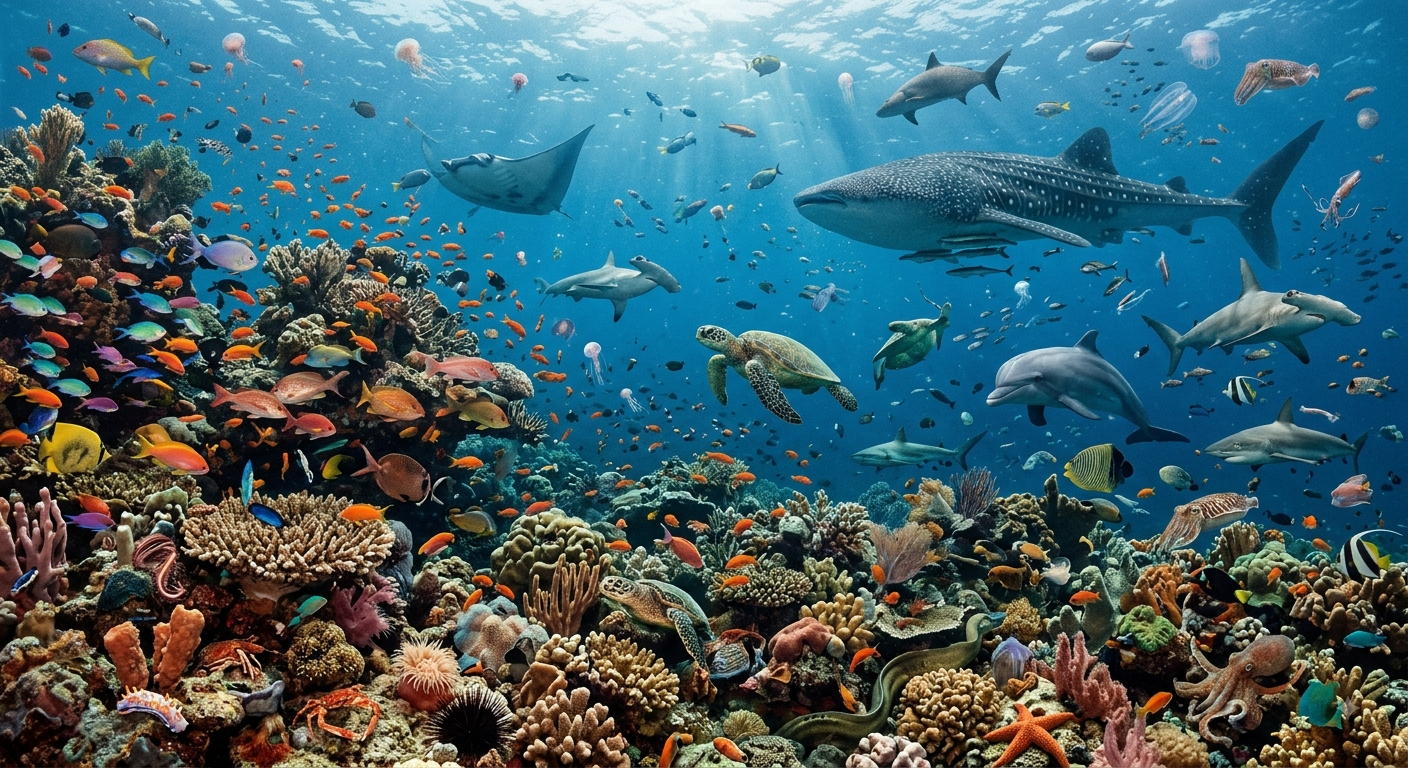
A Comprehensive Scientific Exploration of Marine Biodiversity, the Ocean Census and the Unmapped Living World
Abstract
Earth’s oceans constitute the largest connected living environment on the planet. Covering more than 70% of Earth’s surface, the oceans contain an extraordinary spectrum of life extending from microscopic organisms to the largest animals ever known.
Yet humanity does not possess a complete census of ocean life.
The number of marine species that have been formally described is already enormous, with the World Register of Marine Species reporting at least 249,000 marine species whose names are scientifically managed. However, this represents only the documented portion of marine biodiversity. Scientific estimates indicate that hundreds of thousands of additional marine species may remain undescribed, unsampled or insufficiently studied.
A major historical estimate placed total marine biodiversity at approximately 0.7–1.0 million eukaryotic species, although estimates vary substantially depending on the methods and taxonomic groups considered.
The situation is changing rapidly. In 2026, the Ocean Census reported the discovery of 1,121 previously unknown marine species from its work during the preceding year, demonstrating that modern exploration continues to reveal substantial biological diversity in environments that have been poorly studied.
The ocean therefore should not be viewed simply as a catalogue of known fish, whales, sharks and corals. It is a planetary biological system containing organisms occupying virtually every available ecological niche—from sunlit surface waters to deep-sea sediments, hydrothermal environments and the enormous microbial ecosystems associated with marine organisms.
1. The Fundamental Question: How Many Ocean Species Exist?
The simplest question is:
How many species live in the ocean?
The scientifically responsible answer is:
We do not yet know.
There are three different numbers that must be distinguished:
- Described species — organisms formally identified and scientifically named.
- Discovered but undescribed species — organisms collected or observed but not yet formally classified.
- Undiscovered species — organisms that science has not yet encountered.
Confusing these three categories produces misleading estimates.
The World Register of Marine Species currently manages names for at least 249,000 described marine species. WoRMS also emphasizes that this is not equivalent to the total number of species actually existing in the ocean.
2. Why the Number Is So Difficult to Determine
The ocean presents an extraordinary sampling problem.
Scientists cannot simply survey the entire ocean in the way that researchers might survey a small terrestrial ecosystem.
The marine environment contains:
- enormous geographical distances;
- extreme depths;
- enormous pressure;
- complete darkness in deep environments;
- highly variable temperatures;
- complex sediments;
- underwater mountains;
- trenches;
- caves;
- coral reefs;
- seamounts;
- polar environments;
- open-ocean ecosystems;
- microscopic habitats;
- chemically extreme environments.
Consequently, much of the ocean remains biologically under-sampled.
Even where scientists have physically visited an environment, they may encounter organisms that cannot immediately be assigned to a known species.
3. The Known Marine Species Inventory
The most important global reference system is the World Register of Marine Species (WoRMS).
WoRMS is maintained by an international scientific community and provides an authoritative taxonomic framework for marine organisms.
Its importance goes beyond producing a simple species list.
A modern marine biodiversity database must account for:
- accepted scientific names;
- synonyms;
- taxonomic revisions;
- genera;
- families;
- orders;
- phyla;
- geographic distributions;
- fossil taxa;
- newly described species;
- relationships between taxonomic groups.
According to WoRMS, at least 249,000 marine species have been described and their names are managed within the system.
That number should therefore be understood as a minimum documented inventory, not the final number of marine species.
4. The Estimated Hidden Biodiversity
One influential marine-species assessment estimated approximately:
0.7–1.0 million marine species
for the major eukaryotic groups considered.
That analysis estimated that approximately 482,000–741,000 additional species might remain to be sampled, while tens of thousands of collected organisms could remain formally undescribed.
This produces a profound conclusion:
A large proportion of marine biodiversity may still be unknown to science.
However, this should not be interpreted as an exact census.
It is an estimate produced from statistical and taxonomic modelling.
Different studies can produce different results because they use different assumptions about:
- sampling intensity;
- taxonomic groups;
- cryptic species;
- geographic distribution;
- extinction;
- species discovery rates;
- microbial diversity;
- species-area relationships;
- molecular identification.
5. A Critical Distinction: Species Versus Individual Organisms
Another important distinction is between:
Species richness
The number of different species.
Abundance
The number of individual organisms.
The ocean contains enormously more individual organisms than its species count suggests.
For example, a single species of plankton can occur in enormous populations.
Therefore:
250,000 species does not mean 250,000 individual marine organisms.
It could represent an astronomical number of individual animals, plants, algae, fungi, protists and microorganisms.
The ocean is simultaneously:
a species system + an abundance system + an energy system + a nutrient system + a genetic system.
6. The Major Categories of Ocean Life
Marine biodiversity extends across an extraordinary range of biological groups.
6.1 Bacteria
Marine bacteria are fundamental components of ocean ecosystems.
They participate in:
- decomposition;
- nutrient recycling;
- carbon cycling;
- nitrogen cycling;
- sulfur cycling;
- primary production;
- symbiosis.
Many marine bacteria are microscopic and difficult to distinguish using traditional methods.
6.2 Archaea
Archaea are another major domain of life.
They occur in environments including:
- deep ocean water;
- sediments;
- oxygen-poor environments;
- hydrothermal systems;
- extreme-temperature habitats.
Their biochemical pathways contribute significantly to global nutrient and carbon cycles.
6.3 Protists
Marine protists include an enormous diversity of microscopic organisms.
Examples include:
- dinoflagellates;
- diatoms;
- ciliates;
- radiolarians;
- foraminiferans.
Many are essential components of plankton communities.
7. Marine Algae and Phytoplankton
Phytoplankton form one of Earth’s most important biological production systems.
They capture energy from sunlight and convert inorganic carbon into organic matter.
Important groups include:
- diatoms;
- dinoflagellates;
- coccolithophores;
- cyanobacteria;
- other microscopic algae.
Their ecological significance is enormous because they support marine food webs.
A simplified ocean food chain can be represented as:
Sunlight → phytoplankton → zooplankton → small fish → large fish → marine predators
But real ocean food webs are substantially more complicated.
8. Marine Invertebrates
Marine invertebrates constitute an enormous proportion of known marine animal diversity.
They include:
- molluscs;
- crustaceans;
- annelid worms;
- nematodes;
- cnidarians;
- echinoderms;
- sponges;
- bryozoans;
- tunicates;
- flatworms;
- numerous microscopic groups.
This category is especially important when considering the hidden biodiversity of the deep sea.
WoRMS notes that nematodes are particularly diverse, and some estimates suggest millions of nematode species may exist across environments, although such broad estimates should not automatically be interpreted as a confirmed count of ocean species.
9. Fish
Fish are among the most recognizable marine organisms.
They occupy:
- coral reefs;
- continental shelves;
- open oceans;
- estuaries;
- polar waters;
- deep-sea habitats.
Marine fish include:
- sharks;
- rays;
- skates;
- eels;
- tuna;
- cod;
- groupers;
- lanternfish;
- seahorses;
- many other groups.
However, fish represent only a fraction of total marine biodiversity.
The popular image of the ocean as principally a world of fish dramatically underestimates the importance of microscopic and invertebrate life.
10. Marine Reptiles
Marine reptiles include:
- sea turtles;
- sea snakes;
- marine iguanas;
- saltwater crocodiles.
Although they contain relatively few species compared with marine invertebrates, they occupy important ecological positions.
Sea turtles, for example, can influence marine and coastal ecosystems through their feeding activities and movement between oceanic and terrestrial environments.
11. Marine Birds
Many bird species depend heavily on marine ecosystems.
Examples include:
- penguins;
- albatrosses;
- petrels;
- gannets;
- cormorants;
- gulls;
- terns.
Marine birds connect oceanic food webs with terrestrial ecosystems because they transport nutrients between environments.
12. Marine Mammals
Marine mammals include:
- whales;
- dolphins;
- porpoises;
- seals;
- sea lions;
- walruses;
- manatees;
- dugongs;
- sea otters.
The blue whale is the largest known animal ever to exist, yet its biological abundance is tiny compared with microscopic marine organisms.
This demonstrates an important principle:
The largest organisms are not necessarily the most numerous or most ecologically dominant.
13. Coral Reefs: Cities of the Ocean
Coral reefs are among the most biologically complex marine ecosystems.
A reef is not merely coral.
It is an interconnected community containing:
- corals;
- algae;
- fish;
- crustaceans;
- molluscs;
- worms;
- sponges;
- microorganisms;
- predators;
- scavengers;
- decomposers.
Coral reefs therefore function as highly complex ecological networks.
Their biodiversity is disproportionately important relative to their physical area.
14. The Deep Ocean: Earth’s Great Biological Frontier
The deep ocean represents one of the greatest remaining biological frontiers.
At increasing depth, conditions change dramatically:
Sunlight decreases → pressure increases → temperature changes → food becomes scarcer → biological communities change.
Yet the deep ocean is not biologically empty.
It contains:
- deep-sea corals;
- amphipods;
- isopods;
- worms;
- sea cucumbers;
- brittle stars;
- sponges;
- fish;
- cephalopods;
- microorganisms.
Ocean Census expeditions have recently demonstrated how much remains to be discovered.
In 2026, Ocean Census reported 1,121 new marine species, including organisms discovered at depths reaching approximately 6,575 metres.
15. Hydrothermal Vents
Hydrothermal vents are among the most extraordinary marine environments.
They occur where geologically active regions of the seafloor release chemically enriched fluids.
Vent ecosystems can support organisms through chemical energy rather than direct dependence on sunlight.
This fundamentally expanded scientific understanding of where life can exist.
The basic ecological model can be represented as:
Geological energy → chemical compounds → microbial production → larger organisms
These ecosystems demonstrate that Earth’s biosphere is not simply a surface phenomenon.
16. The Ocean Floor as a Living Landscape
The seafloor is not merely geological material.
It contains complex biological communities.
Sediments can contain enormous populations of:
- bacteria;
- archaea;
- nematodes;
- tiny crustaceans;
- worms;
- protists;
- other microscopic organisms.
Consequently, biodiversity surveys that focus only on visible animals dramatically underestimate marine life.
17. The Plankton Universe
Plankton are organisms that drift with water currents.
They include both:
Phytoplankton
Primarily photosynthetic organisms.
Zooplankton
Animal and animal-like organisms that consume other organisms.
Examples include:
- copepods;
- krill;
- jellyfish larvae;
- fish larvae;
- mollusc larvae;
- numerous microscopic organisms.
Plankton form the foundation of many marine food webs.
18. The Genetic Dimension of Ocean Biodiversity
Species are not the only measure of biological diversity.
Scientists increasingly examine:
Genetic diversity → species diversity → ecosystem diversity
Two organisms that appear nearly identical may contain substantial genetic differences.
Molecular techniques can reveal:
- cryptic species;
- previously unknown lineages;
- evolutionary relationships;
- microbial communities;
- population structure.
This means that future estimates of ocean biodiversity may change substantially as DNA sequencing becomes cheaper and more widespread.
19. Environmental DNA
One of the most powerful emerging tools is environmental DNA (eDNA).
Organisms continuously release genetic material into their surroundings.
Scientists can collect water or sediment samples and analyse DNA fragments.
This can reveal evidence of organisms without necessarily capturing them.
A simplified process is:
Ocean water → DNA sampling → sequencing → genetic matching → species identification
This technology could transform marine biodiversity monitoring.
20. Artificial Intelligence and Ocean Biodiversity
Artificial intelligence is becoming increasingly important in marine research.
AI can assist with:
- underwater image classification;
- acoustic identification;
- species recognition;
- DNA sequence analysis;
- habitat mapping;
- autonomous underwater vehicles;
- population monitoring;
- ecological forecasting.
Modern computer vision can potentially recognize organisms from underwater imagery, while machine-learning systems can assist scientists in sorting enormous quantities of observations.
The combination of:
AI + robotics + DNA sequencing + satellites + autonomous vehicles
could create an entirely new generation of ocean biodiversity science.
21. Autonomous Ocean Exploration
Traditional ocean exploration is expensive because research vessels, crews and specialised equipment are required.
Autonomous systems can extend human observation.
These include:
- autonomous underwater vehicles;
- remotely operated vehicles;
- underwater cameras;
- acoustic sensors;
- environmental sensors;
- robotic sampling systems.
The future ocean census could therefore resemble a distributed planetary observation network.
22. The Ocean Census Revolution
The Ocean Census initiative demonstrates how modern technology can accelerate species discovery.
In 2026, Ocean Census reported 1,121 previously unknown marine species from its recent work. These discoveries included organisms from deep and poorly explored environments.
This is significant because taxonomy has traditionally been a relatively slow process.
Finding an organism is only the beginning.
Scientists must establish:
- whether it is genuinely different;
- whether it matches an existing species;
- its evolutionary relationships;
- its morphological characteristics;
- its genetic characteristics;
- its ecological characteristics;
- its formal scientific name.
23. The Taxonomic Bottleneck
One of the hidden problems in biodiversity science is the shortage of taxonomic capacity.
There can be a substantial gap between:
finding an organism
and
formally describing the organism as a new species.
This means that biodiversity discovery is not simply an exploration problem.
It is also an:
information-processing problem.
The future therefore requires investment in:
- taxonomists;
- geneticists;
- marine biologists;
- data scientists;
- museums;
- specimen repositories;
- biodiversity databases;
- AI systems;
- molecular laboratories.
24. Why Discovering Species Matters
Species discovery is not merely an academic exercise.
Knowing what exists is fundamental to conservation.
A species cannot easily be protected if humanity does not know:
- that it exists;
- where it lives;
- what it eats;
- how it reproduces;
- what environmental conditions it requires;
- what threatens it.
Therefore:
Discovery → identification → monitoring → conservation
is a fundamental scientific chain.
25. Ocean Biodiversity and Climate Change
Marine ecosystems are being affected by global environmental change.
Major pressures include:
- warming oceans;
- ocean acidification;
- deoxygenation;
- pollution;
- habitat destruction;
- overfishing;
- invasive species;
- coastal development;
- noise pollution;
- changes in ocean circulation.
Recent research and reporting also illustrate how warming and human-mediated species movement are transforming marine ecosystems. For example, invasive species are increasingly altering the Mediterranean ecosystem as warming waters create conditions more suitable for species arriving from other regions.
26. The Biodiversity Paradox
Humanity has reached an extraordinary technological position.
We can:
- sequence genomes;
- operate spacecraft;
- build artificial intelligence;
- communicate globally;
- map planets;
- construct enormous data centres.
Yet we still do not possess a complete biological inventory of our own oceans.
This creates a profound scientific paradox:
Human technological knowledge is advancing faster than our biological knowledge of Earth.
27. A Proposed Ocean Biodiversity Architecture
A future global ocean census could integrate multiple technological layers:
Layer 1 — Satellites
Monitor:
- sea-surface temperature;
- ocean colour;
- chlorophyll;
- currents;
- coastal changes.
Layer 2 — Surface platforms
Monitor:
- atmospheric conditions;
- ocean chemistry;
- biological productivity.
Layer 3 — Autonomous vehicles
Explore:
- continental shelves;
- seamounts;
- deep ocean;
- trenches.
Layer 4 — Underwater robotics
Collect:
- imagery;
- specimens;
- sediment;
- water;
- environmental measurements.
Layer 5 — Genomics
Analyse:
- DNA;
- RNA;
- microbial communities;
- population genetics.
Layer 6 — Artificial intelligence
Integrate:
- images;
- sound;
- genetics;
- geography;
- ecological observations.
Layer 7 — Global biodiversity database
Create a continually updated planetary inventory.
28. The Ocean as a Planetary Database
A future marine biodiversity platform could assign each organism a digital identity containing:
Species ID
→ scientific name
→ genetic information
→ images
→ geographic distribution
→ depth range
→ habitat
→ food relationships
→ predators
→ reproductive biology
→ population trends
→ conservation status
→ environmental tolerances
→ ecological function.
This would transform the traditional species catalogue into a dynamic living planetary database.
29. Why “Total Species” Will Always Be a Moving Number
Even if humanity eventually catalogues most marine species, the number will continue changing.
Species can:
- evolve;
- diverge;
- become extinct;
- be reclassified;
- be merged taxonomically;
- be split into multiple species;
- be discovered in previously inaccessible habitats.
Therefore, the “total number of ocean species” should be viewed as a dynamic scientific variable, rather than a permanent number.
30. The 2026 Scientific Position
The most defensible summary is:
| Category | Current scientific understanding |
|---|---|
| Ocean surface | More than 70% of Earth’s surface |
| Formally described marine species | At least ~249,000 |
| Estimated total eukaryotic marine species | Roughly ~700,000–1,000,000 in one major estimate |
| Unknown/unsampled component | Potentially hundreds of thousands |
| New marine discoveries | Continuing rapidly |
| 2026 Ocean Census result | 1,121 new marine species reported |
| Complete global census | Not yet achieved |
The numbers should not be treated as perfectly interchangeable because they come from different datasets, methodologies and definitions.
31. The Most Important Scientific Lesson
The central lesson is not simply that there are “millions of creatures in the sea.”
It is more profound:
Humanity has explored only a fraction of Earth’s biological diversity.
The ocean contains an enormous biological information system whose full structure remains unknown.
Every new expedition can potentially reveal:
- new species;
- new genes;
- new ecosystems;
- new biochemical compounds;
- new evolutionary relationships;
- new ecological processes.
32. The Future: From Ocean Census to Planetary Biodiversity Census
The ultimate objective should be a continuously updated Global Ocean Biodiversity Digital Twin.
Such a system could integrate:
Satellite observation
robotic exploration
environmental DNA
genomics
underwater acoustics
artificial intelligence
marine databases
human scientific expertise
to produce a constantly evolving representation of ocean life.
Instead of asking:
“How many species are in the ocean?”
future science could answer:
“Which organisms exist, where are they located, how abundant are they, how are they related, what ecological functions do they perform, and how are their populations changing?”
That is a much more powerful scientific objective.
33. Conclusion
The world’s oceans represent perhaps the greatest remaining biological frontier on Earth.
At least 249,000 marine species have already been formally described, but this is only the documented portion of marine biodiversity. Scientific modelling indicates that the true number of marine eukaryotic species could be substantially larger, with one major assessment estimating approximately 700,000–1,000,000 species.
The continuing discovery of new organisms demonstrates that the inventory remains incomplete. In 2026, Ocean Census reported 1,121 newly discovered marine species from its recent research, including organisms from environments thousands of metres beneath the ocean surface.
The significance of this is enormous.
The ocean is not simply a reservoir of water containing fish and whales. It is a planetary biological machine containing an extraordinary network of microorganisms, invertebrates, plants and algae, fish, reptiles, birds, mammals and countless organisms that remain poorly understood.
The next great phase of ocean science will combine biology with artificial intelligence, robotics, genomics, autonomous exploration and global data infrastructure.
Humanity’s ultimate challenge is therefore not merely to discover the remaining species.
It is to understand the relationships connecting all of them.
The future of marine science can consequently be expressed as:
DISCOVER → IDENTIFY → SEQUENCE → MAP → UNDERSTAND → MONITOR → PROTECT
The ocean remains one of Earth’s greatest unexplored scientific frontiers—and the catalogue of life within it is still being written.



Be First to Comment