
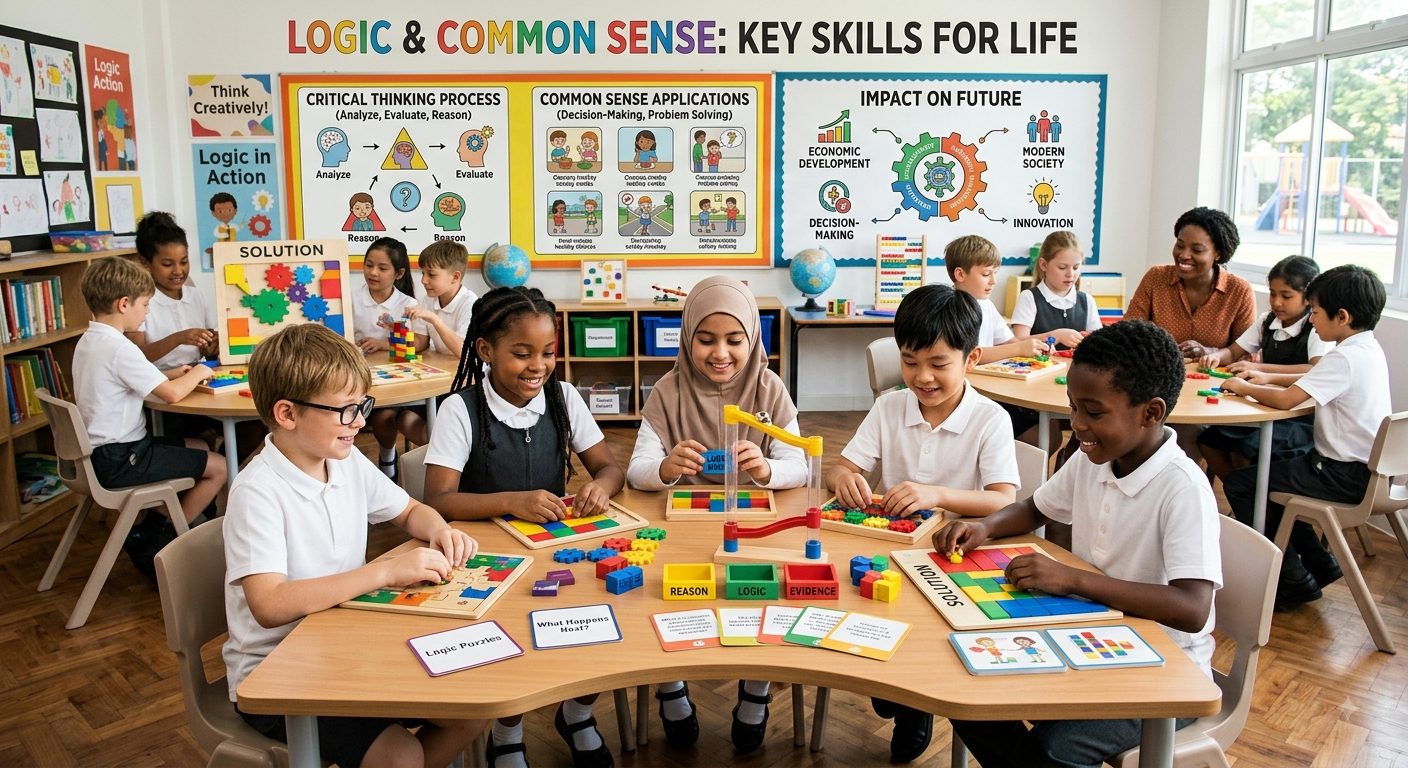
A Comprehensive Study of Their Impact on Modern Society, Critical Thinking, Decision-Making, and Future Economic Development
Abstract
proposed thesis is a strong subject for a modern education and economic-development framework. The central idea should be broader than simply adding “Logic” as another examination subject: it should establish reasoning, evidence evaluation, problem-solving, responsible decision-making, and intellectual independence as foundational capabilities from primary school onward.
Education traditionally places strong emphasis on reading, writing, mathematics, science, history, geography, and other bodies of knowledge. These subjects are essential, but modern societies increasingly require another category of capability: the ability to reason effectively about information, evidence, uncertainty, choices, problems, risks, and consequences.
This thesis proposes that age-appropriate Logic and Common Sense should become explicit components of primary education. The purpose would not be to replace mathematics, literacy, science, or humanities, but to strengthen the cognitive foundations through which children learn and apply those subjects.
Logic would teach children how to recognize patterns, identify relationships, distinguish valid from invalid reasoning, construct explanations, test assumptions, use evidence, solve problems, and understand cause and effect. Common sense would develop practical judgment: recognizing obvious risks, considering consequences, checking information before accepting it, understanding social situations, managing everyday choices, and applying knowledge to real-world circumstances.
The proposal is particularly relevant to a world characterized by digital information, artificial intelligence, misinformation, automation, complex economic systems, rapid technological change, and increasingly sophisticated decision-making. The OECD identifies creativity and critical thinking as important skills for complex, globalized and digitalized economies and has developed educational approaches for cultivating these capabilities in primary and secondary schools. (OECD)
The thesis therefore argues that the educational system should deliberately cultivate a reasoning architecture in every child. The long-term objective is not merely higher examination performance. It is the development of citizens, workers, entrepreneurs, scientists, engineers, managers, professionals, and leaders capable of thinking carefully before acting.
1. Introduction
A modern economy is ultimately a system of human decisions.
Every factory, hospital, farm, bank, school, government department, software company, transport network and research laboratory depends upon people making decisions.
A child who eventually becomes an engineer must learn to reason about physical systems.
A doctor must reason about evidence and alternative explanations.
An entrepreneur must evaluate opportunities and risks.
An accountant must detect inconsistencies.
A scientist must distinguish hypotheses from evidence.
A software engineer must break complex problems into logical structures.
A citizen must evaluate competing claims.
A manager must decide how scarce resources should be allocated.
Therefore, education should not merely ask:
What does the child know?
It should also ask:
How does the child think about what they know?
This distinction is fundamental.
Knowledge gives a person information.
Logic provides a framework for reasoning with information.
Common sense helps connect reasoning with everyday reality.
Critical thinking allows information and reasoning to be evaluated.
Decision-making converts analysis into action.
Together, these capabilities form an important part of what may be called the cognitive infrastructure of society.
2. The Central Thesis
The central proposition of this thesis is:
Primary education should explicitly teach children how to reason, question, evaluate evidence, identify assumptions, recognize consequences, solve problems and make responsible decisions through age-appropriate Logic and Common Sense education.
This should not become an excessively theoretical philosophy course.
For young children, logic should begin with simple experiences:
- sorting objects;
- recognizing patterns;
- identifying similarities and differences;
- sequencing events;
- solving puzzles;
- determining cause and effect;
- identifying contradictions;
- explaining why an answer is reasonable;
- comparing alternatives;
- detecting simple mistakes in reasoning;
- distinguishing fact from opinion;
- asking useful questions.
As children mature, these activities can progressively become more sophisticated.
3. Why Primary School Is the Appropriate Starting Point
Early childhood is a critical period for developing foundational capabilities that support later learning and well-being. The OECD’s 2026 work on foundational skills emphasizes the importance of early development for lifelong learning. (OECD)
Primary school therefore represents an important opportunity.
If children are taught to reason from an early age, logical thinking becomes a normal intellectual habit rather than a remedial skill introduced later.
Consider two educational models.
Model A: Knowledge-first
The child is primarily taught:
- facts;
- definitions;
- formulas;
- procedures;
- memorization.
Model B: Knowledge + reasoning
The child learns:
- facts;
- concepts;
- procedures;
- how to question them;
- how to apply them;
- how to test them;
- how to explain them;
- how to recognize when they may not apply.
The second model produces a stronger intellectual foundation.
The objective should therefore be:
Knowledge + Logic + Evidence + Creativity + Judgment + Application
4. What Is Logic?
Logic is the systematic study and practice of reasoning.
At primary level, it does not need to begin with complicated symbolic notation.
Children can first learn practical logical relationships.
Example
If:
- all birds have certain biological characteristics;
- an animal is identified as a bird;
then the child can learn how to reason from a general statement to a particular case.
More importantly, children should learn that the quality of a conclusion depends upon the quality of the information and reasoning supporting it.
Logic education can include:
- patterns;
- classification;
- sequences;
- comparison;
- relationships;
- conditional reasoning;
- cause and effect;
- evidence;
- consistency;
- contradictions;
- probability;
- argument structure;
- assumptions;
- inference;
- problem decomposition.
5. What Is Common Sense?
Common sense is more difficult to define precisely than formal logic.
It can be understood as practical judgment developed through experience, observation, social learning, knowledge and awareness of consequences.
For children, common-sense education might involve questions such as:
- Is this action safe?
- What could happen next?
- Do I have enough information?
- Should I ask an adult?
- Is this claim believable?
- What evidence supports it?
- What might happen if everyone behaved this way?
- Am I confusing what I want to be true with what is actually true?
- Is there another explanation?
- What are the consequences of my decision?
Importantly, common sense should not be presented as an infallible source of truth.
People can have different intuitions, and intuition can be wrong.
Therefore:
Common sense should be combined with evidence and logic.
6. Logic and Common Sense Are Complementary
The two subjects should not be treated as identical.
| Logic | Common Sense |
|---|---|
| Formal reasoning | Practical judgment |
| Consistency | Context |
| Evidence | Experience |
| Inference | Consequences |
| Structure | Everyday application |
| Validity | Practicality |
| Analysis | Situational awareness |
The strongest educational model combines both.
For example:
A child might logically calculate that a particular action is possible.
Common sense asks:
“Even if it is possible, is it sensible?”
This distinction becomes extremely important in adulthood.
Something can be:
- technically possible;
- legally permissible;
- mathematically correct;
yet still be impractical or unwise.
7. Relationship With Critical Thinking
Logic and common sense should become foundations for critical thinking.
Critical thinking involves processes such as:
- identifying a claim;
- asking what the claim means;
- identifying evidence;
- evaluating the evidence;
- identifying assumptions;
- considering alternatives;
- recognizing uncertainty;
- reaching a reasoned conclusion.
The OECD’s work on creativity and critical thinking specifically addresses how these capabilities can be developed through teaching and learning in primary and secondary education. (OECD)
The important principle is that critical thinking should not mean teaching children to reject everything.
It means teaching children to ask:
“What makes this claim believable?”
That is very different from automatic skepticism.
8. Logic and Mathematics
Mathematics is one of the strongest environments for logical reasoning.
However, mathematics and logic are not identical.
Mathematics teaches:
- quantities;
- relationships;
- structures;
- measurement;
- calculation;
- mathematical models.
Logic teaches children to reason about:
- statements;
- relationships;
- evidence;
- consistency;
- inference;
- conclusions.
The two reinforce one another.
A mathematics problem can therefore become a reasoning exercise.
Instead of asking only:
“What is the answer?”
the teacher can also ask:
“How did you know?”
“What evidence supports your answer?”
“Could there be another method?”
“What assumption did you make?”
This transforms mathematics from calculation into reasoning.
9. Logic and Science
Science is fundamentally dependent upon disciplined reasoning.
Students should learn the structure:
Observation → Question → Hypothesis → Test → Evidence → Analysis → Conclusion
Primary education can introduce this process through simple experiments.
For example:
A child notices that some plants grow differently.
Instead of merely memorizing a biological fact, the child can ask:
- What changed?
- What stayed the same?
- What could explain the difference?
- How could we test the explanation?
- What evidence would support it?
- What evidence would contradict it?
This develops scientific thinking.
10. Logic and Language
Language is another major reasoning system.
Children need to understand:
- meaning;
- context;
- ambiguity;
- argument;
- explanation;
- evidence;
- persuasion.
A child should gradually learn the difference between:
“I believe this.”
and:
“I believe this because the evidence indicates…”
That distinction becomes increasingly important in the digital information environment.
11. Logic and Digital Literacy
The modern child encounters enormous quantities of information.
The internet, social media, search engines, recommendation systems and AI systems can expose students to:
- accurate information;
- incomplete information;
- advertisements;
- opinions;
- rumors;
- manipulated content;
- misleading statistics;
- fabricated claims;
- AI-generated material.
Therefore, digital literacy increasingly requires reasoning skills.
A child should eventually learn to ask:
Source
Who produced this?
Evidence
What supports the claim?
Verification
Can it be independently checked?
Motivation
Why might someone want me to believe it?
Context
What information might be missing?
Uncertainty
How confident should I be?
These are forms of practical logic.
12. The AI Era Makes Reasoning More Important
Artificial intelligence changes the educational environment dramatically.
AI systems can generate:
- explanations;
- essays;
- images;
- computer code;
- summaries;
- recommendations;
- calculations;
- simulated conversations.
But an AI-generated answer is not automatically a correct answer.
Therefore, future education must teach children a crucial principle:
Never confuse an answer with verified knowledge.
The student should learn to evaluate AI outputs.
This means future AI literacy should include:
Question → AI Output → Verification → Reasoning → Human Judgment
Recent research discussions around AI in education emphasize the importance of preserving learner agency, cognition, critical evaluation and ethical judgment rather than allowing technology to replace meaningful intellectual effort. (arXiv)
This makes logic education increasingly strategic.
13. Decision-Making as an Educational Skill
Decision-making should become an explicit educational competency.
A simple primary-school decision framework could be:
Step 1 — Identify the problem
What decision must be made?
Step 2 — Identify choices
What are the available options?
Step 3 — Gather information
What do we know?
Step 4 — Identify consequences
What could happen after each choice?
Step 5 — Compare
Which option has the strongest justification?
Step 6 — Decide
Choose an option.
Step 7 — Review
What happened?
Step 8 — Learn
What would you do differently next time?
This transforms mistakes into learning opportunities.
Research on decision-making as a pedagogy for social-emotional learning similarly argues for explicitly teaching structured decision processes and responsible decision-making. (ScienceDirect)
14. Emotional Intelligence and Logic
Logic should not be taught as though human beings were emotionless machines.
People make decisions using both:
- cognition;
- emotion.
Children therefore need to understand that emotions provide information but do not always provide accurate conclusions.
For example:
“I am afraid, therefore this must be dangerous.”
is not necessarily logically valid.
Likewise:
“I like this person, therefore everything they say must be true.”
is also unreliable.
Children can learn to distinguish:
Feeling → Information
from:
Feeling → Proof
This is an important foundation for emotional maturity.
Research on social-emotional learning indicates that school-based interventions can support social, emotional and behavioural capabilities, although the evidence varies considerably by programme and implementation. (PubMed Central (PMC))
15. Problem-Solving
Modern economies increasingly reward people who can solve problems rather than merely reproduce information.
A logic curriculum should therefore contain practical problems.
Examples:
Environmental problem
How can our classroom reduce waste?
Transport problem
How can 100 students travel safely and efficiently?
Agricultural problem
How can a farmer use limited water efficiently?
Energy problem
How can a household reduce unnecessary electricity consumption?
Business problem
How can a small business serve customers efficiently?
Children can learn to:
- define the problem;
- collect information;
- generate alternatives;
- compare alternatives;
- select a solution;
- test it;
- improve it.
This introduces the foundations of engineering thinking.
16. Creativity and Logic Are Not Opposites
A common misconception is that logic suppresses creativity.
In reality, mature innovation requires both.
Creativity asks:
What could we create?
Logic asks:
Would it work?
Science asks:
Can we test it?
Engineering asks:
Can we build it?
Economics asks:
Can it be produced sustainably?
Entrepreneurship asks:
Will people value it?
Innovation emerges from the interaction of these capabilities.
The OECD explicitly treats creativity and critical thinking as important capabilities for contemporary economies and societies. (OECD)
17. Proposed Primary-School Curriculum
A six-level structure could be developed.
Grade/Foundation Level
Subject: Thinking Through Play
Topics:
- matching;
- sorting;
- patterns;
- sequencing;
- simple puzzles;
- similarities;
- differences;
- observation.
Early Primary
Subject: Basic Reasoning
Topics:
- classification;
- patterns;
- cause and effect;
- ordering;
- simple rules;
- observation;
- “why” questions;
- consequences.
Middle Primary
Subject: Logic and Problem-Solving
Topics:
- evidence;
- assumptions;
- simple arguments;
- contradictions;
- probability;
- decision trees;
- problem decomposition;
- alternative solutions.
Upper Primary
Subject: Critical Thinking
Topics:
- fact versus opinion;
- source evaluation;
- evidence;
- bias;
- misleading arguments;
- statistics;
- uncertainty;
- media literacy.
Advanced Primary
Subject: Practical Reasoning
Topics:
- ethical decisions;
- economic choices;
- environmental decisions;
- scientific reasoning;
- technology;
- AI-generated information;
- risk;
- long-term consequences.
18. A Weekly Lesson Structure
A practical programme might require only a small amount of dedicated classroom time while integrating reasoning throughout the curriculum.
Lesson 1 — Logic puzzle
Students solve a reasoning problem.
Lesson 2 — Real-world decision
Students examine a practical situation.
Lesson 3 — Evidence
Students determine whether a claim is supported.
Lesson 4 — Problem-solving project
Students work collaboratively.
Lesson 5 — Reflection
Students explain how they reached their conclusions.
This would make reasoning an active practice rather than another memorization-heavy subject.
19. Teaching Methodology
The teaching approach should be highly interactive.
Useful techniques include:
- puzzles;
- games;
- experiments;
- debates;
- stories;
- simulations;
- group problem-solving;
- observation exercises;
- case studies;
- mathematical challenges;
- engineering activities;
- classroom investigations.
The teacher should frequently ask:
Why?
How do you know?
What evidence supports that?
What would happen if…?
Is there another explanation?
What assumption are we making?
What could go wrong?
These questions gradually become internal habits of thought.
20. Assessment
Traditional examinations alone are insufficient.
Assessment should measure reasoning processes, not merely final answers.
Students could be assessed on:
| Capability | Example |
|---|---|
| Observation | Identifies relevant information |
| Classification | Groups objects correctly |
| Reasoning | Explains conclusion |
| Evidence | Uses supporting information |
| Problem-solving | Produces workable solution |
| Decision-making | Compares alternatives |
| Communication | Explains reasoning clearly |
| Reflection | Learns from mistakes |
| Creativity | Produces alternatives |
| Judgment | Recognizes risks and consequences |
A student who reaches the wrong answer through excellent reasoning should not necessarily receive the same evaluation as a student who guesses correctly.
The educational objective is to strengthen the thinking process.
21. The Economics of Better Reasoning
The economic implications are potentially enormous.
An economy depends upon the quality of decisions made by:
- workers;
- managers;
- entrepreneurs;
- investors;
- engineers;
- scientists;
- civil servants;
- policymakers;
- consumers.
Poor reasoning can create:
- wasted resources;
- defective products;
- failed projects;
- inefficient organisations;
- poor investments;
- operational errors;
- unnecessary disputes;
- weak public policy.
Better reasoning can contribute to:
- productivity;
- innovation;
- entrepreneurship;
- quality control;
- scientific development;
- efficient resource allocation;
- technological adoption.
Therefore, reasoning education should be regarded as part of human-capital development.
22. Logic as Economic Infrastructure
Physical infrastructure includes:
- roads;
- railways;
- ports;
- electricity;
- water;
- telecommunications.
Digital infrastructure includes:
- data centres;
- networks;
- cloud systems;
- software;
- computing infrastructure.
Human cognitive infrastructure includes:
- literacy;
- numeracy;
- reasoning;
- problem-solving;
- scientific thinking;
- communication;
- judgment.
A country can build excellent physical infrastructure but still struggle economically if its human systems cannot operate and maintain those assets effectively.
Therefore:
Human reasoning capacity is an invisible infrastructure of economic development.
23. Entrepreneurship
Entrepreneurship is fundamentally a decision-making activity.
An entrepreneur must ask:
- Is there a genuine problem?
- Who experiences it?
- How large is the problem?
- What solution is possible?
- What resources are required?
- What could fail?
- Who are the competitors?
- What evidence supports the business idea?
Teaching these questions in primary school does not mean turning children into businesspeople.
It means developing the intellectual foundations required for future economic participation.
24. Engineering and Technology
Engineering is applied reasoning.
An engineer constantly asks:
What is the problem?
What constraints exist?
What are the possible solutions?
Which solution is most efficient?
What could fail?
How can the system be tested?
Primary education can introduce this through simple construction projects.
Children can build:
- bridges;
- towers;
- water systems;
- simple machines;
- model farms;
- transport systems.
The goal is not the sophistication of the object.
The goal is the thinking process.
25. Government and Public Administration
The quality of public administration depends heavily upon reasoning.
Government officials make decisions involving:
- infrastructure;
- budgets;
- education;
- healthcare;
- transport;
- energy;
- water;
- housing;
- economic development.
Poor reasoning can result in large-scale resource waste.
Therefore, developing reasoning skills decades before individuals enter public service represents a long-term investment in institutional capability.
26. Democracy and Citizenship
Citizens encounter competing political and social claims.
A mature citizen should be able to ask:
- What is being claimed?
- What evidence supports it?
- What evidence contradicts it?
- Who benefits?
- What assumptions are being made?
- Is the argument internally consistent?
- Are alternative explanations possible?
This does not require children to adopt a particular political position.
It requires them to develop the ability to evaluate arguments independently.
That is an important foundation for responsible citizenship.
27. Fighting Misinformation
Misinformation is not solved simply by giving people more information.
People also need the ability to evaluate information.
A reasoning curriculum can teach:
Claim
What is being asserted?
Evidence
What supports it?
Source
Where did it come from?
Verification
Can it be checked?
Logic
Does the conclusion actually follow?
Context
What information is missing?
This framework can become increasingly important as synthetic media and generative AI make content production easier.
28. Common Cognitive Errors
Children can gradually learn that human reasoning has limitations.
Age-appropriate lessons can introduce concepts such as:
- jumping to conclusions;
- assuming correlation means causation;
- relying on a single example;
- confusing confidence with evidence;
- believing something because many people say it;
- ignoring contradictory evidence;
- choosing information that confirms an existing belief.
The objective should not be to teach children psychological terminology for its own sake.
It should be to help them recognize:
“My brain can make mistakes, so I should check my reasoning.”
That is a powerful intellectual habit.
29. The Principle of Intellectual Humility
A strong reasoning curriculum should teach students that saying:
“I don’t know.”
is sometimes a sign of intellectual strength.
Students should learn three categories:
Known
There is strong evidence.
Unknown
Insufficient evidence exists.
Uncertain
Evidence exists but does not justify high confidence.
This is essential to scientific thinking.
30. Logic, Ethics and Responsibility
Logic alone does not tell society what it ought to value.
A person can construct a logically consistent plan that is ethically unacceptable.
Therefore, education should combine:
Logic + Knowledge + Ethics + Empathy + Responsibility
Children should learn to consider:
- fairness;
- consequences;
- responsibility;
- respect;
- cooperation;
- human dignity;
- environmental consequences.
The goal is not simply to produce clever people.
It is to produce responsible people who can use intelligence constructively.
31. The Teacher’s Role
Teachers should not become lecturers in abstract logic.
They should become facilitators of reasoning.
Instead of immediately correcting a student, a teacher might ask:
“What made you think that?”
Then:
“What evidence supports your answer?”
Then:
“Can you think of another possibility?”
This transforms the classroom from an environment where the teacher possesses all answers into an environment where students learn how to investigate questions.
32. The Family’s Role
Parents and caregivers can reinforce reasoning through ordinary activities.
For example:
When a child asks:
“Why?”
instead of always answering immediately, an adult can sometimes respond:
“What do you think?”
or:
“What makes you think that?”
This encourages independent reasoning.
Household activities such as cooking, budgeting, gardening, repairing objects, planning journeys and organizing tasks can all become informal reasoning exercises.
33. Schools as Problem-Solving Laboratories
A future-oriented school could become a miniature society.
Students could collectively manage projects involving:
- water;
- energy;
- waste;
- food;
- gardens;
- transport;
- technology;
- finance;
- environmental conservation.
For example, students might receive a limited budget for a school project.
They would have to:
- identify needs;
- collect information;
- compare prices;
- prioritize;
- calculate costs;
- make a decision;
- implement it;
- evaluate the result.
This combines mathematics, economics, logic, communication and responsibility.
34. Integration Rather Than Isolation
There is a significant danger in creating too many separate school subjects.
The ideal solution is therefore dual integration.
Dedicated Logic lessons
Students receive explicit instruction.
Logic across all subjects
Teachers continuously reinforce reasoning.
For example:
Mathematics: Why does the calculation work?
Science: What evidence supports the conclusion?
History: What evidence tells us what happened?
Geography: Why does this pattern occur?
Language: Is the argument convincing?
Technology: Why does the system work?
Economics: What are the consequences of this decision?
Thus, logic becomes a thread running through the entire curriculum.
35. A Possible “Reasoning Ladder”
The curriculum can progressively develop six levels.
Level 1 — Observe
What do you see?
Level 2 — Describe
What is happening?
Level 3 — Explain
Why might it be happening?
Level 4 — Evaluate
Which explanation is best supported?
Level 5 — Decide
What should we do?
Level 6 — Reflect
What did we learn?
This six-stage model can become a universal framework for primary education.
36. The Long-Term Human-Capital Effect
Imagine two societies.
Society A produces millions of graduates who can reproduce information but struggle to evaluate it independently.
Society B produces graduates who can:
- learn;
- reason;
- question;
- experiment;
- communicate;
- collaborate;
- solve problems;
- use technology;
- evaluate evidence;
- make decisions.
The second society has a stronger foundation for innovation.
This is why educational reform should not focus exclusively on increasing the quantity of schooling.
It should improve the quality of cognition produced by schooling.
37. Implications for South Africa
The concept has particular relevance for South Africa.
A modern South African education system must prepare young people for participation in:
- mining;
- manufacturing;
- agriculture;
- financial services;
- telecommunications;
- software;
- artificial intelligence;
- renewable energy;
- logistics;
- healthcare;
- construction;
- scientific research;
- entrepreneurship.
These sectors require increasingly sophisticated problem-solving.
A national reasoning curriculum could therefore complement literacy, mathematics, science, technology and vocational education.
It could also help connect education more directly to the demands of a modern economy.
38. Logic and the Future African Economy
African economies will increasingly need to move beyond dependence on raw-material extraction toward:
- mineral beneficiation;
- manufacturing;
- technology;
- engineering;
- scientific research;
- digital services;
- biotechnology;
- advanced agriculture;
- energy systems;
- intellectual property.
This transition requires human capital.
And human capital requires more than memorized information.
It requires people capable of:
understanding → reasoning → creating → building → improving
Logic education can contribute to that chain from the earliest years of schooling.
39. Avoiding an Important Educational Mistake
Introducing Logic and Common Sense should not mean reducing time spent on foundational literacy and numeracy.
A child who cannot read adequately will struggle to evaluate written arguments.
A child who lacks mathematical foundations will struggle to interpret quantitative evidence.
Therefore:
Logic should strengthen foundational education rather than compete with it.
The priority should be:
Literacy + Numeracy + Science + Logic + Digital Literacy + Social Development
rather than replacing one subject with another.
40. Measuring National Impact
A national programme could be evaluated through long-term indicators.
Educational indicators
- reasoning assessment;
- problem-solving;
- mathematical reasoning;
- science reasoning;
- reading comprehension.
Economic indicators
- productivity;
- entrepreneurship;
- innovation;
- patent creation;
- technical skills;
- business survival.
Social indicators
- responsible decision-making;
- cooperation;
- information evaluation;
- civic participation.
Institutional indicators
- administrative efficiency;
- project quality;
- evidence-based decision-making.
Longitudinal research would be particularly important because the ultimate economic effects of primary-school reasoning education may appear many years after the original intervention.
41. Risks and Challenges
A serious policy proposal must acknowledge potential problems.
41.1 Overloading the curriculum
Adding another subject could increase teacher and student workload.
Solution: integrate logic across existing subjects.
41.2 Poor teacher preparation
Teachers may themselves require professional development.
Solution: create teacher-training programmes.
41.3 Excessive abstraction
Young children may struggle with formal symbolic logic.
Solution: use games, stories, experiments and practical problems.
41.4 Cultural bias
“Common sense” differs across cultures and contexts.
Solution: distinguish universal reasoning principles from culturally specific assumptions.
41.5 Turning logic into memorization
Students could simply memorize definitions.
Solution: assess reasoning through practical problems.
41.6 Political misuse
Critical thinking education could be manipulated to promote particular ideological conclusions.
Solution: establish transparent, evidence-based curriculum standards and encourage students to examine competing arguments.
42. The Ideal Graduate of This System
A student completing such an education should gradually become capable of saying:
I know what I know.
I know what I do not know.
I can explain why I believe something.
I can identify evidence.
I can recognize weak reasoning.
I can consider another explanation.
I can change my mind when evidence changes.
I can identify consequences.
I can make a decision.
I can learn from the result.
These are powerful lifelong capabilities.
43. The 21st-Century Reasoning Stack
A future-oriented education system can be conceptualized as a hierarchy:
FOUNDATIONAL LITERACY
↓
NUMERACY
↓
OBSERVATION
↓
LOGIC
↓
CRITICAL THINKING
↓
PROBLEM-SOLVING
↓
DECISION-MAKING
↓
CREATIVITY
↓
INNOVATION
↓
ENTREPRENEURSHIP
↓
ECONOMIC PRODUCTIVITY
This represents a potential human-capital development pathway.
44. From Child to Citizen to Economic Participant
The ultimate objective is developmental continuity.
Primary school
Learn to think.
Secondary school
Learn to analyze.
Higher education
Learn to specialize.
Professional life
Learn to apply.
Entrepreneurship and research
Learn to innovate.
Leadership
Learn to make complex decisions responsibly.
Thus, primary education becomes the beginning of a lifelong reasoning architecture.
45. A Proposed National Framework
A government introducing such a programme could establish a national framework called:
National Logic, Reasoning and Practical Judgment Programme
Pillar 1 — Logical reasoning
Patterns, inference, consistency and problem-solving.
Pillar 2 — Critical thinking
Evidence, claims, assumptions and evaluation.
Pillar 3 — Practical judgment
Consequences, risk and everyday decision-making.
Pillar 4 — Scientific reasoning
Observation, experimentation and evidence.
Pillar 5 — Digital reasoning
Information verification, algorithms and AI literacy.
Pillar 6 — Ethical reasoning
Responsibility, consequences, fairness and cooperation.
Pillar 7 — Economic reasoning
Resources, opportunity cost, value and trade-offs.
Pillar 8 — Creative problem-solving
Innovation, design and alternative solutions.
46. The Ultimate Educational Objective
The purpose of education should not be to produce students who simply know the correct answers.
The deeper objective is to produce people who can determine:
What is the problem?
What do we know?
What do we not know?
What evidence do we have?
What alternatives exist?
What are the consequences?
What is the most reasonable decision?
What did we learn?
That is the foundation of intelligent action.
47. Conclusion
Introducing Logic and Common Sense as core components of primary education represents a potentially important evolution in the philosophy of schooling.
The proposal should not be understood as an attempt to turn children into philosophers or mathematicians.
Its purpose is much more practical.
It is about teaching children to:
- observe carefully;
- ask good questions;
- distinguish evidence from assumption;
- identify cause and effect;
- recognize patterns;
- solve problems;
- evaluate information;
- understand consequences;
- make responsible decisions;
- communicate reasoning;
- learn from mistakes;
- remain intellectually humble.
These capabilities have significance far beyond the classroom.
They influence the quality of science, engineering, business, government, entrepreneurship, citizenship and technological innovation.
The OECD’s research reinforces the broader educational importance of developing critical thinking and creativity in response to increasingly complex and digital societies. (OECD)
At the same time, recent evidence on foundational learning reinforces the importance of developing essential capabilities early in life. (OECD)
The central proposition can therefore be summarized as follows:
A nation that teaches children how to think is investing not merely in education, but in the cognitive infrastructure of its future economy.
The school of the future should therefore not ask only:
“What should children know?”
It should also ask:
“How should children learn to think?”
And ultimately:
“How can education develop generations capable of reasoning, creating, solving, building and making responsible decisions in an increasingly complex civilization?”
That question places Logic, Critical Thinking, Practical Judgment and Decision-Making near the foundation of future education.
Proposed Core Formula
Knowledge + Logic + Evidence + Common Sense + Critical Thinking + Creativity + Ethics + Technology + Decision-Making = Future Human Capital
This is the broader significance of making reasoning a deliberate part of primary education: the objective is not simply smarter students, but a more capable society.


Be First to Comment