
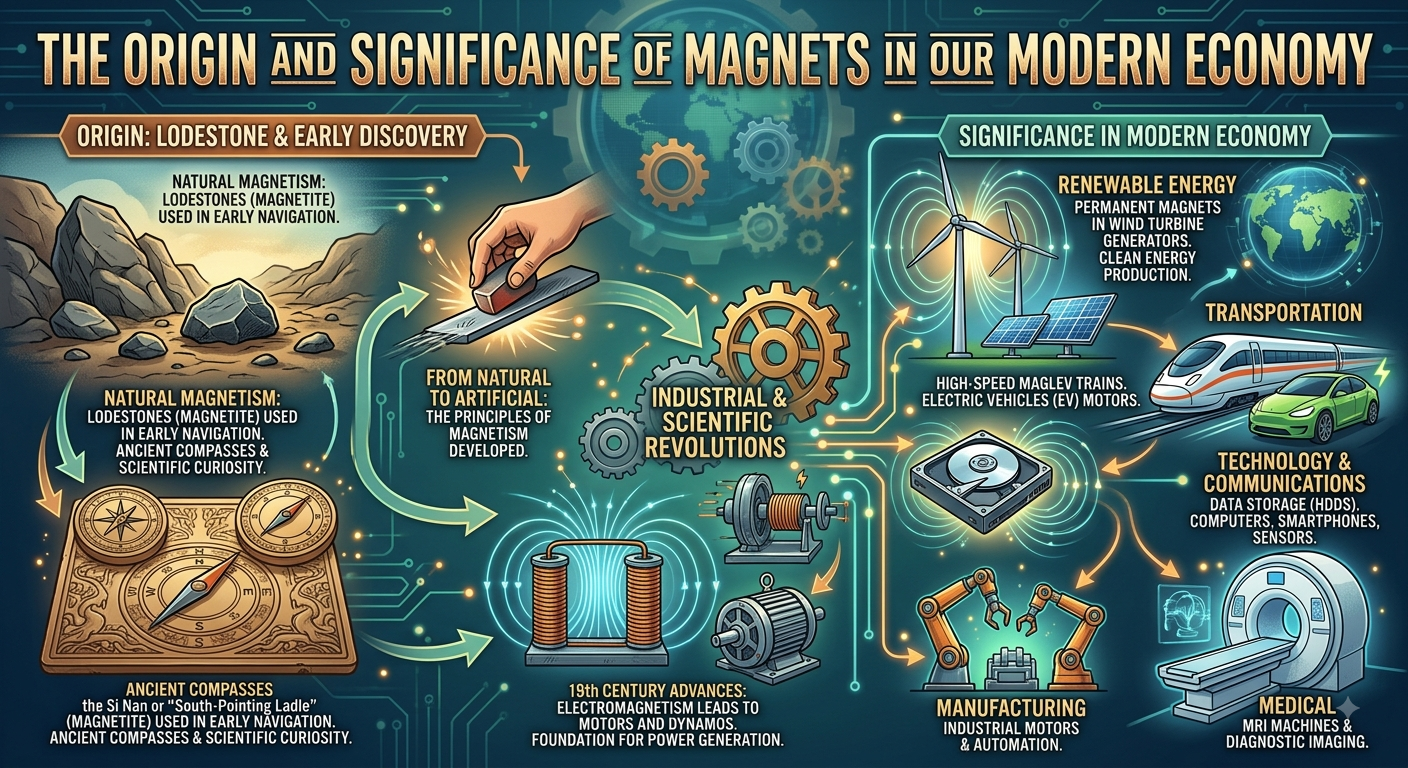
Magnets are among the most important—yet often invisible—technologies underlying modern civilisation. What began with naturally magnetic stones thousands of years ago has developed into a sophisticated global industry connecting physics, materials science, mining, metallurgy, electrical engineering, electronics, computing, transportation, renewable energy, medicine and automation.
The historical development of permanent magnets has been particularly dramatic. Modern magnet technology progressed through materials such as Alnico, ferrite, samarium-cobalt and neodymium-iron-boron (NdFeB), with NdFeB currently providing exceptionally high magnetic performance. (ScienceDirect)
1. What is a magnet?
A magnet is a material or device that produces a magnetic field and can exert forces on certain magnetic materials and moving electric charges.
At the fundamental level, magnetism is associated with the behaviour of electrons, particularly their:
- spin;
- orbital motion;
- magnetic moments;
- interactions with neighbouring atoms.
In ferromagnetic materials such as iron, microscopic magnetic moments can become organised into regions called magnetic domains.
When many domains become preferentially aligned, the material can exhibit strong macroscopic magnetism.
This gives us a useful conceptual chain:
Electron → atomic magnetic moment → magnetic domain → magnetic material → magnet → machine → economic activity
That chain explains why magnets are much more than simple objects that attract iron.
2. The natural origin of magnets
The earliest magnets known to humans were naturally occurring magnetic minerals called lodestones.
Lodestone is naturally magnetised magnetite, an iron-oxide mineral. Historical evidence indicates that humans were familiar with lodestone by approximately the sixth century BCE. (ScienceDirect)
This discovery was extraordinarily important because humans encountered a phenomenon that could act without visible mechanical contact.
A piece of lodestone could attract certain pieces of iron.
This raised fundamental questions:
How can one object exert a force on another without touching it?
The eventual scientific investigation of magnetism became part of the foundation of modern physics.
3. The compass revolution
One of the earliest transformative applications of magnetism was the magnetic compass.
The compass converted an invisible magnetic phenomenon into a practical navigation instrument.
This had enormous consequences for:
- exploration;
- maritime transportation;
- cartography;
- trade;
- military navigation;
- geographical discovery;
- global commerce.
The compass therefore represents an important historical transition:
Natural magnetism → scientific understanding → navigation technology → global economic integration
Without reliable navigation, the development of long-distance maritime trade would have been considerably more difficult.
4. From observation to scientific magnetism
Magnetism gradually moved from folklore and practical experimentation into systematic science.
A major milestone was the development of scientific theories describing the relationship between electricity and magnetism.
During the nineteenth century, scientists including:
- Hans Christian Ørsted;
- André-Marie Ampère;
- Michael Faraday;
- James Clerk Maxwell
helped establish the foundations of electromagnetic science.
This was revolutionary because electricity and magnetism were shown to be deeply interconnected.
The relationship can be simplified as:
Electric current → magnetic field
and
Changing magnetic field → induced electrical effects
This relationship became one of the foundations of the electrical-industrial revolution.
5. The electromagnetic revolution
The discovery of electromagnetic induction transformed the economic importance of magnets.
Faraday’s work demonstrated that changing magnetic fields could induce electrical currents.
That principle eventually enabled the development of:
- electrical generators;
- transformers;
- electric motors;
- alternators;
- industrial electrical machinery;
- telecommunications equipment.
Consequently, magnetism became an essential component of the transition from mechanical industry to electrical industry.
6. Permanent magnets versus electromagnets
Modern magnet technology can broadly be divided into two categories.
Permanent magnets
A permanent magnet maintains substantial magnetisation without continuously requiring electrical power.
Important materials include:
| Magnet family | Major characteristics |
|---|---|
| Ferrite | Low cost, corrosion resistant, widely used |
| Alnico | High-temperature capability |
| Samarium-cobalt | Excellent temperature and environmental performance |
| NdFeB | Extremely high magnetic energy density |
Electromagnets
An electromagnet produces magnetism through electrical current.
Its strength can generally be controlled by changing the electrical conditions.
This makes electromagnets particularly useful in:
- motors;
- generators;
- relays;
- industrial machinery;
- scientific equipment;
- magnetic lifting systems;
- medical equipment.
7. The great evolution of permanent magnets
The twentieth century produced extraordinary improvements in permanent-magnet technology.
Important milestones included:
Lodestone → steel magnets → Alnico → ferrite → samarium-cobalt → NdFeB
Research literature describes the twentieth century as a period of rapid permanent-magnet innovation, with major developments including Alnico, sintered ferrites, Sm-Co and NdFeB. (ScienceDirect)
The performance improvement was enormous. According to the historical review, between approximately 1930 and the early 1980s, magnetic energy product increased by roughly a factor of 50 while intrinsic coercivity increased by roughly a factor of 100. (ScienceDirect)
8. The importance of neodymium magnets
Neodymium-iron-boron magnets—commonly called NdFeB magnets—are among the most technologically important permanent magnets.
Their significance comes from their combination of:
- very high magnetic strength;
- compact size;
- high energy density;
- relatively low mass for a given magnetic performance;
- suitability for high-performance electric machines.
The underlying material is commonly represented by the compound:
Nd₂Fe₁₄B
Its magnetic properties arise from interactions involving rare-earth and transition-metal electrons, producing strong magnetisation and magnetic anisotropy. (arXiv)
9. Why magnets are fundamental to electric motors
One of the most important economic applications of magnetism is the electric motor.
A motor converts:
Electrical energy → mechanical energy
Magnetic fields provide the physical mechanism through which electrical energy produces rotational force.
Electric motors are everywhere:
- pumps;
- refrigerators;
- washing machines;
- fans;
- industrial machinery;
- robots;
- elevators;
- railway systems;
- electric vehicles;
- factory automation;
- computer cooling systems.
Therefore, the magnet is effectively one of the hidden components of modern mechanical productivity.
10. Magnets and electricity generation
The reverse process is equally important.
A generator converts:
Mechanical energy → electrical energy
Mechanical rotation causes changing magnetic fields relative to electrical conductors, producing electricity.
Generators are therefore central to:
- hydroelectric power;
- wind power;
- thermal power stations;
- backup generators;
- industrial power systems.
This gives magnets a remarkable economic role:
The same fundamental electromagnetic principles can participate in both the consumption and production of electricity.
11. Magnets and renewable energy
The growth of renewable energy has increased the strategic importance of high-performance magnetic materials.
Wind turbines can use magnetic components in their electrical generators, while electric vehicles use magnets in certain types of traction motors.
USGS research identifies rare-earth-containing high-strength magnets as important in technologies including wind-turbine generators and hybrid/electric vehicles. (USGS Publications)
This creates a powerful connection:
Minerals → magnet materials → electric machines → renewable energy → economic decarbonisation
12. Magnets and electric vehicles
Electric vehicles represent an important modern magnet application.
Depending on motor architecture, permanent magnets can provide a strong magnetic field within the motor without requiring continuous electrical power to establish that field.
This can contribute to compact and efficient motor designs.
The broader EV supply chain therefore potentially includes:
Mining → mineral processing → rare-earth separation → alloy production → magnet manufacturing → motor manufacturing → vehicle manufacturing → transportation services
The magnet is only a small component physically, but it can be strategically important to the entire system.
13. Magnets and robotics
Modern robotics depends heavily on electric motors and precision actuators.
A robotic system can contain numerous motors controlling:
- joints;
- wheels;
- grippers;
- pumps;
- positioning mechanisms;
- manufacturing tools.
High-performance permanent magnets can therefore contribute to the development of:
- industrial robots;
- warehouse automation;
- precision machinery;
- autonomous systems;
- medical robotics;
- agricultural automation.
USGS’s 2025 critical-minerals analysis explicitly connects NdFeB magnet consumption with industrial robotics and automobile manufacturing. (USGS Publications)
14. Magnets and computing
Magnetism has also played a major role in information technology.
Magnetic storage historically enabled enormous quantities of digital information to be stored in relatively compact physical devices.
Examples include:
- hard-disk drives;
- magnetic tape;
- magnetic sensors;
- magnetic memory technologies.
Magnetic recording uses controlled magnetic states to represent information.
Conceptually:
Magnetic state → binary information → digital data → computing economy
This makes magnetism part of the infrastructure of the information age.
15. Magnets and telecommunications
Magnetic materials have also been used throughout telecommunications and electronics.
Applications include:
- transformers;
- inductors;
- speakers;
- microphones;
- electromagnetic switches;
- sensors;
- signal-processing components.
Although semiconductor technology dominates modern computing, electromagnetic components remain essential to the surrounding electrical infrastructure.
16. Magnets and audio technology
Speakers provide an elegant example of electromagnetic energy conversion.
A speaker converts:
Electrical signal → electromagnetic force → mechanical vibration → sound
Microphones perform the reverse conceptual process:
Sound vibration → mechanical movement → electrical signal
This means magnets have played an important role in the development of recorded and transmitted sound.
17. Magnets in medicine
Magnetism has become extremely important in medical technology.
The most famous example is magnetic resonance imaging (MRI).
MRI uses powerful magnetic fields and radio-frequency techniques to generate detailed images of internal structures.
The economic significance extends beyond the machine itself:
- hospitals require MRI systems;
- engineers manufacture superconducting and magnetic components;
- software processes medical images;
- specialists interpret results;
- maintenance companies support equipment;
- healthcare institutions depend on the technology.
Thus:
Magnetism → medical instrument → diagnosis → healthcare productivity
18. Magnets and industrial automation
Industrial automation relies heavily on electromagnetic technology.
Factories use motors and actuators for:
- conveyor systems;
- pumps;
- machining;
- packaging;
- material handling;
- robotic assembly;
- precision positioning.
The modern factory can therefore be understood as a network of energy-conversion systems.
Magnets frequently sit at the centre of those systems.
19. The magnet supply chain
The modern magnet economy is much larger than the finished magnet.
A simplified supply chain is:
Geology
↓
Mining
↓
Ore processing
↓
Chemical separation
↓
Rare-earth oxides/metals
↓
Alloy production
↓
Powder processing
↓
Magnet manufacturing
↓
Motor/generator/electronic component
↓
Machine
↓
Final product
↓
Consumer and industrial economy
This is why magnet technology has become a strategic industrial issue.
20. Rare-earth minerals and geopolitical importance
High-performance permanent magnets can depend on rare-earth elements, particularly in NdFeB and related technologies.
USGS notes that rare-earth elements have become important in numerous high-technology products and that supply-chain concentration has generated concern among governments. (USGS)
The strategic issue is not simply:
“Who has the minerals?”
It is:
Who controls the entire mine-to-magnet industrial chain?
That distinction is crucial.
A country may possess mineral deposits but still lack:
- separation technology;
- refining capacity;
- alloy production;
- magnet manufacturing;
- engineering expertise;
- industrial-scale factories;
- recycling systems.
Therefore, mineral wealth does not automatically equal technological sovereignty.
21. Africa’s strategic opportunity
Africa possesses significant mineral resources relevant to modern technology.
USGS research on African industrial minerals identifies rare-earth applications including magnets for:
- automobiles;
- computer hard drives;
- industrial motors;
- loudspeakers;
- wind turbines. (USGS Publications)
The economic opportunity is therefore much larger than simply exporting ore.
A strategic African industrial model could be:
Mineral extraction
→ refining
→ advanced materials
→ magnet production
→ electric motors
→ generators
→ robots
→ electric vehicles
→ industrial equipment
→ technology exports
This would capture substantially more value than exporting unprocessed minerals.
22. South Africa’s opportunity
For South Africa, magnet technology should be viewed within a broader industrial strategy involving:
- mining;
- mineral beneficiation;
- advanced manufacturing;
- electrical engineering;
- renewable energy;
- automotive manufacturing;
- rail;
- robotics;
- scientific research;
- recycling.
The objective should not merely be to become a supplier of raw materials.
A stronger ambition would be to develop a complete advanced-materials ecosystem.
That means building capabilities in:
- geological exploration;
- mineral processing;
- chemical engineering;
- metallurgy;
- materials science;
- magnet manufacturing;
- motor engineering;
- power electronics;
- automation;
- product manufacturing.
23. Magnets and the circular economy
Magnet technology also creates a recycling opportunity.
A future-oriented magnet economy should include:
Mining → manufacturing → product use → collection → magnet recovery → material separation → remanufacturing
Recycling can reduce pressure on primary mineral extraction and potentially strengthen supply security.
Research is also exploring rare-earth-efficient and rare-earth-free permanent magnets because high-performance rare-earth magnets have supply and environmental challenges. (arXiv)
24. The search for rare-earth-free magnets
One of the major scientific challenges is developing magnets that combine:
- high magnetic strength;
- low cost;
- thermal stability;
- mechanical durability;
- abundant raw materials;
- low environmental impact.
Ferrite magnets are already extremely important because they are inexpensive, chemically stable and do not require rare-earth elements. Research continues into improving ferrite performance and developing other rare-earth-reduced or rare-earth-free materials. (arXiv)
This creates a major research frontier:
Can humanity build the next generation of high-performance magnets from more abundant materials?
The answer could significantly reshape the global industrial supply chain.
25. Magnets and artificial intelligence
An important modern connection is the relationship between magnets and AI infrastructure.
AI itself is primarily computational, but AI systems depend on physical infrastructure containing electromagnetic components.
Consider a data centre:
Electricity
→ power conversion
→ cooling systems
→ electric motors
→ servers
→ storage
→ networking
→ sensors
→ automation
Magnets can therefore appear indirectly throughout the physical infrastructure supporting AI.
The AI revolution is consequently not independent of materials science.
26. Magnets and the semiconductor industry
Semiconductor factories require sophisticated equipment involving:
- precision motors;
- sensors;
- actuators;
- vacuum systems;
- robotics;
- pumps;
- automated material handling.
These machines depend on electromagnetic engineering.
Thus, the semiconductor economy is connected to the magnet economy through industrial automation and precision equipment.
27. Magnets as an economic multiplier
The value of a magnet is not determined solely by its physical size.
A small high-performance magnet can participate in a product worth thousands or millions of rand.
For example:
Magnet
→ motor
→ industrial machine
→ automated factory
→ manufactured product
→ export revenue
The magnet therefore has multiplier effects.
Its economic significance comes from what it enables.
28. The hidden infrastructure of civilisation
Modern civilisation can be represented as interconnected technological layers:
Layer 1 — Natural resources
Iron, rare earths, cobalt, nickel and other minerals.
Layer 2 — Materials science
Alloys, ceramics, magnetic compounds and engineered microstructures.
Layer 3 — Components
Permanent magnets, electromagnets, motors, generators and sensors.
Layer 4 — Machines
Robots, pumps, vehicles, generators and industrial equipment.
Layer 5 — Infrastructure
Factories, power grids, transport systems and data centres.
Layer 6 — Economy
Manufacturing, logistics, healthcare, communications and commerce.
This demonstrates why magnetism is strategically important.
29. The future magnet economy
The next generation of magnet technology is likely to focus on several areas:
1. Higher magnetic performance
More energy density from smaller quantities of material.
2. Reduced rare-earth dependence
Developing materials requiring fewer critical elements.
3. Recycling
Recovering valuable magnetic materials from end-of-life products.
4. Advanced manufacturing
More precise control of microstructure and magnet geometry.
5. Computational materials science
Using simulation and AI to discover new magnetic materials.
6. Electrification
Improving motors and generators for electric transportation and renewable energy.
7. Robotics
Creating smaller, lighter and more efficient actuators.
8. Spintronics
Using electron spin and magnetic states for information technologies.
30. The strategic triangle
The future magnet economy can be understood through three interconnected domains:
MINERALS
↓
Rare-earth and other magnetic materials
↓
MAGNETS
↓
High-performance electromagnetic components
↓
MACHINES
↓
Motors, generators, robots, vehicles and industrial systems
↓
ECONOMY
This creates an important strategic principle:
Control of advanced materials can influence control of advanced manufacturing.
31. Major economic sectors affected by magnet technology
| Sector | Importance of magnets |
|---|---|
| Electricity | Generators, transformers and motors |
| Renewable energy | Wind-turbine generators |
| Automotive | Electric motors and sensors |
| Rail | Traction and electrical systems |
| Robotics | Motors and actuators |
| Manufacturing | Automation and machinery |
| Computing | Storage and electromagnetic components |
| Telecommunications | Transformers and electronic components |
| Medicine | MRI and other equipment |
| Consumer electronics | Speakers, motors and sensors |
| Aerospace | Actuators, sensors and specialised systems |
| Research | Scientific magnetic instruments |
USGS research confirms that rare-earth materials and magnets span clean-energy, electronics, transportation and defence-related applications. (USGS Publications)
32. Why magnet technology matters for national development
A technologically advanced country needs more than roads and buildings.
It needs industrial capabilities.
Those capabilities include:
- materials science;
- electrical engineering;
- mechanical engineering;
- chemical engineering;
- automation;
- manufacturing;
- mineral processing;
- scientific research;
- skilled technicians;
- digital engineering.
Magnet technology sits at the intersection of many of these disciplines.
Consequently, developing a magnet industry can help stimulate a much broader technological ecosystem.
33. A historical timeline
~6th century BCE
Knowledge of natural lodestone.
↓
Ancient and medieval periods
Development and use of magnetic navigation.
↓
17th century
Scientific investigation of magnetism accelerates.
↓
19th century
Electricity and magnetism become scientifically unified through major experimental and theoretical advances.
↓
Late 19th century
Electric motors, generators and electrical infrastructure expand.
↓
20th century
Alnico and ferrite magnets become commercially important.
↓
Mid-to-late 20th century
Samarium-cobalt magnets emerge.
↓
1980s onward
NdFeB magnets transform high-performance permanent-magnet applications.
↓
21st century
Magnets become strategically important for electrification, robotics, renewable energy, computing and advanced manufacturing.
↓
Future
Recycling, AI-assisted materials discovery and rare-earth-efficient/free magnets become increasingly important.
34. The deeper meaning of the magnet
The history of the magnet is ultimately a story about humanity’s ability to understand invisible forces and transform them into useful technology.
A naturally magnetised rock appears simple.
But from that phenomenon humanity eventually developed:
compasses
→ electromagnetism
→ generators
→ electric motors
→ industrialisation
→ electronics
→ automation
→ robotics
→ electric vehicles
→ renewable-energy systems
→ advanced digital civilisation
That is an extraordinary technological progression.
35. Conclusion
The magnet is one of the foundational technologies of modern civilisation.
Its journey began with naturally occurring lodestone, but scientific understanding transformed magnetism into a controllable engineering resource. The development of permanent-magnet materials—from early steels through Alnico, ferrites, samarium-cobalt and NdFeB—dramatically increased the performance and range of magnetic technologies. (ScienceDirect)
Today, magnets are embedded within the infrastructure of the modern economy.
They help convert:
electricity into motion
and
motion into electricity.
They contribute to:
- industrial production;
- renewable energy;
- electric transportation;
- robotics;
- computing;
- telecommunications;
- medicine;
- automation;
- scientific research.
The modern magnet economy also reveals a larger geopolitical lesson. Advanced technology depends not only on possessing mineral resources but on possessing the knowledge, processing capacity, manufacturing capability and industrial ecosystems required to transform minerals into sophisticated products.
Current supply-chain concerns surrounding rare-earth materials demonstrate why magnet manufacturing has become a strategic industrial issue. (Financial Times)
For Africa—and particularly for mineral-rich economies such as South Africa—the long-term opportunity is therefore not simply to extract minerals. It is to move progressively up the value chain:
MINERALS → REFINING → MATERIALS → MAGNETS → MOTORS → MACHINES → ROBOTS → PRODUCTS → GLOBAL EXPORTS
That transformation would turn geological wealth into technological wealth.
In this sense, the magnet is much more than an object that attracts metal. It is one of the fundamental technological bridges between the physical resources of Earth and the productive machinery of modern civilisation.


Be First to Comment