
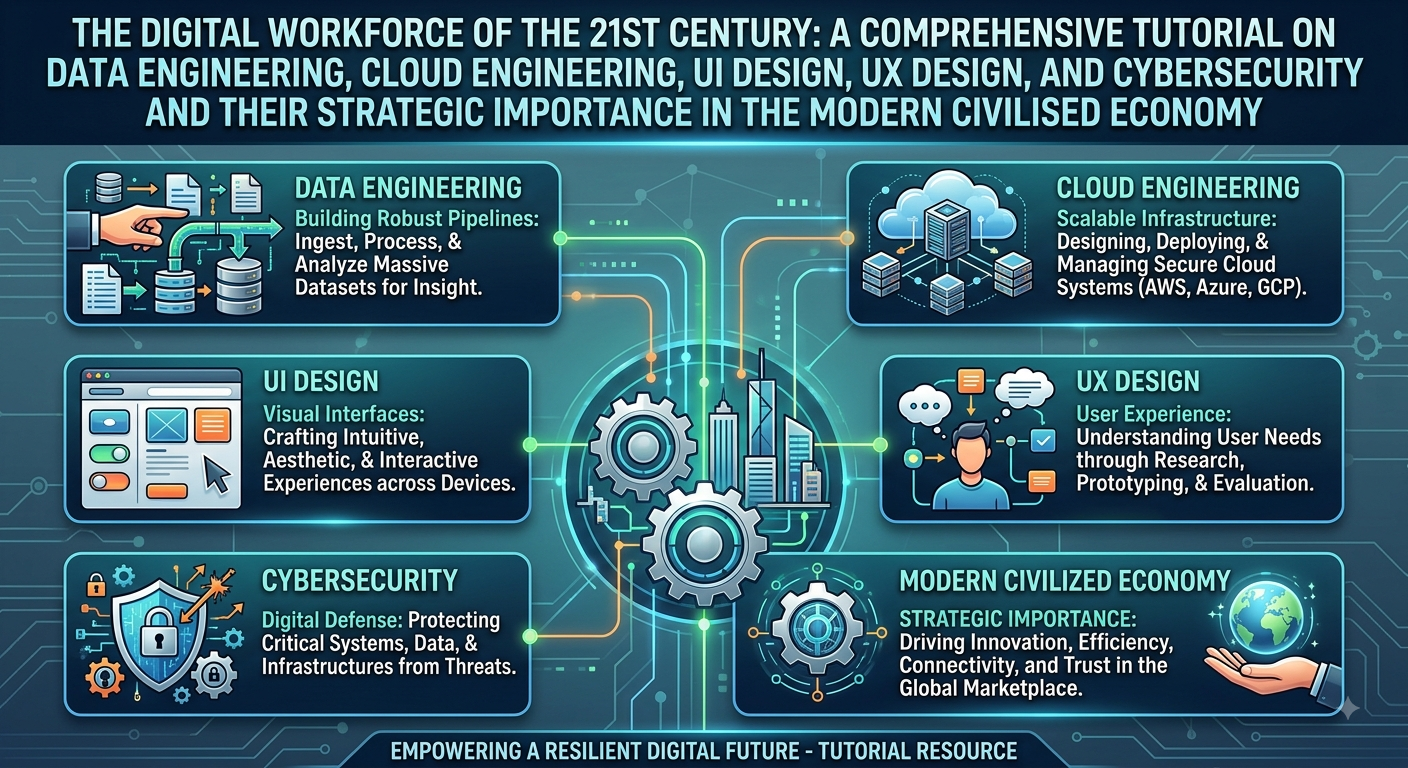
A Comprehensive Tutorial on Data Engineering, Cloud Engineering, UI Design, UX Design, and Cybersecurity and Their Strategic Importance in the Modern Civilised Economy
Abstract
The 21st-century economy is increasingly built upon digital infrastructure. Businesses, governments, universities, hospitals, financial institutions, manufacturers, farms, transport networks and households now depend on interconnected systems that collect, process, store, analyse and communicate information.
Five professional disciplines sit at the centre of this transformation:
- Data Engineering
- Cloud Engineering
- User Interface (UI) Design
- User Experience (UX) Design
- Cybersecurity
These disciplines should not be viewed as isolated occupations. Together they form an integrated digital-production system.
Data engineers create reliable information pipelines. Cloud engineers build the computational infrastructure on which modern digital services operate. UI designers create the visual interaction layer. UX designers ensure that systems actually work for human beings. Cybersecurity professionals protect identities, applications, infrastructure, data and organisations from digital threats.
The strategic importance of this workforce has increased as artificial intelligence, cloud computing, automation and interconnected systems expand. Current cybersecurity research, for example, identifies growing demand for cloud-security and AI-related capabilities, while workforce research highlights a shift toward skills-based rather than purely headcount-based planning.
The central argument of this thesis is therefore:
A modern economy cannot become genuinely digital merely by purchasing computers and software. It requires a skilled human and AI-enabled workforce capable of designing, building, operating, securing and continuously improving the entire digital ecosystem.
1. Introduction: The Emergence of the Digital Workforce
Industrial societies were historically organised around physical infrastructure.
Factories required:
- land;
- machinery;
- electricity;
- roads;
- railways;
- ports;
- warehouses;
- skilled workers;
- financial capital.
The digital economy adds another infrastructure layer:
- computers;
- networks;
- cloud platforms;
- databases;
- software;
- data pipelines;
- cybersecurity systems;
- digital interfaces;
- artificial intelligence;
- digital identities;
- automation.
The result is a transformation in the meaning of work.
A modern worker may produce value without physically manufacturing a product. A data engineer can create a pipeline that supports thousands of business decisions. A cloud engineer can operate infrastructure serving millions of users. A UX designer can redesign a process used by an entire population. A cybersecurity engineer can protect critical infrastructure without ever physically touching the systems being protected.
The digital workforce therefore represents an economic production system based upon information, computation, human interaction and digital trust.
2. The Digital Economy as an Ecosystem
The five disciplines can be understood as interconnected layers.
Digital workforce architecture
Human need
↓
UX research
↓
UX architecture
↓
UI design
↓
Application/software
↓
Data
↓
Data engineering
↓
Cloud infrastructure
↓
Cybersecurity
↓
AI and automation
↓
Business/government outcomes
This architecture demonstrates an important principle:
No single discipline is sufficient.
A beautiful application without reliable data may fail.
A powerful cloud platform without cybersecurity may become dangerous.
A secure system that users cannot understand may be rejected.
A sophisticated data platform without appropriate cloud infrastructure may become expensive or difficult to scale.
A technically excellent product that does not solve a genuine human problem may have little economic value.
3. Data Engineering
3.1 Definition
Data engineering is the discipline concerned with designing, constructing, operating and maintaining systems that collect, transport, transform, store and deliver data.
The data engineer essentially builds the information supply chain of an organisation.
A simplified architecture is:
Data sources → ingestion → processing → storage → quality control → analytics → AI → decisions
Data may originate from:
- websites;
- mobile applications;
- financial transactions;
- sensors;
- telecommunications networks;
- industrial machines;
- vehicles;
- satellites;
- hospitals;
- government systems;
- customer interactions;
- IoT devices;
- enterprise applications.
4. The Data Engineering Pipeline
A professional data platform generally contains several stages.
Stage 1: Data generation
Information is produced by operational systems.
For example:
A bank transaction generates:
- customer information;
- transaction amount;
- time;
- account information;
- merchant information;
- location information;
- transaction status.
Stage 2: Data ingestion
Data must be transported into a processing environment.
Common approaches include:
- batch ingestion;
- streaming ingestion;
- event-driven ingestion;
- API ingestion;
- database replication.
Stage 3: Data processing
Raw information often needs:
- cleaning;
- validation;
- transformation;
- enrichment;
- aggregation;
- deduplication.
Stage 4: Data storage
Data may be stored in:
- relational databases;
- data warehouses;
- data lakes;
- lakehouses;
- object storage;
- distributed databases.
Stage 5: Data governance
Organisations must determine:
- who owns data;
- who can access it;
- how long it should be retained;
- how accurate it is;
- where it is stored;
- how sensitive it is.
Stage 6: Data consumption
The resulting information supports:
- dashboards;
- business intelligence;
- analytics;
- machine learning;
- artificial intelligence;
- automation;
- decision-making.
5. Why Data Engineering Is Strategically Important
Data has become a productive economic asset.
Consider a modern retailer.
A single customer interaction can generate information about:
- products viewed;
- products purchased;
- time of purchase;
- location;
- inventory;
- payment;
- delivery;
- customer support.
When properly managed, these datasets can improve:
- inventory management;
- forecasting;
- logistics;
- pricing;
- customer service;
- fraud detection;
- marketing;
- supply-chain planning.
Thus:
Data → Information → Knowledge → Decision → Action → Economic value
This is one of the fundamental production chains of the digital economy.
6. Cloud Engineering
6.1 Definition
Cloud engineering is the design, deployment, operation and optimisation of computing infrastructure delivered through cloud platforms.
Cloud infrastructure can provide:
- computing;
- storage;
- databases;
- networking;
- identity management;
- monitoring;
- analytics;
- AI infrastructure;
- application services.
Instead of every organisation owning and operating all computing infrastructure itself, cloud platforms allow computing resources to be provisioned according to requirements.
7. Cloud Engineering Architecture
A simplified cloud system consists of:
Physical layer
- data centres;
- servers;
- storage;
- networking;
- power;
- cooling.
↓
Virtualisation/container layer
- virtual machines;
- containers;
- orchestration.
↓
Platform layer
- databases;
- APIs;
- messaging;
- application services;
- analytics.
↓
Application layer
- websites;
- mobile applications;
- enterprise systems;
- AI applications.
↓
User layer
- employees;
- customers;
- governments;
- machines;
- organisations.
Cloud engineers connect these layers into an operational system.
8. Core Cloud Engineering Skills
A modern cloud engineer needs knowledge of:
- computer networking;
- operating systems;
- databases;
- virtualisation;
- containers;
- infrastructure as code;
- automation;
- monitoring;
- identity and access management;
- cloud architecture;
- reliability engineering;
- cybersecurity;
- cost management.
Cloud engineering increasingly overlaps with cybersecurity. Current industry research identifies cloud security as one of the major capability requirements for cybersecurity teams.
9. Infrastructure as Code
One of the most important changes in modern infrastructure is Infrastructure as Code (IaC).
Instead of manually configuring every server, engineers can describe infrastructure through machine-readable configuration.
The principle is:
Infrastructure becomes programmable.
This allows:
- repeatability;
- automation;
- version control;
- faster deployment;
- standardisation;
- easier recovery.
This is an important step toward the broader concept of software-defined infrastructure.
10. Cloud and Artificial Intelligence
Modern AI systems require enormous computational infrastructure.
AI workloads depend upon:
- CPUs;
- GPUs;
- specialised accelerators;
- high-speed networks;
- large-scale storage;
- data pipelines;
- model-serving infrastructure.
Consequently, AI engineering increasingly depends upon cloud and data engineering.
The relationship can be represented as:
Cloud → Compute
Data engineering → Data
AI engineering → Models
Applications → User interaction
Cybersecurity → Trust and protection
Together these form an AI-enabled digital production architecture.
11. User Interface Design
11.1 Definition
User Interface design concerns the visible and interactive components through which people interact with digital systems.
Examples include:
- buttons;
- menus;
- forms;
- navigation;
- typography;
- icons;
- colours;
- layouts;
- dashboards;
- mobile screens;
- notifications.
UI is essentially the interaction surface between human beings and software.
12. Principles of Good UI Design
A professional UI should emphasise:
Clarity
Users should understand what they are seeing.
Consistency
Similar actions should behave similarly.
Feedback
The system should communicate what happened.
Accessibility
People with different abilities should be able to use the system.
Simplicity
Unnecessary complexity should be reduced.
Hierarchy
Important information should receive appropriate visual emphasis.
Responsiveness
Interfaces should work across relevant devices and screen sizes.
13. User Experience Design
UI and UX are related but different.
UI asks:
What does the interface look and feel like?
UX asks:
How does the entire experience work?
UX therefore includes:
- user research;
- interviews;
- journey mapping;
- information architecture;
- usability testing;
- interaction design;
- accessibility;
- service design;
- product strategy.
UX designers attempt to understand the user’s problem before designing the solution.
14. The UX Design Cycle
A typical UX process can be represented as:
Research
↓
Define
↓
Ideate
↓
Prototype
↓
Test
↓
Improve
↓
Deploy
↓
Measure
↓
Iterate
This creates a continuous improvement loop.
15. Why UX Is an Economic Discipline
UX is not merely about making applications attractive.
Poor UX can produce:
- abandoned transactions;
- increased support costs;
- employee frustration;
- training costs;
- errors;
- reduced customer loyalty;
- lower productivity.
Good UX can improve:
- completion rates;
- productivity;
- customer satisfaction;
- accessibility;
- adoption;
- operational efficiency.
This makes UX a legitimate economic productivity discipline.
Importantly, cybersecurity and UX increasingly overlap. Security controls that users cannot understand or operate correctly can undermine the very security they were intended to provide.
16. Cybersecurity
16.1 Definition
Cybersecurity is the discipline of protecting digital systems, networks, applications, identities and information from unauthorised access, disruption, manipulation or destruction.
Its traditional objectives are commonly expressed through the CIA triad:
Confidentiality
Only authorised people or systems can access information.
Integrity
Information remains accurate and trustworthy.
Availability
Systems and information remain available when legitimately required.
17. Cybersecurity Architecture
A comprehensive cybersecurity system includes:
Identity security
Who are you?
Access control
What are you allowed to do?
Endpoint security
Are devices trustworthy?
Network security
Can communications be trusted?
Application security
Is the software secure?
Cloud security
Is the cloud environment properly protected?
Data security
Is sensitive information protected?
Monitoring
Can abnormal behaviour be detected?
Incident response
Can an organisation respond effectively?
Recovery
Can operations be restored after disruption?
18. The Rise of Zero Trust
Traditional security often assumed that systems inside an organisational perimeter were relatively trustworthy.
Modern distributed environments challenge this assumption.
Zero Trust adopts a different principle:
Trust should be continuously established rather than automatically assumed.
This involves:
- identity verification;
- least privilege;
- continuous monitoring;
- segmentation;
- device assessment;
- policy enforcement.
This architecture becomes particularly important when organisations use cloud systems, remote workers, mobile devices, APIs, IoT and AI applications.
19. Cybersecurity and Artificial Intelligence
AI is transforming cybersecurity in both defensive and offensive directions.
Defensively, AI can help with:
- anomaly detection;
- threat analysis;
- log analysis;
- vulnerability prioritisation;
- security monitoring;
- incident investigation;
- automated response.
At the same time, attackers can use automation and AI to increase the speed and sophistication of malicious activity.
Recent 2026 cybersecurity reporting highlights AI’s increasing importance to both cyberattack and cyberdefence ecosystems.
Therefore:
AI security must become part of mainstream digital engineering.
20. The Five Disciplines as One System
The most important insight is that these occupations should not operate in isolation.
Consider an online banking application.
UX designer
Determines how customers complete tasks.
UI designer
Creates the screens and interaction components.
Data engineer
Builds the pipelines supporting transaction and analytical data.
Cloud engineer
Provides scalable infrastructure.
Cybersecurity professional
Protects identities, applications, infrastructure and information.
Software engineer
Builds the application.
AI engineer
May provide fraud detection, assistance or personalised services.
Product manager
Coordinates the business objective.
This is the modern digital production team.
21. The Digital Production Chain
A useful conceptual model is:
Human problem
↓
UX research
↓
Product architecture
↓
UI
↓
Software
↓
Data
↓
Cloud
↓
Cybersecurity
↓
AI/automation
↓
Business process
↓
Economic value
This chain demonstrates why digital transformation is an organisational transformation rather than simply an IT upgrade.
22. Digital Workforce Competency Model
A future-oriented digital professional should develop several competency categories.
Technical competence
Understanding:
- computers;
- networks;
- databases;
- programming;
- cloud;
- data;
- security;
- AI.
Analytical competence
Ability to:
- investigate;
- measure;
- interpret;
- model;
- diagnose;
- solve problems.
Human competence
Ability to:
- communicate;
- collaborate;
- understand users;
- explain complexity;
- negotiate;
- teach.
Business competence
Understanding:
- costs;
- revenue;
- productivity;
- risk;
- customers;
- supply chains;
- strategy.
Ethical competence
Understanding:
- privacy;
- fairness;
- accountability;
- safety;
- responsible AI;
- data governance.
23. The Digital Workforce and Automation
Automation changes the composition of work.
Routine activities are increasingly suitable for software and AI.
Examples include:
- repetitive data transformation;
- routine infrastructure provisioning;
- basic report generation;
- automated testing;
- monitoring;
- document classification.
But automation does not eliminate the need for skilled professionals.
Instead, the skill requirement moves upward toward:
- architecture;
- supervision;
- system thinking;
- judgement;
- governance;
- security;
- problem definition;
- quality control.
The emerging model is therefore:
Human intelligence + AI + automation + digital infrastructure
rather than simply:
Human versus machine.
24. The Rise of Human-AI Collaboration
The future digital worker increasingly becomes an orchestrator.
For example, a data engineer may use AI to:
- generate transformation logic;
- explain unfamiliar datasets;
- identify anomalies;
- document pipelines.
A cloud engineer may use AI to:
- analyse infrastructure configurations;
- investigate operational anomalies;
- generate documentation;
- assist with troubleshooting.
A UX designer may use AI to:
- generate design alternatives;
- analyse research;
- create prototypes;
- test conceptual variations.
A cybersecurity professional may use AI to:
- analyse large volumes of security events;
- identify suspicious patterns;
- prioritise alerts;
- assist investigations.
The human remains responsible for judgement, governance and accountability.
25. The Importance of Digital Literacy
A modern economy cannot rely solely on a small group of elite technology professionals.
Digital literacy must spread throughout society.
A digitally capable workforce should understand:
- how data works;
- how cloud services work;
- basic cybersecurity;
- AI limitations;
- privacy;
- digital identity;
- online collaboration;
- information quality.
This applies to:
- teachers;
- farmers;
- accountants;
- engineers;
- doctors;
- entrepreneurs;
- government officials;
- administrators;
- technicians;
- managers.
Digital transformation becomes more powerful when digital competence becomes widespread.
26. Education Architecture for the Digital Workforce
A modern curriculum should progressively develop:
Primary education
- computational thinking;
- problem solving;
- digital literacy;
- mathematics;
- science.
Secondary education
- programming;
- databases;
- networking;
- digital design;
- cybersecurity awareness;
- statistics.
Tertiary education
- data engineering;
- cloud engineering;
- software engineering;
- AI;
- cybersecurity;
- UI/UX;
- systems architecture.
Professional education
- continuous reskilling;
- certifications;
- specialised training;
- industry projects;
- leadership.
The objective should be lifelong digital competence.
27. The Digital Workforce in South Africa
For South Africa, these disciplines have particular strategic significance.
A technologically capable workforce can contribute to:
- financial technology;
- telecommunications;
- mining;
- manufacturing;
- agriculture;
- logistics;
- healthcare;
- education;
- government services;
- energy;
- tourism;
- retail.
South African cybersecurity commentary in 2026 has specifically identified the talent dimension as a major part of the cybersecurity challenge, emphasising the need for professionals who can connect technical security with business strategy and decision-making.
This means South Africa needs more than technology procurement.
It needs technology capability.
28. Digital Workforce and Industrialisation
Traditional industrialisation required:
- engineers;
- technicians;
- machinists;
- electricians;
- mechanics;
- managers.
Digital industrialisation requires:
- software engineers;
- data engineers;
- cloud engineers;
- cybersecurity engineers;
- AI engineers;
- UX designers;
- UI designers;
- systems architects;
- network engineers;
- digital product managers.
The digital workforce is therefore part of a country’s industrial infrastructure.
29. Digital Infrastructure as National Infrastructure
Modern national infrastructure should be understood as a combination of:
Physical infrastructure
- roads;
- rail;
- ports;
- electricity;
- water;
- buildings.
and
Digital infrastructure
- fibre;
- mobile networks;
- data centres;
- cloud;
- digital identity;
- payment systems;
- databases;
- cybersecurity;
- AI infrastructure.
The two systems increasingly depend upon each other.
For example:
A modern port requires physical cranes but also requires:
- databases;
- logistics software;
- networks;
- sensors;
- cloud infrastructure;
- cybersecurity;
- analytics.
30. The Digital Workforce and Supply Chains
Global supply chains increasingly operate through digital information.
A simplified chain is:
Supplier
↓
Procurement
↓
Inventory
↓
Transport
↓
Warehouse
↓
Distribution
↓
Customer
Every stage generates data.
Data engineers make that information usable.
Cloud engineers make the systems scalable.
UI/UX professionals make them usable.
Cybersecurity professionals protect them.
AI can optimise them.
This makes the five disciplines strategically important to national economic efficiency.
31. Digital Government
Governments increasingly need digital capabilities to provide:
- identity services;
- tax services;
- licensing;
- healthcare systems;
- education platforms;
- social services;
- public records;
- municipal services.
A poorly designed digital government system can create the same problems as poor physical infrastructure.
Therefore public-sector digital transformation requires:
Technology + people + governance + security + usability.
32. Digital Trust
The digital economy depends upon trust.
A citizen must trust:
- government systems.
A customer must trust:
- financial platforms.
A business must trust:
- cloud infrastructure.
A patient must trust:
- digital healthcare systems.
An employee must trust:
- enterprise software.
Trust therefore becomes an economic asset.
Cybersecurity protects trust.
UX makes trust understandable.
Data engineering preserves information integrity.
Cloud engineering supports reliable infrastructure.
33. The Economics of Cybersecurity
Cybersecurity should not be regarded merely as an expense.
It protects:
- intellectual property;
- customer information;
- financial assets;
- operational continuity;
- reputation;
- national infrastructure.
Modern workforce research describes cybersecurity as increasingly central to enterprise resilience rather than merely an isolated IT function.
Consequently, cybersecurity investment can be understood as risk-adjusted infrastructure investment.
34. The Skills Gap
One of the greatest barriers to digital transformation is not necessarily hardware.
It is human capability.
Organisations may possess:
- cloud subscriptions;
- software;
- AI platforms;
- databases;
- security products.
Yet still fail to obtain value because they lack people who understand how to integrate and operate them.
Current research highlights this problem particularly strongly in cybersecurity, where organisations face shortages of people possessing both technical and strategic capabilities.
35. From Headcount to Capability
A modern organisation should therefore ask:
Not merely:
How many technology employees do we have?
But:
What capabilities does our organisation possess?
For example:
| Capability | Strategic question |
|---|---|
| Data | Can we trust our information? |
| Cloud | Can infrastructure scale reliably? |
| UX | Can people use our systems effectively? |
| UI | Is interaction clear and accessible? |
| Security | Can we protect digital assets? |
| AI | Can we automate intelligently? |
| Governance | Can we control risk? |
| Leadership | Can we convert technology into business value? |
This is a more sophisticated workforce-management model.
36. The Future Digital Professional
The future professional will increasingly be T-shaped.
They will possess:
Broad knowledge
Understanding of:
- data;
- cloud;
- AI;
- cybersecurity;
- software;
- business.
Deep expertise
Specialisation in one primary domain.
For example:
Data engineer
with strong knowledge of:
- cloud;
- cybersecurity;
- AI.
Or:
UX designer
with strong knowledge of:
- accessibility;
- data;
- AI interfaces;
- cybersecurity.
Cross-disciplinary knowledge increases organisational adaptability.
37. Emerging Role: AI-Augmented Engineer
A new class of worker is emerging.
The AI-augmented engineer combines:
Domain expertise
software
AI tools
automation
human judgement
This may fundamentally change productivity.
However, AI-generated output still requires:
- validation;
- security review;
- testing;
- documentation;
- governance.
Current discussions around AI-assisted software development highlight the risk of accelerating development without adequate controls, including security vulnerabilities and technical debt.
38. Digital Ethics
Technology must operate within ethical boundaries.
Important principles include:
Privacy
People should have appropriate control over personal information.
Transparency
Important automated decisions should be explainable where appropriate.
Accountability
Someone must remain responsible for consequential systems.
Security
Digital systems should be designed to resist misuse.
Accessibility
Technology should not unnecessarily exclude users.
Fairness
Automated systems should be evaluated for harmful bias.
Human oversight
High-impact systems should not blindly delegate responsibility to machines.
39. Digital Workforce Governance
An advanced organisation should establish governance covering:
- data;
- AI;
- cybersecurity;
- cloud;
- software;
- privacy;
- access;
- compliance;
- technology procurement.
Governance ensures that technology development remains aligned with:
Strategy + law + ethics + security + economic objectives.
40. The Digital Enterprise Operating Model
A mature digital organisation can be conceptualised as:
Strategy layer
What are we trying to achieve?
↓
Product layer
What should we build?
↓
UX/UI layer
How should humans interact with it?
↓
Application layer
How does the software work?
↓
Data layer
What information does it require?
↓
Cloud layer
Where and how does it operate?
↓
Security layer
How is it protected?
↓
AI layer
What can be intelligently automated?
↓
Governance layer
How do we ensure responsible operation?
↓
Measurement layer
Is it delivering value?
41. Measuring Digital Workforce Performance
Organisations should measure more than employee activity.
Useful metrics include:
Data
- data quality;
- pipeline reliability;
- processing latency;
- availability.
Cloud
- availability;
- performance;
- cost efficiency;
- deployment frequency.
UX/UI
- task completion;
- error rates;
- accessibility;
- satisfaction.
Cybersecurity
- detection time;
- response time;
- control effectiveness;
- security maturity.
Business
- productivity;
- revenue;
- customer retention;
- operating costs;
- service quality.
The final measure is not:
“How much technology did we deploy?”
It is:
“What economic and social value did the technology create?”
42. The Digital Workforce and Productivity
Digital technology can increase productivity by allowing one person to accomplish tasks that previously required many people.
However, productivity gains depend upon organisational design.
Poorly designed digitalisation can produce:
- duplicated systems;
- excessive complexity;
- cybersecurity risk;
- fragmented data;
- expensive software;
- employee frustration.
Therefore:
Automation without process redesign can simply automate inefficiency.
The better principle is:
Understand → redesign → digitise → automate → measure → improve.
43. The Digital Workforce and Innovation
Innovation requires experimentation.
Digital systems make experimentation cheaper and faster through:
- prototypes;
- simulations;
- cloud environments;
- digital twins;
- analytics;
- AI;
- automated testing.
UI/UX allows rapid experimentation with user experiences.
Data engineering enables evidence-based experimentation.
Cloud engineering provides scalable environments.
Cybersecurity makes experimentation safer.
AI accelerates exploration.
Together these disciplines create an innovation engine.
44. The Digital Workforce and Economic Competitiveness
Countries increasingly compete through technological capability.
Competitive advantages can arise from:
- skilled workers;
- reliable electricity;
- broadband;
- data centres;
- cloud infrastructure;
- research institutions;
- cybersecurity;
- AI capabilities;
- digital businesses;
- effective education.
Consequently, digital workforce development should be considered part of national economic strategy.
45. A Strategic Workforce Development Model
A country or organisation can build capability through five stages.
Stage 1 — Digital literacy
Ensure broad basic competence.
Stage 2 — Technical education
Develop specialised skills.
Stage 3 — Practical experience
Create laboratories, apprenticeships and projects.
Stage 4 — Industry integration
Connect education with employers.
Stage 5 — Continuous innovation
Maintain lifelong reskilling.
This creates a continuous pipeline:
Education → Skills → Employment → Experience → Innovation → New education
46. Recommended Learning Path
A person beginning a digital career can follow this progression.
Foundation
Learn:
- mathematics;
- logic;
- computer fundamentals;
- operating systems;
- networking;
- basic programming.
Intermediate
Choose a specialisation.
Data pathway
Learn:
- SQL;
- databases;
- Python;
- data modelling;
- ETL/ELT;
- analytics.
Cloud pathway
Learn:
- networking;
- Linux;
- virtualisation;
- containers;
- automation;
- cloud architecture.
UI/UX pathway
Learn:
- design principles;
- user research;
- interaction design;
- prototyping;
- accessibility;
- usability testing.
Cybersecurity pathway
Learn:
- networking;
- operating systems;
- identity;
- security principles;
- monitoring;
- risk management.
Advanced
Add:
- AI;
- automation;
- cloud security;
- data governance;
- architecture;
- leadership.
47. The Future Architecture: Data + Cloud + AI + Human
The long-term digital economy can be represented by four major pillars:
Pillar 1 — Data
Provides organisational memory.
Pillar 2 — Cloud
Provides computational infrastructure.
Pillar 3 — AI
Provides machine intelligence and automation.
Pillar 4 — Humans
Provide:
- judgement;
- creativity;
- ethics;
- leadership;
- empathy;
- accountability.
Cybersecurity protects all four.
UX/UI connects humans to the digital system.
This creates the broader architecture:
Human intelligence
↕
UX/UI
↕
Applications
↕
AI
↕
Data
↕
Cloud
↕
Cybersecurity
↕
Physical infrastructure
48. The 21st-Century Digital Worker
The ideal digital worker is not simply someone who knows how to operate software.
The ideal worker understands the system.
They can ask:
- Where does the data originate?
- Is the data trustworthy?
- Where is it stored?
- How does the application use it?
- How does the cloud infrastructure operate?
- Who can access it?
- What happens when something fails?
- How does the user experience the system?
- Can AI improve the process?
- What are the security implications?
- What economic value is being created?
This is systems thinking.
49. Strategic Lessons for Organisations
Organisations should adopt several principles.
Principle 1
Treat data as strategic infrastructure.
Principle 2
Treat cloud as an engineering discipline, not simply a purchasing decision.
Principle 3
Integrate UX into product development from the beginning.
Principle 4
Make cybersecurity part of design rather than an afterthought.
Principle 5
Use AI to augment skilled workers.
Principle 6
Invest continuously in workforce development.
Principle 7
Measure technology through economic outcomes.
Principle 8
Develop governance alongside innovation.
50. Strategic Lessons for Governments
Governments should consider digital capability a component of national infrastructure.
Priority areas include:
- digital education;
- broadband;
- data centres;
- cloud adoption;
- cybersecurity;
- digital identity;
- digital public services;
- AI research;
- technology entrepreneurship;
- technical workforce development.
The objective should not merely be to consume foreign technology.
It should also be to develop domestic capability to:
understand → build → operate → secure → improve → export technology.
51. Strategic Lessons for South Africa
South Africa has an opportunity to build a larger technology economy by connecting:
universities
TVET institutions
private companies
government
technology entrepreneurs
research institutions
young digital professionals
A national digital workforce strategy could focus particularly on:
- cloud;
- data engineering;
- cybersecurity;
- AI;
- software;
- UI/UX;
- telecommunications;
- semiconductor-related skills;
- industrial automation.
The goal should be to convert digital skills into productive economic capacity.
52. A 2030–2040 Workforce Vision
Over the next decade, the digital workforce is likely to become increasingly:
- AI-assisted;
- cloud-native;
- data-driven;
- security-conscious;
- automation-oriented;
- multidisciplinary.
The boundary between professions may become less rigid.
A cloud engineer will need security.
A data engineer will need cloud knowledge.
A UX designer will need to understand AI interfaces.
A cybersecurity engineer will need cloud and data skills.
A software engineer will increasingly work alongside AI systems.
Therefore the future belongs increasingly to integrated digital professionals.
53. The Ultimate Digital-Economy Formula
A useful conceptual formula is:
Digital value
=
People
×
Data
×
Compute
×
Software
×
Connectivity
×
Security
×
User experience
×
Governance
×
Innovation
If any major component approaches zero, the overall system can fail.
For example:
Excellent software × poor cybersecurity = unacceptable risk.
Excellent data × poor UX = poor adoption.
Excellent cloud × poor data = limited intelligence.
Excellent AI × poor governance = uncontrolled risk.
Excellent technology × poor workforce = underutilised infrastructure.
54. Conclusion
The digital workforce of the 21st century is not simply a collection of new technology occupations.
It is the human operating system of the modern economy.
Data engineering creates reliable information infrastructure.
Cloud engineering creates scalable computational infrastructure.
UI design creates the visible interface between people and machines.
UX design ensures that technology solves real human problems.
Cybersecurity creates the trust required for the entire digital ecosystem to operate.
Artificial intelligence is now becoming an additional force across all five disciplines.
The resulting economic architecture is therefore:
People + Data + Cloud + Software + AI + UX/UI + Cybersecurity + Governance = Digital Economic Capability
The strategic question for businesses and nations is no longer whether they will participate in the digital economy. Increasingly, the question is whether they will possess sufficient skills, infrastructure, institutions and leadership to shape it.
For South Africa and other developing economies, this distinction is particularly important. Buying digital technology creates consumption capacity. Building a skilled digital workforce creates productive capacity.
The ultimate objective should therefore be to develop a generation capable of moving beyond being users of technology to becoming:
designers, engineers, builders, operators, researchers, entrepreneurs, cybersecurity professionals, AI collaborators and strategic leaders of the digital civilisation.
That is the deeper meaning of the digital workforce of the 21st century.



Be First to Comment