
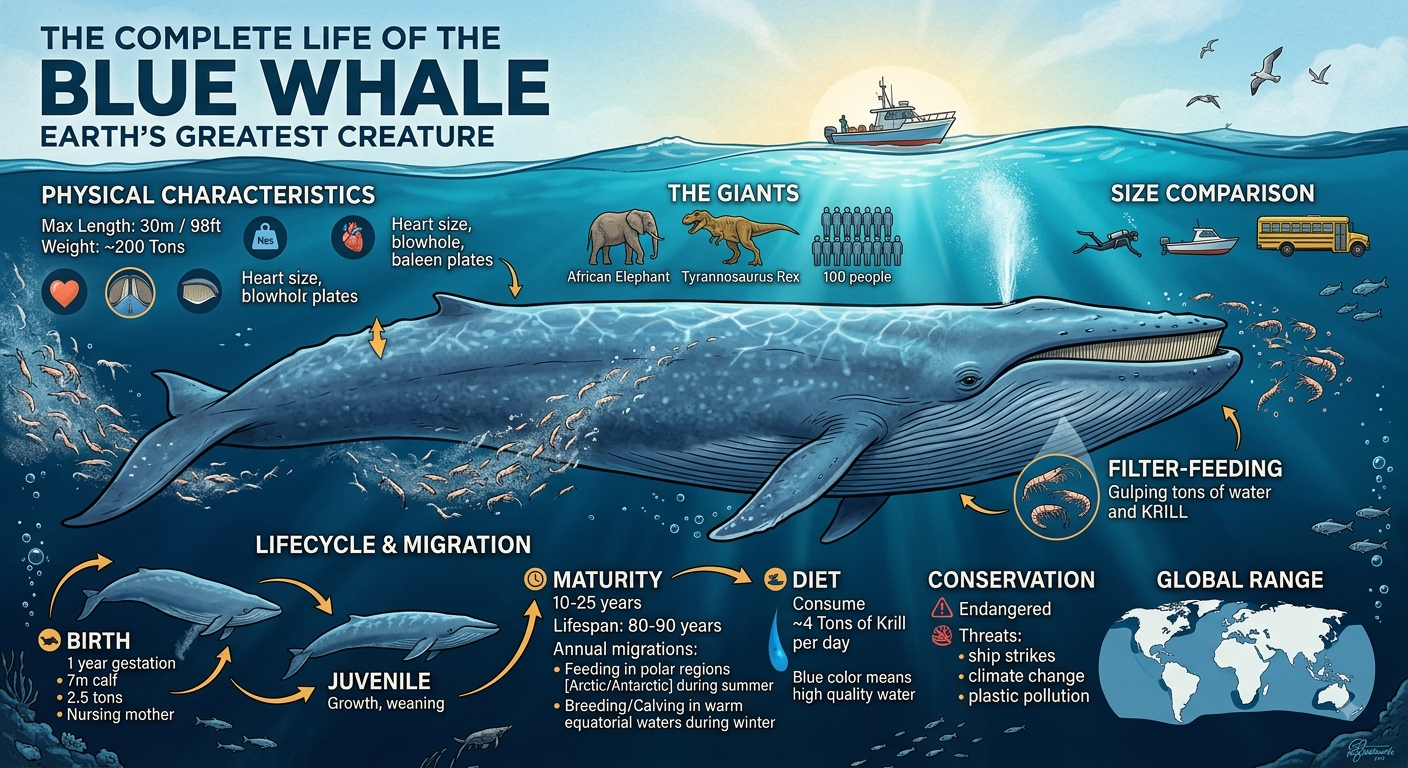
The Complete Life of the Blue Whale: Earth’s Greatest Creature. Current scientific sources describe the blue whale as the largest animal known to have lived, with Antarctic individuals reaching roughly 33–34 metres and more than 150 tonnes. (International Whaling Commission)
Introduction
The blue whale (Balaenoptera musculus) represents one of the most extraordinary achievements of evolution. It is not merely the largest living animal; it is the largest animal known to have existed on Earth. Its enormous body, sophisticated physiology, extraordinary feeding strategy, complex acoustic communication and ability to travel across entire ocean basins demonstrate how life can evolve toward an immense scale while remaining highly efficient.
The blue whale’s story is also a story about the oceans themselves. Its existence depends upon enormous marine ecosystems, particularly the productivity of waters containing dense concentrations of krill. Consequently, understanding the blue whale means understanding marine food webs, ocean circulation, climate, migration, human industry and conservation.
The species is currently classified as Endangered globally. Although international protection has allowed some populations to begin recovering, several populations remain severely depleted, particularly the Antarctic blue whale. (International Whaling Commission)
1. Scientific Identity
Common name: Blue whale
Scientific name: Balaenoptera musculus
Kingdom: Animalia
Phylum: Chordata
Class: Mammalia
Order: Cetartiodactyla
Family: Balaenopteridae
Genus: Balaenoptera
Species: Balaenoptera musculus
Blue whales belong to the baleen whales, or mysticetes. Unlike toothed whales, they do not possess teeth for capturing prey. Instead, they have plates of baleen that function as a biological filtration system.
Recognised forms include northern blue whales, Antarctic blue whales, Northern Indian Ocean blue whales, pygmy blue whales and a Chilean population/subspecies. (Whale Watching Handbook)
2. Why Is the Blue Whale So Large?
The blue whale’s enormous size is the result of millions of years of evolutionary adaptation to life in the ocean.
Water provides buoyancy, allowing a mammal to support a body far larger than would be practical on land. The ocean also contains enormous concentrations of small organisms, particularly krill.
This creates an extraordinary evolutionary relationship:
Tiny prey → enormous food concentration → efficient filter feeding → enormous body → high swimming efficiency → long-distance migration
The blue whale therefore demonstrates an important principle of biological engineering: enormous size becomes possible when an organism can efficiently obtain enormous quantities of concentrated energy.
3. The Blue Whale’s Physical Architecture
A mature blue whale has a streamlined, elongated body designed for efficient movement through water.
Its major systems include:
- massive muscular body
- streamlined head
- enormous mouth
- baleen filtration system
- expandable throat pleats
- powerful tail flukes
- dorsal fin
- highly efficient cardiovascular system
- lungs adapted for repeated diving
- thick insulating blubber
- sophisticated sensory and acoustic systems
The animal’s body is not simply “large.” It is an integrated biological machine in which every major structure contributes to survival in the marine environment.
4. Record-Breaking Dimensions
The largest recorded blue whales have reached approximately 33 metres in length. Antarctic blue whales can reach approximately 110 feet (33.5 metres) and weigh more than 330,000 pounds, or approximately 150 tonnes. Females are generally larger than males. (International Whaling Commission)
The International Whaling Commission notes that the blue whale’s heart can be approximately the size of a small car, illustrating the extraordinary scale of its cardiovascular system. (International Whaling Commission)
However, record measurements should not be confused with typical adult dimensions. Individual size varies according to population, sex, age and environmental conditions.
5. Birth: The Beginning of a Giant
A blue whale begins life at a remarkable biological disadvantage: it is born into an environment where it must ultimately become one of Earth’s largest organisms.
Gestation is estimated at approximately 10–12 months. Most reproductive activity occurs during winter, although timing varies among populations. (NOAA Fisheries)
A newborn calf is already enormous compared with most mammals, but it is still tiny compared with its mother.
The first stage of life is therefore dominated by:
- nursing,
- rapid growth,
- developing swimming ability,
- learning breathing and diving patterns,
- developing coordination,
- following the mother,
- eventually learning how to feed independently.
6. The Mother–Calf Relationship
The mother is central to the calf’s early survival.
A young blue whale must learn how to function in a three-dimensional aquatic environment. It must coordinate breathing, swimming, diving and eventually feeding.
The mother provides:
- protection,
- milk,
- behavioural guidance,
- migration experience,
- access to feeding environments,
- and social contact.
This makes the early life of a blue whale an important example of intergenerational biological knowledge.
Migration routes and feeding areas are not simply geographical coordinates. They can represent ecological knowledge accumulated through generations.
7. Milk and Rapid Growth
Like all mammals, blue whale calves depend upon milk during their earliest development.
The milk is exceptionally energy-rich, allowing calves to grow extremely rapidly.
The calf eventually transitions from dependence upon maternal milk toward independent feeding on krill.
Weaning is estimated to occur at approximately 6–7 months, although the timing and circumstances can vary. (NOAA Fisheries)
This rapid growth is essential because the young whale must eventually acquire the enormous body size necessary for efficient survival in the open ocean.
8. Childhood and Adolescence
As the young whale grows, its priorities change.
Early life is dominated by survival and maternal dependence.
Later, the young whale progressively develops:
- independent swimming ability,
- diving capacity,
- feeding skills,
- navigation,
- communication,
- environmental awareness,
- and eventually reproductive capability.
Sexual maturity is estimated to occur somewhere between approximately 5 and 15 years of age, reflecting variation among populations and individuals. (NOAA Fisheries)
9. The Blue Whale’s Diet
The principal food of blue whales is krill—small shrimp-like crustaceans.
This creates one of nature’s most spectacular size paradoxes:
The largest animal on Earth primarily feeds on some of the smallest animals in the ocean.
Blue whales may occasionally consume fish and other small crustaceans, but krill dominate their diet. (NOAA Fisheries)
The whale does not need to chase individual krill.
Instead, it exploits dense concentrations of prey.
10. The Engineering of Filter Feeding
Blue whale feeding is a masterpiece of biological engineering.
The whale approaches a dense concentration of prey with its enormous mouth open.
Water and krill enter the mouth.
The whale then closes its mouth and uses its tongue and powerful muscular system to force water outward through the baleen.
The baleen acts as a filter.
Water leaves.
Krill remain.
The whale then swallows the concentrated prey.
This system allows an enormous animal to exploit tiny organisms efficiently. (NOAA Fisheries)
11. Throat Pleats: The Expandable Feeding System
One of the most remarkable structures of the blue whale is its system of throat grooves or pleats.
These grooves allow the enormous mouth and throat region to expand dramatically during feeding.
The animal therefore has something resembling an expandable biological intake system.
The process can be simplified as:
Locate prey → accelerate → open mouth → engulf water and krill → expand throat pleats → close mouth → expel water → retain krill → swallow
This is an extraordinary example of evolutionary biomechanics.
12. The Blue Whale’s Energy Economy
Maintaining a body weighing tens or hundreds of tonnes requires enormous quantities of energy.
The whale therefore spends much of its ecological year moving between environments where energy availability differs.
In many populations, summer is associated with highly productive feeding grounds, while winter involves movement toward lower-latitude breeding areas. However, migration patterns vary substantially between populations. (NOAA Fisheries)
This creates an annual biological cycle:
Feeding → energy accumulation → migration → reproduction → migration → feeding
The ocean effectively becomes a gigantic seasonal energy landscape.
13. Migration Across the Ocean
Blue whales occur throughout the world’s oceans except the Arctic.
Many populations undertake seasonal migrations between feeding and breeding areas.
However, scientists still do not completely understand all blue whale migration routes. Some individuals or populations may not migrate in the same way every year. (NOAA Fisheries)
Migration may be influenced by:
- ocean temperature,
- currents,
- seasonal productivity,
- krill distribution,
- reproduction,
- environmental conditions,
- and climate-driven changes.
The whale therefore operates within an enormous dynamic ecosystem rather than a fixed geographical territory.
14. The Blue Whale as an Ocean Navigator
Blue whales travel through an environment in which visibility can be extremely limited.
Sound becomes critically important.
Their vocalizations are extremely powerful and occur at very low frequencies. The International Whaling Commission reports calls generally around 17–20 Hz, below the main range of human hearing. (Whale Watching Handbook)
NOAA notes that under suitable oceanographic conditions, blue whale sounds may potentially be heard by other whales at distances approaching 1,000 miles. (NOAA Fisheries)
Their acoustic world is therefore vastly larger than the visual world available to humans.
15. The Blue Whale’s “Voice”
Blue whale sounds include pulses, moans and other low-frequency vocalizations.
These sounds may serve several purposes, including:
- communication,
- maintaining contact over large distances,
- reproductive signalling,
- social interaction,
- and potentially aspects of navigation.
Scientists continue to investigate exactly how blue whales use their acoustic environment.
The important principle is that the ocean is not silent.
For blue whales, it is an enormous acoustic communication network.
16. The Blue Whale’s Heart and Circulation
An animal of this magnitude requires a cardiovascular system capable of supporting enormous tissue mass.
The heart circulates blood throughout a body extending tens of metres in length.
This requires:
- powerful cardiac contraction,
- extensive blood vessels,
- oxygen transport,
- efficient circulation,
- and adaptations associated with diving.
The blue whale therefore represents an extraordinary example of large-scale mammalian cardiovascular engineering.
17. Breathing and Diving
Although blue whales live underwater, they are mammals and must breathe atmospheric oxygen.
They periodically return to the surface to breathe.
A simplified diving sequence is:
Surface → inhalation → descent → feeding/travel → ascent → surface breathing → repeat
Their lungs, blood and muscles contain adaptations that allow them to manage oxygen during diving.
This differs fundamentally from fish respiration.
The blue whale is therefore a terrestrial-descended mammal that has undergone extraordinary evolutionary transformation for marine life.
18. Swimming
Blue whales normally cruise at approximately 5 miles per hour (8 km/h) while feeding or travelling, but they can accelerate considerably for short periods, exceeding 20 miles per hour according to NOAA. (NOAA Fisheries)
Their primary propulsion comes from the powerful tail flukes.
The tail converts muscular contraction into vertical oscillations that push water backward and propel the whale forward.
The body shape reduces drag.
This creates a highly efficient combination of:
Muscle + hydrodynamics + buoyancy + streamlined anatomy
19. The Adult Life
An adult blue whale spends its existence balancing several fundamental biological priorities:
Survival
Avoid predators, disease, injury and human-related hazards.
Feeding
Locate dense concentrations of krill.
Migration
Move between important ecological regions.
Reproduction
Find suitable mates and successfully reproduce.
Energy management
Maintain an enormous body under changing environmental conditions.
Communication
Exchange information through acoustic signals.
The adult blue whale is therefore continuously managing energy, distance, time and environmental uncertainty.
20. Reproduction
Blue whales reproduce sexually.
Mating generally occurs during the winter breeding period, although reproductive patterns vary geographically.
Females generally produce a single calf after a gestation of approximately 10–12 months.
The estimated average interval between calves is approximately 2–3 years. (NOAA Fisheries)
Because blue whales grow slowly and reproduce relatively slowly, population recovery after severe depletion can take many decades.
21. Reaching Old Age
Blue whales are long-lived mammals.
NOAA estimates an average lifespan of approximately 80–90 years. Scientists can estimate age by examining layers in wax-like earplugs collected from deceased whales. (NOAA Fisheries)
An individual may therefore experience many decades of ocean history.
A whale born in one era can survive long enough to experience dramatic changes in:
- ocean temperature,
- shipping,
- fisheries,
- pollution,
- climate,
- prey distribution,
- and human technology.
The lifetime of a blue whale can therefore span almost a century of environmental change.
22. The Blue Whale and the Ocean Food Web
The blue whale occupies a high position in the marine food web but feeds primarily on small organisms.
Its existence depends upon primary productivity.
The basic chain can be simplified as:
Sunlight → phytoplankton → zooplankton/krill → blue whale
This means the blue whale is indirectly dependent upon solar energy captured by microscopic marine organisms.
The largest animal on Earth therefore ultimately depends upon microscopic life.
That is one of the most profound lessons of marine ecology.
23. The Importance of Krill
Krill are not merely food for whales.
They form an important component of marine ecosystems.
They consume microscopic organisms and are themselves consumed by numerous marine animals.
The blue whale has evolved to exploit this energy pathway at enormous scale.
Consequently, changes in krill abundance or distribution can affect blue whale populations.
The International Whaling Commission identifies commercial exploitation of krill and climate-driven changes in krill distribution as potential threats. (International Whaling Commission)
24. The Human Era
For most of human history, blue whales were difficult to hunt because of their size, speed and open-ocean habitat.
Industrial technology changed this relationship.
Mechanized vessels, improved harpoons and factory ships enabled humans to pursue and process blue whales at unprecedented scales.
The result was catastrophic population depletion.
The International Whaling Commission reports that more than 300,000 blue whales were killed in the Southern Hemisphere alone, with additional large losses in the North Atlantic and North Pacific. (International Whaling Commission)
25. The Industrial Whaling Crisis
The twentieth century demonstrated a fundamental principle of technological power:
Technology can increase both human productivity and human destructive capacity.
Industrial whaling transformed the whale from an animal that was difficult to exploit into a commercially valuable biological resource.
Blue whales were particularly valuable because of their enormous bodies and oil yield.
The consequences were devastating.
Some populations were reduced to tiny fractions of their historical abundance.
26. International Protection
Blue whales have been protected from commercial hunting by the International Whaling Commission since 1966. (International Whaling Commission)
International protection represents one of the most important turning points in the history of the species.
The transition was:
Industrial exploitation → population collapse → international recognition → legal protection → monitoring → gradual recovery in some populations
However, protection from whaling alone does not eliminate all modern threats.
27. Current Conservation Status
The blue whale remains classified globally as Endangered.
The Antarctic blue whale is in an even more serious condition and is classified as Critically Endangered according to the International Whaling Commission’s summary of conservation assessments. Its current estimated population remains below 1% of its original pre-whaling level. (International Whaling Commission)
Some populations have shown encouraging recovery rates, while others remain small or difficult to assess because blue whales spend much of their lives offshore. (International Whaling Commission)
28. Modern Threat: Ship Strikes
Modern shipping creates a major conservation challenge.
Blue whales and large commercial vessels increasingly share the same ocean.
A collision can cause severe injury or death.
Risk is particularly significant in areas where important whale habitat overlaps with major shipping routes and ports. (NOAA Fisheries)
This illustrates a new conservation problem:
The technology that connects the global economy can also create hazards for marine megafauna.
29. Fishing Gear Entanglement
Blue whales can become entangled in fishing equipment such as nets, traps and other gear.
Entanglement can interfere with:
- swimming,
- feeding,
- energy expenditure,
- migration,
- reproduction,
- and general health.
Some whales may carry gear for long distances, increasing energetic costs and the risk of serious injury. (NOAA Fisheries)
30. Ocean Noise
Modern oceans are increasingly noisy.
Major sources include:
- commercial shipping,
- industrial activity,
- construction,
- sonar,
- and other human-generated sounds.
Because blue whales depend heavily upon low-frequency acoustic communication, changes in the underwater acoustic environment may interfere with natural communication.
The precise effects vary and remain an active research area.
31. Climate Change
Climate change introduces another layer of uncertainty.
Blue whales depend upon ecosystems that produce large concentrations of krill.
Climate change can alter:
- ocean temperature,
- currents,
- sea-ice conditions,
- primary productivity,
- prey distribution,
- migration routes,
- and the timing of seasonal biological events.
The consequence is potentially profound:
Climate change → changing ocean conditions → changing krill distribution → changing whale feeding opportunities
The International Whaling Commission identifies climate change as a potential threat to blue whales. (International Whaling Commission)
32. Pollution and Habitat Degradation
Blue whales inhabit oceans increasingly influenced by human activity.
Potential pressures include:
- chemical pollution,
- plastic and marine debris,
- habitat degradation,
- vessel disturbance,
- underwater noise,
- and changing prey distributions.
NOAA identifies habitat degradation, pollution, vessel disturbance and climate change among additional threats requiring continued scientific attention. (NOAA Fisheries)
33. The Blue Whale as a Symbol of Technological Responsibility
The history of the blue whale offers humanity an important lesson.
Humans developed technologies capable of harvesting animals on an unprecedented scale.
Later, humans developed international institutions and conservation technologies capable of protecting them.
Thus:
Technology is not inherently destructive or beneficial.
Its consequences depend upon:
- knowledge,
- governance,
- ethics,
- incentives,
- regulation,
- scientific monitoring,
- and long-term planning.
The blue whale is therefore not merely a biological subject.
It is also a case study in civilisation’s relationship with nature.
34. Scientific Monitoring
Modern researchers use increasingly sophisticated methods to study blue whales.
These include:
- photo-identification,
- acoustic monitoring,
- satellite tracking,
- aerial surveys,
- genetic analysis,
- population modelling,
- historical whaling records,
- oceanographic measurements,
- and ecological modelling.
Individual whales can sometimes be identified by distinctive patterns of mottling and markings on their bodies and tail flukes. Long-term photographic catalogues have allowed researchers to follow individuals over many years. (Whale Watching Handbook)
35. The Blue Whale as a Biological Data System
Modern whale research increasingly resembles a global information system.
Researchers can combine:
Whale identity + location + time + movement + sound + prey + ocean temperature + shipping activity
This produces a multidimensional picture of whale ecology.
In the future, artificial intelligence and advanced sensor networks could potentially improve:
- population estimates,
- migration modelling,
- collision-risk prediction,
- acoustic recognition,
- habitat mapping,
- and conservation planning.
The blue whale is therefore becoming part of the emerging intersection between biology, oceanography, computing and artificial intelligence.
36. A Complete Life-Cycle Model
The life of a blue whale can be represented as a biological cycle:
Birth
↓
Nursing
↓
Rapid growth
↓
Weaning
↓
Juvenile development
↓
Migration learning
↓
Independent feeding
↓
Sexual maturity
↓
Breeding
↓
Migration
↓
Long-term adult survival
↓
Repeated reproduction
↓
Old age
↓
Death
↓
Return of nutrients to the marine ecosystem
This final stage is important.
The whale’s life does not end its ecological influence when the animal dies.
Its body can become a major source of nutrients for marine organisms, creating an ecological pathway between one enormous animal and many smaller organisms.
37. The Blue Whale and the Concept of Scale
The blue whale challenges human intuition.
Humans are accustomed to measuring objects in metres and kilograms.
The blue whale operates at a scale where:
- its body is longer than many buildings,
- its mass can exceed 100 tonnes,
- its heart approaches the dimensions of a small car,
- its vocalizations can travel enormous distances,
- and its migrations may span ocean basins.
It therefore provides an extraordinary biological reference point for understanding scale.
38. Why the Blue Whale Matters to Humanity
The blue whale matters for several reasons.
Scientific importance
It provides insights into mammalian evolution, biomechanics, physiology and ecology.
Ecological importance
It is part of the complex marine food web.
Conservation importance
Its history demonstrates the consequences of uncontrolled exploitation.
Climate importance
Its dependence upon productive marine ecosystems makes it relevant to changing ocean conditions.
Cultural importance
Few animals have captured the human imagination as profoundly.
Technological importance
Modern research demonstrates how satellites, sensors, acoustics, genetics and computational modelling can be combined to understand wildlife.
39. The Blue Whale as an Evolutionary Masterpiece
The blue whale represents millions of years of evolutionary experimentation.
Its body integrates:
- hydrodynamics,
- biomechanics,
- respiratory physiology,
- cardiovascular engineering,
- thermoregulation,
- sensory biology,
- acoustic communication,
- reproductive biology,
- and energy management.
Its enormous size is therefore not a single adaptation.
It is the result of thousands of interacting adaptations.
40. The Future of the Blue Whale
The future of the blue whale depends heavily upon humanity’s ability to manage the oceans.
The major priorities include:
- maintaining protection from commercial whaling;
- reducing ship-strike risk;
- reducing harmful fishing-gear interactions;
- protecting important feeding and breeding habitats;
- monitoring krill and marine productivity;
- studying climate impacts;
- reducing harmful ocean pollution;
- understanding underwater noise;
- improving international cooperation;
- continuing long-term population monitoring.
Conservation must increasingly operate at the scale at which the whales themselves operate: internationally and across entire ocean ecosystems.
41. A Millennium Perspective
The blue whale provides an excellent model for understanding the relationship between biology and civilisation.
Humanity has entered an era in which technological systems influence the entire planet.
Ships cross oceans.
Satellites monitor ecosystems.
Artificial intelligence analyses enormous datasets.
Industrial fisheries can alter food webs.
Climate change can modify ocean conditions.
Therefore, protecting a blue whale is no longer simply a matter of protecting an individual animal.
It requires managing an interconnected planetary system.
The blue whale’s future is connected to the future of the ocean.
The future of the ocean is connected to the future of civilisation.
42. The Central Lesson
The greatest lesson of the blue whale is not simply that it is enormous.
It is that extraordinary complexity can emerge from simple biological principles operating over immense periods of evolutionary time.
The whale feeds on tiny organisms.
Tiny organisms depend upon microscopic marine productivity.
That productivity depends upon sunlight, nutrients and ocean circulation.
The whale depends upon the entire chain.
Thus, the largest creature on Earth ultimately depends upon some of the smallest components of the planetary ecosystem.
Conclusion
The blue whale is one of Earth’s greatest evolutionary achievements.
From its birth as a dependent calf to its development into a gigantic adult, its life is governed by energy, migration, reproduction, communication and adaptation.
It is a mammal that returned to the sea yet retained the fundamental characteristics of mammalian life. It breathes air, nurses its young and gives birth to live offspring, while simultaneously possessing the extraordinary adaptations required to survive in the open ocean.
Its history also contains a warning.
Industrial whaling demonstrated how rapidly technological power can overwhelm biological resilience. International protection subsequently demonstrated that scientific knowledge, law and global cooperation can reverse some of the damage.
Yet the species remains Endangered, and some populations are still extraordinarily depleted. Modern conservation therefore requires a broader approach involving shipping, fisheries, climate change, pollution, habitat protection, acoustic ecology and long-term scientific monitoring. (International Whaling Commission)
The blue whale ultimately represents more than an animal.
It represents scale, evolution, ocean ecology, technological power, conservation and humanity’s responsibility toward the living Earth.
The complete life of the blue whale is therefore also a story about the complete life of the ocean—and about whether human civilisation can learn to coexist with the largest creatures that evolution has ever produced.
Key Scientific Facts
| Characteristic | Blue Whale |
|---|---|
| Scientific name | Balaenoptera musculus |
| Animal group | Baleen whale |
| Maximum recorded length | Approximately 33 m |
| Antarctic maximum | Approximately 33.5 m |
| Maximum reported mass | More than 150 tonnes in exceptional Antarctic individuals |
| Main food | Krill |
| Feeding mechanism | Baleen filter feeding |
| Typical swimming speed | About 8 km/h while travelling/feeding |
| Short-burst speed | More than 32 km/h |
| Lifespan | Approximately 80–90 years |
| Gestation | Approximately 10–12 months |
| Weaning | Approximately 6–7 months |
| Sexual maturity | Approximately 5–15 years |
| Typical social pattern | Usually solitary or in pairs |
| Distribution | Most oceans except the Arctic |
| Conservation status | Endangered globally |
| Major modern threats | Ship strikes, entanglement, climate change, pollution, habitat degradation and ocean noise |
The biological values above are based principally on current NOAA Fisheries and International Whaling Commission information. (International Whaling Commission)
Final Perspective
If humanity wants to understand what the Earth is capable of producing through evolution, the blue whale is an extraordinary place to begin.
It is a living demonstration that the planet can transform microscopic energy pathways into a creature weighing more than 100 tonnes, moving through oceans thousands of kilometres wide and communicating through sounds that travel across enormous distances.
The blue whale is not simply Earth’s greatest creature because of its size. It is Earth’s greatest creature because its existence reveals the extraordinary interconnectedness of life, energy, oceans, evolution and time.





Be First to Comment