
Executive Summary
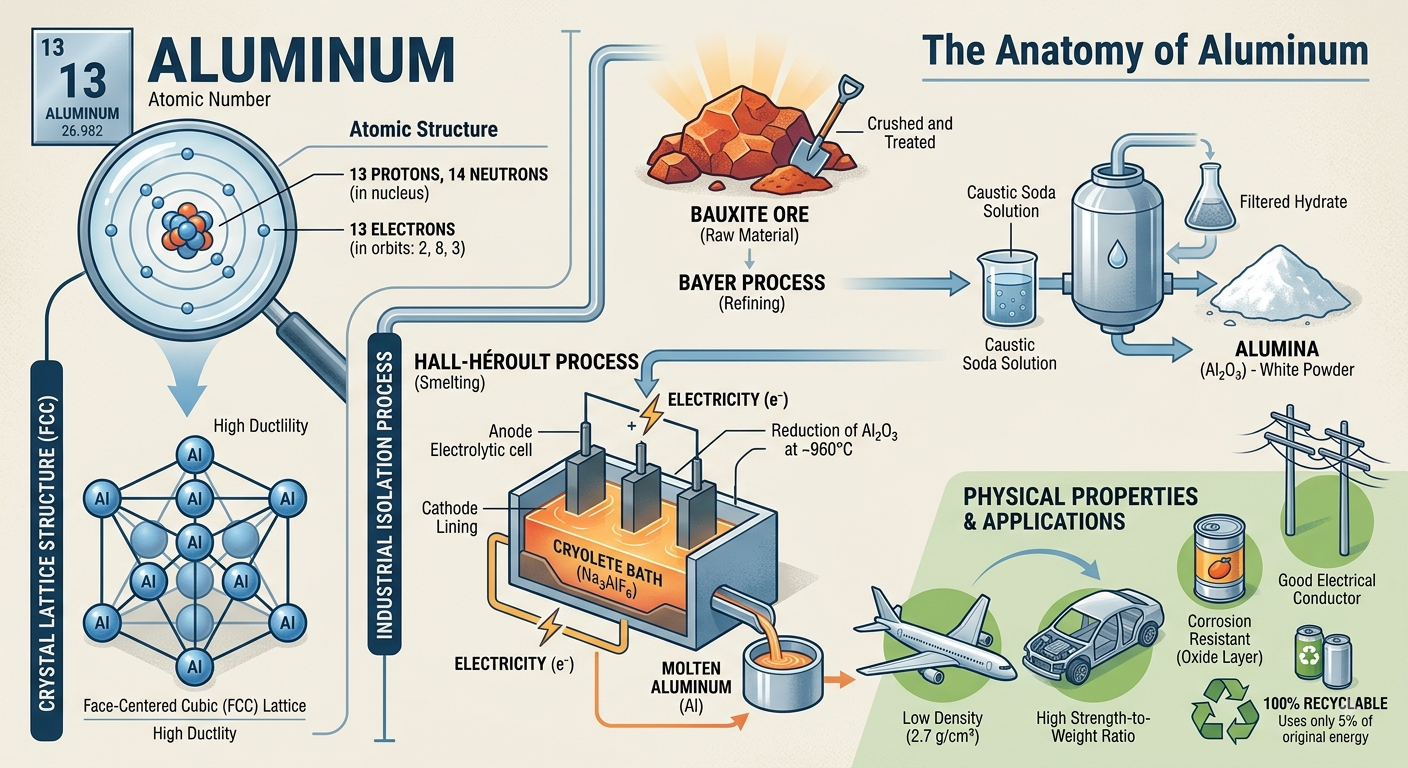
Aluminum—spelled aluminium in many countries—is one of the most important materials of modern civilization. It is the most abundant metallic element in Earth’s crust and the third-most abundant element overall, after oxygen and silicon. Modern estimates put aluminum at roughly 8.2% by weight of the upper continental crust.
Yet there is an extraordinary geological and technological paradox: aluminum is abundant, but metallic aluminum is rarely found naturally in its elemental form. It is strongly chemically bound to oxygen and other elements inside minerals. Consequently, humanity had to develop sophisticated chemistry, mining, refining and electrolysis before aluminum could become an industrial metal.
Today aluminum is fundamental to transportation, construction, electrical systems, packaging, electronics, machinery, renewable energy infrastructure and aerospace. Its combination of low density, corrosion resistance, conductivity, ductility, malleability and alloyability makes it exceptionally versatile.
The modern aluminum industry can be understood as a technological chain:
Earth → bauxite → alumina → aluminum metal → alloy → fabrication → product → use → collection → recycling → new aluminum product
This circular chain is increasingly important because producing primary aluminum is energy-intensive, whereas recycling aluminum can preserve material value and reduce the need for new primary production.
1. What Is Aluminum?
Aluminum is a chemical element with:
- Symbol: Al
- Atomic number: 13
- Atomic mass: approximately 26.98 u
- Group: 13
- Period: 3
- Block: p-block
- Classification: post-transition metal
- Room-temperature state: solid
- Appearance: silvery-white metallic
- Crystal structure: face-centered cubic (FCC)
The word “aluminum” is commonly used in American English, while “aluminium” is standard in British English and therefore widely used in South Africa and other Commonwealth countries.
Aluminum’s importance comes not simply from its abundance, but from the remarkable combination of its physical, chemical and engineering characteristics.
2. Aluminum’s Position in Earth’s Chemistry
The Earth’s crust can be viewed as an enormous natural chemical library. Oxygen and silicon dominate the crust, and aluminum is incorporated into many of the minerals produced from them.
A simplified abundance ranking is:
| Rank | Element | Approximate crustal abundance |
|---|---|---|
| 1 | Oxygen | ~46% |
| 2 | Silicon | ~28% |
| 3 | Aluminum | ~8% |
| 4 | Iron | ~5% |
| 5 | Calcium | ~3–4% |
| 6 | Sodium | ~3% |
| 7 | Potassium | ~2–3% |
| 8 | Magnesium | ~2% |
The exact percentages vary according to the geological model and definition of Earth’s crust.
The important conclusion is that aluminum is not a scarce element. The challenge is concentrating it into economically exploitable deposits and separating it from oxygen, silicon and other elements.
3. Why Doesn’t Aluminum Usually Occur as a Metal?
This is one of the most important concepts in understanding aluminum.
Aluminum has a strong chemical affinity for oxygen. In nature, aluminum therefore tends to exist in compounds rather than as free metallic aluminum.
It occurs in minerals containing combinations of:
- aluminum;
- oxygen;
- silicon;
- hydroxyl groups;
- sodium;
- potassium;
- calcium;
- iron and other elements.
Examples include:
- feldspars;
- clay minerals;
- kaolinite;
- mica;
- aluminum hydroxides;
- aluminum oxides;
- bauxite minerals.
USGS geological information notes that aluminum occurs widely in aluminosilicate minerals, especially feldspars and clays.
Therefore:
Abundant aluminum atoms ≠ abundant aluminum metal.
This distinction is fundamental.
4. The Geological Origin of Bauxite
The principal commercial ore of aluminum is bauxite.
Bauxite is not a single pure mineral. It is a heterogeneous natural material containing aluminum hydroxide minerals together with impurities such as:
- iron oxides;
- silica;
- titanium minerals;
- aluminosilicates;
- clay minerals.
Important aluminum-bearing minerals include:
Gibbsite
Al(OH)₃
Boehmite
AlO(OH)
Diaspore
AlO(OH)
USGS describes bauxite as the principal raw material for alumina production and notes that approximately 85% of bauxite production is used to manufacture alumina through the Bayer process.
5. How Bauxite Forms
Bauxite is strongly associated with geological weathering.
A simplified geological pathway is:
Aluminum-bearing rock
↓
Intense chemical weathering
↓
Breakdown of feldspar and other minerals
↓
Removal of soluble components
↓
Concentration of relatively immobile aluminum minerals
↓
Bauxite deposit
Warm, humid environments with suitable drainage can promote intense chemical weathering and the formation of bauxite.
This explains why major bauxite resources are concentrated in particular geological and climatic environments.
6. The Aluminum Production Chain
The modern primary aluminum industry has three major stages:
Stage 1 — Mining
Bauxite ore
↓
Stage 2 — Refining
Bauxite → Alumina (Al₂O₃)
through the Bayer process
↓
Stage 3 — Smelting
Alumina → Aluminum metal
through the Hall-Héroult process
↓
Stage 4 — Alloying and casting
Primary aluminum → alloy products
↓
Stage 5 — Manufacturing
Rolling / extrusion / forging / casting
↓
Stage 6 — Finished product
Vehicle / building / package / electrical system / aircraft / machine
This sequence represents one of the world’s major industrial material pipelines.
7. The Bayer Process
The Bayer process was developed in the late nineteenth century and became the principal industrial technology for producing alumina from bauxite.
Its objective is to separate aluminum compounds from unwanted materials.
A simplified sequence is:
Bauxite
→ crushing and preparation
→ digestion in caustic solution
→ separation of insoluble residues
→ precipitation of aluminum hydroxide
→ calcination
→ alumina (Al₂O₃)
The process generates a major by-product commonly known as bauxite residue or red mud, which contains iron oxides and other non-aluminum components.
This creates an important environmental-management challenge for the industry.
8. Alumina: The Intermediate Material
Alumina is aluminum oxide:
Al₂O₃
It is not metallic aluminum.
This distinction is essential.
| Material | Formula | Role |
|---|---|---|
| Bauxite | Variable | Ore |
| Alumina | Al₂O₃ | Refined feedstock |
| Aluminum | Al | Metal |
Alumina itself is a technologically valuable ceramic material because it has high hardness, high-temperature stability, electrical insulating properties and chemical resistance.
But for most primary aluminum production, alumina is the bridge between the mine and the metal.
9. The Hall-Héroult Process
The breakthrough that transformed aluminum into a major industrial metal was the development of the Hall-Héroult electrolytic process in 1886. The Bayer process followed shortly afterward in 1888.
The Hall-Héroult process uses electricity to reduce alumina to aluminum.
In simplified terms:
Al₂O₃ → Al
The process occurs in a molten electrolyte containing cryolite, allowing the alumina to be electrolytically reduced at high temperature.
The fundamental idea is:
Electricity supplies the energy necessary to separate aluminum from oxygen.
This is why aluminum production is closely connected to the electricity system.
10. Why Aluminum Production Requires So Much Energy
Aluminum’s abundance does not make it easy to manufacture.
The central challenge is chemical:
Aluminum strongly bonds with oxygen.
Breaking those bonds requires substantial energy.
Consequently, primary aluminum production is an energy-intensive industrial activity. The International Energy Agency tracks aluminum production, energy demand and associated CO₂ emissions as important parts of the global energy/materials system.
This creates a direct relationship:
Electricity system → aluminum industry → industrial economy
Countries with abundant, reliable and relatively low-carbon electricity can therefore possess important advantages in aluminum production.
11. Anatomy of the Aluminum Atom
An aluminum atom contains:
- 13 protons
- normally 13 electrons
- commonly 14 neutrons in its most abundant stable isotope, aluminum-27.
Its electron configuration is:
1s² 2s² 2p⁶ 3s² 3p¹
The three outer-shell electrons are particularly important to aluminum’s chemistry.
Aluminum commonly forms the Al³⁺ ion in compounds.
This helps explain why aluminum bonds strongly with oxygen and forms stable aluminum oxides.
12. The Aluminum-Oxygen Relationship
Aluminum’s surface behavior is fascinating.
When fresh aluminum is exposed to oxygen, a very thin layer of aluminum oxide rapidly forms.
This oxide layer acts as a protective barrier.
Consequently, although aluminum is chemically reactive, bulk aluminum can exhibit excellent corrosion resistance under many ordinary conditions.
This phenomenon is called passivation.
It is one of aluminum’s most commercially important characteristics.
13. Physical Properties
Important physical characteristics include:
| Property | General characteristic |
|---|---|
| Density | ~2.70 g/cm³ |
| Melting point | ~660°C |
| Crystal structure | FCC |
| Electrical conductivity | Good |
| Thermal conductivity | Good |
| Ductility | High |
| Malleability | High |
| Reflectivity | High |
| Corrosion resistance | Generally high |
| Magnetic behavior | Essentially non-ferromagnetic |
Its density is approximately one-third that of steel or copper by volume, contributing significantly to its transportation applications.
14. Why Aluminum Is So Lightweight
Density is one of aluminum’s greatest economic advantages.
Consider three broad material classes:
Steel → heavy
Copper → relatively heavy
Aluminum → substantially lighter
This means engineers can reduce mass while maintaining useful structural performance through appropriate alloy design and geometry.
The result is particularly valuable in:
- aircraft;
- automobiles;
- rail systems;
- electric vehicles;
- bicycles;
- ships;
- packaging;
- portable equipment.
15. Aluminum Is Not Simply “Weak”
A common misconception is:
“Aluminum is lightweight, therefore it must be weak.”
That is incorrect.
Pure aluminum is relatively soft and has limited strength compared with many engineering steels.
However, aluminum can be alloyed and processed to achieve dramatically improved mechanical properties.
Important alloying elements include:
- magnesium;
- silicon;
- copper;
- zinc;
- manganese;
- lithium.
Heat treatment, cold working and manufacturing processes can further modify its properties.
Thus engineers rarely design major structures using only commercially pure aluminum.
16. Aluminum Alloys
Aluminum alloys are commonly divided into wrought and cast families.
Wrought alloys
These are mechanically worked into products such as:
- sheets;
- plates;
- bars;
- tubes;
- wires;
- extrusions.
Cast alloys
These are produced by pouring molten alloy into molds.
They are useful for complex shapes such as:
- engine components;
- housings;
- machinery components;
- structural parts.
17. Major Aluminum Alloy Families
The widely used wrought alloy numbering system includes:
1xxx series
Very high aluminum content.
Characteristics include:
- high corrosion resistance;
- high electrical conductivity;
- good formability.
2xxx series
Primarily aluminum-copper alloys.
Often associated with high strength and aerospace applications.
3xxx series
Aluminum-manganese alloys.
Often used in:
- heat exchangers;
- cooking equipment;
- architectural products.
4xxx series
Aluminum-silicon alloys.
Commonly used for welding and brazing applications.
5xxx series
Aluminum-magnesium alloys.
Known for good corrosion resistance and useful strength.
6xxx series
Aluminum-magnesium-silicon alloys.
Extremely important for:
- extrusion;
- transportation;
- construction;
- structural applications.
7xxx series
Aluminum-zinc alloys.
Can achieve very high strength and are important in aerospace and other demanding engineering applications.
18. Aluminum and Electricity
Aluminum is an important electrical conductor.
Although copper generally provides higher conductivity for a given cross-sectional area, aluminum has a major advantage:
low density.
Therefore aluminum is extensively used in:
- overhead transmission lines;
- distribution networks;
- electrical cables;
- busbars;
- electrical infrastructure.
This produces an important engineering principle:
Conductivity + low mass = excellent long-distance electrical conductor.
19. Aluminum in Transportation
Transportation is one of aluminum’s most important application areas.
Aviation
Aircraft designers value aluminum alloys because of:
- low density;
- strength-to-weight performance;
- corrosion resistance;
- manufacturability.
Automotive
Aluminum is used in:
- body structures;
- wheels;
- engine components;
- heat exchangers;
- suspension components;
- battery-related structures;
- vehicle frames and parts.
Rail
Aluminum extrusions can produce lightweight train bodies and structural systems.
Marine
Marine aluminum alloys can provide useful corrosion resistance and reduced mass, particularly when appropriate alloys and joining methods are selected.
20. Aluminum in Construction
The construction industry uses aluminum extensively.
Examples include:
- window frames;
- doors;
- curtain walls;
- roofing;
- façades;
- structural components;
- electrical systems;
- heating and cooling equipment.
Its combination of low weight, corrosion resistance and ability to be extruded into complex profiles makes it particularly valuable in architecture.
21. Aluminum and Extrusion
Extrusion is one of aluminum’s most powerful manufacturing technologies.
Imagine a soft metal billet being pushed through a specially shaped opening.
The result is a long component with a consistent cross-section.
This allows engineers to produce complex profiles efficiently.
Examples include:
- window frames;
- rails;
- heat sinks;
- structural beams;
- vehicle components;
- machine frames.
The ability to create complicated shapes from aluminum is one reason the material is so deeply integrated into modern engineering.
22. Aluminum in Packaging
Aluminum is extensively used in packaging because it can be:
- thin;
- lightweight;
- formable;
- corrosion resistant;
- impermeable to light;
- impermeable to gases;
- recyclable.
Applications include:
- beverage containers;
- food packaging;
- pharmaceutical packaging;
- foil;
- industrial packaging.
Aluminum foil demonstrates the extraordinary ability of the metal to be rolled into extremely thin sheets while retaining useful barrier properties.
23. Aluminum in Electronics
Modern electronics also depend on aluminum.
Applications include:
- heat sinks;
- electrical conductors;
- electronic housings;
- capacitors;
- semiconductor-related components;
- telecommunications equipment;
- computer chassis.
One especially important characteristic is thermal conductivity.
Aluminum can transfer heat away from electronic components into the surrounding environment.
24. Aluminum in Renewable Energy
The energy transition is creating additional material requirements.
Aluminum can contribute to:
- solar installations;
- electrical transmission;
- wind-energy components;
- battery systems;
- electric vehicles;
- charging infrastructure;
- grid modernization.
A key connection is:
Renewable electricity → electrification → greater infrastructure demand → material demand
Aluminum therefore sits at an important intersection between the traditional industrial economy and the emerging low-carbon economy.
25. Aluminum and Electric Vehicles
Electric vehicles create a strong engineering incentive to manage mass.
A lighter vehicle can potentially improve:
- energy efficiency;
- range;
- handling;
- component sizing;
- payload efficiency.
Aluminum can therefore be used in vehicle structures and components where its material properties justify the additional cost or manufacturing complexity.
However, aluminum is not automatically superior to steel in every component.
Engineering is a process of optimization.
26. Aluminum in Aerospace
Aerospace represents one of the most technologically demanding uses of aluminum alloys.
Aircraft structures must simultaneously manage:
- weight;
- strength;
- fatigue;
- corrosion;
- temperature;
- manufacturability;
- safety;
- cost.
Aluminum alloys historically became fundamental aircraft materials because they provided a highly useful balance of low density and mechanical performance.
Modern aerospace increasingly combines aluminum alloys with:
- carbon-fiber composites;
- titanium;
- advanced steels;
- nickel-based materials.
Therefore aluminum remains important but is part of a broader advanced-materials ecosystem.
27. Aluminum and Heat
Aluminum’s thermal conductivity makes it useful in heat-management systems.
Applications include:
- radiators;
- heat exchangers;
- air-conditioning equipment;
- refrigeration;
- electronics cooling;
- automotive cooling systems.
A heat sink often uses aluminum because its geometry can be engineered to provide a large surface area for heat transfer.
28. Aluminum and Corrosion
Aluminum’s corrosion resistance comes largely from its oxide layer.
However, the statement:
“Aluminum never corrodes”
would be incorrect.
Aluminum can experience corrosion under unfavorable conditions.
Important factors include:
- chloride exposure;
- acidity;
- alkalinity;
- moisture;
- temperature;
- contact with dissimilar metals;
- mechanical damage;
- alloy composition.
Engineering design therefore considers both the material and its operating environment.
29. Anodizing
One method used to improve aluminum surfaces is anodizing.
Anodizing intentionally develops a controlled oxide layer.
It can improve:
- surface durability;
- corrosion resistance;
- appearance;
- wear resistance.
It also allows aluminum products to receive different finishes and colors.
30. Aluminum and Fire
Aluminum is noncombustible as a bulk structural metal, but aluminum components can lose strength as temperature rises.
Therefore engineers must consider:
- operating temperature;
- fire exposure;
- heat transfer;
- alloy condition;
- structural requirements.
The distinction between chemical combustibility and loss of mechanical strength at high temperature is important in materials engineering.
31. The Aluminum Industry as an Energy System
The aluminum industry is not merely a mining industry.
It is an integrated energy-and-material system:
Mining
↓
Refining
↓
Electricity-intensive smelting
↓
Casting
↓
Rolling / extrusion / forging
↓
Manufacturing
↓
Transportation
↓
Consumer and industrial use
↓
Collection
↓
Recycling
Every stage requires infrastructure, capital, skilled workers, logistics, electricity and technology.
32. Aluminum and Global Industrial Geography
The aluminum value chain is distributed internationally.
Different regions may specialize in:
- bauxite mining;
- alumina refining;
- primary aluminum smelting;
- alloy production;
- semi-fabrication;
- component manufacturing;
- recycling.
USGS maintains current statistics covering bauxite, alumina and aluminum production and material flows, illustrating how extensive the global aluminum system has become.
This means aluminum is a strategic industrial material rather than simply a commodity extracted from the ground.
33. Africa and Aluminum
Africa is particularly important to the upstream aluminum value chain because it contains significant bauxite resources.
Countries such as Guinea have become major participants in global bauxite supply.
This creates an important development question:
Should mineral-rich countries primarily export ore, or should they develop progressively higher-value stages of the aluminum value chain?
A more sophisticated industrial strategy can potentially progress through:
Bauxite mining
→ alumina refining
→ aluminum smelting
→ alloy production
→ rolling/extrusion
→ component manufacturing
→ finished industrial products
The higher stages generally require more:
- electricity;
- infrastructure;
- technical expertise;
- capital;
- industrial organization;
- market access.
34. South Africa’s Strategic Position
For South Africa, aluminum is particularly relevant because the country possesses an established industrial, mining, engineering, electrical and manufacturing ecosystem.
The strategic challenge is not merely producing metal.
It is building a broader value chain involving:
- mining;
- energy;
- ports;
- rail;
- engineering;
- fabrication;
- automotive manufacturing;
- aerospace;
- construction;
- recycling;
- research and development.
The deeper economic opportunity is therefore:
Aluminum → industrial capability → manufacturing → skilled employment → exports → technological development
35. Aluminum Recycling
One of aluminum’s greatest characteristics is recyclability.
Aluminum can be repeatedly recycled into new products while retaining its fundamental metallic identity.
A simplified circular model is:
Product
↓
Collection
↓
Sorting
↓
Processing
↓
Melting
↓
Casting
↓
New aluminum product
This transforms aluminum from a linear resource into a potentially circular industrial material.
36. Why Recycling Matters
Primary aluminum production requires substantial energy.
Recycling avoids the need to repeat the complete:
bauxite → alumina → primary aluminum
route for every new product.
Instead, existing metal can be recovered and remelted.
This creates several advantages:
- reduced demand for virgin material;
- lower energy requirements;
- reduced landfill;
- preservation of valuable metal;
- reduced pressure on mining;
- improved resource efficiency.
However, recycling still requires collection, sorting, transport, processing and melting infrastructure.
37. The Aluminum Circular Economy
A mature aluminum economy should operate as a circular network:
Mine
→ Refine
→ Smelt
→ Manufacture
→ Use
→ Collect
→ Sort
→ Recycle
→ Manufacture again
The objective is not necessarily to eliminate mining immediately, because demand continues to grow and some metal is lost or remains locked into long-lived products.
Instead, the objective is to maximize the useful life of every aluminum atom.
38. Environmental Challenges
The aluminum industry has several environmental challenges.
Mining
Bauxite mining can affect:
- landscapes;
- ecosystems;
- soil;
- water systems;
- communities.
Refining
The Bayer process generates bauxite residue.
Smelting
Primary aluminum production requires substantial electricity and can produce greenhouse-gas emissions depending on the electricity source and process technology.
Transportation
Mining and moving ore, alumina and metal require substantial logistics.
Waste
Poorly managed residues and industrial waste can create environmental risks.
Therefore the future aluminum industry must improve its environmental performance throughout the entire value chain.
39. The Red-Mud Challenge
Bauxite residue, commonly called red mud, is one of the major by-products of alumina refining.
Its reddish appearance is associated largely with iron-bearing minerals.
The material can contain:
- iron compounds;
- residual aluminum compounds;
- silica;
- titanium-bearing materials;
- alkaline components.
Modern research investigates ways to:
- improve residue management;
- recover useful elements;
- reduce storage requirements;
- convert residues into construction materials;
- improve resource efficiency.
This illustrates a major principle of future industrial civilization:
Waste should increasingly become a resource.
40. Decarbonizing Aluminum
The aluminum industry is under pressure to reduce greenhouse-gas emissions.
Several technological pathways are important:
Cleaner electricity
Replacing fossil-intensive electricity with lower-carbon electricity can reduce smelting emissions.
Energy efficiency
Improving the efficiency of refining and smelting reduces energy requirements.
Advanced anodes
Conventional carbon anodes contribute to process emissions.
Alternative anode technologies could potentially reduce direct emissions.
Recycling
Greater recycling reduces the need for energy-intensive primary production.
Process innovation
Digital control, automation and advanced electrolysis can improve industrial performance.
The IEA currently tracks aluminum production, energy demand and emissions as part of its assessment of industrial decarbonization.
41. Digitalization of the Aluminum Industry
The next generation of aluminum production will increasingly combine metallurgy with digital technology.
Important technologies include:
- industrial sensors;
- artificial intelligence;
- machine learning;
- digital twins;
- robotics;
- autonomous mining;
- predictive maintenance;
- process control;
- computer vision;
- industrial IoT;
- satellite monitoring;
- automated quality inspection.
A future smelter can therefore be understood as:
Electricity + chemistry + metallurgy + sensors + software + AI + robotics
42. Artificial Intelligence in Aluminum Production
AI can potentially optimize:
- furnace conditions;
- energy consumption;
- production quality;
- equipment maintenance;
- raw-material blending;
- anomaly detection;
- logistics;
- environmental monitoring.
For example:
Sensor data
↓
Industrial data platform
↓
Machine-learning model
↓
Prediction
↓
Operator or automated control
↓
Optimized process
This is an example of how digital intelligence can become embedded inside physical industry.
43. Aluminum and Robotics
Robotics can assist with:
- material handling;
- inspection;
- warehouse operations;
- repetitive manufacturing;
- hazardous industrial environments;
- quality control.
The deeper transformation is the convergence of:
Robotics + AI + sensors + industrial machinery
This is creating increasingly autonomous manufacturing environments.
44. Aluminum and the Semiconductor Economy
Aluminum also intersects with semiconductor manufacturing.
It has historically been used in electrical interconnects and remains relevant to electronics manufacturing, packaging, heat management and equipment.
The semiconductor industry demonstrates how materials are increasingly engineered at extremely small scales.
The aluminum industry, by contrast, demonstrates the opposite scale:
microscopic atoms → massive industrial systems
Together they illustrate the complete technological spectrum of modern civilization.
45. Aluminum as an Engineering Material
Engineers rarely ask:
“Is aluminum good?”
They ask:
“Is aluminum the optimum material for this particular application?”
The answer depends on:
- strength;
- density;
- cost;
- temperature;
- corrosion;
- fatigue;
- conductivity;
- manufacturability;
- recyclability;
- availability;
- joining requirements.
This is the essence of materials engineering.
46. Aluminum Versus Steel
| Characteristic | Aluminum | Steel |
|---|---|---|
| Density | Low | Higher |
| Strength | Alloy-dependent | Often higher |
| Corrosion resistance | Generally good | Often requires protection |
| Electrical conductivity | Good | Relatively poor |
| Thermal conductivity | Good | Lower |
| Formability | Excellent in many alloys | Excellent in many grades |
| Recyclability | Excellent | Excellent |
| Typical structural cost | Often higher | Often lower |
| Major advantage | Low mass | Strength and cost |
There is no universally superior material.
Engineering selects the appropriate material for the required function.
47. Aluminum Versus Copper
Copper generally has superior electrical conductivity.
However:
Copper = excellent conductivity + high density
Aluminum = good conductivity + low density
Therefore aluminum becomes particularly attractive for applications where mass and long-distance transmission matter.
This is why aluminum and copper coexist rather than one completely replacing the other.
48. Aluminum Versus Titanium
Titanium offers outstanding strength-to-weight performance and excellent corrosion resistance but is generally more difficult and expensive to produce and process.
Aluminum is usually much easier to manufacture economically.
Therefore:
Titanium → specialized high-performance applications
Aluminum → broad industrial applications
49. Aluminum’s Economic Anatomy
The aluminum economy can be divided into several layers.
Layer 1 — Geology
Bauxite deposits.
Layer 2 — Mining
Extraction and beneficiation.
Layer 3 — Chemical refining
Production of alumina.
Layer 4 — Electricity
Electrolytic reduction.
Layer 5 — Metallurgy
Casting and alloying.
Layer 6 — Manufacturing
Rolling, extrusion, forging and casting.
Layer 7 — Industrial products
Vehicles, buildings, packaging and machinery.
Layer 8 — Consumers
Use of products.
Layer 9 — Recycling
Recovery of aluminum.
Layer 10 — Circular economy
Return of recovered metal to manufacturing.
This is the complete industrial anatomy of aluminum.
50. Aluminum as a Strategic Material
Aluminum is strategically important because it intersects with numerous critical economic systems:
Transportation
Electricity
Construction
Defense and aerospace
Packaging
Electronics
Renewable energy
Automotive manufacturing
Infrastructure
Industrial machinery
A disruption in aluminum supply can therefore affect many sectors simultaneously.
51. Aluminum and Infrastructure
Consider the material requirements of a modern city.
A city contains:
- buildings;
- electricity networks;
- transport systems;
- telecommunications;
- vehicles;
- data centers;
- cooling systems;
- factories;
- warehouses.
Many of these systems contain aluminum.
Therefore aluminum is embedded within the physical architecture of modern civilization.
52. Aluminum and the Data-Center Economy
Modern data centers require:
- electrical infrastructure;
- cooling systems;
- power distribution;
- heat management;
- structural equipment;
- telecommunications equipment.
Aluminum can contribute to several of these systems, particularly electrical, thermal and structural components.
As digital infrastructure expands, the importance of advanced materials increases.
53. Aluminum and Space Technology
Spacecraft and launch systems operate under extreme requirements involving:
- low mass;
- strength;
- temperature;
- vibration;
- radiation;
- vacuum;
- reliability.
Aluminum alloys have historically played major roles in spacecraft and aerospace structures, although advanced systems increasingly use composites and specialized materials alongside aluminum.
54. The Historical Revolution of Aluminum
The history of aluminum demonstrates an extraordinary transformation.
Before industrial extraction
Aluminum compounds were common, but metallic aluminum was difficult to obtain.
Nineteenth century
Scientists developed methods for isolating aluminum.
1880s
The Bayer and Hall-Héroult processes transformed aluminum production.
Twentieth century
Mass production dramatically expanded aluminum’s role.
Twenty-first century
Aluminum became integral to:
- transportation;
- electronics;
- construction;
- packaging;
- renewable energy;
- global manufacturing.
Thus aluminum’s history is fundamentally a story of scientific discovery becoming industrial infrastructure.
55. The Great Aluminum Paradox
Aluminum represents one of the most interesting paradoxes in materials science:
It is abundant in nature but historically difficult to produce as metal.
Iron is less abundant in the crust than aluminum, yet iron metallurgy developed thousands of years earlier.
Why?
Because technological civilization must overcome chemistry.
The problem is not merely:
“How much aluminum exists?”
The real problem is:
“How efficiently can humans separate aluminum from its compounds and transform it into useful engineered material?”
This distinction explains much of aluminum’s history.
56. The Future of Aluminum
The future aluminum industry will probably be shaped by six major forces:
1. Electrification
Electric vehicles and power infrastructure increase demand for lightweight conductive materials.
2. Renewable energy
Solar, wind and grid infrastructure require enormous quantities of industrial materials.
3. Urbanization
Growing cities require buildings, transport and electrical systems.
4. Lightweight engineering
Transportation industries continuously seek mass reduction.
5. Circular economy
Recycling will become increasingly important.
6. Decarbonization
The industry will need lower-carbon mining, refining and smelting.
57. Future Aluminum Factory Architecture
A future advanced aluminum facility could resemble:
Bauxite mine
↓
Autonomous mining equipment
↓
AI geological modeling
↓
Digital ore management
↓
Low-impact refining
↓
Advanced alumina production
↓
Low-carbon electricity
↓
Advanced electrolytic cells
↓
Automated casting
↓
AI-controlled alloy production
↓
Robotic fabrication
↓
Smart products
↓
Digital product tracking
↓
Automated collection
↓
Advanced recycling
↓
Circular aluminum
This represents a transition from a traditional commodity industry toward a digitally integrated industrial ecosystem.
58. The Ultimate Aluminum Value Chain
The complete civilization-scale chain can be summarized as:
Cosmic elements
↓
Planetary geology
↓
Earth’s crust
↓
Aluminum-bearing minerals
↓
Weathering
↓
Bauxite
↓
Mining
↓
Bayer refining
↓
Alumina
↓
Hall-Héroult electrolysis
↓
Primary aluminum
↓
Alloying
↓
Casting
↓
Rolling / extrusion / forging
↓
Manufacturing
↓
Vehicles / buildings / electricity / electronics / packaging
↓
Human civilization
↓
Product recovery
↓
Recycling
↓
New products
This is the extraordinary journey of an aluminum atom from geological material to modern civilization and potentially back into another product.
59. Key Lessons
The study of aluminum reveals several broader principles of technological civilization.
Lesson 1 — Abundance is not the same as accessibility
A material can be abundant but difficult to extract.
Lesson 2 — Energy transforms minerals into metals
Modern metallurgy depends heavily on energy.
Lesson 3 — Chemistry determines industrial economics
The strength of aluminum-oxygen bonds fundamentally shaped its technological history.
Lesson 4 — Materials determine technological possibilities
Aircraft, automobiles, electrical grids and modern buildings depend on material properties.
Lesson 5 — Recycling changes resource economics
The value of aluminum does not disappear after the first product life.
Lesson 6 — Digital technology is transforming physical industry
AI, sensors and robotics increasingly interact with metallurgy.
Lesson 7 — Industrial development requires entire ecosystems
A successful aluminum industry needs much more than mines. It needs electricity, ports, railways, engineering, finance, skilled labor, manufacturing and markets.
60. Conclusion
Aluminum is far more than a lightweight silver-colored metal.
It is a geological resource, chemical system, energy-intensive industrial product, engineering material, manufacturing platform and circular-economy asset.
Its story begins billions of years ago inside Earth’s crust, where aluminum atoms became incorporated into minerals. Geological weathering eventually concentrated some of those atoms into bauxite. Human science then developed the Bayer process to produce alumina and the Hall-Héroult process to produce metallic aluminum.
From there, metallurgy transformed aluminum into alloys, and manufacturing transformed those alloys into aircraft, automobiles, buildings, electrical systems, packaging, electronics and countless other products.
The most important insight is that aluminum connects geology to civilization.
The chain is:
Earth → minerals → bauxite → alumina → electricity → aluminum → alloys → manufacturing → infrastructure → society → recycling.
As civilization moves toward electrification, renewable energy, lightweight transportation, advanced manufacturing and increasingly circular resource systems, aluminum is likely to remain one of the foundational materials of the global industrial economy.
The future challenge is therefore not simply to produce more aluminum. It is to produce it more efficiently, more intelligently, with lower environmental impact, greater recycling, cleaner electricity and increasingly sophisticated manufacturing technology.
In that sense, the future of aluminum is simultaneously a story about materials science, energy, mining, chemistry, engineering, artificial intelligence, infrastructure and the circular economy.



Be First to Comment