
Abstract
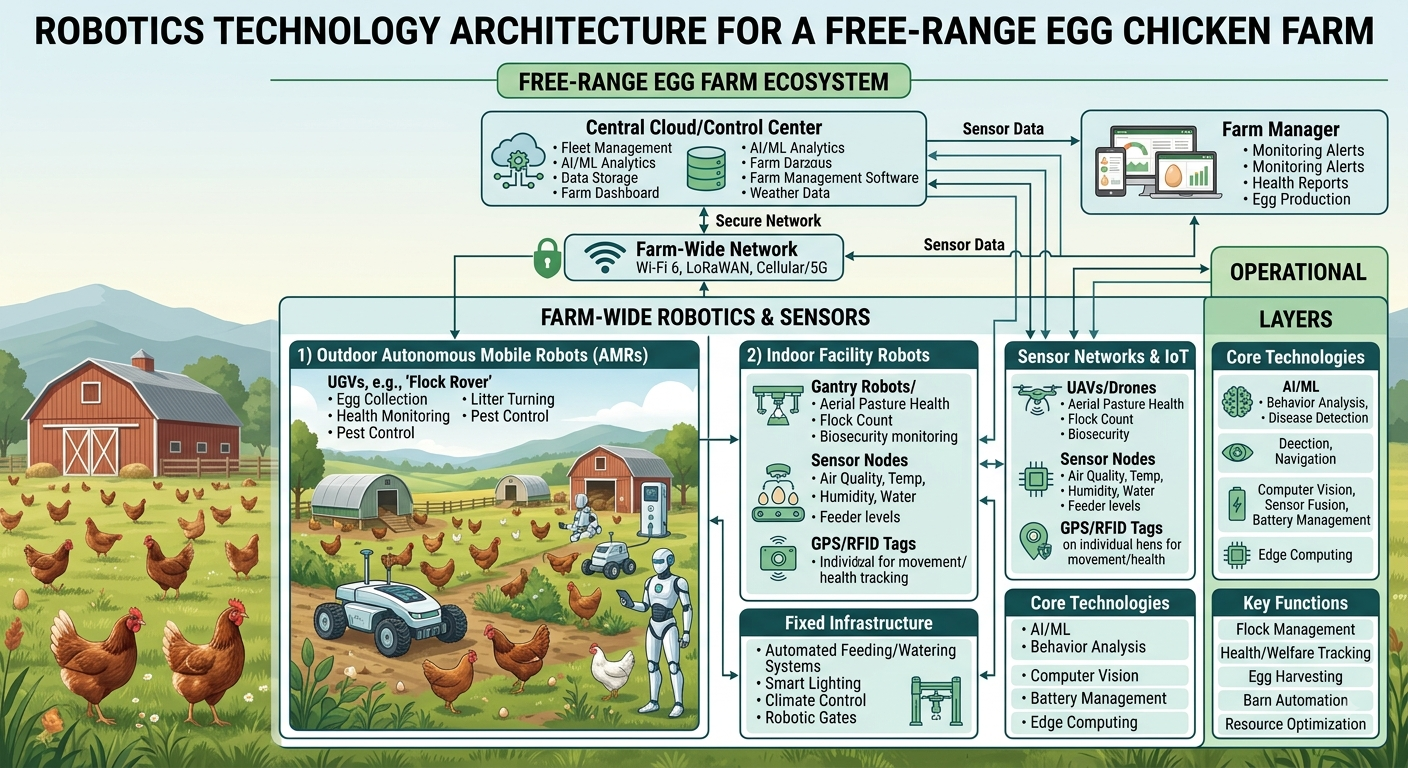
The modern free-range egg farm can be understood as a biological–digital–robotic ecosystem rather than simply a chicken house with automated equipment. The objective is to combine good animal husbandry with sensors, artificial intelligence (AI), robotics, automation, renewable energy, connectivity and farm-management software.
A properly designed system should not attempt to replace the farmer. Instead, robotics should handle repetitive monitoring and physical tasks while humans remain responsible for veterinary decisions, animal welfare, strategic management, maintenance and business decisions.
Research has already demonstrated the feasibility of mobile robots capable of detecting, locating and collecting eggs in free-range environments using computer vision. One experimental system reported egg-recognition rates of approximately 94.7–97.6% under its test conditions. (MDPI) Recent research is also moving toward integrated poultry-intelligence platforms combining cameras, audio, sensors, egg counting, forecasting and automated alerts. (arXiv)
1. Introduction
Free-range egg production presents a particularly interesting robotics challenge.
In a conventional automated poultry house, chickens occupy a relatively controlled environment. A free-range system is much more complex because hens can move between:
- the poultry house;
- nesting areas;
- feeding stations;
- drinking stations;
- shaded areas;
- outdoor pasture;
- vegetation;
- walking paths;
- fenced zones; and
- weather-exposed environments.
Consequently, the robotics architecture must operate in an environment that is dynamic, biological, unpredictable and partially outdoors.
The farm therefore becomes a distributed cyber-physical system:
Chickens → Sensors → Edge computers → AI → Farm software → Robots → Physical actions → New sensor data
This creates a continuous feedback loop.
2. The Core Architecture
A technologically advanced free-range farm can be organized into ten layers.
Layer 1 — Biological system
This is the most important layer.
It contains:
- hens;
- eggs;
- feed;
- water;
- vegetation;
- soil;
- insects and microorganisms;
- nesting behaviour;
- flock behaviour;
- environmental conditions.
Technology must serve this biological system rather than the other way around.
Layer 2 — Physical infrastructure
The farm requires:
- poultry houses;
- nesting facilities;
- feeders;
- drinkers;
- fencing;
- gates;
- shade structures;
- pasture;
- storage;
- egg-handling facilities;
- veterinary isolation facilities;
- maintenance areas.
Layer 3 — Sensor network
Sensors continuously measure conditions such as:
- temperature;
- humidity;
- light;
- water availability;
- feed levels;
- environmental conditions;
- equipment status;
- egg production;
- movement;
- sound;
- flock activity.
Layer 4 — Computer vision
Cameras can monitor:
- hens;
- eggs;
- nesting areas;
- entrances;
- feeding stations;
- drinking stations;
- unusual behaviour;
- obstacles;
- infrastructure.
Computer vision is particularly valuable because a robot cannot operate effectively without understanding its surroundings.
Layer 5 — Edge computing
Small computers located on the farm process information locally.
This reduces dependence on constant internet connectivity.
For example:
Camera → Edge computer → AI model → Detection → Robot decision
Instead of sending every video frame to a distant cloud server, the farm can process many events locally.
Layer 6 — Artificial intelligence
AI can analyse:
- egg production;
- flock behaviour;
- environmental patterns;
- equipment anomalies;
- movement patterns;
- production trends;
- unusual activity.
Machine-learning models have also been investigated for forecasting egg production in commercial free-range systems. (Refubium)
Layer 7 — Robotics
Robots become the physical workforce of the digital system.
Possible robots include:
- inspection robots;
- egg-collection robots;
- mobile monitoring robots;
- feed-monitoring robots;
- cleaning-support robots;
- autonomous transport vehicles;
- drone-based observation systems;
- robotic gate systems.
Not every farm needs all of these.
Layer 8 — Farm operating system
The farm needs a central software platform.
It should integrate:
Sensors + Cameras + AI + Robots + Production + Inventory + Alerts + Finance
This becomes the farm’s digital command centre.
Layer 9 — Human management
The farmer receives information through:
- computer;
- smartphone;
- tablet;
- control room;
- dashboards;
- alerts;
- reports.
The farmer can then make decisions based on real-time information.
Layer 10 — Business ecosystem
The final layer connects production with:
- egg grading;
- packaging;
- distribution;
- customers;
- retailers;
- accounting;
- inventory;
- logistics;
- traceability.
The result is a farm-to-market digital ecosystem.
3. Conceptual Architecture
                    SMART FREE-RANGE EGG FARM
                              │
             ┌────────────────┴────────────────┐
             │                                 │
       BIOLOGICAL SYSTEM                 DIGITAL SYSTEM
             │                                 │
       Hens + Eggs                         Sensors
       Feed + Water                        Cameras
       Pasture                             AI
       Environment                         Edge Computing
             │                                 │
             └───────────────┬─────────────────┘
                             │
                     FARM CONTROL PLATFORM
                             │
              ┌──────────────┼──────────────┐
              │              │              │
          Analytics       Alerts         Database
              │              │              │
              └──────────────┼──────────────┘
                             │
                         ROBOTICS
                             │
       ┌──────────┬──────────┼──────────┬──────────┐
       │          │          │          │          │
   Inspection   Egg       Transport   Cleaning   Monitoring
     Robot     Robot       Robot       Robot      Robot
       │          │          │          │          │
       └──────────┴──────────┼──────────┴──────────┘
                             │
                       HUMAN FARMER
                             │
                    Business Decisions
                             │
                       MARKET / CUSTOMER
4. The Robotic Egg-Collection System
One of the most attractive applications is autonomous egg collection.
Free-range hens may lay eggs in different locations, making manual collection labour-intensive.
Researchers have demonstrated a mobile robot concept that uses visual recognition to locate eggs, navigate toward them and collect them. (PubMed Central (PMC))
A commercial architecture could contain:
Camera → Egg detection → Position estimation → Navigation → Collection mechanism → Egg protection → Storage → Transfer
The robot would need to distinguish eggs from:
- stones;
- leaves;
- dirt;
- feathers;
- shadows;
- other objects.
This is a computer-vision problem.
5. Navigation Architecture
A free-range robot needs to know where it is.
Possible technologies include:
- cameras;
- GPS/GNSS;
- inertial sensors;
- wheel encoders;
- proximity sensors;
- depth sensors;
- mapping technology.
The navigation system can create a digital map:
              FARM DIGITAL MAP

     ┌─────────────────────────────┐
     │          PASTURE            │
     │                             │
     │   R1 → → → → → →           │
     │                             │
     │       [SHADE]               │
     │                             │
     │            [NESTING]        │
     │                 ↓           │
     │             [HOUSE]         │
     │                 ↓           │
     │             [EGG ROOM]      │
     │                             │
     └─────────────────────────────┘
The robot continuously compares its sensor information with the digital map.
6. Robot Safety Around Chickens
This is one of the most important design requirements.
A farm robot should be designed around the principle:
Animal safety > robot efficiency
The robot should detect obstacles and animals before moving into their path.
The system could have several levels of safety:
Level 1 — Detection
Detect an object.
Level 2 — Classification
Determine whether the object is:
- chicken;
- human;
- egg;
- infrastructure;
- obstacle.
Level 3 — Distance estimation
Determine how close the object is.
Level 4 — Decision
The robot decides whether to:
- continue;
- slow down;
- stop;
- change direction.
Level 5 — Human override
The operator can stop the robot remotely or locally.
7. Poultry-House Robotics
The poultry house can become an intelligent building.
Sensors can monitor environmental conditions while automated equipment manages routine operations.
A conceptual architecture is:
        POULTRY HOUSE
             │
 ┌───────────┼────────────┐
 │           │            │
Temperature Humidity     Light
 │           │            │
 └───────────┼────────────┘
             │
       EDGE COMPUTER
             │
            AI
             │
     ┌───────┼────────┐
     │       │        │
   Alert   Control   Record
     │       │        │
     └───────┼────────┘
             │
        FARM CLOUD
8. Smart Feeding Architecture
Feed management is a major component of poultry economics.
The system could monitor:
- feed inventory;
- feeder levels;
- feeding activity;
- equipment operation;
- consumption trends.
Instead of simply asking:
“How much feed is left?”
an intelligent system can ask:
“Is today’s feed consumption consistent with the flock’s historical pattern?”
That distinction is important.
AI transforms raw measurement into operational intelligence.
9. Smart Water System
Water infrastructure can be connected to sensors.
The system could monitor:
- reservoir level;
- pump operation;
- flow;
- pressure;
- abnormal consumption;
- equipment faults.
A simple architecture:
Reservoir → Pump → Main pipe → Distribution → Drinkers → Sensors → Controller
An abnormal pattern could generate an alert.
For example:
Expected water consumption ≠ measured consumption → investigate
The system should not automatically assume the cause; a human or qualified animal-health professional should investigate unusual biological changes.
10. Computer Vision as the Farm’s Eyes
Cameras become distributed sensory organs.
Strategically positioned cameras can monitor:
Nesting areas
Detect:
- eggs;
- occupancy;
- nesting activity.
Feeding areas
Monitor:
- flock activity;
- access;
- equipment condition.
Outdoor areas
Monitor:
- flock distribution;
- gates;
- fencing;
- obstacles.
Farm perimeter
Monitor:
- infrastructure;
- unauthorized access;
- environmental events.
The objective is not simply to record video.
The objective is:
Video → Information → Decision
11. Audio Intelligence
Chickens produce acoustic information.
Microphones can potentially contribute to monitoring:
- flock activity;
- unusual sounds;
- environmental events;
- behavioural changes.
Future poultry systems are likely to combine:
Video + Audio + Environmental Sensors + Production Data
rather than depending on a single sensor.
Research into integrated poultry intelligence is already exploring multimodal monitoring and analytics. (arXiv)
12. The Farm Edge-Computing Architecture
A sophisticated farm should not depend entirely on the internet.
The architecture should therefore contain three computing levels.
Edge
Located physically on the farm.
Used for:
- immediate detection;
- robot navigation;
- safety decisions;
- sensor processing.
Local server
Used for:
- databases;
- farm analytics;
- historical records;
- dashboards.
Cloud
Used for:
- long-term storage;
- advanced analytics;
- model training;
- remote access;
- multi-farm comparison.
Therefore:
SENSORS
   ↓
EDGE COMPUTING
   ↓
LOCAL FARM SERVER
   ↓
CLOUD PLATFORM
   ↓
MANAGEMENT DASHBOARD
13. Digital Twin of the Farm
A particularly advanced architecture would create a digital twin.
A digital twin is a continuously updated digital representation of the physical farm.
It could contain:
- number of hens;
- pasture zones;
- poultry houses;
- nesting areas;
- feed inventory;
- water infrastructure;
- robot locations;
- egg production;
- environmental measurements;
- maintenance records.
The farmer could therefore see a virtual representation of the farm.
PHYSICAL FARM
      ↕
DIGITAL TWIN
      ↕
AI ANALYTICS
      ↕
PREDICTION
      ↕
FARM DECISION
14. Autonomous Robot Fleet
Rather than designing one enormous robot, a future farm could use several specialized robots.
| Robot | Primary function |
|---|---|
| Egg robot | Locate and collect eggs |
| Inspection robot | Inspect farm infrastructure |
| Monitoring rover | Observe flock/environment |
| Transport robot | Move materials |
| Cleaning robot | Assist with routine cleaning |
| Drone | Aerial observation |
| Fixed robotic system | Automate stationary processes |
This is known as a robot fleet architecture.
The robots can share information.
For example:
Robot A discovers an obstacle → Farm network records obstacle → Robot B receives updated map.
15. Drone Integration
Drones could provide an aerial perspective of the farm.
Potential applications include:
- pasture observation;
- fence inspection;
- infrastructure inspection;
- environmental mapping;
- identifying areas requiring human attention.
However, drones should complement ground-based systems rather than replace them.
The farm therefore becomes a multi-robot environment:
Drone + Ground Robot + Fixed Sensors + Cameras + Human
Agricultural robotics research increasingly explores cooperation between aerial and ground robotic systems. (arXiv)
16. AI Farm Brain
The central AI platform could be divided into specialized modules.
Production AI
Studies egg-production patterns.
Vision AI
Interprets images.
Behaviour AI
Studies flock activity.
Predictive AI
Forecasts future production and resource requirements.
Maintenance AI
Identifies equipment abnormalities.
Logistics AI
Coordinates egg movement and inventory.
Business AI
Analyses:
- production;
- costs;
- inventory;
- sales;
- profitability.
This produces a layered Farm Intelligence System.
17. Robotics Communication Network
The farm should have reliable connectivity.
Possible communication architecture:
                   CLOUD
                     │
                  INTERNET
                     │
              FARM NETWORK
                     │
       ┌─────────────┼─────────────┐
       │             │             │
     Wi-Fi        Local LAN     IoT Network
       │             │             │
   Cameras       Computers      Sensors
       │             │             │
       └─────────────┼─────────────┘
                     │
                  ROBOTS
For a large property, a mixture of technologies may be required.
The important principle is network redundancy.
A robot performing a safety-critical operation should not depend on one communication pathway.
18. Energy Architecture
Robotics increases electricity demand.
A modern free-range farm could integrate:
Solar → Battery → Farm Microgrid → Computers + Sensors + Robots + Pumps
Potential components include:
- solar panels;
- battery storage;
- grid connection;
- backup power;
- smart energy management.
This is particularly useful for remote agricultural properties.
The energy-management system could prioritize essential services during an outage.
19. Biosecurity Architecture
Automation should not undermine biosecurity.
Robots moving between zones need careful design.
The farm could establish:
Clean Zone → Controlled Zone → Outdoor Zone → Service Zone
Robotic equipment should be designed so that contamination risks can be controlled.
Humans also remain essential because biosecurity involves management practices, cleaning, quarantine and veterinary protocols—not merely technology.
20. Free-Range Design Must Remain Genuinely Free-Range
Technology should never be used to create the appearance of free-range production while restricting the animals.
South African poultry guidance describes free-range systems in terms of access to outdoor space, appropriate stocking conditions, vegetation, shade and protection. (South Africa Online)
South Africa’s egg grading, packing and marking requirements also need to be considered when designing the commercial operation. (Government of South Africa)
Therefore:
Robotics must adapt to the free-range system—not eliminate the characteristics that make the system free-range.
21. Animal Welfare as a Technology KPI
Traditional farms often measure:
- eggs/day;
- feed consumption;
- mortality;
- revenue.
The robotic farm should additionally measure welfare indicators.
A future dashboard could display:
FARM HEALTH DASHBOARD

Egg Production        ██████████
Feed Consumption      ████████
Water Availability    ██████████
Environmental Status  █████████
Flock Activity        █████████
Equipment Status      ██████████
Welfare Indicators    █████████
The objective is to make animal welfare a measurable management variable.
22. Egg Traceability
Every production batch could receive a digital identity.
For example:
Farm → House/Zone → Collection → Grading → Packing → Distribution
This creates traceability.
A digital record might contain:
- production date;
- collection location;
- batch number;
- grading information;
- packing information;
- distribution information.
This can improve quality control and accountability.
23. Smart Egg-Grading Facility
After collection, eggs enter the processing system.
A future automated line could include:
EGGS
 ↓
Collection
 ↓
Inspection
 ↓
Cleaning/handling according to applicable standards
 ↓
Computer Vision
 ↓
Weight Measurement
 ↓
Quality Classification
 ↓
Grading
 ↓
Packaging
 ↓
Labelling
 ↓
Inventory
 ↓
Distribution
Computer vision could assist with identifying visible defects, while weighing and other sensors provide additional classification information.
24. Farm Management Dashboard
The farmer should not have to examine hundreds of individual sensors.
The system should convert complexity into a simple dashboard.
Example
Farm Status: NORMAL
- 🐔 Flock: Normal
- 🥚 Egg production: Normal
- 💧 Water: Normal
- 🌾 Feed: Normal
- 🌡 Environment: Normal
- 🤖 Robots: 5/5 operational
- 🔋 Energy: 82%
- 📦 Egg inventory: 1,240
- ⚠ Alerts: 1 requiring inspection
The objective is decision compression:
Thousands of sensor readings → a small number of useful decisions.
25. Human-in-the-Loop Architecture
A completely autonomous farm is not necessarily the best farm.
The preferred architecture is:
Human + AI + Robotics
rather than:
AI + Robotics without humans
The AI identifies patterns.
The robot performs selected physical tasks.
The farmer makes strategic decisions.
Veterinary professionals make animal-health decisions where appropriate.
Technicians maintain the machinery.
Managers control the business.
This creates a new agricultural workforce.
26. New Skills Required
The robotic farm creates demand for people who understand:
- poultry science;
- agriculture;
- robotics;
- electronics;
- mechanical systems;
- computer networks;
- AI;
- data analysis;
- cybersecurity;
- renewable energy;
- software;
- business management.
The modern farmer therefore increasingly becomes a systems manager.
27. Cybersecurity
A connected farm is also a cyber-physical system.
Security should protect:
- farm accounts;
- cameras;
- robot controls;
- databases;
- customer information;
- production records;
- network infrastructure.
Important principles include:
- strong authentication;
- role-based access;
- network segmentation;
- software updates;
- backups;
- audit logs;
- secure remote access.
A farm robot should never be allowed to become an uncontrolled entry point into the entire farm network.
28. Maintenance Architecture
Robots require maintenance.
The system should monitor:
- battery health;
- motor performance;
- wheel condition;
- sensor condition;
- mechanical wear;
- software status;
- charging cycles.
This enables predictive maintenance.
Instead of:
Machine breaks → repair
the goal becomes:
Machine behaviour changes → AI detects anomaly → technician investigates → planned maintenance
That can reduce unexpected downtime.
29. Economic Architecture
Robotics should not be purchased simply because it is technologically impressive.
Every robot should answer five questions:
- What problem does it solve?
- How much labour or time does it save?
- Does it improve productivity?
- Does it improve quality or welfare?
- Does the investment generate sufficient economic value?
The appropriate metric is therefore:
Technology Cost → Operational Benefit → Productivity → Revenue → Return on Investment
For smaller farms, modular automation may be more sensible than attempting full autonomy immediately.
30. Recommended Development Roadmap
A practical farm should develop progressively.
Phase 1 — Smart infrastructure
Install:
- reliable electricity;
- water monitoring;
- network;
- cameras;
- basic sensors;
- farm database.
Phase 2 — Digital management
Introduce:
- production records;
- inventory management;
- mobile dashboard;
- automated alerts.
Phase 3 — AI
Introduce:
- computer vision;
- production forecasting;
- anomaly detection;
- environmental analytics.
Phase 4 — Robotics
Introduce:
- inspection robot;
- egg-collection assistance;
- autonomous transport.
Phase 5 — Robot fleet
Integrate:
- multiple robots;
- central fleet management;
- autonomous navigation.
Phase 6 — Digital twin
Create:
- real-time farm model;
- predictive analytics;
- simulation.
Phase 7 — Semi-autonomous farm
The system begins coordinating:
Sensors → AI → Robots → Farm operations
while humans supervise.
31. Example Architecture for a 3,000 m² Farm
For a relatively small farm, the architecture should be deliberately modular rather than excessively expensive.
A possible conceptual arrangement is:
             3,000 m² SMART FARM
                     │
        ┌────────────┼────────────┐
        │            │            │
     POULTRY       PASTURE      SERVICES
      HOUSE          AREA          AREA
        │            │            │
    Cameras       Robot        Water
    Sensors       Paths        System
        │            │            │
        └────────────┼────────────┘
                     │
                FARM SERVER
                     │
                 AI ENGINE
                     │
          ┌──────────┼──────────┐
          │          │          │
       Dashboard   Robots    Database
          │          │          │
          └──────────┼──────────┘
                     │
                  FARMER
This architecture can later expand to a much larger commercial operation.
32. The Ultimate Vision: Farm as an Operating System
The most important conceptual change is to stop thinking of the farm as a collection of machines.
Instead, think of it as an operating system.
Biological layer
Chicken → Egg → Flock
Physical layer
Buildings → Pasture → Water → Feed → Energy
Digital layer
Sensors → Cameras → Data → AI
Robotic layer
Mobility → Collection → Inspection → Transport
Intelligence layer
Prediction → Optimisation → Decision support
Human layer
Farmer → Veterinarian → Technician → Manager
Commercial layer
Egg → Packaging → Distribution → Customer
Together:
                 SMART FARM OPERATING SYSTEM

                         HUMAN
                           │
                     FARM AI BRAIN
                           │
          ┌────────────────┼────────────────┐
          │                │                │
       ROBOTICS         SENSORS          SOFTWARE
          │                │                │
          └────────────────┼────────────────┘
                           │
                  PHYSICAL FARM
                           │
             ┌─────────────┼─────────────┐
             │             │             │
           HENS          EGGS          PASTURE
             │             │             │
             └─────────────┼─────────────┘
                           │
                     MARKET SYSTEM
33. Strategic Significance for South Africa
For South Africa, this architecture has significance beyond producing eggs.
It creates a platform for developing local capabilities in:
- agricultural robotics;
- AI;
- electronics;
- software;
- mechanical engineering;
- renewable energy;
- food processing;
- logistics;
- data science;
- rural entrepreneurship.
South Africa’s poultry sector can therefore become part of the broader Industry 4.0 → Agriculture 4.0 transition.
Rather than importing an entire foreign automated farm, a modular architecture could allow local businesses, universities, engineers and agricultural enterprises to develop individual components.
34. Major Challenges
Robotic free-range farming still faces significant challenges.
1. Uneven outdoor terrain
Robots must operate on grass, soil and changing surfaces.
2. Weather
Rain, dust, heat and sunlight affect sensors and electronics.
3. Animal interaction
Chickens are unpredictable moving objects.
4. Egg diversity
Eggs can differ in colour, size, position and cleanliness.
5. Cost
Sophisticated robotics can be expensive.
6. Maintenance
Agricultural environments are demanding for electronics and mechanical systems.
7. Connectivity
Remote farms may have unreliable network infrastructure.
8. AI reliability
A model trained in one environment may not perform identically in another.
9. Animal welfare
Automation must not compromise the natural behaviour and welfare objectives of free-range production.
10. Skills
The farm requires people capable of managing both biological and technological systems.
These challenges explain why current poultry robotics research describes the field as promising but still containing substantial technical and operational challenges. (arXiv)
35. Final Strategic Model
The ideal architecture can be summarized as:
FREE-RANGE CHICKENS
↓
SMART FARM INFRASTRUCTURE
↓
IoT SENSORS + CAMERAS
↓
EDGE COMPUTING
↓
ARTIFICIAL INTELLIGENCE
↓
DIGITAL FARM PLATFORM
↓
ROBOT FLEET
↓
AUTOMATED EGG COLLECTION & LOGISTICS
↓
QUALITY CONTROL
↓
DIGITAL TRACEABILITY
↓
MARKET
↓
CUSTOMER
The fundamental principle is:
Automate the repetitive, measure the measurable, predict what can be predicted, and keep humans responsible for biological, ethical and strategic decisions.
A robotic free-range egg farm is therefore not simply a farm containing robots. It is a cyber-physical agricultural ecosystem in which biological production, mechanical automation, artificial intelligence, energy, communications, data and human expertise operate as one integrated architecture.
The most realistic near-term model is human-supervised automation, rather than a completely autonomous farm. Research already demonstrates individual components such as robotic egg collection and AI-based poultry monitoring, while the larger opportunity is to integrate those components into one farm operating system. (PubMed Central (PMC))
For a South African enterprise, the strongest long-term strategy would therefore be to build the system modularly: start with smart sensing and farm management, add computer vision and AI, then introduce specialised robots as each application demonstrates a clear economic and welfare benefit.


Be First to Comment