
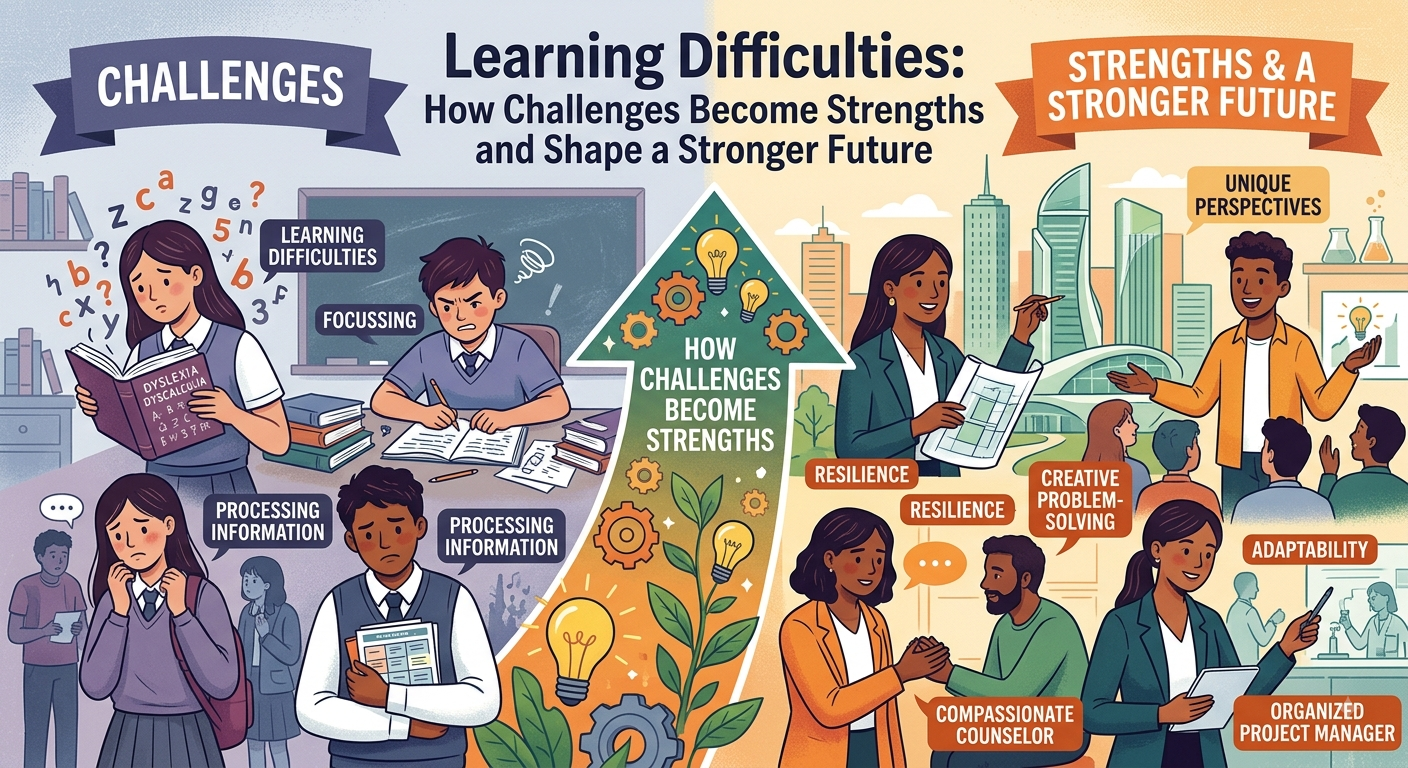
A Comprehensive Thesis on Learning, Resilience, Neurodiversity, Education and Human Potential
Abstract
Learning is one of the most fundamental processes through which human beings develop knowledge, skills, independence and participation in society. Yet learning does not occur in exactly the same way, at the same speed, or through the same methods for every person.
Some learners experience persistent difficulties with reading, writing, mathematics, attention, memory, language processing, organization or other aspects of academic learning. These challenges may be associated with conditions such as dyslexia, dyscalculia, dysgraphia, attention-related difficulties and other learning or neurodevelopmental differences.
A learning difficulty, however, should not be confused with low intelligence, lack of ambition or lack of future potential. A person can experience significant difficulty in one area while demonstrating considerable ability in another.
Modern research is increasingly examining the concept of resilience: how individuals facing learning difficulties develop determination, self-efficacy, perseverance, self-advocacy and supportive relationships. A 2025 scoping review of 51 studies identified these characteristics, together with supportive communities and environmental adaptations, as important resources associated with resilience among people with learning disabilities.
The central argument of this thesis is therefore:
Learning difficulties can create genuine obstacles, but with appropriate identification, teaching, technology, social support and opportunity, those obstacles do not have to determine a person’s future.
The goal should not be to romanticize difficulty or claim that every learning disability automatically produces special talents. Rather, society should recognize difficulties accurately while creating conditions in which people can discover, develop and contribute their strengths.
1. Introduction
Education is often organized around an implicit assumption: students of approximately the same age should be able to absorb information through approximately the same instructional system.
Reality is considerably more complex.
Human beings differ in:
- attention;
- memory;
- language processing;
- reading development;
- mathematical reasoning;
- visual processing;
- motor coordination;
- executive functioning;
- communication;
- motivation;
- prior knowledge;
- learning speed;
- emotional regulation;
- interests;
- environmental circumstances.
Consequently, educational difficulty cannot always be explained simply by saying that a student is “lazy” or “not intelligent.”
A learner may understand a complex scientific concept but struggle to read a textbook quickly. Another may understand mathematics conceptually but have difficulty recalling multiplication facts. Someone else may have excellent technical reasoning but struggle to organize a long written assignment.
This distinction is fundamental.
Difficulty in performing a particular task is not necessarily equivalent to a lack of intellectual capacity.
2. What Are Learning Difficulties?
The term “learning difficulties” can refer broadly to persistent challenges that interfere with acquiring or applying academic skills.
Specific learning disorders commonly involve areas such as:
Reading
Difficulty may occur with:
- accurate word recognition;
- reading fluency;
- spelling;
- decoding;
- reading comprehension.
Dyslexia is particularly associated with difficulties involving reading and related language processes. A revised definition of dyslexia was published in 2026 following a 2025 revision process by the International Dyslexia Association.
Writing
Some learners experience difficulty with:
- handwriting;
- spelling;
- written expression;
- organizing ideas;
- producing written work efficiently.
Mathematics
Difficulties can involve:
- number sense;
- arithmetic;
- mathematical facts;
- calculation;
- mathematical reasoning.
Dyscalculia is commonly used to describe significant mathematical learning difficulties.
Attention and executive functioning
Some learners struggle with:
- maintaining attention;
- planning;
- starting tasks;
- managing time;
- remembering instructions;
- organizing materials;
- controlling distractions.
Attention-related difficulties can coexist with specific learning disabilities, and recent research emphasizes the importance of considering multiple domains rather than treating academic difficulties as isolated problems.
3. Learning Difficulty Is Not the Same as Low Intelligence
One of the most damaging misconceptions is:
“If someone struggles academically, that person must not be intelligent.”
This conclusion is scientifically and educationally unsound.
Human capability is multidimensional.
A person may possess strong:
- spatial reasoning;
- mechanical reasoning;
- artistic ability;
- entrepreneurial thinking;
- verbal communication;
- practical intelligence;
- interpersonal skills;
- problem-solving ability;
- technological ability;
- creativity;
- leadership;
- persistence.
Traditional examinations measure only a subset of these capabilities.
Therefore, education should avoid reducing a human being to a single examination score.
4. The Psychological Consequences of Learning Difficulties
Learning difficulties can become particularly damaging when the educational environment interprets difficulty as personal failure.
A repeating cycle can develop:
Difficulty → poor performance → criticism → reduced confidence → avoidance → less practice → further difficulty
The opposite cycle is also possible:
Difficulty → appropriate support → successful experience → confidence → persistence → skill development
This distinction demonstrates why educational intervention matters.
Learning difficulty itself is only part of the problem.
The surrounding environment can either amplify the difficulty or help the learner manage it.
Research on dyslexia, for example, documents numerous school-related challenges that can affect students’ educational experiences.
5. From Weakness to Strength: The Resilience Principle
The phrase “challenges become strengths” requires careful interpretation.
It does not mean:
- every disability produces a special talent;
- suffering is automatically beneficial;
- students should simply overcome difficulties without assistance;
- educational institutions should ignore disability because adversity builds character.
Instead, the principle means that people can develop valuable psychological and practical capabilities while learning to navigate challenges.
Research on resilience among individuals with learning disabilities identifies several important strengths, including:
- determination;
- perseverance;
- self-efficacy;
- self-advocacy;
- supportive relationships;
- meaning-making;
- mentoring;
- appropriate environmental adaptations.
These are not magical properties of disability.
They are capabilities that can be developed through experience, education, support and opportunity.
6. Determination
A learner who repeatedly encounters an academic obstacle may eventually develop a powerful understanding:
“I have not mastered this yet.”
That mindset is different from:
“I am incapable.”
Determination can encourage a learner to:
- identify the difficulty;
- seek assistance;
- try alternative methods;
- practice repeatedly;
- monitor progress;
- learn from mistakes;
- continue despite temporary failure.
This can become valuable far beyond school.
The same persistence can later be applied to:
- engineering;
- entrepreneurship;
- scientific research;
- programming;
- agriculture;
- manufacturing;
- business;
- creative work.
7. Self-Efficacy
Self-efficacy refers broadly to a person’s belief that they can successfully perform tasks or overcome challenges.
For a learner who has repeatedly experienced failure, developing self-efficacy can be transformative.
Instead of:
“I cannot learn.”
the learner begins to think:
“I can learn, but I may need a different method.”
That is a major psychological transition.
The objective is not unrealistic confidence.
It is evidence-based confidence built through achievable progress.
8. Self-Advocacy
One of the most important strengths identified in resilience research is self-advocacy.
A student who understands their learning needs can eventually become capable of explaining:
- what they find difficult;
- which teaching methods help;
- what technology assists them;
- when additional time is useful;
- when instructions need clarification;
- what their strengths are.
This skill becomes increasingly important in higher education and employment.
A mature learner should eventually become an active participant in designing their own learning environment.
9. The Importance of Teachers
A teacher can either become part of the problem or part of the solution.
Effective teaching for diverse learners requires flexibility.
Useful approaches can include:
- breaking complex tasks into smaller steps;
- providing clear instructions;
- using examples;
- combining visual and verbal explanations;
- checking understanding;
- allowing appropriate practice;
- providing constructive feedback;
- using assistive technologies;
- recognizing individual progress.
The objective is not to reduce educational standards.
It is to improve access to the learning process.
10. Multisensory Learning
Some learners benefit from receiving information through multiple channels.
For example:
Visual + auditory + practical experience
may be more effective than relying exclusively on:
Text + lecture + examination.
A useful lesson might therefore combine:
- diagrams;
- spoken explanations;
- demonstrations;
- physical models;
- simulations;
- interactive exercises;
- written summaries.
Evidence from specialized educational settings illustrates how multisensory approaches can help some students with dyslexia and related challenges engage with learning.
However, educational methods should be individualized rather than assuming that one technique works for every person.
11. Technology as an Equalizer
Technology has transformed the possibilities available to learners.
Modern educational technologies can provide:
Text-to-speech
Written information can be converted into spoken language.
Speech-to-text
Students can dictate ideas instead of relying exclusively on handwriting or typing.
Spell checking
Software can identify and suggest corrections for spelling errors.
Digital organization
Calendars, reminders and task-management systems can support executive functioning.
Interactive mathematics
Digital visualization can make abstract mathematical relationships easier to explore.
Educational simulations
Science, engineering and technical concepts can be demonstrated interactively.
Artificial intelligence
AI systems can potentially provide:
- explanations at different levels;
- practice questions;
- summaries;
- alternative explanations;
- structured learning exercises;
- feedback;
- personalized tutoring.
The important principle is that technology should support learning rather than replace thinking.
12. Artificial Intelligence and the Future of Inclusive Education
AI could become one of the most significant educational technologies of the twenty-first century.
A future learning platform could build an individualized learning profile containing:
- current knowledge;
- areas of difficulty;
- preferred explanation formats;
- learning progress;
- common mistakes;
- vocabulary development;
- mathematics performance;
- reading performance.
The AI tutor could then dynamically adjust instruction.
For example:
Student struggles with fractions
↓
AI identifies the specific misconception
↓
AI creates a visual explanation
↓
Student practices with simple examples
↓
AI detects improvement
↓
Difficulty gradually increases
↓
Student demonstrates mastery
This creates a personalized learning loop.
13. Neurodiversity and Education
Neurodiversity describes the idea that human neurological development varies across individuals and that neurological differences should be considered within the broader diversity of human beings.
The concept should not be interpreted as meaning that every neurological difference is easy or harmless.
Some conditions produce substantial difficulties and require substantial support.
The balanced position is:
Recognize the disability, recognize the person, and recognize the potential.
Recent research in computing education, for example, emphasizes the importance of inclusive approaches for students with neurodivergent characteristics, while also noting that evidence about specific educational interventions remains an evolving research field.
14. Discovering Hidden Strengths
A student who struggles with conventional academic tasks may demonstrate extraordinary ability in another environment.
Potential strengths can emerge through:
Practical projects
Building, repairing and experimenting can reveal technical reasoning.
Art and design
Visual creativity can reveal spatial and conceptual abilities.
Programming
Logical problem-solving can emerge through computational tasks.
Entrepreneurship
Some learners may excel when allowed to identify problems and create solutions.
Agriculture
Practical observation and biological understanding can develop through hands-on work.
Engineering
Mechanical systems can provide an alternative pathway for demonstrating understanding.
Digital media
Video, animation, design and interactive technologies provide additional forms of expression.
The education system should therefore provide multiple pathways through which students can demonstrate competence.
15. The Danger of Labeling
Labels can be useful when they help identify support needs.
They become harmful when they become identities that restrict expectations.
For example:
“You have a learning difficulty.”
should never become:
“Therefore, you cannot succeed.”
A diagnosis or educational classification should function as a tool for understanding and support—not a prediction of someone’s entire future.
16. The Family’s Role
Families are often the first environment in which a child’s educational identity develops.
Constructive family support includes:
- listening;
- encouraging questions;
- recognizing progress;
- celebrating effort;
- avoiding humiliating comparisons;
- communicating with teachers;
- establishing routines;
- helping children discover interests.
A child should not constantly hear:
“You are behind.”
They should also hear:
“Let’s find out how you learn best.”
17. Peer Relationships and Social Support
Social isolation can compound educational difficulties.
A supportive peer network can provide:
- encouragement;
- collaboration;
- shared learning;
- friendship;
- emotional support;
- opportunities to explain concepts to others.
Research on resilience emphasizes the importance of social networks that understand the effects of learning disabilities.
This suggests that inclusion is not merely an administrative educational policy.
It is also a social system.
18. From Student to Mentor
One of the most interesting pathways identified in resilience research is meaning-making through helping others.
A person who once struggled may eventually become:
- a tutor;
- mentor;
- teacher;
- coach;
- software developer;
- educational entrepreneur;
- disability advocate;
- researcher.
The experience of overcoming an obstacle can create a powerful desire to make the pathway easier for the next generation.
This creates a positive chain:
Challenge → learning → adaptation → achievement → mentorship → social benefit
19. Learning Difficulties and Employment
The importance of learning support does not end when school finishes.
Modern workplaces increasingly require:
- continuous learning;
- digital literacy;
- communication;
- problem-solving;
- adaptability;
- collaboration;
- technical skills.
Therefore, education should prepare learners not simply to pass examinations but to become lifelong learners.
A person who learns how to overcome academic difficulty can develop valuable workplace characteristics such as persistence, problem-solving and self-advocacy.
20. The Digital Economy Creates New Opportunities
The digital economy provides alternative ways to learn and demonstrate competence.
Potential fields include:
- software development;
- cybersecurity;
- cloud engineering;
- data engineering;
- UI design;
- UX design;
- animation;
- digital marketing;
- electronics;
- robotics;
- artificial intelligence;
- technical support;
- digital entrepreneurship.
This is particularly important because the modern economy increasingly values demonstrated skills alongside traditional academic credentials.
21. Learning Difficulties in Africa
The issue has particular importance in Africa.
Educational systems across the continent face challenges involving:
- unequal resources;
- teacher shortages;
- large classrooms;
- limited specialist services;
- technology access;
- language diversity;
- poverty;
- transport;
- infrastructure;
- educational inequality.
These factors can make learning difficulties harder to identify and support.
Research from Johannesburg published in 2025 illustrates the importance of resilience among learners facing substantial educational adversity.
Therefore, African education policy should combine:
access + identification + teacher training + technology + inclusion + vocational pathways + family support.
22. South Africa: A Strategic Opportunity
For South Africa, inclusive education should be understood as part of national human-capital development.
The country requires large numbers of people capable of working in:
- engineering;
- manufacturing;
- mining technology;
- agriculture;
- medicine;
- software;
- telecommunications;
- energy;
- construction;
- logistics;
- finance;
- science;
- artificial intelligence.
If educational difficulties cause capable young people to disengage from learning, the country loses potential human capital.
Consequently, improving educational support is not merely a social-service objective.
It is an economic-development strategy.
23. A New Educational Architecture
A future-oriented education system should move away from a single pathway.
Instead, imagine an educational architecture with multiple pathways:
Pathway A — Academic
Mathematics, science, languages, humanities and university preparation.
Pathway B — Technical
Engineering, electronics, mechanics, construction and manufacturing.
Pathway C — Digital
Programming, AI, cybersecurity, data and cloud technologies.
Pathway D — Creative
Design, art, animation, media and communication.
Pathway E — Entrepreneurial
Business creation, finance, marketing and innovation.
Pathway F — Practical
Agriculture, food production, logistics and skilled trades.
A learner could move between pathways as abilities and interests become clearer.
24. The Role of Assessment
Traditional examinations are useful but incomplete.
A modern assessment system could evaluate:
- knowledge;
- practical ability;
- projects;
- problem-solving;
- creativity;
- communication;
- teamwork;
- technical competence;
- long-term improvement.
Digital portfolios could allow students to demonstrate what they can actually build or accomplish.
For example, a student interested in robotics could demonstrate competence through a functioning robot rather than relying entirely on written examinations.
25. Universal Design for Learning
A future education system should attempt to make learning accessible from the beginning rather than treating every accommodation as an exception.
This means providing multiple ways to:
Engage
Students can interact with material through different activities.
Represent information
Information can be presented through:
- text;
- images;
- audio;
- video;
- demonstrations;
- simulations.
Express knowledge
Students can demonstrate understanding through:
- writing;
- speaking;
- projects;
- diagrams;
- presentations;
- practical demonstrations.
The fundamental objective is flexibility without lowering intellectual standards.
26. The Teacher-AI Partnership
AI should not replace teachers.
The stronger model is:
Teacher + AI + student + family + learning technology
The teacher provides:
- human judgment;
- emotional understanding;
- classroom leadership;
- social development;
- ethical guidance.
AI can provide:
- rapid feedback;
- personalized exercises;
- explanations;
- progress tracking;
- additional practice.
The student remains the central participant.
27. A Learning Difficulty Support Framework
A comprehensive support system can follow seven stages.
Stage 1 — Observe
Identify persistent difficulties.
Stage 2 — Understand
Determine what specific skills are affected.
Stage 3 — Assess
Use appropriate educational or professional assessment when necessary.
Stage 4 — Adapt
Modify teaching methods and learning environments.
Stage 5 — Practice
Provide structured opportunities for improvement.
Stage 6 — Monitor
Measure progress rather than relying on assumptions.
Stage 7 — Empower
Teach the learner to understand and manage their own learning.
This transforms support from a passive service into a process of developing independence.
28. What Schools Should Avoid
Schools should avoid:
- humiliating students;
- assuming laziness;
- excessive comparison;
- public ranking;
- ignoring persistent difficulties;
- relying exclusively on one teaching method;
- defining children entirely by test scores;
- lowering expectations unnecessarily;
- treating accommodations as unfair advantages.
Support should provide equitable access, not artificial superiority.
29. What Students Can Learn From Difficulty
Learning difficulties can teach important life lessons when appropriate support exists.
A learner may discover:
Patience
Mastery can take time.
Persistence
Progress may require repeated attempts.
Self-knowledge
The learner discovers how they work best.
Adaptability
Different problems require different approaches.
Humility
Everyone has areas where they need assistance.
Empathy
Personal difficulty can increase understanding of other people’s struggles.
Independence
The learner gradually becomes capable of managing their own learning.
These qualities can become valuable throughout adulthood.
30. The Difference Between Romanticizing Difficulty and Recognizing Strength
This distinction is essential.
It would be irresponsible to say:
“Learning disabilities are good because they make people stronger.”
Learning disabilities can cause real difficulties and can negatively affect educational and employment outcomes when appropriate support is unavailable. Research explicitly documents these risks.
A more accurate statement is:
“People experiencing learning difficulties can develop significant strengths and resilience, particularly when they receive appropriate support and opportunities.”
This position respects both the reality of disability and the potential of the individual.
31. A Future Model of Education
Imagine an education system in which every student receives an evolving digital learning profile.
The system records:
Knowledge
↓
Skills
↓
Strengths
↓
Difficulties
↓
Learning preferences
↓
Progress
↓
Career interests
↓
Recommended learning opportunities
Such a system could help identify potential much earlier.
Instead of asking:
“Why is this student failing?”
the system would ask:
“What is preventing this student from demonstrating what they know?”
That is a fundamentally different philosophy.
32. From Deficit Model to Development Model
The traditional deficit model asks:
What is wrong with the learner?
The development model asks:
What does the learner need to develop?
The difference is profound.
The first focuses primarily on limitation.
The second focuses on:
- capability;
- development;
- adaptation;
- opportunity;
- progress.
A modern education system should understand both.
33. Learning Difficulties and Human Innovation
Many technological advances originated from people confronting difficult problems.
Human progress itself follows a similar pattern:
Problem → investigation → experimentation → failure → adaptation → innovation
The same principle can operate at the individual level.
A learner encounters:
Difficulty → strategy → practice → adaptation → mastery
This does not mean every difficulty produces innovation.
It means that human beings can transform obstacles into opportunities for learning when the right environment exists.
34. The Stronger Future
The future should not be built around eliminating every difference between learners.
It should be built around enabling different learners to contribute.
A strong society needs:
- analytical thinkers;
- practical problem-solvers;
- engineers;
- artists;
- scientists;
- programmers;
- entrepreneurs;
- communicators;
- technicians;
- researchers;
- caregivers;
- designers;
- builders.
Human civilization advances because different capabilities interact.
35. Core Principles for a Better Education System
A future-oriented learning system should follow ten principles:
- Every learner deserves dignity.
- Learning difficulty does not automatically indicate low intelligence.
- Early identification matters.
- Teaching should be adaptable.
- Technology should improve accessibility.
- Families should be partners in education.
- Students should learn self-advocacy.
- Assessment should measure multiple forms of competence.
- Schools should develop strengths as well as remediate difficulties.
- Educational success should ultimately produce independence and meaningful participation in society.
36. Conclusion
Learning difficulties are among the most misunderstood challenges in education.
A learner may struggle with reading while possessing excellent spatial reasoning. Another may experience difficulty with mathematics while demonstrating outstanding artistic ability. Someone may struggle with written expression while possessing exceptional practical intelligence.
The correct response is neither to deny the difficulty nor to define the person by it.
The correct response is to understand the difficulty, provide appropriate support, develop effective strategies, identify strengths and create opportunities for meaningful achievement.
Current resilience research provides an important foundation for this approach. Determination, perseverance, self-efficacy, self-advocacy, supportive relationships and appropriate environmental modifications can contribute to resilience among people with learning disabilities.
The ultimate objective should therefore be larger than academic remediation.
It should be human development.
A child struggling to read today could become a software engineer tomorrow.
A student struggling with mathematics could become an entrepreneur.
A young person who finds traditional classroom learning difficult could discover extraordinary ability through robotics, agriculture, design, engineering or digital technology.
The future should not ask only:
“What can this learner not do?”
It should ask:
“What can this learner become, and what environment will allow that potential to emerge?”
That is the foundation of a stronger education system and, ultimately, a stronger civilization.
Final Thesis Statement
Learning difficulty is a challenge in the learning pathway, not a complete definition of the learner. When education combines early understanding, individualized instruction, technology, supportive relationships, resilience development and genuine opportunities for achievement, difficulties can become catalysts for self-knowledge, perseverance, innovation and lifelong growth. The strongest future is therefore not one in which every learner learns identically, but one in which every learner has a meaningful opportunity to discover, develop and contribute their capabilities.


Be First to Comment