
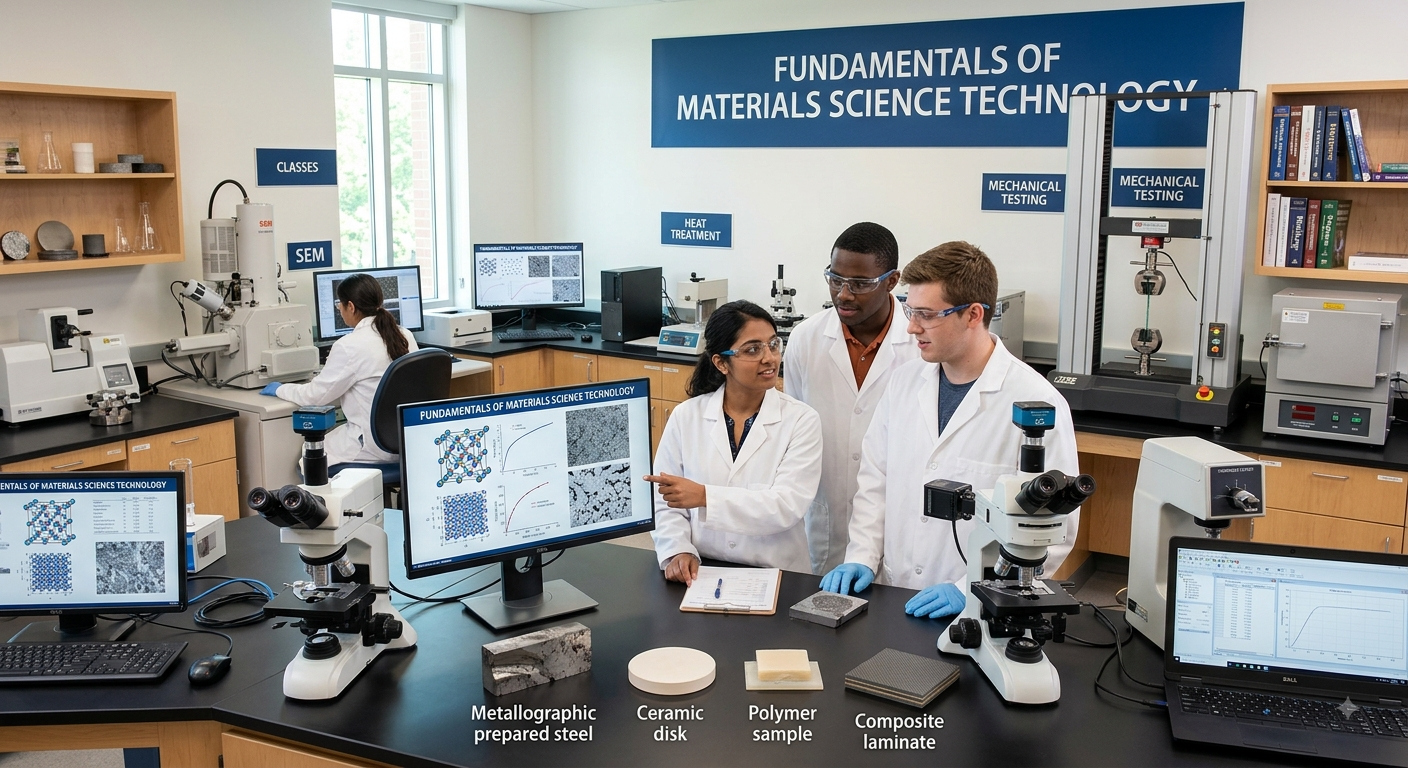
1. Introduction
Materials are the physical foundation of civilization. Almost every technology surrounding modern human life—buildings, roads, bridges, vehicles, electrical grids, computers, telecommunications systems, medical devices, batteries, satellites, aircraft and renewable-energy systems—depends on materials with carefully controlled properties.
Materials science is the scientific study of how the composition and internal structure of matter determine its properties and behavior. Materials engineering applies this knowledge to design, manufacture, process and select materials for practical applications.
The central idea can be expressed as:
Processing → Structure → Properties → Performance
A material’s performance is therefore not determined simply by what chemical elements it contains. Two materials with similar chemical compositions can behave very differently if their atomic arrangement, defects, grain structure, phases or processing histories differ.
This relationship is one of the central organizing principles of materials science.
2. What Is Materials Science?
Materials science sits at the intersection of several disciplines:
- Physics
- Chemistry
- Mathematics
- Mechanical engineering
- Electrical engineering
- Chemical engineering
- Metallurgy
- Nanotechnology
- Biology
- Computer science
- Environmental science
At its simplest, materials science asks four fundamental questions:
- What is the material made of?
- How are its atoms and molecules arranged?
- How does that structure produce particular properties?
- How can we process or modify the material to achieve the desired performance?
MIT’s introductory materials-science curriculum similarly emphasizes structure, energetics and bonding as foundations for understanding material behavior.
3. The Materials Science Tetrahedron
A useful conceptual model is the materials-science tetrahedron:
Processing ↔ Structure ↔ Properties ↔ Performance
Processing
Processing describes how a material is produced or transformed.
Examples include:
- Casting
- Forging
- Rolling
- Welding
- Heat treatment
- Sintering
- Extrusion
- Injection molding
- Deposition
- Additive manufacturing
- Machining
- Annealing
Structure
Structure exists at several scales:
Electronic → atomic → crystal → nano → micro → macro
Properties
Properties describe how a material responds to its environment.
Examples include:
- Strength
- Hardness
- Toughness
- Elasticity
- Electrical conductivity
- Thermal conductivity
- Optical behavior
- Magnetic behavior
- Corrosion resistance
Performance
Performance describes whether the material actually succeeds in its intended application.
For example, a bridge material must withstand:
- Static loads
- Dynamic loads
- Fatigue
- Temperature changes
- Corrosion
- Environmental exposure
Therefore, materials engineering is not simply about finding the “strongest” material. It is about finding the material whose total combination of properties, cost, manufacturability, reliability and sustainability satisfies the engineering requirement.
4. Matter and the Atomic Foundation
Everything begins with matter.
Matter is composed of atoms, which contain:
- Protons
- Neutrons
- Electrons
The nucleus contains protons and neutrons, while electrons occupy regions around the nucleus.
The number and arrangement of electrons strongly influence chemical bonding and therefore the properties of materials.
The periodic table provides the fundamental chemical map from which engineers understand materials.
Important material-forming elements include:
- Iron
- Aluminum
- Copper
- Silicon
- Carbon
- Titanium
- Nickel
- Chromium
- Oxygen
- Nitrogen
- Lithium
- Sodium
- Magnesium
- Calcium
Materials are usually combinations of elements rather than isolated elements.
5. Atomic Bonding
Atoms interact through several major types of bonding.
5.1 Ionic Bonding
Ionic bonding occurs when electrons are transferred between atoms, producing positively and negatively charged ions.
Ceramic materials commonly contain strong ionic bonding.
Typical consequences include:
- High melting temperatures
- High stiffness
- Good chemical stability
- Generally low ductility
5.2 Covalent Bonding
Covalent bonding involves the sharing of electrons between atoms.
Examples include:
- Diamond
- Silicon
- Silicon carbide
- Many semiconductor materials
Covalent bonding can produce extremely strong atomic structures.
5.3 Metallic Bonding
Metallic bonding allows electrons to move relatively freely through a lattice of positive atomic cores.
This helps explain several characteristic properties of metals:
- Electrical conductivity
- Thermal conductivity
- Ductility
- Malleability
- Reflectivity
Copper, aluminum, silver and many steels are examples of metallic materials.
5.4 Secondary Bonding
Weaker interactions include:
- Van der Waals forces
- Hydrogen bonding
- Dipole interactions
Although individually weaker than primary bonds, these interactions can be extremely important in polymers, biological materials and molecular structures.
6. Major Families of Engineering Materials
Materials are commonly divided into several major families.
6.1 Metals and Alloys
Examples:
- Steel
- Stainless steel
- Aluminum alloys
- Copper alloys
- Titanium alloys
- Nickel alloys
Advantages often include:
- High strength
- Toughness
- Ductility
- Electrical conductivity
- Thermal conductivity
- Manufacturability
Metals dominate many areas of construction, transportation, machinery and infrastructure.
7. Ceramics and Glasses
Ceramics are generally inorganic, nonmetallic materials.
Examples include:
- Alumina
- Silicon carbide
- Silicon nitride
- Cement
- Concrete constituents
- Porcelain
- Glass
Typical characteristics include:
- High temperature resistance
- High hardness
- Chemical resistance
- Wear resistance
- Electrical insulation
A major limitation of many conventional ceramics is relatively low fracture toughness compared with metals.
8. Polymers
Polymers are materials built from long molecular chains.
Examples include:
- Polyethylene
- Polypropylene
- PVC
- Nylon
- Polyester
- Polystyrene
- Epoxy
- Rubber
Important characteristics can include:
- Low density
- Corrosion resistance
- Ease of processing
- Electrical insulation
- Flexibility
- Low manufacturing cost
Polymer properties depend strongly on molecular structure, chain length, branching, crystallinity and processing.
9. Composites
Composites combine two or more distinct materials to achieve a combination of properties that is difficult to obtain from one material alone.
A typical composite contains:
Matrix + reinforcement
Examples include:
- Carbon-fiber-reinforced polymer
- Glass-fiber-reinforced polymer
- Reinforced concrete
- Ceramic-matrix composites
The reinforcement can provide strength or stiffness while the matrix transfers loads and protects the reinforcement.
Composites are particularly important in:
- Aerospace
- Automotive engineering
- Wind energy
- Sports equipment
- Infrastructure
- Marine engineering
10. Semiconductors
Semiconductors occupy a special position because their electrical properties can be deliberately controlled.
Important semiconductor materials include:
- Silicon
- Germanium
- Gallium nitride
- Silicon carbide
- Gallium arsenide
Semiconductor technology underpins:
- Microprocessors
- Memory
- Sensors
- Solar cells
- LEDs
- Power electronics
- Telecommunications
- Artificial intelligence hardware
The electrical behavior of semiconductors is closely related to their electronic structure, crystal structure, defects and controlled impurities.
11. Materials at Different Length Scales
Materials should not be studied at only one scale.
Electronic scale
Electrons determine:
- Bonding
- Energy levels
- Electrical behavior
- Optical behavior
Atomic scale
Atomic arrangement determines:
- Crystal structure
- Bond strength
- Density
- Chemical behavior
Nanometer scale
Nanostructures can possess properties substantially different from bulk materials.
Micrometer scale
Microstructure includes:
- Grains
- Phases
- Pores
- Inclusions
- Dislocations
Macroscopic scale
This is the scale at which engineers observe:
- Components
- Structures
- Machines
- Buildings
- Devices
Understanding materials therefore requires movement across multiple scales.
12. Crystal Structures
Many solids form ordered crystalline structures.
Common crystal structures include:
Body-Centered Cubic — BCC
Examples include several important forms of iron and other metals.
Face-Centered Cubic — FCC
Examples include:
- Aluminum
- Copper
- Nickel
FCC metals often exhibit considerable ductility.
Hexagonal Close-Packed — HCP
Examples include:
- Titanium
- Magnesium
- Zinc
Crystal structure affects:
- Deformation
- Diffusion
- Density
- Electrical properties
- Mechanical behavior
13. Crystalline and Amorphous Materials
A crystalline material possesses long-range structural order.
An amorphous material lacks the same long-range periodic arrangement.
Glass is a major example of an amorphous solid.
Polymers may contain both crystalline and amorphous regions.
This distinction is extremely important because atomic ordering affects:
- Melting behavior
- Mechanical properties
- Optical properties
- Diffusion
- Electrical properties
14. Crystal Defects
Perfect crystals rarely exist in practical materials.
Defects are extremely important because they can control material properties.
Major categories include:
Point defects
Examples:
- Vacancies
- Interstitial atoms
- Substitutional atoms
Line defects
The most important are dislocations.
Planar defects
Examples include:
- Grain boundaries
- Phase boundaries
- Stacking faults
Volume defects
Examples include:
- Voids
- Cracks
- Inclusions
- Large precipitates
Defects are not necessarily undesirable.
Engineers deliberately manipulate defects to control properties.
15. Dislocations and Plastic Deformation
A dislocation is a line defect in a crystal.
Dislocation motion provides an important mechanism for permanent plastic deformation in many crystalline materials.
This helps explain why metals can be:
- Rolled
- Forged
- Stretched
- Bent
- Extruded
Strengthening mechanisms often work by making dislocation motion more difficult.
Examples include:
- Grain refinement
- Solid-solution strengthening
- Precipitation strengthening
- Work hardening
16. Grain Structure
Many engineering metals contain numerous crystalline regions called grains.
Each grain has its own crystallographic orientation.
The boundaries between grains are called grain boundaries.
Grain size can strongly affect mechanical properties.
Generally, refining grains can increase yield strength in many metallic systems through the Hall–Petch relationship:
[
\sigma_y = \sigma_0 + k_y d^{-1/2}
]
where:
- (\sigma_y) = yield stress
- (\sigma_0) = material-dependent constant
- (k_y) = Hall–Petch coefficient
- (d) = average grain diameter
The relationship illustrates a fundamental materials-science principle: microstructural engineering can change macroscopic mechanical performance.
17. Mechanical Properties
Mechanical properties describe how materials respond to forces.
Important properties include:
Strength
Ability to withstand applied stress without failure or unacceptable deformation.
Stiffness
Resistance to elastic deformation.
Young’s modulus is:
[
E = \frac{\sigma}{\epsilon}
]
where:
- (E) = Young’s modulus
- (\sigma) = stress
- (\epsilon) = strain
Hardness
Resistance to indentation, scratching or localized deformation.
Ductility
Ability to undergo significant plastic deformation before fracture.
Brittleness
Tendency to fracture with relatively little plastic deformation.
Toughness
Ability to absorb energy before fracture.
Fatigue resistance
Ability to withstand repeated cyclic loading.
Creep resistance
Ability to resist slow deformation under sustained load, particularly at elevated temperature.
18. Stress and Strain
Stress describes applied force relative to area:
[
\sigma = \frac{F}{A}
]
Strain describes deformation relative to original dimension:
[
\epsilon = \frac{\Delta L}{L_0}
]
A typical tensile test generates a stress–strain curve.
Important regions include:
- Elastic region
- Yield point
- Plastic deformation
- Strain hardening
- Ultimate tensile strength
- Fracture
The stress–strain curve provides a powerful fingerprint of mechanical behavior.
19. Thermal Properties
Materials respond strongly to temperature.
Important thermal properties include:
- Thermal conductivity
- Thermal expansion
- Specific heat
- Melting point
- Glass-transition temperature
- Thermal diffusivity
Thermal expansion can be represented approximately as:
[
\Delta L = \alpha L_0 \Delta T
]
where (\alpha) is the coefficient of thermal expansion.
Thermal expansion becomes especially important when two different materials are joined together.
20. Electrical Properties
Materials can be classified according to their electrical behavior.
Conductors
Examples:
- Copper
- Aluminum
- Silver
Insulators
Examples:
- Glass
- Many ceramics
- Many polymers
Semiconductors
Examples:
- Silicon
- Germanium
- Gallium nitride
- Silicon carbide
The electrical properties of materials are essential to modern electronics and power systems.
21. Magnetic Materials
Materials can exhibit different magnetic behaviors.
Important categories include:
- Diamagnetic
- Paramagnetic
- Ferromagnetic
- Antiferromagnetic
- Ferrimagnetic
Magnetic materials are important in:
- Electric motors
- Generators
- Transformers
- Data storage
- Sensors
- Medical technology
22. Optical Materials
Materials interact with electromagnetic radiation in different ways.
Important phenomena include:
- Reflection
- Refraction
- Absorption
- Transmission
- Scattering
- Luminescence
Optical materials are fundamental to:
- Fiber-optic communications
- Cameras
- Displays
- Lasers
- Solar cells
- Photonic systems
23. Diffusion
Diffusion is the movement of atoms through a material.
It is fundamental to:
- Alloy formation
- Heat treatment
- Semiconductor fabrication
- Sintering
- Surface modification
- Corrosion
- Phase transformations
A simplified form of Fick’s first law is:
[
J=-D\frac{dC}{dx}
]
where:
- (J) = diffusion flux
- (D) = diffusion coefficient
- (C) = concentration
- (x) = position
Temperature strongly affects diffusion.
24. Phase Diagrams
Phase diagrams are among the most powerful tools in materials engineering.
They show which phases are thermodynamically stable under specified conditions, often as a function of:
- Temperature
- Composition
- Pressure
For alloy systems, phase diagrams help engineers understand:
- Melting
- Solidification
- Phase formation
- Heat treatment
- Microstructure
- Composition limits
The study of phase diagrams is a major component of formal materials-science education.
25. Phase Transformations
A phase transformation occurs when a material changes from one structural or compositional state to another.
Examples include:
- Melting
- Solidification
- Precipitation
- Crystallization
- Martensitic transformation
- Recrystallization
Phase transformations allow engineers to deliberately manipulate microstructure.
26. Heat Treatment
Heat treatment uses controlled thermal cycles to modify material structure and properties.
Typical operations include:
- Annealing
- Normalizing
- Quenching
- Tempering
- Solution treatment
- Aging
Steel is a particularly important example because its properties can be dramatically modified through controlled heating and cooling.
27. Corrosion and Degradation
Materials can deteriorate when exposed to their environments.
Metallic materials may experience:
- Oxidation
- Uniform corrosion
- Galvanic corrosion
- Pitting
- Stress-corrosion cracking
Polymers can experience:
- UV degradation
- Oxidation
- Thermal degradation
- Chemical attack
Ceramics can undergo chemical or thermal degradation depending on their environment.
Materials engineering therefore involves not only creating materials but also predicting their lifetime.
28. Fracture
Fracture is the separation of a material into two or more pieces.
Two broad categories are:
Ductile fracture
Usually preceded by significant plastic deformation.
Brittle fracture
Can occur with relatively little plastic deformation.
Fracture mechanics studies how cracks behave under applied stresses.
A critical engineering objective is often not simply maximizing strength but controlling crack initiation and propagation.
29. Fatigue
Fatigue occurs when repeated or cyclic stresses cause progressive material damage.
A component can fail under repeated loading even when the individual loads are below its static strength.
Fatigue is therefore crucial for:
- Aircraft
- Bridges
- Vehicles
- Rotating machinery
- Turbines
- Railway systems
- Industrial equipment
Engineering design must account for loading cycles, stress concentrations, material defects and environmental conditions.
30. Materials Processing Technology
The transformation from raw material to engineered component may involve several stages:
Raw resources → extraction → refining → synthesis → shaping → heat treatment → finishing → assembly → inspection → service → recycling
Examples:
Metals
Ore → refining → alloying → casting → rolling/forging → heat treatment → machining → component
Polymers
Chemical feedstocks → polymerization → compounding → molding/extrusion → finishing → product
Ceramics
Powders → mixing → shaping → drying → sintering → finishing
Semiconductors
Raw materials → purification → crystal growth → wafer production → deposition → lithography → etching → doping → metallization → packaging
31. Nanotechnology
Nanotechnology operates at extremely small dimensions.
At the nanoscale, properties can change because of:
- Surface-to-volume effects
- Quantum effects
- Grain-size effects
- Interface effects
Nanomaterials include:
- Nanoparticles
- Nanowires
- Nanotubes
- Graphene
- Nanostructured ceramics
- Nanostructured metals
Applications include:
- Electronics
- Energy storage
- Catalysis
- Sensors
- Medicine
- Advanced coatings
32. Advanced Materials
Modern materials science increasingly focuses on materials designed for highly specific functions.
Examples include:
- Superalloys
- Shape-memory alloys
- Biomaterials
- Smart materials
- Metamaterials
- High-performance composites
- Advanced ceramics
- Two-dimensional materials
- Quantum materials
- Solid-state battery materials
These materials demonstrate the transition from simply discovering materials to engineering materials for specific performance requirements.
33. Biomaterials
Biomaterials are engineered materials designed to interact with biological systems.
Applications include:
- Orthopedic implants
- Dental materials
- Prosthetic devices
- Tissue-engineering scaffolds
- Medical sensors
Important requirements include:
- Biocompatibility
- Mechanical compatibility
- Chemical stability
- Sterilization compatibility
- Long-term reliability
34. Materials for Energy Technology
The global energy system depends heavily on materials.
Solar energy
Requires:
- Semiconductor materials
- Conductive materials
- Transparent materials
- Protective coatings
Batteries
Require:
- Electrodes
- Electrolytes
- Current collectors
- Separators
- Packaging materials
Wind turbines
Require:
- Structural composites
- Steels
- Copper
- Permanent magnets
- Protective coatings
Hydrogen technologies
Require specialized:
- Catalysts
- Electrodes
- Membranes
- Storage materials
- Structural materials
Materials innovation can therefore influence the economics and scalability of entire energy systems.
35. Materials and the Semiconductor Industry
Modern computing is fundamentally a materials-technology achievement.
A semiconductor device depends on precise control over:
- Crystal quality
- Dopants
- Interfaces
- Thin films
- Dielectrics
- Conductors
- Defects
- Thermal behavior
Advanced semiconductor manufacturing combines materials science with:
- Physics
- Chemistry
- Lithography
- Plasma processing
- Nanotechnology
- Metrology
- Computer modeling
The result is an extraordinarily complex engineered material system operating at microscopic and nanoscopic dimensions.
36. Materials for Telecommunications
Modern telecommunications depends on specialized materials.
Examples include:
Optical fiber
Primarily glass-based materials engineered to transmit light efficiently.
Semiconductor lasers
Used to generate optical signals.
Photodetectors
Convert optical signals into electrical signals.
RF materials
Used in antennas, filters and wireless communication equipment.
Semiconductor materials
Enable high-frequency electronics and signal processing.
Thus, the global communications network is also a gigantic materials-engineering system.
37. Materials and Artificial Intelligence
Artificial intelligence depends on a physical infrastructure composed of materials.
AI systems require:
- Semiconductor chips
- Memory
- High-performance substrates
- Copper interconnects
- Advanced packaging
- Cooling materials
- Power electronics
- Optical communications
- Data-center structures
This creates a powerful connection:
Materials → semiconductor devices → computers → data centers → AI → digital economy
Materials science is therefore one of the physical foundations underneath artificial intelligence.
38. Computational Materials Science
Computer modeling increasingly allows scientists to investigate materials before physically producing them.
Methods include:
- Molecular dynamics
- Density functional theory
- Finite-element modeling
- Phase-field modeling
- Thermodynamic modeling
- Machine learning
The objective is increasingly to create a digital pathway:
Composition → simulated structure → predicted properties → optimized material → experimental validation → manufacturing
Machine learning is becoming particularly useful because the amount of materials data generated by experiments and simulations is growing rapidly. Research has demonstrated the use of data-driven approaches for discovering relationships between material structure and properties.
39. Artificial Intelligence for Materials Discovery
AI can help researchers search enormous combinations of:
- Elements
- Compositions
- Crystal structures
- Processing conditions
- Microstructures
Instead of testing every possible material experimentally, computational models can prioritize promising candidates.
This creates a new materials-development loop:
AI prediction → simulation → laboratory experiment → characterization → manufacturing → real-world feedback
AI has already been investigated for controlling material properties such as semiconductor behavior through strain engineering.
40. Materials Characterization
Scientists need sophisticated tools to understand materials.
Important techniques include:
Microscopy
- Optical microscopy
- Scanning electron microscopy
- Transmission electron microscopy
- Atomic force microscopy
Diffraction
- X-ray diffraction
- Electron diffraction
Spectroscopy
- Raman spectroscopy
- Infrared spectroscopy
- X-ray photoelectron spectroscopy
Mechanical testing
- Tensile testing
- Compression testing
- Hardness testing
- Impact testing
- Fatigue testing
- Creep testing
Characterization connects microscopic structure with measurable engineering performance.
41. Materials Selection
Selecting a material requires balancing multiple variables.
A designer may consider:
| Requirement | Possible consideration |
|---|---|
| Strength | Yield strength, tensile strength |
| Weight | Density |
| Temperature | Maximum service temperature |
| Durability | Fatigue, corrosion, wear |
| Manufacturing | Casting, machining, molding |
| Electrical | Conductivity |
| Thermal | Conductivity and expansion |
| Cost | Raw material + processing |
| Sustainability | Energy, emissions, recyclability |
| Availability | Supply-chain security |
The best material is rarely the material with the highest value of one property.
It is the material offering the best system-level combination of performance, cost, reliability and sustainability.
42. Materials and the Circular Economy
Traditional industrial systems often follow:
Extract → manufacture → use → discard
A circular materials system attempts to move toward:
Design → manufacture → use → repair → reuse → remanufacture → recycle → recover
Materials science is essential because circularity depends on understanding:
- Material composition
- Separation
- Contamination
- Degradation
- Recyclability
- Reprocessing
- Lifetime
- Recovery economics
Future materials should increasingly be designed not only for performance but also for their entire lifecycle.
43. Critical Materials and Strategic Supply Chains
Modern economies depend on specialized materials and minerals.
Examples include materials containing:
- Lithium
- Nickel
- Cobalt
- Copper
- Rare-earth elements
- Silicon
- Graphite
- Titanium
These resources support:
- Batteries
- Electronics
- Renewable energy
- Motors
- Aerospace
- Telecommunications
- Defense and infrastructure
Consequently, materials science has become closely connected to industrial strategy, resource security and international supply chains.
44. Materials Science and South Africa
South Africa possesses an important materials and mineral-resource base.
Its materials ecosystem connects:
Mining → mineral processing → metallurgy → manufacturing → engineering → infrastructure → technology
Strategic opportunities include:
- Advanced mineral beneficiation
- Metallurgical innovation
- Battery-material processing
- Platinum-group-metal technologies
- Renewable-energy materials
- Hydrogen-related materials
- Advanced manufacturing
- Recycling
- Research and development
The long-term economic opportunity is not simply exporting raw minerals. Greater value can potentially be created by developing knowledge, processing capability, manufacturing capacity and intellectual property around those resources.
45. Materials Engineering as an Industrial Multiplier
One kilogram of raw material can potentially become:
Ore → refined material → engineered alloy → precision component → machine → technology system
At each stage, additional:
- Knowledge
- Energy
- Capital
- Engineering
- Manufacturing
- Software
- Intellectual property
can be incorporated.
This is why materials technology has enormous strategic importance.
A country with advanced materials capabilities can participate in much higher-value sections of industrial supply chains.
46. The Future of Materials Science
The next generation of materials technology is likely to combine:
1. Materials science
Understanding matter.
2. Nanotechnology
Engineering matter at extremely small dimensions.
3. Artificial intelligence
Predicting and optimizing materials.
4. Robotics
Automating synthesis and experimentation.
5. Advanced manufacturing
Producing complex structures.
6. Quantum science
Engineering materials with unusual electronic, magnetic and quantum behavior.
7. Biotechnology
Learning from biological materials and processes.
8. Circular manufacturing
Designing materials for recovery and reuse.
This convergence could produce a new industrial paradigm.
47. The Emerging Autonomous Materials Laboratory
A future materials laboratory could operate as an intelligent closed loop:
Research question
↓
AI proposes material
↓
Simulation predicts properties
↓
Robot synthesizes sample
↓
Automated instruments characterize sample
↓
AI analyzes results
↓
Model improves
↓
Next experiment is selected
↓
Manufacturing process is optimized
This is sometimes described as autonomous or self-driving experimentation.
The major transformation is a shift from:
Human intuition + trial and error
toward:
Human scientific objectives + computation + automation + experimental feedback
48. The Materials Technology Hierarchy
A useful way to understand the entire field is as a hierarchy:
Level 1 — Elements
Atoms and the periodic table.
Level 2 — Bonds
Ionic, covalent, metallic and secondary bonding.
Level 3 — Atomic structure
Crystal and amorphous structures.
Level 4 — Defects
Vacancies, dislocations, boundaries and inclusions.
Level 5 — Microstructure
Grains, phases and interfaces.
Level 6 — Properties
Mechanical, electrical, thermal, optical and magnetic properties.
Level 7 — Processing
Manufacturing and transformation.
Level 8 — Components
Engineered parts.
Level 9 — Systems
Machines, buildings, vehicles, networks and devices.
Level 10 — Civilization
Infrastructure, industry, energy, transportation, communication and technology.
This hierarchy demonstrates why materials science is fundamental to technological civilization.
49. A Complete Materials-Technology Workflow
A modern materials-development program can be represented as:
Problem definition
↓
Performance requirements
↓
Material selection
↓
Composition design
↓
Atomic/structural modeling
↓
Processing design
↓
Microstructure engineering
↓
Characterization
↓
Mechanical/physical testing
↓
Prototype
↓
Reliability testing
↓
Manufacturing scale-up
↓
Deployment
↓
Lifecycle monitoring
↓
Recycling/recovery
↓
Next-generation redesign
This is the complete materials innovation cycle.
50. Fundamental Equations to Know
A beginner should become familiar with several fundamental relationships.
Stress
[
\sigma=\frac{F}{A}
]
Strain
[
\epsilon=\frac{\Delta L}{L_0}
]
Young’s modulus
[
E=\frac{\sigma}{\epsilon}
]
Density
[
\rho=\frac{m}{V}
]
Thermal expansion
[
\Delta L=\alpha L_0\Delta T
]
Diffusion
[
J=-D\frac{dC}{dx}
]
Hall–Petch relationship
[
\sigma_y=\sigma_0+k_y d^{-1/2}
]
These equations are not isolated mathematical formulas. They provide quantitative links between physical structure, loading, temperature, composition and material performance.
51. Ten Fundamental Principles
A strong foundation in materials science can be summarized through ten principles:
- Atoms determine fundamental chemical behavior.
- Bonding determines many fundamental properties.
- Atomic arrangement determines structure.
- Defects influence material behavior.
- Microstructure controls many engineering properties.
- Processing changes microstructure.
- Properties determine component performance.
- Environment changes material lifetime.
- Materials must be selected at the system level.
- Future materials development will increasingly combine computation, AI, automation and experimentation.
52. Recommended Learning Sequence
For someone beginning materials science, the most logical learning pathway is:
Stage 1 — Basic science
- Atomic structure
- Periodic table
- Chemical bonding
- Basic physics
- Basic chemistry
- Mathematics
Stage 2 — Materials structure
- Crystal structures
- Amorphous materials
- Defects
- Dislocations
- Grain boundaries
- Microstructure
Stage 3 — Materials properties
- Mechanical
- Thermal
- Electrical
- Magnetic
- Optical
- Chemical
Stage 4 — Materials processing
- Casting
- Forming
- Machining
- Heat treatment
- Sintering
- Polymer processing
- Composite manufacturing
Stage 5 — Thermodynamics and kinetics
- Phase equilibrium
- Diffusion
- Phase diagrams
- Phase transformations
Stage 6 — Failure and reliability
- Fracture
- Fatigue
- Creep
- Corrosion
- Wear
Stage 7 — Advanced materials
- Nanomaterials
- Semiconductors
- Biomaterials
- Composites
- Smart materials
- Energy materials
Stage 8 — Digital materials science
- Computational modeling
- Materials databases
- Machine learning
- AI-assisted discovery
- Autonomous experimentation
This sequence closely reflects the way comprehensive university materials-science programs connect bonding, defects, mechanical properties, diffusion, phase diagrams and phase transformations.
53. Final Perspective
Materials science is much more than the study of metals, plastics and ceramics.
It is the science of controlling matter to produce useful performance.
At the deepest level, the field connects:
Atoms
→ Bonding
→ Crystal structure
→ Defects
→ Microstructure
→ Processing
→ Properties
→ Components
→ Machines
→ Infrastructure
→ Technology
→ Economic productivity
→ Civilization
This explains why materials have historically marked major technological eras—from stone and bronze to iron and steel—and why modern economies are increasingly defined by semiconductors, composites, nanomaterials, advanced ceramics, energy materials and engineered alloys. Contemporary materials education explicitly treats materials as foundational to sectors ranging from aerospace and telecommunications to transportation and infrastructure.
The future is likely to go one step further: instead of merely discovering materials and then finding applications for them, engineers will increasingly design materials backward from a required performance, using physics-based simulation, artificial intelligence, automated experimentation and advanced manufacturing.
The central philosophy can therefore be summarized as:
Understand matter → engineer structure → control processing → obtain desired properties → achieve required performance.
That is the fundamental intellectual architecture of modern materials science and materials technology.



Be First to Comment