
Abstract
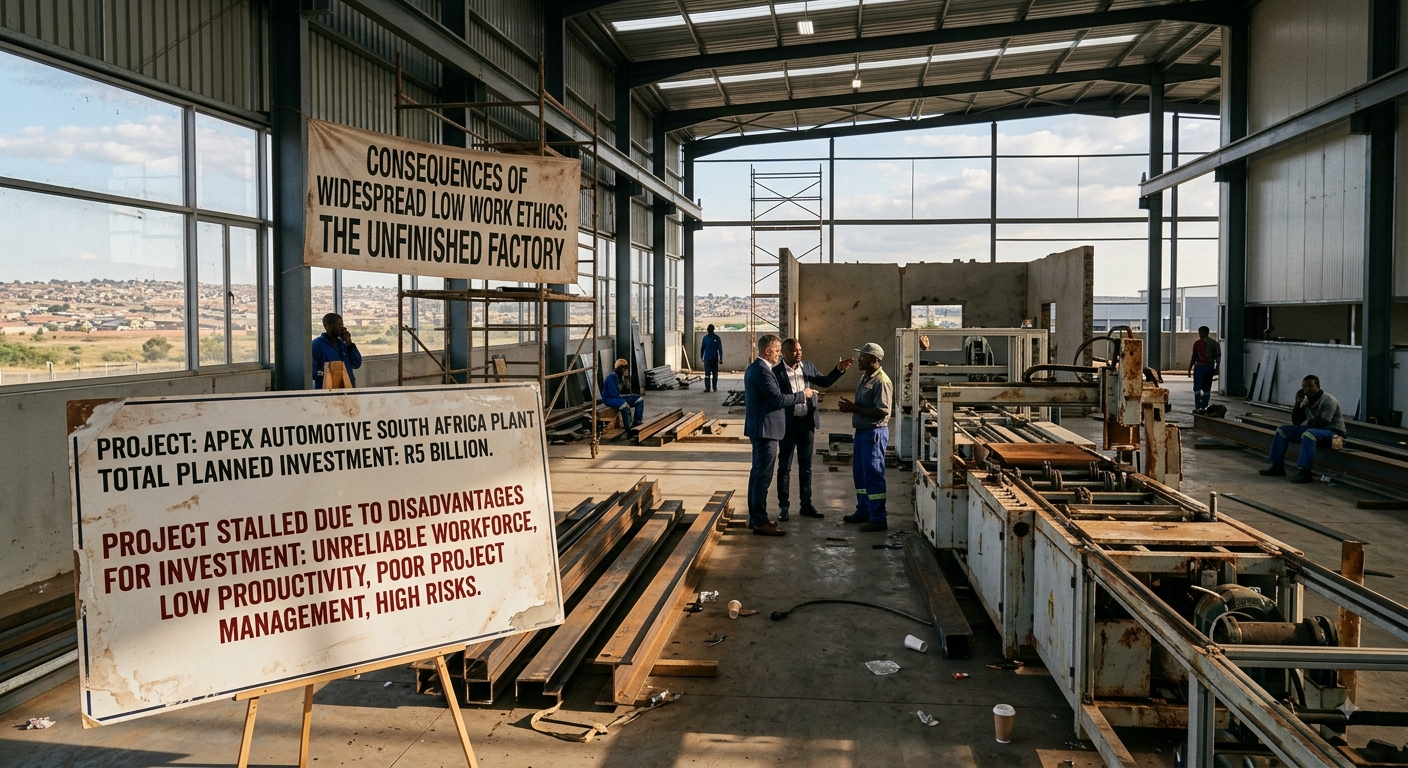
Work ethics—the norms governing reliability, honesty, accountability, professionalism, productivity, respect for time, quality of work, and responsibility—are an important component of an investment ecosystem. They do not operate independently of wages, management quality, labour institutions, skills, infrastructure, governance, or economic conditions. Therefore, it would be inaccurate to explain South Africa’s investment difficulties simply by blaming workers. Nevertheless, where poor work practices become widespread across organisations or institutions, they can increase operating costs, reduce productivity, weaken confidence, delay projects, and ultimately reduce the attractiveness of investment.
South Africa’s investment challenge is much broader. The World Bank reports that the economy grew by only about 0.7% annually over the past decade, while persistent infrastructure, logistics, water, governance and productivity constraints continue to weigh on investment. (World Bank) The South African Reserve Bank reported that real gross fixed capital formation declined in the first quarter of 2026, driven by lower private-sector fixed investment. (South African Reserve Bank)
The central thesis of this analysis is therefore:
A productive investment economy requires a chain of trust: investors must trust institutions, managers must trust employees, employees must trust management, businesses must trust suppliers, and citizens must trust public institutions. Low work ethics can weaken this entire chain.
1. Introduction: Why Work Ethics Matter to Investment
Investment is fundamentally a decision about the future.
An investor commits capital today in expectation that:
- the project will be completed;
- employees will perform their responsibilities;
- managers will control resources effectively;
- suppliers will deliver;
- infrastructure will function;
- regulations will be applied predictably;
- assets will be maintained;
- customers will receive reliable products and services; and
- the investment will generate an acceptable return.
Consequently, investment is not merely about money.
It is about the interaction between:
Capital + People + Institutions + Infrastructure + Technology + Management + Productivity + Trust.
If one component repeatedly fails, the economic return on the entire system can deteriorate.
This is why work ethics should be considered part of South Africa’s broader productivity and institutional-capacity challenge, rather than simply a question of individual morality.
2. Defining Work Ethics
Work ethics can be understood as the collection of behaviours and principles that determine how seriously individuals and organisations approach their responsibilities.
Important dimensions include:
2.1 Reliability
A reliable worker or institution:
- arrives when expected;
- completes assigned responsibilities;
- communicates problems early;
- meets agreed deadlines;
- follows established procedures.
2.2 Accountability
Accountability means accepting responsibility for decisions and outcomes.
A weak accountability culture creates the opposite behaviour:
“It was not my responsibility.”
This can become extremely expensive in large organisations.
2.3 Productivity
Productivity concerns the amount and quality of output generated from available resources.
A simple conceptual relationship is:
Productivity = Output ÷ Inputs
If labour, capital, electricity, equipment and materials increase while useful output does not increase proportionately, economic efficiency deteriorates.
2.4 Quality
Low-quality work generates:
- rework;
- repairs;
- complaints;
- delays;
- warranty costs;
- reputational damage.
2.5 Integrity
Integrity means performing duties honestly and resisting practices that undermine the organisation.
This is particularly important in:
- procurement;
- construction;
- finance;
- engineering;
- government;
- mining;
- logistics;
- healthcare;
- infrastructure.
2.6 Professionalism
Professionalism involves competence, discipline, continuous learning and respect for organisational standards.
3. A Critical Qualification: Low Work Ethics Is Not the Same as Low Productivity
This distinction is essential.
A person may work hard but still be unproductive because:
- machinery is obsolete;
- electricity is unreliable;
- software is inadequate;
- management is poor;
- training is insufficient;
- materials arrive late;
- transport systems fail;
- procedures are unnecessarily bureaucratic.
Similarly, an employee’s apparent underperformance may result from organisational failures rather than personal unwillingness.
South Africa’s World Bank analysis identifies infrastructure services, private-sector participation, cities and efficient public spending as major areas for unlocking growth. (World Bank)
Therefore:
A serious national productivity strategy must improve both individual work practices and the systems within which people work.
4. The Investment Equation
Investment decisions can be represented conceptually as:
Expected Return = Revenue − Operating Costs − Risk Costs − Financing Costs
Poor work ethics can increase several of these costs simultaneously.
For example:
Low accountability → mistakes → rework → delays → higher costs → lower profit → higher investment risk.
This creates a multiplier effect.
A single inefficient activity may appear insignificant.
But when multiplied across thousands of companies and millions of transactions, the national economic effect can become substantial.
5. Direct Consequences of Poor Work Ethics
5.1 Reduced Labour Productivity
One of the first consequences is reduced output.
Suppose two factories possess similar:
- machinery;
- buildings;
- technology;
- financial resources.
But Factory A has stronger:
- attendance;
- management;
- quality control;
- maintenance;
- accountability;
- teamwork.
Factory A can potentially produce more from the same capital stock.
This increases its return on investment.
Investors naturally prefer environments where capital can be converted efficiently into output.
6. Higher Cost of Doing Business
Poor work practices can increase operational expenditure.
Costs may arise through:
- overtime;
- rework;
- equipment damage;
- missed deadlines;
- supervision;
- administrative monitoring;
- recruitment;
- training;
- legal disputes;
- customer compensation.
Therefore:
Low work discipline → higher operating cost → lower margins → lower expected investment return.
When this occurs repeatedly, investors may demand a higher risk premium.
7. The Hidden Cost of Supervision
An organisation with strong professional norms can operate with relatively high levels of trust.
An organisation with weak accountability often requires more monitoring.
Management may have to introduce:
- additional supervisors;
- biometric attendance;
- extensive reporting;
- repeated inspections;
- approval layers;
- audits;
- disciplinary systems.
These controls can be necessary, but they consume resources.
Instead of investing R1 million into productive technology, for example, an organisation may have to devote additional resources to controlling operational failures.
This is an example of an agency cost.
8. Delays and Project Overruns
Investment projects are extremely sensitive to time.
Consider a major:
- railway;
- port;
- factory;
- solar facility;
- data centre;
- hospital;
- housing development.
The investor has a financial model based on a particular completion date.
If construction or implementation is delayed:
Delay → delayed revenue → additional financing costs → contractual penalties → reduced return.
Repeated delays can make future projects less attractive.
This is especially important in infrastructure.
The World Bank has identified infrastructure bottlenecks in electricity, freight transport, water and sanitation as major constraints on South African growth and investment. (World Bank)
9. Quality Failures and Rework
Poor workmanship can create an economic chain reaction.
For example:
Poor installation → equipment failure → inspection → repair → downtime → lost production.
The initial mistake may cost R10,000.
But the total economic consequence could be much larger if a production facility remains inactive for several days.
This is why investors evaluate not simply the cost of labour, but the total cost of reliable production.
10. Impact on Foreign Direct Investment
Foreign investors compare countries.
They may examine:
- political stability;
- infrastructure;
- electricity;
- logistics;
- skills;
- labour productivity;
- taxation;
- regulation;
- corruption risks;
- market size;
- currency stability;
- property rights;
- institutional quality.
If operating conditions appear unreliable, an investor may choose another country.
This does not necessarily mean that capital disappears from South Africa completely.
It may mean that:
- projects become smaller;
- investment is postponed;
- investors demand higher returns;
- companies diversify into other countries;
- headquarters are located elsewhere;
- expansion plans are reduced.
11. The Difference Between Investment and Speculation
This distinction is important.
Financial capital can move relatively quickly.
Long-term productive investment is different.
A company building a:
- factory;
- mine;
- logistics centre;
- semiconductor facility;
- data centre;
- power plant;
- research centre
is making a long-term commitment.
Such investors require confidence that the surrounding ecosystem will remain functional for many years.
Consequently, institutional reliability and work culture become long-term investment variables.
12. Effects on Small and Medium Enterprises
Poor work ethics can be particularly damaging to SMEs.
A large corporation may have:
- human-resource departments;
- legal teams;
- financial reserves;
- sophisticated software;
- multiple suppliers.
A small business often does not.
One unreliable employee, supplier or contractor can significantly disrupt an SME.
For example:
Late supplier → delayed production → missed customer order → lost revenue → cash-flow pressure.
Repeated incidents can cause otherwise viable businesses to fail.
This matters because SMEs are important channels through which investment becomes employment.
13. Consequences for Entrepreneurship
Entrepreneurs need predictable execution.
An entrepreneur may have:
- an excellent idea;
- funding;
- customers;
- technology.
But the business still requires people who can execute.
If the entrepreneur repeatedly encounters:
- unreliable contractors;
- poor service;
- administrative delays;
- low-quality suppliers;
- weak maintenance;
- poor accountability,
the cost of entrepreneurship rises.
This discourages some forms of investment.
14. Impact on Manufacturing
Manufacturing is particularly sensitive to operational discipline.
A modern factory depends upon synchronisation.
For example:
Raw materials → production → quality control → packaging → warehouse → transport → customer
A failure at one stage can disrupt the entire chain.
This is why modern manufacturing uses:
- lean production;
- quality management;
- predictive maintenance;
- automation;
- enterprise-resource planning;
- statistical process control;
- continuous improvement.
The goal is to minimise waste and variability.
15. Impact on Mining
Mining is strategically important to South Africa.
Mining operations require:
- engineering discipline;
- safety procedures;
- maintenance;
- geological planning;
- equipment management;
- logistics;
- environmental compliance.
Poor operational discipline can increase:
- downtime;
- maintenance costs;
- production losses;
- regulatory risk;
- reputational risk.
Consequently, investment in mining depends not only on mineral resources but also on the reliability of the surrounding operational ecosystem.
16. Impact on Ports and Logistics
South Africa’s geographical position gives it enormous potential as a logistics gateway.
But logistics depends upon coordination.
A simplified chain is:
Mine → Rail → Port → Ship → International Market
If one component becomes unreliable, the entire chain becomes less competitive.
The World Bank has reported that rail and port inefficiencies have significantly affected South African exports and identified freight logistics as a central area for reform. (World Bank)
This demonstrates an important principle:
National competitiveness is determined by the performance of the entire supply chain, not merely by the performance of individual companies.
17. Government and Public-Sector Work Ethics
The issue becomes even more significant in government.
Government employees manage systems that affect millions of citizens and businesses.
Weak administrative performance can produce:
- delayed permits;
- slow procurement;
- poor maintenance;
- ineffective project management;
- delayed payments;
- weak enforcement;
- poor municipal services.
These failures create costs for private investors.
The World Bank has specifically identified weak governance, limited competition and skills shortages as structural barriers to South African growth. (World Bank)
18. The Investment Consequence of Institutional Failure
Investors often ask a fundamental question:
“Can I predict how this system will behave?”
If the answer is uncertain, risk increases.
This produces a relationship:
Institutional uncertainty → risk premium → higher required return → fewer viable projects.
Some projects that would have been profitable under predictable conditions become financially unattractive when risk increases.
19. Corruption and Work Ethics
Corruption is more serious than ordinary poor work discipline because it directly attacks institutional trust.
Examples include:
- manipulation of procurement;
- conflicts of interest;
- fraudulent reporting;
- favouritism;
- misuse of public resources.
These behaviours distort competition.
Instead of:
Best company → wins contract
the system can become:
Best-connected company → wins contract.
That undermines productive investment.
20. The Difference Between Corruption and Inefficiency
They should not be treated as identical.
Inefficiency
Someone performs poorly because of:
- insufficient skills;
- weak management;
- inadequate systems;
- poor training.
Corruption
Someone deliberately abuses entrusted authority for improper benefit.
Both can damage investment, but they require different solutions.
Inefficiency requires capability improvement.
Corruption requires stronger integrity systems, enforcement and transparency.
21. Absenteeism and Reliability
Persistent absenteeism can create significant organisational costs.
One absent worker can sometimes be replaced.
But if absenteeism affects interconnected teams, the consequences become larger.
For example:
Technician absent → maintenance delayed → machine unavailable → production delayed → delivery missed.
The effect therefore spreads through the organisation.
22. Poor Management Can Create Poor Work Ethics
Work ethics should never be analysed only from the employee’s perspective.
Management influences behaviour through:
- incentives;
- promotion;
- discipline;
- training;
- leadership;
- communication;
- workplace design.
If an organisation rewards poor performance while ignoring excellent performance, employees receive a powerful signal:
Performance does not matter.
Over time, organisational culture deteriorates.
Therefore:
Leadership → incentives → behaviour → organisational culture → productivity.
23. The Skills Dimension
South Africa also faces a skills challenge.
An employee cannot produce sophisticated output without appropriate:
- education;
- technical training;
- experience;
- tools;
- supervision.
The World Bank identifies skills shortages among the structural barriers affecting South Africa’s economic performance. (World Bank)
Therefore, improving work ethics must be combined with:
Education + Technical Skills + Management + Technology + Accountability.
24. Labour Policy and Productivity
Labour relations are another important part of the equation.
The South African Reserve Bank’s 2026 review of the literature finds that the relationship between labour policy, productivity, employment and investment is complex. Evidence varies according to firm size, technology, workforce skills and employment arrangements. (South African Reserve Bank)
This is important because simplistic arguments such as:
“All labour protections reduce investment”
or:
“All employers are responsible for low productivity”
are inadequate.
The actual economic system is much more complicated.
25. The Investment Confidence Mechanism
Investment confidence can be represented as:
Confidence = Predictability + Productivity + Infrastructure + Institutional Quality + Market Opportunity − Risk
Work ethics influence the productivity and predictability components.
When reliability declines, investors may perceive greater uncertainty.
That uncertainty can influence:
- project size;
- financing;
- location;
- technology selection;
- employment;
- expansion decisions.
26. The National Productivity Trap
A country can become trapped in a cycle:
Low productivity
↓
Low business profitability
↓
Low investment
↓
Low capital formation
↓
Old technology and infrastructure
↓
Low productivity
This becomes a productivity-investment feedback loop.
Breaking it requires simultaneous investment in:
- infrastructure;
- skills;
- technology;
- institutions;
- management;
- human capital.
27. The Social Consequence
Low investment means fewer opportunities for economic expansion.
South Africa’s unemployment remains extremely high. The Reserve Bank reported an official unemployment rate of 32.7% in Q1 2026, while the World Bank reports unemployment above 30% in 2025. (South African Reserve Bank)
This creates a paradox:
Poor work systems can discourage investment, while insufficient investment limits the creation of productive employment.
Therefore, the solution cannot simply be:
“People must work harder.”
The country needs more productive economic systems in which people can work effectively.
28. The Youth Dimension
Young people require:
- apprenticeships;
- internships;
- technical education;
- entrepreneurship;
- digital skills;
- engineering skills;
- manufacturing experience;
- management experience.
If companies do not invest sufficiently in training, young workers can enter the labour market without the experience required for high-productivity employment.
Investment therefore has a second function:
It is also a mechanism for transferring technology, skills and organisational knowledge.
29. Technology as a Partial Solution
Automation can reduce some forms of human error.
Technologies such as:
- artificial intelligence;
- robotics;
- sensors;
- enterprise software;
- digital workflow systems;
- predictive maintenance;
- automated quality control
can improve consistency.
But technology cannot completely replace work ethics.
Someone must still:
- design the system;
- maintain equipment;
- interpret information;
- supervise operations;
- make strategic decisions.
Therefore:
Technology × Human Capability = Productivity
rather than:
Technology alone = Productivity.
30. Why Automation May Increase the Importance of Work Ethics
Modern industries increasingly require fewer repetitive tasks and more:
- problem solving;
- technical knowledge;
- system management;
- quality control;
- continuous learning.
Therefore, the future worker needs to become more—not less—responsible.
The transition from manual production to AI-enabled production means that the value of:
- precision;
- learning;
- reliability;
- analytical thinking;
- teamwork
will increase.
31. The Maintenance Problem
One of the most underestimated dimensions of economic development is maintenance.
A country can build:
- roads;
- bridges;
- power stations;
- water networks;
- railways;
- ports.
But without maintenance, capital depreciates.
Therefore:
Investment without maintenance = declining productive capacity.
A strong work culture must therefore include respect for:
Build → Operate → Maintain → Upgrade → Renew
This should become a national infrastructure philosophy.
32. Public Infrastructure and Private Investment
Private investment cannot flourish independently of public infrastructure.
The World Bank’s 2026 infrastructure programme explicitly focuses on electricity, freight transport, water and sanitation because these systems affect business costs, productivity and private investment. (World Bank)
This illustrates a critical principle:
Public-sector productivity is an input into private-sector productivity.
33. South Africa’s Opportunity
The situation should not be viewed only negatively.
South Africa possesses major advantages:
- sophisticated financial markets;
- established industrial capacity;
- mineral resources;
- agricultural potential;
- universities;
- skilled professionals;
- entrepreneurial businesses;
- deep capital markets;
- major cities;
- ports;
- renewable-energy potential;
- regional African market access.
The World Bank describes South Africa as having one of Africa’s most diversified production bases and a deep financial sector. (World Bank)
Therefore, the problem is not an absence of potential.
It is the conversion of potential into consistent productivity and investment.
34. Reform Architecture
A comprehensive response should operate on several levels.
Level 1 — Individual
Develop:
- punctuality;
- responsibility;
- honesty;
- continuous learning;
- professional behaviour;
- quality consciousness.
Level 2 — Management
Develop:
- measurable performance standards;
- merit-based promotion;
- effective supervision;
- training;
- feedback;
- accountability.
Level 3 — Organisation
Implement:
- performance management;
- quality systems;
- digital workflows;
- maintenance programmes;
- transparent procurement;
- data-driven management.
Level 4 — Government
Strengthen:
- institutional capacity;
- professional public administration;
- procurement;
- infrastructure;
- regulatory certainty;
- municipal management.
Level 5 — National Economy
Promote:
- investment;
- competition;
- skills;
- infrastructure;
- industrialisation;
- innovation;
- exports.
35. Building a National Culture of Excellence
South Africa could develop a national productivity philosophy based on five principles:
1. Do the job correctly
Quality should be the default.
2. Do it on time
Time is an economic resource.
3. Take responsibility
Problems must have identifiable owners.
4. Continuously improve
Every process should be open to improvement.
5. Measure results
What is not measured is difficult to manage.
36. Performance Measurement
Organisations should establish measurable indicators.
Examples include:
| Dimension | Possible measurement |
|---|---|
| Productivity | Output per worker/hour |
| Reliability | On-time completion rate |
| Quality | Defect rate |
| Maintenance | Equipment availability |
| Service | Customer resolution time |
| Finance | Cost per unit |
| Training | Skills certification |
| Innovation | Process improvements |
| Attendance | Unplanned absence rate |
| Governance | Audit/compliance performance |
Measurement should be used to improve systems, not merely punish individuals.
37. Investment and the Culture of Trust
Investment ultimately depends heavily on trust.
A simplified chain is:
Trust
↓
Lower perceived risk
↓
Lower risk premium
↓
More investment
↓
More capital
↓
More productive employment
↓
Higher tax base
↓
Better infrastructure and public services
↓
Higher productivity
↓
Greater investment confidence
This is the positive cycle South Africa should aim to create.
38. What Should Investors Look For?
A sophisticated investor should not merely ask:
“What is the labour cost?”
The better question is:
“What is the total cost of achieving reliable, high-quality output?”
This includes:
- wages;
- productivity;
- skills;
- infrastructure;
- electricity;
- logistics;
- management;
- regulation;
- maintenance;
- security;
- financing;
- compliance.
A country with relatively inexpensive labour may still be expensive if productivity and reliability are poor.
Conversely, highly productive workers can justify higher wages because they generate greater economic value.
39. What South Africa Should Avoid
The country should avoid a simplistic narrative that blames either:
- workers alone, or
- employers alone, or
- government alone.
The economy is an interconnected system.
A useful model is:
Worker capability
× Management quality
× Infrastructure reliability
× Technology
× Institutional quality
× Market access
= Economic productivity
If one component approaches zero, overall performance can collapse.
40. A National Investment Compact
South Africa could benefit from a broad social and economic compact involving:
Government
Commit to:
- reliable infrastructure;
- competent administration;
- regulatory certainty;
- transparent procurement;
- effective public spending.
Business
Commit to:
- training;
- technology;
- productivity;
- fair management;
- innovation;
- long-term investment.
Labour
Commit to:
- professionalism;
- productivity;
- skills development;
- workplace responsibility;
- constructive labour relations.
Education sector
Commit to:
- mathematics;
- science;
- engineering;
- digital skills;
- technical education;
- problem solving;
- entrepreneurship.
41. Current Reform Direction
There are signs that South Africa is attempting to address several structural constraints.
The World Bank reported in July 2026 that reforms in electricity, freight transport and water/sanitation are being pursued to modernise infrastructure and attract private investment. It estimates that these reforms could support almost 600,000 additional and better-paid jobs by 2032 under its economic modelling. (World Bank)
A separate 2026 World Bank programme is designed to mobilise approximately $10 billion of capital over ten years through a credit-guarantee mechanism for infrastructure investment. (World Bank)
These initiatives illustrate an important lesson:
Improving investment conditions requires structural reform, not merely appeals for people to work harder.
42. Strategic Recommendations
Short term
South Africa should prioritise:
- performance standards in government;
- infrastructure maintenance;
- faster project execution;
- transparent procurement;
- skills certification;
- workplace training;
- improved municipal management;
- stronger project monitoring.
Medium term
The country should expand:
- technical colleges;
- apprenticeships;
- industry-university partnerships;
- manufacturing investment;
- logistics modernisation;
- digital government;
- AI-assisted administration;
- SME financing.
Long term
South Africa should build an economy based on:
Skills + Infrastructure + Technology + Industrialisation + Institutional Excellence + Capital Formation.
43. A New South African Productivity Philosophy
The ultimate objective should not be to create a culture where people merely work more.
It should be to create a culture where people:
work intelligently, work safely, work productively, work ethically and continuously improve.
This distinction is fundamental.
The goal is not:
More hours.
The goal is:
More value per hour.
44. Final Thesis
The consequences of widespread low work ethics can be economically serious because they affect far more than individual workplaces. They can increase operating costs, reduce productivity, create delays, increase supervision costs, damage quality, weaken organisational trust and make investment projects less predictable.
However, South Africa’s investment challenge cannot responsibly be attributed to work ethics alone. The country’s low-growth environment is also shaped by infrastructure bottlenecks, logistics constraints, skills shortages, institutional weaknesses, policy uncertainty, governance problems, financing conditions and other structural factors. Current World Bank and Reserve Bank evidence supports viewing the problem as a systemic productivity and investment challenge rather than a simple failure of individual workers. (World Bank)
The central economic lesson is therefore:
Investment follows productive ecosystems.
And productive ecosystems require:
**Ethical people
- competent management
- skilled workers
- reliable infrastructure
- effective institutions
- modern technology
- predictable regulation
- competitive markets
- continuous investment.**
South Africa does not lack resources, entrepreneurial capacity or economic potential. Its central challenge is to convert those assets into reliable execution at national scale.
If the country succeeds in building a culture of accountability, competence, maintenance, productivity and continuous improvement—while simultaneously repairing infrastructure and strengthening institutions—the result can be a powerful positive cycle:
Better work → higher productivity → greater profitability → greater investment → more productive employment → stronger tax revenues → better infrastructure → greater investor confidence → more investment.
That is the transition from an economy constrained by execution failures to an economy driven by productive capacity and investment confidence.





Be First to Comment