
Executive Summary
South Africa’s mining industry occupies a paradoxical position in the national economy. It remains one of the country’s most important sources of exports, fiscal revenue, industrial inputs and relatively well-paid formal employment, yet its capacity to create large numbers of direct jobs has weakened substantially over the past three decades.
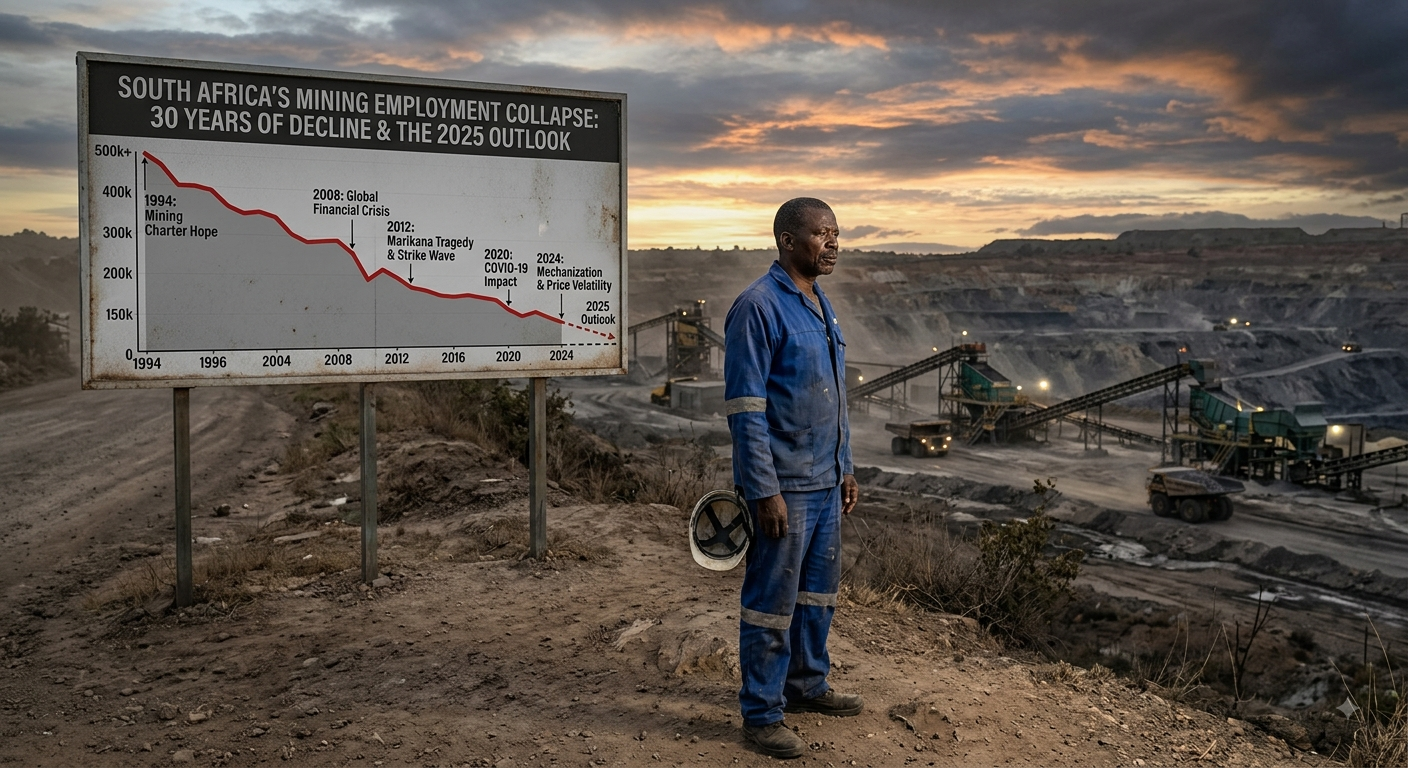
The employment story is more complicated than the phrase “mining employment collapse” suggests. South Africa did not experience a continuous decline from 1994 to 2025. Mining employment fell sharply during the late 1990s and reached roughly 400,000 around 2000, subsequently recovered to more than 500,000 by 2012, and then entered another period of weakness. (Parliamentary Monitoring Group)
By 2024, Minerals Council data put direct mining employment at 473,484 employees, while the Department of Mineral and Petroleum Resources reports approximately 460,000 employees in 2025. Differences between datasets reflect different measurement periods and definitions, so these figures should not be treated as contradictory without considering their statistical basis. (Minerals Council SA)
The deeper structural issue is therefore not simply that “mining jobs disappeared.” Rather, South Africa has struggled to translate its enormous mineral endowment into sustained employment growth, new mine development, exploration, beneficiation and broader industrialisation.
The principal causes include the maturation and depletion of some historically dominant mines, increasing extraction costs, declining gold production, mechanisation and productivity improvements, electricity constraints, rail and port bottlenecks, regulatory uncertainty, inadequate exploration, community and infrastructure challenges, and competition for international mining capital.
The 2025 outlook nevertheless contained important opportunities. Higher mineral demand associated with electrification, renewable energy, batteries, infrastructure and advanced manufacturing could create a new mining cycle—provided South Africa can improve logistics, electricity reliability, exploration, permitting, investment conditions, skills and downstream mineral processing.
1. Introduction
Mining has historically been one of the foundations of South Africa’s modern economy.
Gold, diamonds, coal, platinum-group metals, manganese, iron ore, chrome and other minerals helped build the country’s industrial infrastructure, financial system, transport networks and export economy.
Yet the employment architecture of mining has changed dramatically.
The twentieth-century mining model depended heavily on large underground workforces. Modern mining increasingly depends on combinations of:
- mechanisation;
- automation;
- remote operations;
- geological modelling;
- advanced processing;
- digital communications;
- data analytics;
- autonomous equipment;
- improved worker productivity;
- sophisticated safety systems; and
- highly specialised technical skills.
Consequently, the relationship between mineral production and employment is no longer linear.
A mine can produce more minerals while employing fewer people.
This distinction is essential when evaluating South Africa’s mining employment trajectory.
2. The Three-Decade Employment Story
2.1 1994: The beginning of the modern democratic period
In 1994, South Africa inherited a mining economy characterised by enormous mineral wealth but also by:
- deep racial inequalities;
- migrant-labour structures;
- relatively labour-intensive underground operations;
- aging infrastructure;
- declining gold grades;
- large numbers of low-skilled and semi-skilled workers;
- substantial dependence on global commodity prices.
The democratic transition therefore created an enormous policy challenge.
South Africa had to simultaneously:
- transform ownership and participation;
- improve worker rights;
- increase workplace safety;
- expand economic participation;
- maintain international investment;
- preserve mining competitiveness; and
- use mineral wealth to support wider economic development.
These objectives frequently interacted in difficult ways.
3. The First Major Employment Decline: 1994–2000
One of the most important characteristics of the post-1994 period was the contraction of traditional mining employment.
Mining employment fell to approximately 400,000 jobs around 2000, according to parliamentary documentation reviewing sector employment trends. (Parliamentary Monitoring Group)
Several forces contributed.
3.1 Gold-sector contraction
Gold was historically the dominant employer within South African mining.
However, many gold mines became progressively more difficult and expensive to operate because of:
- declining ore grades;
- increasing underground depths;
- rising energy requirements;
- difficult geological conditions;
- greater safety requirements;
- increasing labour costs;
- ageing infrastructure.
Consequently, gold’s historical employment model became progressively less sustainable.
3.2 Productivity restructuring
Mining companies increasingly sought to produce more output per employee.
The logic was straightforward:
higher productivity → lower unit costs → greater competitiveness.
However, the social consequence could be:
higher productivity → fewer workers required for a given level of production.
This created a fundamental tension between corporate competitiveness and employment creation.
4. The Recovery: 2000–2012
It would be inaccurate to describe South African mining employment as a continuous three-decade decline.
After reaching approximately 400,000 employees around 2000, employment recovered to more than 500,000 by 2012. (Parliamentary Monitoring Group)
This recovery was supported by:
- the commodity supercycle;
- strong Chinese demand;
- expansion of platinum-group metals;
- coal production;
- iron ore;
- manganese;
- renewed investment;
- relatively strong mineral prices.
This period demonstrates an important economic principle:
Mining employment responds not only to geological conditions but also to commodity prices, investment and the availability of profitable new projects.
When commodity prices and investment conditions improve simultaneously, mining companies can expand production and employment.
5. The Post-2012 Structural Decline
After the 2012 employment peak, the industry encountered increasingly difficult operating conditions.
The mining sector became exposed to a combination of:
- declining profitability at marginal operations;
- electricity shortages;
- transport constraints;
- labour disputes;
- regulatory uncertainty;
- rising operating costs;
- community conflicts;
- illegal mining;
- ageing infrastructure;
- slow permitting;
- weak exploration activity.
The result was a more difficult investment environment.
By 2024, Minerals Council figures indicated approximately 473,484 direct mining employees. (Minerals Council SA)
This means that the industry remained a very large employer, but employment was substantially below its post-2012 peak.
6. Why Gold Is Central to the Employment Story
Gold deserves particular attention because South Africa’s mining employment history is inseparable from the history of gold.
The country once possessed the world’s most powerful gold-mining industry.
But the economics of deep-level gold mining changed fundamentally.
The industry faced:
Geological pressure
Many of the richest and most accessible deposits had already been exploited.
Depth
Some operations became extraordinarily deep, increasing:
- ventilation requirements;
- cooling requirements;
- transport distances;
- worker travel times;
- energy consumption;
- engineering complexity.
Safety
Deep mining requires sophisticated engineering and extensive safety systems.
Cost
As mines mature, maintaining infrastructure becomes increasingly expensive.
Productivity
Mechanisation and improved technology reduce the number of employees required for certain activities.
The consequence is that gold production can decline while the employment decline is even more pronounced.
7. Platinum and the Changing Employment Structure
Platinum-group metals became increasingly important in the employment structure of South African mining.
South Africa possesses enormous platinum-group metal resources, particularly in the Bushveld Igneous Complex.
However, platinum mining also faces difficult economics.
Operations can experience:
- high labour costs;
- deep underground workings;
- geological complexity;
- electricity costs;
- capital requirements;
- volatile platinum-group metal prices;
- increasing mechanisation pressures.
The platinum sector therefore illustrates another central principle:
Having enormous mineral reserves does not automatically guarantee large-scale employment.
The mineral must be economically recoverable at competitive cost.
8. Mechanisation: Threat and Opportunity
Mechanisation is frequently presented as one of the causes of mining job losses.
That interpretation is partly correct but incomplete.
Mechanisation can eliminate certain repetitive and dangerous jobs while creating demand for:
- engineers;
- electricians;
- robotics technicians;
- software specialists;
- automation engineers;
- data analysts;
- maintenance specialists;
- remote-control operators;
- geological modelling specialists.
The real question is therefore not simply:
“Will automation destroy mining jobs?”
The more important question is:
Can South Africa transform displaced labour into a higher-skilled mining and industrial workforce?
That is a skills-development question as much as a technology question.
9. Electricity: A Major Competitiveness Constraint
Mining is an energy-intensive industry.
Deep mines require substantial electricity for:
- ventilation;
- refrigeration;
- pumping;
- hoisting;
- crushing;
- milling;
- processing;
- water management.
South Africa’s electricity crisis therefore directly affected mining economics.
When electricity supply became unreliable, companies faced:
- production interruptions;
- increased maintenance requirements;
- capital expenditure;
- reduced productivity;
- uncertainty about future investment.
Electricity reform has consequently become a central part of the mining employment question.
A competitive mining economy requires reliable and increasingly affordable energy.
10. Rail and Port Constraints
Mining is fundamentally connected to logistics.
A mineral deposit has little economic value if the industry cannot efficiently transport the mineral to:
- processing plants;
- domestic customers;
- ports;
- international markets.
South Africa’s freight rail and port constraints became a major limitation on mining performance.
Minerals Council assessments have specifically identified electricity and poor rail and port performance among constraints preventing the industry from responding fully to favourable commodity prices. (Business Report)
This produces a damaging economic chain:
poor rail → stockpiles → reduced exports → reduced revenue → lower investment → weaker expansion → fewer potential jobs.
11. Exploration: The Missing Employment Pipeline
One of the most important long-term problems is insufficient exploration.
Mining employment depends upon a pipeline:
geological research → exploration → discovery → feasibility study → financing → construction → production → employment.
If exploration declines today, the employment consequences may appear many years later.
South Africa therefore needs to think about mining employment not only in terms of existing mines but also in terms of the future mine-development pipeline.
A country can have enormous known mineral resources while simultaneously experiencing weak future mining investment.
12. Mining Employment in 2025
The 2025 picture was more nuanced than a simple “collapse.”
The Department of Mineral and Petroleum Resources reports approximately 460,000 mining employees in 2025. (Mineral Resources and Energy)
At the same time, Minerals Council data and later reporting indicate that mining employment actually experienced some stabilisation during parts of 2025. The council’s figures reported approximately 472,000 jobs, with employment increasing by roughly 3,000 jobs over the year in one measure. (LinkedIn)
This is important.
The 2025 outlook should therefore be described as:
structurally weak but potentially stabilising, rather than simply collapsing.
13. The Broader Labour-Market Context
Mining employment must also be considered against South Africa’s exceptionally high unemployment.
In the first quarter of 2025, total employment declined by approximately 291,000, leaving about 16.8 million employed people according to the Quarterly Labour Force Survey. (Government of South Africa)
Mining therefore represents only one component of a much larger national employment challenge.
However, mining has disproportionate importance because a mining job supports economic activity far beyond the employee.
Mining wages support:
- households;
- retailers;
- transport businesses;
- housing;
- education;
- financial services;
- local contractors;
- municipalities.
The industry therefore has a significant employment multiplier.
14. The Wage Multiplier
In 2024, mining companies paid approximately R195 billion in wages and salaries, representing around 5% of all wages paid in South Africa, according to Minerals Council data. (Minerals Council SA)
This demonstrates why mining employment cannot be evaluated solely by counting direct jobs.
The economic chain is approximately:
mine → employee → household income → consumption → local business → suppliers → tax revenue → economic activity.
Therefore, losing a mining job can have consequences extending well beyond the mine itself.
15. Illegal Mining and the Employment Crisis
Illegal mining has increasingly become associated with South Africa’s abandoned and poorly secured mining infrastructure.
The issue should not simply be interpreted as a law-enforcement problem.
It also reveals an economic problem involving:
- unemployment;
- abandoned mines;
- weak local economic opportunities;
- informal livelihoods;
- criminal networks;
- inadequate rehabilitation;
- difficulties integrating legitimate small-scale mining.
The human and safety consequences can be severe. Recent events around abandoned mining areas demonstrate the dangers associated with informal underground activity. (Reuters)
A sustainable strategy therefore requires both:
law enforcement + legitimate economic alternatives.
16. Mining’s Changing Employment Architecture
The mining job of 1994 and the mining job of 2025 are fundamentally different.
Traditional mining workforce
- rock drill operators;
- underground general workers;
- locomotive operators;
- conventional blasting teams;
- manual material handling;
- maintenance workers.
Emerging mining workforce
- automation technicians;
- robotics engineers;
- data scientists;
- remote equipment operators;
- industrial electricians;
- AI specialists;
- environmental scientists;
- geospatial analysts;
- cybersecurity specialists;
- advanced maintenance technicians.
This transition creates a strategic opportunity.
South Africa can either experience automation primarily as job displacement, or it can use automation as a mechanism for workforce upgrading.
17. Mining and the Fourth Industrial Revolution
The future mine is increasingly becoming a cyber-physical system.
A modern mine can integrate:
Sensors → communications networks → edge computing → cloud platforms → AI → digital twins → autonomous equipment → human decision-making.
For example:
- geological sensors collect information;
- telecommunications networks transmit information;
- software analyses geological conditions;
- AI identifies patterns;
- autonomous equipment executes selected tasks;
- engineers supervise operations;
- predictive maintenance reduces equipment failure.
This changes the composition of employment.
The mining industry increasingly requires people who understand both physical mining systems and digital technology.
18. The Critical Skills Gap
South Africa’s future mining employment strategy should therefore concentrate on technical skills.
Priority areas include:
Engineering
- mining engineering;
- mechanical engineering;
- electrical engineering;
- metallurgical engineering;
- civil engineering.
Digital technology
- artificial intelligence;
- machine learning;
- robotics;
- Internet of Things;
- cloud computing;
- cybersecurity;
- industrial software.
Earth sciences
- geology;
- geophysics;
- geochemistry;
- remote sensing;
- GIS.
Industrial operations
- predictive maintenance;
- automation;
- process control;
- advanced manufacturing.
The objective should be to turn the mining workforce into a high-productivity technical workforce.
19. The Investment Problem
Mining is a capital-intensive industry.
Developing a new mine can require billions of rand and many years.
Investors therefore evaluate:
- geological potential;
- electricity;
- rail;
- ports;
- taxes;
- mineral rights;
- environmental rules;
- permitting;
- labour relations;
- political stability;
- security;
- community relationships.
If the total investment risk becomes too high, capital moves elsewhere.
Consequently, mining employment is partially determined by the country’s ability to compete for global mining capital.
20. Policy Failure Versus Structural Reality
It is tempting to attribute mining employment decline entirely to government policy.
That would be too simplistic.
Some employment losses reflect unavoidable structural factors:
- depleted deposits;
- declining grades;
- mine maturity;
- technological change;
- international commodity cycles.
However, policy and infrastructure can influence whether South Africa compensates for mature mines through new investment and new discoveries.
The critical policy question is therefore:
Can South Africa replace declining mining operations with new, competitive mineral projects?
That is where exploration, infrastructure, regulatory certainty and investment conditions become crucial.
21. The 2025 Outlook
The 2025 outlook can be divided into five scenarios.
Scenario 1: Managed decline
Existing mines continue operating but new investment remains weak.
Result:
- gradual employment decline;
- ageing workforce;
- reduced investment;
- greater regional economic pressure.
Scenario 2: Stabilisation
Electricity and logistics improve sufficiently to protect existing operations.
Result:
- employment stabilises;
- productivity improves;
- some marginal mines remain viable.
Scenario 3: Mining renewal
Exploration increases, permitting improves and new mines are developed.
Result:
- construction jobs;
- new permanent mining jobs;
- supplier growth;
- additional exports.
Scenario 4: Mineral-industrial renaissance
South Africa moves beyond extraction into processing and manufacturing.
Result:
ore → concentrate → refined material → component → manufactured product.
This could create substantially more employment than exporting raw minerals.
Scenario 5: Technology-led mining economy
South Africa combines mineral resources with:
- AI;
- robotics;
- renewable energy;
- advanced processing;
- digital twins;
- autonomous equipment;
- scientific research.
This would create fewer traditional jobs but potentially more high-value technical employment.
22. The Strategic Opportunity: Critical Minerals
The global energy transition creates new demand for minerals used in:
- batteries;
- electricity networks;
- renewable-energy systems;
- electric vehicles;
- electronics;
- defence technologies;
- advanced manufacturing.
South Africa’s mineral base gives it an opportunity to participate in these emerging supply chains.
However, merely exporting minerals would capture only part of the potential value.
The greater opportunity is:
mining + refining + processing + manufacturing + technology.
23. Beneficiation as an Employment Strategy
Consider two economic models.
Model A: Raw mineral export
Mine → concentrate → port → foreign processing
Employment is concentrated primarily in extraction and logistics.
Model B: Integrated mineral economy
Mine → processing → refining → materials → components → manufacturing → exports
This creates additional employment in:
- engineering;
- metallurgy;
- chemicals;
- manufacturing;
- logistics;
- maintenance;
- research;
- technology.
Therefore, beneficiation should not be treated merely as a mining policy.
It should be treated as an industrialisation strategy.
24. A New National Mining Employment Strategy
South Africa could establish a long-term Mining Employment and Industrialisation Programme built around seven pillars.
Pillar 1 — Exploration
Create a world-class geological exploration system.
Pillar 2 — Infrastructure
Modernise:
- rail;
- ports;
- electricity;
- water;
- telecommunications.
Pillar 3 — Skills
Build mining technical colleges and university-industry programmes focused on emerging technologies.
Pillar 4 — Technology
Accelerate:
- robotics;
- automation;
- AI;
- digital twins;
- autonomous equipment.
Pillar 5 — Beneficiation
Develop domestic processing and mineral manufacturing.
Pillar 6 — Investment
Create a predictable and competitive investment environment.
Pillar 7 — Communities
Connect mining investment to:
- local suppliers;
- housing;
- education;
- infrastructure;
- entrepreneurship;
- environmental rehabilitation.
25. A 2030 Employment Architecture
The objective should not simply be to recreate the employment structure of 1980 or 1994.
That would be economically unrealistic.
The objective should be to create a higher-value mining ecosystem.
A future employment structure could contain:
| Sector | Employment function |
|---|---|
| Exploration | Geological discovery |
| Mining | Mineral extraction |
| Automation | Robotics and autonomous systems |
| Processing | Mineral upgrading |
| Refining | High-value materials |
| Manufacturing | Components and products |
| Technology | AI, software and data |
| Logistics | Rail, ports and supply chains |
| Environmental services | Rehabilitation and sustainability |
| Research | New materials and extraction technologies |
This represents a transition from a mine-centric economy to a mineral-industrial ecosystem.
26. Measuring Success Differently
South Africa should stop measuring mining success exclusively through the number of people working underground.
A better dashboard would measure:
- mining employment;
- wages;
- productivity per employee;
- exploration expenditure;
- new mines developed;
- mineral production;
- mineral exports;
- beneficiation;
- manufacturing jobs;
- local procurement;
- electricity reliability;
- rail capacity;
- port performance;
- technical skills;
- mining technology exports.
This would provide a much more sophisticated picture of the industry’s economic contribution.
27. Conclusion
South Africa’s mining employment history since 1994 is not a simple uninterrupted collapse.
It is better understood as three major phases:
1994–2000: substantial employment contraction;
2000–2012: strong employment recovery driven by the commodity boom;
2012–2025: structural stagnation and decline, followed by signs of employment stabilisation.
The underlying challenge is profound.
South Africa remains extraordinarily mineral-rich, yet its ability to convert mineral wealth into expanding employment has weakened.
The problem is not simply a shortage of minerals.
It is the interaction of:
geology + capital + infrastructure + electricity + logistics + technology + skills + regulation + investment + industrial policy.
The central strategic lesson is therefore:
South Africa cannot solve its mining employment problem simply by trying to preserve old mining jobs. It must build a new mineral economy capable of creating high-productivity employment across exploration, mining, processing, manufacturing, technology and services.
The 2025 outlook should consequently be viewed not only as a question of how many miners South Africa can employ, but as a test of whether the country can transform its extraordinary mineral endowment into a modern mineral-industrial economy.
If South Africa succeeds in combining reliable infrastructure, competitive investment conditions, exploration, technological modernisation, skills development and beneficiation, mining can remain a major employment and industrial platform well into the next generation.
If these conditions are not achieved, the country risks experiencing a slow structural contraction in traditional mining employment while simultaneously failing to create sufficient replacement employment elsewhere.
The choice is therefore not simply between mining jobs and automation.
The strategic choice is between an ageing extraction economy and a technology-enabled mineral-industrial ecosystem.
Key sources
The analysis draws particularly on the Department of Mineral and Petroleum Resources, Statistics South Africa, Minerals Council South Africa, parliamentary records and contemporary reporting on mining employment and infrastructure constraints. The Minerals Council’s Facts and Figures 2025 provides a useful industry-level statistical reference, while official government employment data provide the broader labour-market context. (Mineral Resources and Energy)





Be First to Comment