
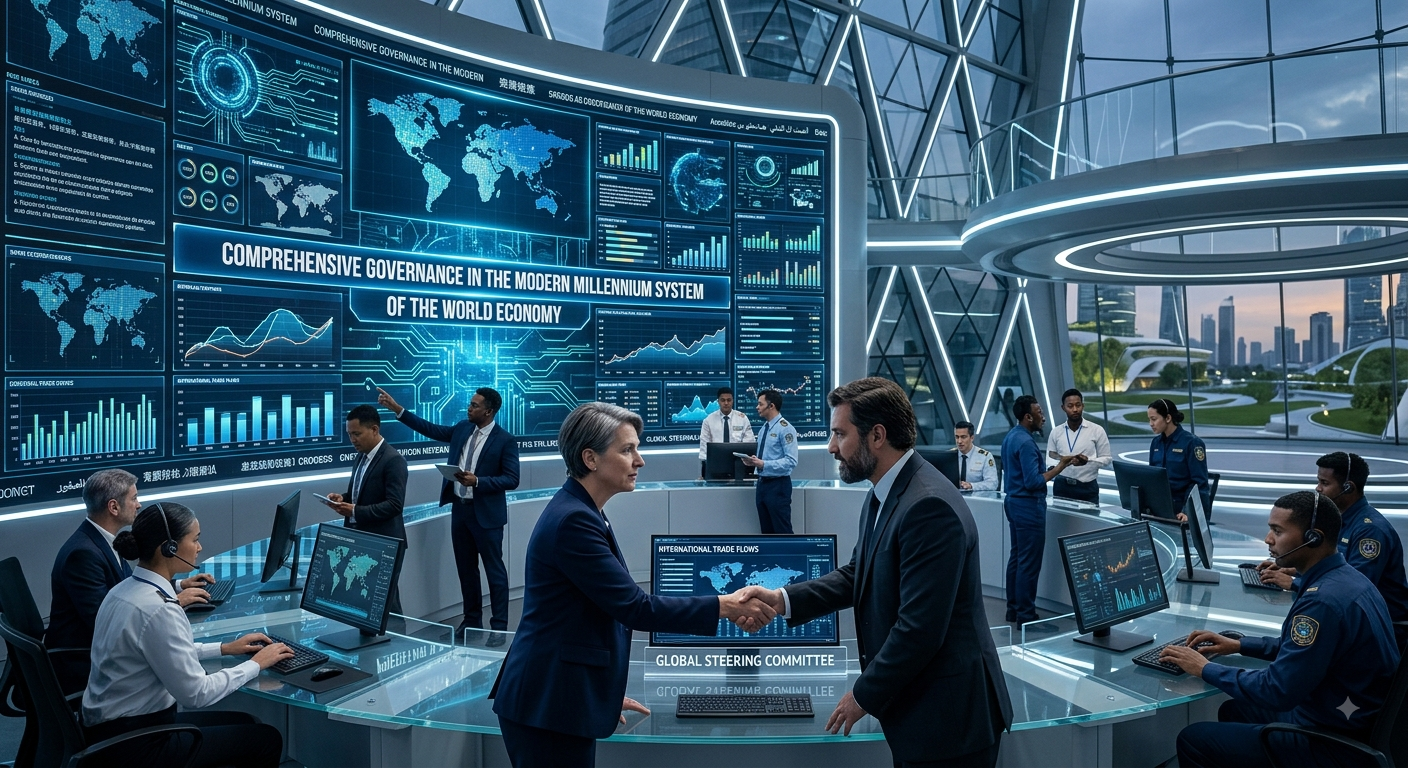
Architecture, Challenges, and Pathways Toward a Sustainable Global Order
Abstract
Governance is the architecture through which societies make collective decisions, allocate resources, establish rules, manage institutions, resolve conflicts, and coordinate economic and technological development. In the modern millennium, governance has expanded far beyond the traditional functions of governments. It now encompasses national states, cities, corporations, financial institutions, universities, civil-society organisations, international organisations, technology platforms, artificial-intelligence systems, supply chains, and increasingly interconnected digital infrastructure.
The modern world economy can therefore be understood as a multi-layered governance ecosystem. Decisions made in one country can affect energy prices, food security, semiconductor availability, currencies, migration, investment, climate conditions and technological development thousands of kilometres away.
The central governance challenge of the 21st century is consequently not merely how governments govern. It is:
How can humanity coordinate billions of people, millions of organisations, enormous technological systems and finite planetary resources while maintaining prosperity, freedom, security, accountability and sustainability?
A sustainable global order requires governance systems capable of combining economic efficiency with social legitimacy, technological innovation with human responsibility, national sovereignty with international cooperation, and present development with the interests of future generations.
1. Understanding Governance
Governance is broader than government.
Government generally refers to formal public institutions exercising authority.
Governance refers to the broader system through which collective affairs are organised.
It includes:
- laws;
- regulations;
- institutions;
- markets;
- courts;
- public administration;
- corporate governance;
- international agreements;
- financial systems;
- digital platforms;
- scientific institutions;
- civil society;
- communities;
- standards;
- social norms;
- data systems;
- accountability mechanisms.
A useful conceptual equation is:
Governance = Rules + Institutions + Decision-making + Resources + Accountability + Coordination
If one of these components fails, the governance system can become unstable.
For example:
Good rules + weak institutions = poor implementation
Strong institutions + corruption = distorted outcomes
Large resources + poor planning = waste
Advanced technology + weak governance = technological risk
Economic growth + environmental destruction = unsustainable development
Governance therefore concerns the entire architecture connecting decisions to outcomes.
2. The Evolution of Governance
Human governance has undergone several major transformations.
Stage 1 — Tribal and community governance
Early societies relied heavily on:
- elders;
- customs;
- kinship;
- traditions;
- religious authority;
- collective decision-making.
Governance was relatively local.
Stage 2 — Agricultural civilisation
The development of agriculture created:
- permanent settlements;
- taxation;
- land ownership;
- armies;
- administrative systems;
- writing;
- accounting;
- formal leadership.
Governance became more bureaucratic.
Writing was particularly important because it allowed governments to record:
- taxes;
- property;
- laws;
- inventories;
- population;
- trade.
In this sense, writing became an early information technology of governance.
Stage 3 — Nation-state governance
Over centuries, political authority increasingly became organised around territorial states.
The modern state developed institutions such as:
- legislatures;
- executive government;
- courts;
- ministries;
- central banks;
- police;
- public education;
- infrastructure agencies.
Governance became increasingly institutionalised.
Stage 4 — Industrial governance
The Industrial Revolution transformed governance because economies became much larger and more interconnected.
Governments had to manage:
- factories;
- railways;
- ports;
- labour markets;
- urbanisation;
- public health;
- banking;
- industrial standards;
- energy systems.
The state became increasingly involved in economic coordination.
Stage 5 — International governance
Industrialisation and global trade created problems that individual countries could not solve independently.
This contributed to the development of international institutions dealing with:
- trade;
- finance;
- health;
- development;
- security;
- diplomacy;
- aviation;
- telecommunications.
Stage 6 — Digital governance
The internet introduced another transformation.
Information began moving across borders almost instantaneously.
Governance now involves:
- cloud computing;
- cybersecurity;
- digital identity;
- artificial intelligence;
- algorithms;
- data governance;
- online platforms;
- digital currencies;
- telecommunications;
- autonomous systems.
Stage 7 — Millennium governance
The emerging millennium governance system is characterised by hyperconnectivity.
A country’s economy is connected to:
Energy → minerals → manufacturing → logistics → finance → telecommunications → computing → AI → consumers
A disruption anywhere can propagate throughout the network.
Governance therefore increasingly resembles ecosystem management rather than isolated administration.
3. The Architecture of the Modern World Governance System
A useful way of understanding the global system is as a hierarchy of interconnected layers.
                    HUMANITY
                       │
             ┌─────────┴─────────┐
             │ Global Governance │
             └─────────┬─────────┘
                       │
        ┌──────────────┼──────────────┐
        │              │              │
   International     Regional       National
   Institutions      Systems        Governments
        │              │              │
        └──────────────┼──────────────┘
                       │
              Local Government
                       │
              Communities/Cities
                       │
              Citizens & Firms
                       │
        ┌──────────────┼──────────────┐
        │              │              │
      Markets      Technology      Society
        │              │              │
        └──────────────┼──────────────┘
                       │
                Planetary Systems
These layers cannot operate independently.
4. The Seven Major Governance Layers
Layer 1 — Individual governance
The foundation is the individual.
People make decisions concerning:
- education;
- employment;
- entrepreneurship;
- consumption;
- savings;
- health;
- technology;
- community participation.
A governance system ultimately exists to serve human beings.
Layer 2 — Community governance
Communities coordinate:
- schools;
- local infrastructure;
- water;
- sanitation;
- local safety;
- community development;
- social services.
Strong communities provide resilience when larger institutions fail.
Layer 3 — Municipal governance
Cities are increasingly important economic governance centres.
Modern cities manage:
- transport;
- housing;
- electricity;
- water;
- waste;
- telecommunications infrastructure;
- urban planning;
- public spaces.
Because urban populations are enormous, municipal competence is becoming strategically important to national economic performance.
5. National Governance
The nation-state remains the central governance institution.
Its major responsibilities include:
Political governance
- constitutional order;
- elections;
- legislation;
- public accountability.
Economic governance
- taxation;
- public expenditure;
- monetary policy frameworks;
- industrial policy;
- investment policy;
- trade policy.
Social governance
- education;
- healthcare;
- social protection;
- housing;
- employment policies.
Infrastructure governance
- electricity;
- roads;
- railways;
- ports;
- telecommunications;
- water.
Security governance
- defence;
- policing;
- cybersecurity;
- border management.
The effectiveness of these systems strongly influences national development.
6. Corporate Governance
Corporations have become major economic institutions.
Large companies may control or influence:
- supply chains;
- technology;
- energy;
- telecommunications;
- banking;
- logistics;
- manufacturing;
- pharmaceuticals;
- digital platforms.
Corporate governance therefore involves:
Shareholders → Boards → Management → Employees → Customers → Suppliers → Regulators → Communities
Modern corporate governance increasingly needs to consider not only shareholder returns but also:
- cybersecurity;
- environmental impact;
- worker welfare;
- data protection;
- supply-chain resilience;
- ethical AI;
- long-term investment.
7. Financial Governance
The global economy depends heavily on financial architecture.
Its components include:
- central banks;
- commercial banks;
- stock exchanges;
- bond markets;
- pension funds;
- insurance companies;
- investment funds;
- payment systems;
- international financial institutions.
Financial governance determines how capital moves.
The basic economic chain is:
Savings → Capital → Investment → Production → Employment → Income → Consumption → Economic growth
If financial governance becomes unstable, the consequences can spread rapidly across countries.
8. International Governance
The international system consists of institutions and agreements designed to coordinate countries.
Important areas include:
- international peace and security;
- trade;
- development;
- financial stability;
- health;
- environmental protection;
- aviation;
- maritime systems;
- telecommunications;
- international law.
Examples include the United Nations, International Monetary Fund, World Bank and World Trade Organization.
These institutions do not constitute a single world government. Instead, they form parts of a fragmented international governance architecture.
9. Governance of the Global Economy
The modern economy operates through interconnected systems.
A simplified architecture is:
NATURAL RESOURCES
       ↓
ENERGY
       ↓
MINING & MATERIALS
       ↓
MANUFACTURING
       ↓
SEMICONDUCTORS
       ↓
COMPUTING
       ↓
TELECOMMUNICATIONS
       ↓
DIGITAL PLATFORMS
       ↓
AI & AUTOMATION
       ↓
FINANCE
       ↓
GLOBAL MARKETS
       ↓
CONSUMERS
Governance must increasingly understand this entire chain.
For example, semiconductor shortages can affect:
chips → automobiles → telecommunications → data centres → AI → industrial production
Likewise, energy shortages can affect:
electricity → manufacturing → transport → food production → employment → economic growth
This is why modern governance requires systems thinking.
10. The Infrastructure Governance Challenge
Infrastructure is the physical foundation of economic civilisation.
It includes:
- electricity;
- water;
- roads;
- bridges;
- railways;
- ports;
- airports;
- telecommunications;
- data centres;
- housing;
- hospitals;
- schools.
A sophisticated economy cannot operate without reliable infrastructure.
We can conceptualise this as:
Infrastructure × Institutions × Human Capital × Technology = Productive Capacity
If infrastructure deteriorates, economic productivity eventually suffers.
11. Digital Governance
Digital infrastructure has become a new layer of civilisation.
The modern digital ecosystem includes:
- fibre networks;
- mobile networks;
- satellites;
- cloud computing;
- data centres;
- software;
- databases;
- digital payments;
- AI systems.
Governance questions now include:
- Who controls data?
- How should personal information be protected?
- Who is responsible when algorithms cause harm?
- How should AI systems be evaluated?
- How should cybersecurity be managed?
- How should digital monopolies be regulated?
- How can digital infrastructure remain accessible?
These questions did not exist in their current form in previous centuries.
12. Artificial Intelligence and Governance
AI represents one of the largest governance transformations of the millennium.
AI can support:
- public administration;
- education;
- scientific research;
- infrastructure planning;
- disease surveillance;
- agriculture;
- logistics;
- financial analysis;
- disaster prediction;
- energy optimisation.
However, AI introduces governance challenges involving:
- reliability;
- bias;
- privacy;
- cybersecurity;
- employment disruption;
- misinformation;
- concentration of technological power;
- accountability.
A useful principle is:
The more powerful an automated decision system becomes, the more important its accountability architecture becomes.
AI governance should therefore include:
Data governance → Model governance → Deployment governance → Monitoring → Human oversight → Audit → Accountability
13. Environmental Governance
Humanity’s economic system ultimately depends on the planet.
The economy requires:
- minerals;
- water;
- forests;
- soils;
- energy;
- biodiversity;
- oceans;
- atmospheric stability.
This creates a fundamental relationship:
Planetary systems → Natural resources → Economic production → Human prosperity
If resource consumption systematically exceeds ecological regeneration, the economic system becomes vulnerable.
Sustainable governance therefore seeks to transition from:
Extract → Produce → Consume → Dispose
toward:
Design → Produce → Use → Repair → Reuse → Recover → Recycle
This is the foundation of a circular economic model.
14. Climate Governance
Climate governance is difficult because climate systems are global while political authority remains largely national.
One country can reduce emissions while another increases them.
Therefore effective climate governance requires:
- international cooperation;
- technology transfer;
- financing;
- energy transition;
- industrial transformation;
- adaptation;
- resilient infrastructure.
The challenge is particularly difficult because developing economies need economic growth while simultaneously facing environmental constraints.
15. The Global Governance Problem
The fundamental structural problem is:
Global problems are increasingly interconnected, but political authority remains divided among sovereign states.
Consider:
Climate change
Global problem → national governments.
Pandemics
Global transmission → national health systems.
Cybersecurity
Borderless networks → territorial laws.
AI
Global technology → fragmented regulation.
Financial crises
Global capital → national regulators.
Supply chains
Global production → multiple jurisdictions.
This creates a governance mismatch.
16. Major Challenges Facing Modern Governance
Challenge 1 — Institutional fragmentation
Different institutions often operate independently.
For example:
- finance;
- environment;
- energy;
- transport;
- education;
- industry
may have separate strategies.
But the real economy connects them.
Challenge 2 — Short-term political incentives
Governments often operate according to election cycles.
Infrastructure and education, however, require decades of investment.
This creates a fundamental tension:
Political time horizon ≠ infrastructure time horizon
Challenge 3 — Corruption
Corruption redirects public resources away from productive purposes.
It can cause:
- inflated contracts;
- poor infrastructure;
- weakened institutions;
- reduced investor confidence;
- declining public trust.
Anti-corruption governance therefore requires:
Transparency + independent auditing + competitive procurement + accountability + enforcement
17. Challenge — Lack of Technical Capacity
Modern governance increasingly requires sophisticated technical knowledge.
Governments must understand:
- economics;
- engineering;
- data science;
- cybersecurity;
- AI;
- energy systems;
- logistics;
- finance;
- environmental science.
A government cannot effectively manage a modern technological economy without sufficient technical expertise.
This leads to an important principle:
Administrative authority without technical competence can produce poor economic outcomes.
18. Challenge — Inequality
Economic growth does not automatically guarantee equitable distribution.
A modern governance system must therefore consider:
Growth + productivity + opportunity + social mobility
rather than GDP alone.
Important indicators include:
- employment;
- educational attainment;
- household income;
- productivity;
- access to infrastructure;
- health;
- technological access.
19. Challenge — The Digital Divide
Technology can increase productivity while simultaneously creating exclusion.
The digital divide may involve differences in:
- internet access;
- computer ownership;
- digital literacy;
- AI access;
- technical education;
- cybersecurity awareness.
A sustainable digital economy therefore requires inclusive technological infrastructure.
20. Challenge — Geopolitical Competition
The global economy is increasingly shaped by strategic competition over:
- semiconductors;
- critical minerals;
- energy;
- telecommunications;
- AI;
- biotechnology;
- space technology;
- shipping routes.
Countries increasingly recognise that technological capability is also economic and geopolitical capability.
This produces a difficult balance:
Competition ↔ Cooperation
Too little competition may reduce innovation.
Too much competition can fragment the global economy.
21. Challenge — Supply-Chain Fragility
Modern economies rely upon enormous international supply networks.
A smartphone, automobile or computer can depend on components produced across many countries.
A simplified network is:
Mining → refining → components → manufacturing → shipping → distribution → retail
Governance must therefore focus increasingly on resilience rather than efficiency alone.
The old question was:
“How cheaply can we produce this?”
The new question is:
“Can we continue producing it during disruption?”
22. Challenge — Energy Transition
Modern civilisation remains heavily dependent on energy.
The future governance challenge is balancing:
- affordability;
- reliability;
- energy security;
- industrial competitiveness;
- environmental sustainability.
The transition therefore cannot simply be understood as replacing one energy source with another.
It involves restructuring:
Mining → electricity → grids → storage → transport → industry → buildings
23. Challenge — Demographic Transformation
Different countries face different demographic realities.
Some societies face:
- ageing populations;
- declining birth rates;
- labour shortages.
Others face:
- rapidly growing youth populations;
- unemployment;
- urbanisation;
- educational pressure.
Governance must therefore align:
Population → education → skills → employment → productivity
24. Governance and Education
Education may be the most important long-term governance investment.
A modern curriculum should develop:
- mathematics;
- science;
- technology;
- economics;
- financial literacy;
- logic;
- critical thinking;
- communication;
- ethics;
- digital literacy;
- problem-solving.
The future economy increasingly rewards people who can connect different disciplines.
For example:
Mathematics + computing + economics = financial technology
Physics + materials science + engineering = advanced manufacturing
Biology + computing = biotechnology
AI + agriculture = precision agriculture
Education therefore becomes an important component of national economic infrastructure.
25. Governance as a Systems-Engineering Problem
One of the most useful ways to understand modern governance is through systems engineering.
A country can be viewed as an interconnected system:
                    GOVERNANCE
                        │
       ┌────────────────┼────────────────┐
       ↓                ↓                ↓
   EDUCATION         FINANCE          INFRASTRUCTURE
       │                │                │
       ↓                ↓                ↓
     SKILLS          CAPITAL        PRODUCTIVITY
       │                │                │
       └────────────────┼────────────────┘
                        ↓
                    INDUSTRY
                        ↓
                     JOBS
                        ↓
                    INCOME
                        ↓
                  CONSUMPTION
                        ↓
                  TAX REVENUE
                        ↓
                  PUBLIC SERVICES
                        ↓
                   HUMAN CAPITAL
This creates feedback loops.
Good governance strengthens the loops.
Poor governance can create negative loops.
26. From Government Departments to Economic Ecosystems
Traditional government often operates through departments:
Department A → Department B → Department C
Modern governance should increasingly operate through missions and ecosystems.
For example:
National industrial development mission
Education
+
Infrastructure
+
Energy
+
Finance
+
Technology
+
Manufacturing
+
Exports
This is more powerful than treating each department as an isolated organisation.
27. Data-Driven Governance
Data is becoming a critical governance resource.
A modern government should know:
- population characteristics;
- infrastructure condition;
- education outcomes;
- energy demand;
- water availability;
- economic activity;
- transport flows;
- public expenditure.
The governance cycle becomes:
Measure → Analyse → Decide → Implement → Monitor → Correct
Without measurement, governments may make decisions based on assumptions rather than evidence.
28. Performance Governance
Modern governance should move from:
“Did we spend the money?”
toward:
“What result did society receive?”
For example:
Instead of measuring only kilometres of road constructed, measure:
- travel-time reduction;
- maintenance quality;
- freight efficiency;
- accident reduction;
- economic activity generated.
This is outcome-based governance.
29. The Architecture of High-Performance Governance
A high-performance governance architecture can be represented as:
                VISION
                  ↓
             STRATEGY
                  ↓
              PRIORITIES
                  ↓
               BUDGET
                  ↓
             INSTITUTIONS
                  ↓
             IMPLEMENTATION
                  ↓
               DATA
                  ↓
            PERFORMANCE
                  ↓
               AUDIT
                  ↓
             CORRECTION
                  ↓
              LEARNING
                  ↓
             NEW STRATEGY
This creates a continuous improvement cycle.
30. The Pathway Toward Sustainable Global Order
A sustainable global order does not necessarily require a single world government.
Instead, it requires compatible governance systems capable of cooperating across borders.
The pathway can be organised around ten pillars.
Pillar 1 — Strong institutions
Institutions must be:
- competent;
- transparent;
- predictable;
- professional;
- accountable;
- resilient.
Pillar 2 — Rule of law
Economic development requires predictable rules.
Investors, citizens and businesses need confidence that:
- contracts will be respected;
- property rights will be protected;
- disputes can be resolved;
- regulations will be applied fairly.
Pillar 3 — Human capital
Countries should invest systematically in:
- education;
- science;
- engineering;
- vocational training;
- digital literacy;
- research;
- entrepreneurship.
Human capital is one of the most renewable strategic resources available to a nation.
31. Pillar 4 — Infrastructure
Future infrastructure should integrate:
- electricity;
- water;
- transport;
- telecommunications;
- digital systems;
- logistics;
- housing.
The objective should be interoperable infrastructure ecosystems.
32. Pillar 5 — Technological governance
Governments should develop the capacity to understand and regulate emerging technologies.
This includes:
- AI;
- robotics;
- biotechnology;
- quantum computing;
- advanced materials;
- cybersecurity;
- space systems.
The objective should not be to stop innovation.
It should be:
Enable innovation while managing systemic risk.
33. Pillar 6 — Sustainable economics
Economic policy should increasingly measure more than output.
A broader framework considers:
Economic prosperity + human wellbeing + environmental sustainability + resilience
This encourages long-term rather than purely short-term decision-making.
34. Pillar 7 — Global cooperation
Countries need mechanisms for cooperation concerning:
- climate;
- health;
- trade;
- financial stability;
- technology;
- migration;
- oceans;
- space;
- cybersecurity.
International cooperation is particularly important where problems cross borders.
35. Pillar 8 — Circular economy
The future economy should progressively reduce waste.
The strategic objective is:
Maximum economic value from minimum resource consumption.
This requires:
- product durability;
- repair;
- reuse;
- recycling;
- material recovery;
- industrial symbiosis;
- renewable energy.
36. Pillar 9 — Inclusive prosperity
Sustainable governance must ensure that technological progress creates broad opportunity.
This means expanding access to:
- quality education;
- infrastructure;
- finance;
- technology;
- entrepreneurship;
- employment.
Otherwise technological progress can increase social instability.
37. Pillar 10 — Intergenerational governance
Governments should consider the interests of people who do not yet exist.
This changes the question from:
“What benefits society today?”
to:
“What institutional, environmental, technological and financial system are we leaving for the next generation?”
This is the essence of intergenerational sustainability.
38. A New Millennium Governance Model
The emerging governance model can be conceptualised as:
                         HUMANITY
                            │
                 ┌──────────┴──────────┐
                 │   GLOBAL ORDER      │
                 └──────────┬──────────┘
                            │
          ┌─────────────────┼─────────────────┐
          ↓                 ↓                 ↓
      GOVERNMENT          MARKET           SOCIETY
          │                 │                 │
          └─────────────────┼─────────────────┘
                            ↓
                     TECHNOLOGY
                            ↓
                         DATA
                            ↓
                           AI
                            ↓
                     INFRASTRUCTURE
                            ↓
                        INDUSTRY
                            ↓
                       PROSPERITY
                            ↓
                    HUMAN WELLBEING
                            ↓
                     PLANETARY HEALTH
The critical insight is that these components must function as an integrated system.
39. Governance 1.0 to Governance 5.0
A useful conceptual model is:
Governance 1.0
Authority and hierarchy.
Governance 2.0
Bureaucratic institutions and law.
Governance 3.0
Democratic and market institutions.
Governance 4.0
Digital and data-driven governance.
Governance 5.0
Human-centred, AI-assisted, sustainable ecosystem governance.
Governance 5.0 would not mean replacing humans with machines.
Instead:
Human judgement + institutional knowledge + data + AI + democratic accountability
would work together.
40. The Future Role of AI Agents
AI agents could eventually assist institutions with:
- analysing budgets;
- monitoring infrastructure;
- detecting procurement anomalies;
- forecasting energy demand;
- modelling transport systems;
- analysing economic indicators;
- supporting scientific research;
- identifying service-delivery problems.
But an important governance principle must remain:
AI can assist decision-making, but accountability must remain identifiable.
An algorithm should not become an excuse for eliminating responsibility.
41. Governance and the African Century
Africa provides an important case study for modern governance.
The continent possesses enormous opportunities in:
- minerals;
- renewable energy;
- agriculture;
- young populations;
- telecommunications;
- biodiversity;
- manufacturing;
- digital services.
But converting resources into prosperity requires governance capacity.
The strategic chain is:
Natural resources → Infrastructure → Education → Technology → Manufacturing → Employment → Exports → Tax revenue → Public services → Human development
If countries export primarily raw materials while importing high-value manufactured products, much of the potential value remains outside the domestic economy.
The strategic objective should therefore increasingly involve value-chain development.
42. South Africa as a Governance Case Study
South Africa demonstrates why governance must be understood as an ecosystem.
Its economy depends upon interconnected systems involving:
- electricity;
- mining;
- ports;
- railways;
- roads;
- manufacturing;
- finance;
- telecommunications;
- education;
- municipalities.
A weakness in one major infrastructure system can propagate through the economy.
For example:
Electricity constraints → manufacturing disruption → lower production → employment pressure → reduced investment → weaker economic growth
Similarly:
Port inefficiency → delayed exports/imports → higher logistics costs → weaker industrial competitiveness
The lesson is broader than South Africa:
Modern economic governance requires managing networks rather than isolated institutions.
43. The Governance Dashboard of the Future
A future-oriented government could maintain a national real-time dashboard measuring:
Economic
- GDP;
- productivity;
- inflation;
- employment;
- investment;
- exports.
Infrastructure
- electricity availability;
- water reliability;
- road conditions;
- rail capacity;
- port performance;
- internet coverage.
Human capital
- literacy;
- mathematics;
- science;
- technical skills;
- university research;
- vocational training.
Technology
- broadband;
- computing capacity;
- AI adoption;
- cybersecurity;
- digital public services.
Environment
- water quality;
- emissions;
- biodiversity;
- waste;
- land degradation.
Governance
- procurement;
- project completion;
- expenditure;
- audit findings;
- service delivery.
This would transform government from predominantly reactive administration toward continuous system monitoring.
44. The Golden Principle of Modern Governance
The central principle can be summarised as:
Governance should convert collective resources into sustainable human capability and long-term societal value.
A government collects resources.
Institutions transform resources into programmes.
Infrastructure enables production.
Education creates capability.
Technology multiplies productivity.
Markets allocate capital and goods.
Law establishes trust.
Democracy provides legitimacy.
International cooperation manages cross-border problems.
Sustainability protects the future.
45. The Ultimate Governance Equation
A conceptual equation for sustainable governance is:
Sustainable Global Order =
Competent Institutions
× Rule of Law
× Human Capital
× Infrastructure
× Technology
× Economic Productivity
× Environmental Sustainability
× International Cooperation
× Accountability
× Social Trust
The multiplication symbol is important conceptually.
If one factor approaches zero, overall system performance can deteriorate substantially.
For example:
Advanced technology × weak institutions = technological capacity without effective governance
Natural resources × weak governance = resource wealth without broad development
Large budget × poor implementation = expenditure without outcomes
Education × no employment ecosystem = human potential without sufficient economic absorption
46. The Grand Transition
Humanity is moving through several simultaneous transitions:
Industrial → digital
Fossil-intensive → lower-carbon
Linear economy → circular economy
Manual production → automation
Information scarcity → information abundance
Traditional computing → AI computing
National production → interconnected ecosystems
Reactive government → predictive governance
Departmental administration → systems governance
These transitions are occurring simultaneously, making governance more complicated than at almost any previous point in history.
47. A 21st-Century Governance Blueprint
A high-performing governance system should therefore have the following architecture:
                     LONG-TERM VISION
                            ↓
                   NATIONAL / GLOBAL
                       STRATEGY
                            ↓
                 SCIENCE & EVIDENCE
                            ↓
                   HUMAN CAPITAL
                            ↓
                    INFRASTRUCTURE
                            ↓
                     TECHNOLOGY
                            ↓
                      INDUSTRY
                            ↓
                       MARKETS
                            ↓
                      PROSPERITY
                            ↓
                   HUMAN WELLBEING
                            ↓
                  ENVIRONMENTAL HEALTH
                            ↓
                    FUTURE GENERATIONS
                            ↺
The circular arrow represents continuous learning.
Governance should never be considered “finished.”
It should continuously:
measure → learn → adapt → improve.
48. Conclusion
The governance challenge of the modern millennium is fundamentally a challenge of coordination at unprecedented scale.
Humanity has created economic, technological and infrastructure networks of extraordinary complexity. Yet many governing institutions remain organised according to older assumptions: geographical boundaries, departmental silos, short political cycles and fragmented information.
The future requires a different architecture.
It requires governments that can think in systems, institutions that can operate with precision, economies that can innovate while remaining sustainable, educational systems that create technical capability, and international institutions capable of addressing problems that no country can solve alone.
The sustainable global order of the future should therefore rest on five fundamental foundations:
1. Competent institutions
2. Knowledge-rich societies
3. Resilient infrastructure and economic ecosystems
4. Responsible technological innovation
5. International cooperation and planetary stewardship
The deepest transformation is therefore not simply technological.
It is institutional.
Humanity already possesses extraordinary technologies. The decisive question is whether our governance systems can become sufficiently intelligent, adaptive, transparent and cooperative to use those technologies for long-term human prosperity.
In the coming decades, the most successful societies will likely not simply be those possessing the most natural resources, largest populations or most advanced machines. They will increasingly be those capable of organising knowledge, capital, people, infrastructure, technology and natural resources into coherent, resilient and continuously improving systems.
That is the central architecture of governance for the modern millennium.



Be First to Comment