
Abstract
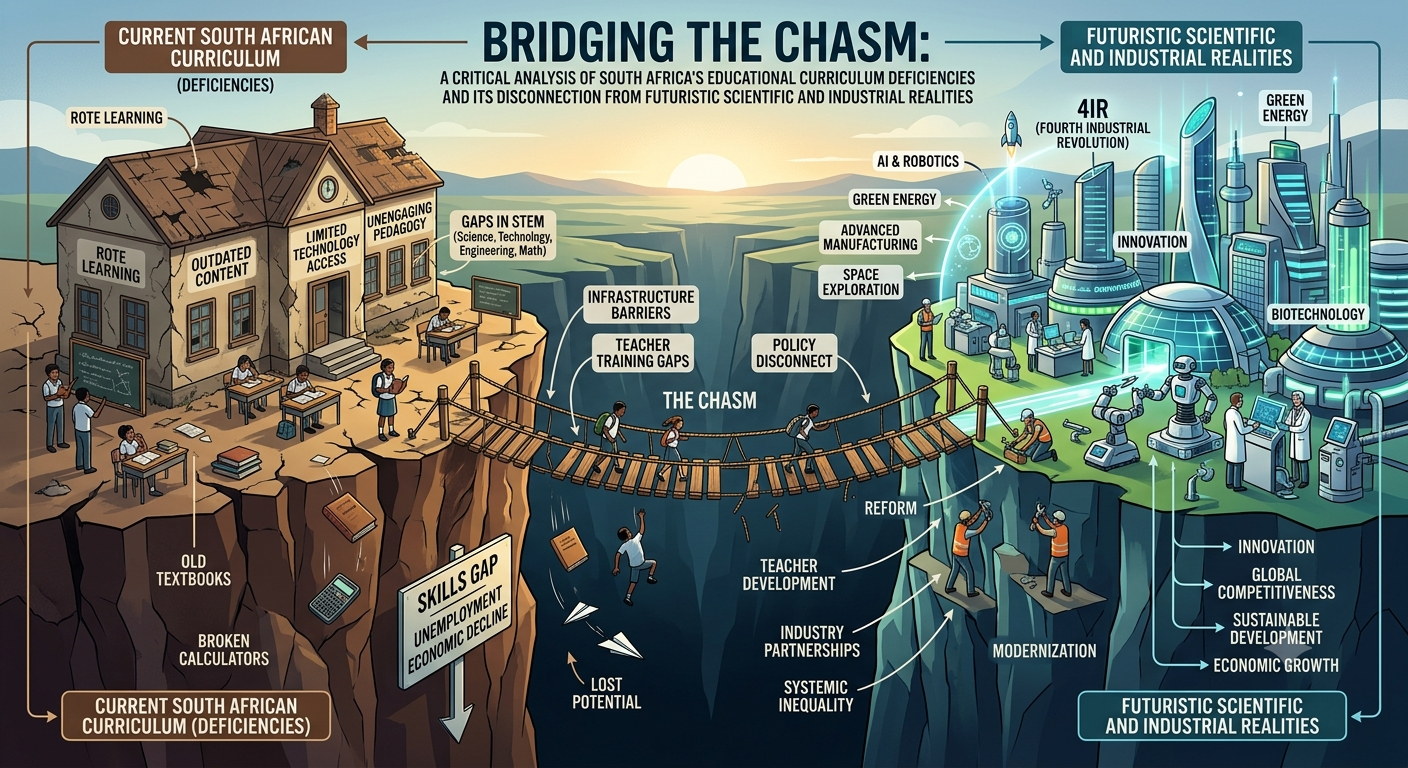
South Africa stands at a defining historical moment. While the global economy is rapidly transforming through artificial intelligence (AI), robotics, biotechnology, quantum computing, renewable energy, semiconductor manufacturing, advanced logistics, aerospace engineering, and digital ecosystems, the country’s educational curriculum continues to struggle with preparing learners for these realities. Although South Africa possesses world-class universities, scientific institutions, and a young population with immense potential, the broader curriculum remains insufficiently aligned with the emerging industrial revolution.
This article critically examines the structural gaps between South Africa’s education system and the scientific, technological, and industrial demands of the twenty-first century. It argues that education must evolve from primarily knowledge transmission toward developing innovation, systems thinking, engineering capability, entrepreneurship, computational literacy, and interdisciplinary problem-solving.
Chapter 1: Introduction
Education has always served as the foundation upon which civilizations build their economic strength, scientific advancement, and national security.
Throughout history:
- Ancient Egypt trained architects and engineers.
- Ancient China emphasized mathematics, engineering, and administration.
- Britain educated workers during the Industrial Revolution.
- Germany pioneered vocational and engineering education.
- Japan aligned education with industrial modernization.
- South Korea synchronized education with electronics and manufacturing.
- Singapore integrated education with global finance and advanced technology.
Today, nations compete through knowledge rather than merely natural resources.
The future economy increasingly rewards countries capable of producing:
- Scientists
- Engineers
- Data scientists
- AI researchers
- Semiconductor specialists
- Biotechnology experts
- Cybersecurity professionals
- Advanced manufacturing engineers
The central question is therefore:
Is South Africa’s curriculum preparing learners for tomorrow’s industries—or yesterday’s economy?
Chapter 2: The Nature of the Future Economy
The Fourth and emerging Fifth Industrial Revolutions are characterized by convergence between digital, biological, and physical systems.
Major drivers include:
- Artificial Intelligence
- Robotics
- Internet of Things (IoT)
- Autonomous transportation
- Smart cities
- Quantum computing
- Biotechnology
- Precision agriculture
- Renewable energy
- Semiconductor fabrication
- Space technologies
- Digital finance
- Industrial automation
- Additive manufacturing (3D printing)
Future employment increasingly values:
- Critical thinking
- Creativity
- Systems engineering
- Computational reasoning
- Data interpretation
- Human-AI collaboration
- Innovation management
- Lifelong learning
Chapter 3: Current Curriculum Challenges
Several structural weaknesses continue to limit the curriculum’s responsiveness to future needs.
These include:
1. Limited computational thinking from early grades
Many learners encounter programming and algorithmic thinking only in later schooling, if at all.
2. Insufficient engineering exposure
Engineering concepts are rarely introduced before tertiary education.
3. Weak integration between subjects
Mathematics, science, economics, and technology are often taught separately rather than as interconnected disciplines.
4. Limited emphasis on innovation
Learners frequently focus on memorization instead of experimentation, design, and invention.
5. Digital inequality
Access to reliable internet, devices, laboratories, and technical resources varies widely across schools, creating unequal opportunities.
Chapter 4: Missing Future-Oriented Subjects
A modern curriculum could incorporate greater exposure to areas such as:
- Artificial Intelligence fundamentals
- Machine learning concepts
- Robotics
- Coding and software engineering
- Cybersecurity
- Data science
- Semiconductor technology
- Electronics
- Systems engineering
- Renewable energy systems
- Climate technology
- Biotechnology
- Financial technology (FinTech)
- Entrepreneurship
- Supply chain management
- Industrial automation
- Space science
- Materials science
- Digital ethics
- Human-centered design
These subjects need not replace foundational literacy and numeracy; rather, they can complement them progressively through age-appropriate learning.
Chapter 5: International Lessons
Several countries have aligned education with long-term economic development.
- South Korea expanded STEM education alongside investments in electronics, shipbuilding, and semiconductors.
- Singapore emphasized mathematics, bilingual education, digital literacy, and technical skills while fostering innovation.
- Finland introduced phenomenon-based learning to connect knowledge across disciplines.
- China has increased investment in engineering, AI, advanced manufacturing, and research capacity as part of its industrial modernization.
- Germany continues to benefit from strong vocational pathways linked closely with industry.
Each country’s approach reflects its own context, but a common theme is stronger alignment between education, research, and economic priorities.
Chapter 6: Education and National Competitiveness
Education influences:
- Productivity
- Innovation
- Research capacity
- Industrial diversification
- Employment
- Economic resilience
- Global competitiveness
Countries that cultivate skilled scientists, engineers, technicians, and entrepreneurs are generally better positioned to adopt new technologies and create high-value industries.
Chapter 7: Proposed Curriculum Transformation
A future-oriented curriculum could emphasize:
Foundation Phase (Grades R–3)
- Logic
- Creativity
- Curiosity
- Basic coding concepts
- Digital citizenship
- Problem solving
Intermediate Phase (Grades 4–6)
- Robotics
- Computational thinking
- Scientific investigation
- Engineering design projects
- Environmental sustainability
Senior Phase (Grades 7–9)
- Python programming
- Electronics
- Artificial Intelligence concepts
- Entrepreneurship
- Data literacy
- Design thinking
FET Phase (Grades 10–12)
- Machine learning foundations
- Cybersecurity
- Industrial automation
- Renewable energy systems
- Biotechnology
- Supply chain management
- Financial technology
- Innovation and commercialization
Chapter 8: The Role of Teachers
Teachers remain central to curriculum transformation. Successful reform requires:
- Continuous professional development
- Access to digital teaching resources
- Partnerships with universities and industry
- Practical laboratory training
- AI-assisted instructional tools
- Supportive leadership and mentoring
Chapter 9: Industry–Education Partnerships
Closer collaboration between schools, higher education, government, and industry can help bridge the gap between learning and employment.
Potential initiatives include:
- Internship opportunities
- Apprenticeships
- Industry-sponsored laboratories
- STEM competitions
- Innovation hubs
- Coding boot camps
- University outreach programs
- Research collaborations
Chapter 10: Challenges to Reform
Curriculum reform must contend with:
- Budgetary constraints
- Infrastructure disparities
- Teacher training needs
- Digital access gaps
- Administrative capacity
- Policy continuity
- Rural–urban inequalities
Addressing these challenges requires coordinated planning, sustained investment, and broad stakeholder engagement.
Chapter 11: Recommendations
Key priorities include:
- Introduce computational thinking from the early grades.
- Expand practical STEM education with laboratory and project-based learning.
- Strengthen digital infrastructure in underserved schools.
- Increase investment in teacher training for emerging technologies.
- Build stronger partnerships between education, research institutions, and industry.
- Encourage innovation, entrepreneurship, and critical thinking across subjects.
- Develop flexible curricula that can adapt as technology evolves.
- Promote lifelong learning through accessible upskilling and reskilling opportunities.
Conclusion
South Africa possesses many of the ingredients needed to thrive in the future knowledge economy: a young population, respected universities, scientific expertise, and significant natural and human resources. The challenge is ensuring that education equips learners with the skills required for rapidly changing technological and industrial environments.
Bridging the gap between the current curriculum and future scientific realities is not solely about adding new subjects. It also involves fostering curiosity, interdisciplinary thinking, practical problem-solving, adaptability, and collaboration. By aligning education more closely with national development goals and emerging global industries, South Africa can strengthen its capacity for innovation, inclusive growth, and long-term competitiveness.


Be First to Comment