
Abstract
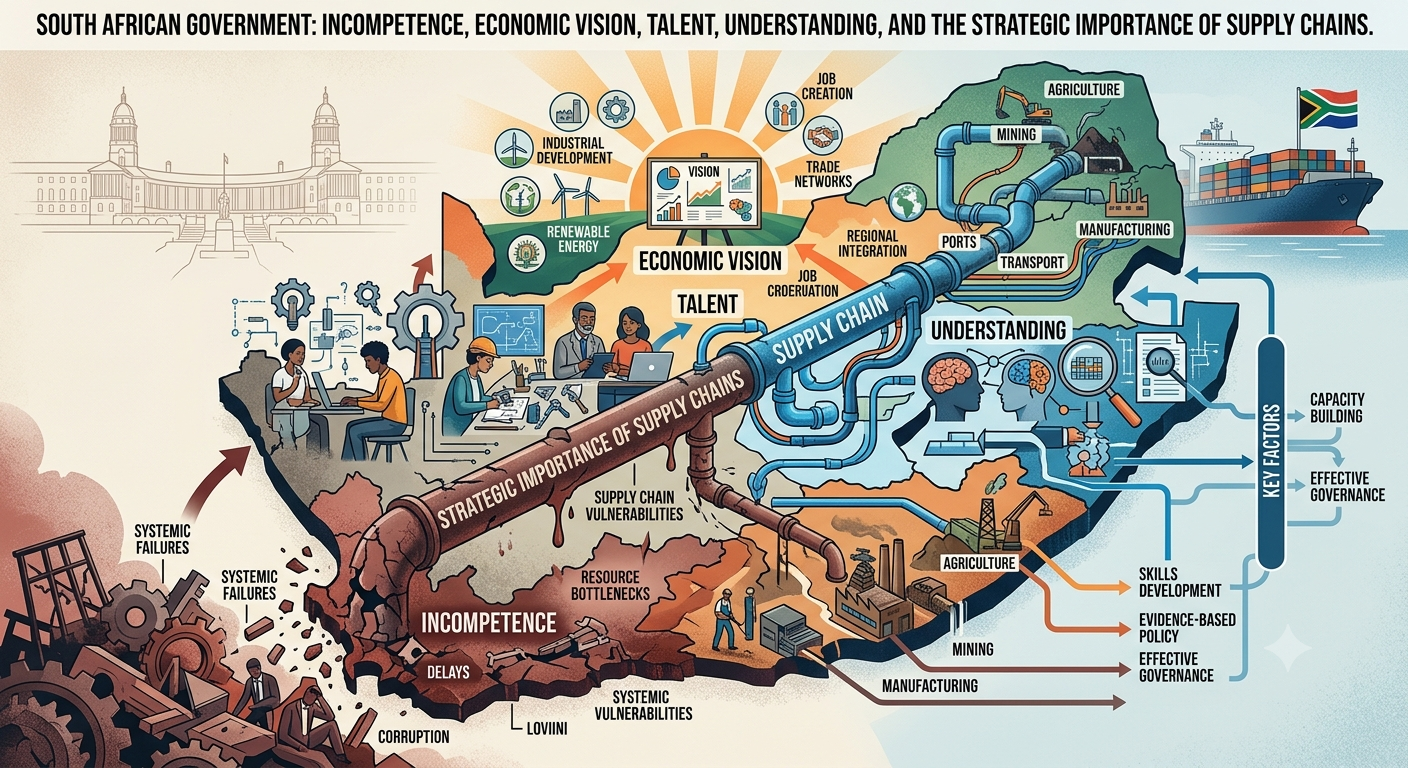
A government’s long-term success depends on five interconnected pillars:
- Competent leadership
- Strategic economic vision
- Skilled human capital
- Institutional understanding and coordination
- Efficient supply chain management
When one or more of these pillars are weak, the consequences extend across the economy, affecting infrastructure, healthcare, education, energy, public finance, industrial growth, employment, and investor confidence.
South Africa possesses abundant natural resources, advanced financial institutions, and significant industrial capabilities. However, the country has also faced persistent governance, institutional, and implementation challenges that have affected economic growth and service delivery. Understanding these issues requires distinguishing between structural constraints, policy choices, institutional capacity, and operational execution rather than attributing outcomes to any single cause.
Chapter 1: Understanding Government Competence
Government competence is the ability to:
- Make informed decisions
- Plan strategically
- Execute policies effectively
- Manage public resources responsibly
- Deliver quality public services
- Learn and improve over time
Competence is demonstrated through measurable outcomes rather than intentions.
Examples include:
- Reliable electricity
- Functional transport systems
- Efficient hospitals
- Effective schools
- Predictable regulations
- Sound public finances
Competence is ultimately reflected in citizens’ lived experiences.
Chapter 2: Understanding Incompetence
Incompetence does not necessarily imply a lack of intelligence. It often reflects gaps in systems, skills, coordination, or execution.
It may include:
- Poor planning
- Weak implementation
- Delayed decision-making
- Insufficient technical expertise
- Inadequate monitoring
- Ineffective communication
- Poor project management
Common manifestations include:
- Infrastructure delays
- Cost overruns
- Procurement failures
- Weak maintenance
- Service delivery backlogs
- Underperforming state-owned entities
Chapter 3: Lack of Economic Vision
Economic vision is a long-term strategy for national development.
Countries with strong economic vision often establish priorities over decades, including:
- Industrial development
- Export competitiveness
- Skills development
- Research and innovation
- Energy security
- Digital transformation
- Infrastructure investment
Without a coherent long-term vision, governments may face:
- Short-term policy shifts
- Uncertain investment environments
- Fragmented industrial policies
- Slower productivity growth
- Missed opportunities in emerging industries
Chapter 4: Importance of Talent
Government increasingly relies on specialized expertise.
Critical skills include:
- Economists
- Engineers
- Scientists
- Data analysts
- Financial managers
- Procurement specialists
- Logistics experts
- Urban planners
- Cybersecurity professionals
- Project managers
Strong institutions typically combine technical expertise with accountability and continuity.
Chapter 5: Understanding Complex Systems
Modern governments operate highly interconnected systems.
For example:
Healthcare depends on:
- Medicine procurement
- Transport
- Warehousing
- Information systems
- Human resources
- Electricity
- Water
- Financial management
Weakness in one area can affect the entire system.
Chapter 6: Why Supply Chains Matter
A supply chain is the coordinated movement of goods, services, information, and finances from origin to end user.
Government supply chains support:
- Hospitals
- Schools
- Police services
- Water systems
- Electricity infrastructure
- Roads
- Ports
- Railways
- Municipal services
Efficient supply chains improve:
- Service delivery
- Cost control
- Reliability
- Transparency
- Emergency preparedness
Chapter 7: Supply Chain Management in Government
Public sector supply chain management generally includes:
- Planning
- Budgeting
- Procurement
- Contract management
- Logistics
- Warehousing
- Distribution
- Inventory management
- Asset management
- Performance evaluation
Weaknesses at any stage can increase costs and reduce effectiveness.
Chapter 8: Economic Consequences of Weak Supply Chains
Challenges in supply chain management may contribute to:
- Delayed infrastructure projects
- Higher project costs
- Interruptions in medicine availability
- Delays in school resource delivery
- Increased maintenance backlogs
- Lower investor confidence
- Reduced industrial competitiveness
Over time, these issues can affect productivity and economic growth.
Chapter 9: International Lessons
Several countries have strengthened public administration by focusing on long-term institutional capacity.
Examples include:
- Singapore, which invested in professional public administration and strategic planning.
- South Korea, which aligned industrial policy, education, and infrastructure development.
- China, which expanded manufacturing capacity alongside logistics, ports, and transport infrastructure over several decades.
Each country followed a different path shaped by its own institutions and history, but all emphasized long-term planning and administrative capability.
Chapter 10: South Africa’s Strategic Opportunities
South Africa has significant strengths, including:
- Rich mineral resources
- Sophisticated banking and financial systems
- Established manufacturing sectors
- Advanced universities
- Strategic ports
- Extensive road networks
- Strong legal and constitutional institutions
- A young population with potential for skills development
Realizing these advantages depends on continued improvements in governance, infrastructure, education, regulatory certainty, and institutional effectiveness.
Chapter 11: Building Government Excellence
Potential areas of focus include:
- Strengthening professional public service capacity
- Investing in technical and managerial skills
- Improving project planning and execution
- Expanding digital government systems
- Enhancing procurement transparency
- Using data for evidence-based decision-making
- Strengthening monitoring and evaluation
- Supporting collaboration across national, provincial, and municipal levels
Chapter 12: Conclusion
The effectiveness of a modern government is determined not only by its policies but also by its ability to implement them consistently and efficiently. Competence, strategic vision, skilled personnel, institutional understanding, and well-managed supply chains reinforce one another. Weaknesses in these areas can contribute to slower economic growth, higher public costs, and reduced service delivery, while sustained investment in institutional capability can improve resilience, productivity, and public trust.
For South Africa, continued progress will depend on combining long-term economic planning with strong public administration, transparent governance, effective supply chain management, and ongoing investment in human capital. These foundations can help support inclusive growth, improved public services, and greater competitiveness in the global economy.






Be First to Comment