
Comprehensive Thesis
Abstract
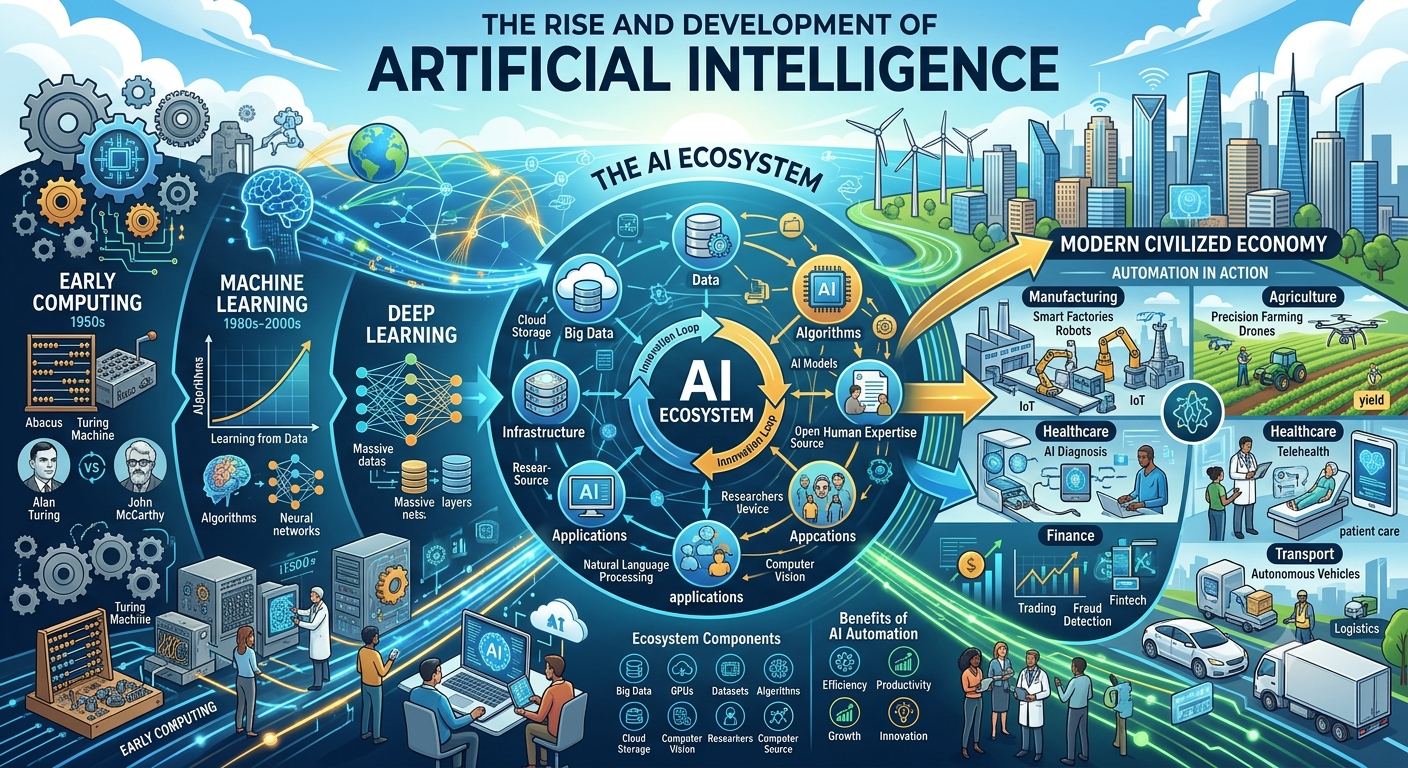
Artificial Intelligence (AI) has become one of the defining technologies of the twenty-first century. Together with automation, cloud computing, semiconductor innovation, robotics, big data, and telecommunications, AI is reshaping nearly every sector of the global economy. Rather than replacing human civilization, AI is increasingly functioning as a general-purpose technology—similar in historical significance to electricity, the steam engine, and the internet—enhancing productivity, accelerating scientific discovery, improving decision-making, and creating new industries.
This thesis examines the historical development, technological architecture, economic ecosystem, industrial applications, strategic importance, societal implications, future trends, and governance challenges of AI and automation.
Table of Contents
- Introduction
- Historical Evolution of Artificial Intelligence
- The AI Ecosystem
- Core Technologies Behind AI
- Automation Revolution
- AI Infrastructure
- AI Value Chain
- Industrial Applications
- AI in Business
- AI in Government
- AI in Science
- AI and Economic Growth
- Global AI Competition
- AI Risks
- Ethical AI
- Future of AI
- Conclusion
Chapter 1
Introduction
Artificial Intelligence refers to computer systems capable of performing tasks that traditionally require human intelligence, including:
- Learning
- Reasoning
- Planning
- Language understanding
- Vision
- Decision making
- Prediction
- Creativity
Modern AI combines mathematics, statistics, neuroscience, computer science, engineering, and economics.
Today’s AI economy includes:
- Machine Learning
- Deep Learning
- Robotics
- Automation
- Cloud Computing
- Edge Computing
- Data Centers
- Semiconductor Manufacturing
- Cybersecurity
- Digital Twins
- Autonomous Systems
- Large Language Models (LLMs)
- Agentic AI
Together these form the AI ecosystem.
Chapter 2
History of Artificial Intelligence
1943–1955: Foundations
Scientists developed mathematical models of artificial neurons.
Key milestones:
- Artificial neuron concept
- Boolean logic
- Early computing machines
- Information theory
1956: Birth of AI
The field formally emerged at the historic Dartmouth Summer Research Project on Artificial Intelligence, where researchers proposed that aspects of intelligence could be described precisely enough for machines to simulate them. Dartmouth Summer Research Project on Artificial Intelligence
1960–1980
Research focused on:
- Expert systems
- Rule engines
- Symbolic reasoning
- Planning systems
Computers remained limited.
1980–2000
Rise of:
- Machine Learning
- Statistical methods
- Neural networks
- Data mining
- Internet expansion
2010–2020
Deep Learning revolution
Advances included:
- GPUs
- Big Data
- Cloud Computing
- Speech Recognition
- Image Recognition
2020–Present
Generative AI transformed:
- Education
- Programming
- Research
- Design
- Healthcare
- Finance
- Manufacturing
Large Language Models became mainstream.
Chapter 3
Anatomy of the AI Ecosystem
The AI ecosystem consists of interconnected layers.
Layer 1
Natural Resources
- Silicon
- Gallium
- Germanium
- Rare Earth Elements
- Copper
- Electricity
↓
Layer 2
Semiconductor Industry
- Chip Design
- Wafer Manufacturing
- Lithography
- Packaging
- Testing
↓
Layer 3
Computing Infrastructure
- CPUs
- GPUs
- TPUs
- NPUs
- AI Accelerators
↓
Layer 4
Data Centers
Provide:
- Storage
- Networking
- AI Training
- AI Inference
↓
Layer 5
Cloud Computing
Provides:
- Scalable computing
- Databases
- AI platforms
- APIs
↓
Layer 6
Data
The “fuel” of AI:
- Images
- Video
- Audio
- Medical records
- Scientific data
- Financial transactions
- Industrial sensor data
↓
Layer 7
Machine Learning Models
Examples:
- Recommendation systems
- Fraud detection
- Forecasting
- Image recognition
- Language models
↓
Layer 8
Applications
- Healthcare
- Banking
- Manufacturing
- Retail
- Agriculture
- Mining
- Logistics
- Education
- Government
Chapter 4
Core AI Technologies
Machine Learning
Machines learn patterns from data.
Applications:
- Credit scoring
- Medical diagnosis
- Demand forecasting
Deep Learning
Uses artificial neural networks.
Applications:
- Vision
- Speech
- Translation
Computer Vision
Allows computers to understand images.
Used in:
- Self-driving cars
- Security
- Agriculture
- Manufacturing
Natural Language Processing
Enables machines to understand language.
Examples:
- Translation
- Chatbots
- Summarization
- AI assistants
Reinforcement Learning
Systems learn through rewards.
Applications:
- Robotics
- Games
- Industrial optimization
Generative AI
Creates:
- Images
- Video
- Code
- Music
- Documents
Agentic AI
AI systems increasingly coordinate multiple tools and carry out sequences of tasks with limited human supervision, while people remain responsible for setting objectives and providing oversight.
Chapter 5
Automation Revolution
Automation refers to machines performing work with minimal human intervention.
Evolution:
Manual Labor
↓
Mechanization
↓
Industrial Automation
↓
Computer Automation
↓
Digital Automation
↓
Artificial Intelligence
↓
Autonomous Systems
Types include:
- Factory automation
- Warehouse automation
- Office automation
- Banking automation
- Healthcare automation
- Agricultural automation
- Mining automation
Benefits
- Higher productivity
- Lower costs
- Better quality
- Faster production
- Greater safety
- Consistency
Chapter 6
AI Infrastructure
The digital infrastructure supporting AI includes:
Data Centers
Functions:
- AI training
- Cloud computing
- Storage
- Networking
Electricity
AI consumes significant electrical power.
Future AI depends upon:
- Renewable energy
- Nuclear power
- Smart grids
- Energy storage
Networking
High-speed communication relies on:
- Fiber optics
- 5G
- Emerging 6G research
- Satellites
Cooling Systems
Modern AI servers require:
- Liquid cooling
- Air cooling
- Immersion cooling
Chapter 7
AI Value Chain
Natural Resources

↓

Semiconductors

↓

Electronics

↓

Servers

↓

Data Centers

↓

Cloud

↓

Foundation Models

↓

Applications

↓

Businesses

↓

Consumers

↓

Economic Growth
Chapter 8
AI Across Industries
Healthcare
- Disease diagnosis
- Drug discovery
- Personalized medicine
- Medical imaging
Manufacturing
- Predictive maintenance
- Quality inspection
- Robotics
- Process optimization
Agriculture
- Precision farming
- Soil analysis
- Smart irrigation
- Crop monitoring
Mining
- Autonomous haul trucks
- Mineral exploration
- Safety monitoring
- Equipment optimization
Banking
- Fraud detection
- Credit risk
- Algorithmic trading
- Customer service
Education
- Personalized learning
- Automated assessment
- Tutoring systems
- Research assistance
Transportation
- Route optimization
- Fleet management
- Traffic prediction
- Driver assistance
Chapter 9
AI and the Modern Economy
AI contributes to:
Productivity
Automation reduces repetitive work while allowing workers to focus on higher-value tasks.
Innovation
AI accelerates:
- Scientific research
- Engineering
- Drug discovery
- Materials science
Entrepreneurship
AI lowers barriers for startups by providing tools for software development, design, customer support, and data analysis.
Employment
AI changes the mix of skills demanded in the labor market. Some tasks become automated, while new roles emerge in AI development, oversight, integration, cybersecurity, data management, and human-centered services.
Chapter 10
AI in Government
Governments increasingly use AI for:
- Tax administration
- Fraud detection
- Urban planning
- Healthcare planning
- Disaster response
- Environmental monitoring
- Public safety analysis
Responsible deployment requires transparency, accountability, and protection of citizens’ rights.
Chapter 11
AI in Scientific Discovery
AI accelerates:
- Protein structure prediction
- Climate modeling
- Astronomy
- Materials discovery
- Genomics
- Physics simulations
These capabilities complement human expertise and can shorten research cycles.
Chapter 12
AI and GDP Growth
AI can contribute to economic development by:
- Increasing labor productivity
- Improving capital efficiency
- Enhancing supply chains
- Supporting innovation
- Enabling higher-value exports
- Strengthening digital industries
Countries that invest in education, digital infrastructure, research, and sound institutions are generally better positioned to benefit from AI-driven growth.
Chapter 13
Global AI Competition
Major areas of competition include:
- Semiconductor manufacturing
- Advanced computing hardware
- Foundation models
- Robotics
- Cloud infrastructure
- Scientific research
- Talent development
- AI regulation
- Cybersecurity
- Data infrastructure
Long-term competitiveness depends on sustained investment in research, education, infrastructure, and international collaboration.
Chapter 14
Risks and Challenges
Major concerns include:
- Bias in AI systems
- Privacy risks
- Cybersecurity threats
- Misinformation and synthetic media
- Job displacement in some occupations
- High energy consumption
- Concentration of computing resources
- Intellectual property disputes
Addressing these challenges requires technical safeguards, governance, and public trust.
Chapter 15
Principles of Responsible AI
A trustworthy AI ecosystem should emphasize:
- Fairness
- Transparency
- Accountability
- Privacy protection
- Security
- Human oversight
- Reliability
- Environmental sustainability
- Compliance with laws and regulations
Chapter 16
Future Outlook (2026–2050)
Expected developments include:
- More capable multimodal AI systems
- Wider adoption of autonomous robots in logistics, manufacturing, and agriculture
- AI-assisted scientific discovery at greater scale
- Smarter energy grids and infrastructure
- Personalized education and healthcare
- Human-AI collaboration becoming a standard feature of many professions
- Increased focus on efficient AI hardware and sustainable computing
The pace and direction of these changes will depend on technological advances, public policy, economic incentives, and societal choices.
Chapter 17
Conclusion
Artificial Intelligence has evolved from a theoretical concept into one of the foundational technologies of the modern economy. Its ecosystem spans natural resources, semiconductor manufacturing, computing infrastructure, data centers, cloud platforms, algorithms, applications, and skilled human talent. Automation powered by AI is transforming industries by improving productivity, enabling innovation, and supporting scientific progress.
The greatest long-term value of AI is likely to come not from replacing people, but from augmenting human capabilities—helping individuals, businesses, researchers, and governments solve increasingly complex problems. Achieving these benefits will require continued investment in education, digital infrastructure, responsible governance, and international cooperation so that AI remains a force for inclusive and sustainable economic development.


Be First to Comment