
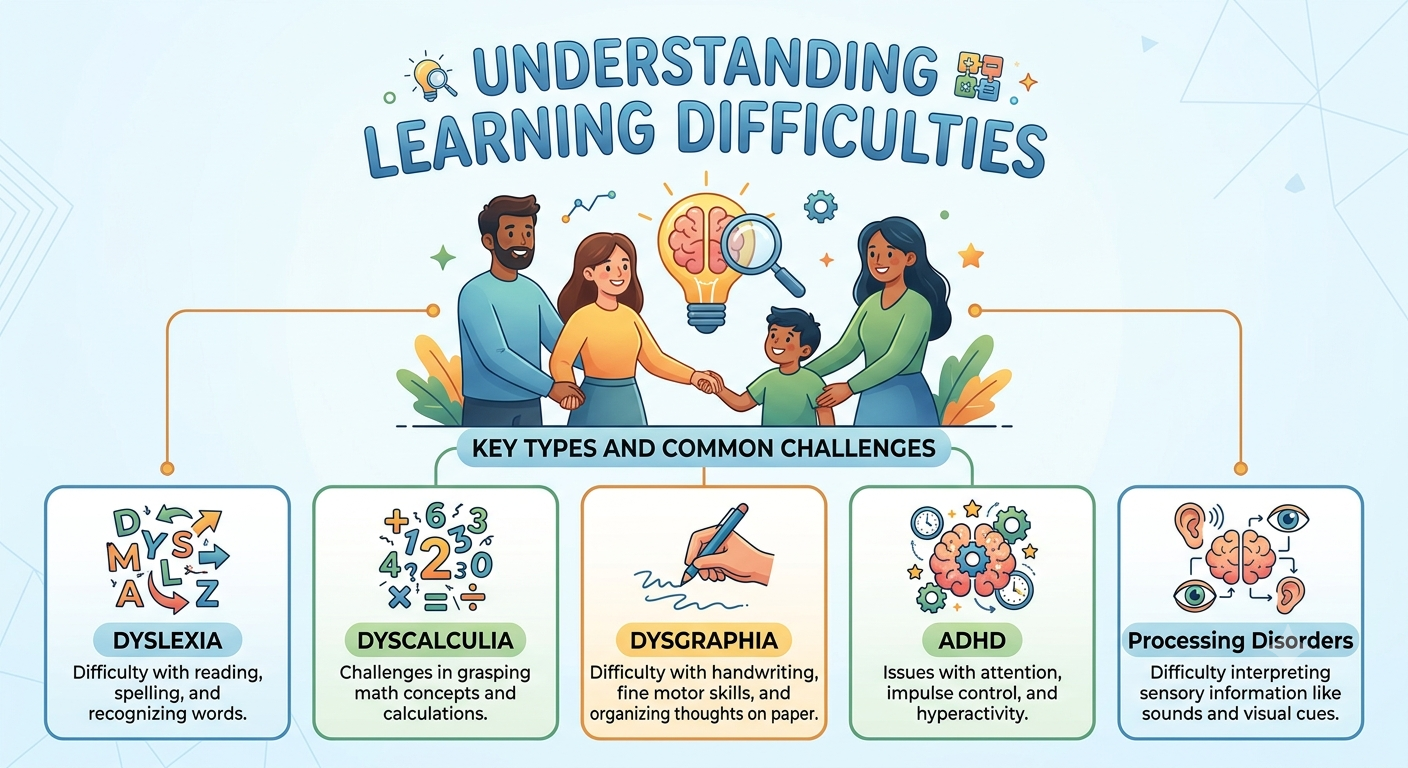
Learning difficulties (or learning disabilities in some countries) are neurological differences that affect how individuals receive, process, store, or communicate information. They are unrelated to intelligence. A person may have average or above-average intelligence while experiencing significant difficulty in specific academic areas.
Common examples include:
- Dyslexia – affects reading, spelling, and language processing.
- Dyscalculia – affects understanding numbers and mathematical reasoning.
- Dysgraphia – affects writing, spelling, and fine motor coordination.
- Attention-Deficit/Hyperactivity Disorder (ADHD) – can affect attention, organization, and impulse control.
These challenges may make schoolwork more demanding, but they do not determine a person’s potential.
Learning difficulties are often viewed only in terms of the obstacles they create in education. However, history, neuroscience, psychology, and education research all show that, with appropriate support and opportunities, many people develop valuable strengths alongside these challenges. Learning difficulties do not automatically produce strengths, but the process of adapting to them can foster resilience, creativity, problem-solving abilities, and persistence.
How Challenges Can Become Strengths
1. Building Resilience
Students with learning difficulties often encounter setbacks more frequently than their peers. When supported by teachers, families, and appropriate interventions, overcoming these obstacles can strengthen resilience.
Resilience includes:
- Recovering after failure
- Adapting to change
- Managing frustration
- Maintaining motivation
- Developing emotional maturity
Over time, these experiences can prepare individuals for challenges in higher education, careers, and life.
2. Developing Creative Thinking
Because conventional learning methods may not always work, many learners develop alternative approaches.
Examples include:
- Visual thinking
- Storytelling
- Pattern recognition
- Hands-on experimentation
- Practical problem-solving
Rather than following standard methods, they often learn to invent new ways to understand information.
3. Strengthening Problem-Solving Skills
Daily learning often requires creative strategies such as:
- Breaking complex tasks into smaller steps
- Using memory techniques
- Organizing information differently
- Using technology effectively
- Seeking alternative explanations
These experiences build flexible thinking that can be valuable in many professions.
4. Increasing Determination
Repeated effort despite setbacks can strengthen perseverance.
Determination grows through:
- Setting goals
- Practicing consistently
- Learning from mistakes
- Celebrating gradual progress
- Building confidence through achievement
This perseverance is valuable in entrepreneurship, science, engineering, sports, and many other fields.
The Science Behind Adaptation
The human brain has an ability known as neuroplasticity, meaning it can adapt by strengthening existing neural pathways and forming new ones through learning and practice.
With appropriate teaching, interventions, and repetition, people often improve skills while developing compensatory strategies that make use of their individual strengths.
Emotional Growth
Successfully navigating learning challenges can contribute to:
- Greater empathy for others
- Patience
- Self-awareness
- Emotional regulation
- Confidence built through effort rather than effortless success
These qualities support healthy relationships and effective leadership.
Technology as an Equalizer
Modern technology helps many learners overcome barriers.
Examples include:
- Text-to-speech software
- Speech-to-text tools
- AI tutoring systems
- Audiobooks
- Digital note-taking
- Smart organization apps
These tools reduce barriers and allow individuals to focus on understanding concepts and expressing ideas.
Famous Individuals Who Faced Learning Challenges
Many accomplished people have spoken about learning differences, including:
- Richard Branson
- Steven Spielberg
- Whoopi Goldberg
- Anderson Cooper
Their success reflects a combination of talent, opportunity, persistence, and support—not learning difficulties alone.
Practical Strategies for Turning Challenges into Strengths
Effective approaches include:
- Recognize individual strengths alongside areas of difficulty.
- Set realistic, measurable goals.
- Use evidence-based learning strategies such as spaced practice and retrieval practice.
- Build supportive relationships with teachers, mentors, and family.
- Use assistive technology when appropriate.
- Encourage a growth mindset—the understanding that abilities can improve with effective practice.
- Celebrate progress, not just perfect performance.
- Develop organizational and time-management skills.
- Learn self-advocacy by communicating needed accommodations.
- Maintain physical health through sleep, exercise, and balanced nutrition.
Benefits Beyond School
The skills developed while managing learning difficulties often transfer to many areas of life:
| Challenge | Possible Strength Developed |
|---|---|
| Reading difficulties | Strong listening and verbal communication |
| Writing challenges | Creative verbal expression and presentation skills |
| Mathematics difficulties | Innovative practical problem-solving |
| Attention challenges | High energy, adaptability, and creativity (for some individuals) |
| Repeated setbacks | Persistence and resilience |
| Need for alternative methods | Flexible thinking and innovation |
These strengths vary from person to person and are not guaranteed, but they can emerge when individuals receive effective support.
The Role of Families and Schools
Supportive environments make a significant difference. Families and educators can:
- Identify learning difficulties early.
- Provide appropriate interventions.
- Focus on strengths as well as challenges.
- Encourage curiosity and confidence.
- Teach practical learning strategies.
- Foster inclusion and understanding.
Such support helps learners reach their potential.
Conclusion
Learning difficulties are real challenges that can affect academic progress and daily life. They should not be minimized. At the same time, with appropriate instruction, encouragement, and access to effective tools, many individuals develop qualities such as resilience, creativity, adaptability, and determination. These strengths can contribute to success in education, careers, and personal life.
The most important message is that learning difficulties do not define a person’s intelligence or future. With the right support and opportunities, they can become part of a journey that develops both competence and character.





Be First to Comment