
Abstract
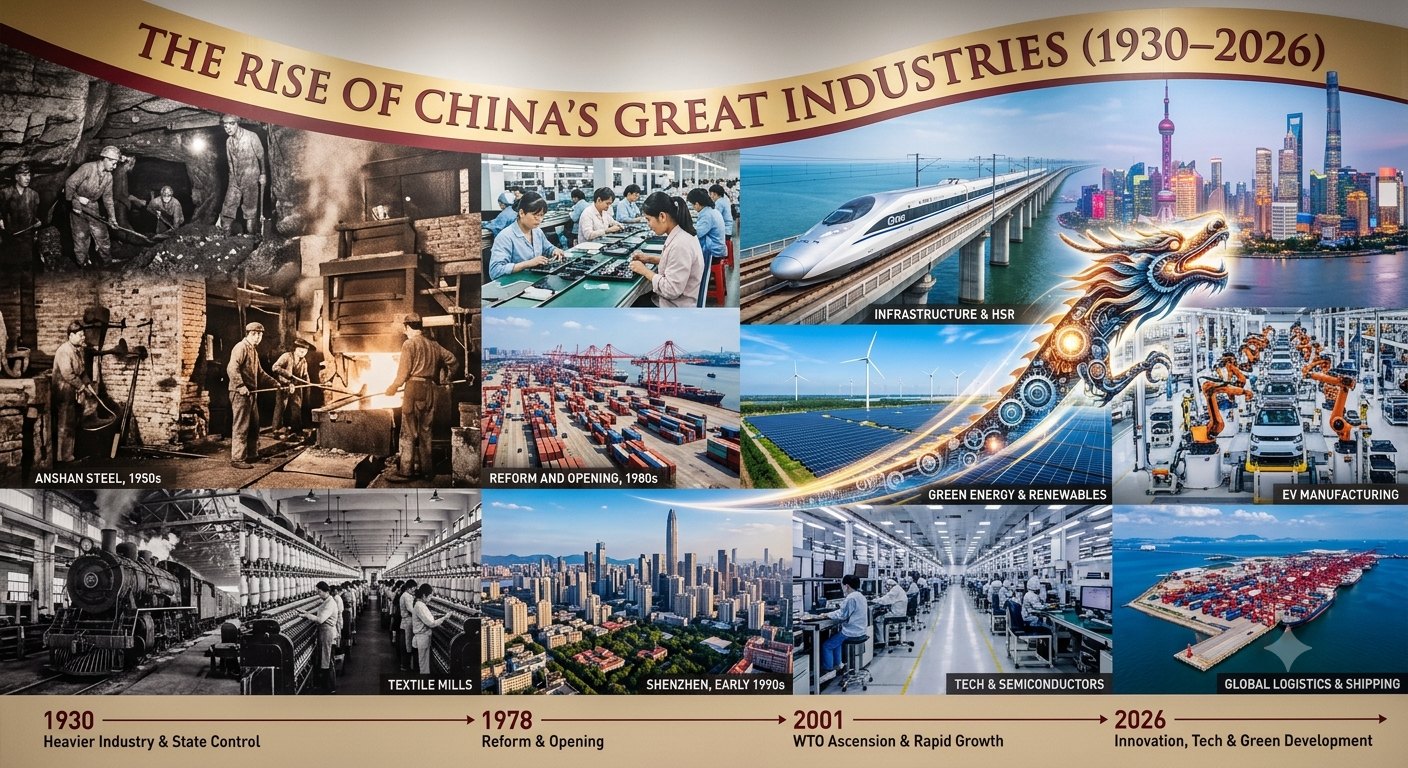
China’s industrial rise is one of the most remarkable economic transformations in human history. Between the 1930s and 2026, China evolved from a predominantly agrarian economy disrupted by war into the world’s largest manufacturing nation and a global leader in infrastructure, renewable energy, high-speed rail, consumer electronics, electric vehicles, telecommunications, and increasingly advanced semiconductor manufacturing. This transformation was driven by a combination of state planning, market reforms, investment in education, infrastructure development, openness to foreign technology and investment, and long-term industrial policy. While China’s achievements have been substantial, they have also been accompanied by challenges such as regional inequality, environmental pressures, demographic change, debt, and geopolitical competition. (OUP Academic)
Chapter 1: China Before Industrial Takeoff (1930–1949)
Economic Conditions
During the 1930s China was characterized by:
- Agriculture employing over 80% of the population
- Limited industrialization concentrated around Shanghai and parts of Manchuria
- Low literacy
- Poor transportation
- Limited electricity
- Small manufacturing capacity
Political instability, civil conflict, and the Second Sino-Japanese War (1937–1945) severely disrupted industrial development, destroying factories, transport infrastructure, and productive capacity. Despite these setbacks, some industrial foundations had already been established before 1949, especially in textiles, mining, and light manufacturing. (Routledge)
Chapter 2: Early Industrial Foundations (1949–1978)
Following the establishment of the People’s Republic of China in 1949, the government adopted a Soviet-inspired centrally planned economic model.
Major priorities included:
- Heavy industry
- Steel production
- Coal mining
- Machinery manufacturing
- Hydroelectric power
- Defense industries
- Railways
Large state-owned enterprises (SOEs) became the backbone of industrial production.
Achievements included:
- Expansion of steel plants
- National electricity grid development
- Large irrigation projects
- Growth in engineering capabilities
- Improved literacy and technical education
However, this period also experienced serious disruptions, including the Great Leap Forward and the Cultural Revolution, which reduced productivity and slowed technological progress. (ScienceDirect)
Chapter 3: Reform and Opening Up (1978–1990)
A decisive turning point came in 1978 under the leadership of Deng Xiaoping.
Key reforms included:
- Market-oriented reforms
- Opening to foreign investment
- Creation of Special Economic Zones
- Export-oriented manufacturing
- Agricultural reforms
- Greater autonomy for enterprises
China began attracting multinational corporations seeking efficient manufacturing and access to a large labor force. This period marked the start of rapid industrial expansion and integration into the global economy. (China.org.cn)
Chapter 4: Manufacturing Expansion (1990–2001)
The 1990s saw the rapid growth of:
- Electronics
- Garments
- Toys
- Consumer goods
- Household appliances
- Furniture
- Chemical industries
- Steel
- Cement
China became a preferred manufacturing base due to:
- Competitive labor costs
- Large-scale industrial parks
- Expanding port infrastructure
- Reliable electricity
- Improved logistics
- Supportive industrial policies
Foreign companies increasingly established production facilities in China, transferring technology and management practices. (Lynne Rienner Publishers)
Chapter 5: WTO Accession and Global Integration (2001–2010)
China’s accession to the World Trade Organization in 2001 accelerated export growth and foreign investment.
During this decade China became:
- The world’s largest exporter of manufactured goods
- The world’s largest steel producer
- The largest cement producer
- A leading shipbuilder
- A major producer of consumer electronics
Industrial clusters emerged in regions such as the Yangtze River Delta, Pearl River Delta, and Bohai Economic Rim, supported by extensive infrastructure investments. (Nature)
Chapter 6: Moving Up the Value Chain (2010–2020)
China increasingly focused on higher-value industries:
- Robotics
- Aerospace
- Artificial intelligence
- Biotechnology
- Electric vehicles
- Renewable energy
- Telecommunications
- Advanced manufacturing
The government promoted indigenous innovation while firms expanded research and development spending. Companies such as Huawei, BYD, CATL, DJI, Lenovo, Xiaomi, and others became globally recognized in their sectors.
Chapter 7: Industrial Development (2020–2026)
Recent priorities have included:
- Semiconductor manufacturing
- Industrial automation
- Artificial intelligence
- Green energy
- Battery technology
- High-speed rail
- Smart manufacturing
- Digital infrastructure
China has also invested heavily in domestic semiconductor capabilities, although it continues to face technological and geopolitical constraints in the most advanced chipmaking equipment. (Nature)
Major Industrial Sectors
China has developed global leadership or major competitive positions in:
- Steel
- Shipbuilding
- Solar panels
- Wind turbines
- Batteries
- Electric vehicles
- Consumer electronics
- Telecommunications equipment
- Construction machinery
- High-speed rail
- Chemicals
- Textiles
- Cement
- Robotics
- E-commerce logistics
Key Drivers of Success
Several interconnected factors contributed to China’s industrial rise:
- Long-term industrial planning
- Massive infrastructure investment
- High domestic savings and investment rates
- Expansion of technical and higher education
- Integration into global trade
- Attraction of foreign direct investment
- Development of industrial clusters
- Large domestic market
- Continuous improvements in logistics and manufacturing capabilities
- Increasing investment in research and development. (OUP Academic)
Infrastructure as an Industrial Foundation
China invested extensively in:
- Expressways
- High-speed rail
- Deep-water ports
- Airports
- Hydropower
- Ultra-high-voltage electricity transmission
- Industrial parks
- Broadband and 5G networks
These investments reduced transportation costs, improved connectivity, and supported large-scale manufacturing.
Science and Technology
China’s scientific capabilities expanded through:
- Growth in engineering graduates
- Increased R&D spending
- National laboratories
- University–industry collaboration
- Technology parks
- Patent generation
- Industrial innovation ecosystems
Challenges
Despite its achievements, China faces important structural challenges:
- Population aging
- Slower labor-force growth
- Environmental pollution and climate commitments
- Local government debt
- Real-estate sector adjustment
- Income and regional inequality
- Dependence on some foreign technologies
- Trade tensions and export controls affecting advanced technologies. (Nature)
Global Significance
China’s industrial transformation has reshaped global production networks by:
- Lowering manufacturing costs for many goods
- Expanding global supply chains
- Accelerating renewable energy deployment
- Increasing competition in advanced manufacturing
- Influencing international infrastructure development through overseas investment
Its experience is widely studied as an example of rapid industrialization, though many analysts note that China’s specific historical, institutional, demographic, and geopolitical circumstances are difficult to replicate directly in other countries. (OUP Academic)
Conclusion
The rise of China’s industries from the 1930s to 2026 represents a long-term transformation rather than a single event. Early industrial foundations, post-1949 state-led development, the market reforms initiated in 1978, integration into the global economy, sustained infrastructure investment, educational expansion, and growing technological capabilities collectively enabled China to become the world’s largest manufacturing economy. While future growth will depend increasingly on innovation, productivity, and adaptation to demographic and geopolitical challenges, China’s industrial development remains one of the defining economic stories of the modern era. (OUP Academic)


Be First to Comment