
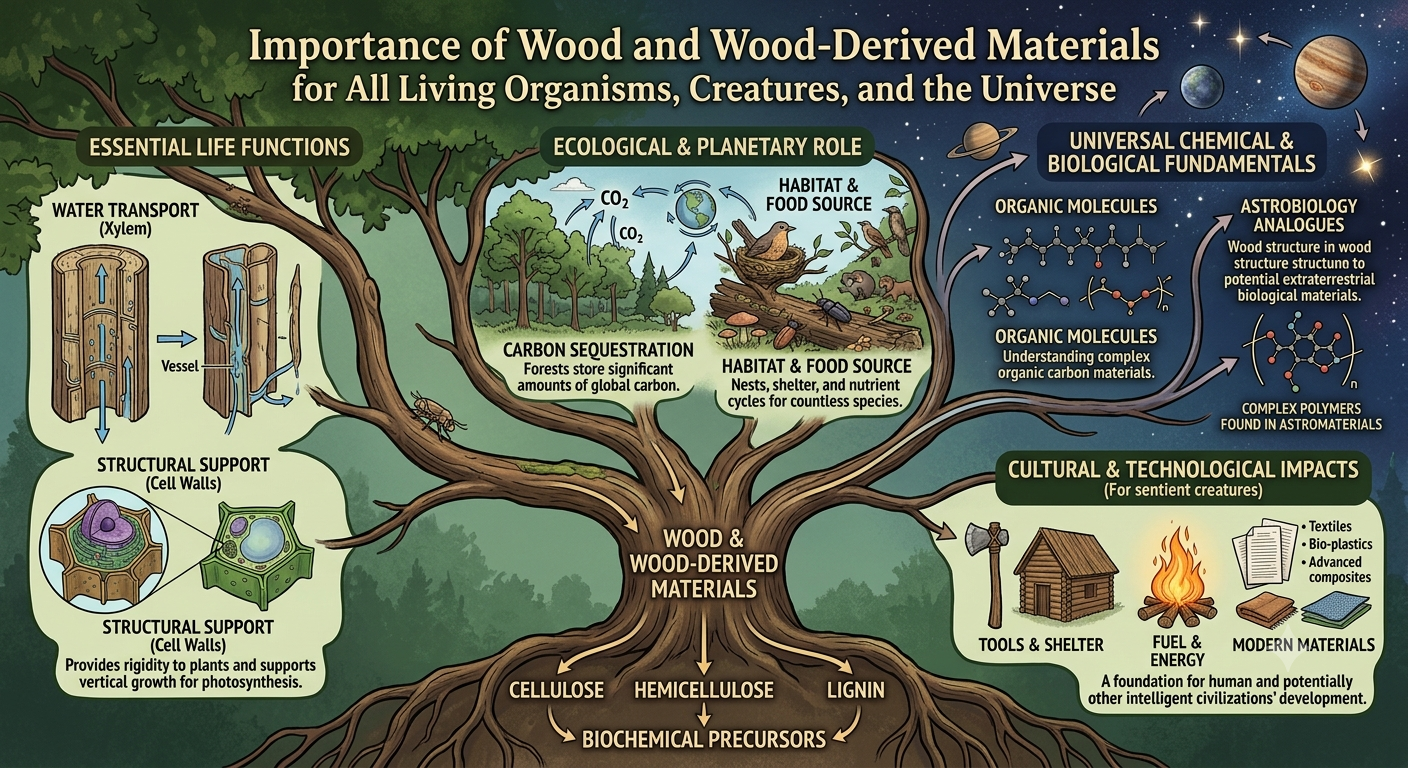
Wood is far more than a resource for human industry; it is one of the most significant evolutionary innovations in the history of life on Earth. At its core, wood is secondary xylem—a highly specialized, lignified tissue that evolved roughly 400 million years ago during the Devonian period. Without it, the terrestrial biosphere as we know it could not exist.
This thesis and tutorial explores the biophysical chemistry of wood, its critical role in sustaining terrestrial life, and its profound significance for living organisms across our planet.
1. The Biophysical Chemistry of Wood
To understand why wood is so vital, we must first look at its molecular architecture. Wood is a natural composite material composed of three primary organic polymers: cellulose, hemicellulose, and lignin.
- Cellulose (~40–50%): A linear polymer of glucose units linked by $\beta(1\rightarrow4)$ glycosidic bonds. Cellulose microfibrils provide immense tensile strength (resistance to being pulled apart), acting like the steel rebar in reinforced concrete.
- Hemicellulose (~20–30%): A branched carbohydrate polymer that cross-links the cellulose microfibrils, binding them into a cohesive network.
- Lignin (~20–35%): A complex, hydrophobic (water-repelling) aromatic polymer. Lignin acts as the “concrete” that fills the spaces between cellulose and hemicellulose. It provides compressive strength (resistance to crushing under gravity) and makes cell walls completely waterproof.
The combination of these three polymers results in lignification—the process by which plant cells harden into wood, allowing them to support massive physical loads and transport water under high tension.
2. Structural and Physiological Importance to Plants
Wood serves two fundamental, intertwined purposes for vascular plants (woody plants and trees): mechanical support and fluid dynamics.
Hydraulic Lift (Xylem Transport)
Plants must transport water absorbed by roots up to leaves that may be over 100 meters in the air (such as in Coast Redwoods). This is driven by transpiration (evaporation of water from leaves), which pulls water columns upward under extreme negative pressure (suction).
Without lignified wood walls, the microscopic tubes—tracheids in gymnosperms (conifers) and vessel elements in angiosperms (flowering plants)—would collapse inward under this intense suction, much like a paper straw collapses when you suck too hard. Wood ensures these straws remain open and structurally sound.
The Race for Light
In a dense forest, light is the limiting resource. By utilizing rigid, lignified trunks, woody plants can grow vertically, outcompeting shorter vegetation for solar energy. This vertical growth created the multi-tiered canopy systems of our forests, expanding the physical space available for other forms of life.
3. Ecological Significance to All Living Organisms
The evolutionary success of wood directly transformed Earth’s climate and created the ecosystems that support virtually all terrestrial creatures.
Carbon Sequestration and Climate Regulation
Wood is a massive planetary carbon sink. Through photosynthesis, trees convert atmospheric carbon dioxide ($CO_2$) into wood.
$$\text{Atmospheric Carbon} \xrightarrow{\text{Photosynthesis}} \text{Wood (Cellulose/Lignin)} \xrightarrow{\text{Sequestration}} \text{Long-term Storage}$$
Forests store approximately 80% of all aboveground terrestrial carbon. By locking carbon away in durable woody structures, trees regulate global temperatures, keeping the planet hospitable for climate-sensitive organisms.
Habitat and Microclimates
Woody plants physically engineer ecosystems:
- Living Habitats: Forest canopies harbor over 50% of all terrestrial species, including birds, insects, primates, and epiphytic plants (plants that grow on other plants).
- Coarse Woody Debris (Dead Wood): Fallen logs and decaying wood are vital “biological hotspots.” They provide shelter for small mammals, reptiles, and amphibians, and act as “nurse logs” where new seedlings germinate in nutrient-rich organic matter.
4. The Foundation of the Saproxylic Food Web
Wood is notoriously difficult to digest due to the tough, chemical shield of lignin. However, this slow decomposition rate is exactly what fuels an incredibly rich and diverse subsystem of life: the saproxylic (dead-wood dependent) food web.
             [ Dead Wood / Lignin & Cellulose ]
                             │
                             ▼
         [ Primary Decomposers: Fungi (White/Brown Rot) ]
                             │
                             ▼
         [ Secondary Consumers: Wood-boring Insects ]
                             │
                             ▼
  [ Predators: Insectivorous Birds, Amphibians, Mammals ]
- Fungi (The Master Chemists): Fungi—specifically white-rot and brown-rot fungi—are among the very few organisms capable of breaking down lignin and cellulose using specialized enzymes (cellulases and laccases).
- Saproxylic Insects: Thousands of beetle, termite, and wasp species rely directly on decaying wood for food and nesting. Many harbor symbiotic gut microbes to help them digest wood fiber.
- Trophic Cascade: These wood-eating insects form the primary food source for larger animals like woodpeckers, bats, and small carnivores, carrying energy from dead plant matter back into the wider food chain.
AbstractWood is not just “trees.” It is Earth’s original advanced composite material. From the cellulose in a blade of grass to the lignin in fungal cell walls to the paper in your hands, wood-derived materials shape energy flow, structure, and survival across the entire biosphere. This tutorial + thesis explores the biology, chemistry, ecological, and cosmic significance of wood-based materials.1. What Is “Wood” and “Wood-Derived Material”?Wood: A complex biological composite made primarily of:Cellulose 40-50%: Long glucose chains. The structural fiber. Hemicellulose 20-30%: Shorter polysaccharides that bind fibers.Lignin 20-30%: A rigid, aromatic polymer. Gives wood stiffness and rot resistance.Extractives + Water: Resins, oils, minerals.Wood-derived materials: Anything made from or mimicking this structure.
Examples: paper, cardboard, rayon, cellophane, biofuels, nanocellulose, charcoal, cork, bamboo, fungal chitin-lignin composites, plant cell walls.2. The Biological Significance: Why Life Depends on Wood-Based StructuresA. The Foundation of Land Life – Plant Cell Walls
Every plant, algae, and many microbes use cellulose as their skeleton. Without cellulose and lignin, plants could not stand upright against gravity.
That structure allows forests, grasslands, crops, and phytoplankton. That means wood chemistry is the basis of primary production: turning sunlight + CO2 into food.B. Energy and Carbon Storage
Wood is solidified sunlight. A single tree can store tons of carbon for centuries. This regulates climate for all creatures.
Herbivores eat cellulose. Fungi and bacteria evolved enzymes to break lignin and recycle it. Decomposers turn dead wood back into soil nutrients.C. Habitat and Protection for All CreaturesInsects bore, nest, and feed in woodBirds, mammals, reptiles use trees for shelterFungi grow mycelial networks through wood to trade nutrients with plantsEven marine organisms: shipworms and wood-boring crustaceans depend on driftwoodD. At the Cellular Level
Cellulose is the most abundant biopolymer on Earth. It’s in plant cells, some algae, and is structurally similar to chitin in insect exoskeletons and fungal cell walls. Life reuses this “wood-like” chemistry everywhere for strength.3. Ecological and Planetary ImportanceA. The Carbon Cycle
Wood locks carbon. Forests are the planet’s biggest terrestrial carbon sink. When wood decays or burns, that carbon returns to the atmosphere.B. Water and Soil
Tree roots, made of woody tissue, prevent erosion. Leaf litter becomes humus. Wood debris in rivers creates habitats for fish and microbes.C. Oxygen Production
Photosynthesis that builds wood also releases O2. All aerobic creatures depend on this.D. Climate Regulation
Forests influence rainfall, temperature, and albedo. Cut the wood network, and regional climates change.4. Wood-Derived Materials in Human and Animal LifeA. Direct UseFood: Fruits, seeds, leaves all grow from woody plants. Cellulose is dietary fiber for gut bacteria.Shelter: Wood, bamboo, cork for buildingTools: From spears to paper to pencilsB. Industrial and Biomedical DerivativesPaper and Packaging: From cellulose fibersTextiles: Rayon, lyocell from wood pulpBiofuels: Ethanol from celluloseBiomedicine: Nanocellulose for wound dressings, drug delivery, 3D tissue scaffoldsComposites: Wood-plastic, fiberboard, engineered lumberC. Microbial and Fungal Economy
Fungi don’t make true wood, but they make lignin-degrading enzymes and chitin. This wood-decay network feeds the entire soil food web. Without it, dead plants would pile up and nutrients would stall.5. A Cosmic Perspective: Is Wood Universal?We don’t know if trees exist elsewhere. But the principle of wood does:
Life needs structural polymers made from abundant elements to resist gravity and environment.On Earth, evolution chose cellulose + lignin because carbon, oxygen, and hydrogen are common and sunlight is available. Any biosphere with plants will likely evolve a “wood analog” for support, water transport, and carbon storage.So wood is significant not just on Earth, but as a model for how life builds durable structures from local chemistry.6. Modern Tutorial: How to Think About Wood in SystemsTo study wood’s importance, use this 4-layer framework:Layer 1: Molecular
Cellulose chains, hydrogen bonds, lignin cross-links. This gives tensile strength.Layer 2: Cellular/Tissue
Plant cells, xylem vessels, fibers. This gives water transport and mechanical support.Layer 3: Organismal/Ecosystem
Trees, forests, soil, animals. This gives habitat, carbon storage, climate.Layer 4: Technological/Societal
Paper, bioplastics, construction, nanocellulose. This gives materials for civilization.Every innovation with wood asks: “How do we copy or improve Layer 1 to solve a Layer 4 problem?”7. Conclusion: Wood as a Universal TechnologyWood and wood-derived materials are significant because they do 4 things no other material class does as well:Store energy and carbon for long timesProvide mechanical strength with low densityBe fully biodegradable and recyclable by biologySupport the food webs of nearly all land lifeFrom the smallest bacterium breaking down a wood chip, to the tallest redwood, to the paper you write on, to the potential forests on other planets, wood chemistry is a central thread in the fabric of life.In short: without wood-based structures, there would be no forests, no soil as we know it, no stable climate, and no complex terrestrial ecosystems. Wood is not a material. It is infrastructure for life.



Be First to Comment