
A Comprehensive Foundational Thesis on Character, Productivity, Innovation, and Human Excellence
Introduction
As humanity enters the age of artificial intelligence, quantum computing, biotechnology, robotics, advanced manufacturing, and space exploration, technical skills alone will not determine success. The greatest competitive advantage will increasingly be strong work ethics combined with intelligence, lifelong learning, emotional maturity, and responsible leadership.
Work ethics are the invisible operating system of civilization. They influence how individuals, businesses, governments, universities, and entire nations innovate and prosper.
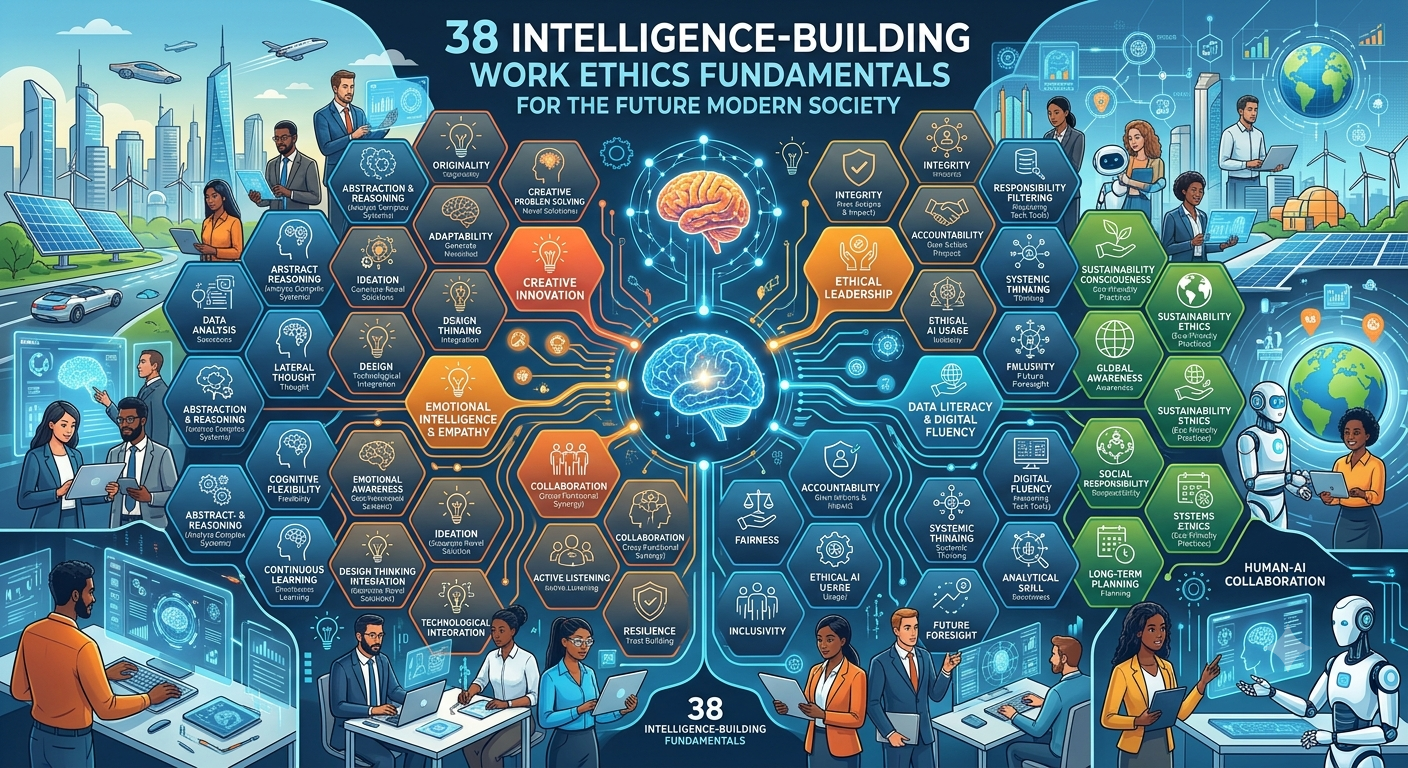
Below are 38 foundational work ethics principles designed to build intellectual discipline and prepare individuals for the modern economy.
1. Integrity
Integrity is doing the right thing even when nobody is watching.
People with integrity earn trust, and trust becomes the foundation of leadership, investment, scientific collaboration, and national development.
2. Honesty
Honesty produces accurate information.
Scientific discoveries, engineering projects, accounting systems, and medical research depend upon truthful reporting.
3. Discipline
Discipline means consistently doing necessary work despite discomfort.
Talent without discipline rarely produces excellence.
4. Personal Responsibility
Future societies reward individuals who accept ownership of both successes and failures instead of blaming others.
Responsible people continuously improve.
5. Punctuality
Time is the world’s most valuable non-renewable resource.
Being punctual demonstrates respect for people and commitments.
6. Reliability
Organizations depend upon reliable individuals.
Reliability creates stable teams, stronger institutions, and economic growth.
7. Continuous Learning
Knowledge doubles rapidly.
Successful professionals continuously update their skills throughout life.
8. Curiosity
Curiosity drives innovation.
Every major scientific breakthrough started with someone asking:
“Why?”
9. Critical Thinking
Rather than accepting information blindly, intelligent professionals evaluate evidence before reaching conclusions.
Critical thinkers reduce costly mistakes.
10. Problem Solving
Modern employers reward people who solve problems instead of merely identifying them.
Every problem represents an opportunity.
11. Adaptability
Technology changes industries rapidly.
Future workers must continuously adapt to new tools, software, and business models.
12. Resilience
Failure is an educational process.
Resilient individuals recover quickly and continue improving.
13. Accountability
Accountability means measuring performance honestly and accepting consequences.
Successful organizations value accountability over excuses.
14. Respect
Respect creates healthy workplaces.
It improves communication, cooperation, and innovation.
15. Teamwork
Large projects require specialists working together.
Modern innovation depends upon multidisciplinary collaboration.
16. Communication
Ideas only create value when communicated clearly.
Effective communication reduces misunderstandings and improves productivity.
17. Listening
Listening often teaches more than speaking.
Great leaders first understand before responding.
18. Humility
No one knows everything.
Humility allows continuous learning and intellectual growth.
19. Professionalism
Professional behavior reflects competence, ethics, and respect.
Professional reputations often take years to build.
20. Excellence
Aim beyond average.
Future societies increasingly reward exceptional performance rather than minimum effort.
21. Quality Mindset
Quality reduces waste.
Producing excellent work once is cheaper than repeatedly correcting mistakes.
22. Attention to Detail
Small errors may cause enormous failures.
Precision matters in medicine, engineering, aviation, finance, and software.
23. Innovation
Innovation means creating better solutions rather than repeating outdated methods.
It drives economic growth and competitiveness.
24. Creativity
Creativity connects existing knowledge into new possibilities.
Many breakthroughs emerge from combining ideas across different fields.
25. Productivity
Working longer hours does not always mean achieving more.
Effective productivity emphasizes priorities, planning, and meaningful outcomes.
26. Time Management
Successful individuals allocate time intentionally.
Planning prevents unnecessary stress and missed opportunities.
27. Decision Making
Good decisions combine logic, evidence, ethics, and long-term thinking.
Poor decisions often have lasting consequences.
28. Financial Responsibility
Understanding budgeting, saving, investing, and responsible spending contributes to personal and national economic resilience.
29. Ethical Use of Technology
Artificial intelligence, automation, and data analytics should be used responsibly, respecting privacy, fairness, and security.
30. Environmental Responsibility
Future prosperity depends on managing natural resources wisely and reducing unnecessary waste.
Sustainability supports long-term economic and social well-being.
31. Service to Others
Organizations exist to solve problems for customers, communities, and society.
Creating value for others builds lasting success.
32. Leadership
Leadership is guiding people toward shared goals through vision, responsibility, and example rather than authority alone.
33. Emotional Intelligence
Understanding and managing emotions improves teamwork, conflict resolution, and leadership effectiveness.
34. Courage
Progress often requires making difficult decisions, taking calculated risks, and standing by ethical principles.
35. Vision
Vision allows individuals and organizations to prepare for future opportunities and challenges rather than reacting only to current circumstances.
36. Lifelong Improvement
Continuous improvement involves regularly evaluating performance, learning from experience, and refining skills over time.
37. Knowledge Sharing
Sharing knowledge strengthens teams, accelerates innovation, and helps build resilient organizations and societies.
38. Purpose
A clear sense of purpose provides direction, motivation, and resilience. Individuals who connect their work to meaningful goals are often more engaged and persistent.
Conclusion
These 38 work ethics form a foundation for thriving in a modern, knowledge-driven society. They complement technical expertise by fostering trust, adaptability, innovation, and responsible leadership.
Together, they help individuals become:
- Ethical professionals
- Lifelong learners
- Effective collaborators
- Innovative problem-solvers
- Responsible leaders
- Productive citizens
- Contributors to sustainable economic and social development
In the decades ahead, success will depend not only on what people know, but also on how they work, how they learn, how they treat others, and how responsibly they apply knowledge. Cultivating these work ethics provides a durable framework for personal excellence and for building stronger organizations and societies.





Be First to Comment