
Introduction
Among all insects on Earth, fungus-farming ants are among the most remarkable. Long before humans invented agriculture approximately 12,000 years ago, certain ant species had already become highly successful farmers. They cultivate fungi, protect crops from diseases, fertilize gardens, recycle organic waste, and organize millions of workers into one of nature’s most efficient agricultural civilizations.
Scientists often describe leafcutter ants as the first farmers on Earth, with agricultural systems that have evolved over 55–66 million years.
Their society demonstrates:
- Agriculture
- Food security
- Waste management
- Chemical communication
- Division of labor
- Engineering
- Logistics
- Disease control
- Environmental sustainability
- Collective intelligence
Chapter 1: History of Ant Farming
Origins
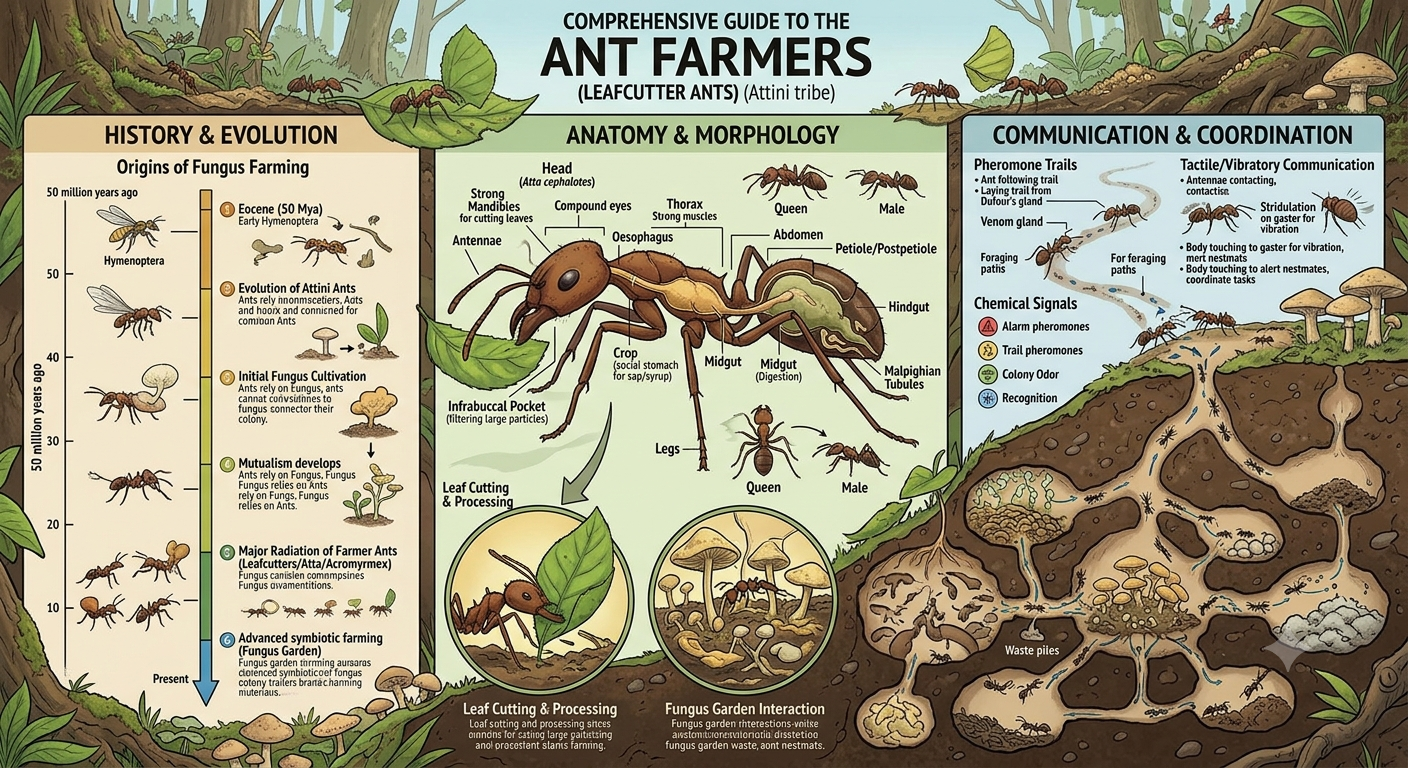
Scientists believe fungus farming evolved approximately 55–66 million years ago in South America after the extinction of the dinosaurs.
Before farming fungi, ants were hunters and scavengers.
Over millions of years they discovered that:
- Dead plant material could support fungal growth.
- Certain fungi produced nutritious food.
- Protecting fungi increased survival.
- Better gardens meant larger colonies.
Eventually this relationship became permanent.
The ants cannot survive without the fungus.
The fungus cannot survive without the ants.
This relationship is called obligate mutualism.
Evolution Timeline
| Time | Event |
|---|---|
| 66 million years ago | Dinosaurs disappear |
| 60 million years ago | Primitive fungus farming begins |
| 50 million years ago | Specialized farming ants evolve |
| 30 million years ago | Large underground farming colonies develop |
| Today | More than 250 fungus-farming ant species exist |
Chapter 2: The Farmers
The most famous farming ants belong to the genera:
- Atta (Leafcutter ants)
- Acromyrmex
These species build enormous underground farms.
Some colonies contain:
- over 8 million workers
- thousands of fungus chambers
- several kilometers of underground tunnels
Chapter 3: Colony Anatomy
A colony functions like a superorganism.
Queen
│
├── Soldiers
│
├── Large workers
│
├── Medium workers
│
├── Small gardeners
│
├── Nurses
│
├── Waste workers
│
└── Young ants
Every ant has one specific profession.
Chapter 4: Anatomy of Individual Ants
Every worker consists of:
Head
Contains:
- Brain
- Compound eyes
- Antennae
- Mandibles
The head acts as:
- Communication center
- Navigation center
- Decision-making center
Antennae
The antennae function like:
- Nose
- Radar
- Telephone
- GPS
- Internet receiver
They detect:
- Chemicals
- Colony identity
- Food
- Danger
- Queen pheromones
- Fungus health
Thousands of chemical sensors exist on each antenna.
Mandibles
Powerful jaws used for:
- Cutting leaves
- Carrying food
- Digging tunnels
- Fighting enemies
- Grooming nestmates
Thorax
Contains muscles controlling the six legs.
The thorax is the ant’s engine.
Legs
Six legs provide:
- Speed
- Climbing ability
- Carrying heavy loads
Leafcutters may carry many times their own body weight.
Abdomen
Contains:
- Digestive system
- Reproductive organs (in queens and males)
- Poison gland
- Pheromone glands
Chapter 5: Fungus Gardens
The fungus is the colony’s crop.
Workers bring:
- Leaves
- Flowers
- Grass
- Fruit pieces
They do not eat these leaves directly.
Instead they:
- Cut leaves.
- Carry them underground.
- Chew them into pulp.
- Mix with enzymes.
- Feed the pulp to the fungus.
The fungus digests the plant material and produces nutrient-rich structures that the ants eat.
Chapter 6: Underground Farm Architecture
Large nests may contain:
- Thousands of chambers
- Nursery rooms
- Fungus gardens
- Food storage
- Queen chamber
- Waste dumps
- Air shafts
- Ventilation tunnels
Some nests extend several meters underground.
Chapter 7: Communication
Communication is one of the greatest strengths of ant societies.
They rarely rely on sound. Instead, they primarily communicate through chemicals.
1. Pheromones
Pheromones are chemical messages.
Workers lay trails using glands in their abdomen.
Other ants detect these trails with their antennae.
Messages include:
- Food found
- Danger
- New nest
- Attack
- Help
- Queen present
One ant can recruit thousands of workers by laying a pheromone trail.
2. Touch Communication
Ants touch antennae.
This exchanges:
- Identity
- Colony membership
- Food status
- Work assignments
3. Vibrations
Ants produce vibrations by rubbing body parts together (stridulation) or tapping surfaces.
Vibrations signal:
- Danger
- Heavy food
- Rescue needs
- Nest emergencies
4. Food Sharing (Trophallaxis)
Workers exchange liquid food mouth-to-mouth.
This also spreads:
- Nutrients
- Beneficial microbes
- Chemical signals
- Colony odors
Chapter 8: Division of Labor
Different workers specialize according to size and age.
| Worker | Responsibility |
|---|---|
| Queen | Egg production |
| Soldiers | Defense |
| Large workers | Cut leaves |
| Medium workers | Transport leaves |
| Small workers | Tend fungus |
| Nurses | Care for eggs and larvae |
| Waste workers | Remove refuse and reduce disease |
This specialization improves efficiency.
Chapter 9: Disease Management
Ant farmers protect their crops by:
- Cleaning leaves before use
- Removing infected fungus
- Isolating waste
- Grooming each other
- Producing antimicrobial substances
- Cultivating beneficial bacteria on their bodies that help suppress harmful fungi
Their sanitation resembles modern agricultural biosecurity.
Chapter 10: Colony Life Cycle
- A winged queen mates.
- She carries a tiny piece of fungus from her original colony.
- She digs a new chamber.
- She plants the fungus.
- She lays eggs.
- The first workers hatch.
- Workers expand the garden.
- The colony grows over many years.
Large colonies can persist for decades if the queen survives.
Chapter 11: Intelligence Without a Leader
Individual ants have limited cognitive abilities, yet together they accomplish complex tasks.
This collective intelligence allows colonies to:
- Find efficient routes to food
- Allocate workers where needed
- Adapt to changing conditions
- Maintain stable farming systems
Complex organization emerges from many simple interactions rather than detailed central control.
Chapter 12: Lessons for Human Society
Ant farming offers insights into:
- Sustainable agriculture
- Supply-chain logistics
- Teamwork and specialization
- Waste recycling
- Disease prevention
- Decentralized decision-making
- Environmental stewardship
While humans and ants are fundamentally different, studying ant colonies has inspired research in robotics, optimization algorithms, and network design.
Conclusion
Fungus-farming ants represent one of Earth’s oldest and most successful agricultural systems. Over tens of millions of years, they have evolved highly organized societies capable of cultivating crops, protecting them from disease, engineering elaborate underground farms, and coordinating millions of individuals through chemical communication.
Their success is rooted not in the intelligence of any single ant, but in the coordinated behavior of the colony as a whole. By combining specialized labor, efficient communication, sustainable farming, and sophisticated nest engineering, these tiny insects have built resilient agricultural civilizations that continue to fascinate biologists and inspire innovations in science, engineering, and management.


Be First to Comment