
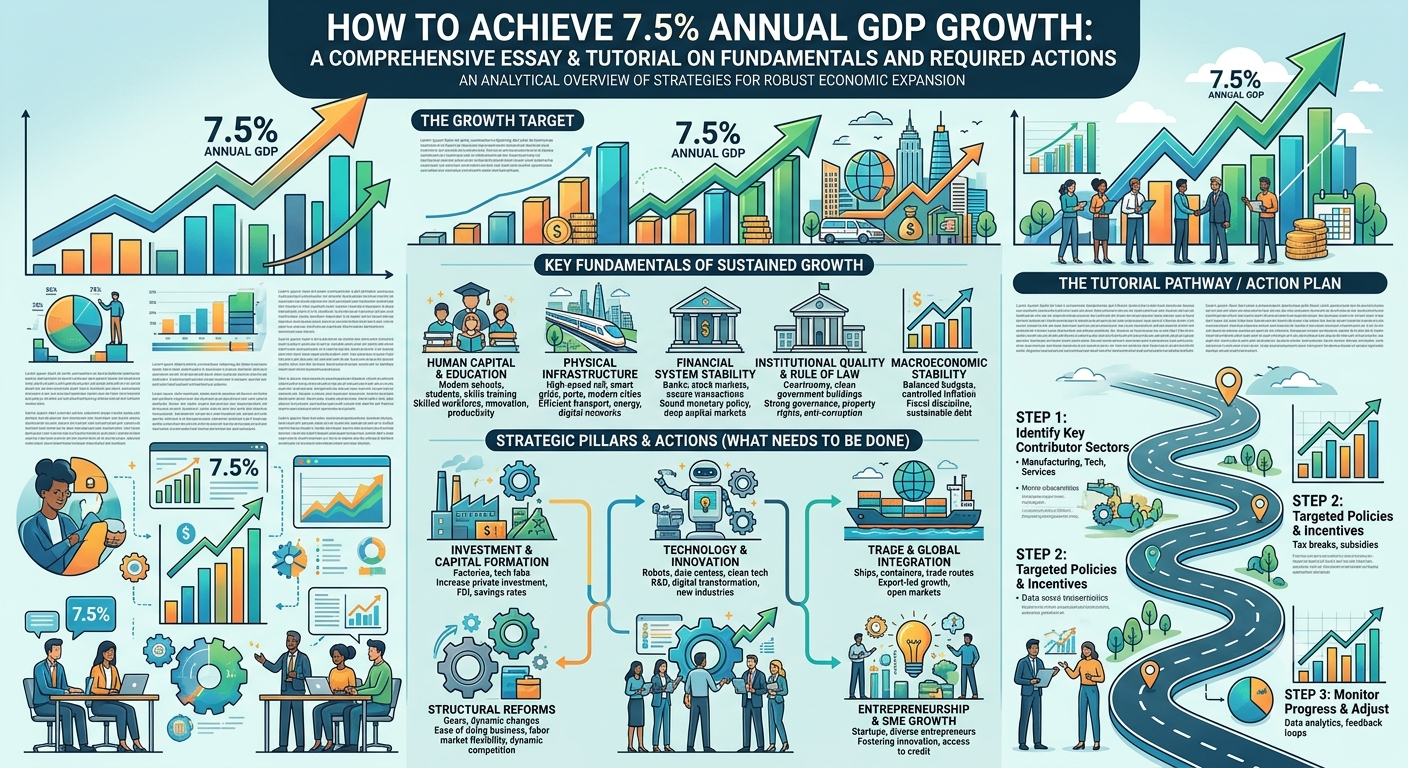
Sustaining 7.5% annual GDP growth is a major national achievement. Few countries have maintained such high growth for a decade or more. Economies such as China, South Korea, Singapore, and more recently Vietnam achieved this through decades of investment, industrialization, education, exports, infrastructure, and stable institutions.
A country cannot simply “decide” to grow by 7.5%. Growth comes from increasing the production of goods and services while improving productivity and innovation.
Understanding GDP Growth
GDP (Gross Domestic Product) measures the total value of all goods and services produced in one year.
For example:
- Year 1 GDP = US$500 billion
- Year 2 GDP = US$537.5 billion
Growth = 7.5%
That extra wealth must come from:
- More factories
- Better technology
- Higher productivity
- Increased exports
- More skilled workers
- Strong investment
The Economic Engine of Growth
genui{“economics_markets_learning_block_staging”:{“type_id”:”SOLOW_STEADY_STATE”}}
One of the most widely used frameworks for understanding long-term growth is the Solow Growth Model, which shows how savings, investment, technology, labor force growth, and productivity combine to determine sustainable economic growth.
The 15 Pillars Needed to Reach 7.5% GDP Growth
1. Stable Government
A growing economy requires:
- Political stability
- Rule of law
- Independent courts
- Low corruption
- Efficient public administration
Investors need confidence that rules will remain predictable.
2. Massive Infrastructure Investment
Infrastructure forms the backbone of growth.
Investment priorities include:
- Roads
- Railways
- Airports
- Ports
- Electricity
- Water systems
- Broadband internet
- Data centres
Reliable infrastructure lowers business costs and raises productivity.
3. Reliable Electricity
Industries cannot expand without dependable power.
Key actions:
- Expand electricity generation
- Modernize transmission grids
- Improve maintenance
- Diversify energy sources
- Encourage private investment
4. Industrialization
Countries grow richer by producing higher-value manufactured goods.
Priority industries include:
- Steel
- Chemicals
- Pharmaceuticals
- Electronics
- Automotive manufacturing
- Machinery
- Renewable energy equipment
Manufacturing creates jobs, exports, and technology spillovers.
5. Agricultural Modernization
Modern agriculture should focus on:
- Mechanization
- Irrigation
- Improved seed varieties
- Precision farming
- Food processing
- Cold-chain logistics
- Export-oriented farming
This raises rural incomes and food security.
6. Education and Skills
A skilled workforce increases productivity.
Invest in:
- Early childhood education
- Primary and secondary schools
- Technical colleges
- Universities
- Engineering
- Mathematics
- Computer science
- Vocational training
Human capital is one of the strongest drivers of long-term growth.
7. Innovation and Research
High-growth economies invest heavily in:
- Scientific research
- Artificial intelligence
- Biotechnology
- Robotics
- Semiconductors
- Space technology
- Advanced manufacturing
Research and development supports new industries and higher-value exports.
8. Strong Private Sector
Businesses create jobs, wealth, and innovation.
Governments should:
- Reduce unnecessary regulation
- Simplify business registration
- Protect property rights
- Improve access to finance
- Encourage entrepreneurship
9. Export-Led Growth
Successful economies often expand through exports.
Priority export sectors include:
- Manufacturing
- Agriculture
- Minerals
- Tourism
- Digital services
- Business services
Competing internationally encourages productivity and innovation.
10. Foreign Direct Investment (FDI)
Attract investors through:
- Stable policies
- Good infrastructure
- Skilled workers
- Efficient regulation
- Investment incentives
- Trade agreements
FDI can bring capital, technology, and management expertise.
11. Financial System Development
A healthy financial system supports investment through:
- Banks
- Capital markets
- Venture capital
- Pension funds
- Development finance
Businesses need affordable access to credit.
12. Digital Economy
Digital transformation includes:
- Nationwide broadband
- Cloud computing
- Artificial intelligence
- Cybersecurity
- Digital payments
- E-commerce
- Smart manufacturing
Digital technologies improve efficiency across sectors.
13. Efficient Public Spending
Government expenditure should prioritize:
- Infrastructure
- Education
- Healthcare
- Research
- Maintenance of public assets
Reducing waste and corruption increases the impact of public investment.
14. Competitive Tax System
A balanced tax system should:
- Encourage investment
- Be simple to administer
- Broaden the tax base
- Limit avoidance
- Support productive enterprise
15. Environmental Sustainability
Long-term growth depends on:
- Sustainable water management
- Renewable energy
- Climate resilience
- Conservation
- Circular economy practices
Protecting natural resources supports future productivity.
Key Economic Sectors for High Growth
A diversified economy can draw growth from multiple sectors:
- Agriculture
- Mining
- Manufacturing
- Construction
- Energy
- Tourism
- Financial services
- Information technology
- Healthcare
- Education
- Logistics
- Creative industries
Productivity: The Ultimate Driver
Long-term prosperity depends on producing more value with the same or fewer resources.
Productivity improves through:
- Better technology
- Better management
- Worker training
- Modern equipment
- Efficient infrastructure
- Research and innovation
Investment Targets
Many fast-growing economies have maintained:
- Investment rates of 25–35% of GDP
- Strong infrastructure spending
- High savings
- Significant research investment
- Rising exports
These factors reinforce one another over time.
South Africa: A Possible Growth Strategy
For South Africa, reaching sustained 7.5% annual growth would likely require coordinated reforms across many areas, including:
- Reliable electricity supply.
- Modern transport infrastructure.
- Better logistics at ports and rail.
- Faster business licensing and regulatory processes.
- Higher investment in technical education and apprenticeships.
- Support for manufacturing and export industries.
- Expanded digital infrastructure.
- Stronger anti-corruption measures and improved governance.
- Increased public and private investment in research and development.
- Greater regional trade within the African Continental Free Trade Area.
Common Obstacles
Challenges that often prevent sustained high growth include:
- Power shortages
- High unemployment
- Weak education outcomes
- Corruption
- Policy uncertainty
- Poor infrastructure maintenance
- Low investment
- Crime
- Skills shortages
- Limited innovation
Addressing these issues can improve the conditions for faster economic expansion.
Measuring Progress
Governments should monitor indicators such as:
- GDP growth rate
- Productivity growth
- Employment
- Investment as a share of GDP
- Export growth
- Inflation
- Public debt
- Poverty rates
- Education outcomes
- Infrastructure quality
- Research and development spending
Conclusion
Achieving 7.5% annual GDP growth is an ambitious objective that requires consistent policies over many years. No single reform is enough. Countries that have reached this pace of growth generally combined sound institutions, infrastructure, education, industrial development, technological innovation, competitive businesses, openness to trade, and sustained investment.
Economic growth is most durable when it is inclusive, creating opportunities across society while improving productivity, encouraging innovation, strengthening governance, and using natural resources responsibly. With coordinated long-term planning and effective implementation, higher growth can translate into rising incomes, better public services, and improved living standards.




Be First to Comment