
Introduction
Radio waves are one of humanity’s greatest scientific discoveries. Every mobile phone call, Wi-Fi connection, satellite transmission, GPS navigation, television broadcast, aircraft communication, Bluetooth device, remote control, and deep-space signal depends on radio waves.
Unlike water flowing through pipes or electricity moving through wires, radio waves travel through free space at the speed of light without requiring a physical cable. They are invisible, silent, and constantly surround us.
Radio waves belong to the family of electromagnetic waves, which also includes visible light, infrared, ultraviolet, X-rays, and gamma rays.
Chapter 1: What Are Radio Waves?
A radio wave is a type of electromagnetic wave used to transmit information through space.
Think of dropping a stone into a calm pond.
The ripples spread outward.
Radio waves behave similarly, except they travel through air and space rather than water.
They consist of two linked fields:
- Electric field
- Magnetic field
These fields continually create one another as the wave moves.
Chapter 2: The Electromagnetic Spectrum
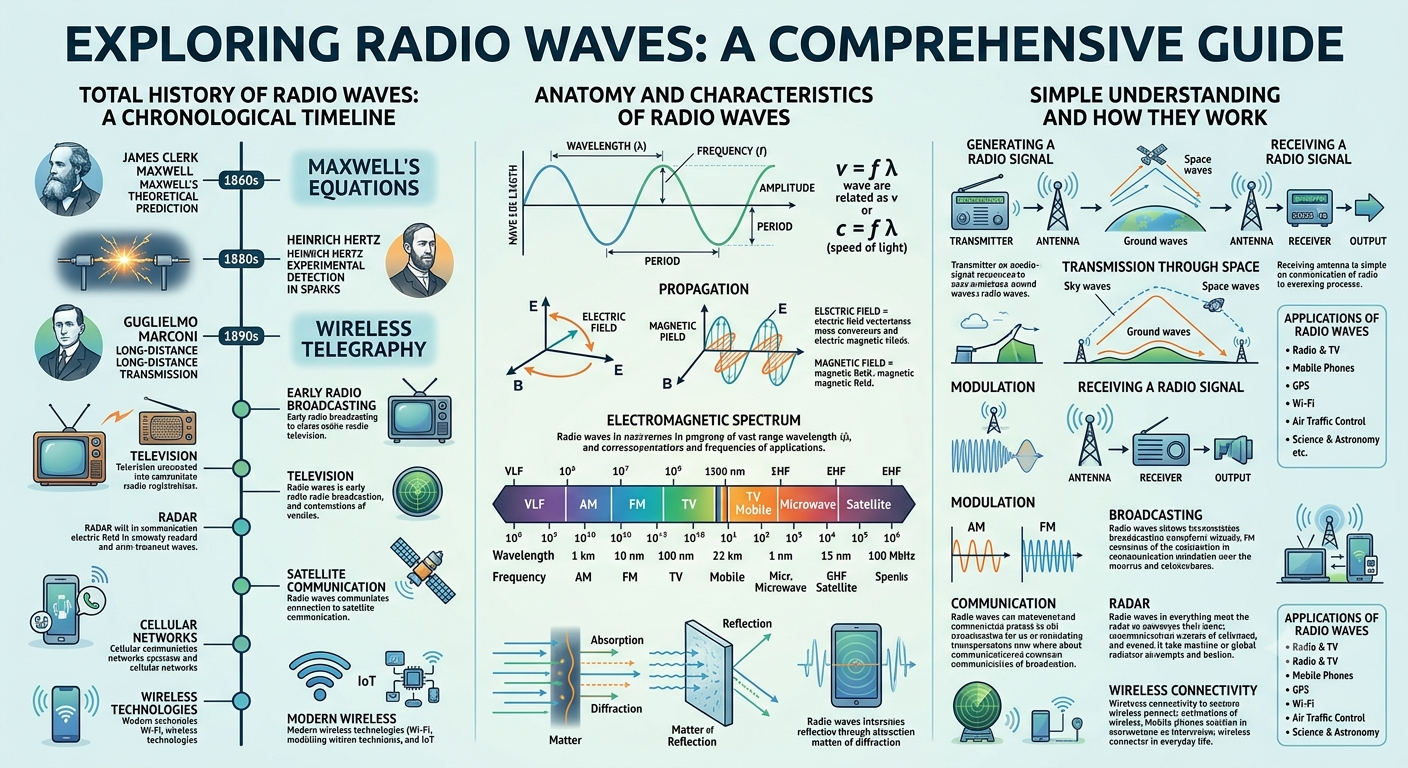
Radio waves are the longest-wavelength and lowest-frequency part of the electromagnetic spectrum.
| Type | Frequency | Wavelength |
|---|---|---|
| Radio waves | 3 Hz – 300 GHz | 100,000 km – 1 mm |
| Microwaves | 300 MHz – 300 GHz | 1 m – 1 mm |
| Infrared | 300 GHz – 400 THz | 1 mm – 750 nm |
| Visible Light | 400–790 THz | 750–380 nm |
| Ultraviolet | Higher | Smaller |
| X-rays | Very high | Very small |
| Gamma Rays | Highest | Smallest |
Radio waves have the longest wavelengths and the lowest energy in this spectrum.
Chapter 3: The History of Radio Waves
1831 – Electricity and Magnetism
Michael Faraday demonstrated that electricity and magnetism are closely connected.
This laid the foundation for electromagnetic science.
1864 – The Prediction
James Clerk Maxwell developed equations showing that oscillating electric and magnetic fields could travel through space as waves at the speed of light.
This was the theoretical prediction of radio waves.
1887 – Experimental Proof
Heinrich Hertz generated and detected radio waves in a laboratory, confirming Maxwell’s prediction.
The unit of frequency, the hertz (Hz), is named in his honor.
1895 – Wireless Communication
Guglielmo Marconi developed practical wireless telegraphy, enabling messages to be transmitted without wires.
Early 1900s
Radio broadcasting became widespread.
Ships communicated across oceans.
Military communications expanded rapidly.
Mid-1900s
Radio technology advanced into:
- Television
- Radar
- Air traffic control
- Satellites
- Space exploration
Modern Era
Radio waves now support:
- 5G and 6G research
- Wi-Fi
- Bluetooth
- GPS
- Internet of Things (IoT)
- Autonomous vehicles
- Satellite internet
- Deep-space communication
Chapter 4: The Anatomy of a Radio Wave


Every radio wave has several key characteristics.
1. Frequency
Frequency is the number of wave cycles passing a point each second.
Measured in hertz (Hz):
- 1 Hz = one cycle per second
- 1 kHz = 1,000 Hz
- 1 MHz = 1 million Hz
- 1 GHz = 1 billion Hz
Higher frequency means more cycles each second.
2. Wavelength
Wavelength is the distance between two successive peaks of a wave.
Long wavelengths travel farther and can better diffract around obstacles.
3. Amplitude
Amplitude is the height of the wave.
Greater amplitude generally corresponds to a stronger signal.
4. Phase
Phase describes the position of one wave relative to another and is essential for many modern communication systems.
5. Polarization
The orientation of the electric field can be:
- Vertical
- Horizontal
- Circular
Matching transmitter and receiver polarization improves signal quality.
Chapter 5: Speed of Radio Waves
Radio waves travel at approximately:
299,792,458 metres per second
This is the speed of light in a vacuum.
Approximate travel times:
- Around Earth: about 0.13 seconds
- Earth to Moon: about 1.3 seconds
- Earth to Sun: about 8 minutes
- Earth to Mars: roughly 3–22 minutes, depending on planetary positions
Chapter 6: How Radio Waves Are Produced
A transmitter generates an alternating electrical current.
This current causes electrons in an antenna to oscillate.
The oscillating charges produce changing electric and magnetic fields that radiate outward as radio waves.
Chapter 7: How Information Is Carried
Information is added to a radio wave through modulation.
Common methods include:
- Amplitude Modulation (AM): varies the wave’s amplitude.
- Frequency Modulation (FM): varies the wave’s frequency.
- Phase Modulation (PM): varies the wave’s phase.
- Modern digital systems combine these ideas in advanced modulation techniques to transmit large amounts of data efficiently.
Chapter 8: Radio Frequency Bands
| Band | Frequency | Typical Uses |
|---|---|---|
| VLF | 3–30 kHz | Submarine communication |
| LF | 30–300 kHz | Navigation |
| MF | 300 kHz–3 MHz | AM radio |
| HF | 3–30 MHz | Long-distance shortwave |
| VHF | 30–300 MHz | FM radio, aviation |
| UHF | 300 MHz–3 GHz | Television, mobile phones |
| SHF | 3–30 GHz | Wi-Fi, radar, satellites |
| EHF | 30–300 GHz | 5G/6G research, scientific applications |
Chapter 9: Everyday Uses
Radio waves enable:
- Mobile phones
- Wi-Fi
- Bluetooth
- Television broadcasting
- Radio broadcasting
- GPS
- Aircraft communication
- Maritime communication
- Emergency services
- Satellite communication
- Weather radar
- Smart homes
- Industrial automation
- Scientific research
- Deep-space missions
Chapter 10: How Radio Waves Travel
Propagation occurs in several ways:
- Ground wave: follows Earth’s surface, useful for lower frequencies.
- Skywave: reflects or refracts from the ionosphere, allowing long-distance communication.
- Line-of-sight: travels directly between antennas, common at higher frequencies.
- Satellite links: relay signals through orbiting spacecraft.
Chapter 11: Advantages
- Wireless communication
- High-speed information transfer
- Global coverage through satellites
- Reliable emergency communications
- Supports modern economies
- Enables scientific discovery
- Connects billions of devices
Chapter 12: Limitations
- Interference from other signals
- Buildings and terrain can block higher-frequency waves
- Weather can affect some frequencies
- Radio spectrum is limited and must be managed carefully
- Security requires encryption because radio transmissions can potentially be intercepted
Chapter 13: Radio Waves and Space Exploration
Radio waves are essential for communicating with spacecraft and astronomical observations using radio telescopes. They also allow scientists to study distant galaxies, pulsars, and clouds of gas that are invisible in ordinary light.
Chapter 14: Simple Analogy
Imagine a stadium where one person starts a synchronized “wave.”
People do not physically move around the stadium; instead, each person stands and sits in sequence, creating a traveling wave.
Similarly, in a radio wave, energy and information travel through space while charged particles in the transmitting antenna oscillate locally.
Chapter 15: Why Radio Waves Matter
Modern civilization depends on radio waves. They make possible:
- Global communication
- Internet connectivity
- Air and sea navigation
- Emergency response
- Broadcasting
- Satellite services
- Scientific research
- Space exploration
- Smart infrastructure
- Connected industries
Conclusion
Radio waves transformed communication by allowing information to travel through space without physical wires. From the theoretical work of James Clerk Maxwell and the experiments of Heinrich Hertz to today’s wireless networks and interplanetary missions, they remain one of the foundations of modern technology. Understanding concepts such as frequency, wavelength, amplitude, propagation, and modulation provides a clear picture of how invisible electromagnetic waves connect people, machines, and even spacecraft across vast distances.





Be First to Comment