
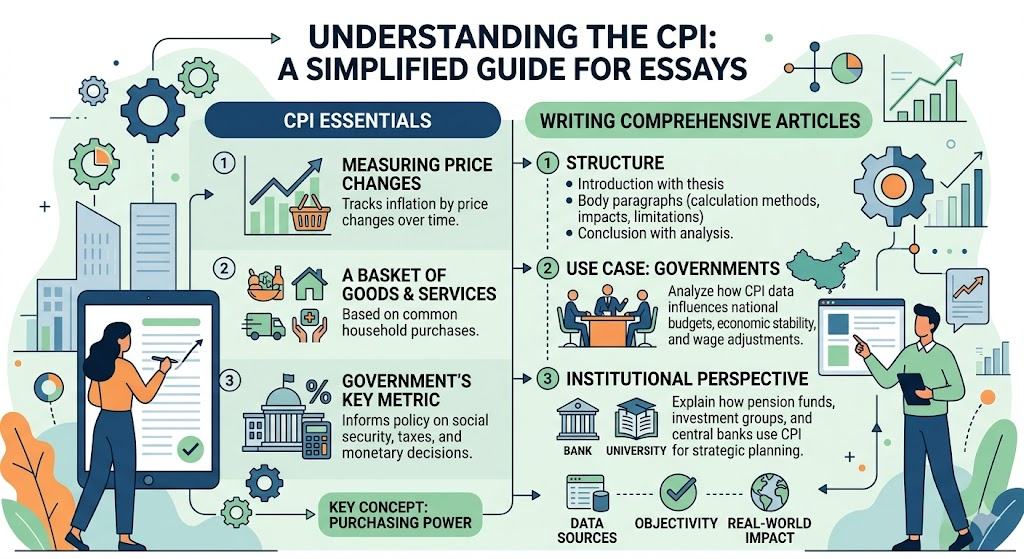
The Three Pillars of CPI in Government, Public Policy, and Institutional Governance
Introduction
The acronym CPI serves as a linguistic intersection for three of the most powerful diagnostic frameworks in contemporary governance, public finance, and institutional operations. Depending on whether an administrator is assessing macroeconomic stability, public sector integrity, or the financial execution of a public infrastructure project, CPI shifts dynamically between three distinct identities:
The Consumer Price Index (Macroeconomic Policy): A gauge tracking inflation and changes in consumer purchasing power.
The Corruption Perceptions Index (Geopolitical Governance): An analytical metric used to score and rank the perceived purity or systemic compromise of public institutions worldwide.
The Cost Performance Index (Operations & Project Management): A quantitative baseline used within Earned Value Management (EVM) systems to measure budgetary efficiency.
Understanding these three pillars is essential for public sector administrators, policymakers, and institutional researchers. This comprehensive analysis unpacks each iteration of CPI, stripping away dense technical terminology to present clear, structurally rigorous breakdowns of their methodologies, systemic implications, and institutional functions.
The Consumer Price Index (CPI): The Economic Thermometer
The Consumer Price Index is the primary instrument used to measure inflation—the gradual decline in the purchasing power of money over time.
The “Market Basket
Statistical agencies fill a hypothetical shopping cart with hundreds of goods and services commonly purchased by urban households. This selection is known as the CPI Market Basket.
+--------------------------------------------------------------+
|                     THE CPI MARKET BASKET                    |
+--------------------------------------------------------------+
|  [ Housing ]       [ Food & Bev ]    [ Transport ]           |
|  Rent, Mortgages   Groceries, Milk   Gasoline, Public Transit|
|                                                              |
|  [ Medical Care ]  [ Apparel ]       [ Utilities ]           |
|  Insurance, Meds   Clothing, Shoes   Electricity, Water      |
+--------------------------------------------------------------+
To prevent the index from becoming obsolete, statistical bureaus periodically adjust the “weights” assigned to each category to mirror actual shifting consumer habits. For example, if households begin allocating more of their monthly income to digital connectivity and less to physical media, the weight of the telecommunications sector scales upward within the calculation.
The Mathematics of Purchasing Power
The basic formula for computing the CPI at any given point relative to a designated historical base period is:
The rate of inflation is simply the percentage growth of this index over a specific duration
Why is it important to Government and institutions?
- Monetary Policy Intervention: Central banks use headline and core CPI data to make interest rate adjustments. If the CPI climbs beyond a target threshold, central banks typically raise interest rates to cool aggregate demand and stabilize the currency.
- Cost-of-Living Adjustments: Governments anchor social safety nets directly to CPI movements. Social grants, civil servant salaries, and senior citizen pensions are mathematically scaled upward alongside CPI expansions to prevent vulnerable populations from falling into structural poverty due to eroding real values.
- Private-Public Inflation Dispersions: Emerging evidence indicates that government-controlled price categories such as municipal utility tariffs and state-regulated logistics fees often experience inflation rates that vastly outpace private-sector market pricing, creating acute structural bottlenecks within the broader economy.
The Corruption Perceptions Index (CPI): The Integrity Gauge
Compiled annually by Transparency International, the Corruption Perceptions Index acts as a global benchmark for ranking countries according to the perceived level of corruption within their public sectors and state offices.
A Composite Matrix
Because bribery, nepotism, and the embezzlement of public funds are inherently clandestine activities, they cannot be measured directly through raw criminal data. Instead, Transparency International constructs the CPI as a composite index, compiling data from independent, specialized governance and business climate assessments.
+-----------------------------------------------------------------+
|               TRANSPARENCY INTERNATIONAL CPI MATRIX            |
+-----------------------------------------------------------------+
|  [ World Bank ]     [ World Economic Forum ]  [ Freedom House ] |
|  Governance Data     Executive Survey Data     Political Risk   |
|         \                      |                     /          |
|          +---------------------+--------------------+          |
|                                |                                |
|                                v                                |
|             [ COMPOSITE AGGREGATION & STANDARDIZATION ]         |
|                                |                                |
|                                v                                |
|                    FINAL METRIC: 0 TO 100 SCALE                 |
+-----------------------------------------------------------------+
Why is it important to Government and institutions?
- Foreign Direct Investment (FDI) Attraction: Institutional capital markets treat a country’s CPI standing as a major sovereign risk indicator. A low score or declining rank acts as a structural deterrent for foreign corporations due to the perceived threats of legal instability and extortion risks.
- The Inequality-Corruption Feedback Loop: Empirical public policy research demonstrates that higher perceived corruption correlates closely with wider domestic income inequality. When state mechanisms are compromised, the efficiency of public resource redistribution degrades, depriving marginalized communities of adequate education, healthcare, and infrastructure.
- Policy Critiques and “The Transparency Fix”: Modern political science literature cautions that relying solely on the CPI can privilege the perspectives of foreign business elites over ordinary citizens. Critics argue that institutional mandates pushed by global watchdogs sometimes favor punitive measures against individual bad actors rather than dismantling the underlying systemic vulnerabilities embedded within a developing state’s economy.
The Cost Performance Index (CPI): The Efficiency Ruler
Within project management and institutional operations, CPI stands for the Cost Performance Index. It serves as a core quantitative component of Earned Value Management (EVM) systems, allowing oversight bodies to evaluate the financial health and efficiency of large-scale public works or corporate initiatives.
Actual Cost
Rather than checking how much money is left in a bank account, the Cost Performance Index analyzes the value of the technical progress achieved relative to the capital spent to achieve it. It depends on two primary metrics: Earned Value (EV): The budgeted cost of the physical work actually completed by a specific date.
Actual Cost (AC): The total capital actually spent to complete that work.
The Mathematics of Project Efficiency
The index is derived by dividing the earned value by the actual expenditures:
The output provides an immediate, highly scannable indicator of an institution’s operational performance:
                  [ PROJECT BUDGET METRIC VALUES ]

     CPI > 1.0                  CPI = 1.0                  CPI < 1.0
+-----------------+        +-----------------+        +-----------------+
|  UNDER BUDGET   |        |    ON BUDGET    |        |   OVER BUDGET   |
| Capital spent   |        | Financial track |        | Project spending |
| yields surplus  |        | matches physical|        | outpaces physical|
| physical value. |        | work perfectly. |        | progress value.  |
+-----------------+        +-----------------+        +-----------------+
Why is it important to governments and institutions?
- Accountability Over Taxpayer Capital: Public sector infrastructure updates—such as building transport networks or implementing municipal IT frameworks—are notorious for cost overruns. Monitoring project-level CPI provides auditing bodies with real-time early warnings before budgets are entirely exhausted.
- Mathematical Forecasting: The CPI is not merely diagnostic; it is predictive. Project managers use a project’s current CPI to calculate its Estimate at Completion (EAC), giving treasury officials a reliable projection of the final total cost based on ongoing performance trends:
- Intervention Strategies: When a strategic project’s CPI falls below a designated threshold, it triggers mandatory structural interventions. These can include contract renegotiations, scope reductions, or the implementation of digital transparency tools, which empirical studies have shown to be highly effective at curbing institutional waste.
Synthesis: The Institutional Convergence of CPI
While these three indices belong to distinct fields, they frequently intersect within the administration of modern states. A government executing a massive public infrastructure program must manage all three concepts simultaneously:
+-----------------------------------------------------------------------+
|                 GOVERNMENT INFRASTRUCTURE PROGRAM                    |
+-----------------------------------------------------------------------+
|                                                                       |
|   [ Consumer Price Index ] ----> Affects cost of imported raw         |
|                                  materials and equipment.             |
|                                                                       |
|   [ Cost Performance Index ] --> Tracks whether contractors are       |
|                                  efficiently using public funds.      |
|                                                                       |
|   [ Corruption Perceptions Index ] -> Safeguards public bids from     |
|                                       systemic tender inflation.      |
+-----------------------------------------------------------------------+
When macroeconomic inflation (consumer price index) spikes, the cost of raw materials increases, putting upward pressure on project costs. If an institution suffers from weak public sector integrity (Corruption Perceptions Index), uncompetitive bidding processes can inflate project costs even further. Ultimately, these compounding forces show up as a declining efficiency score (Cost Performance Index) on individual public works projects.
For public policy analysts, economic strategists, and institutional leaders alike, a clear understanding of all three definitions of CPI is essential for building stable, transparent, and efficient governance systems.






Be First to Comment