
Carbon-12: A Comprehensive Essay
Introduction
Carbon-12 (¹²C) is the most abundant isotope of carbon, constituting approximately 98.9% of all carbon found in nature. It holds a position of extraordinary importance in science—not only as the structural backbone of all organic chemistry and life itself, but also as the internationally agreed-upon standard for atomic mass. Every atom on the periodic table is measured relative to carbon-12, which is defined as exactly 12 atomic mass units (amu). To understand carbon-12 is to understand one of the universe’s most fundamental building blocks.
Nuclear Architecture: The Nucleus
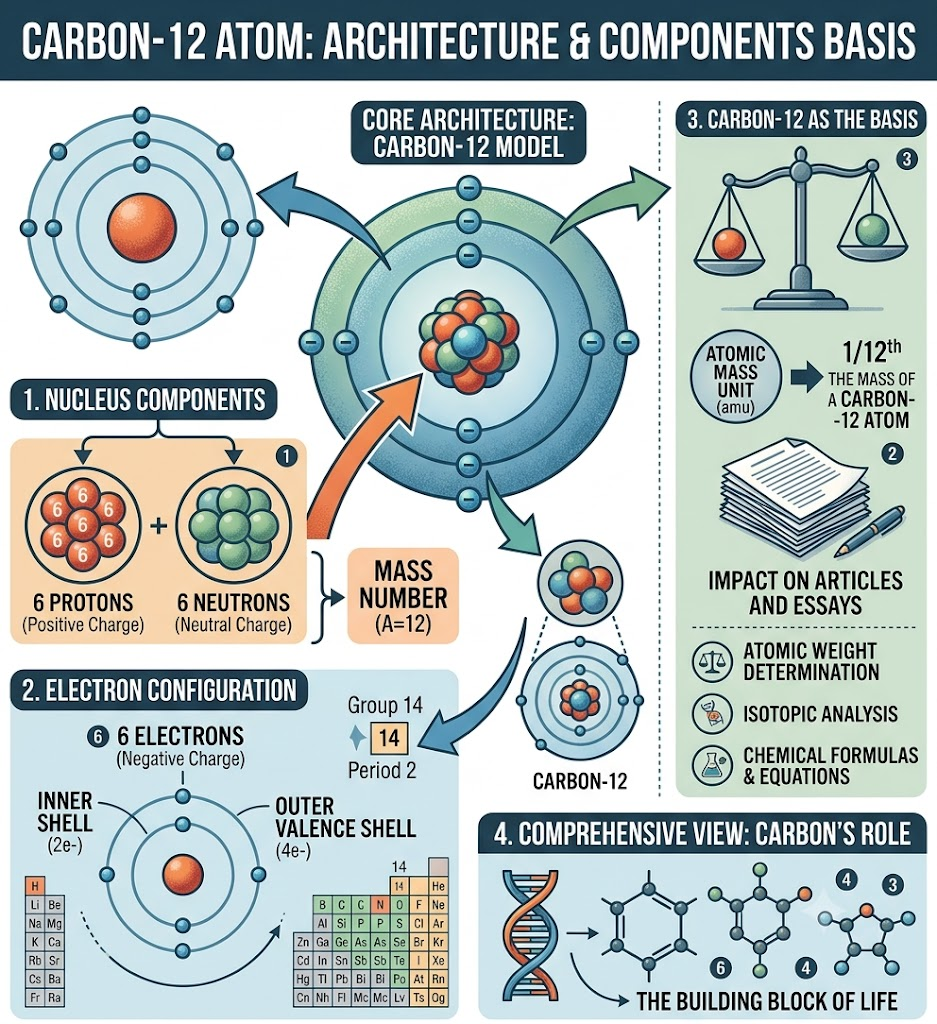
The nucleus of a carbon-12 atom sits at its core and contains 6 protons and 6 neutrons — a perfectly symmetric arrangement that gives the atom its remarkable stability.
Protons
The 6 protons each carry a positive electric charge (+1e). Their count defines the element: any atom with exactly 6 protons is carbon, by definition. Protons have a mass of approximately 1.0073 amu each and are composed of quarks—specifically, two up quarks and one down quark—bound together by gluons via the strong nuclear force.
Neutrons
The 6 neutrons carry no electric charge but contribute nearly the same mass as protons (~1.0087 amu each). Their role is critical: they act as nuclear “glue,” diluting the electrostatic repulsion between the positively charged protons and allowing the nucleus to hold together. Carbon-12’s equal number of protons and neutrons (6:6 ratio) is a hallmark of nuclear stability in lighter elements.
Nuclear Binding Energy
The nucleus is held together by the *strong nuclear force, the most powerful of the four fundamental forces. The binding energy of carbon-12’s nucleus is approximately 7.68 MeV (megavolts)—or about 7.68 MeV per nucleon. This is one of the highest binding energies per nucleon of any element, which explains why carbon-12 is so exceptionally stable and why it is synthesized so abundantly in stellar nucleosynthesis.
The Nuclear Shell Model
Carbon-12 fits neatly into the nuclear shell model. Both 6 protons and 6 neutrons fill the first two nuclear shells completely (the 1s shell holds 2 nucleons, the 1p shell holds 4). This closed-shell configuration contributes greatly to its stability—analogous to how noble gases are chemically inert due to full electron shells.
Electronic Architecture: The Electron Cloud
Surrounding the nucleus are 6 electrons, each carrying a charge of −1e, balancing the nucleus’s +6 charge to produce a neutral atom.
Electron Configuration
The electrons are arranged as 1s² 2s² 2p²
| Shell | Subshell | Electrons |
|---|---|---|
| 1 (K) | 1s | 2 |
| 2 (L) | 2s | 2 |
| 2 (L) | 2p | 2 |
- The 1s orbital is the innermost, spherical, and holds 2 core electrons tightly bound to the nucleus.
- The 2s orbital is also spherical but larger, holding 2 electrons at a higher energy level.
- The 2p orbitals (there are three: 2p_x, 2p_y, 2p_z) are dumbbell-shaped. In carbon’s ground state, only 2 of the 3 available 2p orbitals are occupied, each holding one electron (per Hund’s rule).
Valence Electrons and Chemical Bonding
Carbon has 4 valence electrons in its outer shell (2s² 2p²). This is the single most consequential fact about carbon’s chemistry. With 4 electrons to share and 4 “vacancies” to fill to reach a stable octet, carbon can form four covalent bonds simultaneously—with itself, hydrogen, oxygen, nitrogen, sulfur, and virtually every other element.
This tetravalency gives carbon an almost infinite capacity for molecular architecture: chains, rings, branches, double bonds, triple bonds, and three-dimensional frameworks. It is the reason life is carbon-based.
Hybridization
Carbon’s bonding geometry can shift through orbital hybridization:
- —4sp³ hybridization—4 equivalent bonds in a tetrahedral geometry (e.g., methane, CH₄)
- sp² hybridization—3 bonds in a planar, trigonal geometry + 1 π bond (e.g., ethylene, graphene)
- sp hybridization—2 bonds in a linear geometry + 2 π bonds (e.g., acetylene, CO₂)
Physical Properties
| Property | Value |
|---|---|
| Atomic number | 6 |
| Mass number | 12 |
| Atomic mass | exactly 12.000 amu (by definition) |
| Nuclear spin | 0 (bosonic nucleus) |
| Natural abundance | ~98.9% |
| Nuclear radius | ~2.7 fm (femtometers) |
| Atomic radius (covalent) | ~77 pm |
| Electronegativity (Pauling) | 2.55 |
| Ionization energy (1st) | 11.26 eV |
Carbon-12 as the Universal Mass Standard
Before 1961, atomic masses were measured relative to oxygen. The international scientific community—through IUPAC—redefined the atomic mass unit so that one atom of carbon-12 equals exactly 12 amu. This makes 1 amu = 1/12 the mass of a carbon-12 atom ≈ 1.66054 × 10⁻²⁷ kg. Every atomic mass on the periodic table flows from this single anchor point.
Carbon-12 in Stellar Nucleosynthesis: The Triple-Alpha Process
Carbon-12 is forged inside stars through the triple-alpha process, one of the most remarkable nuclear reactions in the universe:
- Two helium-4 nuclei (alpha particles) fuse to form unstable beryllium-8.
- Before it decays (in ~10⁻¹⁶ seconds), a third alpha particle collides with it.
- The result is an excited state of carbon-12 called the Hoyle state (7.65 MeV above ground state), which quickly decays to stable ¹²C.
Physicist Fred Hoyle predicted the Hoyle state in 1953 before it was experimentally confirmed—reasoning that if carbon existed in such abundance, there must be a resonance that made the triple-alpha process efficient. This prediction stands as one of the great triumphs of theoretical nuclear physics.
Carbon-12 vs. Other Carbon Isotopes
| Isotope | Protons | Neutrons | Stability | Abundance |
|---|---|---|---|---|
| Carbon-12 | 6 | 6 | Stable | 98.9% |
| Carbon-13 | 6 | 7 | Stable | 1.1% |
| Carbon-14 | 6 | 8 | Radioactive (t½ = 5,730 yr) | Trace |
Carbon-14, produced in the upper atmosphere by cosmic ray bombardment of nitrogen-14, is the basis of radiocarbon dating—one of archaeology’s most powerful tools.
Role in Life and Organic Chemistry
Every living organism is built on a carbon framework. DNA, proteins, lipids, and carbohydrates—all are carbon scaffolds. The carbon cycle moves ¹²C through the atmosphere (as CO₂), into plants (via photosynthesis), through the food chain, and back. Carbon-12’s stability means it doesn’t decay, making it the permanent structural currency of biology.
Conclusion
Carbon-12 is far more than just a common atom. Its architecture—6 protons, 6 neutrons, and 6 electrons arranged with extraordinary symmetry—produces a nucleus of exceptional stability, a chemistry of unrivaled versatility, and a cosmic abundance that makes life possible. It is the atom by which all other atoms are measured, the building block of every living thing, and a product of the nuclear furnaces of stars. In its elegant simplicity, carbon-12 encodes much of what makes the universe habitable and comprehensible




Be First to Comment