
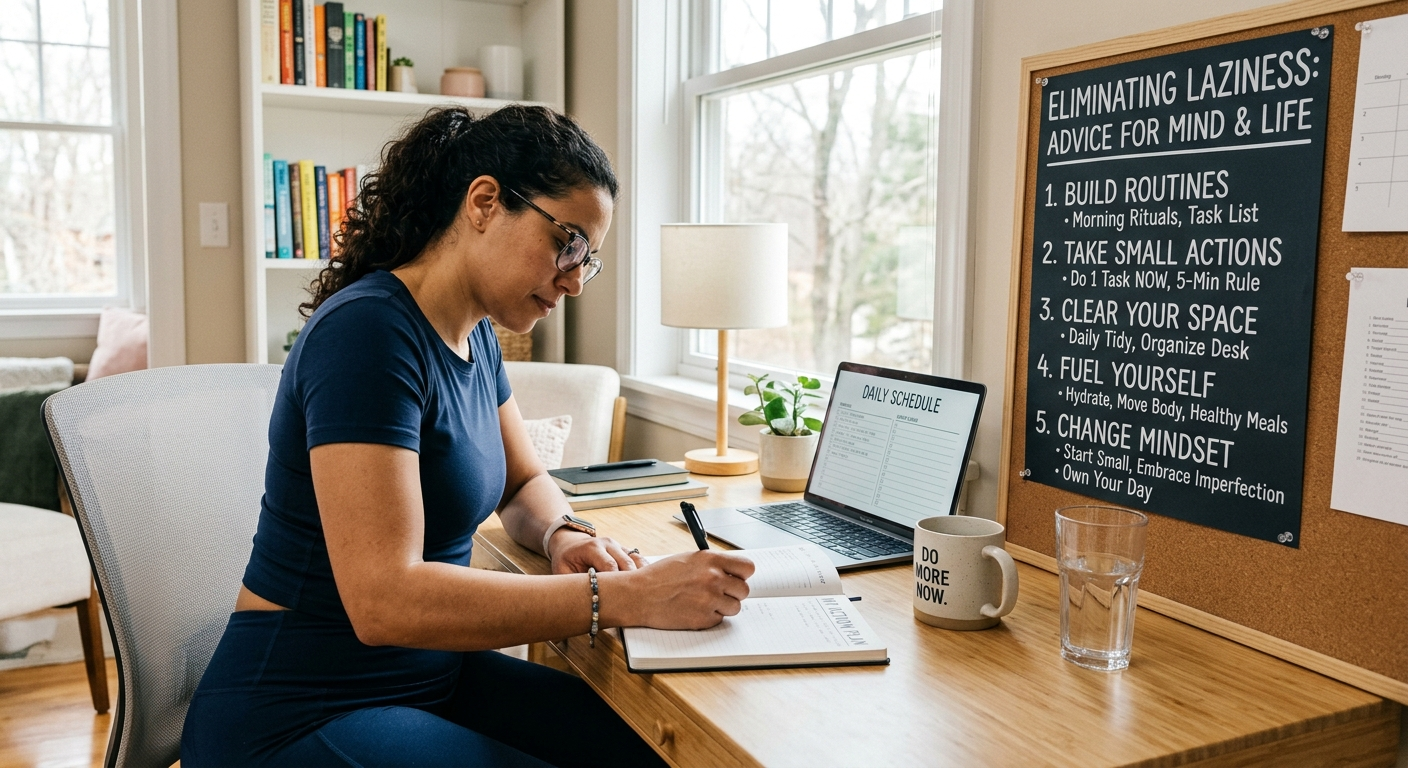
Introduction
“Laziness” is a word people often use when they see a gap between what someone wants to accomplish and what they actually do. However, the situation is usually more complicated than simply lacking character or discipline. Delaying work can result from boredom, uncertainty, distractions, fear of failure, poor organization, lack of meaningful goals, insufficient rest, or feeling overwhelmed.
A better objective is therefore not to “destroy laziness,” but to develop the ability to start, continue, and complete worthwhile activities even when motivation is not strong.
Research on procrastination and self-regulation supports the importance of practical planning and translating intentions into specific actions. One useful approach is an “if–then” plan: If a particular situation occurs, then I will perform a specific action. Research has found that such implementation intentions can help bridge the gap between intending to act and actually acting.
The following article presents a comprehensive framework for building an active, disciplined and purposeful life.
1. Understand What You Call “Laziness”
Before trying to change a behavior, identify what is actually happening.
Someone who repeatedly postpones homework, business work, exercise, reading, household responsibilities or personal projects may appear lazy. But several different problems can produce similar behavior.
For example:
- Boredom: “This activity does not interest me.”
- Overwhelm: “There is too much to do, so I don’t know where to begin.”
- Fear of failure: “What if I try and discover that I cannot do it?”
- Perfectionism: “I cannot start until I know exactly how to do it.”
- Distraction: “My phone, games or entertainment are easier and more immediately rewarding.”
- Poor planning: “I know what I want, but I have no clear next step.”
- Low energy: “I am genuinely tired.”
- Lack of purpose: “I do not understand why this matters.”
- Habit: “I have become accustomed to postponing things.”
Consequently, the first question should not be:
“Why am I so lazy?”
A better question is:
“What is preventing me from taking the next useful action?”
That question turns a negative label into a solvable problem.
2. Replace the Identity of “I Am Lazy”
One of the most damaging habits is turning a temporary behavior into a permanent identity.
There is a major psychological difference between:
“I am lazy.”
and:
“I have been postponing this task.”
The first statement describes a person as if the behavior were permanent. The second describes a behavior that can change.
Instead of saying:
- “I am lazy.”
- “I never finish anything.”
- “I cannot concentrate.”
- “I have no discipline.”
Try:
- “I am learning to become more consistent.”
- “I need a better system for starting tasks.”
- “I will work on this for a short period.”
- “I can improve through repeated practice.”
The objective is not unrealistic positive thinking. It is to recognize that behavior is changeable.
3. Motivation Is Not the Same as Discipline
Many people wait for motivation before starting.
They think:
“When I feel motivated, I will begin.”
This creates a problem because motivation naturally changes. Some days a person feels enthusiastic; other days they feel tired, distracted or uninterested.
A more reliable approach is:
Decision → Action → Progress → Motivation
rather than:
Motivation → Action
You do not always need to feel ready before beginning.
For example, instead of deciding:
“I am going to study for three hours.”
begin with:
“I will open my book and study one section.”
Starting reduces the psychological barrier.
4. Use the Five-Minute Principle
A large task can feel intimidating.
“Write an entire report” sounds difficult.
“Open the document and write the title” sounds manageable.
Therefore, make the first step extremely small.
Examples:
| Large task | Small starting action |
|---|---|
| Study mathematics | Solve one problem |
| Write an article | Write the introduction |
| Clean a room | Put away five items |
| Read a book | Read two pages |
| Learn programming | Write one small program |
| Organize files | Organize one folder |
| Exercise | Begin with gentle movement |
| Start a project | Write the first three tasks |
The purpose is not to remain at five minutes forever.
The purpose is to break the resistance to starting.
Once you begin, continuing often becomes easier.
5. Turn Goals Into Actions
A goal describes a destination.
An action describes what you will actually do.
For example:
Goal:
“I want to become good at mathematics.”
Actions:
- Study one mathematical concept.
- Work through examples.
- Attempt problems without looking at the answer.
- Check mistakes.
- Review difficult areas.
- Repeat regularly.
The same principle applies to almost everything.
Instead of:
“I want to become successful.”
ask:
“What can I do today that moves me one step toward that goal?”
6. Use the “If–Then” Method
One particularly useful self-regulation technique is an implementation intention.
The structure is:
If X happens, then I will do Y.
Examples:
- If it is 17:00, I will begin my study session.
- If I feel like checking social media while studying, I will finish the current section first.
- If I do not understand a question, I will mark it and continue with the next one.
- If I miss one day, I will restart the following day rather than abandoning the entire plan.
This technique converts vague intentions into specific behavioral responses. Research on implementation intentions has found benefits for translating intentions into action, although results vary depending on the situation and intervention.
7. Eliminate the “All-or-Nothing” Mentality
A common trap is believing:
“If I cannot do everything perfectly, there is no point starting.”
This creates unnecessary pressure.
Suppose you planned to study for two hours but only have thirty minutes.
You have two choices:
Choice A:
“I cannot complete two hours, so I will do nothing.”
Choice B:
“I have thirty minutes, so I will make those thirty minutes useful.”
Choice B develops consistency.
Progress does not have to be perfect to be valuable.
8. Build a Daily Structure
A person without structure must repeatedly decide what to do next.
That creates decision fatigue and makes distractions more attractive.
A simple daily structure might contain:
Morning
- Wake at a consistent time.
- Wash and prepare for the day.
- Eat appropriately.
- Review the day’s priorities.
- Begin with an important task.
Afternoon
- Continue school, work or responsibilities.
- Take reasonable breaks.
- Complete important assignments.
- Review progress.
Evening
- Finish essential tasks.
- Prepare for tomorrow.
- Reduce unnecessary distractions.
- Relax appropriately.
- Get sufficient sleep.
The exact schedule should be adapted to the person’s age, responsibilities and circumstances.
9. Create Three Priorities Each Day
A huge task list can become discouraging.
Instead, identify three important priorities.
For example:
Today’s three priorities
- Complete mathematics homework.
- Read ten pages.
- Organize tomorrow’s school materials.
Everything else becomes secondary.
This creates a sense of direction without requiring an enormous daily workload.
10. Control Your Environment
Willpower is useful, but the environment also influences behavior.
If distractions are constantly available, resisting them requires repeated effort.
Therefore, make productive behavior easier.
For studying
- Keep necessary materials nearby.
- Use a reasonably quiet location.
- Put unnecessary notifications aside.
- Keep only relevant materials in front of you.
For reading
- Keep the book visible.
- Choose a regular reading location.
- Start with manageable reading sessions.
For projects
- Keep project files organized.
- Maintain a written list of next actions.
- Break large projects into smaller stages.
The principle is:
Make good behavior easier and unnecessary distraction less convenient.
11. Treat the Smartphone as a Tool, Not the Boss
Digital technology can be extremely useful, but constant notifications and entertainment can interrupt concentration.
A practical strategy is to create periods during which the phone is not the center of attention.
For example:
Study period → focused work → short break → focused work
Rather than:
Study → notification → phone → video → message → social media → return to study
The problem is not that technology is inherently bad.
The problem is uncontrolled switching of attention.
12. Learn to Work With Boredom
Not every valuable activity is exciting.
Mathematics may sometimes be difficult.
Reading may sometimes feel slow.
Cleaning may be boring.
Learning a new skill may involve repetition.
A mature approach is to understand:
“I do not have to enjoy every moment of an activity for the activity to be valuable.”
Learning to tolerate ordinary boredom is an important part of developing persistence.
13. Break Difficult Work Into Stages
Large projects create psychological resistance when they are treated as one enormous task.
Instead, use a sequence.
For example:
Writing a major article
Stage 1: Choose the subject.
Stage 2: Define the main question.
Stage 3: Research the subject.
Stage 4: Create an outline.
Stage 5: Write the introduction.
Stage 6: Write the main sections.
Stage 7: Add examples and evidence.
Stage 8: Edit.
Stage 9: Proofread.
Stage 10: Publish or submit.
Suddenly, “write an article” becomes ten manageable actions.
14. Develop the Habit of Finishing
Starting many things and finishing very few can create a permanent feeling of being behind.
Therefore, finishing should become a skill.
Before starting another major project, ask:
“What unfinished task should I complete first?”
Finishing small things develops confidence.
For example:
- Finish the chapter.
- Finish the assignment.
- Finish organizing the folder.
- Finish the first version of the article.
- Finish the day’s essential responsibility.
Completion creates evidence that you can trust yourself.
15. Do Not Confuse Rest With Laziness
Rest is not automatically laziness.
Human beings require recovery.
Sleep, relaxation, social connection, recreation and breaks can all be legitimate parts of a healthy life.
The problem occurs when “rest” becomes an excuse to avoid everything indefinitely.
There is a difference between:
Healthy rest:
“I have completed my important responsibilities, and now I am relaxing.”
and:
Avoidance:
“I will keep postponing my responsibilities because entertainment is easier.”
A balanced life requires both effort and recovery.
16. Protect Your Sleep
A tired person may find concentration and self-control more difficult.
Therefore, developing discipline should not mean constantly forcing yourself to work while exhausted.
For young people especially, adequate sleep is an important part of learning, attention and general well-being.
A useful principle is:
Do not try to solve an energy problem entirely with willpower.
If someone is persistently exhausted despite getting adequate opportunities for sleep, it is sensible to discuss the problem with a parent, guardian, teacher, school counselor or healthcare professional rather than simply labeling themselves lazy.
17. Move Your Body Regularly
Regular physical activity can support general physical and mental well-being.
It does not have to mean extreme exercise.
Walking, playing a sport, cycling, stretching, dancing or other age-appropriate movement can help break long periods of inactivity.
The objective is not to pursue a particular body shape.
The objective is to support energy, health, mobility and concentration.
18. Discover Your Purpose
Discipline becomes easier when activities have meaning.
Ask:
What do I want to learn?
What problems do I want to solve?
What kind of person do I want to become?
What skills could help me contribute to society?
What knowledge genuinely interests me?
Purpose does not have to be discovered overnight.
It can develop through experimentation.
A student might begin with an interest in computers and eventually discover programming, cybersecurity, artificial intelligence, engineering or entrepreneurship.
Curiosity can become purpose.
19. Replace Instant Rewards With Meaningful Rewards
Modern life provides immediate entertainment almost everywhere.
Learning, however, often produces delayed rewards.
For example:
Entertainment: immediate pleasure.
Learning: effort now, benefits later.
The ability to delay gratification can therefore become valuable.
One approach is to connect focused work with a reasonable later reward:
“After completing my important task, I can relax.”
This creates a sequence:
Responsibility → Achievement → Reward
rather than:
Distraction → Delay → Stress → More distraction
20. Use a Progress Journal
A simple journal can reveal patterns.
At the end of each day, write:
What did I accomplish?
What did I postpone?
Why did I postpone it?
What distracted me?
What worked well?
What will I change tomorrow?
This turns failure into information.
Instead of:
“I failed again.”
you can ask:
“What caused the failure, and how can I modify the system?”
That is a much more productive mindset.
21. Learn From Failure Without Attacking Yourself
Everyone procrastinates sometimes.
Everyone has unproductive days.
Everyone loses concentration.
The danger is turning one bad day into a bad week.
For example:
Day 1: You fail to complete your plan.
Day 2: “I already failed, so there is no point.”
Day 3: More avoidance.
A better response is:
“Yesterday did not work. Today I restart.”
Consistency does not mean never falling off track.
It means returning to the track.
22. Use Accountability
Some people work better when another person knows what they are trying to accomplish.
Accountability can come from:
- a teacher;
- parent or guardian;
- study partner;
- coach;
- mentor;
- responsible friend;
- project team.
For example:
“By Friday I will complete the first draft.”
Then report whether you completed it.
Accountability creates an additional reason to follow through.
Research on self-imposed deadlines also suggests that deadlines can help people control procrastination, although externally imposed deadlines may sometimes produce stronger performance effects.
23. Understand That No Single Technique Works for Everyone
It is important not to turn productivity advice into another source of guilt.
Research on procrastination interventions has produced mixed findings. A systematic review found considerable variation in outcomes, and one experimental study found that SMART goals and implementation intentions, as implemented in that particular study, did not significantly reduce academic procrastination.
More recent research has nevertheless found promising results for approaches combining mental contrasting with implementation intentions in some settings, including a 2026 randomized trial involving academic procrastination.
The lesson is important:
Productivity is not a magic formula. It is a process of discovering which strategies work for a particular person and situation.
24. The 10-10-10 Restart Method
When you feel stuck, try a simple restart:
10 seconds
Decide what the next action is.
10 minutes
Work exclusively on that action.
10 minutes
Continue if you have momentum, or take a short break and return.
The objective is not to create a rigid productivity system.
It is to overcome the psychological barrier between thinking about work and beginning work.
25. The Anti-Laziness Formula
A useful conceptual formula is:
Purpose + Structure + Small Actions + Environment + Consistency + Recovery = Sustainable Productivity
Each component matters.
Purpose
Why does this matter?
Structure
When and where will I do it?
Small actions
What is the next physical action?
Environment
What makes the action easier?
Consistency
Can I repeat it regularly?
Recovery
Am I allowing myself adequate rest?
Remove one of these and the system may become weaker.
26. A Practical Seven-Day Reset
A person wanting to change their habits can begin with a simple seven-day experiment.
Day 1 — Observe
Identify the activities you repeatedly postpone.
Do not judge yourself. Simply observe.
Day 2 — Remove One Major Distraction
Identify one environmental factor that repeatedly interrupts your concentration.
Reduce it during important work.
Day 3 — Choose Three Priorities
Select three realistic priorities for the day.
Complete them before adding unnecessary tasks.
Day 4 — Practice Small Starts
Take a difficult task and begin with only the first small action.
Day 5 — Use an If–Then Plan
Create several specific plans:
“If X happens, I will do Y.”
Day 6 — Finish Something
Choose one unfinished task and complete it.
Day 7 — Review
Ask:
- What improved?
- What remained difficult?
- What caused procrastination?
- Which strategy helped?
- What should I continue next week?
The seven-day experiment is not supposed to transform someone overnight.
Its purpose is to demonstrate that behavior can be deliberately modified.
27. A Long-Term Personal Development System
Over the long term, productive living can be organized into five areas.
Area 1: Mind
Develop:
- curiosity;
- patience;
- concentration;
- emotional awareness;
- resilience;
- willingness to learn.
Area 2: Body
Develop:
- healthy sleep habits;
- regular movement;
- appropriate nutrition;
- adequate recovery.
Area 3: Knowledge
Develop:
- reading;
- mathematics;
- science;
- technology;
- communication;
- practical skills.
Area 4: Character
Develop:
- reliability;
- honesty;
- responsibility;
- persistence;
- respect;
- self-control.
Area 5: Purpose
Develop:
- meaningful goals;
- useful skills;
- contribution to others;
- long-term vision.
This creates a broader definition of success than simply “being busy.”
28. When “Laziness” May Actually Signal Another Problem
It is important not to assume that every lack of motivation is a character problem.
Persistent difficulty with concentration, energy, sleep, mood, learning or everyday functioning can have many possible causes.
If someone consistently struggles despite genuinely trying to improve their habits, they should talk with a trusted adult, teacher, school counselor, parent or guardian, and—when appropriate—a healthcare professional.
The goal should be understanding the underlying difficulty rather than blaming the person.
29. The Most Important Habit: Start Again
Perhaps the most powerful principle is extremely simple:
Start again.
You missed yesterday?
Start again.
You wasted the morning?
Start again in the afternoon.
You abandoned your plan?
Start again tomorrow.
You failed an assignment?
Learn from it and start again.
You lost motivation?
Take the next manageable action.
A successful life is rarely built from perfect days. It is built from repeatedly returning to worthwhile actions.
Conclusion
Eliminating “laziness” is not about becoming a machine that works constantly. It is about developing the ability to choose meaningful actions, begin them, persist through reasonable difficulty, complete important responsibilities and recover properly.
The most effective transformation begins with a change in thinking:
Do not ask:
“Why am I lazy?”
Ask:
“What is stopping me from taking the next useful step?”
Then make that step smaller.
Make the environment more supportive.
Create a specific plan.
Reduce unnecessary distractions.
Protect your rest.
Track your progress.
Learn from setbacks.
And begin again when you fall off course.
The ultimate goal is not simply to become “hard-working.” It is to become a person who can direct attention, manage time, develop useful skills, fulfill responsibilities and move steadily toward meaningful goals.
That is the deeper meaning of overcoming laziness: not fighting yourself every day, but gradually building a life in which productive action becomes a normal part of who you are.





Be First to Comment