
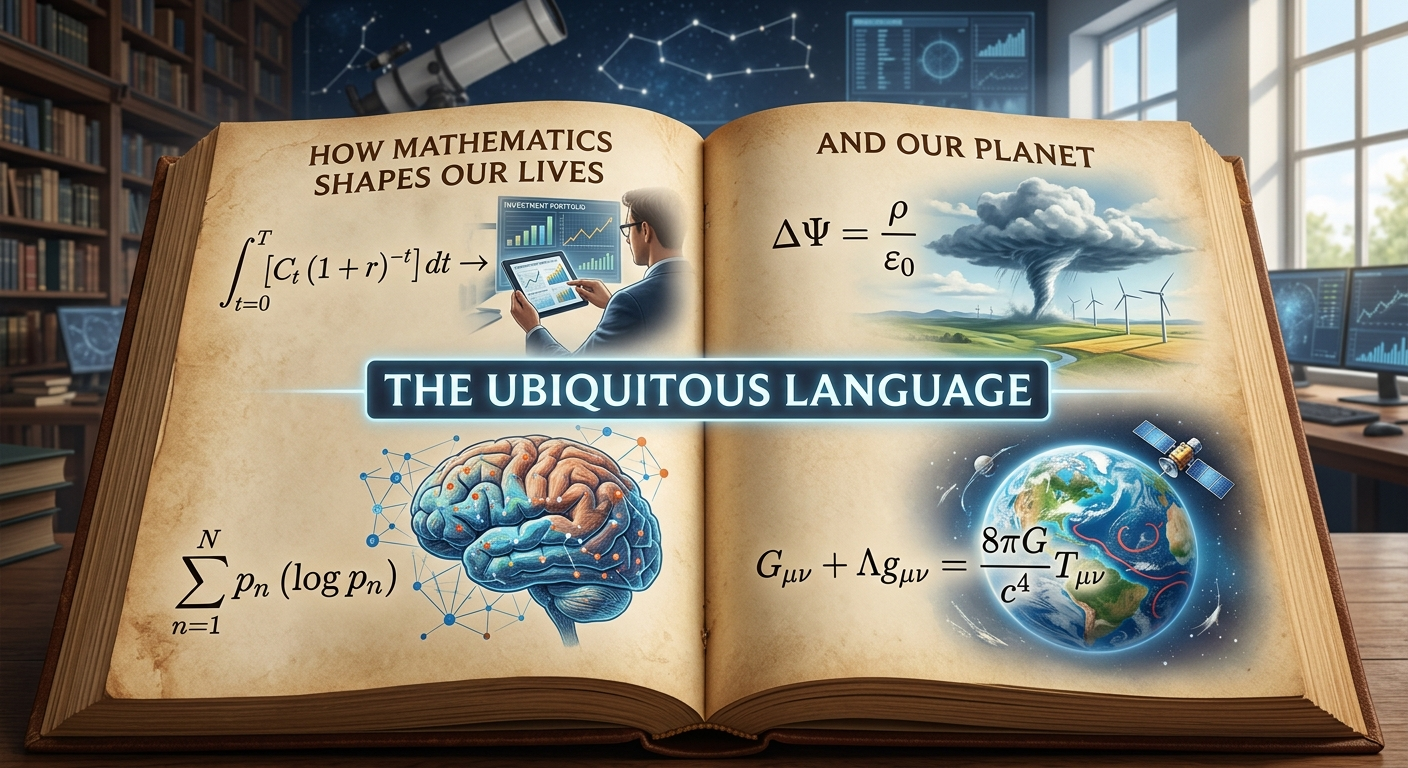
Introduction
Mathematics is often introduced as a school subject consisting of numbers, equations, formulas, graphs, geometry and calculations. Yet mathematics is much more than a classroom discipline. It is one of humanity’s most powerful languages for describing patterns, measuring change, predicting events, designing technologies and understanding the natural world.
From the movement of planets to the structure of a leaf, from the operation of a smartphone to the management of a city, mathematical relationships are embedded throughout modern civilization. We use mathematics when we measure time, calculate distance, compare prices, navigate with GPS, communicate through digital networks, analyse medical information, design buildings, forecast weather and manage resources.
UNESCO describes mathematics as fundamental to understanding nature, space, time and uncertainty, while emphasizing its importance in areas ranging from technology and transportation to climate change and public health.
The deeper significance of mathematics is therefore not simply that it helps us calculate answers. Mathematics allows humanity to turn observations into knowledge, knowledge into models, and models into decisions.
1. Mathematics as a Universal Language
A language normally allows people to communicate ideas. Mathematics performs a similar function, but with extraordinary precision.
Words can sometimes be interpreted differently. Mathematical notation can express relationships with much greater exactness.
For example:
2 + 3 = 5
communicates a relationship independently of whether the reader speaks English, Chinese, French, Arabic, Sesotho or another language.
Similarly:
distance = speed × time
expresses a relationship that can be applied to vehicles, aircraft, spacecraft, machinery and countless other systems.
Mathematics provides a common framework through which scientists, engineers, economists, architects, computer scientists and many other professionals can collaborate.
This universality is one reason mathematics became fundamental to modern science and engineering.
2. Mathematics Begins With Measurement
One of humanity’s earliest mathematical activities was measurement.
People needed to answer practical questions:
- How much land belongs to a particular farm?
- How far is one settlement from another?
- How much grain has been harvested?
- How much material is required to construct a building?
- When should crops be planted?
- How long until a particular astronomical event occurs?
Measurement transformed vague observations into quantities.
Length, area, volume, mass, temperature and time are all examples of measurable quantities.
Once something can be measured, mathematical relationships can be established.
For example, if a rectangular field has length (L) and width (W), its area is:
[
A=L\times W
]
This simple relationship has enormous practical importance in agriculture, construction, land management and urban planning.
3. Mathematics and Time
Time is one of the most fundamental quantities in human civilization.
Clocks, calendars and schedules all depend upon mathematical organization.
The measurement of time enables:
- transport timetables;
- financial transactions;
- industrial production;
- scientific experiments;
- telecommunications;
- satellite navigation;
- computer synchronization;
- astronomy.
Modern digital systems depend particularly heavily on accurate timing.
A telecommunications network, for example, must coordinate enormous numbers of signals and data exchanges. Tiny differences in timing can affect how information is transmitted and interpreted.
Mathematics therefore helps civilization coordinate activities across milliseconds, seconds, hours, days and centuries.
4. Mathematics in Nature
Mathematics is not merely something humans invented for accounting and commerce. Mathematical relationships appear throughout our descriptions of nature.
Physics expresses fundamental relationships using mathematical equations.
For example, Newton’s famous relationship is:
[
F=ma
]
where:
- (F) represents force,
- (m) represents mass,
- (a) represents acceleration.
This equation provides a mathematical description of how force, mass and acceleration are related.
Similarly, waves can be described mathematically through relationships involving wavelength, frequency and velocity.
The mathematical description of nature allows scientists to move beyond simply observing phenomena. They can construct models, test hypotheses and make predictions.
5. Mathematics and Geometry in the Natural World
Geometry provides another important connection between mathematics and nature.
Shapes and spatial relationships appear everywhere:
- crystals;
- snowflakes;
- leaves;
- shells;
- mountains;
- rivers;
- clouds;
- planetary bodies;
- biological structures.
Natural forms are not always perfectly geometric, but mathematical concepts help scientists describe their structure.
Fractals, for example, are mathematical structures associated with patterns that can display similar characteristics across different scales. Ideas related to fractal geometry have been useful in studying complicated natural forms and processes.
Geometry also provides the foundation for architecture, engineering, surveying, computer graphics and geographic information systems.
6. Mathematics and the Human Body
The human body is another extraordinary mathematical system.
Medical science uses mathematics to analyse:
- heart rate;
- blood pressure;
- body temperature;
- growth;
- fluid flow;
- medical images;
- genetic data;
- disease patterns;
- drug concentrations;
- population health.
Medical imaging provides a particularly striking example.
A medical scanner collects enormous amounts of information, and mathematical algorithms help transform that information into images that clinicians can interpret.
UNESCO notes that algorithms are central to applications including medical imaging.
Mathematics therefore becomes an invisible bridge between physical measurements and medical understanding.
7. Mathematics in Biology
Biology was once primarily associated with observation and classification. Today, mathematics plays an increasingly important role.
Scientists use mathematical models to investigate:
- population growth;
- predator-prey relationships;
- disease transmission;
- ecosystem dynamics;
- genetics;
- biodiversity;
- cellular processes;
- evolution;
- biological networks.
A simple population model might begin with the relationship:
[
P_{t+1}=P_t+rP_t
]
where (P) represents population and (r) represents a growth rate.
Real ecosystems are considerably more complicated, but the principle is powerful: mathematics allows scientists to represent biological processes in a structured form.
8. Mathematics and Agriculture
Agriculture depends on mathematical decision-making even when farmers do not explicitly think of themselves as mathematicians.
Consider a farm.
The farmer may need to calculate:
- field area;
- seed quantities;
- fertilizer requirements;
- water consumption;
- feed requirements;
- expected harvest;
- production costs;
- market prices;
- transport requirements.
Modern precision agriculture takes this even further.
Sensors, satellites, drones and farm-management systems generate large quantities of data. Mathematical analysis can help identify patterns in soil conditions, rainfall, crop development and resource consumption.
This creates an important transition:
traditional farming → measured farming → data-driven farming → precision agriculture.
9. Mathematics and Water
Water management is fundamentally mathematical.
A water authority needs to understand:
- rainfall;
- reservoir levels;
- river flows;
- groundwater;
- household consumption;
- industrial consumption;
- agricultural demand;
- evaporation;
- treatment capacity.
Engineers can use mathematical models to estimate how much water is available and how much is required.
The same principles apply to flood management.
By combining rainfall measurements, terrain data, river-flow information and mathematical models, scientists and engineers can estimate potential flood behaviour.
Mathematical modelling is increasingly important for environmental planning and disaster preparedness. UNESCO identifies applications of mathematics in areas including weather prediction, agriculture, fisheries and climate-related challenges.
10. Mathematics and Weather
Weather forecasting is one of the most visible applications of mathematics.
The atmosphere contains enormous numbers of interacting variables:
- temperature;
- pressure;
- humidity;
- wind;
- solar radiation;
- clouds;
- precipitation;
- ocean conditions.
Weather models divide the atmosphere into computational regions and use mathematical equations to estimate how atmospheric conditions evolve.
The calculations are performed repeatedly using powerful computers.
This illustrates a fundamental principle:
more data + better mathematics + greater computing power = increasingly sophisticated models.
However, mathematical models are not magical predictions. They are approximations of complicated physical systems.
11. Mathematics and Climate Change
Climate science provides perhaps one of the clearest examples of mathematics being used to understand the planet.
Climate models represent interactions among:
- atmosphere;
- oceans;
- land;
- ice;
- vegetation;
- solar energy;
- greenhouse gases;
- clouds.
NASA explains that modern climate modelling combines scientific understanding, observations, satellite measurements and increasingly powerful computational methods.
Mathematical models allow scientists to investigate questions that cannot be tested by simply conducting experiments on Earth.
For example, scientists cannot create another Earth and change its atmospheric composition for comparison. Instead, they can use computer models to investigate how different conditions affect climate.
NASA describes climate models as computer-based laboratories that allow researchers to investigate interactions that would be difficult or impossible to test directly.
12. Mathematics and Planetary Science
Mathematics also allows humanity to investigate worlds far beyond Earth.
Astronomers calculate:
- planetary orbits;
- distances;
- velocities;
- masses;
- gravitational interactions;
- temperatures;
- radiation;
- trajectories of spacecraft.
NASA educational material demonstrates how mathematical models can connect planetary distance, incoming solar energy and planetary temperature.
This means mathematics provides a bridge between what humanity can directly observe and what humanity can infer about distant worlds.
13. Mathematics and Space Exploration
Space exploration would be impossible without mathematics.
A spacecraft travelling from Earth to another celestial body must follow a carefully calculated trajectory.
Engineers must consider:
- gravitational forces;
- velocity;
- fuel;
- orbital mechanics;
- timing;
- spacecraft mass;
- planetary positions.
A tiny error in a trajectory calculation can become significant over enormous distances.
Mathematical models therefore transform space exploration from a simple act of launching an object into a carefully controlled process of navigation through a gravitational environment.
14. Mathematics and GPS
Global Positioning System technology provides an excellent everyday example.
A GPS receiver determines its location using signals from satellites.
The system relies on measurements of signal travel time and mathematical calculations involving satellite positions.
The receiver effectively solves a geometric positioning problem.
This means that when someone uses navigation on a smartphone, mathematical principles involving:
- geometry;
- time;
- distance;
- coordinates;
- signal propagation
are operating invisibly in the background.
UNESCO specifically identifies GPS positioning as an everyday example of mathematics in action.
15. Mathematics and Telecommunications
Modern telecommunications are mathematical systems.
Every phone call, text message, video stream and internet connection involves mathematical processing.
Mathematics contributes to:
- signal processing;
- data compression;
- error correction;
- modulation;
- encryption;
- network optimization;
- routing;
- bandwidth management.
Digital communication must deal with noise and errors.
Error-correcting codes use mathematical structures to help systems detect and sometimes correct errors introduced during transmission.
UNESCO notes that error-correction methods are fundamental to telecommunications systems.
Thus, mathematics helps transform imperfect physical communication channels into reliable digital networks.
16. Mathematics and Computers
Computers are mathematical machines at their foundation.
At the lowest level, digital computers represent information using binary states.
Binary arithmetic provides the basis for:
- logical operations;
- memory;
- data processing;
- digital communication;
- software execution.
Higher-level mathematics then enables increasingly sophisticated computational systems.
Computer graphics use geometry.
Cryptography uses number theory and algebra.
Machine learning uses statistics, linear algebra, probability and optimization.
Simulation uses numerical mathematics.
Computer science is therefore deeply connected to mathematical thinking.
17. Mathematics and Artificial Intelligence
Artificial intelligence is one of the clearest modern demonstrations of mathematics becoming embedded inside technology.
Many AI systems depend on mathematical concepts including:
- vectors;
- matrices;
- probability;
- statistics;
- optimization;
- functions;
- derivatives;
- numerical computation.
Machine-learning systems process data and adjust internal parameters to improve their performance on particular tasks.
A simplified optimization concept can be expressed as:
[
\text{Find parameters that minimize error}
]
Although real AI systems can involve extremely complex mathematical structures, the basic principle remains understandable.
UNESCO notes that algorithms are central to artificial intelligence and other technological developments.
18. Mathematics and the Internet
The internet is sometimes perceived as a purely technological infrastructure, but underneath its physical cables, radio systems and computers lies an enormous mathematical architecture.
Mathematics supports:
- addressing;
- routing;
- encryption;
- compression;
- error correction;
- traffic optimization;
- search algorithms;
- data storage.
When a person requests information from a website, computers must determine how data should travel through interconnected networks.
This creates a mathematical problem involving paths, probabilities, capacity and optimization.
19. Mathematics and Cryptography
Digital security depends heavily on mathematics.
Cryptography transforms information so that unauthorized parties cannot easily interpret it.
Modern cryptographic systems rely on mathematical concepts involving areas such as:
- number theory;
- modular arithmetic;
- probability;
- algebra;
- computational complexity.
This has enormous importance for modern society because digital transactions depend upon secure communication.
Online banking, secure websites, digital identity systems and many other services rely on cryptographic techniques.
20. Mathematics and Finance
Finance is one of the most obvious areas where mathematical thinking influences everyday life.
Consider a bank account.
Interest can be represented using mathematical relationships.
For simple compound growth:
[
A=P(1+r)^t
]
where:
- (A) is the final amount;
- (P) is the initial amount;
- (r) is the rate per period;
- (t) is the number of periods.
Financial institutions use far more sophisticated mathematics to analyse:
- interest rates;
- loans;
- credit risk;
- insurance;
- investments;
- market behaviour;
- portfolio allocation.
21. Mathematics and Economics
Economics uses mathematical models to study how individuals, companies and governments make decisions.
Mathematical economics can examine:
- supply and demand;
- production;
- employment;
- inflation;
- economic growth;
- taxation;
- trade;
- resource allocation.
However, mathematical models in economics should be interpreted carefully.
Human societies are not machines. Human decisions involve culture, psychology, politics, expectations and uncertainty.
Mathematics can provide structure without eliminating uncertainty.
22. Mathematics and Transportation
Transportation networks are large mathematical systems.
Consider a city with:
- roads;
- buses;
- trains;
- traffic lights;
- airports;
- pedestrians;
- delivery networks.
Mathematical optimization can help determine how resources should be allocated.
For example, transportation planners can study traffic flow and attempt to minimize:
- congestion;
- travel time;
- fuel consumption;
- operating costs.
Mathematics therefore contributes to the design of systems that move millions of people and enormous quantities of goods.
23. Mathematics and Architecture
Architecture combines artistic creativity with mathematical structure.
Buildings require calculations involving:
- dimensions;
- angles;
- loads;
- areas;
- volumes;
- structural forces;
- materials.
A modern skyscraper cannot simply be designed according to appearance.
Engineers must determine whether its structural system can withstand expected loads, including wind and other forces.
Mathematical modelling allows engineers to test designs computationally before construction.
24. Mathematics and Engineering
Engineering can be described, in part, as the application of mathematical and scientific knowledge to practical problems.
Electrical engineers use mathematics to analyse circuits and signals.
Mechanical engineers use mathematics to analyse motion, forces and energy.
Civil engineers use mathematics to design structures and infrastructure.
Chemical engineers use mathematics to model industrial processes.
Aerospace engineers use mathematics to study aerodynamics and flight.
Computer engineers use mathematics to design and analyse digital systems.
Thus, mathematics is not an isolated academic subject. It is one of the foundations of engineering civilization.
25. Mathematics and Energy
The world’s energy systems also depend on mathematics.
Engineers must calculate:
- electricity demand;
- power generation;
- transmission losses;
- battery capacity;
- energy storage;
- fuel consumption;
- renewable energy production.
Solar panels, wind turbines, hydroelectric systems, batteries and electrical grids all involve mathematical models.
For example, solar-energy production depends upon variables such as sunlight intensity, panel area, efficiency and environmental conditions.
26. Mathematics and Environmental Protection
Environmental management requires measurement and modelling.
Scientists may monitor:
- air pollution;
- water quality;
- biodiversity;
- soil conditions;
- deforestation;
- greenhouse-gas emissions;
- ocean temperatures.
Once data are collected, mathematical methods can reveal trends and relationships.
Mathematics therefore helps transform environmental observations into evidence that can support planning and policy.
27. Mathematics and Biodiversity
Biodiversity involves enormous complexity.
Scientists may need to estimate:
- population sizes;
- species distributions;
- extinction risks;
- habitat changes;
- genetic diversity.
Statistical models help researchers analyse incomplete information.
For example, scientists rarely observe every individual organism in an ecosystem. Instead, they collect samples and use statistical methods to estimate larger populations.
Mathematics thus helps humanity understand biological systems that are too large and complicated to observe completely.
28. Mathematics and Disaster Management
Natural disasters create urgent mathematical problems.
Researchers and emergency planners may model:
- floods;
- storms;
- droughts;
- wildfires;
- earthquakes;
- disease outbreaks.
Mathematical models can help estimate probabilities, potential impacts and possible scenarios.
UNESCO highlights mathematical modelling as an important tool for disaster-related forecasting, including improvements in tropical cyclone trajectory prediction.
The purpose is not to predict every event perfectly. Rather, better information can improve preparation and decision-making.
29. Mathematics and Population
Human populations can also be studied mathematically.
Demographers analyse:
- birth rates;
- death rates;
- migration;
- age distributions;
- population growth;
- household structures.
Governments use demographic projections when planning:
- schools;
- hospitals;
- housing;
- transport;
- employment;
- water systems;
- electricity infrastructure.
Population mathematics therefore connects directly to public planning.
30. Mathematics and Education
Mathematics education is itself strategically important.
A society with strong mathematical skills can develop greater capacity in:
- science;
- engineering;
- medicine;
- economics;
- computing;
- data analysis;
- technology.
UNESCO emphasizes the importance of mathematics and STEM education for solving contemporary challenges and expanding opportunities.
The challenge is that mathematics can appear intimidating when taught only as a collection of procedures.
A more powerful approach is to show learners why mathematics matters.
Instead of seeing mathematics only as equations on a page, students can encounter mathematics through:
music → patterns → physics → technology → nature → architecture → computing → space.
31. Mathematics and Music
Music provides an interesting intersection between creativity and mathematics.
Musical systems involve:
- rhythm;
- frequency;
- ratios;
- repetition;
- patterns;
- timing;
- structure.
Sound itself is a physical phenomenon that can be represented mathematically as waves.
Digital audio systems then convert sound into numerical information that computers can store, process and transmit.
A song heard through a smartphone is therefore simultaneously:
sound + physics + mathematics + computation + communication technology.
32. Mathematics and Art
Art also contains mathematical structures.
Perspective depends on geometry.
Digital graphics depend on coordinates and transformations.
Animation depends on time and numerical movement.
Three-dimensional computer graphics rely heavily on mathematical representations of objects, surfaces, light and spatial relationships.
Even when an artist is not consciously calculating equations, mathematical structures can exist beneath the visual result.
33. Mathematics and Language
Natural languages and mathematics are different, but they interact continuously.
Computer systems process language using mathematical representations.
Search engines rank information using algorithms.
Speech-recognition systems transform sound into computational representations.
Translation systems analyse relationships between words and statistical or machine-learning patterns.
Modern language technologies therefore demonstrate another transformation:
human language → data → mathematical representation → computation → useful output.
34. Mathematics and Everyday Decisions
Mathematics does not require a laboratory.
People use basic mathematical reasoning every day when deciding:
- whether a purchase is affordable;
- which product offers better value;
- how much time is available;
- how much material is needed;
- how far a journey is;
- how much food is required;
- how resources should be divided.
Percentages, ratios, averages and comparisons are particularly important.
Financial literacy is therefore partly mathematical literacy.
35. Mathematics and Probability
Life contains uncertainty.
We do not know exactly what will happen tomorrow.
Probability provides a structured language for uncertainty.
It is used in:
- weather forecasting;
- insurance;
- medical research;
- scientific experiments;
- finance;
- engineering;
- artificial intelligence;
- risk management.
Probability does not guarantee what will happen. It quantifies uncertainty under specified assumptions and available information.
This distinction is crucial.
A probability is not the same thing as certainty.
36. Mathematics and Statistics
Statistics allows society to learn from data.
Suppose a city wants to understand public transport usage.
It might collect information about:
- passengers;
- routes;
- times;
- destinations;
- delays;
- frequency.
Statistical analysis can reveal patterns that would be difficult to see from individual observations.
Statistics is therefore one of the major bridges between raw data and knowledge.
In the modern world, this role has become increasingly important because digital systems generate enormous quantities of data.
37. Mathematics, Big Data and the Digital Age
Modern civilization produces data at unprecedented scales.
Sensors, smartphones, satellites, financial systems, scientific instruments and industrial machines continuously generate information.
But data alone is not knowledge.
Mathematics helps answer:
- What patterns exist?
- Which observations are unusual?
- Which variables are related?
- What trends are emerging?
- How reliable is the conclusion?
- What might happen next?
This makes mathematics essential to the transformation:
Data → information → analysis → knowledge → decision.
38. Mathematics and Scientific Discovery
Science depends upon a continuous cycle:
Observation → Measurement → Mathematical representation → Model → Prediction → Experiment → Revision.
Mathematics is therefore not merely used after scientific discovery.
It is often part of the discovery process itself.
A mathematical model can reveal relationships that are not immediately obvious from raw observations.
When the predictions of a model disagree with observations, scientists have an opportunity to investigate why.
That disagreement can lead to better theories.
39. Mathematical Models Are Powerful—but Imperfect
One of the most important lessons about mathematics is that a model is not reality itself.
A mathematical model is a representation of reality.
Consider a weather model.
The real atmosphere is enormously complex. A model simplifies that system so that computers can calculate its behaviour.
The model can be extremely useful while still being imperfect.
NASA’s educational material emphasizes that mathematical models involve advantages, disadvantages and uncertainties and can be improved as additional variables and better observations become available.
This principle applies everywhere.
A model is useful because it simplifies reality—not because it perfectly reproduces reality.
40. Mathematics and the Limits of Prediction
Mathematics can improve prediction, but it cannot eliminate uncertainty.
There are several reasons.
First, measurements contain errors.
Second, models contain assumptions.
Third, natural systems can be extremely complex.
Fourth, some systems are sensitive to initial conditions.
Fifth, human behaviour can change in response to predictions.
Therefore, responsible mathematical analysis should communicate uncertainty rather than hide it.
Good mathematical reasoning asks not only:
“What does the model predict?”
but also:
“How reliable is the prediction, what assumptions produced it, and what could make it wrong?”
41. Mathematics and Civilization
The development of civilization can be understood partly as an increasing ability to measure, calculate and model.
Ancient civilizations developed mathematics for:
- agriculture;
- taxation;
- trade;
- architecture;
- calendars;
- astronomy.
Later societies developed increasingly sophisticated mathematics for:
- navigation;
- mechanics;
- engineering;
- finance;
- physics.
The industrial age accelerated mathematical engineering.
The digital age transformed mathematics into computational algorithms.
The emerging AI era is pushing mathematics even further into automated analysis, prediction and decision-support systems.
42. From Ancient Arithmetic to Artificial Intelligence
The historical progression is remarkable.
Stage 1: Counting
Humans learned to represent quantities.
Stage 2: Arithmetic
Addition, subtraction, multiplication and division enabled increasingly complex commerce and administration.
Stage 3: Geometry
Measurement of space supported construction, agriculture and astronomy.
Stage 4: Algebra
Unknown quantities could be represented symbolically.
Stage 5: Calculus
Change and motion could be mathematically analysed.
Stage 6: Statistics and Probability
Uncertainty and populations could be studied systematically.
Stage 7: Computational Mathematics
Computers could perform enormous numbers of calculations.
Stage 8: Machine Learning
Algorithms could learn mathematical patterns from data.
The result is that mathematics has moved from being primarily a human calculation tool to becoming a fundamental operating language of modern technological civilization.
43. Mathematics and the Future Planet
The importance of mathematics may become even greater as humanity faces interconnected planetary challenges.
These include:
- climate change;
- population growth;
- food security;
- water management;
- energy transition;
- biodiversity loss;
- urbanization;
- disease;
- infrastructure development;
- technological transformation.
Each problem contains interacting variables.
Mathematics helps organize those relationships.
UNESCO’s work on mathematics for sustainable development emphasizes that mathematical approaches can support science-based decision-making across environmental, social and economic challenges.
44. The Planet as a Mathematical System
Earth can be viewed as a collection of interconnected systems.
For example:
Sun → energy → atmosphere → oceans → land → ecosystems → agriculture → society → economy → technology
Changes in one part can affect others.
Mathematical modelling provides a method for studying these interactions.
NASA’s climate-modeling work demonstrates how computer models can combine physical processes and observations to investigate Earth’s climate and even conditions on distant planets.
This is one of the most important developments in modern science: mathematics allows humanity to study systems too large, complicated or slow-moving to understand through direct observation alone.
45. Mathematics and Sustainable Development
Sustainable development requires balancing several objectives.
Society wants:
- economic prosperity;
- environmental protection;
- reliable energy;
- food security;
- social development;
- efficient infrastructure.
These objectives can sometimes conflict.
Mathematical optimization can help decision-makers explore different possibilities.
For example, a city may want to minimize transport emissions while maintaining affordable mobility.
An energy planner may want to maximize renewable generation while maintaining reliability.
A water manager may need to balance agricultural, industrial, environmental and household requirements.
Mathematics cannot make these decisions automatically, because values and political choices are involved. But it can help reveal the consequences of different choices.
46. Mathematics as a Bridge Between Disciplines
Perhaps the greatest strength of mathematics is its ability to connect different fields.
A single mathematical idea can appear in several disciplines.
For example:
Optimization
can be used in:
- engineering;
- logistics;
- economics;
- AI;
- transportation;
- energy;
- agriculture.
Statistics
can be used in:
- medicine;
- biology;
- finance;
- government;
- climate science;
- education.
Geometry
can be used in:
- architecture;
- astronomy;
- robotics;
- computer graphics;
- engineering.
Mathematics therefore functions as a bridge between specialized areas of knowledge.
47. The Hidden Mathematics of Modern Life
A person can move through an entire day without consciously thinking about mathematics while constantly depending upon it.
Morning
An alarm clock measures time.
Travel
A navigation system calculates position and routes.
Communication
A smartphone processes digital signals.
Work
A computer performs numerical and logical operations.
Banking
Financial systems perform calculations and secure transactions.
Shopping
Prices, discounts, taxes and quantities involve arithmetic.
Weather
Forecasting depends upon mathematical models.
Evening
Streaming services use algorithms to process and deliver digital media.
Mathematics is therefore often invisible precisely because it has become so deeply integrated into technology.
48. The Central Lesson
The central lesson is simple:
Mathematics is not merely about numbers. Mathematics is about relationships.
It asks:
- How does one quantity affect another?
- What changes?
- What remains constant?
- What pattern exists?
- What is the probability of an event?
- What is the optimal solution?
- What happens if conditions change?
These questions are applicable almost everywhere.
49. Why Mathematical Literacy Matters
A mathematically literate society is better equipped to interpret information.
This matters because modern citizens encounter numerical claims constantly.
Examples include:
- economic statistics;
- health information;
- environmental measurements;
- election statistics;
- scientific findings;
- financial offers;
- technology specifications.
Mathematical literacy helps people distinguish between:
measurement and opinion,
correlation and causation,
probability and certainty,
evidence and assumption.
This makes mathematics important not only for scientists but also for responsible citizenship.
50. Conclusion: Mathematics as the Architecture of Understanding
Mathematics is one of humanity’s most remarkable intellectual achievements because it simultaneously describes the smallest measurable relationships and some of the largest systems imaginable.
It helps us understand atoms and galaxies, cells and ecosystems, markets and cities, computers and communications networks.
It allows engineers to design bridges, scientists to model climates, doctors to analyse medical information, farmers to manage resources, economists to study markets and astronomers to navigate spacecraft.
It also operates quietly in everyday life: when we use a phone, navigate a journey, purchase something, read a timetable or estimate how much time remains in a day.
The relationship between mathematics and the planet is especially profound. Earth is a dynamic system containing interacting physical, biological and human processes. Mathematical models give us tools for studying those interactions, testing scenarios and making better-informed decisions. NASA’s climate research and educational materials demonstrate how mathematical models can be used to investigate planetary conditions and climate processes.
The future will make mathematics even more important.
Artificial intelligence, advanced computing, climate modelling, biotechnology, robotics, space exploration, renewable energy and global infrastructure will all require increasingly sophisticated mathematical reasoning.
The real power of mathematics therefore lies not in memorizing formulas.
It lies in learning to recognize patterns, measure reality, understand relationships, reason about uncertainty, construct models and make informed decisions.
Mathematics is consequently much more than a school subject.
It is a language of science.
It is a foundation of engineering.
It is a framework for computation.
It is a tool for understanding nature.
It is an instrument for managing civilization.
And, perhaps most importantly, it is one of humanity’s most powerful ways of asking a fundamental question:
How does the world work?
Key Takeaways
- Mathematics is a universal language of relationships and patterns.
- Measurement converts observations into quantities that can be analysed.
- Mathematical models allow scientists to represent complicated real-world systems.
- Modern technology—including GPS, telecommunications, computing and AI—depends heavily on mathematics.
- Medicine, agriculture, finance, transportation and engineering all use mathematical methods.
- Climate and planetary science rely on mathematical and computational modelling.
- Mathematics helps society manage uncertainty rather than simply eliminating it.
- A mathematical model is a representation of reality, not reality itself.
- Mathematical literacy is increasingly important for understanding modern information and making informed decisions.
- The future of sustainable civilization will require mathematics to connect science, technology, economics and environmental stewardship.
Selected References
- UNESCO, Maths Counts.
- UNESCO, An Essential Tool for Understanding the World.
- UNESCO, Mathematics for Action: Supporting Science-Based Decision-Making.
- UNESCO, International Day of Mathematics 2025.
- NASA, An Introduction to Climate Modeling.
- NASA, What Are Climate Models?.
- NASA Goddard, How Earth Climate Models Help Scientists Picture Life on Unimaginable Worlds.

Be First to Comment