
Abstract
Scientific research is one of the principal foundations of modern economic development, technological progress, public health, environmental management, national competitiveness, and human understanding. Nations that build strong research ecosystems tend to combine universities, government laboratories, private companies, research hospitals, scientific infrastructure, skilled human capital, financing, international collaboration, and systems for transforming discoveries into practical applications.
The global scientific landscape, however, is undergoing a major transformation. For much of the modern era, the United States, Western Europe, Japan, and a relatively small group of advanced economies dominated international scientific research. During the twenty-first century, China has expanded its research capacity extraordinarily rapidly, while India, South Korea, Singapore, Brazil, Australia, Canada, and other countries have strengthened their scientific capabilities.
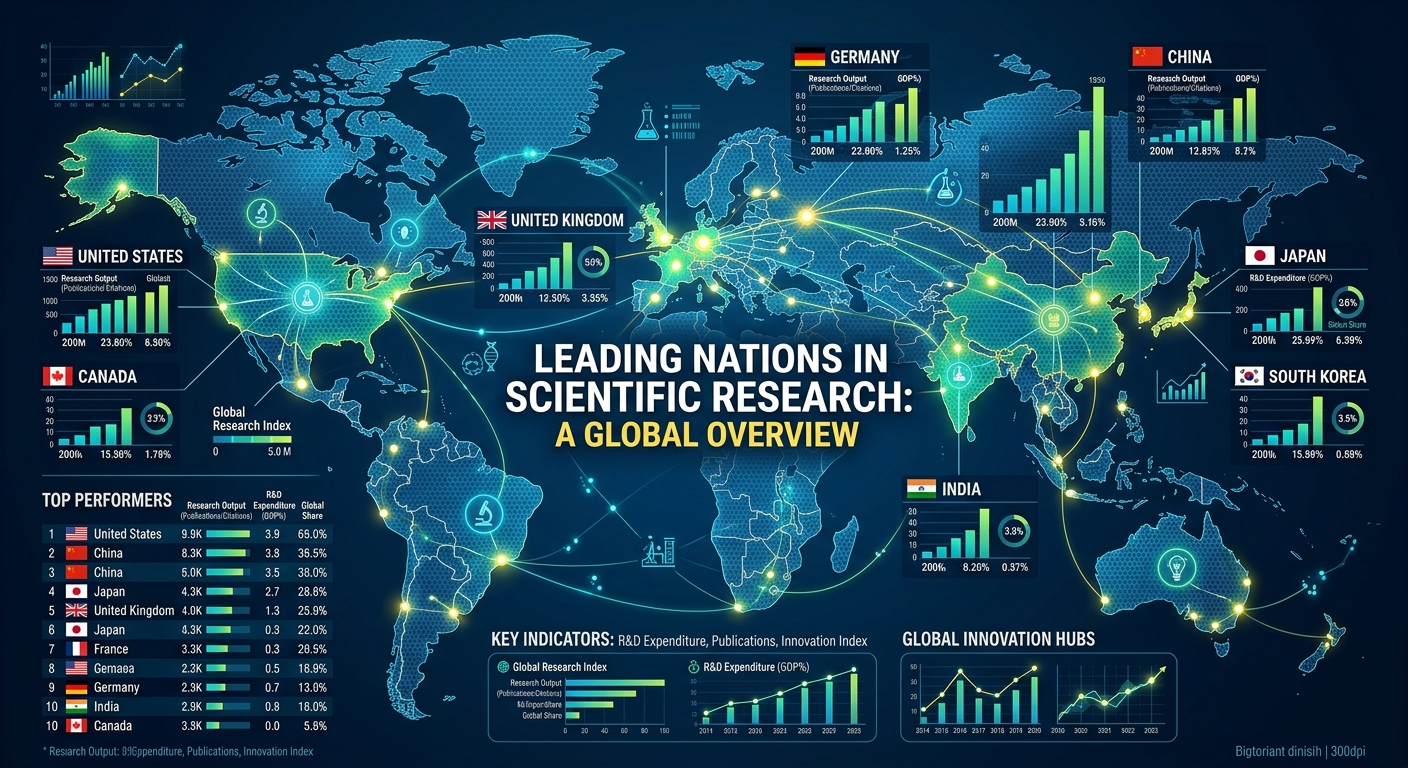
Recent data illustrate the scale of this transformation. In 2024, global R&D expenditure reached approximately $3.48 trillion. On an internationally comparable basis, China accounted for approximately $1.028 trillion, or about 30% of global R&D, while the United States accounted for approximately $1.009 trillion, or about 29%. Japan, Germany, and South Korea followed among the largest individual national performers.
Research publication output has also shifted substantially. In 2024, approximately 3.5 million science and engineering articles were produced worldwide. China accounted for about 31%, the United States 12%, and India 7%. Yet publication quantity alone does not determine scientific leadership: highly cited research, breakthrough discoveries, patents, research infrastructure, scientific influence, commercialization, and international collaboration are equally important.
This thesis examines the leading scientific nations, the historical development of their research systems, their strengths and weaknesses, emerging scientific powers, the changing relationship between research and economic development, and the future geography of global science.
1. Introduction
Science is a cumulative human enterprise. Every generation inherits knowledge from previous generations and extends it through observation, experimentation, mathematical reasoning, engineering, computation, and collaboration.
Modern scientific leadership is therefore much more than the number of scientists a country possesses. A scientifically powerful nation generally requires an ecosystem capable of answering several fundamental questions:
- How much does the country invest in research and development?
- How many researchers and engineers does it educate?
- How strong are its universities?
- How sophisticated are its laboratories?
- How effectively does government support fundamental research?
- How much R&D does the private sector perform?
- How many important scientific publications does it produce?
- How influential are those publications?
- How successfully does research become technology?
- How extensively does the country collaborate internationally?
Consequently, there is no single perfect ranking of scientific nations.
A country can lead in publication volume but have less influence in commercialization. Another may produce fewer papers but generate exceptionally influential discoveries. A third may specialize in biotechnology, another in semiconductors, another in astronomy, and another in agricultural science.
Scientific leadership should therefore be understood as a multidimensional ecosystem.
2. The Meaning of Scientific Leadership
Scientific leadership can be defined as a nation’s sustained capacity to generate, validate, disseminate, protect, and apply new knowledge.
A useful conceptual equation is:
Scientific Leadership = Research Investment + Human Capital + Infrastructure + Discovery + Scientific Impact + Innovation + Collaboration
Each component matters.
2.1 Research investment
R&D financing provides the resources required for laboratories, researchers, equipment, computing systems, field experiments, data collection, and long-term scientific programs.
2.2 Human capital
Scientists, engineers, mathematicians, physicians, technicians, statisticians, computer scientists, and research managers form the intellectual foundation of a research system.
2.3 Infrastructure
Modern science depends on sophisticated infrastructure, including:
- laboratories;
- supercomputers;
- particle accelerators;
- telescopes;
- genomic sequencing facilities;
- synchrotrons;
- research vessels;
- satellites;
- high-performance computing;
- semiconductor fabrication facilities;
- scientific databases; and
- advanced instrumentation.
2.4 Scientific impact
Publication numbers provide one measurement of activity, but citations and highly cited research provide additional information about influence.
2.5 Innovation
Research becomes economically and socially powerful when discoveries can be transformed into technologies, medicines, industrial processes, materials, software, and services.
3. The Historical Geography of Scientific Power
The geography of scientific leadership has changed repeatedly.
Ancient scientific achievements emerged across civilizations including Mesopotamia, Egypt, India, China, Greece, the Islamic world, and other regions.
During the Scientific Revolution, European countries became increasingly influential in mathematics, physics, astronomy, chemistry, and biology.
The Industrial Revolution subsequently connected scientific knowledge with industrial production.
During the nineteenth and twentieth centuries, countries such as Germany, Britain, France, Russia, Japan, and eventually the United States developed increasingly sophisticated research institutions.
After the Second World War, the United States became the dominant scientific and technological power, supported by enormous government investment, world-class universities, national laboratories, industrial R&D, and international migration of highly skilled researchers.
Japan subsequently became a major technological and industrial research power.
South Korea transformed from a relatively poor country into a highly R&D-intensive economy.
China then embarked on one of the largest expansions of scientific and technological capacity in modern history.
India has also experienced major growth in scientific publications, engineering, space research, information technology, pharmaceuticals, and digital technologies.
The result is a much more geographically distributed global research system.
4. The United States
The United States remains one of the world’s most influential scientific powers.
Its strengths include:
- world-leading research universities;
- major government laboratories;
- exceptionally strong private-sector R&D;
- advanced biomedical research;
- computer science;
- artificial intelligence;
- aerospace;
- physics;
- biotechnology;
- materials science;
- energy research;
- semiconductor research; and
- a powerful venture-capital ecosystem.
Although China is estimated to have surpassed the United States in total R&D expenditure in 2024 on an internationally comparable basis, the United States remains exceptionally influential in highly cited research and innovation.
The American research model is particularly notable for its integration of universities, government, industry, investors, hospitals, and entrepreneurial companies.
The business sector performed approximately 77% of U.S. R&D in 2024 and funded approximately 75%, demonstrating the extraordinary role of private enterprise in the American research ecosystem.
Major American scientific strengths
The United States has major capabilities in:
- artificial intelligence;
- computer science;
- medicine;
- biotechnology;
- aerospace;
- astronomy;
- particle physics;
- neuroscience;
- quantum science;
- energy technology;
- materials science; and
- engineering.
Its greatest strategic advantage is arguably not simply expenditure but the ability to connect basic research → engineering → entrepreneurship → investment → commercialization.
5. China
China represents the most significant transformation in the contemporary global scientific system.
Its R&D expenditure grew dramatically during the last two decades. China’s internationally comparable R&D expenditure reached approximately $1.028 trillion in 2024, compared with approximately $1.009 trillion for the United States.
China’s share of global R&D increased from approximately 4.8% in 2000 to approximately 29.6% in 2024. During the same period, the U.S. share declined from approximately 38.9% to 29.0%.
China is also the world’s largest producer of science and engineering publications by volume.
In 2024, Chinese authors accounted for approximately 31% of global S&E publication output.
Major Chinese strengths
China has developed substantial capabilities in:
- engineering;
- materials science;
- chemistry;
- artificial intelligence;
- telecommunications;
- renewable energy;
- batteries;
- electric vehicles;
- robotics;
- high-speed rail;
- space science;
- quantum technologies;
- advanced manufacturing; and
- information technology.
China’s rise demonstrates how sustained national investment can rapidly expand scientific capacity.
Nevertheless, publication quantity should not automatically be interpreted as equivalent to scientific leadership. Quality, reproducibility, citations, breakthrough discoveries, international recognition, and practical impact must also be considered.
6. Japan
Japan remains one of the world’s major scientific and technological nations.
Its research system is characterized by:
- high R&D intensity;
- sophisticated manufacturing;
- strong universities;
- corporate laboratories;
- advanced materials research;
- robotics;
- electronics;
- automotive engineering;
- chemistry;
- precision engineering; and
- biomedical research.
In 2024, Japan’s R&D expenditure was approximately $234 billion, with an R&D intensity of about 3.62% of GDP.
Japan’s scientific importance therefore extends beyond publication volume. Its strength is closely connected with its ability to combine research with advanced industrial manufacturing.
7. Germany
Germany is Europe’s largest individual national R&D performer.
Its research ecosystem combines:
- universities;
- government research institutions;
- industrial laboratories;
- engineering organizations;
- applied research institutes;
- manufacturing companies; and
- strong vocational and technical education.
Germany’s 2024 R&D expenditure was approximately $193 billion, representing around 3.13% of GDP.
Germany is particularly strong in:
- engineering;
- chemistry;
- automotive technology;
- materials science;
- physics;
- industrial automation;
- manufacturing;
- environmental technologies; and
- applied research.
The country’s model demonstrates the importance of connecting academic science with industrial engineering.
8. South Korea
South Korea is one of the most R&D-intensive major economies in the world.
In 2024, South Korea’s R&D intensity was approximately 5.13% of GDP, considerably above the global average. Its total R&D expenditure was approximately $162 billion on the internationally comparable measure used by NCSES.
South Korea’s scientific and technological strengths include:
- semiconductors;
- electronics;
- telecommunications;
- batteries;
- materials;
- artificial intelligence;
- biotechnology;
- robotics; and
- advanced manufacturing.
The Korean example demonstrates that a country does not need the world’s largest population to become a major scientific and technological power.
9. India
India is emerging as one of the most important research-producing nations.
Its scientific ecosystem is supported by:
- large universities;
- engineering institutions;
- government laboratories;
- space research;
- pharmaceutical research;
- information technology;
- mathematics;
- physics;
- biotechnology; and
- a large population of scientists and engineers.
India accounted for approximately 7% of global S&E publications in 2024, making it the third-largest national contributor by publication volume after China and the United States.
India’s scientific development is particularly significant because it combines a large domestic market with a large technical workforce.
Its future potential depends on increasing research intensity, strengthening laboratory infrastructure, improving university research capacity, expanding private R&D, and converting more research into high-impact technologies.
10. United Kingdom
The United Kingdom has a relatively small population but an extraordinarily influential scientific tradition.
Its strengths include:
- physics;
- medicine;
- biology;
- chemistry;
- mathematics;
- astronomy;
- computer science;
- neuroscience;
- climate science; and
- social science.
British universities and research institutions have historically played a disproportionate role in global scientific discovery.
The United Kingdom also benefits from extensive international research networks.
Its challenge is maintaining research intensity and infrastructure while competing with larger research systems in the United States, China, India, and other countries.
11. France
France is another major European scientific power.
Its capabilities include:
- mathematics;
- physics;
- nuclear science;
- aerospace;
- medicine;
- chemistry;
- environmental science;
- computer science; and
- engineering.
France’s research ecosystem includes universities, national laboratories, specialized research institutions, and major industrial companies.
It is particularly important in large-scale scientific infrastructure and strategic technologies.
12. Canada
Canada has a strong scientific ecosystem despite its relatively small population.
Its major strengths include:
- artificial intelligence;
- medicine;
- neuroscience;
- astronomy;
- environmental science;
- agriculture;
- quantum research;
- computer science; and
- natural resources research.
Canada’s international research relationships also contribute significantly to its scientific influence.
13. Australia
Australia possesses a distinctive research portfolio shaped partly by its geography and natural environment.
Its strengths include:
- astronomy;
- marine science;
- climate research;
- environmental science;
- agriculture;
- medicine;
- mining technology;
- geology; and
- biotechnology.
Its geographic position also gives it strategic importance for Southern Hemisphere astronomy, climate observation, ocean research, and Antarctic science.
14. Italy
Italy has a long scientific tradition and remains a significant contributor to global research.
Its strengths include:
- physics;
- medicine;
- engineering;
- chemistry;
- materials science;
- mathematics;
- archaeology; and
- cultural heritage science.
Italy also participates extensively in European research programs and international scientific infrastructure.
15. Spain
Spain has developed a substantial research ecosystem in:
- medicine;
- biotechnology;
- physics;
- renewable energy;
- astronomy;
- environmental science;
- engineering; and
- agricultural science.
Its participation in European scientific programs provides access to large multinational research networks and infrastructure.
16. Russia
Russia retains important scientific capabilities inherited partly from the Soviet scientific system.
Its major areas include:
- mathematics;
- physics;
- space science;
- nuclear science;
- engineering;
- chemistry;
- materials science; and
- Earth sciences.
Its publication output has also increased in absolute terms over the long term, although international collaboration and institutional conditions affect its position in the global scientific system.
17. Brazil
Brazil is the leading scientific power in Latin America by many measures.
Its strengths include:
- agriculture;
- tropical medicine;
- biodiversity;
- environmental science;
- energy;
- biofuels;
- forestry;
- geology; and
- public health.
Brazil’s scientific importance is particularly connected to its enormous biological diversity and its role in global environmental and agricultural research.
18. The European Union as a Scientific Power
Although individual European countries are important, the European Union should also be considered collectively.
The EU-27 accounted for approximately $612 billion in R&D expenditure in 2024, placing it behind China and the United States when treated as a collective economic bloc.
Europe’s collective strengths include:
- fundamental physics;
- medicine;
- chemistry;
- climate science;
- aerospace;
- engineering;
- materials science;
- renewable energy;
- mathematics; and
- social science.
European cooperation allows countries to build scientific infrastructure that would be difficult for many individual nations to finance independently.
19. The Publication Revolution
One of the clearest indicators of the changing scientific landscape is the growth of research publications.
In 2023, the 15 largest producing countries and economies accounted for enormous shares of global S&E publication output.
China produced approximately 932,712 publications, representing 28.48% of the global total in the dataset; the United States produced approximately 430,843, representing 13.16%; and India produced approximately 228,174, representing 6.97%.
This represents a profound transformation from earlier decades.
China’s research output has grown particularly rapidly, while the publication output of several established research powers has grown much more slowly.
However, publication counts should never be interpreted alone.
A country producing one million papers is not automatically more scientifically influential than a country producing fewer papers with exceptionally high-impact discoveries.
20. Scientific Quality Versus Scientific Quantity
Scientific leadership contains a fundamental distinction:
Quantity asks: How much research is produced?
Quality asks: How important is the research?
Impact asks: How widely does the research influence subsequent knowledge and technology?
Innovation asks: What does the research enable society to build?
This distinction is essential when comparing nations.
The United States continues to produce a disproportionately high share of highly cited scientific articles. Recent NCSES analysis states that U.S. researchers continue to generate a high share of highly cited articles across scientific fields.
China, meanwhile, has rapidly increased both publication volume and scientific impact.
This suggests that the global scientific balance is not simply moving from one dominant country to another. Instead, the system is becoming increasingly multipolar.
21. Research Intensity
Absolute expenditure is only one measurement.
Another important indicator is:
R&D Intensity = R&D Expenditure ÷ GDP × 100
This measures how much of a country’s economy is devoted to research.
For example, in 2024:
| Country/Economy | Approx. R&D expenditure | R&D intensity |
|---|---|---|
| United States | $1.009 trillion | 3.44% |
| China | $1.028 trillion | 2.69% |
| Japan | $234 billion | 3.62% |
| Germany | $193 billion | 3.13% |
| South Korea | $162 billion | 5.13% |
| United Kingdom* | $115 billion | 2.75% |
| France | $93 billion | 2.18% |
| Taiwan | $77 billion | 4.10% |
*United Kingdom data shown are for 2023 in the cited NCSES table.
These figures demonstrate why South Korea, Japan, Taiwan, Germany, and the United States are scientifically significant even though their populations are much smaller than China’s or India’s.
22. Universities as Engines of Discovery
Universities remain central to scientific development.
A strong research university provides:
- undergraduate education;
- postgraduate training;
- doctoral programs;
- laboratories;
- scientific publications;
- patents;
- research centers;
- international partnerships;
- entrepreneurship; and
- knowledge transfer.
The world’s strongest research systems therefore tend to contain dense networks of universities rather than a single elite institution.
Universities also provide a crucial pipeline of future scientists.
23. Government Research
Private companies cannot finance every type of research.
Fundamental research often has uncertain commercial returns and may require decades before practical applications emerge.
Governments therefore finance areas such as:
- fundamental physics;
- astronomy;
- climate science;
- public health;
- national laboratories;
- space science;
- agricultural research;
- environmental monitoring;
- defense-related science;
- disease surveillance; and
- large scientific infrastructure.
The most successful national research systems generally maintain a balance between public and private investment.
24. Industry as a Scientific Force
Modern scientific leadership increasingly depends on private companies.
Technology companies conduct enormous amounts of research in:
- artificial intelligence;
- semiconductors;
- cloud computing;
- biotechnology;
- robotics;
- telecommunications;
- pharmaceuticals;
- energy;
- aerospace; and
- advanced manufacturing.
The United States provides one of the clearest examples of this model, with business R&D accounting for the majority of national R&D performance.
China, South Korea, Japan, Germany, and other nations have also developed powerful relationships between industrial companies and research institutions.
25. Scientific Infrastructure
Scientific leadership increasingly depends on infrastructure that is too expensive for individual laboratories.
Examples include:
- particle accelerators;
- nuclear research facilities;
- supercomputers;
- astronomical observatories;
- space telescopes;
- genomic databases;
- synchrotron radiation facilities;
- fusion laboratories;
- deep-sea research systems;
- climate observation networks; and
- national semiconductor research facilities.
Large infrastructure creates a multiplier effect because thousands of researchers can use the same facility.
26. Artificial Intelligence and the New Scientific Revolution
Artificial intelligence is changing scientific research itself.
AI can assist scientists with:
- pattern recognition;
- protein structure prediction;
- drug discovery;
- materials discovery;
- climate modeling;
- astronomical data analysis;
- simulation;
- automated experimentation;
- literature analysis;
- mathematical reasoning; and
- scientific hypothesis generation.
Consequently, future scientific leadership may depend not only on human researchers but also on access to:
AI models + data + computing + laboratories + scientific expertise.
Countries capable of combining these elements may achieve substantial advantages.
27. Quantum Science
Quantum research is another strategic area.
Major research nations are investing in:
- quantum computing;
- quantum communication;
- quantum sensing;
- quantum materials;
- quantum simulation; and
- fundamental quantum physics.
The field illustrates the increasing overlap between fundamental science and strategic technology.
28. Biotechnology and Medicine
Biomedical research remains one of the most important dimensions of global science.
Major research powers compete and collaborate in:
- genomics;
- vaccines;
- cancer research;
- neuroscience;
- regenerative medicine;
- infectious diseases;
- medical imaging;
- pharmaceutical science;
- synthetic biology; and
- personalized medicine.
The COVID-19 pandemic demonstrated the importance of national and international scientific capacity.
Countries with strong biomedical research institutions were better positioned to understand emerging diseases and develop medical responses.
29. Energy and Climate Research
The transition toward lower-carbon energy systems has created enormous scientific challenges.
Research priorities include:
- solar energy;
- wind energy;
- batteries;
- hydrogen;
- nuclear energy;
- fusion;
- carbon management;
- energy storage;
- smart grids;
- energy efficiency; and
- climate modeling.
China, the United States, Japan, Germany, South Korea, and European institutions are particularly important contributors.
30. Scientific Collaboration
Modern science is increasingly international.
A research project may involve:
- a university in one country;
- a laboratory in another;
- a telescope in a third;
- computing infrastructure in a fourth; and
- researchers from ten or more countries.
The proportion of S&E articles involving international collaboration increased from approximately 19% in 2012 to 22% in 2024. U.S. researchers contributed to 31% of internationally coauthored articles in 2024.
This demonstrates that scientific competition and scientific cooperation coexist.
Countries compete for talent, funding, patents, technologies, and strategic capabilities while simultaneously collaborating on problems that transcend national borders.
31. Africa and the Global Scientific System
Africa remains underrepresented in global R&D relative to its population.
However, the continent possesses enormous scientific potential.
Important areas include:
- agriculture;
- tropical medicine;
- infectious disease research;
- biodiversity;
- renewable energy;
- mining science;
- astronomy;
- climate science;
- water management;
- food security; and
- digital technology.
South Africa has one of the continent’s most developed research ecosystems, with significant capabilities in astronomy, mining research, medicine, engineering, environmental science, and physics.
African countries can strengthen their scientific position through regional research networks, improved universities, doctoral training, research infrastructure, public funding, private-sector participation, and international partnerships.
32. Latin America
Latin America has several important research centers.
Brazil is the largest research system in the region, while Argentina, Mexico, Chile, Colombia, and other countries contribute significantly in specialized fields.
Regional strengths include:
- agriculture;
- biodiversity;
- medicine;
- astronomy;
- environmental science;
- energy;
- geology; and
- public health.
Latin America’s scientific future will depend heavily on sustained research financing and the ability to retain highly trained researchers.
33. The Global Scientific Competition
The emerging global scientific order can broadly be characterized by several major centers.
North America
United States and Canada.
East Asia
China, Japan, South Korea, and Taiwan.
Europe
Germany, United Kingdom, France, Italy, Spain, and the wider European Union.
South Asia
India and emerging research systems in neighboring countries.
Oceania
Australia and New Zealand.
Latin America
Brazil, Mexico, Argentina, Chile, and others.
Africa
South Africa, Egypt, Nigeria, Kenya, Morocco, and other emerging systems.
The scientific world is therefore becoming more geographically diverse.
34. The Most Important Lesson: There Is No Single Scientific Ranking
A scientifically mature assessment should avoid declaring one country “the best” in every field.
Instead, leadership should be measured across dimensions.
| Dimension | Major leaders |
|---|---|
| Overall R&D expenditure | China, United States |
| Research publication volume | China, United States, India |
| Highly cited research | United States and other advanced research systems |
| R&D intensity | South Korea, Taiwan, Japan, United States |
| Engineering | China, United States, Germany, Japan, South Korea |
| Biomedical science | United States, Europe, China, Japan and others |
| Space science | United States, China, Europe, Russia, Japan, India and others |
| Advanced manufacturing | China, Japan, Germany, South Korea |
| AI research | United States, China and other major research systems |
| Fundamental physics | United States, Europe, Japan, China and others |
| Agricultural research | United States, China, Brazil, India and others |
| Climate/environmental research | Europe, United States, China, Australia and others |
The table should be understood as a broad analytical framework rather than a definitive ranking.
35. Why Scientific Leadership Matters
Scientific leadership affects almost every dimension of national development.
Economic development
Research creates new industries, products, services, and jobs.
Health
Biomedical research improves diagnosis, prevention, and treatment.
Food security
Agricultural research improves crop productivity and resilience.
Energy
Research enables new energy technologies.
Environment
Scientific monitoring helps societies understand climate and ecological change.
Education
Research universities train future generations.
Technology
Scientific knowledge provides the foundation for engineering innovation.
National resilience
Research capacity helps countries respond to pandemics, environmental disasters, technological disruptions, and other major challenges.
36. Problems Facing Global Science
Despite extraordinary scientific progress, several challenges remain.
36.1 Unequal funding
Research funding remains concentrated in a relatively small number of countries.
36.2 Unequal infrastructure
Many developing nations lack advanced laboratories and computing infrastructure.
36.3 Brain drain
Researchers may migrate toward countries offering better funding, salaries, facilities, and career opportunities.
36.4 Fragmentation
International tensions can disrupt scientific collaboration.
36.5 Reproducibility
Scientific systems must continuously improve research quality, transparency, and reproducibility.
36.6 Commercial pressure
Excessive emphasis on short-term commercial results can reduce investment in fundamental science.
36.7 Access to data and computing
AI-driven science increasingly requires enormous datasets and computational resources.
37. The Future of Scientific Leadership
The next generation of scientific competition will likely be determined by the ability to integrate multiple capabilities.
The leading research systems of the future are likely to combine:
Education
↓
Researchers
↓
Universities
↓
Government laboratories
↓
Computing
↓
AI
↓
Scientific infrastructure
↓
Industry
↓
Venture capital
↓
Commercialization
↓
Global collaboration
This represents a transition from traditional scientific competition toward integrated knowledge ecosystems.
38. Implications for Developing Countries
Developing nations do not necessarily need to replicate the entire research systems of the United States or China.
Instead, they can identify strategic areas where they possess comparative advantages.
For example:
- countries with major agricultural sectors can prioritize agricultural science;
- mineral-rich nations can develop mining and materials research;
- countries with high biodiversity can develop biotechnology;
- countries with abundant solar resources can develop renewable-energy research;
- countries with strong universities can build specialized research centers;
- countries with astronomical advantages can invest in astronomy; and
- countries with young populations can invest heavily in STEM education.
A strategic specialization approach can allow smaller economies to achieve international scientific significance.
39. Recommendations for Building a Strong National Research System
A country seeking to strengthen its scientific capabilities should consider the following long-term strategy.
1. Strengthen mathematics and science education
Scientific capacity begins in schools.
2. Expand university research
Universities should be supported not merely as teaching institutions but as research and innovation centers.
3. Increase R&D investment
Government and private-sector investment should grow predictably over many years.
4. Build laboratories
Modern research requires modern infrastructure.
5. Support doctoral education
PhD researchers are essential to advanced scientific capacity.
6. Encourage private-sector R&D
Companies should be connected with universities and government laboratories.
7. Create research funding mechanisms
Competitive grants encourage scientific excellence.
8. Develop national scientific priorities
Countries should identify strategic areas where research can address national challenges.
9. Reduce brain drain
Scientists require attractive research environments, career pathways, infrastructure, and stable funding.
10. Expand international collaboration
Developing countries can accelerate capacity building through partnerships with established research systems.
11. Use AI for research
AI can increase the productivity of researchers and help scientists process enormous datasets.
12. Measure quality, not merely quantity
Publication counts should be complemented by citations, patents, reproducibility, research impact, technology transfer, and societal outcomes.
40. Conclusion
The global scientific system is undergoing one of the most significant transformations in modern history.
The United States remains a scientific superpower, particularly in highly cited research, advanced innovation, biomedical science, computing, and private-sector R&D. China has emerged as a formidable scientific competitor and, according to internationally comparable 2024 estimates, became the largest national performer of R&D expenditure.
Japan, Germany, South Korea, the United Kingdom, France, India, Canada, Australia, Italy, Brazil, and other countries contribute important specialized capabilities.
The most important transformation, however, is not simply the rise of one country. It is the emergence of a multipolar global scientific system.
China’s enormous publication output, India’s rapidly expanding research base, South Korea’s extraordinary R&D intensity, Japan and Germany’s industrial research capabilities, Europe’s multinational scientific infrastructure, and America’s continuing influence in high-impact research demonstrate that scientific power is increasingly distributed among multiple centers.
The data also reveal an important distinction between research volume and research influence. China leads global publication volume, while U.S. researchers continue to hold a strong position in highly cited research.
Ultimately, the nations that will lead science in the coming decades will not simply be those that spend the most money. They will be those that can successfully connect education, talent, fundamental research, engineering, computing, artificial intelligence, infrastructure, entrepreneurship, industry, international collaboration, and long-term national vision.
The future of scientific leadership will therefore be determined by the ability to build complete knowledge ecosystems.
Science is no longer the achievement of isolated laboratories or individual nations. It has become a global network in which discoveries made in one country can be transformed into technologies in another, tested by researchers in a third, manufactured in a fourth, and used by people across the world.
The central question for the twenty-first century is consequently not simply which nation leads science, but rather:
Which nations can build the most capable, open, innovative, resilient, and interconnected scientific ecosystems?
That question will increasingly determine the future distribution of technological power, economic opportunity, human health, environmental sustainability, and knowledge itself.
Selected Research Sources
- National Center for Science and Engineering Statistics, The State of U.S. Science and Engineering 2026.
- National Science Board, Discovery: R&D Activity and Research Publications.
- OECD-based internationally comparable R&D indicators reported by NCSES.
- National Science Foundation, New report shows China science enterprise on the rise, business continues to lead U.S. R&D.



Be First to Comment