
Abstract
Trees and plants are living biological systems that form the foundation of terrestrial ecosystems, agriculture, forestry, food production, biodiversity, and human settlements. Like humans and animals, plants can become sick. Plant sickness may result from infectious organisms such as fungi, bacteria, viruses, viroids, nematodes, and parasitic plants, or from non-infectious stresses such as drought, flooding, nutrient deficiencies, pollution, unsuitable soil conditions, temperature extremes, physical damage, and poor management.
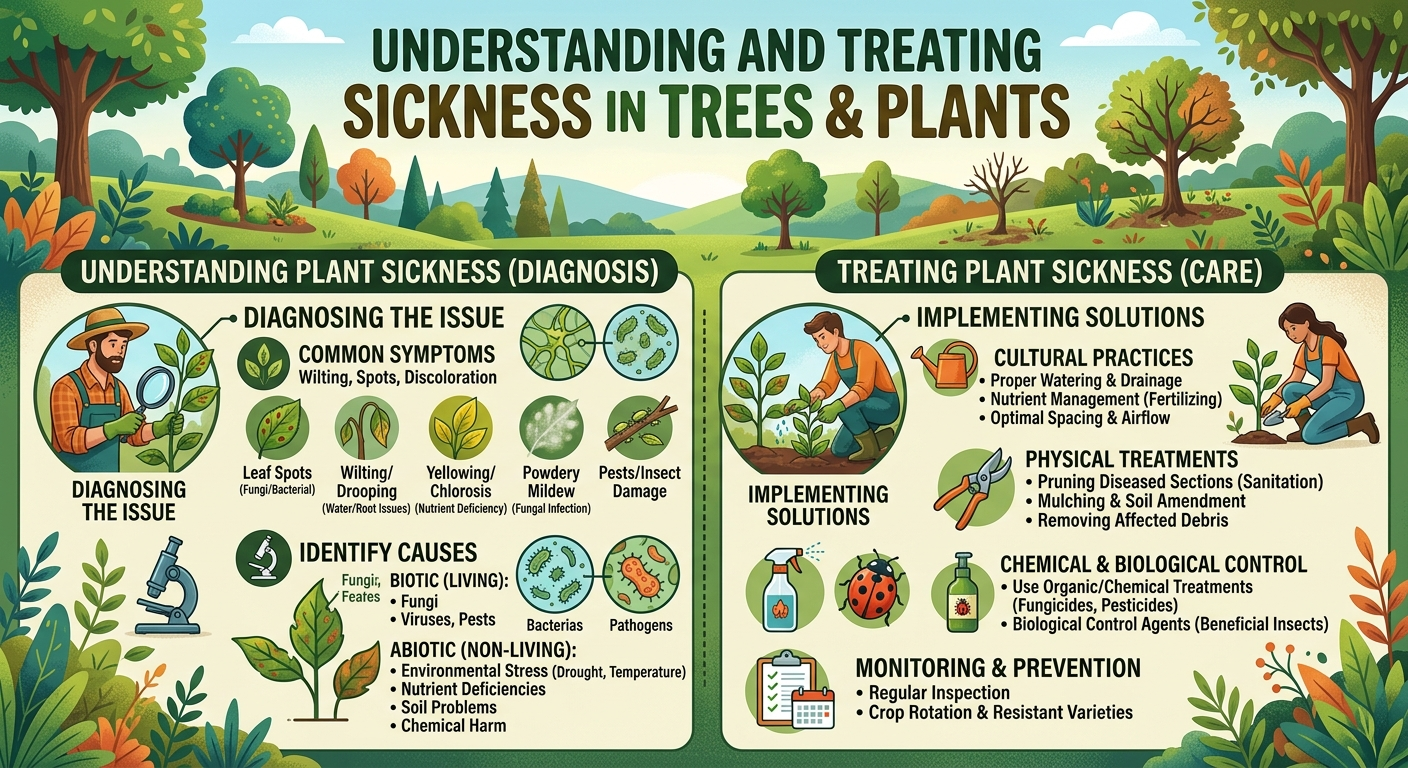
Understanding plant health requires more than simply identifying visible symptoms. A yellow leaf, dying branch, wilted plant, or damaged root can have many different causes. Effective treatment therefore begins with diagnosis: identifying the plant, examining its symptoms and environment, determining whether the problem is infectious or non-infectious, and then selecting an appropriate management strategy.
This thesis presents a comprehensive framework for understanding plant diseases and disorders, from the biology of healthy plants and the causes of sickness to diagnosis, prevention, treatment, integrated plant-health management, emerging technologies, and the future of sustainable plant protection.
1. Introduction
Plants occupy a unique position in Earth’s biological system. Through photosynthesis, they convert light energy into chemical energy while absorbing carbon dioxide and releasing oxygen. They provide food, timber, fibres, medicines, habitat, fuel, soil protection, and numerous ecosystem services.
Despite their apparent resilience, plants are constantly exposed to biological and environmental stresses.
A plant can be affected by:
- fungal diseases;
- bacterial diseases;
- viral diseases;
- nematodes;
- insects and mites;
- parasitic plants;
- nutrient deficiencies;
- nutrient toxicity;
- drought;
- excessive water;
- unsuitable temperatures;
- soil problems;
- air pollution;
- chemical injury;
- mechanical damage;
- poor pruning;
- root damage; and
- combinations of several stresses.
The central challenge is that plants cannot communicate discomfort in the way humans do. Their problems must be interpreted through changes in leaves, stems, roots, flowers, fruits, growth patterns, colour, texture, and overall development.
Consequently, plant health is fundamentally a diagnostic science.
2. What Does It Mean for a Plant to Be Sick?
A sick or unhealthy plant is one whose normal physiological processes have been disrupted sufficiently to affect growth, reproduction, appearance, survival, or productivity.
Plant sickness is often divided into two broad categories:
2.1 Infectious diseases
These are caused by biological agents capable of invading or interacting with the plant.
Examples include:
- fungi;
- oomycetes;
- bacteria;
- viruses;
- viroids;
- nematodes; and
- parasitic plants.
Some infectious diseases can spread from one plant to another.
2.2 Non-infectious disorders
These are caused by environmental or physiological conditions rather than an infectious pathogen.
Examples include:
- drought;
- waterlogging;
- nutrient deficiency;
- nutrient excess;
- soil compaction;
- salinity;
- frost;
- heat;
- air pollution;
- herbicide injury;
- inappropriate pesticides;
- physical injury; and
- poor planting practices.
An important principle is that not every damaged plant has a disease caused by a pathogen.
3. The Biology of a Healthy Plant
Understanding sickness begins with understanding normal plant function.
A typical plant contains several interconnected systems.
3.1 Roots
Roots anchor the plant and absorb:
- water;
- nitrogen;
- phosphorus;
- potassium;
- calcium;
- magnesium;
- sulfur;
- micronutrients.
Roots also interact with microorganisms in the soil.
Healthy roots are essential because damage to the root system can eventually appear as symptoms in leaves and branches.
3.2 Stems and trunks
Stems provide:
- structural support;
- pathways for water;
- pathways for minerals;
- pathways for carbohydrates;
- storage functions.
In trees, the trunk contains complex vascular tissues that transport materials between roots and leaves.
3.3 Leaves
Leaves are major sites of photosynthesis.
They capture light and use carbon dioxide and water to produce carbohydrates.
Consequently, diseases or stresses affecting leaves can reduce photosynthesis and ultimately weaken the entire plant.
3.4 Flowers and reproductive structures
Flowers enable reproduction in flowering plants.
Diseases affecting flowers may reduce:
- pollination;
- fruit formation;
- seed production;
- crop yield.
3.5 Vascular system
The plant’s vascular system contains two major transport tissues:
Xylem transports water and dissolved minerals primarily from roots toward shoots.
Phloem distributes sugars and other organic compounds throughout the plant.
Damage to either system can produce wilting, poor growth, dieback, or other symptoms.
4. The Plant Disease Triangle
One of the most important concepts in plant pathology is the disease triangle.
Disease generally develops when three conditions interact:
- a susceptible host;
- a disease-causing organism; and
- a favourable environment.
A fourth factor—time—is often added to produce the disease tetrahedron.
This explains why a pathogen may be present without immediately causing severe disease.
For example, a fungus may exist in soil but cause little damage until:
- the plant becomes stressed;
- soil moisture becomes excessive;
- temperatures become favourable;
- roots become damaged.
Therefore, disease management can target any part of this system.
5. Major Causes of Plant Sickness
5.1 Fungi
Fungal and fungus-like organisms are responsible for many important plant diseases.
They may cause:
- leaf spots;
- rots;
- wilts;
- cankers;
- blights;
- damping-off;
- powdery mildew;
- rusts.
Some fungal pathogens attack roots, while others colonize leaves, stems, fruits, or vascular tissues.
Fungal diseases can spread through:
- wind;
- rain;
- irrigation;
- contaminated soil;
- infected plant material;
- tools;
- insects;
- animals;
- human activity.
6. Bacterial Diseases
Bacteria can enter plants through:
- wounds;
- natural openings;
- insect damage;
- damaged roots;
- contaminated planting material.
Bacterial diseases may produce:
- leaf spots;
- water-soaked lesions;
- wilting;
- soft rots;
- cankers;
- abnormal growth.
Management often emphasizes sanitation, resistant varieties, water management, and prevention of unnecessary plant injury.
Antibiotic use in plant disease management is highly regulated or restricted in many places and should not be treated as a general-purpose solution.
7. Viral Diseases
Viruses are fundamentally different from fungi and bacteria.
They depend on living host cells for reproduction.
Plant viruses may cause:
- mosaic patterns;
- unusual leaf coloration;
- distortion;
- stunting;
- reduced yield;
- abnormal growth.
They are frequently spread by vectors such as:
- aphids;
- whiteflies;
- thrips;
- leafhoppers;
- other organisms.
Once a plant is systemically infected with a virus, simply applying a conventional fungicide will not cure it.
Management therefore often focuses on:
- prevention;
- vector management;
- removal of infected plants where appropriate;
- resistant varieties;
- certified clean planting material;
- sanitation.
8. Nematodes
Nematodes are microscopic worm-like organisms.
Some species attack plant roots and interfere with:
- water absorption;
- mineral uptake;
- root development.
Root-knot nematodes, for example, can produce characteristic swelling of roots.
Above-ground symptoms may include:
- stunted growth;
- yellowing;
- wilting;
- poor yield.
Because root damage is hidden underground, nematode problems can be difficult to diagnose without examining roots and soil.
9. Insects and Mites
Not all plant sickness is technically classified as plant disease.
Insects and mites can cause serious plant damage.
Examples include:
- aphids;
- caterpillars;
- beetles;
- scale insects;
- mealybugs;
- whiteflies;
- thrips;
- leaf miners;
- mites.
They may:
- chew leaves;
- suck plant sap;
- damage roots;
- bore into stems;
- transmit viruses;
- create wounds through which pathogens enter.
The correct response depends on identifying the organism rather than automatically applying an insecticide.
10. Parasitic Plants
Some plants obtain resources from other plants.
Examples include parasitic plants that attach to host tissues and obtain water or nutrients.
These organisms can weaken:
- agricultural crops;
- shrubs;
- forest plants;
- trees.
Control may involve removing the parasite, managing host plants, preventing seed production, and reducing sources of reinfestation.
11. Nutrient Deficiencies
Plants require both macronutrients and micronutrients.
Important nutrients include:
Macronutrients
- nitrogen;
- phosphorus;
- potassium;
- calcium;
- magnesium;
- sulfur.
Micronutrients
- iron;
- manganese;
- zinc;
- copper;
- boron;
- molybdenum;
- chlorine;
- nickel.
A deficiency can interfere with plant metabolism.
For example, nitrogen deficiency often causes reduced growth and generalized yellowing, while iron deficiency commonly produces chlorosis in younger leaves.
However, symptoms can overlap considerably.
Therefore, leaf colour alone should not automatically determine which fertilizer is needed.
12. Nutrient Toxicity
Too much of a nutrient can also damage plants.
Excess fertilizer may cause:
- root injury;
- leaf scorching;
- nutrient imbalance;
- salt accumulation;
- reduced water uptake.
This is why fertilization should be based on plant requirements, soil conditions, and, when appropriate, soil or tissue testing.
13. Water Stress
Water is essential for plant life, but both too little and too much water can be harmful.
13.1 Drought
Drought can cause:
- wilting;
- leaf curling;
- premature leaf drop;
- reduced growth;
- branch dieback.
Prolonged drought can weaken trees and make them more vulnerable to insects and pathogens.
13.2 Excess water
Waterlogged soil reduces oxygen availability around roots.
Roots require oxygen for respiration.
Persistent waterlogging can therefore cause:
- root dysfunction;
- root decay;
- nutrient problems;
- leaf yellowing;
- wilting despite wet soil.
This creates one of the most confusing situations in plant care: a plant can wilt even though the soil is saturated.
14. Soil as the Foundation of Plant Health
Soil is not simply a material that holds plants upright.
It is a complex biological and chemical environment containing:
- minerals;
- organic matter;
- water;
- air;
- microorganisms;
- fungi;
- bacteria;
- soil fauna.
Important soil properties include:
- pH;
- texture;
- drainage;
- organic matter;
- nutrient availability;
- salinity;
- compaction.
Poor soil conditions can create chronic plant stress even when no pathogen is present.
15. Recognizing Symptoms
Symptoms are changes in the plant caused by stress or disease.
Common symptoms include:
Yellowing
Known as chlorosis, it can result from:
- nutrient deficiency;
- root problems;
- water stress;
- disease;
- natural ageing;
- chemical injury.
Wilting
May result from:
- drought;
- root damage;
- vascular disease;
- excessive heat;
- waterlogging.
Leaf spots
May be associated with:
- fungi;
- bacteria;
- environmental injury;
- insects.
Dieback
Branches progressively lose vitality.
Possible causes include:
- drought;
- root damage;
- vascular disease;
- insects;
- cankers;
- poor pruning;
- environmental stress.
Cankers
Localized areas of damaged or dead bark may develop on branches or trunks.
Root decay
Roots may become:
- discoloured;
- soft;
- structurally damaged;
- foul-smelling in some rotting conditions.
16. Symptoms Versus Signs
Plant pathology distinguishes between symptoms and signs.
A symptom is the plant’s response.
Examples:
- yellow leaves;
- wilting;
- stunting;
- dieback.
A sign is direct evidence of the causal organism.
Examples can include:
- fungal structures;
- bacterial ooze;
- visible insects;
- nematodes;
- pathogen-associated structures.
This distinction is important because symptoms alone may not reveal the actual cause.
17. The Importance of Correct Diagnosis
Incorrect diagnosis can make plant problems worse.
For example:
Yellow leaves do not automatically mean nitrogen deficiency.
Yellowing could result from:
- excessive water;
- root damage;
- iron deficiency;
- disease;
- natural ageing;
- soil pH problems;
- chemical injury.
Likewise:
Wilting does not automatically mean the plant needs more water.
If the roots are already waterlogged, adding more water can increase the problem.
Diagnosis should therefore precede treatment whenever possible.
18. A Systematic Plant-Diagnosis Process
A practical diagnosis can follow several stages.
Step 1: Identify the plant
Determine:
- species;
- variety;
- age;
- growing requirements.
Different plants have different vulnerabilities.
Step 2: Examine the entire plant
Look at:
- leaves;
- stems;
- branches;
- trunk;
- flowers;
- fruit;
- roots;
- surrounding soil.
Step 3: Examine the pattern
Ask:
- Is one branch affected?
- Is the whole plant affected?
- Are several plants affected?
- Are symptoms concentrated in one area?
- Are older leaves affected first?
- Are younger leaves affected first?
The pattern can be highly informative.
Step 4: Examine the environment
Check:
- sunlight;
- irrigation;
- drainage;
- soil;
- temperature;
- recent weather;
- fertilizer;
- pesticide applications;
- construction or root disturbance.
Step 5: Look for pests and disease signs
Inspect carefully for:
- insects;
- fungal growth;
- lesions;
- cankers;
- abnormal roots;
- unusual exudates.
Step 6: Consider laboratory testing
For difficult cases, diagnostic laboratories may use:
- microscopy;
- culture;
- molecular tests;
- soil analysis;
- plant tissue analysis.
19. Treating Sick Plants
Treatment depends on the cause.
There is no universal “plant medicine.”
19.1 Correct environmental problems
If the problem is environmental, correcting the growing conditions may be the most effective treatment.
Examples:
- improve drainage;
- adjust irrigation;
- reduce soil compaction;
- correct nutrient deficiencies;
- protect from extreme temperatures;
- improve soil structure;
- reduce mechanical injury.
19.2 Remove severely affected material
Pruning or removing infected plant material can sometimes reduce disease pressure.
However, pruning should be performed carefully and according to appropriate horticultural practice.
For valuable or large trees, professional assessment may be appropriate.
19.3 Improve sanitation
Good sanitation can reduce disease spread.
It may involve:
- removing diseased plant debris where appropriate;
- cleaning tools;
- using healthy planting material;
- controlling weeds that host pests or pathogens;
- avoiding unnecessary plant injury.
19.4 Manage pests
Pest management should begin with identification.
Integrated approaches may combine:
- biological control;
- physical control;
- cultural practices;
- resistant plants;
- targeted chemical control when justified.
20. Integrated Pest Management
Integrated Pest Management, commonly called IPM, is a major principle of modern plant protection.
Instead of attempting to eliminate every insect or microorganism, IPM seeks to maintain pests below economically or environmentally unacceptable levels.
A typical IPM system involves:
- monitoring;
- correct identification;
- understanding pest biology;
- establishing action thresholds;
- using preventive cultural practices;
- encouraging natural enemies;
- applying targeted treatments when necessary;
- evaluating results.
This approach can reduce unnecessary pesticide use.
21. Biological Control
Biological control uses living organisms or naturally occurring biological processes to suppress pests or pathogens.
Examples include:
- beneficial predatory insects;
- parasitoids;
- beneficial microorganisms;
- microbial antagonists.
Biological control can become an important component of sustainable agriculture and horticulture.
However, biological control is not automatically harmless. Organisms introduced into ecosystems must be carefully evaluated because ecological interactions can be complex.
22. Chemical Control
Chemical treatments can sometimes be useful when properly selected and applied.
Categories include:
- fungicides;
- insecticides;
- herbicides;
- nematicides;
- other crop-protection products.
However, chemical treatment should not be considered the first response to an unidentified problem.
Potential concerns include:
- resistance development;
- environmental contamination;
- harm to beneficial organisms;
- application errors;
- residues;
- human and animal exposure.
Products must always be used according to the applicable label and local regulations.
23. Why Pesticide Resistance Develops
Repeated use of the same pesticide mode of action can select for resistant populations.
This is an evolutionary process.
Suppose a pest population contains individuals with slightly different levels of susceptibility.
A pesticide kills susceptible individuals more effectively.
Survivors reproduce.
Over repeated generations, resistance may become more common.
Therefore, responsible pest management includes:
- rotating appropriate modes of action;
- avoiding unnecessary treatments;
- using non-chemical controls;
- monitoring effectiveness.
24. Tree Diseases Versus Small Plant Diseases
Trees present unique challenges.
A tree may live for decades or centuries.
Its internal structure can contain:
- extensive root systems;
- large vascular networks;
- old wounds;
- cavities;
- multiple branches;
- complex interactions with fungi and microorganisms.
A small annual plant can sometimes be removed and replanted.
A mature heritage tree cannot easily be replaced.
Consequently, tree health management emphasizes:
- prevention;
- structural assessment;
- root protection;
- appropriate pruning;
- soil management;
- long-term monitoring.
25. The Importance of Roots
Many plant problems begin underground.
Roots can be damaged by:
- construction;
- soil compaction;
- trenching;
- drought;
- flooding;
- pathogens;
- nematodes;
- chemical contamination.
A tree may therefore appear to have a leaf problem when the underlying problem is actually root dysfunction.
This illustrates a central principle:
Above-ground symptoms can originate below ground.
26. Plant Immunity and Natural Defense
Plants do not possess an immune system identical to that of humans or animals, but they have sophisticated defense mechanisms.
Plants can detect potential threats and activate defenses.
These include:
- physical barriers;
- antimicrobial compounds;
- strengthening of cell walls;
- localized defense responses;
- signaling molecules;
- systemic defense responses.
The plant immune system operates through complex interactions between the plant, pathogen, microbiome, and environment.
27. The Plant Microbiome
Plants live in association with enormous communities of microorganisms.
These microorganisms inhabit:
- roots;
- leaves;
- stems;
- soil surrounding roots.
Some are harmful, many are neutral, and others can be beneficial.
Beneficial microorganisms may contribute to:
- nutrient acquisition;
- root development;
- disease suppression;
- stress tolerance.
This has led to growing scientific interest in the plant microbiome as part of plant-health management.
28. Mycorrhizal Relationships
Mycorrhizal fungi can form relationships with plant roots.
The fungus receives carbohydrates from the plant while potentially helping the plant acquire nutrients and water.
These relationships demonstrate that plant health is not simply about the individual plant.
It involves an ecosystem consisting of:
plant + soil + microorganisms + water + nutrients + climate + other organisms.
29. Climate Change and Plant Health
Climate change is creating new challenges for plant health.
Changes in:
- temperature;
- rainfall;
- drought frequency;
- humidity;
- storms;
- seasonal timing;
can alter relationships between plants, pests, pathogens, and ecosystems.
Warmer conditions may allow some pests and pathogens to expand into regions where they previously could not survive.
Climate stress can also weaken plants, increasing susceptibility to secondary pests and diseases.
30. Urban Trees
Urban environments can be particularly stressful for trees.
Common stresses include:
- compacted soil;
- limited rooting space;
- heat from buildings and roads;
- air pollution;
- physical damage;
- poor irrigation;
- construction;
- inadequate planting conditions.
Urban tree health therefore requires cooperation among:
- arborists;
- municipalities;
- engineers;
- landscape professionals;
- property owners;
- communities.
31. Agriculture and Food Security
Plant health is directly connected to human food security.
Major crop losses can affect:
- food availability;
- farmer income;
- food prices;
- national economies;
- rural employment.
Plant diseases therefore represent not only a biological problem but also an economic and social challenge.
Protecting crops requires:
- disease-resistant varieties;
- healthy seeds;
- effective monitoring;
- responsible irrigation;
- good soil management;
- pest surveillance;
- integrated disease management.
32. Prevention Is Better Than Treatment
One of the strongest principles in plant health is prevention.
Preventive practices include:
Selecting healthy plants
Start with high-quality planting material.
Choosing appropriate species
A plant poorly adapted to the local climate will experience chronic stress.
Proper planting
Avoid planting too deeply and ensure appropriate drainage.
Water management
Provide adequate water without creating persistent saturation.
Soil management
Maintain suitable soil structure, organic matter, and nutrient availability.
Root protection
Avoid unnecessary disturbance of roots.
Sanitation
Prevent unnecessary movement of contaminated plant material.
Monitoring
Regular inspection allows problems to be identified early.
33. The Role of Technology
Modern plant health management increasingly combines traditional horticulture with digital technology.
Technologies include:
- remote sensing;
- drones;
- satellite imagery;
- machine learning;
- artificial intelligence;
- soil sensors;
- weather stations;
- automated irrigation;
- digital imaging;
- molecular diagnostics.
These technologies can help detect problems before symptoms become obvious to the human eye.
34. Artificial Intelligence and Plant Disease Detection
AI systems can analyze photographs of leaves, fruits, stems, and other plant structures.
A computer-vision system may be trained to distinguish patterns associated with:
- diseases;
- nutrient stress;
- insect damage;
- environmental stress.
However, AI diagnosis has limitations.
A photograph may not reveal:
- root problems;
- soil chemistry;
- pathogen identity;
- environmental history.
Therefore, AI should be regarded as a diagnostic aid rather than an unquestionable authority.
35. Drones and Remote Sensing
Large farms and forests can be difficult to inspect manually.
Drones equipped with cameras and sensors can survey large areas.
They may identify unusual:
- colour;
- temperature;
- canopy density;
- growth patterns.
Satellite systems can extend monitoring to much larger geographical areas.
This creates the possibility of moving from reactive plant treatment toward early-warning plant-health systems.
36. Precision Agriculture
Precision agriculture seeks to apply resources where they are actually needed.
Instead of treating an entire field identically, farmers can use data to determine where:
- irrigation is needed;
- nutrients are deficient;
- pests are concentrated;
- plants are under stress.
This can potentially reduce:
- water consumption;
- fertilizer waste;
- pesticide use;
- operating costs.
37. A Complete Plant-Health Management Framework
A comprehensive plant-health system can be represented as:
Observation → Identification → Diagnosis → Cause → Intervention → Monitoring → Evaluation
Observation
Notice changes in the plant.
Identification
Determine the species and affected tissues.
Diagnosis
Determine the likely cause.
Cause
Distinguish between:
- pathogen;
- pest;
- environmental stress;
- nutritional problem;
- physical damage.
Intervention
Select the least harmful effective response.
Monitoring
Observe whether the plant improves.
Evaluation
Determine whether the treatment actually worked.
This creates a continuous feedback loop.
38. Common Mistakes in Treating Sick Plants
Mistake 1: Treating before diagnosing
Applying multiple products without knowing the cause can waste money and potentially worsen the situation.
Mistake 2: Assuming yellow leaves mean fertilizer deficiency
Yellowing has many possible causes.
Mistake 3: Overwatering
More water is not always better.
Mistake 4: Ignoring roots
Root problems frequently produce above-ground symptoms.
Mistake 5: Using excessive pesticides
More pesticide does not necessarily mean better control.
Mistake 6: Ignoring the environment
A pathogen may remain a problem if the environmental conditions that favour it are not corrected.
Mistake 7: Treating every microorganism as harmful
Many microorganisms are beneficial or neutral.
39. When Professional Help Is Necessary
Professional assistance is particularly appropriate when:
- a large mature tree is declining rapidly;
- a tree has major structural defects;
- roots have been seriously disturbed;
- a valuable tree is affected;
- a disease is spreading rapidly;
- the diagnosis is uncertain;
- a potentially regulated plant pathogen is suspected;
- chemical treatment would present significant risks.
Arborists, horticulturists, plant pathologists, agricultural extension specialists, and diagnostic laboratories can provide specialized assistance.
40. The Future of Plant Medicine
The future of plant health is likely to become increasingly interdisciplinary.
It will combine:
- plant biology;
- microbiology;
- genetics;
- soil science;
- climatology;
- ecology;
- robotics;
- artificial intelligence;
- remote sensing;
- molecular diagnostics.
Future systems may continuously monitor plants through networks of sensors.
A farm could eventually operate as a biological monitoring system in which:
soil sensors + weather stations + cameras + drones + AI + laboratory diagnostics + farmers
work together to identify emerging problems.
41. Toward a Plant-Health Early-Warning System
An advanced plant-health platform could operate in several layers.
Layer 1 — Environmental sensing
Measure:
- temperature;
- humidity;
- rainfall;
- soil moisture;
- soil temperature.
Layer 2 — Plant observation
Monitor:
- leaf colour;
- canopy density;
- growth;
- flowering;
- fruit development.
Layer 3 — Biological diagnosis
Investigate:
- pathogens;
- insects;
- nematodes;
- microbial communities.
Layer 4 — AI analysis
Identify unusual patterns.
Layer 5 — Human verification
Experts confirm important diagnoses.
Layer 6 — Targeted intervention
Apply appropriate management.
Layer 7 — Continuous monitoring
Determine whether the intervention succeeded.
This model could substantially improve the efficiency and sustainability of plant-health management.
42. Sustainable Plant Disease Management
Sustainable plant protection should seek a balance among:
plant health + food production + environmental protection + economic viability + human safety.
The objective is not simply to eliminate every organism that interacts with a plant.
Instead, the objective is to maintain healthy ecological systems while preventing unacceptable damage.
This requires understanding ecosystems rather than treating individual symptoms in isolation.
43. A Practical Decision Tree
When a plant appears sick, ask:
Is the plant actually experiencing a problem?
↓
What part is affected?
- roots?
- leaves?
- stem?
- branches?
- flowers?
- fruit?
↓
Is the problem affecting one plant or many?
↓
Is the pattern uniform or irregular?
↓
Could water be involved?
↓
Could soil or nutrition be involved?
↓
Are insects or other organisms present?
↓
Are there signs of a pathogen?
↓
Has the plant recently been exposed to chemicals, construction, heat, cold, drought, flooding, or mechanical damage?
↓
Can the cause be confidently identified?
If yes → apply appropriate management.
If no → obtain additional diagnostic information rather than repeatedly applying unrelated treatments.
44. Central Thesis
The central argument of this thesis is that plant sickness is best understood as an interaction between biology, environment, and management rather than as a simple problem requiring a single medicine.
A diseased tree or plant is part of a larger system.
Its health depends upon:
- genetics;
- roots;
- soil;
- water;
- nutrients;
- microorganisms;
- pests;
- pathogens;
- climate;
- human management.
Consequently, successful plant healthcare begins with observation and diagnosis and progresses toward targeted intervention and continuous monitoring.
45. Conclusion
Understanding and treating sickness in trees and plants is a multidisciplinary field connecting botany, plant pathology, soil science, microbiology, ecology, agriculture, forestry, environmental science, and modern technology.
Plants can become unhealthy because of infectious organisms, pests, environmental stresses, nutritional problems, physical damage, or combinations of these factors. Because different causes can produce similar symptoms, accurate diagnosis is essential.
The most effective approach is not simply to ask:
“What chemical should I apply?”
The better question is:
“Why is this plant unhealthy, and what combination of environmental, biological, and management changes will restore or protect its health?”
This shift from treatment-first thinking to diagnosis-first thinking is fundamental.
The future of plant health will increasingly involve prevention, biological understanding, sustainable management, molecular diagnostics, sensors, remote sensing, artificial intelligence, and precision agriculture. These technologies can complement—not replace—the knowledge of farmers, gardeners, horticulturists, arborists, and plant pathologists.
Ultimately, healthy plants are essential to healthy ecosystems, productive agriculture, resilient forests, biodiversity, climate regulation, and human civilization. Protecting plant health is therefore not merely a gardening activity. It is an important component of global environmental and food-security strategy.
Key Principles
- Identify the plant before diagnosing the problem.
- Observe the whole plant, not only the damaged leaf.
- Examine roots and soil when appropriate.
- Distinguish infectious diseases from environmental disorders.
- Do not assume every symptom has a single cause.
- Diagnose before applying treatments.
- Prioritize prevention over repeated emergency treatment.
- Use integrated pest and disease management.
- Protect beneficial organisms and soil ecosystems.
- Use pesticides responsibly and according to applicable regulations.
- Monitor plants continuously rather than treating only after severe damage appears.
- Combine biological knowledge with modern technology.
In essence: healthy plants are created not by one universal medicine, but by understanding the living system in which the plant exists.



Be First to Comment