
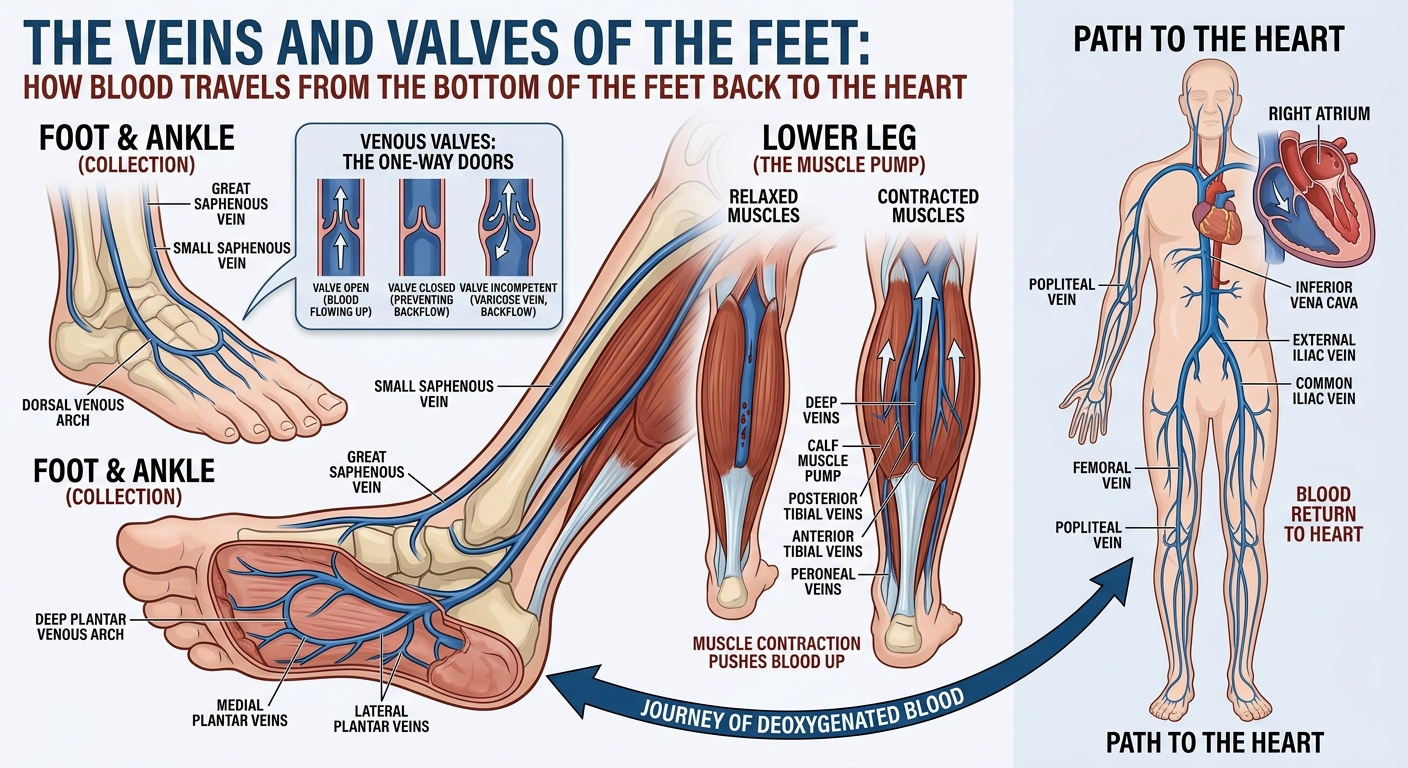
The veins in your feet are part of a remarkable one-way drainage system that helps return blood from the lowest part of the body back to the heart. Because the feet are below the heart when you are standing, blood has to move upward against gravity.
The simplest way to understand it is:
Feet → leg veins → larger veins → abdomen → heart
The system does not work through the veins alone. It depends on vein valves, leg muscles, pressure changes, and breathing.
1. First: What are veins?
Your circulatory system has three major types of blood vessels:
- Arteries carry blood away from the heart.
- Capillaries allow exchange of oxygen, nutrients and waste between blood and tissues.
- Veins carry blood back toward the heart.
Most veins carry blood that has relatively less oxygen and more carbon dioxide than arterial blood. An important exception is the pulmonary veins, which carry oxygen-rich blood from the lungs to the heart.
The veins of the feet belong to the systemic venous circulation.
2. Why is returning blood from the feet difficult?
Imagine standing upright.
Your heart is in your chest, while your feet may be more than a metre below it. Gravity naturally pulls blood downward.
Therefore, the body needs mechanisms to prevent blood from simply accumulating in the feet and lower legs.
Two particularly important mechanisms are:
1. Venous valves
2. The calf-muscle pump
Together they function somewhat like a series of one-way doors and pumps.
3. The veins underneath the feet
The bottom of the foot contains a network of small veins.
One important structure is the plantar venous network, located in the sole of the foot.
Think of this network as a collection system.
Blood arriving from the small blood vessels of the foot gradually enters increasingly larger veins.
A simplified pathway is:
Small veins in the toes and sole
↓
Plantar venous network
↓
Veins on the top and sides of the foot
↓
Larger superficial and deep veins of the leg
The veins of the foot are interconnected, so blood can take different routes toward the leg.
4. What are venous valves?
This is one of the most important parts of the system.
Many veins contain tiny valves.
A valve works approximately like a one-way door.
It allows blood to move:
toward the heart → YES
but prevents it from flowing backward:
toward the feet → NO
A simplified picture is:
Foot
⬆️ Blood moves upward
⬆️
🚪 Valve
⬆️
🚪 Valve
⬆️
🚪 Valve
⬆️
Heart
When blood moves upward, the valves open.
When gravity tries to make blood fall backward, the valves close.
5. Why don’t the valves work alone?
The valves are extremely useful, but they aren’t pumps.
The major additional mechanism is the muscle pump, especially the calf-muscle pump.
When you walk, your calf muscles repeatedly contract.
These muscles surround and compress veins in the lower leg.
For example:
Muscle relaxes
→ vein fills with blood
Muscle contracts
→ vein is compressed
→ blood is pushed upward
→ valves prevent backward flow
Then the muscle relaxes and the process repeats.
So walking is effectively helping your veins move blood back toward your heart.
6. Your feet also participate in the pumping process
Walking causes pressure changes in the veins of the feet and legs.
When you place your foot on the ground and move your ankle and toes, muscles and tissues around the veins change the pressure inside them.
This contributes to the movement of blood from the foot toward the larger veins of the leg.
This is one reason regular movement is important for normal venous circulation.
7. From the foot to the ankle
As blood leaves the small veins of the foot, it enters larger veins around the ankle.
There are broadly two interconnected systems:
Superficial veins
These are veins closer to the surface of the skin.
Deep veins
These travel deeper among muscles and other tissues.
The superficial and deep systems are connected through perforating veins.
These connections allow blood to move between the two systems.
8. From the ankle into the lower leg
Blood continues upward through progressively larger veins.
The deep veins include vessels associated with the major arteries of the lower leg.
Among the important veins are the:
- Anterior tibial veins
- Posterior tibial veins
- Fibular (peroneal) veins
These ultimately contribute to larger veins around the knee and thigh.
The important principle is more important than memorizing every name:
small veins → larger veins → progressively larger veins → heart
9. The calf is a major venous pump
The calf is sometimes described as a “second heart” in relation to venous circulation.
It is not literally another heart, but the comparison helps explain its importance.
When you walk:
Calf contracts
↓
Veins are squeezed
↓
Blood moves upward
↓
Valves prevent backward movement
↓
Calf relaxes
↓
Veins refill
↓
Next contraction pushes more blood upward
This happens repeatedly during walking.
10. What happens when you sit or stand still?
If you remain standing without moving your legs, the calf-muscle pump becomes much less active.
Gravity continues pulling blood downward.
The veins of the feet and legs can therefore contain more blood.
This may contribute to feelings such as:
- heaviness
- tired legs
- mild swelling around the ankles
Moving the ankles, walking, or contracting the calf muscles activates the muscle pump again.
11. From the lower leg to the knee
The deep veins of the lower leg join larger veins around the knee.
An important vessel here is the popliteal vein, located behind the knee.
The simplified pathway becomes:
Foot
↓
Lower-leg veins
↓
Popliteal vein
↓
Femoral vein
↓
Pelvic veins
↓
Inferior vena cava
↓
Heart
12. From the thigh to the pelvis
The femoral vein carries blood upward through the thigh.
As it approaches the pelvis, it becomes part of the larger pelvic venous system.
The veins from both sides eventually contribute to the:
Inferior vena cava
This is one of the body’s largest veins.
It carries a huge volume of blood toward the heart.
13. The final journey to the heart
The inferior vena cava enters the right side of the heart.
The simplified journey is:
Sole of foot
→ foot veins
→ ankle veins
→ lower-leg veins
→ knee veins
→ thigh veins
→ pelvic veins
→ inferior vena cava
→ right atrium of the heart
The blood then passes through the right side of the heart and is pumped to the lungs.
14. What happens after the blood reaches the heart?
Once the blood reaches the right atrium:
Right atrium
↓
Right ventricle
↓
Pulmonary arteries
↓
Lungs
In the lungs, carbon dioxide is removed and oxygen is taken up.
Then oxygen-rich blood returns:
Lungs
↓
Pulmonary veins
↓
Left atrium
↓
Left ventricle
↓
Aorta
↓
Body
So there is a continuous circulation:
Heart → arteries → tissues → veins → heart
15. The entire journey in one simple diagram
                 HEART
                   ↑
                   │
          Inferior vena cava
                   ↑
                   │
             Pelvic veins
                   ↑
                   │
             Femoral vein
                   ↑
                   │
             Knee veins
                   ↑
                   │
            Lower-leg veins
                   ↑
                   │
             Ankle veins
                   ↑
                   │
          Veins of the foot
                   ↑
                   │
        Sole / plantar veins
But remember: blood does not simply climb upward by itself.
The upward movement is assisted by:
VALVES + MUSCLE PUMP + PRESSURE CHANGES + BREATHING
16. The importance of vein valves
Imagine a staircase.
Suppose every step has a door that only allows you to move upward.
You move upward one step.
The door closes behind you.
You move to the next step.
That door closes behind you too.
This is roughly what a healthy valve system accomplishes.
Without functioning valves, blood can more easily move backward and accumulate in the lower limbs.
17. What happens when valves become weak?
Sometimes the valves inside veins do not close effectively.
This is called venous valve dysfunction or venous insufficiency.
Blood can then move backward more easily.
This is sometimes called venous reflux.
Over time, increased pressure in superficial veins can contribute to varicose veins.
Varicose veins are veins that have become enlarged and twisted and are often particularly visible in the legs.
18. Why can ankles swell?
Swelling can have many different causes.
One mechanism involves fluid moving from small blood vessels into surrounding tissues.
When pressure in the veins of the legs becomes elevated, especially after prolonged standing, more fluid can move into surrounding tissue.
The result can be:
ankle swelling → foot swelling → feeling of heaviness
However, swelling is not automatically caused by a vein problem. Heart, kidney, liver, medication, injury, lymphatic and other conditions can also cause swelling.
19. Veins versus arteries
A useful comparison:
| Feature | Arteries | Veins |
|---|---|---|
| Main direction | Away from heart | Toward heart |
| Typical pressure | Higher | Lower |
| Walls | Generally thicker | Generally thinner |
| Valves | Generally absent | Common in limb veins |
| Main function | Deliver blood | Return blood |
| Muscle pump | Not the main mechanism | Very important in legs |
20. Veins are more than simple pipes
It is tempting to imagine veins as ordinary tubes.
They are much more sophisticated.
The venous system functions as a dynamic blood reservoir.
Veins can expand and hold significant amounts of blood.
The nervous system can also influence the diameter of many veins by changing the contraction of their smooth muscle.
Therefore, the venous system contributes not only to returning blood to the heart but also to regulating blood distribution throughout the body.
21. Why walking is important for venous circulation
Walking repeatedly activates:
foot muscles
ankle movement
calf muscles
thigh muscles
These movements help push venous blood upward.
This explains why sitting or standing motionless for long periods can be less favorable for circulation than periodically moving around.
Simple movements such as walking and ankle movements can activate the muscle pump.
22. Why raising the legs can help
When the legs are elevated, gravity can assist venous drainage.
Instead of requiring the veins to move blood upward from the feet against gravity, elevation reduces the gravitational pressure acting against venous return.
This is one reason people may feel relief from leg heaviness when resting with their legs elevated.
23. The lymphatic system is also important
There is another drainage system that should not be forgotten:
The lymphatic system.
Not all excess fluid returns directly through veins.
The lymphatic system collects excess fluid from tissues and eventually returns it to the bloodstream.
So the lower leg has two important drainage systems:
Venous system
→ returns blood toward the heart
Lymphatic system
→ returns excess tissue fluid toward the bloodstream
They work together to maintain fluid balance.
24. A simple analogy: the uphill water system
Imagine a city built on a hill.
Water has to be moved from a low area toward a high reservoir.
You could use:
- one-way gates
- pumps
- pressure differences
- repeated mechanical movement
The veins of the legs operate on a somewhat similar principle.
Valves = one-way gates
Calf muscles = mechanical pump
Heart = central pump
Large veins = return pipelines
This analogy makes the system easier to understand, although the human circulatory system is much more complex.
25. Why the heart doesn’t directly “pull” blood from your feet like a vacuum cleaner
A common misconception is that the heart simply sucks blood from the feet.
It doesn’t work that way.
Venous return results from several interacting mechanisms:
- Muscle contractions
- Venous valves
- Pressure differences
- Breathing movements
- Heart activity
- Changes in vein diameter
The heart provides the central driving force for circulation, while the peripheral mechanisms help move venous blood toward it.
26. The respiratory pump
Breathing also contributes to venous return.
During inhalation, pressure changes occur inside the chest and abdomen.
These pressure changes can help draw venous blood toward the chest.
Therefore, your circulation is influenced by something as ordinary as breathing.
The overall system is remarkably coordinated:
Walking + breathing + valves + heart
work together to maintain circulation.
27. The great lesson from the feet
The feet are not merely the end of the circulatory system.
They are an important starting point for understanding how venous return works.
The blood in the smallest vessels of the foot must eventually make its way through increasingly larger veins.
The journey is approximately:
Microcirculation
→ small foot veins
→ plantar venous network
→ superficial/deep veins
→ lower-leg veins
→ popliteal vein
→ femoral vein
→ pelvic veins
→ inferior vena cava
→ right atrium
And the journey begins again through the lungs and heart.
28. The whole system in one sentence
The veins of your feet collect blood from the tissues, their valves help prevent backward flow, movements of the feet and calf muscles push the blood upward, and progressively larger veins carry it through the legs and abdomen into the heart.
29. Why understanding this system matters
Understanding the foot-to-heart venous pathway helps explain several everyday phenomena:
- Why your feet can feel heavy after standing for hours
- Why walking activates circulation
- Why ankle swelling can occur
- Why varicose veins develop
- Why valves are important
- Why prolonged immobility can affect circulation
- Why leg elevation can sometimes provide relief
- Why the calf muscles are so important to venous return
It also demonstrates a larger principle of human biology:
The body does not depend on one organ working alone. Circulation is a coordinated system involving the heart, blood vessels, valves, muscles, lungs and pressure changes.
Important medical note
If someone develops sudden swelling, significant pain, unusual warmth/redness in one leg, or sudden difficulty breathing or chest pain, they should receive prompt medical assessment because these can sometimes indicate a serious circulation problem.




Be First to Comment