
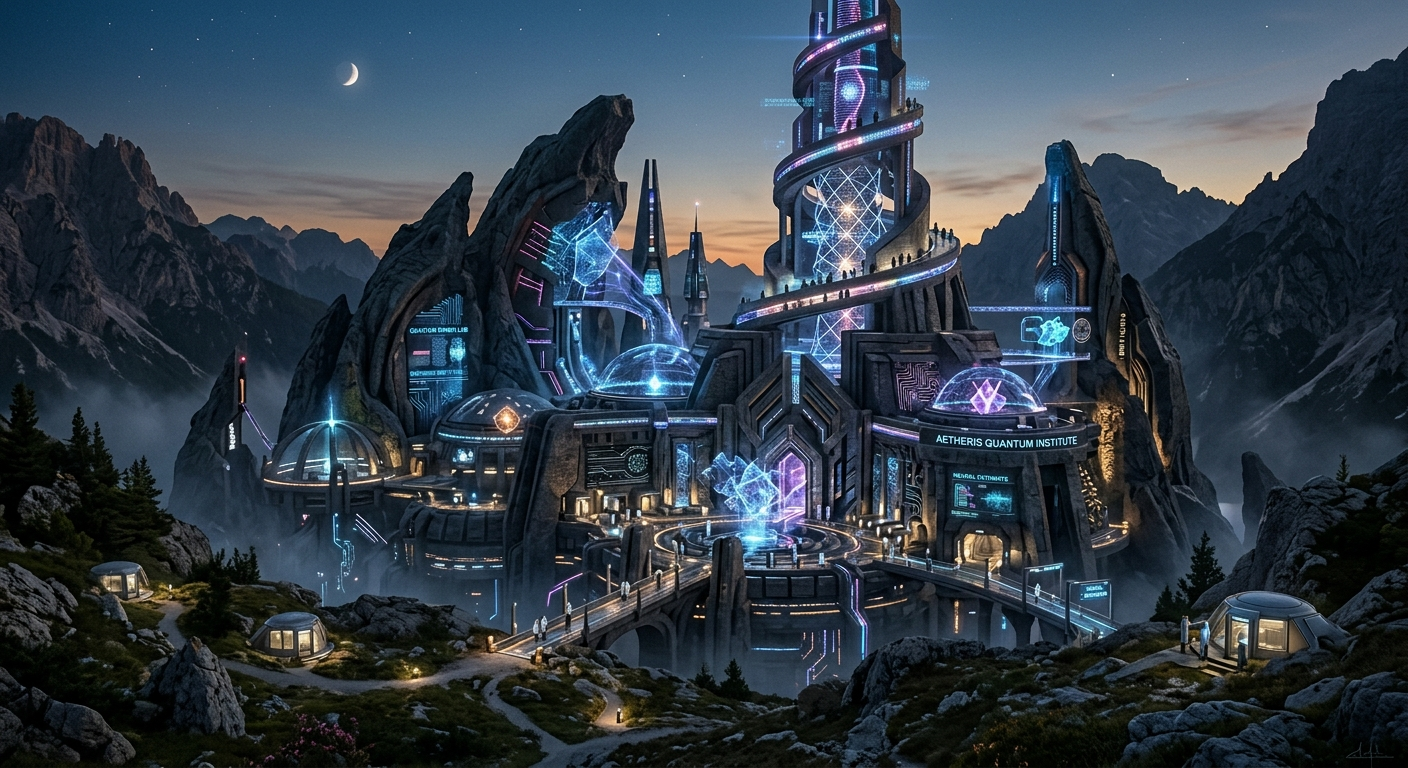
The phrase “mystery origin architecture of quantum modern technology” can be understood as a question about where quantum technology really comes from, what scientific discoveries made it possible, and how those discoveries were assembled into today’s quantum computers, quantum communication systems, quantum sensors, and quantum cryptography.
It is not the result of one invention. It is an enormous technological architecture built over roughly a century, beginning with discoveries about energy, matter, light and atoms and eventually becoming an engineering stack involving quantum physics → materials → devices → control electronics → quantum algorithms → software → applications.
1. The central mystery: how did quantum technology emerge?
Modern quantum technology looks almost magical because engineers manipulate phenomena that are invisible at ordinary scales:
- electrons occupy quantum states;
- photons behave as quantum particles and waves;
- atoms have discrete energy levels;
- particles can become entangled;
- quantum systems can exist in superpositions;
- measurement changes what can be known about a quantum system;
- tunnelling allows particles to cross barriers that classical physics would normally forbid.
But there is a historical chain behind all of this.
A simplified genealogy is:
Classical physics
↓
Problems classical physics could not explain
↓
Quantum theory
↓
Understanding atoms and electrons
↓
Quantum mechanics
↓
Quantum electrodynamics and condensed-matter physics
↓
Semiconductors
↓
Transistors
↓
Integrated circuits
↓
Lasers
↓
Modern optical and electronic technologies
↓
Quantum information theory
↓
Quantum computing / communication / sensing
This means that today’s quantum technology is simultaneously the descendant of physics, mathematics, chemistry, electrical engineering, materials science, computer science and telecommunications.
2. The first layer: the classical world
Before quantum mechanics, scientists primarily described nature using classical physics.
Three enormous intellectual structures were particularly important:
Newtonian mechanics
Isaac Newton developed mathematical descriptions of motion and gravity.
Maxwell’s electromagnetic theory
James Clerk Maxwell unified electricity, magnetism and light into electromagnetic theory.
Thermodynamics and statistical mechanics
Scientists developed mathematical descriptions of heat, energy and enormous collections of particles.
By the late nineteenth century, physics appeared remarkably successful.
But several experimental observations created serious problems.
3. The first cracks in classical physics
Several phenomena could not be satisfactorily explained using classical physics.
Among the most important were:
Black-body radiation
Classical calculations predicted an ultraviolet divergence.
Max Planck proposed in 1900 that electromagnetic energy could be exchanged in discrete amounts.
He introduced the relationship:
[
E=hf
]
where:
- (E) = energy,
- (h) = Planck’s constant,
- (f) = frequency.
This was one of the foundations of quantum theory.
4. Einstein and the quantum of light
In 1905, Albert Einstein proposed that electromagnetic radiation could behave as discrete packets of energy.
These packets eventually became known as photons.
This helped explain the photoelectric effect.
The important conceptual revolution was:
Light is not adequately described as a continuously distributed classical wave in every circumstance.
This discovery eventually became enormously important for:
- lasers,
- optical communications,
- photon detectors,
- quantum optics,
- quantum cryptography,
- photonic quantum computers.
5. The atomic mystery
Another enormous problem was the structure of matter.
Scientists knew atoms existed, but the classical picture of an atom was unstable.
If electrons behaved like classical orbiting charged particles, they should radiate energy and spiral into the nucleus.
Yet ordinary matter is stable.
Something fundamental was missing.
6. Bohr’s atomic model
Niels Bohr proposed that electrons could occupy specific allowed energy states.
Instead of continuously taking any possible energy, atoms possessed discrete energy levels.
This introduced an important quantum principle:
[
E_n \neq \text{arbitrary}
]
Instead, only certain allowed states exist.
When an electron transitions between levels, it can emit or absorb a photon:
[
\Delta E = hf
]
This relationship became fundamental to:
- spectroscopy,
- lasers,
- atomic clocks,
- quantum sensors,
- quantum communication.
7. de Broglie: matter becomes quantum
Louis de Broglie proposed that particles such as electrons also have wave-like properties.
The relationship is:
[
\lambda=\frac{h}{p}
]
where:
- (\lambda) = wavelength,
- (h) = Planck’s constant,
- (p) = momentum.
This destroyed the simple distinction between:
particles and waves.
At the quantum level, objects require a more sophisticated description.
8. Heisenberg, Schrödinger and the mathematical architecture
Quantum mechanics became a mathematical theory through several complementary formulations.
Werner Heisenberg
Developed matrix mechanics.
Erwin Schrödinger
Developed wave mechanics.
The famous Schrödinger equation is:
[
i\hbar\frac{\partial}{\partial t}|\psi\rangle
\hat H|\psi\rangle
]
The symbol
[
|\psi\rangle
]
represents the quantum state.
The Hamiltonian
[
\hat H
]
represents the energy structure governing the system.
This equation is one of the deepest foundations of modern quantum technology.
9. The strange architecture of the quantum state
A classical computer stores information using bits:
[
0 \quad \text{or} \quad 1
]
A quantum system can be represented by a quantum state such as:
[
|\psi\rangle
\alpha|0\rangle+\beta|1\rangle
]
where (\alpha) and (\beta) are complex probability amplitudes satisfying:
[
|\alpha|^2+|\beta|^2=1
]
This is the mathematical basis of the qubit.
The important point is that a qubit is not simply a tiny classical bit.
It is a controllable quantum system with measurable states and probability amplitudes.
10. Superposition
Superposition means that a quantum state can be represented as a combination of possible basis states.
For example:
[
|\psi\rangle =
\frac{1}{\sqrt2}|0\rangle+
\frac{1}{\sqrt2}|1\rangle
]
This does not simply mean that the physical system is simultaneously behaving like two ordinary classical computers.
The amplitudes contain information about the quantum state, and measurement produces classical outcomes according to quantum probabilities.
This distinction is crucial to understanding quantum computing.
11. Entanglement: perhaps the deepest mystery
Suppose two quantum systems become entangled.
Their joint state can no longer be described as two completely independent states.
One example is:
[
|\Phi^+\rangle =
\frac{1}{\sqrt2}
(|00\rangle+|11\rangle)
]
Measurements on the two systems exhibit correlations that cannot be reproduced by a simple classical model with local hidden variables.
Einstein famously found this deeply troubling.
He referred to quantum entanglement in terms of what became known as “spooky action at a distance.”
Modern experiments have repeatedly confirmed quantum predictions.
12. From quantum mechanics to quantum information
For decades, quantum mechanics was primarily treated as a theory for explaining nature.
Then scientists began asking a revolutionary question:
What happens if information itself is treated as a physical quantum object?
This led to quantum information science.
Several researchers were particularly influential, including:
- Richard Feynman;
- Paul Benioff;
- David Deutsch;
- Charles Bennett;
- Peter Shor;
- Lov Grover;
- Artur Ekert and others.
The idea was transformative:
Quantum mechanics could become an engineering resource.
13. The quantum technology stack
Modern quantum technology can be understood as a stack.
Layer 1 — Fundamental physics
Quantum mechanics
↓
Layer 2 — Quantum information
Qubits, states, measurement, entanglement
↓
Layer 3 — Physical platforms
Superconducting circuits, trapped ions, neutral atoms, photons, semiconductor spins and other systems
↓
Layer 4 — Quantum control
Microwave pulses, lasers, magnetic fields, optical systems and electronic control
↓
Layer 5 — Quantum processors
Arrays of controllable qubits
↓
Layer 6 — Quantum algorithms
Algorithms designed to exploit quantum properties
↓
Layer 7 — Classical computing
Conventional processors control, calibrate and interpret quantum systems
↓
Layer 8 — Applications
Cryptography, simulation, chemistry, optimization, sensing and scientific research.
14. The hidden foundation: materials science
One of the biggest misconceptions is that quantum technology is only about exotic physics.
It is also about materials engineering.
Modern quantum devices require extremely precise materials.
Examples include:
- superconducting materials;
- semiconductors;
- high-purity crystals;
- optical materials;
- nanostructures;
- quantum dots;
- Josephson junctions;
- specialized magnetic materials.
This creates an important connection:
Quantum physics → materials science → nanotechnology → semiconductor manufacturing → quantum devices.
15. The semiconductor revolution
The invention of the transistor in the twentieth century was indirectly connected to the development of quantum physics.
Why?
Because understanding electrons inside solids requires quantum mechanics.
Semiconductor physics explains concepts such as:
- energy bands;
- band gaps;
- electrons;
- holes;
- doping;
- carrier transport;
- tunnelling.
These concepts eventually enabled the integrated circuit.
Therefore, modern computing itself is already deeply dependent on quantum physics—even though ordinary computers are classical information-processing machines.
16. The transistor is a quantum-engineered object
A transistor appears classical when viewed from the outside.
But its operation depends upon microscopic physics.
At semiconductor scales, engineers must understand:
- electron energy levels;
- quantum confinement;
- tunnelling;
- interfaces;
- charge distributions;
- semiconductor band structures.
Thus there is a fascinating historical relationship:
Quantum mechanics helped create classical digital computing.
And now:
Quantum information science is attempting to create a new generation of quantum computing.
17. The laser: another hidden bridge
Lasers emerged from quantum theory.
Atoms and other quantum systems have discrete energy transitions.
A stimulated emission process can cause photons to be emitted with closely related properties.
This enables laser amplification.
Lasers subsequently became foundational to:
- fiber-optic telecommunications;
- optical storage;
- semiconductor manufacturing;
- medicine;
- spectroscopy;
- precision measurement;
- quantum optics;
- quantum communication.
Therefore, the global Internet’s optical backbone is partly a technological descendant of quantum physics.
18. Quantum computing architectures
There is no single quantum computer architecture.
Several major approaches exist.
A. Superconducting qubits
These use specially engineered superconducting electrical circuits.
Important components include:
- superconducting materials;
- Josephson junctions;
- microwave control;
- cryogenic refrigeration;
- amplifiers;
- classical control electronics.
The quantum processor operates at extremely low temperatures.
19. Trapped-ion quantum computers
Another approach uses individual ions confined using electromagnetic fields.
Lasers manipulate their quantum states.
The architecture therefore combines:
atomic physics + lasers + electromagnetic trapping + precision electronics + quantum algorithms.
One advantage is that trapped ions can exhibit very high-quality quantum operations.
20. Neutral-atom systems
Neutral atoms can also be manipulated using lasers.
Large arrays of atoms can be arranged and controlled.
This architecture combines:
- atomic physics;
- laser technology;
- optical systems;
- vacuum systems;
- imaging;
- classical computation.
Neutral atoms are particularly interesting because large arrays of individually controlled atoms can potentially be created.
21. Photonic quantum computing
Instead of storing information primarily in matter, photonic systems use photons.
Information can be encoded in properties such as:
- polarization;
- path;
- phase;
- time-bin states.
Photonic systems connect strongly to telecommunications because optical networks already use photons to transmit information.
This creates an especially interesting bridge:
fiber optics → photonics → quantum optics → quantum communication → photonic quantum computing.
22. Semiconductor spin qubits
Another approach attempts to exploit quantum properties of electrons or other carriers inside semiconductor structures.
This creates a potentially powerful connection with the existing semiconductor industry.
The long-term ambition is partly to exploit techniques derived from:
- CMOS manufacturing;
- nanofabrication;
- semiconductor physics;
- cryogenic electronics.
23. Quantum sensing
Quantum technology is much larger than quantum computing.
Quantum systems can be extremely sensitive to their environment.
This can be exploited for precision measurement.
Potential applications include:
- magnetic-field measurement;
- gravitational measurement;
- timing;
- navigation;
- spectroscopy;
- materials analysis;
- geological studies.
The underlying principle is:
Use a quantum system as an extraordinarily sensitive measuring instrument.
24. Atomic clocks
Atomic clocks are among the most mature quantum technologies.
Atoms provide extraordinarily stable frequency references.
The basic principle involves transitions between well-defined atomic energy states.
Modern precision timing supports:
- telecommunications;
- satellite navigation;
- scientific experiments;
- financial infrastructure;
- synchronization networks.
Thus quantum physics is already embedded in global infrastructure.
25. Quantum communication
Quantum communication uses quantum states to transmit information or establish cryptographic security.
One important concept is quantum key distribution (QKD).
The fundamental idea is that measuring an unknown quantum state generally disturbs it.
This can allow communicating parties to detect certain forms of interception.
However, QKD does not magically make an entire network secure. Real-world security also depends on:
- hardware;
- authentication;
- classical networks;
- implementation security;
- software;
- operational procedures.
26. Quantum cryptography versus post-quantum cryptography
These are often confused.
Quantum cryptography
Uses quantum physical phenomena as part of a security system.
Post-quantum cryptography
Uses classical algorithms designed to resist attacks from sufficiently powerful quantum computers.
Post-quantum cryptography is particularly important because a future large-scale quantum computer could threaten some widely used public-key cryptographic systems.
27. The quantum computer does not replace the classical computer
This is one of the most important architectural principles.
A practical quantum computer is better understood as a hybrid system.
Conceptually:
Classical computer
→ sends instructions
→ control electronics
→ manipulate
→ quantum processor
→ measurement
→ classical electronics
→ data processing
→ classical computer
So the architecture is:
[
\text{Classical} \leftrightarrow
\text{Control} \leftrightarrow
\text{Quantum}
]
The classical computer remains essential.
28. The mysterious role of decoherence
Quantum information is fragile.
Interaction with the environment can destroy the delicate quantum information required for computation.
This process is called decoherence.
Sources can include:
- thermal noise;
- electromagnetic disturbances;
- material defects;
- unwanted interactions;
- control imperfections;
- radiation;
- vibration.
Therefore, quantum engineering is partly the art of creating a quantum system that is:
isolated enough to preserve quantum information, but controllable enough to perform useful operations.
That is a fundamental engineering paradox.
29. Quantum error correction
A major challenge is quantum noise.
Classical computers can duplicate bits relatively straightforwardly.
Quantum information cannot simply be copied because of the no-cloning theorem.
Instead, quantum error correction distributes logical information across multiple physical qubits.
Conceptually:
[
\text{Many physical qubits}
\rightarrow
\text{one logical qubit}
]
The objective is to protect the logical information from physical errors.
This is one of the most important architectural ideas in scalable quantum computing.
30. Physical qubits versus logical qubits
This distinction is essential.
A physical qubit is an actual quantum device.
A logical qubit is protected quantum information encoded across multiple physical qubits.
Therefore:
[
N_{\text{physical}}
\gg
N_{\text{logical}}
]
in a fault-tolerant system.
The exact overhead depends heavily on the architecture, error rates, error-correction code and required computation.
31. The quantum software layer
Quantum hardware alone is not useful.
It requires software.
The software stack can include:
Application
↓
Quantum algorithm
↓
Quantum programming language / SDK
↓
Compiler
↓
Quantum intermediate representation
↓
Gate sequence
↓
Hardware-specific control
↓
Quantum processor
This resembles the classical computing stack but contains an additional physical-control dimension.
32. Quantum algorithms
Quantum algorithms exploit quantum mechanics in ways that can provide advantages for particular problems.
Important examples include:
Shor’s algorithm
Provides a theoretical speedup for integer factorization and related mathematical problems.
Grover’s algorithm
Provides a quadratic speedup for certain unstructured search problems.
Quantum simulation
Uses quantum systems to study quantum systems.
Variational quantum algorithms
Combine classical optimization with quantum circuits.
This last category is particularly important for current experimental systems.
33. Why quantum simulation could be revolutionary
Nature itself is quantum mechanical.
A conventional computer can simulate quantum systems, but the computational cost can grow enormously for complex systems.
Richard Feynman famously argued that quantum computers could be useful for simulating quantum physics.
Potential fields include:
- chemistry;
- materials science;
- molecular physics;
- catalysts;
- battery research;
- drug discovery;
- condensed matter physics.
The promise is not that quantum computers solve every scientific problem faster.
Rather:
Certain quantum systems may be naturally represented and manipulated by quantum computers.
34. The cryogenic architecture
Some quantum computers require extremely low temperatures.
This creates a hidden engineering ecosystem:
Quantum processor
↓
Packaging
↓
Cryogenic wiring
↓
Microwave electronics
↓
Amplifiers
↓
Cryogenic refrigeration
↓
Room-temperature electronics
↓
Classical computer
The refrigerator itself can become a major part of the quantum machine.
This is one reason quantum computing is not simply “putting a quantum chip inside a normal PC.”
35. The control architecture
A quantum computer needs precise control.
Depending on the technology, this may involve:
- microwave pulses;
- laser pulses;
- radio-frequency signals;
- magnetic fields;
- optical systems;
- timing systems;
- high-speed measurement electronics.
The control system must manipulate quantum states with extraordinary precision.
Thus a quantum computer is partly a:
physics laboratory + computer + measurement system + control system.
36. The measurement problem
The quantum processor operates using quantum states, but eventually information must become classical data.
Measurement produces classical outcomes.
Therefore the architecture contains a boundary:
[
\text{Quantum information}
\rightarrow
\text{Measurement}
\rightarrow
\text{Classical information}
]
This quantum-to-classical interface is fundamental.
37. The deeper “origin architecture”
If we go backward far enough, modern quantum technology has a remarkable ancestry.
Level 1
Observation of nature
↓
Level 2
Mathematics
↓
Level 3
Classical mechanics
↓
Level 4
Electromagnetism
↓
Level 5
Thermodynamics
↓
Level 6
Atomic physics
↓
Level 7
Quantum mechanics
↓
Level 8
Quantum field theory
↓
Level 9
Solid-state physics
↓
Level 10
Semiconductors
↓
Level 11
Nanotechnology
↓
Level 12
Information theory
↓
Level 13
Quantum information theory
↓
Level 14
Quantum engineering
↓
Level 15
Quantum computing / communication / sensing
This is the hidden architecture behind modern quantum technology.
38. The three great quantum technology branches
Modern quantum technology can broadly be divided into three major families.
Quantum computing
Purpose:
Process certain classes of computational problems using quantum states.
Architecture:
Quantum processor + control + classical computer + software.
Quantum communication
Purpose:
Transmit or manipulate quantum information and enable new forms of secure communication and networking.
Architecture:
Quantum sources + optical channels + detectors + classical communication + cryptographic protocols.
Quantum sensing
Purpose:
Measure physical quantities with extraordinary precision.
Architecture:
Quantum sensor + environmental interaction + control + measurement + classical signal processing.
39. The emerging fourth branch: quantum networks
The ultimate ambition is not necessarily isolated quantum computers.
It may be a network.
Conceptually:
[
QPU_A
\leftrightarrow
Quantum\ Network
\leftrightarrow
QPU_B
]
Potential components include:
- quantum processors;
- quantum memories;
- photon sources;
- single-photon detectors;
- optical fiber;
- free-space optical links;
- quantum repeaters;
- classical control networks.
This leads toward the concept commonly called a quantum Internet.
40. The quantum Internet is not simply a faster Internet
This is another important distinction.
Today’s Internet primarily transports classical information.
A future quantum network would aim to distribute quantum states and entanglement between distant nodes.
The architecture could therefore contain two parallel systems:
[
\text{Classical Internet}
]
and
[
\text{Quantum Network}
]
working together.
Classical communication remains essential for coordinating many quantum protocols.
41. Why quantum technology is difficult
There are several fundamental engineering barriers.
1. Noise
Quantum states are fragile.
2. Decoherence
Environmental interactions destroy quantum information.
3. Control
Quantum operations must be extremely precise.
4. Scaling
Increasing the number of qubits increases engineering complexity.
5. Error correction
Useful fault-tolerant systems require substantial overhead.
6. Manufacturing
Quantum devices require highly controlled materials and fabrication.
7. Software
Programming quantum systems is fundamentally different from ordinary programming.
8. Verification
It can be difficult to determine whether a large quantum computation produced the correct answer.
42. The strange relationship between quantum and classical technology
The most fascinating aspect is that quantum technology does not exist independently of classical technology.
It sits on top of an enormous classical industrial foundation.
For example:
Quantum computer
requires:
→ semiconductor electronics
→ power systems
→ precision clocks
→ computers
→ networking
→ sensors
→ lasers/microwaves
→ materials science
→ cryogenics
→ manufacturing
→ software.
Therefore, quantum technology is better described as a hybrid technological civilization stack than as a single machine.
43. The “quantum technology pyramid”
A useful conceptual model is:
                    APPLICATIONS
          ┌──────────────────────────┐
          │ Chemistry • AI • Science │
          │ Security • Optimization  │
          └────────────┬─────────────┘
                       │
                 QUANTUM SOFTWARE
          ┌──────────────────────────┐
          │ Algorithms • Compilers   │
          │ SDKs • Error Correction  │
          └────────────┬─────────────┘
                       │
                 QUANTUM LOGIC
          ┌──────────────────────────┐
          │ Gates • Circuits • Qubits│
          └────────────┬─────────────┘
                       │
                 QUANTUM CONTROL
          ┌──────────────────────────┐
          │ Lasers • Microwaves      │
          │ Electronics • Timing     │
          └────────────┬─────────────┘
                       │
                 QUANTUM HARDWARE
          ┌──────────────────────────┐
          │ Ions • Atoms • Photons   │
          │ Superconductors • Spins  │
          └────────────┬─────────────┘
                       │
                MATERIALS SCIENCE
          ┌──────────────────────────┐
          │ Semiconductors • Metals  │
          │ Crystals • Nanomaterials │
          └────────────┬─────────────┘
                       │
                 FUNDAMENTAL PHYSICS
          ┌──────────────────────────┐
          │ Quantum Mechanics        │
          │ Electromagnetism         │
          │ Atomic Physics           │
          └──────────────────────────┘
44. The ultimate mystery
The deepest mystery is not really “How does a quantum computer work?”
It is:
How did humanity progress from observing strange behavior in nature to engineering individual quantum states as technological resources?
The answer is a chain of intellectual and industrial evolution:
Observation → mathematics → physics → experiment → theory → materials → devices → information theory → computation → engineering → industrialization.
Every generation converted an apparently mysterious phenomenon into something measurable, controllable and eventually manufacturable.
45. From mystery to engineering
This is perhaps the most important lesson.
At first:
Quantum mechanics was mysterious.
Then:
Quantum mechanics became mathematical.
Then:
Quantum mechanics became experimentally testable.
Then:
Quantum mechanics became engineering knowledge.
Then:
Quantum phenomena became devices.
Then:
Devices became information processors.
And today:
Quantum information is becoming an engineering discipline.
That is the extraordinary origin architecture of modern quantum technology.
46. One master diagram
The entire story can ultimately be compressed into this:
                         UNIVERSE
                            │
                            ▼
                    FUNDAMENTAL PHYSICS
                            │
             ┌──────────────┼──────────────┐
             ▼              ▼              ▼
        PARTICLES        FIELDS         ENERGY
             │              │              │
             └──────────────┼──────────────┘
                            ▼
                   QUANTUM MECHANICS
                            │
          ┌─────────────────┼─────────────────┐
          ▼                 ▼                 ▼
       ATOMS            ELECTRONS          PHOTONS
          │                 │                 │
          └─────────────────┼─────────────────┘
                            ▼
                    MATERIALS SCIENCE
                            │
          ┌─────────────────┼─────────────────┐
          ▼                 ▼                 ▼
    SEMICONDUCTORS     SUPERCONDUCTORS     OPTICS
          │                 │                 │
          └─────────────────┼─────────────────┘
                            ▼
                    QUANTUM DEVICES
                            │
          ┌─────────────────┼─────────────────┐
          ▼                 ▼                 ▼
       QUBITS           SENSORS          PHOTONS
          │                 │                 │
          └─────────────────┼─────────────────┘
                            ▼
                  QUANTUM INFORMATION
                            │
          ┌─────────────────┼─────────────────┐
          ▼                 ▼                 ▼
       COMPUTING       COMMUNICATION       SENSING
          │                 │                 │
          └─────────────────┼─────────────────┘
                            ▼
                 QUANTUM NETWORKS
                            │
                            ▼
             FUTURE QUANTUM INFRASTRUCTURE
The key conclusion
Quantum modern technology did not suddenly appear with the quantum computer. Its origins reach backward through atomic physics, electromagnetism, mathematics, semiconductor physics, information theory, lasers, nanotechnology and precision engineering.
The modern quantum machine is therefore the top layer of a technological pyramid whose foundations were constructed over more than a century.
And perhaps the most surprising fact is that much of the supposedly “quantum” world already surrounds us: transistors, lasers, semiconductor chips, atomic clocks, MRI-related physics, optical communications and many precision sensors all depend fundamentally on quantum mechanics.




Be First to Comment