
Abstract
Stem cells are among the most important biological systems in the human body because they provide a renewable source of cells required for development, tissue maintenance, repair, and regeneration. Unlike highly specialized cells, stem cells possess two defining properties: self-renewal, the ability to produce additional stem cells, and differentiation, the ability to produce specialized cell types.
Stem cells arise at the earliest stages of human development and remain in particular tissues throughout life. During embryonic development they contribute to the formation of the body’s organs and tissues. After birth, adult or somatic stem cells help maintain tissues by replacing cells that naturally die or become damaged. Scientists have also developed induced pluripotent stem cells (iPSCs) by reprogramming mature cells so that they behave in ways similar to embryonic stem cells.
This thesis examines the biological origin of human stem cells, their classification, locations in the body, role in development and tissue maintenance, relationship to disease, applications in medicine and regenerative research, limitations, ethical considerations, and their potential contribution to future healthcare.
1. Introduction
The human body contains an extraordinary variety of specialized cells. Red blood cells transport oxygen, neurons transmit electrical signals, muscle cells generate movement, liver cells perform metabolic functions, and epithelial cells form protective surfaces. Despite their differences, many of these cells ultimately originate from populations of less-specialized cells known as stem cells.
Stem cells can be regarded as part of the body’s cellular renewal and regeneration system. Their importance comes from their ability to reproduce themselves while also generating cells that become increasingly specialized.
The National Institute of General Medical Sciences describes stem cells as cells capable of replicating many times and developing into different cell types. They occur in tissues and organs at different stages of human life.
Understanding stem cells therefore requires understanding the human body not simply as a collection of organs, but as a continuously changing biological system in which cells are produced, differentiated, maintained, repaired, and eventually replaced.
2. What Is a Stem Cell?
A stem cell is an unspecialized cell with two fundamental biological capabilities:
- Self-renewal – producing daughter cells that retain stem-cell characteristics.
- Differentiation – producing cells that become specialized for particular biological functions.
These properties distinguish stem cells from terminally differentiated cells.
For example, a hematopoietic stem cell in the bone marrow can produce progenitor cells that ultimately generate red blood cells and many cells of the immune system.
The importance of stem cells therefore lies not merely in their ability to divide, but in their ability to maintain a controlled balance between producing more stem cells and producing specialized descendants.
3. The Origin of Stem Cells During Human Development
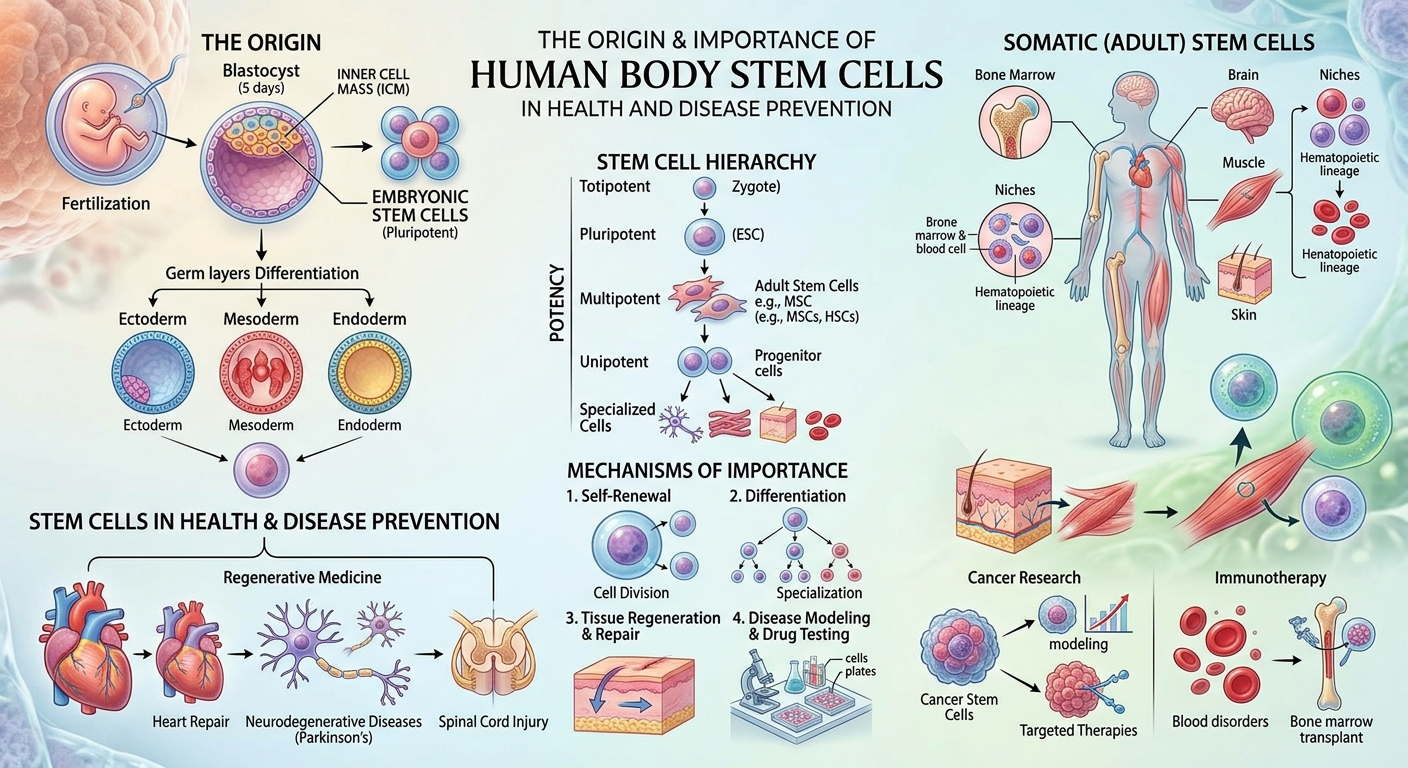
The biological story of human stem cells begins with fertilization.
The union of an egg and sperm produces a zygote. Through successive cell divisions, the developing organism progresses through increasingly complex stages. Early developmental cells possess very broad developmental potential.
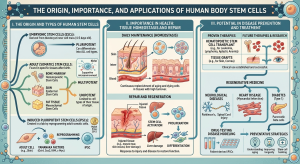
At the blastocyst stage, an inner cell mass gives rise to embryonic stem cells. Human embryonic stem cells are pluripotent, meaning that they can generate cells representing the three major embryonic germ layers and consequently many specialized cell types of the body.
The three germ layers are:
- Ectoderm – contributes to the nervous system and many epithelial structures.
- Mesoderm – contributes to blood, muscle, bone, connective tissues, and other structures.
- Endoderm – contributes to many internal organs and their epithelial tissues.
Development is therefore a progressive process in which cells move from broad developmental potential toward increasingly specialized identities.
4. Potency: How Much Can a Stem Cell Become?
Stem cells can be classified according to their developmental potential.
4.1 Totipotent cells
Totipotent cells have the broadest developmental potential. They can contribute to embryonic tissues as well as extra-embryonic tissues.
The fertilized egg, or zygote, represents the classic example of a totipotent cell.
4.2 Pluripotent cells
Pluripotent cells can generate cells from the three embryonic germ layers. Embryonic stem cells and induced pluripotent stem cells are major examples.
4.3 Multipotent cells
Multipotent cells have a more restricted range. They can generate multiple related cell types within particular biological systems.
Hematopoietic stem cells, for example, produce the diverse cellular components of blood and the immune system.
4.4 Oligopotent and unipotent cells
Some tissue stem cells have still narrower developmental potential and generate only a small number of related cell types.
This hierarchy illustrates an important principle:
As cells become increasingly specialized, their developmental potential generally becomes more restricted.
5. Major Types of Human Stem Cells
Three major categories are especially important in modern stem-cell biology.
5.1 Embryonic stem cells
Embryonic stem cells are obtained from the inner cell mass of early-stage blastocysts. They are pluripotent and therefore have considerable research potential.
Their properties make them valuable for studying:
- early human development;
- cellular differentiation;
- genetic diseases;
- developmental disorders;
- drug development;
- regenerative medicine.
Their use also raises important ethical and regulatory questions because obtaining them involves early-stage embryos.
5.2 Adult or somatic stem cells
Adult stem cells exist within specialized tissues after development and throughout life.
Examples include stem-cell populations associated with:
- bone marrow;
- blood;
- skin;
- gastrointestinal tissues;
- muscle;
- liver;
- nervous-system tissues;
- dental tissues.
Their primary biological function is generally tissue maintenance and repair.
Adult stem cells are generally more restricted than pluripotent stem cells, but their natural integration into tissues makes them extremely important for understanding normal human physiology.
5.3 Induced pluripotent stem cells
Induced pluripotent stem cells, commonly called iPSCs, represent one of the most important developments in modern stem-cell research.
Scientists can take mature cells, such as skin cells, and reprogram them into a pluripotent state. These cells can then be studied as models of human development, aging, disease, and drug responses.
The technology is particularly significant because it provides a way of generating pluripotent cells without starting with an early embryo.
6. Where Are Stem Cells Found in the Human Body?
Stem cells are not confined to one organ.
Different stem-cell populations are associated with different tissues and biological functions.
| Tissue/system | Important stem-cell role |
|---|---|
| Bone marrow | Production of blood and immune cells |
| Blood | Circulating and progenitor-cell populations |
| Skin | Replacement and repair of epithelial cells |
| Intestine | Continuous renewal of intestinal lining |
| Muscle | Contribution to muscle maintenance and repair |
| Liver | Regenerative responses under particular conditions |
| Nervous system | Specialized progenitor/stem-cell populations |
| Dental tissues | Tissue maintenance and research applications |
| Umbilical cord/placental tissues | Sources of cells studied for regenerative medicine |
The precise characteristics and developmental potential of stem cells differ considerably between tissues.
7. Stem Cells and the Development of the Human Body
Stem cells are fundamental to human development.
An embryo begins as a relatively small population of cells. Through controlled cell division, differentiation, migration, and organization, these cells eventually produce an extraordinarily complex organism.
This process requires precise biological coordination.
Cells must determine:
- when to divide;
- when to remain undifferentiated;
- when to differentiate;
- what type of cell to become;
- where to migrate;
- how to communicate with neighboring cells;
- when to stop proliferating.
Development can therefore be viewed partly as a carefully controlled transition from cellular potential to cellular specialization.
8. Stem Cells and Tissue Maintenance
Human tissues are constantly exposed to ordinary wear, cellular aging, environmental stresses, and minor injuries.
Some tissues experience particularly rapid cellular turnover.
For example, cells lining parts of the gastrointestinal tract are continually replaced. Blood cells also have limited lifespans and must be continuously replenished.
Adult stem cells provide an important source of replacement cells.
In this sense, stem cells are part of the body’s maintenance infrastructure.
They help maintain the continuity of tissues by balancing:
Stem-cell renewal → progenitor formation → differentiation → mature cells → tissue function
When this system works properly, tissues can maintain their cellular populations over long periods.
9. Stem Cells and Natural Regeneration
Regeneration is the biological process through which organisms replace or restore damaged or lost cells and tissues.
Humans possess regenerative capacity, but it is limited compared with some other organisms. Human healing can replace damaged cells and repair certain tissues, but the body generally cannot regenerate complete complex structures such as an entire lost limb.
Stem-cell biology therefore provides researchers with a way to investigate why regeneration is powerful in some biological systems but limited in others.
Understanding these mechanisms could eventually contribute to improved approaches for repairing damaged tissues.
10. Stem Cells and the Blood System
One of the clearest examples of naturally occurring stem-cell activity is the blood-forming system.
Hematopoietic stem cells in bone marrow generate progenitor cells that ultimately produce:
- red blood cells;
- platelets;
- several types of white blood cells;
- other blood and immune-system components.
This system demonstrates the fundamental principle of stem-cell biology: a relatively small population of self-renewing cells can continually generate large numbers of specialized descendants.
Blood-forming stem-cell transplantation is also one of the established clinical areas in which stem-cell biology has had major medical importance.
11. Stem Cells and the Immune System
The immune system requires continual production of specialized cells.
Many immune cells originate through the hematopoietic system. Stem and progenitor cells therefore contribute indirectly to the body’s ability to defend itself against infections and other threats.
This illustrates an important connection:
Stem-cell biology → blood production → immune-cell production → immune-system function.
Disruption of stem-cell populations or their environments can therefore affect blood and immune-system development.
12. Stem Cells and Disease
Stem-cell abnormalities can contribute to disease in several ways.
Problems may arise from:
- abnormal stem-cell proliferation;
- defective differentiation;
- genetic mutations;
- altered cellular signaling;
- disruption of the stem-cell environment;
- failure of tissue regeneration.
Cancer provides an important example of abnormal cellular regulation. Some cancers contain populations with stem-like properties that can contribute to tumor maintenance and resistance to treatment.
Consequently, stem-cell research is not limited to regenerative medicine. It also helps scientists understand how diseases develop.
13. Stem Cells and Cancer Research
Cancer is fundamentally a disease of abnormal cellular growth and regulation.
Stem-cell research helps scientists investigate questions such as:
- How does a normal cell become abnormal?
- How are cell-division programs controlled?
- Why do some cells continue dividing?
- How do abnormal cells interact with their environment?
- Why can certain tumors return after treatment?
Cancer researchers can use stem-cell and organoid models to investigate disease mechanisms and evaluate potential treatments.
However, stem-cell biology should not be interpreted as meaning that stem-cell treatments are automatically effective against cancer. Many applications remain experimental.
14. Stem Cells in Disease Modeling
One of the major scientific advantages of iPSCs is their use in disease modeling.
Researchers can generate iPSCs from individuals with particular genetic characteristics and then differentiate those cells into relevant cell types.
This can help scientists study diseases in laboratory models.
Potential research areas include:
- neurological disorders;
- cardiovascular disease;
- genetic disorders;
- metabolic diseases;
- developmental disorders;
- degenerative diseases.
NIH notes that iPSCs are useful for studying human aging and for developing and testing medicines.
15. Stem Cells and Drug Development
Traditional drug development can involve studying isolated cells, animals, and other experimental systems before human testing.
Stem-cell-derived cells provide another research platform.
Scientists can potentially create relevant human cell types and expose them to candidate compounds to study:
- cellular responses;
- toxicity;
- molecular pathways;
- disease mechanisms;
- potential therapeutic effects.
This does not eliminate the need for clinical research, but it can provide additional information during drug discovery.
16. Stem Cells and Regenerative Medicine
Regenerative medicine seeks to repair, replace, or restore damaged biological structures and functions.
Stem cells are important to this field because of their capacity for self-renewal and differentiation.
Potential areas of research include:
- blood disorders;
- tissue repair;
- neurological disease;
- cardiovascular disease;
- musculoskeletal conditions;
- pancreatic and metabolic disorders;
- eye diseases.
However, the distinction between established medical treatments and experimental stem-cell interventions is essential.
The existence of promising laboratory research does not automatically mean that a stem-cell therapy has been demonstrated to be safe or effective for a particular disease. Research reviews emphasize that many proposed regenerative applications remain under investigation.
17. Stem Cells and Tissue Engineering
Stem-cell research increasingly intersects with tissue engineering.
The broad concept is:
Cells + biological signals + supportive materials → tissue development or repair
Scientists investigate biomaterials, three-dimensional structures, growth signals, and cellular environments that can help cells organize into functional tissues.
This research could eventually contribute to technologies for repairing damaged tissues.
18. Stem Cells and Organoids
Organoids are three-dimensional laboratory-grown structures that reproduce some features of particular organs.
Stem cells can be used to generate organoid models representing aspects of:
- the brain;
- intestine;
- liver;
- kidney;
- lung;
- other tissues.
These models provide researchers with systems for studying development and disease.
They are not complete human organs, but they can reproduce selected biological characteristics that are difficult to study using conventional two-dimensional cell cultures.
19. The Stem-Cell Niche
Stem cells do not operate in isolation.
They interact with their surrounding microenvironment, commonly called the stem-cell niche.
The niche can provide:
- chemical signals;
- physical support;
- nutrients;
- neighboring cells;
- extracellular matrix;
- molecular signals regulating division and differentiation.
This means that stem-cell behavior depends not only on the cell itself but also on its environment.
A major area of research is therefore understanding how the niche maintains stem cells and controls their transition toward specialized cells.
20. Stem Cells and Aging
Aging is accompanied by changes in tissues and cellular systems.
Stem-cell populations and their surrounding environments can also change with age.
Researchers investigate whether age-related changes in stem-cell function contribute to:
- slower tissue repair;
- reduced regenerative capacity;
- altered immune function;
- muscle decline;
- changes in blood production;
- age-associated diseases.
Understanding these processes may help explain why the regenerative capacity of tissues changes throughout life.
Importantly, stem-cell research should not be confused with claims that commercially marketed stem-cell products can simply reverse aging. Such claims require rigorous scientific evidence.
21. Stem Cells and Disease Prevention
The phrase disease prevention must be used carefully.
Stem cells are not a universal method for preventing disease.
Their importance to prevention is mainly indirect and scientific.
Stem-cell research can help researchers:
- understand disease mechanisms;
- identify abnormal cellular processes;
- investigate genetic risk factors;
- model disease before symptoms develop;
- test potential medicines;
- investigate tissue damage;
- understand how healthy tissues maintain themselves.
Consequently, stem-cell biology can contribute to preventive medicine by improving our understanding of disease before it reaches advanced stages.
22. Stem Cells and Precision Medicine
Precision medicine attempts to account for individual biological differences when diagnosing and treating disease.
Patient-derived iPSCs may become useful in this field because researchers can potentially study cells carrying an individual’s genetic characteristics.
A conceptual pathway is:
Patient → mature cells → iPSC generation → differentiation → disease model → drug testing → potential personalized treatment research
This approach is especially attractive for diseases in which genetic variation strongly influences biological behavior.
23. Genetic Information and Stem Cells
Stem cells contain the individual’s genome.
The genome provides instructions that influence cellular identity and function.
During differentiation, cells generally retain essentially the same DNA but activate different groups of genes.
Thus:
Same genome + different gene-expression programs = different cell identities.
A neuron and a skin cell can contain essentially the same genetic information while performing completely different functions.
Stem-cell research investigates how these gene-expression programs are established, maintained, and changed.
24. Epigenetics and Stem Cells
Epigenetics concerns regulatory mechanisms that influence gene activity without changing the underlying DNA sequence.
Important mechanisms include:
- DNA methylation;
- histone modification;
- chromatin organization;
- regulatory RNA;
- transcriptional networks.
These mechanisms are especially important during differentiation because cells must activate appropriate genes and suppress others.
Reprogramming mature cells into iPSCs involves major changes in cellular identity and gene regulation.
25. Stem Cells and the Future of Organ Replacement
One of the long-term ambitions of regenerative medicine is the development of functional replacement tissues and organs.
Researchers are investigating whether combinations of stem cells, biomaterials, tissue engineering, organoids, and advanced manufacturing technologies can eventually produce increasingly complex tissues.
Potential future applications could include engineered:
- skin;
- cartilage;
- blood vessels;
- pancreatic tissue;
- cardiac tissue;
- neural tissues;
- other specialized structures.
However, whole-organ replacement remains a major scientific and engineering challenge.
An organ must contain the correct cell types, architecture, blood supply, signaling systems, mechanical properties, and connections to the rest of the body.
26. Major Challenges
Stem-cell science has enormous potential, but substantial challenges remain.
26.1 Controlling differentiation
Researchers must reliably produce the desired cell type.
26.2 Safety
Cells must behave predictably after introduction into a biological system.
26.3 Immune compatibility
The immune system may recognize transplanted cells as foreign.
26.4 Genetic stability
Cells grown and manipulated in laboratories must be carefully evaluated for genetic and cellular abnormalities.
26.5 Tumor formation
Some pluripotent-cell applications require stringent control to prevent unwanted cell growth.
26.6 Integration
A transplanted cell must not merely survive. It may need to integrate correctly with surrounding tissues.
26.7 Function
Producing a cell that looks correct under a microscope does not necessarily mean that it performs all the functions of a mature cell.
26.8 Manufacturing
Producing large quantities of consistent, high-quality cells under controlled conditions is a major technological challenge.
27. Ethical Considerations
Stem-cell research raises important ethical questions.
Embryonic stem-cell research has historically generated debate concerning the moral status of embryos and the circumstances under which embryos may be used for research.
Other ethical issues include:
- informed consent;
- ownership of biological samples;
- genetic privacy;
- commercialization;
- equitable access;
- clinical experimentation;
- communication of risks;
- regulation of unproven interventions.
Ethical oversight is therefore an integral part of responsible stem-cell science.
28. Stem-Cell Research and Society
The social importance of stem-cell research extends beyond laboratories and hospitals.
It affects:
- healthcare systems;
- biotechnology;
- pharmaceutical development;
- biomedical engineering;
- universities;
- government regulation;
- medical ethics;
- biotechnology investment;
- public health.
As regenerative technologies develop, societies will need mechanisms for determining which treatments are sufficiently supported by evidence and how access should be managed.
29. Stem Cells and the Future of Medicine
Future medicine may increasingly combine several disciplines:
**Stem-cell biology
- genomics
- artificial intelligence
- tissue engineering
- molecular medicine
- biomaterials
- robotics
- advanced imaging
- precision medicine**
Artificial intelligence, for example, can help researchers analyze large biological datasets and identify patterns in gene expression, cell development, and disease models.
Advanced imaging can allow scientists to observe cells in greater detail.
Gene-editing technologies may provide additional research tools for investigating disease mechanisms.
Together, these technologies could accelerate understanding of cellular biology.
30. A Systems View of Human Regeneration
The human body’s regenerative system can be represented conceptually as:
DNA and genetic regulation
↓
Stem-cell maintenance
↓
Cell division
↓
Progenitor-cell formation
↓
Cell differentiation
↓
Specialized cells
↓
Tissue formation and maintenance
↓
Repair and regeneration
This demonstrates why stem cells cannot be studied independently from genetics, metabolism, signaling, immunity, tissue architecture, and the body’s overall physiological environment.
31. From Cell to Organ
The hierarchy of biological organization can be expressed as:
DNA
→ Genes
→ Molecules
→ Organelles
→ Stem cells
→ Specialized cells
→ Tissues
→ Organs
→ Organ systems
→ Human organism
Stem cells occupy an important position within this hierarchy because they connect cellular reproduction and differentiation with the maintenance of tissues and organs.
32. Established Medicine Versus Experimental Research
A scientifically responsible discussion of stem cells must distinguish between established treatments and experimental possibilities.
Stem-cell research has already produced important medical applications, particularly in blood-forming systems.
At the same time, many proposed applications involving regeneration of complex tissues remain under research.
Therefore, statements such as “stem cells can cure every disease” are scientifically unjustified.
A more accurate conclusion is:
Stem cells are a powerful biological and technological platform with proven applications in some areas and substantial experimental potential in others.
33. The Importance of Scientific Evidence
Because stem-cell science attracts considerable public attention, patients and families may encounter exaggerated claims.
A scientifically credible treatment should be evaluated according to evidence including:
- controlled studies;
- safety data;
- efficacy data;
- appropriate clinical trials;
- peer-reviewed research;
- regulatory authorization where applicable;
- long-term follow-up.
The existence of a stem-cell clinic, laboratory procedure, or testimonial does not by itself establish that a treatment is effective.
34. The Future Research Frontier
Future research is likely to investigate increasingly sophisticated questions:
- Can damaged tissues be regenerated more reliably?
- Can patient-specific cells be generated safely?
- Can stem-cell differentiation be precisely controlled?
- Can organoids become better models of human organs?
- Can regenerative medicine reduce dependence on donor organs?
- Can cell therapies be made safer and more affordable?
- Can AI improve stem-cell research and cell manufacturing?
- Can scientists better understand aging of stem-cell populations?
- Can genetic diseases be modeled more accurately?
- Can engineered tissues reproduce the complexity of natural organs?
These questions demonstrate that stem-cell science is not a finished technology but an evolving field.
35. Conclusion
Human stem cells are fundamental components of development, tissue maintenance, repair, and biomedical research. Their defining characteristics—self-renewal and differentiation—allow them to serve as renewable sources of specialized cells.
From embryonic development to adult tissue maintenance, stem cells participate in the biological continuity of the human organism. Adult stem cells help maintain particular tissues, while embryonic stem cells and iPSCs provide powerful research platforms for understanding development and disease.
Their importance extends into regenerative medicine, disease modeling, drug development, tissue engineering, and precision medicine. Yet their potential must be balanced against scientific limitations, safety concerns, ethical questions, and the need for rigorous clinical evidence.
The most important lesson is that stem cells should not be viewed simply as “miracle cells.” They are sophisticated biological systems whose behavior depends on genetics, cellular signaling, tissue environments, metabolism, and developmental context.
The future of stem-cell science will therefore depend on understanding the entire biological system surrounding the cell.
Ultimately, stem-cell research represents one of the major scientific pathways toward understanding how the human body develops, maintains itself, responds to injury, develops disease, and potentially regenerates damaged tissues.
Selected Scientific References
- National Institute of General Medical Sciences (NIGMS), What Are Stem Cells?
- National Institutes of Health, Introduction to Stem Cells.
- NIH Intramural Research Program, Stem Cell Biology.
- National Academies/NCBI Bookshelf, Stem Cells and the Future of Regenerative Medicine.
- NIGMS, Regeneration.
- NCBI Bookshelf, Basics of Stem Cell Biology as Applied to the Brain.
- Peer-reviewed literature on stem cells and regenerative medicine.


Be First to Comment