
Abstract
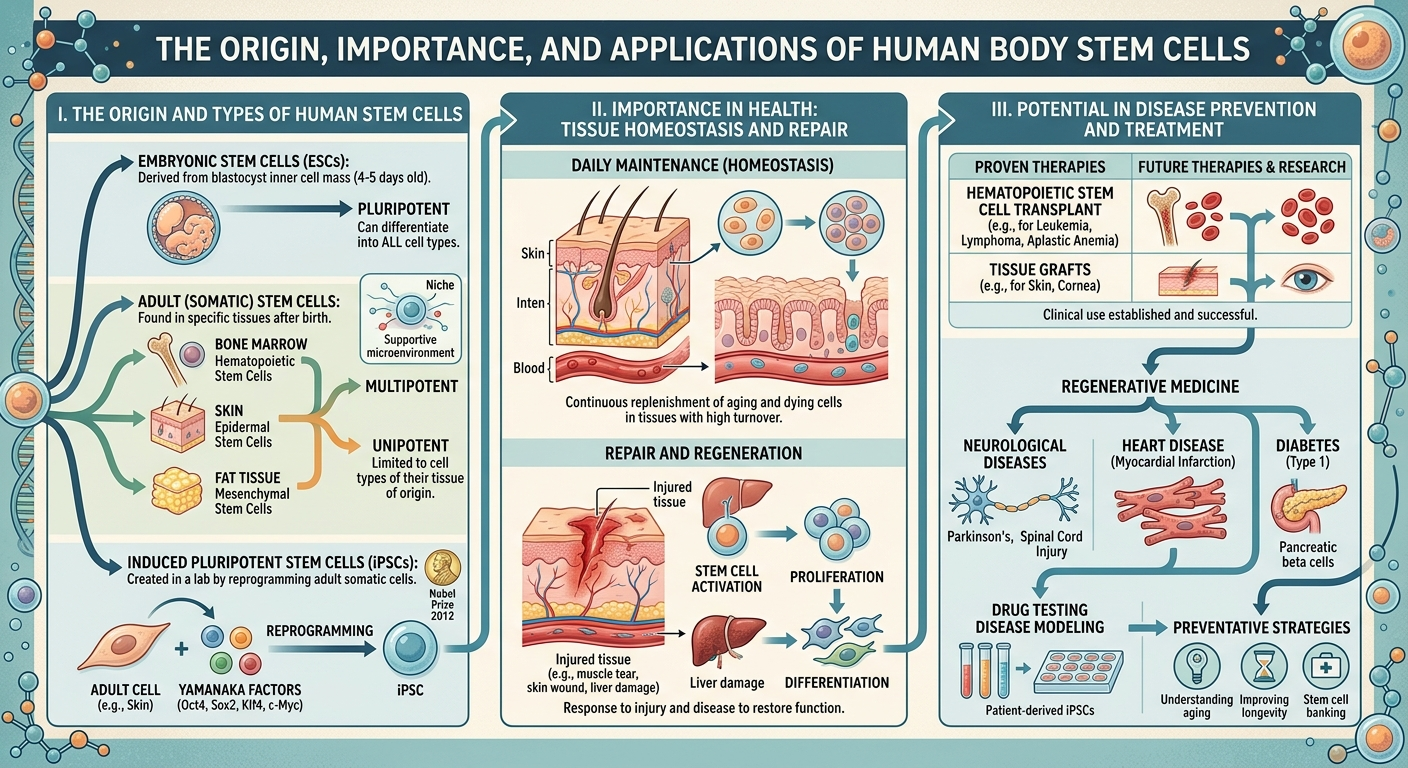
Stem cells are among the most important biological systems for understanding how the human body develops, maintains tissues, repairs damage, and responds to disease. Unlike most specialized cells, stem cells have two defining capabilities: self-renewal, meaning they can produce additional stem cells, and differentiation, meaning they can develop into specialized cell types. Stem cells occur naturally at different stages of human development and remain present in several tissues throughout life.
Modern stem-cell science has expanded from the study of blood formation to regenerative medicine, disease modelling, drug discovery, developmental biology, cancer research and personalized medicine. Researchers now work with embryonic stem cells, adult or somatic stem cells, and induced pluripotent stem cells (iPSCs). iPSCs are particularly significant because mature cells can be experimentally reprogrammed into a pluripotent state, providing powerful models for studying human disease and testing potential treatments.
However, stem cells are not a universal cure or a guaranteed method of preventing disease. Some experimental cell-based therapies remain under investigation, and poorly regulated treatments can carry serious risks. Modern regenerative medicine therefore depends on rigorous laboratory research, clinical trials, regulatory oversight and long-term safety monitoring.
1. Introduction
The human body contains trillions of cells organized into tissues and organs. These cells perform highly specialized functions: neurons transmit information, red blood cells transport oxygen, muscle cells generate force, liver cells perform metabolic functions, and immune cells defend the body.
Yet the body faces a fundamental biological problem: cells become damaged, age, die and must sometimes be replaced.
Stem cells form part of the biological solution.
A stem cell can divide to produce another stem cell while also generating cells that become more specialized. This capacity makes stem cells essential to development and, in many tissues, to lifelong maintenance and repair.
The importance of stem cells can therefore be understood through a simple biological chain:
Stem cells → cell renewal → tissue maintenance → repair and regeneration → preservation of organ function
Understanding this system has become one of the central objectives of modern biomedical science.
2. What Is a Stem Cell?
A stem cell is a cell with unusual developmental potential and the ability to reproduce itself.
Two characteristics are particularly important:
2.1 Self-renewal
Self-renewal is the ability of a stem cell to produce daughter cells that retain stem-cell characteristics.
This allows a stem-cell population to persist over long periods.
2.2 Differentiation
Differentiation is the process through which cells acquire specialized characteristics and functions.
Depending on the type of stem cell, differentiation can produce cells such as:
- red blood cells;
- white blood cells;
- neurons;
- muscle cells;
- bone-forming cells;
- skin cells; and
- other specialized cell populations.
The degree of differentiation potential varies considerably among stem-cell types.
3. The Origin of Human Stem Cells
The story of human stem cells begins at the earliest stages of human development.
Following fertilization, a single cell undergoes repeated divisions. As development progresses, cells become increasingly specialized and organize themselves into tissues and organs.
At the earliest developmental stages, cells possess considerable developmental potential. Embryonic stem cells derived from the early embryo are pluripotent, meaning they can give rise to essentially all major cell types of the body.
As development proceeds, stem and progenitor cells become increasingly restricted to particular biological functions.
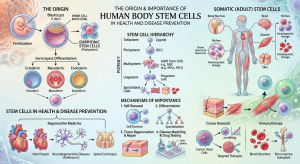
This produces a hierarchy:
Early developmental cells
↓
Pluripotent stem cells
↓
Tissue-specific stem/progenitor cells
↓
Specialized cells
This developmental hierarchy is fundamental to understanding human growth.
4. Embryonic Stem Cells
Embryonic stem cells are associated with the early embryo and are pluripotent.
Their major scientific significance is their ability to produce many different specialized cell types.
Researchers use embryonic stem cells to investigate:
- human development;
- cell differentiation;
- developmental diseases;
- tissue formation;
- genetic disorders;
- potential regenerative therapies; and
- fundamental mechanisms of cell biology.
Human embryonic stem cells were first successfully isolated and cultured in 1998, marking a major milestone in modern stem-cell research.
Their use has also generated important ethical debates because obtaining them involves early embryonic material.
Consequently, stem-cell science developed along several parallel paths, including adult stem-cell research and the development of induced pluripotent stem cells.
5. Adult or Somatic Stem Cells
Adult stem cells, also called somatic stem cells, exist within tissues throughout life.
They are generally more specialized than embryonic stem cells.
For example, hematopoietic stem cells in bone marrow produce the cells of the blood and immune system. Other tissue-resident stem cells contribute to maintenance and repair of particular tissues.
Examples include stem-cell populations associated with:
- bone marrow;
- blood;
- skin;
- intestinal tissues;
- muscles; and
- other organs and tissues.
Adult stem cells are therefore part of the body’s natural maintenance infrastructure.
6. Blood-Forming Stem Cells
One of the best-established examples of human stem-cell medicine involves blood-forming stem cells.
These cells, known as hematopoietic stem cells, generate different blood-cell lineages.
The basic system can be represented as:
Hematopoietic stem cell
↓
Progenitor cells
↓
Red blood cells
White blood cells
Platelets
The clinical history of hematopoietic stem-cell transplantation is particularly important because it demonstrates that stem-cell biology can move from laboratory research into established medical treatment. Bone marrow was the original major source, followed later by peripheral blood stem cells and cord blood.
7. Induced Pluripotent Stem Cells
One of the most important developments in modern stem-cell biology was the creation of induced pluripotent stem cells, or iPSCs.
Scientists can take a mature differentiated cell and experimentally reprogram it into a pluripotent state.
Conceptually:
Mature adult cell
↓
Cellular reprogramming
↓
Induced pluripotent stem cell
↓
Differentiation into specialized cells
iPSCs behave in many respects like embryonic stem cells and have become powerful tools for biomedical research.
They can be used to investigate disease mechanisms and create laboratory models from cells carrying particular genetic characteristics.
8. Stem Cells and Natural Tissue Maintenance
The body is not a static structure.
Every day, cells are being produced, modified, repaired and removed.
Stem cells contribute to this continuous process.
For example, tissue-specific stem cells can replenish cells that have reached the end of their functional lifespan.
The basic concept is:
Stem-cell reservoir → cell division → progenitor cells → differentiated cells → tissue maintenance
This process is especially important in tissues that undergo continuous renewal.
Stem-cell activity therefore represents part of the body’s biological infrastructure for maintaining tissue integrity.
9. Stem Cells and Healing
Healing involves multiple biological processes rather than stem cells alone.
These processes include:
- stopping bleeding;
- inflammation;
- immune activity;
- removal of damaged material;
- formation of new cells;
- rebuilding extracellular structures;
- restoration of tissue function; and
- remodeling.
Stem cells and progenitor cells can participate in certain aspects of tissue regeneration.
However, it is scientifically inaccurate to describe stem cells as an unlimited repair mechanism. Human regenerative capacity varies substantially between tissues.
10. Stem Cells and Disease
Stem-cell biology has two major relationships with disease.
First, failure or dysfunction of stem-cell systems can contribute to disease.
Second, stem cells can provide tools for understanding and potentially treating disease.
Researchers investigate stem cells in conditions involving:
- blood disorders;
- cardiovascular disease;
- neurological disorders;
- diabetes;
- degenerative diseases;
- inherited diseases;
- tissue injury; and
- cancer.
NIH research programs specifically investigate the potential of stem cells to generate replacement cells and tissues and to create disease models for research.
11. Stem Cells and Cancer
Cancer demonstrates that cell-renewal mechanisms must be tightly controlled.
Normal stem cells have mechanisms regulating:
- division;
- differentiation;
- DNA maintenance;
- tissue organization; and
- cell death.
When cellular control mechanisms become disrupted, abnormal cell populations can develop.
Researchers also study cancer stem cells, a term used for tumor-cell populations with stem-like properties in certain cancers.
Understanding these cells may help scientists investigate why some cancers recur or become resistant to treatment.
This illustrates an important principle:
The same biological mechanisms that make stem cells valuable for regeneration must also be carefully controlled to prevent abnormal growth.
12. Stem Cells and Disease Prevention
The phrase “disease prevention” requires careful interpretation.
Stem cells themselves should not be regarded as a general-purpose method for preventing disease.
Instead, stem-cell research contributes to prevention indirectly through several mechanisms.
12.1 Understanding disease earlier
Scientists can use stem-cell-derived models to study how diseases begin.
12.2 Identifying biological risk mechanisms
Stem-cell research can reveal changes in cellular development and tissue maintenance.
12.3 Drug discovery
Scientists can generate specific human cell types and use them to investigate how potential medicines affect human biology.
12.4 Personalized medicine
Patient-derived iPSCs may allow researchers to study disease in cells carrying an individual’s genetic characteristics.
12.5 Understanding aging
Stem cells provide an important system for investigating how tissues change over time.
Thus:
Stem-cell research → better biological understanding → improved diagnosis and drug development → potentially earlier intervention and better prevention
13. Stem Cells, Aging and Regeneration
Aging involves changes across virtually every biological system.
Among the important areas of investigation are:
- DNA damage;
- altered cellular metabolism;
- inflammation;
- mitochondrial dysfunction;
- changes in tissue environments;
- cellular senescence; and
- alterations in stem-cell function.
Research increasingly investigates how aging affects the ability of tissue stem cells to maintain normal regeneration.
Recent NIH-supported research has also examined the relationship between aging-related mutations in blood stem cells, inflammation, sleep and physical activity. This illustrates how stem-cell biology is becoming connected with broader research into healthy aging.
14. Stem Cells and the Immune System
The immune system depends heavily on continuous production of blood and immune cells.
Hematopoietic stem cells in the bone marrow provide the foundation for this process.
They generate progenitor populations that eventually produce numerous blood and immune cell types.
Consequently, stem-cell biology is closely connected with:
- immune development;
- blood production;
- immune-cell replacement;
- transplantation; and
- certain blood disorders.
15. Stem Cells in Regenerative Medicine
Regenerative medicine seeks to repair, replace or restore damaged biological structures.
The field combines:
- stem-cell biology;
- developmental biology;
- tissue engineering;
- biomaterials;
- genetics;
- molecular biology;
- bioengineering;
- transplantation science; and
- increasingly, computational and artificial-intelligence methods.
The long-term vision is to move beyond simply managing symptoms and toward restoring damaged biological function.
However, many proposed regenerative applications remain experimental. NIH and other research organizations emphasize the need to understand how stem cells differentiate and how they behave before they can be safely used for broad clinical applications.
16. Stem Cells in Drug Discovery
Traditional drug development often relies on combinations of laboratory experiments, animal studies and human clinical trials.
Stem-cell-derived human cells can add another layer.
Researchers can create specialized cells and investigate:
- drug toxicity;
- disease mechanisms;
- cellular responses;
- genetic differences;
- potential therapeutic effects; and
- disease progression.
This makes stem-cell biology valuable even when the final treatment does not involve transplantation of stem cells.
In other words:
Stem cells are not only potential treatments; they are also research instruments.
17. Stem Cells and Personalized Medicine
Personalized medicine seeks to account for differences between individual patients.
Patient-derived iPSCs offer a particularly interesting approach.
A mature cell can be obtained from an individual, reprogrammed into an iPSC, and differentiated into relevant cell types for laboratory investigation.
Conceptually:
Patient
↓
Adult cell
↓
iPSC
↓
Disease-relevant cell
↓
Laboratory investigation
↓
Potentially individualized therapeutic research
This approach can help scientists investigate why individuals with apparently similar diseases may respond differently to treatments.
18. Stem Cells and Genetic Disease
Genetic diseases can result from mutations affecting particular proteins, cellular pathways or developmental processes.
Stem-cell technology gives researchers a way to study some genetic diseases at the cellular level.
For example, researchers can investigate:
Genetic mutation → cellular abnormality → tissue dysfunction → disease
This helps bridge the gap between genetics and clinical disease.
Gene-editing technologies may also be combined with stem-cell research, although such approaches require extremely careful scientific and clinical evaluation.
19. The Importance of the Stem-Cell Environment
A stem cell does not operate independently.
Its behavior is influenced by its surrounding microenvironment, sometimes called the stem-cell niche.
The niche can provide:
- chemical signals;
- physical signals;
- neighboring cells;
- nutrients;
- oxygen conditions;
- growth factors; and
- extracellular-matrix interactions.
Therefore, understanding stem cells requires studying both:
the cell
and
the biological environment surrounding the cell.
This is one reason why regenerative medicine is scientifically difficult.
Simply placing cells into damaged tissue does not guarantee that they will behave as intended.
20. Major Challenges
Stem-cell research faces significant challenges.
20.1 Controlling differentiation
Scientists must reliably produce the desired cell type.
20.2 Controlling cell growth
Cells must not grow unpredictably.
20.3 Ensuring genetic stability
Cultured cells can acquire genetic abnormalities, requiring careful monitoring.
20.4 Immune compatibility
The immune system may recognize transplanted cells as foreign.
20.5 Integration
Replacement cells must function correctly within existing tissues.
20.6 Long-term safety
Some cell-based interventions may be difficult to reverse once administered, making safety especially important.
21. Ethical Considerations
Stem-cell research raises important ethical questions, particularly concerning embryonic stem cells.
Key questions include:
- What constitutes appropriate use of embryonic material?
- What ethical standards should govern embryo research?
- How should informed consent be obtained?
- How should donated biological material be stored and used?
- Who owns or controls biological samples?
- How should experimental treatments be regulated?
- How should vulnerable patients be protected?
These questions demonstrate that biomedical progress requires both scientific capability and ethical governance.
22. The Problem of Unproven Stem-Cell Treatments
The popularity of stem-cell research has also created opportunities for misleading medical claims.
A scientifically legitimate stem-cell therapy must not be confused with an unproven commercial procedure.
Regulatory and medical authorities have warned about clinics making exaggerated claims about stem-cell treatments. Unproven interventions can have serious adverse effects, including inappropriate cell growth and other complications.
Therefore, an important principle is:
Promising research ≠ proven treatment.
A treatment should be evaluated according to appropriate scientific evidence, clinical trials, regulatory standards and medical oversight.
23. The Future of Stem-Cell Science
The future of stem-cell research is likely to involve increasing integration with other technologies.
Important areas include:
Artificial intelligence
AI can help analyze enormous quantities of biological data and identify patterns in cellular behavior.
Genomics
Genomic technologies allow researchers to study genetic variation and gene regulation.
Gene editing
Gene-editing techniques may allow scientists to investigate or potentially correct certain genetic abnormalities.
Tissue engineering
Stem cells can be combined with biomaterials and engineered structures to investigate tissue regeneration.
Organoids
Researchers can grow three-dimensional cellular structures that reproduce selected characteristics of organs.
Precision medicine
Patient-derived cells can provide individualized experimental models.
Computational biology
Large-scale computational systems can model cell differentiation, gene regulation and disease processes.
The convergence of these technologies could transform regenerative medicine from a primarily experimental field into an increasingly precise engineering discipline.
24. A Systems View of Human Stem Cells
The importance of stem cells can be represented as a biological systems architecture:
DNA
↓
Gene expression
↓
Stem-cell identity
↓
Self-renewal
↓
Progenitor formation
↓
Differentiation
↓
Specialized cells
↓
Tissues
↓
Organs
↓
Human physiological function
A disruption at any level can affect the levels above it.
This makes stem-cell biology an important bridge between molecular genetics and whole-body medicine.
25. Stem Cells as the Body’s Cellular Renewal Infrastructure
One useful way of understanding stem cells is to compare them conceptually with a renewal infrastructure.
A modern technological system requires:
- maintenance;
- replacement components;
- repair mechanisms;
- quality control;
- monitoring; and
- adaptation.
Biological organisms possess analogous systems.
Stem cells provide renewable cellular populations, while surrounding tissues regulate their activity.
This does not mean the human body is literally a machine, but the analogy illustrates why stem cells are so important.
They form part of the biological infrastructure that allows certain tissues to maintain themselves over time.
26. From Birth to Aging
Stem cells are not limited to early development.
They participate in biology across the lifespan.
A simplified lifecycle is:
Embryonic development
→ formation of tissues and organs
→ childhood growth
→ expansion and maturation of tissues
→ adulthood
→ maintenance and repair
→ aging
→ changes in stem-cell function and tissue regeneration
This lifecycle perspective explains why stem-cell research is relevant to developmental biology, adult health and aging research.
27. What Stem Cells Can and Cannot Do
It is important to separate established biology from future possibilities.
Stem cells can:
- self-renew;
- produce specialized cell populations;
- support normal tissue maintenance;
- contribute to regeneration in particular tissues;
- provide powerful laboratory research models;
- support certain established transplantation procedures;
- help scientists investigate disease; and
- contribute to drug-development research.
Stem cells cannot currently be regarded as:
- a universal cure;
- a guaranteed anti-aging treatment;
- a guaranteed method of preventing cancer;
- a replacement for healthy lifestyle and preventive medicine; or
- a scientifically proven treatment for every degenerative disease.
This distinction is essential for responsible public understanding of regenerative medicine.
28. The Broader Importance to Human Health
Stem-cell research is important because it addresses fundamental questions:
How does a single cell become an entire human body?
How are tissues maintained for decades?
How does the body repair damage?
Why does regeneration vary between tissues?
What happens to cellular renewal during aging?
How does abnormal cell growth arise?
Can damaged cells be replaced safely?
Can human disease be modelled using patient-derived cells?
Answering these questions could influence medicine for generations.
29. Conclusion
Human stem cells are fundamental components of development, tissue maintenance and regeneration. Their importance arises from their capacity for self-renewal and their ability, depending on the stem-cell population, to generate specialized cells. Embryonic stem cells provide broad developmental potential, adult stem cells maintain particular tissues, and induced pluripotent stem cells provide researchers with a powerful method for creating pluripotent cells from mature cells.
The scientific significance of stem cells extends far beyond transplantation. They provide models for studying disease, platforms for drug discovery, tools for investigating human development and aging, and possible foundations for future regenerative therapies.
At the same time, stem-cell medicine must be approached scientifically rather than as a miracle technology. Safety, genetic stability, immune compatibility, controlled differentiation, long-term outcomes and regulatory oversight remain central challenges.
The deepest importance of stem cells is therefore not simply that they may someday replace damaged cells. It is that they provide a window into one of biology’s most fundamental principles:
life maintains itself through the controlled renewal, specialization and organization of cells.
Understanding that process could ultimately improve how humanity prevents, diagnoses, models and treats disease.
Selected Scientific Sources
- National Institute of General Medical Sciences — overview of stem-cell biology and the major categories of human stem cells.
- National Institutes of Health — Introduction to Stem Cells.
- NIH Intramural Research Program — Stem Cell Biology.
- National Academies/NCBI — Stem Cells and the Future of Regenerative Medicine.
- NCBI Bookshelf — selection and history of stem-cell sources for hematopoietic transplantation.
- National Center for Biotechnology Information — 2026 discussion of patient-safety issues in regenerative medicine.


Be First to Comment