
Abstract
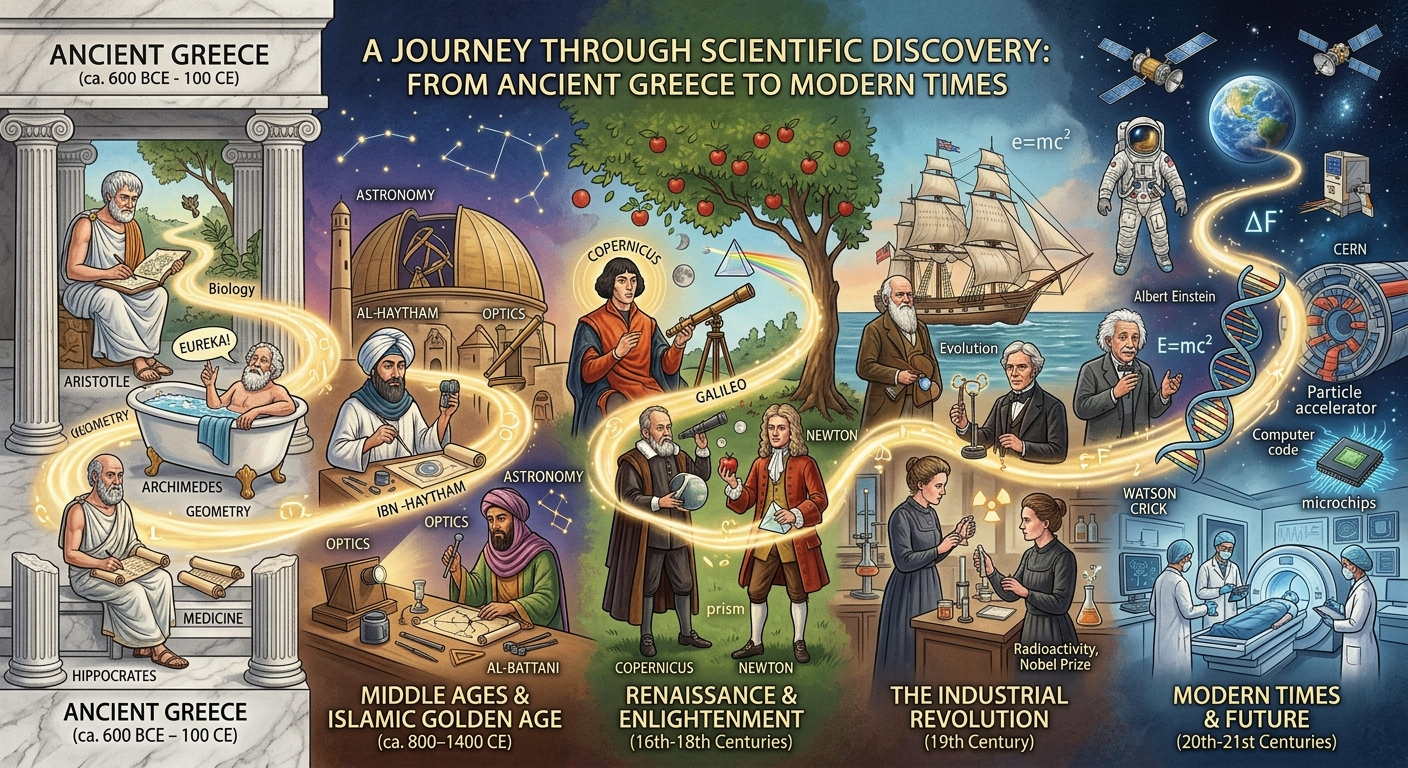
The history of science is the story of humanity’s continuing attempt to understand nature, matter, life, Earth, the universe, and ultimately ourselves. Scientific knowledge did not emerge suddenly in the modern era. It developed through thousands of years of observation, measurement, experimentation, mathematics, engineering, philosophical debate, technological innovation, and the exchange of knowledge among civilizations.
From the natural philosophers of ancient Greece to the mathematical astronomy of the Islamic Golden Age, the scientific achievements of India, China, Africa, and other civilizations, the Scientific Revolution of Europe, the Industrial Revolution, and the extraordinary advances of the twentieth and twenty-first centuries, scientific discovery has progressively transformed human civilization.
This journey encompasses astronomy, mathematics, physics, chemistry, biology, medicine, geology, computing, genetics, space science, materials science, artificial intelligence, quantum science, and biotechnology. Each generation has inherited knowledge from previous generations while challenging established assumptions and developing new methods of investigation.
The history of science therefore should not be viewed simply as a list of famous discoveries. It is better understood as a continuously expanding network of ideas, instruments, institutions, experiments, technologies, and people.
1. Introduction: Humanity’s Search for Knowledge
Long before formal laboratories and universities existed, humans observed the natural world.
People watched the movement of the Sun and Moon, recognized seasonal patterns, studied animals and plants, developed methods of agriculture, learned to work metals and stone, and constructed increasingly sophisticated buildings and tools.
These activities represented early forms of empirical knowledge.
Science eventually developed a more systematic methodology:
Observation → Question → Hypothesis → Experiment → Measurement → Analysis → Verification → Theory → Application
Modern science is distinguished not merely by knowledge but by a systematic process for testing claims against evidence.
2. Science Before Ancient Greece
The intellectual history of science begins much earlier than classical Greece.
2.1 Mesopotamia
Civilizations of Mesopotamia developed sophisticated astronomical observations and mathematical systems.
Babylonian scholars recorded celestial movements, developed numerical methods, and produced astronomical tables that later influenced Greek astronomy.
Their mathematical traditions contributed to the long-term development of arithmetic, geometry, astronomy, and timekeeping.
2.2 Ancient Egypt
Ancient Egyptian civilization developed practical knowledge in:
- mathematics;
- architecture;
- medicine;
- agriculture;
- astronomy;
- surveying;
- engineering;
- calendar systems.
The construction of monumental architecture required substantial knowledge of geometry, materials, logistics, and measurement.
Egyptian medical traditions also demonstrate early attempts to organize observations about the human body and disease.
2.3 India
Ancient Indian intellectual traditions made important contributions to mathematics, astronomy, medicine, linguistics, and philosophy.
The development and transmission of the decimal positional number system and the concept of zero became particularly important for mathematics and eventually modern science and engineering.
Indian astronomers also developed sophisticated mathematical approaches to celestial calculations.
2.4 China
Chinese civilization produced major advances in engineering, mathematics, astronomy, medicine, metallurgy, agriculture, and technology.
Innovations associated with Chinese civilization include:
- papermaking;
- printing;
- sophisticated astronomical instruments;
- advances in metallurgy;
- mechanical engineering;
- navigational technologies;
- mathematical methods.
The broader lesson is important: scientific and technological development has always been geographically distributed.
3. The Scientific Tradition of Ancient Greece
Ancient Greece played an especially influential role in the development of systematic natural philosophy.
Greek thinkers increasingly attempted to explain natural phenomena through rational principles rather than relying exclusively on mythology.
3.1 Thales
Thales of Miletus is traditionally associated with attempts to explain nature through natural principles.
His importance lies partly in the transition toward rational inquiry.
3.2 Pythagoras and the Mathematical View of Nature
The Pythagorean tradition emphasized mathematics as a means of understanding patterns in nature.
The relationship between mathematics and physical reality became one of the most powerful ideas in the subsequent history of science.
3.3 Democritus and Atomism
Democritus and other ancient thinkers proposed that matter could be composed of extremely small indivisible units called atoms.
Although ancient atomism was not equivalent to modern atomic theory, it represented an extraordinarily important conceptual question:
What is matter fundamentally made of?
That question eventually led to modern chemistry and particle physics.
4. Aristotle and the Organization of Knowledge
Aristotle attempted to organize knowledge across numerous fields.
His work addressed:
- physics;
- biology;
- logic;
- ethics;
- astronomy;
- metaphysics;
- political philosophy;
- natural history.
Aristotle’s biological observations were particularly significant because he systematically described and classified numerous organisms.
Although many of his physical theories were later shown to be incorrect, his emphasis on systematic classification and investigation influenced scientific thought for centuries.
5. Archimedes: Mathematics Meets Engineering
Archimedes demonstrated how mathematical reasoning could solve practical physical problems.
His work contributed to:
- geometry;
- mechanics;
- hydrostatics;
- centers of mass;
- engineering principles.
The principle associated with buoyancy illustrates a fundamental characteristic of science: abstract mathematics can produce predictions about physical systems.
6. Greek Astronomy and the Cosmos
Greek astronomers developed increasingly sophisticated models of the universe.
Aristarchus of Samos proposed a heliocentric model in which Earth moved around the Sun.
Later, Hipparchus made important astronomical measurements.
Ptolemy developed a highly influential mathematical model of planetary motion based on an Earth-centered universe.
Ptolemaic astronomy remained influential for many centuries before the Scientific Revolution fundamentally changed humanity’s understanding of the cosmos.
7. The Roman World and Engineering
The Roman world contributed extensively to practical engineering.
Roman achievements included:
- roads;
- bridges;
- aqueducts;
- concrete construction;
- water-management systems;
- military engineering;
- urban infrastructure.
The Roman example demonstrates that technological progress can occur even when theoretical scientific understanding remains incomplete.
Engineering and science are closely related but are not identical:
Science seeks to understand nature.
Engineering applies knowledge to create useful systems.
The two disciplines continually influence each other.
8. The Islamic Golden Age
Between approximately the eighth and fourteenth centuries, scholars working across the Islamic world made major contributions to mathematics, astronomy, medicine, optics, chemistry, geography, and philosophy.
Knowledge from Greek, Persian, Indian, and other traditions was translated, preserved, criticized, expanded, and integrated.
8.1 Al-Khwarizmi
Muhammad ibn Musa al-Khwarizmi made foundational contributions to algebra and mathematical computation.
The word algorithm is historically connected to the Latinized form of his name.
8.2 Ibn al-Haytham
Ibn al-Haytham made major contributions to optics.
His investigations emphasized observation, experimentation, and mathematical analysis.
His work helped establish an important intellectual pathway toward experimental science.
8.3 Medicine
Scholars such as Avicenna compiled and developed extensive medical knowledge.
Medical texts produced during this period influenced learning across Europe and the broader Mediterranean world.
9. Medieval Europe and the Recovery of Knowledge
European universities emerged during the medieval period, creating institutions dedicated to organized learning.
Works originating in Greek, Arabic, Persian, Indian, and other intellectual traditions were translated and studied.
This created a foundation upon which later European scientific developments could build.
The history of science therefore cannot be accurately described as a simple uninterrupted European progression. It was a cumulative process involving many civilizations.
10. The Renaissance and the New Scientific Spirit
The Renaissance encouraged renewed interest in mathematics, observation, classical knowledge, anatomy, engineering, art, and natural philosophy.
Artists and investigators increasingly studied the physical world directly.
The invention and expansion of printing dramatically increased the ability to reproduce and distribute scientific knowledge.
Knowledge could now circulate more rapidly among scholars.
11. Copernicus and the Transformation of Astronomy
Nicolaus Copernicus proposed a mathematical heliocentric model in which Earth and the other planets revolved around the Sun.
The heliocentric model challenged established astronomical assumptions.
This was not merely a change in astronomy. It represented a broader transformation in humanity’s understanding of its position in the universe.
12. Galileo and Experimental Physics
Galileo Galilei transformed the study of motion and astronomy.
He used telescopic observations to examine the heavens and conducted investigations of physical motion.
His work strengthened the idea that mathematical predictions should be tested against observation.
This combination of:
Mathematics + Experiment + Measurement
became central to modern physics.
13. Kepler and Planetary Motion
Johannes Kepler analyzed astronomical observations and formulated laws describing planetary motion.
His work showed that planetary orbits are elliptical rather than perfect circles.
Kepler’s laws became fundamental components of Newtonian celestial mechanics.
14. Newton and the Mathematical Universe
Isaac Newton produced one of the most influential syntheses in scientific history.
His work connected terrestrial motion and celestial motion through universal gravitation.
Newton’s contributions included:
- laws of motion;
- universal gravitation;
- mathematical developments in calculus;
- optics;
- studies of light and color.
Newton demonstrated that the same mathematical laws could describe falling objects on Earth and the motion of celestial bodies.
This represented a profound unification of nature.
15. The Scientific Revolution
The Scientific Revolution transformed the intellectual foundations of Western science.
Important characteristics included:
- systematic observation;
- controlled experimentation;
- mathematical modeling;
- reproducibility;
- scientific instruments;
- publication and communication;
- skepticism toward unsupported claims.
The scientific revolution did not produce modern science overnight. Instead, it established an increasingly powerful methodology.
16. The Rise of Modern Chemistry
Chemistry gradually separated itself from older traditions of alchemy.
Robert Boyle helped establish experimental approaches to chemistry.
Later, Antoine Lavoisier transformed chemistry through quantitative measurement and systematic chemical nomenclature.
Lavoisier’s work helped establish the principle that chemical reactions obey measurable relationships involving matter.
Chemistry increasingly became a quantitative science.
17. Electricity and Magnetism
The eighteenth and nineteenth centuries produced extraordinary advances in the understanding of electricity and magnetism.
Important figures included:
- Benjamin Franklin;
- Alessandro Volta;
- André-Marie Ampère;
- Michael Faraday;
- James Clerk Maxwell.
The invention of batteries, electrical generators, motors, telegraph systems, and other technologies transformed society.
18. Faraday and Electromagnetic Induction
Michael Faraday discovered electromagnetic induction.
This principle became fundamental to electrical power generation.
Modern electrical grids depend on the physical principles developed through this historical progression.
19. Maxwell and the Electromagnetic Field
James Clerk Maxwell unified electricity, magnetism, and light through mathematical equations.
Maxwell’s theory predicted electromagnetic waves.
This provided the theoretical foundation for technologies that eventually included:
- radio;
- television;
- radar;
- wireless communications;
- antennas;
- modern telecommunications.
20. Darwin and Evolution
Charles Darwin transformed biology through the theory of evolution by natural selection.
Evolution provided a framework for understanding how populations change over generations and how biological diversity arises.
Modern evolutionary biology incorporates genetics, molecular biology, ecology, developmental biology, and computational methods.
21. The Germ Theory of Disease
During the nineteenth century, scientists increasingly demonstrated that microorganisms could cause infectious diseases.
Louis Pasteur and Robert Koch were particularly influential.
The development of germ theory transformed medicine.
It contributed to:
- sanitation;
- sterilization;
- vaccination;
- microbiology;
- infection control;
- public health.
Scientific discovery therefore became directly connected to improved human survival.
22. The Industrial Revolution
Scientific knowledge increasingly interacted with industrial technology.
Major developments included:
- steam engines;
- railways;
- mechanized manufacturing;
- electrical machinery;
- chemical industries;
- telecommunications.
Industrialization changed how humans produced goods, transported people, generated energy, and communicated.
It also created new environmental and social challenges.
23. The Discovery of the Atom
By the late nineteenth and early twentieth centuries, scientists demonstrated that atoms were not indivisible.
Important discoveries included:
- the electron;
- the atomic nucleus;
- radioactivity;
- protons;
- neutrons.
Scientists such as J. J. Thomson, Ernest Rutherford, Marie Curie, and James Chadwick contributed to this transformation.
The ancient philosophical question about the nature of matter had become an experimental scientific program.
24. Einstein and Relativity
Albert Einstein revolutionized physics.
Special relativity demonstrated that measurements of time and space depend upon relative motion and that the speed of light has a fundamental role in the structure of spacetime.
The famous relationship:
E = mc²
expresses the equivalence of mass and energy.
General relativity later provided a new theory of gravity in which gravity is associated with the geometry of spacetime.
Relativity became essential to modern astrophysics and has practical relevance to technologies such as satellite navigation.
25. Quantum Mechanics
The early twentieth century produced another revolution.
Quantum theory emerged through the work of scientists including:
- Max Planck;
- Albert Einstein;
- Niels Bohr;
- Werner Heisenberg;
- Erwin Schrödinger;
- Paul Dirac.
Quantum mechanics describes nature at atomic and subatomic scales.
It introduced concepts radically different from classical mechanics, including quantization, wave-particle duality, uncertainty, and quantum states.
Modern technologies based on quantum physics include:
- semiconductors;
- lasers;
- magnetic resonance technologies;
- transistors;
- LEDs;
- advanced sensors;
- quantum computers.
26. Nuclear Science
Research into atomic nuclei revealed enormous amounts of energy contained within matter.
Nuclear science subsequently produced peaceful applications including:
- nuclear medicine;
- medical imaging;
- radiation therapy;
- nuclear power;
- scientific research.
It also created profound ethical and geopolitical challenges, demonstrating that scientific knowledge can produce both beneficial and dangerous consequences depending on how societies use it.
27. The Structure of DNA
The discovery of DNA’s molecular structure represented a turning point in biology.
Research by many scientists, including Rosalind Franklin, James Watson, Francis Crick, Maurice Wilkins, and others, contributed to understanding the molecular basis of heredity.
The discovery led to modern molecular biology and eventually to:
- genome sequencing;
- genetic testing;
- biotechnology;
- genetic engineering;
- personalized medicine;
- computational genomics.
28. The Computer Revolution
Computing transformed science itself.
Early electronic computers demonstrated that machines could perform enormous numbers of calculations.
The development of:
- transistors;
- integrated circuits;
- microprocessors;
- memory;
- operating systems;
- networks;
- personal computers;
created the modern information age.
Computers became scientific instruments as well as commercial technologies.
29. The Internet
The development of computer networking eventually produced the global Internet.
The Internet transformed communication, commerce, education, research, entertainment, government, and social interaction.
Scientific collaboration also became increasingly global.
Researchers could share datasets, papers, software, simulations, and experimental results across continents.
30. The Space Age
The twentieth century expanded scientific investigation beyond Earth.
Humanity developed:
- rockets;
- satellites;
- space probes;
- orbital laboratories;
- planetary spacecraft;
- space telescopes.
Scientific instruments placed beyond Earth’s atmosphere enabled unprecedented observations of the universe.
The Moon, Mars, the outer planets, asteroids, comets, and distant galaxies became direct objects of scientific investigation.
31. Modern Astronomy and Cosmology
Modern cosmology describes an expanding universe originating from an extremely hot, dense early state.
Observations of galaxies, cosmic background radiation, stellar evolution, and large-scale cosmic structure have produced increasingly sophisticated models of the universe.
Contemporary astronomy investigates:
- black holes;
- neutron stars;
- exoplanets;
- dark matter;
- dark energy;
- gravitational waves;
- galaxy formation;
- cosmic evolution.
The ancient question “What is the universe?” has become a sophisticated scientific research program.
32. The Human Genome Era
The Human Genome Project demonstrated the ability of international scientific collaboration to map the human genetic sequence.
Modern genomic science now uses high-throughput sequencing, computational biology, artificial intelligence, and large biological datasets.
The combination of biology and computing has created an entirely new scientific environment.
33. Biotechnology and Gene Editing
Modern biotechnology enables scientists to manipulate biological systems with unprecedented precision.
Gene-editing technologies such as CRISPR have become important research tools.
Applications under investigation include:
- understanding genetic diseases;
- developing potential therapies;
- agricultural biotechnology;
- biological research;
- industrial biotechnology.
Because genetic technologies can affect living organisms, their development requires rigorous scientific, ethical, and regulatory oversight.
34. Nanotechnology
Nanotechnology studies and manipulates materials at extremely small scales.
At the nanoscale, materials can display properties significantly different from their large-scale forms.
Nanoscience contributes to:
- semiconductor manufacturing;
- medicine;
- materials engineering;
- sensors;
- energy technologies;
- advanced coatings.
Modern semiconductor manufacturing represents one of humanity’s most sophisticated applications of nanoscale engineering.
35. Artificial Intelligence and Machine Learning
Artificial intelligence represents a major new phase in the relationship between computation and scientific discovery.
Machine-learning systems can analyze enormous datasets and identify patterns that may be difficult for humans to detect manually.
AI is increasingly used in:
- astronomy;
- medicine;
- materials science;
- climate science;
- chemistry;
- genomics;
- physics;
- engineering.
AI does not replace the scientific method. Rather, it can become a powerful instrument within the scientific process.
A modern research cycle may therefore look like:
Human Question → Data → AI Analysis → Hypothesis → Experiment → Measurement → Validation → Scientific Knowledge
36. The Convergence of Scientific Disciplines
Modern science increasingly crosses traditional disciplinary boundaries.
Examples include:
Physics + Computer Science
Quantum computing and computational physics.
Biology + Computer Science
Bioinformatics and computational genomics.
Chemistry + Materials Science
Advanced batteries and semiconductor materials.
Neuroscience + AI
Computational models of cognition.
Astronomy + Data Science
Automated analysis of astronomical surveys.
Climate Science + Computing
Large-scale Earth-system simulations.
The boundaries between scientific disciplines are becoming increasingly interconnected.
37. Scientific Instruments: Extending Human Senses
Scientific progress has repeatedly depended upon better instruments.
Examples include:
- telescopes;
- microscopes;
- thermometers;
- spectrometers;
- particle accelerators;
- DNA sequencers;
- electron microscopes;
- gravitational-wave detectors;
- radio telescopes;
- supercomputers.
An important principle emerges:
Better instruments allow humanity to observe phenomena that were previously invisible.
The microscope opened the microbial world.
The telescope opened the astronomical universe.
The particle accelerator opened the subatomic world.
The computer opened enormous computational and informational spaces.
38. The Role of Mathematics
Mathematics is one of the central languages of modern science.
It allows scientists to:
- quantify observations;
- express physical laws;
- construct models;
- predict outcomes;
- analyze uncertainty;
- simulate complex systems.
From Newton’s equations to Maxwell’s equations, Einstein’s field equations, quantum mechanics, statistical mechanics, and modern computational models, mathematics provides the structural framework for much of contemporary science.
39. Scientific Discovery and Technology
Science and technology form a feedback loop.
Scientific discovery → technological development → improved instruments → new observations → new scientific discovery
For example:
Quantum physics → semiconductor theory → transistor → computer → computational science → new scientific discoveries
Similarly:
Electromagnetism → radio technology → telecommunications → global networks → digital science
Scientific discovery and technological innovation therefore increasingly reinforce one another.
40. The Changing Scale of Scientific Investigation
Human scientific investigation has expanded through several scales.
Cosmic Scale
Galaxies, stars, planets, black holes, and the universe.
Planetary Scale
Earth systems, climate, oceans, geology, and ecosystems.
Human Scale
Medicine, physiology, psychology, and society.
Cellular Scale
Cells, proteins, DNA, and microorganisms.
Molecular Scale
Atoms and molecules.
Atomic Scale
Electrons and nuclei.
Subatomic Scale
Quarks, leptons, bosons, and quantum fields.
Science has therefore expanded both outward into the universe and inward into the structure of matter.
41. Science and the Earth System
Modern science increasingly treats Earth as an interconnected system.
Researchers study:
- atmosphere;
- oceans;
- land;
- ice;
- ecosystems;
- biodiversity;
- carbon cycles;
- energy flows;
- human activity.
Earth-system science is essential for understanding environmental change and developing sustainable technologies.
42. The Future of Scientific Discovery
The next phase of scientific discovery may be characterized by increasing collaboration between humans and intelligent computational systems.
Potentially transformative fields include:
- artificial intelligence;
- quantum computing;
- robotics;
- advanced biotechnology;
- synthetic biology;
- nanotechnology;
- fusion research;
- advanced materials;
- space science;
- brain-computer interfaces;
- climate engineering research;
- automated scientific laboratories.
Future scientific systems may increasingly combine:
Human intelligence + AI + Robotics + Sensors + Laboratories + Supercomputing + Global Data
This could dramatically accelerate the scientific research cycle.
43. The Scientific Method as Humanity’s Most Important Discovery
Individual discoveries are enormously important, but the scientific method itself may be one of humanity’s greatest intellectual achievements.
Its strength comes from principles such as:
- evidence;
- measurement;
- reproducibility;
- skepticism;
- peer criticism;
- mathematical reasoning;
- experimentation;
- transparency;
- correction of errors.
Science progresses partly because it allows established ideas to be challenged.
A scientific theory is not protected from criticism merely because it is old or influential.
44. The Limits of Scientific Knowledge
Science is extraordinarily powerful, but it is not omniscient.
Major unanswered questions remain.
Scientists continue to investigate:
- the nature of dark matter;
- the nature of dark energy;
- the origin of life;
- the relationship between gravity and quantum mechanics;
- the deepest structure of matter;
- consciousness;
- the origins of the universe;
- the possibility of life beyond Earth.
The existence of unanswered questions is not a failure of science.
It is one of the reasons scientific discovery continues.
45. The Ethical Responsibility of Science
Scientific knowledge creates responsibility.
Technologies developed from scientific discoveries can improve human life, but they can also create new risks.
Therefore scientific progress requires:
Knowledge + Ethics + Responsibility + Governance
Scientists, engineers, governments, companies, educators, and citizens all have roles in determining how discoveries are used.
46. A Timeline of Major Scientific Milestones
| Period | Major Development |
|---|---|
| Ancient civilizations | Mathematics, astronomy, medicine, engineering |
| Ancient Greece | Natural philosophy and mathematical science |
| Hellenistic period | Advanced mathematics and astronomy |
| Roman era | Engineering and infrastructure |
| Medieval Islamic world | Mathematics, optics, medicine, astronomy |
| Medieval Europe | Universities and knowledge transmission |
| Renaissance | Observation, anatomy, mathematics and instruments |
| 1500s | Copernican astronomy |
| 1600s | Galileo, Kepler and Newton |
| 1700s | Chemistry and systematic experimentation |
| 1800s | Electricity, electromagnetism, evolution and industrial science |
| Early 1900s | Relativity, quantum physics and nuclear science |
| Mid-1900s | Computing, genetics and space exploration |
| Late 1900s | Internet, biotechnology and genomics |
| 2000s | AI, advanced genomics, nanotechnology and precision science |
| 2020s | AI-assisted discovery, advanced computing and accelerating scientific convergence |
47. The Grand Pattern of Scientific Discovery
The history of science can be viewed as a sequence of increasingly powerful questions.
Stage 1: What do we observe?
Humanity observes the natural world.
Stage 2: Why does it happen?
Natural philosophy searches for explanations.
Stage 3: Can we measure it?
Mathematics and scientific instruments become increasingly important.
Stage 4: Can we reproduce it?
Experimental science develops.
Stage 5: Can we predict it?
Scientific theories become mathematical models.
Stage 6: Can we control or apply it?
Engineering transforms scientific knowledge into technology.
Stage 7: Can machines help us discover it?
Computing and AI become scientific instruments.
Stage 8: Can we discover phenomena beyond ordinary human perception?
Advanced instruments extend scientific investigation into the cosmic, microscopic, quantum, and computational domains.
48. Conclusion
The journey from ancient Greece to modern science is not simply a story about famous scientists. It is the story of humanity’s gradual development of increasingly powerful ways to ask questions about reality.
Ancient civilizations established mathematics, astronomy, medicine, engineering, and systems of observation. Greek thinkers emphasized rational explanations of nature. Scholars across the Islamic world, India, China, Africa, Europe, and other regions preserved, transformed, and expanded knowledge.
The Scientific Revolution introduced increasingly systematic experimentation and mathematical modeling. Newton unified terrestrial and celestial mechanics. Chemistry became quantitative. Darwin transformed biology. Maxwell unified electricity and magnetism. Einstein reshaped space, time, and gravity. Quantum mechanics revealed a fundamentally different microscopic universe. Computing transformed information processing. Molecular biology transformed our understanding of life. Space science expanded human observation beyond Earth. AI is now becoming a powerful instrument for analyzing scientific complexity.
The great pattern is one of accumulation, correction, integration, and expansion.
Every generation inherits questions from previous generations.
Every new instrument reveals phenomena that were previously hidden.
Every successful theory creates new questions.
And every scientific discovery becomes a potential foundation for another discovery.
Humanity’s scientific journey is therefore unfinished.
The transition from ancient observation to modern experimental science has taken thousands of years, but the process continues. The future may bring scientific instruments and computational systems capable of exploring matter, life, intelligence, Earth, and the universe at scales that are currently difficult to imagine.
The deepest lesson of scientific history is perhaps this:
Human knowledge grows when curiosity is combined with evidence, mathematics, experimentation, imagination, criticism, collaboration, and the willingness to change our understanding when nature tells us that we are wrong.
That principle connects the earliest observers of the night sky with the scientists, engineers, laboratories, computers, and AI systems of the twenty-first century—and provides the foundation for the scientific discoveries of the centuries yet to come.

Be First to Comment