
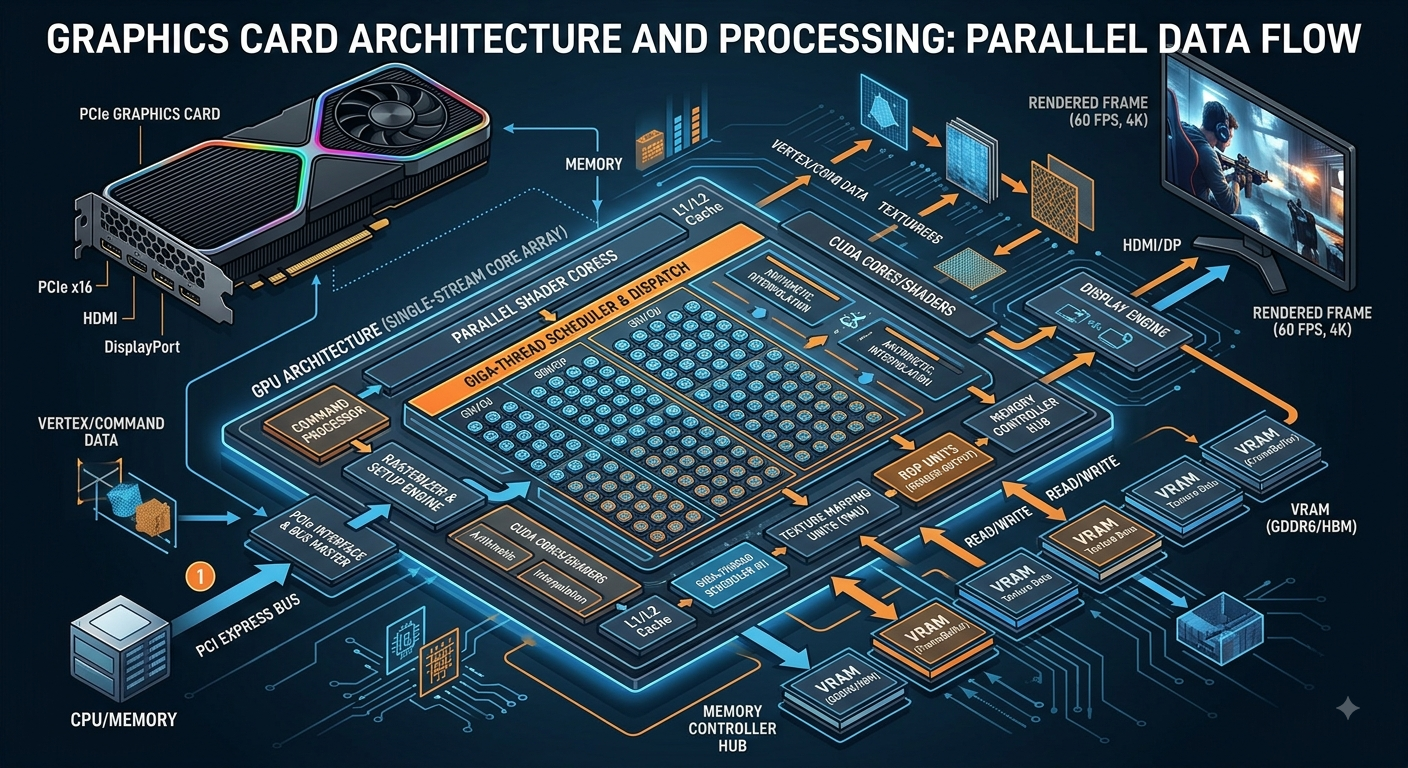
From Early Graphics Accelerators to Modern GPU Computing, Artificial Intelligence and Future Heterogeneous Processors
Abstract
A graphics processing unit (GPU) has evolved from a specialized electronic circuit for drawing pixels into one of the most important computational architectures of the twenty-first century. Modern GPUs simultaneously perform graphics rendering, numerical simulation, artificial intelligence, scientific computing, video processing, data analytics and other massively parallel workloads.
This thesis examines the architecture and operation of graphics cards from the physical semiconductor level through the instruction-execution level and finally to applications. It explains the evolution from early 2D graphics accelerators and fixed-function 3D processors to programmable shader architectures, unified GPUs, ray-tracing accelerators, matrix/AI engines, chiplet-based designs and high-bandwidth memory systems.
The central engineering principle is massive parallelism. Whereas a CPU is optimized for sophisticated sequential and branch-heavy workloads using a relatively small number of powerful general-purpose cores, a GPU dedicates a much larger proportion of its silicon to arithmetic throughput, data parallelism, memory bandwidth and specialized acceleration.
Modern GPU architectures illustrate several approaches to this principle. AMD’s RDNA family combines compute units with dedicated ray-tracing and AI acceleration, while AMD’s CDNA family is designed specifically around AI and high-performance computing. Intel’s Xe architecture similarly organizes vector and matrix engines into larger hierarchical GPU structures.
The thesis therefore treats a graphics card not merely as a “video card,” but as a complete heterogeneous computing subsystem containing a processor, memory hierarchy, interconnects, display engines, media processors, power-management systems, firmware and software interfaces.
Table of Contents
- Introduction
- What Is a Graphics Processing Unit?
- Historical Evolution of Graphics Processing
- Anatomy of a Modern Graphics Card
- GPU Semiconductor Architecture
- CPU Versus GPU Architecture
- The Graphics Rendering Pipeline
- Shader Processing
- GPU Execution Models
- Arithmetic and Floating-Point Processing
- GPU Memory Architecture
- Cache Hierarchy
- Graphics Memory Technologies
- Rasterization
- Texture Processing
- Ray Tracing
- AI and Matrix Processing
- GPU Interconnects
- PCI Express and Host Communication
- Video Encoding and Decoding
- Display Processing
- GPU Programming Models
- CUDA, OpenCL, SYCL, Vulkan and Direct3D
- General-Purpose GPU Computing
- GPU Architecture for Artificial Intelligence
- GPU Architecture for Scientific Computing
- Multi-GPU Computing
- Chiplets and Advanced Packaging
- Power, Cooling and Thermal Engineering
- GPU Manufacturing and Semiconductor Technology
- GPU Performance Metrics
- Major GPU Architecture Families
- Graphics Cards in Gaming and Content Creation
- GPUs in Data Centres and Supercomputers
- GPU Bottlenecks and Architectural Trade-Offs
- Security, Reliability and Error Correction
- The Future of GPU Architecture
- Historical Timeline
- Technical Architecture Diagrams
- Comparative Tables
- Conclusion
- References
Chapter 1 — Introduction
The modern computer is increasingly heterogeneous.
Instead of relying on a single processor to perform every operation, contemporary systems divide computational work among specialized engines:
CPU → GPU → AI accelerator → media engine → storage controller → network processor → memory system
The GPU occupies a particularly important position in this architecture because many computational problems can be expressed as operations performed independently on large collections of data.
For example, rendering millions of pixels can be formulated as parallel operations:
[
Pixel_i = f(Vertex, Texture, Lighting, Geometry, Camera)
]
Similarly, matrix multiplication can be divided into thousands or millions of smaller operations.
This makes GPUs particularly effective for:
- computer graphics;
- image processing;
- scientific simulation;
- numerical computation;
- machine learning;
- neural-network inference;
- cryptography;
- video processing;
- computational physics;
- engineering simulation;
- data analytics.
Modern GPU architectures consequently blur the traditional boundary between graphics processors and general-purpose supercomputers.
Chapter 2 — What Is a GPU?
A Graphics Processing Unit is a highly parallel processor designed originally to accelerate graphics operations.
A complete graphics card, however, is larger than the GPU itself.
A simplified system is:
                 COMPUTER SYSTEM
                       │
                       ▼
              ┌─────────────────┐
              │       CPU       │
              └────────┬────────┘
                       │
                    PCIe
                       │
                       ▼
        ┌─────────────────────────────┐
        │       GRAPHICS CARD         │
        │                             │
        │  ┌───────────────────────┐  │
        │  │         GPU           │  │
        │  │                       │  │
        │  │ Shader/Vector Engines │  │
        │  │ Matrix/AI Engines     │  │
        │  │ Ray-Tracing Engines   │  │
        │  │ Cache                 │  │
        │  │ Memory Controllers    │  │
        │  └───────────────────────┘  │
        │            │                │
        │       ┌────▼─────┐          │
        │       │  VRAM    │          │
        │       └──────────┘          │
        │                             │
        │ Display │ Media │ I/O       │
        └─────────────────────────────┘
Thus:
GPU ≠ graphics card
The GPU is the principal processor.
The graphics card is the complete board-level subsystem containing the GPU and supporting components.
Chapter 3 — Historical Evolution
3.1 Early computer graphics
Early computers generated graphics primarily through the CPU and specialized display hardware.
The increasing demand for graphical user interfaces and computer-aided design created a need for dedicated graphics acceleration.
3.2 2D acceleration
Graphics accelerators initially specialized in operations such as:
- bit-block transfers;
- line drawing;
- rectangle filling;
- font rendering;
- window movement;
- image copying.
This reduced the amount of work performed by the CPU.
3.3 3D acceleration
The next major transformation came with dedicated 3D acceleration.
Hardware began implementing:
- geometry operations;
- texture mapping;
- rasterization;
- depth testing;
- blending;
- lighting calculations.
3.4 Programmable shaders
Fixed-function pipelines eventually became insufficient for increasingly sophisticated graphics.
Programmable shader processors transformed GPU architecture.
Developers could now write programs controlling parts of the rendering process.
3.5 Unified shader architecture
Modern GPUs moved toward unified programmable processing resources capable of executing different types of shader workloads.
This improved hardware utilization.
3.6 GPGPU
Researchers discovered that GPU processors could perform calculations unrelated to graphics.
This created:
General-Purpose computing on GPUs — GPGPU.
Intel describes this transformation as the use of GPU parallel execution resources for workloads traditionally handled by CPUs, particularly HPC and machine learning.
3.7 AI acceleration
The rise of neural networks created another major architectural transformation.
Modern GPUs increasingly contain specialized matrix-processing hardware.
The GPU has therefore evolved through:
Graphics → programmable graphics → parallel computing → AI acceleration
Chapter 4 — Anatomy of a Modern Graphics Card
A modern discrete graphics card can contain:
| Component | Function |
|---|---|
| GPU die | Main processor |
| VRAM | High-speed graphics memory |
| Memory controllers | Connect GPU to memory |
| Cache | Reduce memory latency |
| Voltage regulators | Convert and regulate power |
| PCB | Electrical interconnection |
| Cooling system | Removes heat |
| Firmware | Initializes and configures hardware |
| Display engine | Drives displays |
| Media engine | Video encoding/decoding |
| PCIe interface | Host communication |
| Power connectors | Electrical power input |
The board is therefore an integrated electronic system rather than simply a processor.
Chapter 5 — GPU Semiconductor Architecture
At the lowest level, a GPU consists of billions of transistors organized into functional circuits.
A simplified hierarchy is:
TRANSISTORS
     ↓
LOGIC GATES
     ↓
ARITHMETIC UNITS
     ↓
EXECUTION UNITS
     ↓
COMPUTE CLUSTERS
     ↓
GPU
The transistor is the fundamental electronic switching element.
Large collections of transistors create:
- arithmetic logic units;
- registers;
- caches;
- schedulers;
- memory controllers;
- interconnects;
- specialized accelerators.
Modern GPU architecture therefore represents a highly organized hierarchy of computation and data movement.
Chapter 6 — CPU Versus GPU
The fundamental distinction can be simplified as follows.
| Characteristic | CPU | GPU |
|---|---|---|
| Primary design | General-purpose | Massively parallel |
| Core count | Relatively small | Very large number of execution resources |
| Control complexity | High | Optimized for throughput |
| Sequential workloads | Excellent | Generally less suitable |
| Parallel workloads | Good | Excellent |
| Branch-heavy workloads | Strong | More challenging |
| Memory bandwidth | Lower | Very high |
| Graphics | General support | Specialized |
| AI matrix operations | Increasingly capable | Highly optimized |
| Scientific parallel workloads | Good | Excellent |
This is not an absolute distinction.
Modern CPUs increasingly contain vector units and AI accelerators, while modern GPUs increasingly contain sophisticated control processors.
The two architectures are converging while retaining different design priorities.
Chapter 7 — Graphics Rendering Pipeline
A simplified rendering pipeline is:
3D MODEL
   │
   ▼
VERTEX PROCESSING
   │
   ▼
GEOMETRY PROCESSING
   │
   ▼
TESSELLATION
   │
   ▼
RASTERIZATION
   │
   ▼
FRAGMENT/PIXEL SHADING
   │
   ▼
TEXTURE SAMPLING
   │
   ▼
DEPTH / STENCIL TEST
   │
   ▼
BLENDING
   │
   ▼
FRAME BUFFER
   │
   ▼
DISPLAY
Each stage transforms data.
Chapter 8 — Shader Processing
Shaders are programmable programs executed by GPU hardware.
Important categories historically include:
- vertex shaders;
- geometry shaders;
- pixel/fragment shaders;
- compute shaders;
- mesh shaders;
- task shaders.
Modern GPUs execute thousands of threads using groups of related operations.
The exact terminology differs between architectures.
For example, AMD’s RDNA architecture uses wave-based execution and workgroup processors, while Intel Xe organizes vector and matrix engines into Xe-cores.
Chapter 9 — GPU Execution Model
A GPU does not normally execute one instruction for one completely independent processor core in the same way a CPU does.
Instead, GPU workloads are organized into groups of threads.
Conceptually:
APPLICATION
     │
     ▼
   KERNEL
     │
     ▼
 WORK GROUPS
     │
     ▼
 THREAD GROUPS
     │
     ▼
 SIMD/WAVE EXECUTION
     │
     ▼
 ALUs
This approach allows a large number of arithmetic operations to be processed concurrently.
Chapter 10 — Arithmetic Processing
GPU arithmetic units process data types such as:
- FP64;
- FP32;
- FP16;
- BF16;
- INT64;
- INT32;
- INT16;
- INT8.
Different workloads require different numerical precision.
For example:
Scientific simulation
often requires FP64 or FP32.
Graphics
commonly uses FP32 and lower precision where appropriate.
AI inference
can benefit substantially from FP16, BF16, FP8 and integer formats.
The availability of different numerical formats is therefore an important architectural characteristic.
Intel’s Xe documentation illustrates this broad support across vector and matrix engines.
Chapter 11 — GPU Memory Architecture
GPU performance is not determined solely by arithmetic capacity.
Data must reach the execution units rapidly enough.
A simplified memory hierarchy is:
                 GPU
                  │
          ┌───────┴────────┐
          │   Registers    │
          └───────┬────────┘
                  │
               L0/L1
                  │
                  ▼
                 L2
                  │
                  ▼
            GPU Memory
               (VRAM)
                  │
                  ▼
             PCIe / I/O
                  │
                  ▼
             System RAM
                  │
                  ▼
               Storage
The closer memory is to the execution unit, the lower its latency generally becomes.
However, small memories are expensive and limited in capacity.
Therefore GPU architecture is fundamentally a balance among:
capacity + bandwidth + latency + power + area.
Chapter 12 — Cache Architecture
Caches reduce the need to repeatedly access slower memory.
Typical GPU systems may contain:
- register files;
- local/shared memory;
- L0 cache;
- L1 cache;
- L2 cache;
- larger system-level caches depending on architecture.
AMD’s RDNA documentation describes additional cache organization around its workgroup-processing architecture.
The fundamental principle is:
[
Performance \approx Computation + Data\ Availability
]
A theoretically powerful GPU can perform poorly if its computational units frequently wait for data.
Chapter 13 — Graphics Memory
Common high-performance memory technologies include:
- GDDR;
- HBM;
- HBM2;
- HBM2e;
- HBM3;
- HBM3E;
- emerging HBM generations.
Consumer graphics cards commonly use GDDR memory because of its combination of capacity, cost and bandwidth.
High-performance computing accelerators increasingly use HBM because very wide memory interfaces can deliver extremely high bandwidth.
AMD’s CDNA family illustrates this approach by combining compute-oriented GPU architectures with HBM and advanced packaging.
Chapter 14 — Rasterization
Rasterization converts geometric primitives into screen-space fragments.
For example:
3D Triangle
     │
     ▼
Projection
     │
     ▼
Screen Coordinates
     │
     ▼
Rasterization
     │
     ▼
Fragments
     │
     ▼
Pixel Shading
     │
     ▼
Pixels
A triangle may cover thousands of pixels.
Each pixel may require:
- texture lookups;
- lighting calculations;
- depth testing;
- material calculations;
- blending.
This is inherently parallel.
Chapter 15 — Texture Processing
Textures provide surface information.
A texture can contain:
- color;
- roughness;
- metallic properties;
- normal information;
- displacement information;
- transparency;
- other material attributes.
Texture sampling hardware performs operations such as:
- address calculation;
- filtering;
- mipmapping;
- interpolation.
Specialized texture hardware prevents general arithmetic resources from having to perform every sampling operation manually.
Chapter 16 — Ray Tracing
Rasterization approximates visibility through geometric projection.
Ray tracing approaches the problem differently.
Conceptually:
CAMERA
   │
   ├── Ray ──────────────► Object
   │                         │
   │                         ▼
   │                    Intersection
   │                         │
   │                         ▼
   │                    Material
   │                         │
   │                         ▼
   │                    Reflected Ray
   │
   └──────────────────────────────►
Ray-tracing hardware accelerates operations such as:
- ray traversal;
- bounding-volume hierarchy traversal;
- ray/triangle intersection.
AMD’s RDNA 4 architecture, for example, incorporates third-generation ray-tracing accelerators.
Ray tracing has therefore introduced another specialized computational domain inside the GPU.
Chapter 17 — AI and Matrix Processing
Artificial intelligence changed GPU architecture profoundly.
Neural networks rely heavily on matrix and tensor operations.
A simplified neural-network operation is:
[
Y = WX + B
]
where:
- (W) = weight matrix;
- (X) = input;
- (B) = bias;
- (Y) = output.
Matrix multiplication can contain billions of individual arithmetic operations.
Specialized matrix engines dramatically increase throughput.
Modern architectures therefore contain combinations of:
Vector Units
     +
Scalar Units
     +
Matrix Units
     +
Ray-Tracing Units
     +
Media Engines
AMD’s current architecture documentation describes dedicated AI accelerators in RDNA 4 and matrix-oriented compute architecture in CDNA.
Chapter 18 — GPU Interconnects
The GPU must communicate with:
- CPU;
- system memory;
- other GPUs;
- storage;
- networking hardware;
- display devices.
Interconnects are therefore critical.
Important technologies include:
PCI Express
for CPU-to-GPU connectivity.
High-speed GPU fabrics
for communication among accelerators.
PCI-SIG’s current approved PCI Express Base specification is Revision 7.0, published in June 2025.
Chapter 19 — PCI Express
A discrete GPU normally connects to the motherboard through PCI Express.
Simplified:
CPU
 │
PCIe Root Complex
 │
PCIe Link
 │
GPU
PCIe bandwidth depends on:
- generation;
- number of lanes;
- encoding;
- implementation.
PCIe therefore forms an important part of the complete performance equation.
However, once data has entered the GPU, local VRAM bandwidth is often vastly greater than CPU-GPU interconnect bandwidth.
This makes minimizing unnecessary data transfers extremely important.
Chapter 20 — Video Processing
Modern GPUs often include dedicated media engines.
These can accelerate:
- H.264;
- HEVC/H.265;
- VP9;
- AV1;
- video decoding;
- video encoding.
This allows video processing to occur without consuming large quantities of general shader resources.
AMD’s RDNA 4 architecture, for example, includes an enhanced media engine supporting modern codecs including AV1.
Chapter 21 — Display Processing
The display engine converts rendered frames into signals suitable for monitors.
A simplified path is:
GPU Rendering
     │
Frame Buffer
     │
Display Engine
     │
Display Interface
     │
Monitor
Depending on the hardware and standard, interfaces can support:
- HDMI;
- DisplayPort;
- multiple monitors;
- high resolutions;
- high refresh rates;
- HDR.
Chapter 22 — GPU Programming
GPU hardware requires software capable of expressing parallel workloads.
Important programming technologies include:
- CUDA;
- OpenCL;
- SYCL;
- HIP;
- Vulkan;
- Direct3D;
- OpenMP offloading.
The software stack is approximately:
APPLICATION
     ↓
API / FRAMEWORK
     ↓
COMPILER
     ↓
RUNTIME
     ↓
DRIVER
     ↓
GPU INSTRUCTION SET
     ↓
GPU HARDWARE
A GPU’s usefulness therefore depends heavily on software ecosystems as well as silicon.
Chapter 23 — CUDA, OpenCL, SYCL and Graphics APIs
Different ecosystems expose GPU capabilities in different ways.
CUDA
A major GPU-computing platform developed around NVIDIA GPUs.
OpenCL
An open standard designed for heterogeneous parallel computing.
SYCL
A C++-based heterogeneous programming model associated strongly with modern accelerator programming.
HIP
AMD’s C++ runtime/API for GPU programming.
Vulkan
A low-level graphics and compute API.
Direct3D
Microsoft’s graphics and compute API ecosystem.
These technologies demonstrate that GPU architecture cannot be understood independently from its software model.
Chapter 24 — General-Purpose GPU Computing
GPGPU transforms the GPU into a mathematical accelerator.
Applications include:
- fluid dynamics;
- molecular simulation;
- computational chemistry;
- financial modelling;
- image processing;
- machine learning;
- astronomy;
- seismic analysis;
- engineering simulation.
A typical computation becomes:
CPU
 │
 │ Prepare data
 ▼
GPU
 │
 │ Parallel computation
 ▼
GPU Memory
 │
 │ Results
 ▼
CPU
The objective is to maximize useful computation while minimizing synchronization and data movement.
Chapter 25 — GPU Architecture for Artificial Intelligence
AI workloads increasingly require enormous amounts of:
- matrix multiplication;
- vector operations;
- memory bandwidth;
- model storage;
- communication.
An AI accelerator therefore becomes a system rather than merely a chip.
AI SOFTWARE
     │
MODEL
     │
FRAMEWORK
     │
GPU RUNTIME
     │
GPU
 ┌───┼───────────┐
 │   │           │
Vector Matrix   Memory
 │   │           │
 └───┴───────────┘
       │
      HBM
At large scale:
GPU ── GPU ── GPU ── GPU
 │      │      │      │
 └──────High-Speed────┘
          Fabric
This architecture forms the computational foundation of many modern AI systems.
Chapter 26 — GPU Architecture for Scientific Computing
Scientific computing frequently requires:
- high floating-point throughput;
- large memory bandwidth;
- large memory capacity;
- numerical precision;
- parallel algorithms;
- reliable computation.
Applications include:
Physics
Particle simulations and fluid dynamics.
Chemistry
Molecular dynamics and quantum chemistry.
Astronomy
Cosmological and astrophysical simulations.
Climate science
Atmospheric and ocean modelling.
Engineering
Computational fluid dynamics and structural analysis.
The GPU effectively becomes a massively parallel numerical laboratory.
Chapter 27 — Multi-GPU Computing
A single GPU may not provide sufficient computational resources for the largest workloads.
Multiple GPUs can therefore cooperate.
             CPU
              │
       ┌──────┴──────┐
       │             │
      GPU 1         GPU 2
       │             │
      GPU 3         GPU 4
       │             │
       └──────┬──────┘
              │
        High-Speed Fabric
Performance depends not merely on the number of GPUs but also on:
- interconnect bandwidth;
- synchronization;
- memory placement;
- workload partitioning;
- communication overhead.
Chapter 28 — Chiplets and Advanced Packaging
Traditional processors were commonly designed as a single large silicon die.
As manufacturing technology becomes more expensive, chiplet architectures provide an alternative.
Conceptually:
        GPU PACKAGE
┌───────────────────────────┐
│ Compute Chiplet │ Compute │
│                 │ Chiplet │
│───────────────────────────│
│       I/O Chiplet         │
│───────────────────────────│
│        HBM Memory         │
└───────────────────────────┘
AMD’s RDNA 3 architecture introduced chiplet technology into its graphics architecture, while its CDNA family combines chiplets and HBM for compute-oriented accelerators.
This represents a major transition from:
monolithic GPU → heterogeneous multi-die package.
Chapter 29 — Power and Thermal Engineering
GPU performance is constrained by power.
Electrical power ultimately becomes heat.
A simplified relationship is:
[
P \approx C V^2 f
]
where:
- (P) = dynamic power;
- (C) = effective capacitance;
- (V) = voltage;
- (f) = frequency.
Higher performance can therefore increase thermal requirements.
A graphics card may require:
- heatsinks;
- fans;
- heat pipes;
- vapor chambers;
- thermal interface materials;
- carefully designed airflow.
Thermal engineering is consequently part of GPU architecture.
Chapter 30 — Semiconductor Manufacturing
GPU performance has historically benefited from transistor scaling.
The progression can be represented broadly as:
Large transistors
       ↓
Smaller transistors
       ↓
Higher transistor density
       ↓
More computational units
       ↓
More cache
       ↓
More specialized accelerators
Modern GPU designs may combine different manufacturing processes within one package.
AMD’s published CDNA roadmap illustrates this progression across generations, including combinations such as 3 nm and 6 nm processes and increasingly advanced HBM integration.
The process node, however, is only one component of semiconductor performance.
Architecture, packaging, memory technology, software and power efficiency are equally important.
Chapter 31 — GPU Performance Metrics
Important GPU metrics include:
FLOPS
Floating-point operations per second.
For a simplified calculation:
[
FLOPS = C \times O \times F
]
where:
- (C) = number of computational lanes;
- (O) = operations per cycle;
- (F) = frequency.
Memory bandwidth
[
Bandwidth = Bus\ Width \times Memory\ Rate
]
with appropriate unit conversions.
Latency
The time required to access data.
Throughput
Amount of work completed per unit time.
Performance per watt
[
Efficiency = \frac{Performance}{Power}
]
Modern GPU development increasingly emphasizes this final metric.
Chapter 32 — Major GPU Architecture Families
The GPU market contains several distinct architectural philosophies.
| Company | Architecture family | Major orientation |
|---|---|---|
| NVIDIA | GeForce/RTX and data-centre architectures | Graphics, AI, HPC |
| AMD | RDNA | Graphics, gaming, AI |
| AMD | CDNA | AI, HPC |
| Intel | Xe | Graphics, AI, HPC |
AMD explicitly separates RDNA graphics architecture from CDNA compute architecture.
Intel’s Xe family spans low-power graphics, high-performance gaming, data-centre and HPC variants.
This demonstrates an important trend:
GPU architecture is becoming increasingly specialized by workload.
Chapter 33 — Graphics Cards in Gaming
Gaming combines many computational workloads:
Game Engine
   │
   ├── Geometry
   ├── Shaders
   ├── Textures
   ├── Lighting
   ├── Ray Tracing
   ├── Physics
   ├── AI
   ├── Audio
   └── Video
          │
          ▼
        GPU
The GPU therefore becomes a real-time computational engine rather than simply a pixel generator.
Chapter 34 — GPUs in Data Centres
Data-centre GPUs increasingly function as accelerator processors.
A modern accelerator server may contain:
- CPUs;
- multiple GPUs;
- HBM;
- high-speed networking;
- accelerator interconnects;
- large-scale storage.
The architecture becomes:
                    DATA CENTRE
                         │
              ┌──────────┴──────────┐
              │                     │
           CPU SERVER            GPU SERVER
                                    │
                    ┌───────────────┼───────────────┐
                    │               │               │
                   GPU             GPU             GPU
                    │               │               │
                   HBM             HBM             HBM
                    └───────────────┴───────────────┘
                              │
                       High-Speed Network
This is one reason GPU technology has become central to AI infrastructure.
Chapter 35 — Bottlenecks and Trade-Offs
A GPU can be limited by several factors.
Compute-bound
The arithmetic units are fully occupied.
Memory-bound
The processor waits for memory.
Bandwidth-bound
Data cannot be transferred quickly enough.
Latency-bound
Individual operations require data that arrives too slowly.
Synchronization-bound
Parallel processors spend excessive time waiting for each other.
Power-bound
The GPU cannot increase frequency without exceeding its thermal or electrical limits.
The ideal architecture balances all six.
Chapter 36 — Reliability and Error Correction
Large computational systems must address reliability.
Potential problems include:
- manufacturing defects;
- transient memory errors;
- overheating;
- software errors;
- power instability;
- electromagnetic effects.
Data-centre accelerators may therefore incorporate:
- ECC memory;
- error detection;
- fault reporting;
- monitoring;
- redundancy;
- thermal protection.
Reliability becomes increasingly important as systems scale to thousands of processors.
Chapter 37 — The Future of GPU Architecture
Several trends are likely to shape GPU development.
37.1 More specialized engines
Future GPUs will increasingly combine:
Vector + Matrix + Ray + Media + AI + Compression + Security
37.2 More HBM
High-bandwidth memory will remain important for AI and HPC.
37.3 Chiplets
Large processors will increasingly become collections of smaller dies.
37.4 3D packaging
Future processors may stack:
- compute;
- cache;
- memory;
- interconnect structures.
37.5 AI-native GPUs
AI will increasingly influence GPU architecture from the beginning rather than being added later.
37.6 Heterogeneous computing
The future computer is likely to resemble:
                 COMPUTING SYSTEM
                       │
       ┌───────────────┼────────────────┐
       │               │                │
      CPU             GPU          AI Accelerator
       │               │                │
       └───────────────┼────────────────┘
                       │
                 Shared Fabric
                       │
          ┌────────────┼────────────┐
        Memory       Storage      Network
Chapter 38 — Historical Timeline
| Period | Major development |
|---|---|
| 1960s–1970s | Early computer graphics |
| 1980s | Dedicated graphics hardware |
| Early 1990s | 2D acceleration becomes widespread |
| Mid-1990s | Consumer 3D acceleration |
| Late 1990s | Programmable graphics emerge |
| 2000s | Programmable shaders and unified processing |
| Late 2000s | GPGPU becomes increasingly important |
| 2010s | GPU computing and machine learning expand |
| Late 2010s | Dedicated AI and ray-tracing acceleration emerge |
| 2020s | GPUs become central to AI infrastructure |
| 2023 | Chiplet-based GPU designs become increasingly prominent |
| 2024 | New generations increase AI and ray-tracing acceleration |
| 2025 | PCIe 7.0 becomes the current approved PCI-SIG Base specification |
| 2026 | GPU architecture increasingly converges graphics, AI and HPC |
| Future | Chiplets, 3D packaging, advanced memory and heterogeneous computing |
Chapter 39 — Master Technical Architecture
The complete architecture can be summarized as:
                         APPLICATION
                              │
                              ▼
                    GRAPHICS / AI API
                              │
                              ▼
                         DRIVER
                              │
                              ▼
                         RUNTIME
                              │
                              ▼
                      GPU INSTRUCTION
                              │
                    ┌─────────┴─────────┐
                    │       GPU         │
                    │                   │
                    │ ┌───────────────┐ │
                    │ │ Scheduler     │ │
                    │ └───────┬───────┘ │
                    │         │         │
                    │ ┌───────▼───────┐ │
                    │ │ Vector/Shader │ │
                    │ │ Processing    │ │
                    │ └───────────────┘ │
                    │                   │
                    │ ┌───────────────┐ │
                    │ │ Matrix / AI   │ │
                    │ │ Processing    │ │
                    │ └───────────────┘ │
                    │                   │
                    │ ┌───────────────┐ │
                    │ │ Ray Tracing   │ │
                    │ └───────────────┘ │
                    │                   │
                    │ ┌───────────────┐ │
                    │ │ Texture Units │ │
                    │ └───────────────┘ │
                    │                   │
                    │ ┌───────────────┐ │
                    │ │ Media Engine  │ │
                    │ └───────────────┘ │
                    │                   │
                    │ ┌───────────────┐ │
                    │ │ Cache System  │ │
                    │ └───────────────┘ │
                    │                   │
                    │ ┌───────────────┐ │
                    │ │ Memory Ctrl.  │ │
                    │ └───────┬───────┘ │
                    └─────────┼─────────┘
                              │
                              ▼
                         HBM / GDDR
                              │
                              ▼
                     MEMORY SUBSYSTEM
Chapter 40 — Comparative Architecture Table
| Feature | Traditional GPU | Modern GPU | AI/HPC Accelerator |
|---|---|---|---|
| Graphics | Primary | Major | Secondary |
| Shader processing | Yes | Yes | Limited/varies |
| Vector arithmetic | Yes | Extensive | Extensive |
| Matrix engines | Limited/absent | Increasing | Central |
| Ray tracing | Absent | Dedicated | Usually secondary |
| AI acceleration | Software | Dedicated hardware | Major design priority |
| VRAM | GDDR | GDDR/HBM | Primarily HBM |
| Chiplets | Rare | Increasing | Common |
| Advanced interconnect | Limited | Important | Critical |
| Primary objective | Rendering | Rendering + compute | AI/HPC |
Chapter 41 — Fundamental Engineering Equation
GPU architecture can ultimately be understood as the optimization of five major resources:
[
GPU\ Performance =
f(Compute,\ Memory,\ Bandwidth,\ Latency,\ Power)
]
A more complete systems interpretation is:
[
Useful\ Performance =
\frac{Useful\ Computation}
{Computation + Data\ Movement + Synchronization + Idle\ Time}
]
This reveals the central problem of accelerator architecture.
It is not enough to create more arithmetic units.
The architecture must continuously supply those units with data while keeping power consumption, heat and communication overhead within acceptable limits.
Chapter 42 — Conclusion
The graphics card has undergone one of the most profound transformations in computer engineering.
It began as a specialized device for generating images.
It evolved into a programmable graphics processor.
It then became a massively parallel numerical processor.
Today, it is simultaneously:
- a graphics processor;
- a vector computer;
- a matrix computer;
- an AI accelerator;
- a ray-tracing engine;
- a video processor;
- a high-bandwidth memory system;
- a scientific-computing accelerator;
- and a component of large-scale supercomputing infrastructure.
The most important architectural shift is therefore not simply an increase in transistor count.
It is the transformation from general-purpose sequential computation toward heterogeneous, massively parallel and specialized computation.
The trajectory can be summarized:
PIXEL ACCELERATOR
       ↓
2D GRAPHICS
       ↓
3D GRAPHICS
       ↓
PROGRAMMABLE SHADERS
       ↓
UNIFIED GPU
       ↓
GPGPU
       ↓
CUDA / OPENCL / SYCL / HIP
       ↓
AI ACCELERATION
       ↓
RAY TRACING
       ↓
MATRIX COMPUTING
       ↓
CHIPLET GPU
       ↓
GPU + HBM + HIGH-SPEED FABRIC
       ↓
HETEROGENEOUS COMPUTING
       ↓
FUTURE AI/HPC COMPUTATIONAL FABRICS
The modern GPU should therefore be understood as an architectural platform for parallel computation, not merely as a component responsible for displaying computer graphics.
As semiconductor technology, packaging, memory and software ecosystems continue to evolve, future GPUs are likely to become increasingly modular and specialized. Vector processors, matrix engines, ray-tracing units, media engines, cache systems and high-bandwidth memory will increasingly operate as parts of one computational fabric.
The fundamental lesson of GPU architecture is consequently simple:
The future of computing is not one processor doing everything. It is many specialized computational engines working together through high-bandwidth memory and interconnects.
References and Technical Sources
- Intel, Intel Xe GPU Architecture and oneAPI GPU Optimization Guide. Intel documents describe Xe GPU hierarchy, vector engines, matrix engines, caches, execution models and GPU programming.
- AMD, RDNA Architecture. AMD documents the evolution of RDNA through RDNA 4, including compute units, ray-tracing accelerators, AI accelerators, Infinity Cache and media engines.
- AMD, CDNA Architecture. AMD’s compute-focused architecture documentation covers GPU compute, matrix cores, HBM, chiplets and Infinity Architecture.
- AMD, RDNA Instruction Set Architecture. Provides technical information concerning wave execution, workgroup processors, vector ALUs and GPU instruction architecture.
- AMD, RDNA 2 Instruction Set Architecture. Provides definitions of workgroup processors, compute units, vector ALUs, texture sampling and memory-related architecture.
- Intel, General-Purpose Computing on GPU. Describes the use of GPU massive parallelism for general-purpose computing, HPC and machine learning.
- PCI-SIG, PCI Express Base Specification. The PCI-SIG specification history documents PCIe architecture and the current approved Revision 7.0 specification.
Suggested Publication Structure
For publication as a major technology series, this thesis can be divided into the following volumes:
Volume I — Foundations
- GPU history
- CPU vs GPU
- semiconductor fundamentals
- graphics pipeline
Volume II — GPU Architecture
- shader cores
- SIMD/SIMT
- scheduling
- caches
- memory controllers
- VRAM
Volume III — Advanced Processing
- ray tracing
- AI accelerators
- matrix processing
- video engines
- compute shaders
Volume IV — GPU Computing
- CUDA
- OpenCL
- SYCL
- HIP
- scientific computing
- machine learning
Volume V — GPU Industry and Future
- NVIDIA
- AMD
- Intel
- chiplets
- HBM
- advanced packaging
- data-centre accelerators
- future heterogeneous computing
This five-volume structure would allow the subject to expand from a general educational guide into a full technical reference covering the complete GPU stack—from transistor and semiconductor fabrication through architecture, memory, software, AI and future computing systems.



Be First to Comment