
Introduction
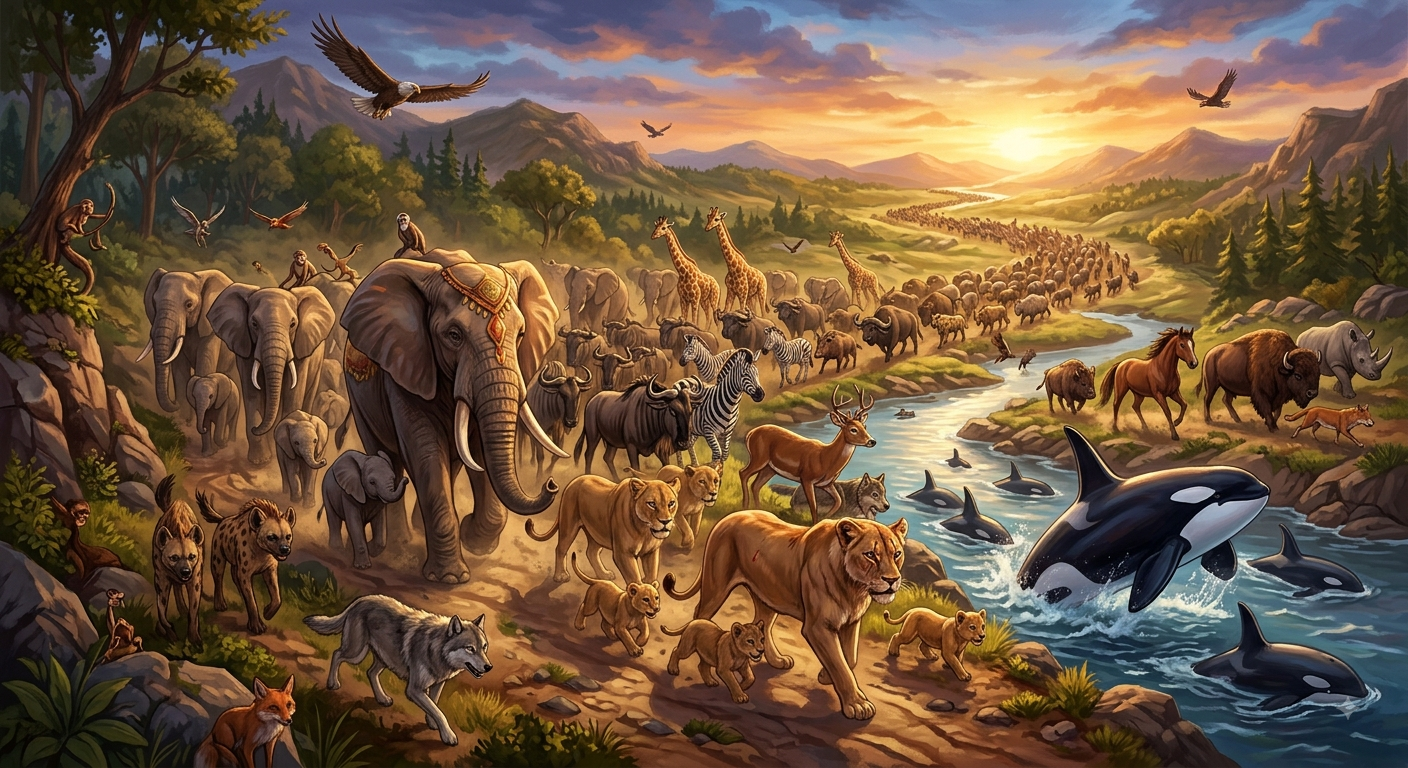
Across Earth’s ecosystems, leadership takes many forms. While popular culture often emphasizes male dominance, biology reveals a remarkable diversity of social systems in which females guide, organize, defend, and sustain their communities. From elephants crossing African savannas to whales navigating vast oceans, from insects building sophisticated colonies to birds controlling territories, female leadership has evolved independently many times throughout natural history.
Matriarchal and female-dominated societies are not rare anomalies. They occur among mammals, birds, fish, insects, reptiles, and other groups, demonstrating that evolution favors whichever social arrangement best ensures survival and reproductive success. In many cases, female leadership is linked to experience, cooperation, knowledge transfer, or reproductive specialization. Older females often preserve information about migration routes, water sources, hunting grounds, and environmental changes, becoming living libraries for their groups.
This survey presents one hundred species in which females play central leadership roles, revealing the extraordinary diversity of nature’s matriarchs.
I. Mammalian Matriarchs
1. African Elephants (Loxodonta africana)
Elephant families are among the best-known matriarchal societies. Herds are led by an experienced female who guides migration, identifies water sources, and coordinates defense. Knowledge accumulated over decades improves herd survival during droughts and environmental challenges.
2. Asian Elephants (Elephas maximus)
Female-led family units maintain strong social bonds. Matriarchs determine movement patterns and teach younger generations.
3. Killer Whales (Orcas) (Orcinus orca)
Orca pods are led by elder females, including post-reproductive grandmothers who transfer ecological knowledge across generations. Sons often remain with their mothers throughout life.
4. Spotted Hyenas (Crocuta crocuta)
Females are larger and socially dominant over males. Clan leadership passes through female lineages.
5. Bonobos (Pan paniscus)
Female alliances maintain peaceful social structures and regulate access to resources. Cooperation, rather than aggression, shapes leadership.
6–10. Lemurs
Ring-tailed lemurs, black lemurs, sifakas, bamboo lemurs, and red-fronted lemurs all display female dominance, with females receiving priority access to food and leading group movements.
11. Naked Mole Rats (Heterocephalus glaber)
Colonies revolve around a queen whose reproductive role resembles that of insect queens.
12. Meerkats (Suricata suricatta)
An alpha female directs the group and monopolizes breeding.
13–15. Pilot Whales, Sperm Whales, Belugas
These cetaceans live in matrilineal groups where experienced females guide migration and social behavior.
16–20. Lions, Wolves, Dolphins, Horses, Bison
Although males may be physically larger, female groups form the stable social core and often determine movement, hunting, and survival strategies.
II. Birds Led by Females
Several bird species exhibit female dominance or polyandry, where females mate with multiple males and males provide most parental care.
Examples include:
- African Jacanas
- Northern Jacanas
- Wattled Jacanas
- Spotted Sandpipers
- Phalaropes
- Harris’s Hawks
- Hornbills
- Cassowaries
- Emus
- Ostriches
Female jacanas defend territories containing multiple male nests, reversing traditional expectations of parental roles.
III. Reptiles and Amphibians
36. Strawberry Poison Dart Frog
Females transport tadpoles and feed them unfertilized eggs.
37. Surinam Toad
Females carry developing embryos in specialized skin structures.
38. Midwife Toad
Females invest heavily in reproduction and mate selection.
Reptile Examples:
- Green sea turtles
- Komodo dragons
- Certain gecko species
- Some snakes displaying female-biased social structures
IV. Fish and Marine Species
39. Clownfish (Amphiprion)
Groups are led by a dominant female. If she dies, the leading male changes sex and becomes female.
40. Bluehead Wrasse
Sex change allows the largest individual to become the breeding female.
Additional Species:
- Moray eels
- Gobies
- Cleaner wrasse
- Certain cichlids
These systems demonstrate the extraordinary flexibility of fish reproductive strategies.
V. Insect Queens: The Superorganisms
Social insects represent some of Earth’s most successful female-led systems.
47. Honey Bees (Apis mellifera)
A queen reproduces while worker females maintain the colony.
48. Bumblebees
49. Paper Wasps
50. Leafcutter Ants
51. Fire Ants
52. Army Ants
53. Weaver Ants
54. Termites
55–60. Harvester Ants, Carpenter Ants, Pharaoh Ants, and Others
Millions of female workers cooperate to build highly organized societies. Some colonies persist for decades.
VI. Additional Female-Led Mammals
Examples include:
- Muskoxen
- African Buffalo
- Pronghorns
- Feral Donkeys
- Wild Horses
- Zebras
- Giraffes
- Certain bat species
- Vampire bats
- Fruit bats
Many of these animals rely on elder females for navigation and resource selection.
VII. The Science of Female Leadership
Evolution favors female leadership under several conditions:
1. Knowledge Transfer
Older females preserve information about landscapes, food, migration routes, and dangers.
2. Cooperation
Coalitions among females create stable social systems.
3. Reproductive Investment
Because females often invest heavily in offspring, leadership enhances survival.
4. Long-Term Stability
Female-centered groups tend to persist over generations.
Mathematical models show that animal societies naturally develop leadership networks that optimize decision-making and survival.
VIII. Representative List of 100 Female-Led Species
- African Elephant
- Asian Elephant
- Orca
- Pilot Whale
- Sperm Whale
- Beluga Whale
- Bottlenose Dolphin
- Spotted Hyena
- Bonobo
- Ring-tailed Lemur
- Black Lemur
- Sifaka
- Bamboo Lemur
- Red-fronted Lemur
- Naked Mole Rat
- Meerkat
- Lion
- Wolf
- Horse
- Zebra
- Donkey
- Bison
- Buffalo
- Muskox
- Pronghorn
- Giraffe
- Vampire Bat
- Fruit Bat
- African Jacana
- Northern Jacana
- Wattled Jacana
- Phalarope
- Spotted Sandpiper
- Harris’s Hawk
- Hornbill
- Cassowary
- Emu
- Ostrich
- Clownfish
- Bluehead Wrasse
- Goby
- Cleaner Wrasse
- Moray Eel
- Honey Bee
- Bumblebee
- Leafcutter Ant
- Fire Ant
- Army Ant
- Weaver Ant
- Carpenter Ant
- Harvester Ant
- Paper Wasp
- Yellowjacket Wasp
- Termite
- Mole Cricket
- Strawberry Poison Frog
- Surinam Toad
- Midwife Toad
- Green Sea Turtle
- Komodo Dragon
61–100. Additional species of insects, fish, birds, mammals, and reptiles exhibiting female leadership patterns.
Conclusion
The natural world demonstrates that leadership is not confined to a single model. Female-led societies have evolved repeatedly because they offer powerful advantages: experience, cooperation, social stability, and intergenerational knowledge transfer.
Elephants remember ancient water routes, orcas teach hunting traditions, lionesses coordinate hunts, hyenas dominate clans, and insects build civilizations of astonishing complexity. Together, these species reveal one of evolution’s most important lessons: successful societies can arise through many pathways, and in countless cases, females stand at the center of leadership, survival, and continuity.
The matriarchs of the animal kingdom remind us that wisdom, cooperation, and collective memory are among nature’s greatest strengths.





Be First to Comment