
A Comprehensive Scientific, Technological, Economic and Geopolitical Thesis, 1945–2026
Abstract
The global defense industry is one of the most technologically sophisticated and politically consequential industrial systems in the modern world. It connects governments, armed forces, research institutions, universities, engineering companies, semiconductor manufacturers, aerospace industries, shipbuilders, software developers, telecommunications companies, logistics providers and financial institutions.
This thesis examines the evolution and structure of that system from the end of the Second World War to 2026. Particular attention is given to the world’s largest defense contractors, their corporate structures, supply chains, technological capabilities, government relationships and international networks.
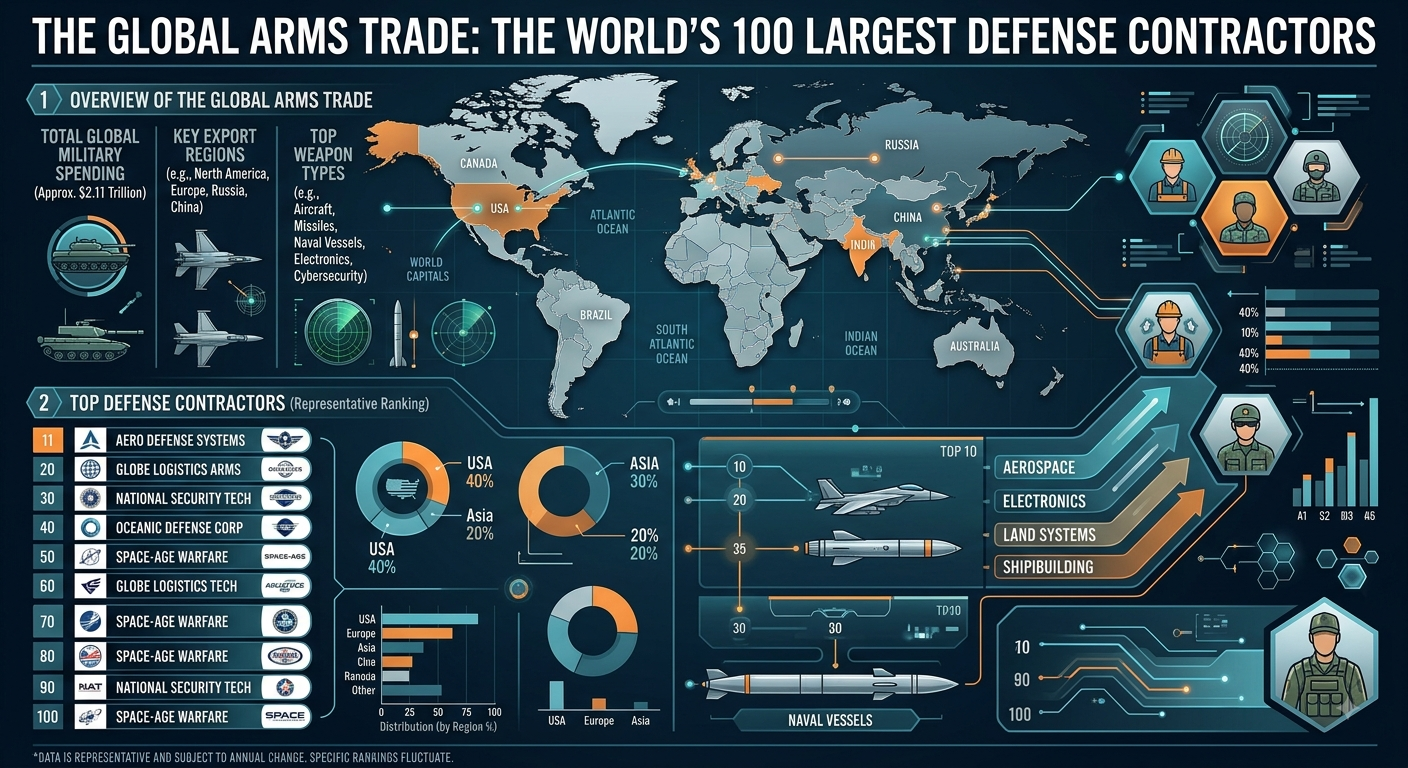
According to the Stockholm International Peace Research Institute (SIPRI), the combined arms revenues of the world’s 100 largest arms-producing and military-services companies reached US$679 billion in 2024, an increase of 5.9% in real terms over 2023 and the highest level recorded by SIPRI.
At the same time, international transfers of major conventional arms increased by 9.2% between 2016–20 and 2021–25. European arms imports more than tripled during that period, making Europe the largest recipient region.
The central argument of this thesis is that the modern arms trade cannot be understood simply as a market for military equipment. It is a global technological ecosystem in which national security policy, industrial strategy, scientific research, capital investment and geopolitical competition interact.
Chapter 1 — Introduction
The global arms industry occupies a unique position in the world economy.
Unlike most commercial industries, its principal customers are governments and public institutions. Unlike ordinary government procurement, defense procurement frequently involves technologies whose development can take decades, whose production may require highly specialized infrastructure and whose supply chains can cross numerous national borders.
The industry therefore operates simultaneously as:
- a manufacturing sector;
- a research-and-development ecosystem;
- a strategic national asset;
- a major employer;
- an exporter;
- a technology-development platform;
- a government contractor network;
- and an instrument of national security policy.
The industry’s importance increased significantly during the twentieth century because industrial warfare transformed military capability from a primarily human-scale activity into an enormous technological enterprise.
Aircraft, radar, satellites, communications systems, computers, nuclear technology, advanced materials, precision manufacturing and semiconductor electronics progressively became fundamental components of national defense.
By 2026, the boundary between the defense industry and the broader technology industry has become increasingly complex.
Artificial intelligence, cloud computing, cybersecurity, robotics, advanced sensors, space systems, semiconductors and autonomous information systems are increasingly relevant to national security.
Chapter 2 — Defining the Global Arms Industry
The expression “arms trade” can refer to several different activities.
2.1 Arms production
This concerns companies manufacturing military equipment and systems.
2.2 Military services
Large defense companies may also provide:
- maintenance;
- engineering;
- logistics;
- training;
- technical support;
- systems integration;
- infrastructure;
- information technology;
- and other military-related services.
2.3 International arms transfers
International transfers concern the movement of major conventional weapons between countries.
This is distinct from the financial revenue of defense companies.
SIPRI maintains separate datasets for the defense industry and international arms transfers, and this distinction is essential when interpreting statistics.
2.4 Military expenditure
A country’s military expenditure is broader still.
Government military expenditure can include:
- personnel;
- infrastructure;
- operations;
- pensions;
- research;
- procurement;
- maintenance;
- and other defense-related activities.
Consequently:
Military expenditure ≠ arms-company revenue ≠ international arms transfers.
Chapter 3 — Historical Origins
3.1 Before industrialization
Military production existed thousands of years before modern corporations.
Ancient societies developed specialized production of:
- metal tools;
- protective equipment;
- transport systems;
- fortifications;
- ships;
- and other military technologies.
However, production remained comparatively decentralized.
3.2 The Industrial Revolution
The Industrial Revolution transformed military production.
Mass manufacturing introduced:
- standardized components;
- machine tools;
- industrial metallurgy;
- steam-powered manufacturing;
- railways;
- mass logistics;
- chemical industries;
- and large-scale shipbuilding.
Military capability increasingly depended on industrial capacity.
3.3 The First World War
The First World War demonstrated the enormous industrial requirements of modern warfare.
Industrial production became inseparable from national military power.
3.4 The Second World War
The Second World War accelerated this transformation dramatically.
Aircraft, ships, vehicles, electronics, radar, communications and large-scale manufacturing became central to military effectiveness.
The United States in particular developed an enormous industrial production system linking government, universities, laboratories and private companies.
Chapter 4 — The Birth of the Modern Defense-Industrial Complex
The post-1945 period created the modern defense-industrial system.
The Cold War produced sustained demand for advanced military technologies.
The United States and Soviet Union constructed enormous research, manufacturing and procurement ecosystems.
Western Europe, China, Japan, Israel and other countries also developed specialized defense industries.
The relationship among:
government + military + industry + science
became a permanent feature of national security planning.
The concept commonly known as the military-industrial complex describes this institutional relationship.
Chapter 5 — The Corporate Structure of Defense
A modern defense contractor is rarely a single factory.
A large company may contain:
Parent corporation
↓
Business divisions
↓
Subsidiaries
↓
Specialized engineering companies
↓
Manufacturing facilities
↓
Component suppliers
↓
Raw-material suppliers
↓
Software and electronics suppliers
↓
Research institutions
This produces an industrial network rather than a simple company.
The SIPRI Arms Industry Database includes public and private companies and uses open-source financial information, including company reports and other publicly available sources.
Chapter 6 — The World’s Largest Defense Contractors
The SIPRI Top 100 provides the principal quantitative framework for studying the world’s largest arms-producing and military-services companies.
The 2024 ranking is the latest comprehensive SIPRI Top 100 dataset available as of 2026.
The companies represent a geographically diverse but highly concentrated industry.
The largest concentration remains in the United States.
SIPRI reports that the 39 US companies in the 2024 Top 100 generated approximately US$334 billion in arms revenues.
Other major industrial centers include:
- Western Europe;
- Russia;
- China;
- Israel;
- South Korea;
- Japan;
- India;
- Türkiye;
- the Middle East;
- and other emerging defense-producing countries.
The purpose of studying the Top 100 is not merely to identify companies. It is to understand where technological and industrial power is concentrated.
Chapter 7 — United States
The United States represents the largest national concentration of defense-industrial capability.
Its ecosystem includes:
- aerospace;
- shipbuilding;
- military electronics;
- space systems;
- information technology;
- cybersecurity;
- communications;
- advanced materials;
- engineering;
- logistics;
- and military services.
The American model is strongly connected to federal procurement and long-term research programs.
Large contractors frequently operate as systems integrators, combining thousands of components and technologies supplied by other companies.
The result is a highly interconnected industrial architecture.
Chapter 8 — Europe
European defense industries consist of national companies as well as multinational corporations.
Important industrial capabilities exist across countries including:
- France;
- Germany;
- Italy;
- the United Kingdom;
- Spain;
- Sweden;
- Norway;
- Poland;
- and others.
European defense integration has encouraged multinational industrial projects.
SIPRI reports that German companies in the 2024 Top 100 experienced particularly strong revenue growth, driven partly by increased demand for air-defense systems, ammunition and armored vehicles.
Chapter 9 — Russia
Russia possesses a large state-linked defense-industrial structure with deep historical roots in the Soviet industrial system.
Its capabilities include:
- aerospace;
- missile-related industries;
- naval construction;
- armored systems;
- military electronics;
- aircraft production;
- and associated engineering.
However, Russia’s defense-industrial ecosystem has also been affected by sanctions, restricted access to foreign technology and changes in international supply chains.
Chapter 10 — China
China has developed one of the world’s largest state-linked industrial ecosystems.
Its development has increasingly emphasized:
- domestic production;
- aerospace;
- shipbuilding;
- electronics;
- space systems;
- advanced manufacturing;
- semiconductors;
- artificial intelligence;
- and civil-military technological integration.
One important development in international arms-transfer statistics is that China fell outside the top ten arms importers in 2021–25 for the first time since 1991–95, reflecting expanded domestic production.
Chapter 11 — Israel
Israel has developed a technologically advanced defense sector strongly connected to:
- electronics;
- aerospace;
- surveillance technologies;
- cybersecurity;
- communications;
- sensors;
- and advanced engineering.
SIPRI reports that the three Israeli companies appearing in the 2024 Top 100 increased their combined arms revenues by 16%, reaching approximately US$16.2 billion.
Chapter 12 — India
India combines a large state-owned defense-industrial base with an expanding private sector.
Its objectives include:
- domestic manufacturing;
- technology development;
- industrial employment;
- export development;
- and reduced dependence on foreign suppliers.
The three Indian companies in the 2024 SIPRI Top 100 increased their combined arms revenues by 8.2%, reaching approximately US$7.5 billion.
Chapter 13 — Türkiye
Türkiye has become an increasingly important defense-industrial producer.
Its industry includes:
- aerospace;
- electronics;
- naval construction;
- armored systems;
- communications;
- and other military technologies.
Five Turkish companies appeared in the 2024 Top 100, with combined arms revenues of approximately US$10.1 billion.
Chapter 14 — South Korea and Japan
East Asia contains highly sophisticated industrial capabilities.
South Korea has developed major capabilities in:
- shipbuilding;
- aerospace;
- electronics;
- armored systems;
- and industrial manufacturing.
Japan possesses advanced capabilities in:
- electronics;
- aerospace;
- shipbuilding;
- robotics;
- materials;
- and precision manufacturing.
SIPRI recorded substantial growth in Japanese arms imports between 2016–20 and 2021–25, while China’s domestic production has reduced its dependence on imports.
Chapter 15 — Middle Eastern Defense Industry
The Middle East is simultaneously:
- a major defense market;
- an importer;
- an emerging producer;
- and a region of intense geopolitical competition.
SIPRI recorded nine Middle Eastern companies in the 2024 Top 100—the first time the region reached that number—with combined arms revenues of about US$31 billion.
This reflects growing efforts by several states to establish domestic industrial capacity.
Chapter 16 — Africa
Africa remains comparatively small in global arms production but is an important defense market.
Its major challenges include:
- limited industrial capacity;
- limited research funding;
- dependence on imported technologies;
- maintenance challenges;
- foreign-exchange constraints;
- and fragmented procurement systems.
South Africa has historically possessed one of the continent’s more sophisticated defense-industrial ecosystems, with capabilities associated with aerospace, electronics, engineering and armored-vehicle development.
The strategic question for Africa is whether defense expenditure can generate greater domestic technological and industrial capability without diverting resources from development priorities.
Chapter 17 — Aerospace
Aerospace is one of the most technologically complex sectors of the defense industry.
It integrates:
- aerodynamics;
- propulsion;
- materials science;
- electronics;
- software;
- navigation;
- communications;
- sensors;
- manufacturing;
- and systems engineering.
The aerospace industry also illustrates the dual-use nature of technology.
Many technologies developed for aerospace have civilian applications, while civilian aerospace technologies can contribute to defense-related engineering.
Chapter 18 — Naval Industry
Modern naval construction requires enormous industrial coordination.
A large ship may require:
- steel production;
- propulsion systems;
- electrical systems;
- software;
- communications;
- navigation;
- sensors;
- environmental systems;
- logistics infrastructure;
- and specialized shipyards.
Naval construction therefore creates extensive regional industrial ecosystems.
Chapter 19 — Electronics and Semiconductors
Modern defense systems depend heavily on electronics.
The underlying technologies include:
- processors;
- memory;
- sensors;
- communications;
- signal processing;
- power electronics;
- embedded computing;
- and specialized software.
This creates an important strategic connection between the defense industry and the semiconductor industry.
A country can possess substantial military expenditure but remain technologically dependent if it cannot secure advanced components.
Chapter 20 — Artificial Intelligence
Artificial intelligence is transforming defense-sector research.
Potential applications include:
- data analysis;
- logistics;
- predictive maintenance;
- cybersecurity;
- simulation;
- intelligence analysis;
- language processing;
- decision-support systems;
- and autonomous information processing.
The major industrial question is increasingly not simply:
Who manufactures military hardware?
but:
Who controls the computational infrastructure, data, algorithms, semiconductor supply chains and software ecosystems underlying advanced national-security systems?
Chapter 21 — Space Technology
Space infrastructure has become increasingly important to national security.
Relevant technologies include:
- satellites;
- communications;
- navigation;
- Earth observation;
- weather monitoring;
- space-based sensing;
- and launch systems.
The defense and civilian space sectors increasingly overlap.
Commercial satellite companies can provide technologies and services that have national-security relevance without being traditional defense manufacturers.
Chapter 22 — Cybersecurity
Cybersecurity has transformed the definition of defense.
National security increasingly involves protecting:
- electrical grids;
- telecommunications;
- financial systems;
- transportation;
- government databases;
- cloud infrastructure;
- industrial control systems;
- and critical infrastructure.
Consequently, cybersecurity companies can become strategically important even when they do not manufacture conventional military equipment.
Chapter 23 — The Global Supply Chain
The largest defense companies depend on thousands of suppliers.
A simplified structure is:
Government
→ procurement authority
→ prime contractor
→ major subsystem supplier
→ electronics supplier
→ semiconductor manufacturer
→ materials supplier
→ mining and chemical industries
This means that defense industrial policy increasingly overlaps with:
- energy policy;
- mineral policy;
- semiconductor policy;
- trade policy;
- education policy;
- infrastructure;
- and industrial policy.
Chapter 24 — Research and Development
Defense innovation depends heavily on research.
Major research areas include:
- physics;
- chemistry;
- mathematics;
- materials science;
- aerospace engineering;
- electrical engineering;
- computer science;
- artificial intelligence;
- telecommunications;
- robotics;
- biotechnology;
- and space science.
Universities and government laboratories can therefore become indirect components of national defense ecosystems.
Chapter 25 — Government Procurement
Government procurement is the financial engine of the industry.
A typical large program can involve:
- strategic requirement;
- government planning;
- research;
- competitive procurement;
- engineering;
- testing;
- manufacturing;
- delivery;
- maintenance;
- modernization;
- eventual retirement.
The entire lifecycle may extend over decades.
This creates unusual economic characteristics.
Defense companies do not simply sell a product once.
They may generate revenue throughout:
development → production → maintenance → upgrades → support → replacement.
Chapter 26 — Mergers and Acquisitions
The modern defense industry has undergone substantial consolidation.
Companies acquire other companies to obtain:
- engineering expertise;
- intellectual property;
- specialized manufacturing;
- software;
- cybersecurity capability;
- market access;
- or government-contracting capacity.
Consolidation can increase efficiency but can also reduce competition.
This creates an important policy question:
How much concentration is compatible with healthy competition and national security?
Chapter 27 — International Partnerships
Defense production increasingly involves multinational cooperation.
Countries may cooperate through:
- joint development;
- co-production;
- technology agreements;
- industrial partnerships;
- licensing;
- research programs;
- and shared procurement.
Such arrangements can reduce development costs while distributing industrial benefits among participating countries.
They can also create dependency between partner countries.
Chapter 28 — Arms Transfers and Geopolitics
Arms transfers are deeply connected to international relations.
SIPRI’s 2026 data show that global transfers of major arms in 2021–25 were 9.2% higher than in 2016–20. European imports increased by 210%, while imports in Africa, Asia and Oceania, and the Middle East declined over the same comparison period.
The United States remained the largest supplier, with its exports increasing by 27% between the two periods.
These patterns demonstrate that arms transfers are not merely commercial transactions.
They can influence:
- alliances;
- diplomatic relationships;
- strategic dependence;
- industrial development;
- deterrence;
- and regional power balances.
Chapter 29 — The Economics of the Defense Industry
The defense sector creates significant economic activity.
It supports:
- engineers;
- scientists;
- machinists;
- software developers;
- technicians;
- logistics workers;
- researchers;
- construction workers;
- and thousands of indirect suppliers.
However, economic benefits must be evaluated alongside opportunity costs.
Government resources allocated to defense cannot simultaneously be spent on every other public priority.
Consequently, defense economics involves a fundamental policy question:
What level and composition of defense expenditure maximizes national security while preserving long-term economic and social development?
Chapter 30 — Technology Spillovers
Defense research has historically contributed to civilian technologies.
Important examples include technological developments associated with:
- computing;
- satellite communications;
- navigation;
- aerospace;
- materials;
- telecommunications;
- and advanced manufacturing.
The relationship is not one-directional.
Civilian technologies increasingly flow into defense systems as well.
This creates a dual-use technology ecosystem.
Chapter 31 — Ethics and International Humanitarian Concerns
The defense industry cannot be studied exclusively through economics.
Its products can have profound humanitarian consequences.
Therefore, responsible analysis must consider:
- international humanitarian law;
- civilian protection;
- arms-control agreements;
- export controls;
- transparency;
- accountability;
- corruption risks;
- and disarmament.
The objective of studying the industry should be understanding the systems governing security—not celebrating conflict.
Chapter 32 — Transparency and Governance
Large defense contracts involve enormous amounts of public money.
Effective governance therefore requires:
- transparent procurement;
- auditing;
- competition where appropriate;
- parliamentary oversight;
- anti-corruption mechanisms;
- independent evaluation;
- lifecycle cost analysis;
- and public accountability.
The greater the technological and financial complexity of a procurement program, the greater the importance of institutional oversight.
Chapter 33 — Africa’s Strategic Opportunity
African countries face a difficult balance.
They need legitimate security capabilities, but excessive dependence on imported equipment can create long-term economic vulnerability.
A more sustainable strategy can emphasize:
- engineering education;
- domestic maintenance;
- research institutions;
- civilian dual-use industries;
- advanced manufacturing;
- telecommunications;
- cybersecurity;
- space science;
- and semiconductor-related skills.
The most valuable long-term investment may therefore be human technological capability, rather than simply purchasing finished systems.
Chapter 34 — South Africa
South Africa has an unusual position within Africa because of its historical industrial and engineering capabilities.
A future-oriented South African strategy could connect:
universities + engineering companies + advanced manufacturing + telecommunications + software + aerospace + cybersecurity + mining + energy
into a broader technological ecosystem.
This approach could generate civilian economic benefits while maintaining appropriate national-security capabilities.
Chapter 35 — The New Defense-Technology Ecosystem
The traditional defense-industrial model was approximately:
Factory → Military
The emerging model is:
Semiconductor → Computing → AI → Software → Communications → Sensors → Cloud → Space → Manufacturing → Integrated systems
This is a profound transformation.
The defense industry is increasingly becoming an information-and-computation industry as much as a hardware industry.
Chapter 36 — The 2026 Turning Point
The year 2026 represents an important analytical point because several long-term trends have converged:
- geopolitical competition;
- renewed European defense demand;
- technological competition;
- semiconductor dependence;
- artificial intelligence;
- space systems;
- cybersecurity;
- supply-chain security;
- and industrial policy.
SIPRI’s latest data show that the world’s Top 100 defense companies reached record combined arms revenues of US$679 billion in 2024.
This provides a quantitative indication of the scale of the modern defense-industrial system.
Chapter 37 — 2026–2050 Outlook
The next generation of defense-industrial competition is likely to depend increasingly on:
1. Computing power
Advanced computing will influence technological development across almost every sector.
2. Semiconductors
Access to advanced chips will remain strategically important.
3. Artificial intelligence
AI will increasingly influence analysis, logistics, engineering and decision-support systems.
4. Space
Satellite infrastructure will become increasingly integrated with communications and information systems.
5. Cybersecurity
Protection of critical infrastructure will become a fundamental national-security requirement.
6. Advanced manufacturing
Automation and precision manufacturing will determine industrial responsiveness.
7. Supply-chain resilience
Countries will increasingly seek secure sources of critical components and materials.
8. Human capital
Engineers, scientists and software specialists will become increasingly valuable strategic resources.
Chapter 38 — A New Model for Understanding the Top 100
The conventional question is:
Who are the world’s largest defense companies?
A more useful research question is:
What technological and economic networks make those companies powerful?
A complete analytical model is:
National strategy
↓
Defense budget
↓
Government procurement
↓
Prime contractors
↓
Subsidiaries
↓
Engineering firms
↓
Component manufacturers
↓
Semiconductor industry
↓
Materials and energy
↓
Universities and laboratories
↓
Software and AI
↓
Logistics and infrastructure
↓
International partners
This network model explains why the modern defense industry is much larger than the companies visible in a ranking.
Chapter 39 — Major Findings
The thesis produces several principal conclusions.
Finding 1
The defense industry is a global technological ecosystem rather than a collection of isolated weapons manufacturers.
Finding 2
The United States remains the dominant national center of the global defense-industrial system.
Finding 3
Europe is experiencing significant renewed demand for defense production and procurement.
Finding 4
China is increasingly emphasizing domestic technological and industrial capability.
Finding 5
Middle Eastern countries are developing stronger domestic defense industries.
Finding 6
India, Türkiye, South Korea and other emerging producers are increasing their industrial capabilities.
Finding 7
Semiconductors, software, AI, cybersecurity and space technology are becoming increasingly important to defense capability.
Finding 8
Supply-chain resilience is becoming a national-security issue.
Finding 9
Defense procurement creates both industrial benefits and significant opportunity costs.
Finding 10
The long-term strategic advantage of a country increasingly depends on education, science, engineering and industrial capacity.
Chapter 40 — Conclusion
The global arms trade is one of the most complex industrial systems created by modern civilization.
Its visible component is the defense contractor.
Its deeper structure is much larger.
Behind every major defense company is a network of:
scientists, engineers, universities, government agencies, software developers, semiconductor manufacturers, mining companies, materials producers, telecommunications companies, logistics providers and financial institutions.
The record US$679 billion in combined arms revenues reported for the SIPRI Top 100 in 2024 demonstrates the extraordinary economic scale of this ecosystem.
Meanwhile, the 2026 SIPRI assessment of international arms transfers demonstrates that geopolitical developments continue to reshape global demand. Transfers of major arms increased 9.2% between 2016–20 and 2021–25, with Europe experiencing an especially dramatic increase in imports.
Yet the ultimate lesson is broader than the size of the industry.
The most important strategic resource of the twenty-first century is increasingly technological capability itself.
Countries that possess strong universities, advanced manufacturing, reliable energy, semiconductor access, computational infrastructure, engineering talent, scientific institutions and resilient supply chains can develop capabilities across both civilian and national-security sectors.
The future defense-industrial system will therefore not be defined solely by factories producing physical equipment.
It will increasingly be defined by the convergence of:
science + mathematics + engineering + computing + AI + semiconductors + telecommunications + space + manufacturing + human capital.
Understanding this network is essential for understanding the economics of national security in the twenty-first century.
The ultimate objective of responsible defense policy should not be the expansion of conflict.
It should be the creation of sufficient security, technological resilience and institutional capability to protect societies while preserving peace, economic development and human life.
Research Note and Principal Sources
The quantitative backbone of this thesis is based primarily on the Stockholm International Peace Research Institute’s Arms Industry Database and International Arms Transfers Database. SIPRI states that its arms-industry database covers major arms-producing and military-services companies using open-source financial information and includes the Top 100 ranking.
The principal 2024 industry dataset is the SIPRI Top 100 Arms-Producing and Military Services Companies, while the latest international-transfer dataset covers 1950–2025 and was released in March 2026.
These datasets should be kept analytically separate because company arms revenue, government military expenditure and international arms-transfer volume measure different aspects of the global security economy.






Be First to Comment