
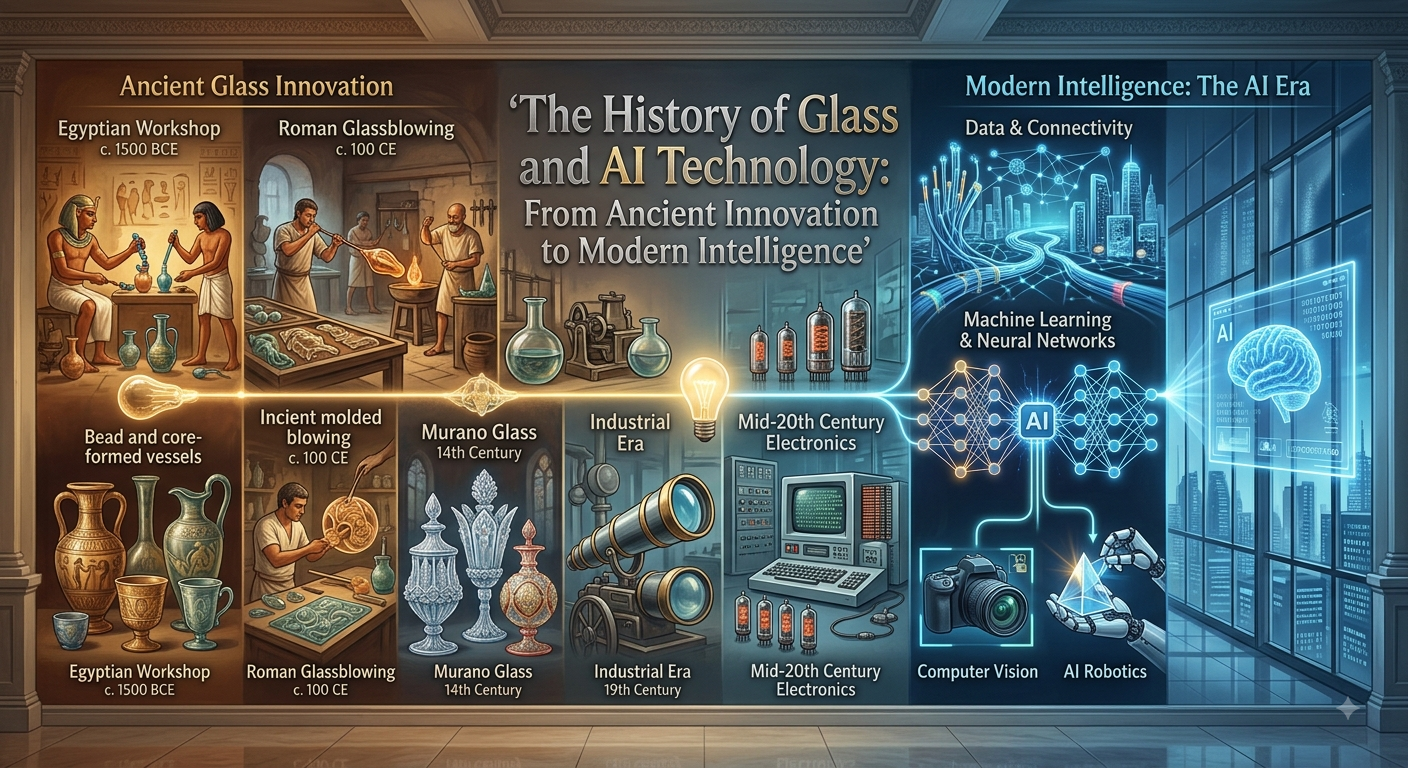
A Comprehensive Scientific, Historical and Technological Thesis
Abstract
The history of civilization can be interpreted as a continuous progression in humanity’s ability to transform natural materials into increasingly sophisticated instruments for observation, communication, calculation and intelligence.
Glass occupies a remarkable position in this history. From early glass beads and vessels to precision lenses, microscopes, telescopes, optical fibers, semiconductor wafers, displays and advanced photonic systems, glass and glass-derived materials have repeatedly enabled technological revolutions.
Artificial intelligence represents another major stage in this progression. Whereas early civilizations used physical tools to extend human strength and vision, modern computing extends human capabilities in calculation, pattern recognition, language processing, scientific discovery and decision support.
The relationship between glass and AI is therefore deeper than it initially appears. Modern AI depends on semiconductor fabrication, optical communications, displays, cameras, sensors, lithography and increasingly photonic technologies—all areas in which glass and glass-related materials play important roles.
This thesis examines the journey from ancient glassmaking to modern artificial intelligence and explores how materials science, optics, mathematics, electronics, computing and machine learning have converged into today’s technological civilization.
1. Introduction
Human technological development has never occurred through a single invention.
Instead, civilization has advanced through interconnected layers:
Natural materials → tools → measurement → mathematics → optics → mechanics → electricity → electronics → computers → networks → artificial intelligence.
Glass is one of the oldest materials in this technological chain.
AI is one of its newest intellectual outcomes.
Between these two extremes lies thousands of years of scientific development.
The central question of this thesis is:
How did an ancient material such as glass become connected to the technologies that ultimately enabled modern artificial intelligence?
The answer requires examination of several technological revolutions.
2. The Origins of Glass
2.1 Natural Glass
Glass-like materials existed before humans deliberately manufactured glass.
Volcanic activity can produce naturally occurring glass such as obsidian.
Humans discovered that certain materials could possess unusual properties:
- hardness;
- sharp fracture surfaces;
- transparency or translucency;
- resistance to many chemicals;
- ability to be shaped when heated.
These properties eventually encouraged experimentation with manufactured glass.
2.2 Early Manufactured Glass
Ancient civilizations learned to produce glass by heating mixtures containing silica and other materials.
Early glass was generally associated with:
- beads;
- ornaments;
- containers;
- decorative objects;
- religious objects;
- luxury goods.
Glassmaking gradually evolved from an artisanal activity into a sophisticated technological discipline.
3. Ancient Civilizations and Glass Technology
Glassmaking developed in the ancient Near East and Mediterranean world and subsequently spread through extensive trade networks.
Egyptian and Mesopotamian craftsmen developed important glassworking traditions.
The Roman world later expanded glass production and distribution on a much larger scale.
One of the most important innovations was glassblowing, which dramatically increased the ability to manufacture vessels efficiently.
This transformed glass from an elite decorative material into a much more practical technological material.
4. The Scientific Transformation of Glass
For many centuries glass was primarily understood as a material for:
- vessels;
- decoration;
- architecture;
- artistic production.
Its scientific importance changed dramatically when humans learned to control its optical properties.
The crucial transition was:
Glass as an object → glass as an optical instrument.
This transformation changed humanity’s relationship with the universe.
5. Glass and the Development of Lenses
Precisely shaped transparent glass can alter the path of light.
This principle enabled the development of:
- spectacles;
- magnifying lenses;
- microscopes;
- telescopes;
- cameras;
- optical instruments.
The lens became an extension of the human eye.
This was a profound technological development because human perception was no longer restricted to the natural capabilities of biological vision.
6. Glass and the Scientific Revolution
Optical instruments helped transform scientific observation.
Telescopes allowed researchers to study distant astronomical objects.
Microscopes opened an entirely different world of biological structures.
The scientific importance of glass therefore extended far beyond material manufacturing.
Glass became an instrument for discovering previously invisible reality.
This created a chain:
Glass → Lens → Optical instrument → Measurement → Scientific knowledge.
7. The Telescope and Astronomy
The telescope transformed astronomy by allowing humans to collect and magnify light from distant objects.
Astronomers could investigate:
- planets;
- moons;
- stars;
- nebulae;
- galaxies;
- planetary motion.
This contributed to the transition from ancient cosmological models toward mathematical astronomy and modern physics.
8. The Microscope and Biology
The microscope created another scientific revolution.
Instead of looking outward toward the universe, scientists could look inward toward microscopic structures.
Microscopy eventually contributed to discoveries concerning:
- cells;
- microorganisms;
- tissues;
- biological structures;
- disease mechanisms.
Thus glass became an important technological bridge between the visible and invisible worlds.
9. From Optics to Mathematics
Scientific instruments produced observations.
Observations required measurement.
Measurement required mathematics.
Mathematics eventually became essential to:
- physics;
- engineering;
- statistics;
- information theory;
- computer science;
- machine learning.
The technological chain consequently expanded:
Glass → optics → measurement → mathematics → computation → AI.
10. The Industrial Revolution
The Industrial Revolution introduced new demands for precision.
Factories required:
- measurement;
- automation;
- mechanical control;
- communication;
- standardized components;
- scientific instrumentation.
Glass manufacturing itself became increasingly industrialized.
At the same time, mechanical computation and mathematical engineering began developing.
11. Electricity and Electronics
The next major technological transition was from mechanical systems toward electrical systems.
Electricity enabled:
- telegraphy;
- telephony;
- radio;
- electrical measurement;
- electronic circuits;
- computers.
This transition created the physical infrastructure from which modern computing eventually emerged.
12. The Rise of Electronic Computing
Electronic computers transformed calculation from a primarily human activity into an increasingly automated process.
Early computers were enormous compared with modern machines.
Nevertheless, they established a fundamental principle:
Mathematical procedures could be represented as executable instructions for machines.
This idea is essential to understanding AI.
13. Alan Turing and Machine Intelligence
Alan Turing made foundational contributions to computing and the philosophical question of machine intelligence.
His work helped establish the theoretical foundations of computation.
The question eventually became:
Can a machine exhibit behavior that can reasonably be described as intelligent?
This question became one of the foundations of artificial intelligence.
14. The Birth of Artificial Intelligence
The term artificial intelligence became associated with the Dartmouth research project of 1956.
John McCarthy played a central role in naming and organizing the field. The original Dartmouth proposal envisioned machines capable of activities involving language, abstraction, problem solving and learning.
The Dartmouth project is widely regarded as a foundational event in the formal development of AI as a research field.
15. Early AI
Early AI research concentrated heavily on symbolic reasoning.
Researchers explored:
- logical inference;
- theorem proving;
- search;
- problem solving;
- language;
- knowledge representation.
One important early system was the Logic Theorist, developed by Allen Newell, Herbert Simon and J.C. Shaw.
It demonstrated approaches involving heuristics and reasoning as search.
16. Programming Languages and AI
John McCarthy subsequently developed LISP.
LISP became particularly important in AI research because programs and data could be represented in closely related structures.
This supported experimentation with symbolic reasoning and machine representations of knowledge.
17. From Mainframes to Modern Computers
Computer technology progressed through several major generations:
- vacuum-tube computers;
- transistor computers;
- integrated circuits;
- microprocessors;
- personal computers;
- workstations;
- servers;
- distributed computing;
- cloud computing;
- GPUs and accelerators;
- specialized AI processors.
Each generation increased computational capability while reducing cost, size or energy per computation.
18. The Semiconductor Revolution
The semiconductor transformed computing.
Modern integrated circuits depend on extremely precise manufacturing processes.
This introduced a surprising connection between glass and computing.
Many semiconductor manufacturing processes depend on carefully engineered materials, including high-purity glass and quartz-based components.
Optical systems are also fundamental to advanced semiconductor manufacturing.
19. Glass in Semiconductor Manufacturing
Modern chip fabrication requires:
- extremely clean environments;
- precision optics;
- specialized glass and quartz components;
- photomasks;
- optical systems;
- chemical processing;
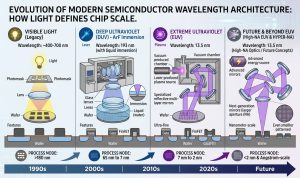
- lithography;
- metrology.
Therefore, although the processor executing an AI model is a semiconductor device, the manufacturing ecosystem surrounding that processor depends partly on advanced optical and glass technologies.
The relationship can be summarized:
Glass → precision optics → lithography → semiconductor → processor → AI computation.
20. Fiber-Optic Communication
Another technological revolution emerged from glass fibers.
Optical fiber allows information to be transmitted through pulses of light.
This created extremely high-capacity communication networks.
Modern digital civilization depends heavily on such networks for:
- Internet connectivity;
- cloud computing;
- data centers;
- telecommunications;
- international data transmission;
- AI services.
Thus glass became part of the physical infrastructure carrying the data used by modern AI.
21. The Internet
The Internet connected computers into a global information system.
Its development transformed computing from isolated machines into interconnected networks.
This produced enormous quantities of digital information.
That information eventually became an essential resource for machine-learning systems.
The technological sequence became:
Computers → networks → data → machine learning.
22. Machine Learning
Traditional programming generally requires humans to explicitly specify rules.
Machine learning introduced a different paradigm.
Instead of programming every rule manually, algorithms can learn statistical relationships from data.
Major approaches include:
- supervised learning;
- unsupervised learning;
- reinforcement learning;
- probabilistic modeling;
- neural networks.
23. Artificial Neural Networks
Neural networks were inspired loosely by the idea of interconnected biological neurons.
A neural network consists of computational units organized into layers.
During training, numerical parameters are adjusted so that the system becomes better at performing a particular task.
This mathematical architecture became enormously more powerful when combined with:
- large datasets;
- powerful processors;
- improved algorithms;
- distributed computing.
24. Deep Learning
Deep learning uses neural networks containing many computational layers.
It became particularly influential in:
- image recognition;
- speech recognition;
- natural-language processing;
- recommendation systems;
- scientific analysis;
- autonomous systems.
Graphics processing units became important because they can perform large numbers of mathematical operations in parallel.
25. GPUs and AI Acceleration
Modern AI models require enormous amounts of computation.
The central operations include:
- matrix multiplication;
- vector operations;
- tensor operations;
- memory movement;
- optimization.
Specialized processors were developed to accelerate these operations.
This produced the modern AI-computing ecosystem involving:
CPUs + GPUs + TPUs + AI accelerators + high-speed memory + networking + storage.
26. Large Language Models
A major transformation occurred with large language models.
These systems learn statistical patterns from enormous collections of text and other information.
Modern architectures, especially transformer-based systems, can process and generate language at a scale that earlier AI systems could not.
They can perform tasks such as:
- summarization;
- translation;
- reasoning assistance;
- programming assistance;
- information extraction;
- question answering;
- content generation.
27. The Transformer Revolution
The transformer architecture became a major foundation for modern generative AI.
Its importance comes partly from its ability to process relationships between elements of a sequence efficiently using attention mechanisms.
Transformers subsequently became central to many large language and multimodal models.
28. Multimodal Artificial Intelligence
Modern AI increasingly operates across multiple forms of information.
These include:
- text;
- images;
- audio;
- video;
- code;
- sensor data.
This creates another connection with glass.
Cameras and optical sensors depend on lenses and transparent optical components.
Therefore:
Glass optics → cameras → digital images → datasets → computer vision → multimodal AI.
29. Displays and Human–AI Interaction
Glass is also deeply connected to how humans interact with computers.
Modern displays may incorporate sophisticated glass substrates and protective glass layers.
These technologies support:
- smartphones;
- tablets;
- computers;
- televisions;
- vehicles;
- industrial systems;
- medical instruments.
The interface between humans and AI is therefore partly mediated through advanced glass technologies.
30. Glass, Sensors and Machine Vision
AI systems increasingly depend on sensors.
Examples include:
- cameras;
- optical sensors;
- lidar systems;
- spectroscopy;
- medical imaging;
- industrial inspection systems.
These systems convert physical phenomena into digital information.
AI can then analyze that information.
This creates the broader technological loop:
Physical world → optical sensor → digital data → AI model → interpretation → human decision.
31. Glass in Photonics
Photonics concerns the generation, manipulation and detection of light.
Glass and optical materials are central to many photonic technologies.
Future computing systems may increasingly combine electronics with photonics to move data and perform certain computational operations using light.
This could become particularly important as conventional electronic systems encounter challenges involving:
- energy consumption;
- heat;
- data movement;
- communication bandwidth.
32. The Emergence of Optical Computing
Optical computing attempts to use light for some computational operations.
Potential advantages include:
- high communication bandwidth;
- parallel information processing;
- reduced electrical interconnect limitations;
- potentially improved energy efficiency for specific workloads.
Although optical computing does not simply replace electronic computing, photonic technologies may become increasingly important in specialized AI infrastructure.
33. The Glass-to-AI Technology Chain
The complete historical chain can now be visualized:
Ancient glassmaking
↓
Controlled transparent materials
↓
Lenses
↓
Microscopes and telescopes
↓
Scientific observation
↓
Precision measurement
↓
Mathematics and physics
↓
Electrical engineering
↓
Electronics
↓
Semiconductors
↓
Computers
↓
Computer networks
↓
Digital data
↓
Machine learning
↓
Deep learning
↓
Generative AI
↓
Multimodal intelligence
↓
Future photonic and AI systems
This is one of the most important conclusions of the thesis.
34. Glass as an Extension of Human Vision
The historical role of glass can be understood through four stages.
Stage 1 — Protection
Glass became a useful physical material.
Stage 2 — Vision
Lenses extended human visual capability.
Stage 3 — Communication
Optical fiber enabled enormous information flows.
Stage 4 — Computation
Advanced optical and semiconductor manufacturing technologies became part of the infrastructure supporting modern computing and AI.
Thus glass evolved from a material of civilization into part of the infrastructure of the information age.
35. AI as an Extension of Human Intelligence
AI represents a similar technological progression.
Human beings first created tools to extend physical strength.
Then they created instruments to extend vision.
Then machines to extend calculation.
Then networks to extend communication.
AI extends certain cognitive capabilities.
The sequence can therefore be represented as:
Tools → Vision → Calculation → Communication → Intelligence.
36. The Convergence of Physical and Digital Technology
Modern technology is no longer divided cleanly into physical and digital systems.
AI depends on a physical infrastructure consisting of:
- electricity;
- buildings;
- cooling systems;
- processors;
- memory;
- storage;
- optical networks;
- sensors;
- manufacturing equipment.
Consequently, artificial intelligence is not purely software.
It is a complete technological ecosystem.
37. Data Centers and AI
Large AI models require substantial computing infrastructure.
A modern AI data center may contain:
- compute accelerators;
- CPUs;
- high-bandwidth memory;
- storage;
- networking equipment;
- optical transceivers;
- cooling infrastructure;
- power systems;
- monitoring systems.
Optical communications are particularly important because large numbers of processors must exchange enormous amounts of information.
38. AI and Scientific Discovery
The relationship between optics and AI is also becoming important in scientific research.
AI can analyze:
- astronomical images;
- microscopic images;
- medical scans;
- satellite imagery;
- molecular structures;
- materials data.
In each case, optical instruments may first convert physical reality into measurable information.
AI then processes the resulting data.
39. AI and Medicine
Modern medical imaging depends heavily on optical and electronic technologies.
Examples include:
- microscopy;
- endoscopy;
- imaging systems;
- digital pathology;
- optical diagnostics.
AI can subsequently assist researchers and clinicians by analyzing large quantities of medical information.
This represents another progression:
Optics → image → digitization → computation → AI analysis.
40. AI and Astronomy
Modern astronomy increasingly relies on enormous quantities of digital observational data.
Telescopes collect electromagnetic radiation.
Sensors convert that information into digital measurements.
Computers process the measurements.
AI can assist with:
- object classification;
- image analysis;
- anomaly detection;
- signal processing;
- astronomical surveys.
The telescope therefore remains part of the ancient-to-modern technological lineage that began with optical glass.
41. AI and Manufacturing
AI is increasingly used in industrial environments for:
- quality inspection;
- predictive maintenance;
- robotics;
- optimization;
- process monitoring;
- logistics.
Machine vision systems can inspect objects at high speed.
Here again, the combination is:
Glass optics + sensors + computing + AI.
42. The Human Eye and the AI Camera
There is a useful conceptual comparison between biological vision and machine vision.
Human visual system
Light → eye → retina → neural processing → brain → perception.
AI vision system
Light → lens → sensor → digital data → neural network → classification or interpretation.
The systems are fundamentally different, but the comparison illustrates how technology has progressively reproduced selected functions of biological perception.
43. From Glass to Artificial Perception
Glass helped humanity extend natural vision.
Digital sensors transformed light into data.
AI transformed data into machine-generated interpretation.
The progression can therefore be expressed as:
See → Record → Compute → Interpret.
This is a powerful framework for understanding modern intelligent machines.
44. The Economic Importance of the Glass–AI Ecosystem
The modern technology economy depends upon an interconnected industrial chain.
Important sectors include:
- specialty glass;
- optical components;
- semiconductor manufacturing;
- lithography;
- chip design;
- semiconductor equipment;
- data centers;
- telecommunications;
- cloud computing;
- AI accelerators;
- software;
- AI applications.
No individual technology operates independently.
45. The Strategic Importance of Materials Science
AI development is frequently discussed in terms of algorithms and software.
However, advanced AI ultimately depends on physical materials.
These include:
- silicon;
- copper;
- specialized glass;
- quartz;
- rare and critical materials;
- advanced polymers;
- ceramics;
- semiconductor materials.
This means that the future of AI is partly a materials-science problem.
46. Energy and AI
Large-scale computation requires electricity.
Energy is therefore one of the fundamental physical inputs to modern AI.
Future AI infrastructure must address:
- energy efficiency;
- cooling;
- computing efficiency;
- data movement;
- renewable electricity;
- hardware optimization.
Photonics and advanced materials may contribute to reducing some of these constraints.
47. The Future of Glass Technology
Future glass technologies may increasingly incorporate:
- smart optical properties;
- advanced coatings;
- nanostructured surfaces;
- stronger compositions;
- specialized photonic functions;
- optical sensing;
- flexible applications;
- energy-related functions.
Glass may therefore remain important even as computing becomes increasingly sophisticated.
48. The Future of AI
AI development is likely to continue moving toward systems that combine:
- language;
- vision;
- audio;
- robotics;
- scientific reasoning;
- autonomous software;
- specialized hardware;
- real-time sensing.
Future AI systems may operate across both digital environments and physical machines.
49. From Ancient Craftsmanship to Intelligent Machines
The historical significance of this journey is profound.
An ancient craftsperson could heat and shape glass.
Centuries later, an optical engineer could shape glass into a lens.
A scientist could use that lens to discover previously invisible phenomena.
An engineer could use scientific knowledge to build electronic computers.
Computer scientists could develop algorithms capable of learning.
Engineers could build enormous computing systems capable of running modern AI.
The modern intelligent machine therefore stands at the end of an extraordinarily long technological chain.
50. Major Milestones
| Period | Development | Historical significance |
|---|---|---|
| Ancient world | Early manufactured glass | Controlled transparent material |
| Classical era | Advanced glass vessels | Industrial/artisanal development |
| Medieval period | Improved glassworking | Expansion of optical possibilities |
| Renaissance | Precision lenses | Scientific observation |
| 1600s | Telescopes and microscopes | Expansion of human perception |
| 1800s | Industrial glass production | Mass technological applications |
| 1800s–1900s | Electrical engineering | Foundation for electronics |
| 1900s | Electronic computers | Automated calculation |
| 1940s–1950s | Mathematical computing and machine intelligence | Foundations of AI |
| 1956 | Dartmouth AI project | Formal emergence of AI as a field |
| 1960s–1980s | Symbolic AI and expert systems | Knowledge-based computing |
| 1980s–2000s | Machine learning | Statistical intelligence |
| 2000s–2010s | Deep learning | Large-scale neural computation |
| 2010s–2020s | Transformers and generative AI | Major expansion of machine intelligence |
| 2020s | Multimodal AI and specialized accelerators | Integrated AI ecosystems |
The 1956 Dartmouth event is especially important: the historical record identifies it as the foundational conference around which the field of AI was formally organized.
51. The Seven-Layer Civilization Model
The entire history can be summarized through seven technological layers.
Layer 1 — Materials
Glass, metals, stone, ceramics and semiconductors.
Layer 2 — Instruments
Lenses, machines, sensors and measuring devices.
Layer 3 — Mathematics
Numbers, geometry, calculus, probability and statistics.
Layer 4 — Electronics
Transistors, integrated circuits and processors.
Layer 5 — Computing
Algorithms, operating systems, databases and software.
Layer 6 — Networks
Telecommunications, Internet and cloud infrastructure.
Layer 7 — Intelligence
Machine learning, deep learning, generative AI and intelligent agents.
This model demonstrates that AI is not an isolated invention.
It is the product of accumulated technological civilization.
52. Central Thesis
The central thesis of this work is:
The history of glass and the history of artificial intelligence are separated by thousands of years, but they are connected through humanity’s continuous effort to extend perception, measurement, communication, computation and intelligence.
Glass helped humanity see farther.
Optics helped humanity measure more precisely.
Electronics helped humanity calculate faster.
Networks helped humanity communicate globally.
AI now helps machines process increasingly complex information.
53. Conclusion
The story of glass begins with humanity learning to transform natural materials through heat and chemistry.
It eventually becomes the story of lenses, microscopes, telescopes and scientific discovery.
It then becomes connected to optical communications, precision manufacturing, semiconductor fabrication, displays and sensors.
The story of artificial intelligence begins much later, emerging from mathematics, logic, computing and theories of machine intelligence.
Yet these histories eventually converge.
Modern AI exists within an enormous technological ecosystem that depends upon physical materials, optical systems, semiconductor manufacturing, communication networks, data centers and mathematical algorithms.
The journey can therefore be summarized:
Ancient material → optical instrument → scientific observation → mathematics → electronics → computing → networking → machine learning → artificial intelligence.
Glass represents one of humanity’s earliest technological breakthroughs.
Artificial intelligence represents one of its newest.
Between them lies thousands of years of cumulative human experimentation, engineering and scientific discovery.
The deepest lesson is therefore not that glass created AI directly.
Rather, glass belongs to the long technological lineage through which humanity progressively extended its ability to see, measure, communicate, calculate and ultimately build machines capable of processing information in increasingly intelligent ways.
54. Final Perspective
Human civilization has repeatedly converted physical discoveries into intellectual capabilities.
Stone became tools.
Metals became machines.
Glass became optics.
Optics became scientific instruments.
Electricity became electronics.
Electronics became computers.
Computers became networks.
Networks created planetary-scale information systems.
Information systems enabled large-scale machine learning.
Machine learning produced modern AI.
The next stage may combine all of these technologies into increasingly integrated systems involving advanced materials, photonics, semiconductors, robotics, quantum technologies and artificial intelligence.
The history of glass is therefore not merely a history of an ancient material.
It is part of the broader history of humanity transforming matter into knowledge, knowledge into machines, and machines into increasingly sophisticated forms of computation and intelligence.

Be First to Comment